
Judge, 1922-02-11 · page 10 of 36
Judge — February 11, 1922 — page 10: what you’re looking at
What you’re looking at
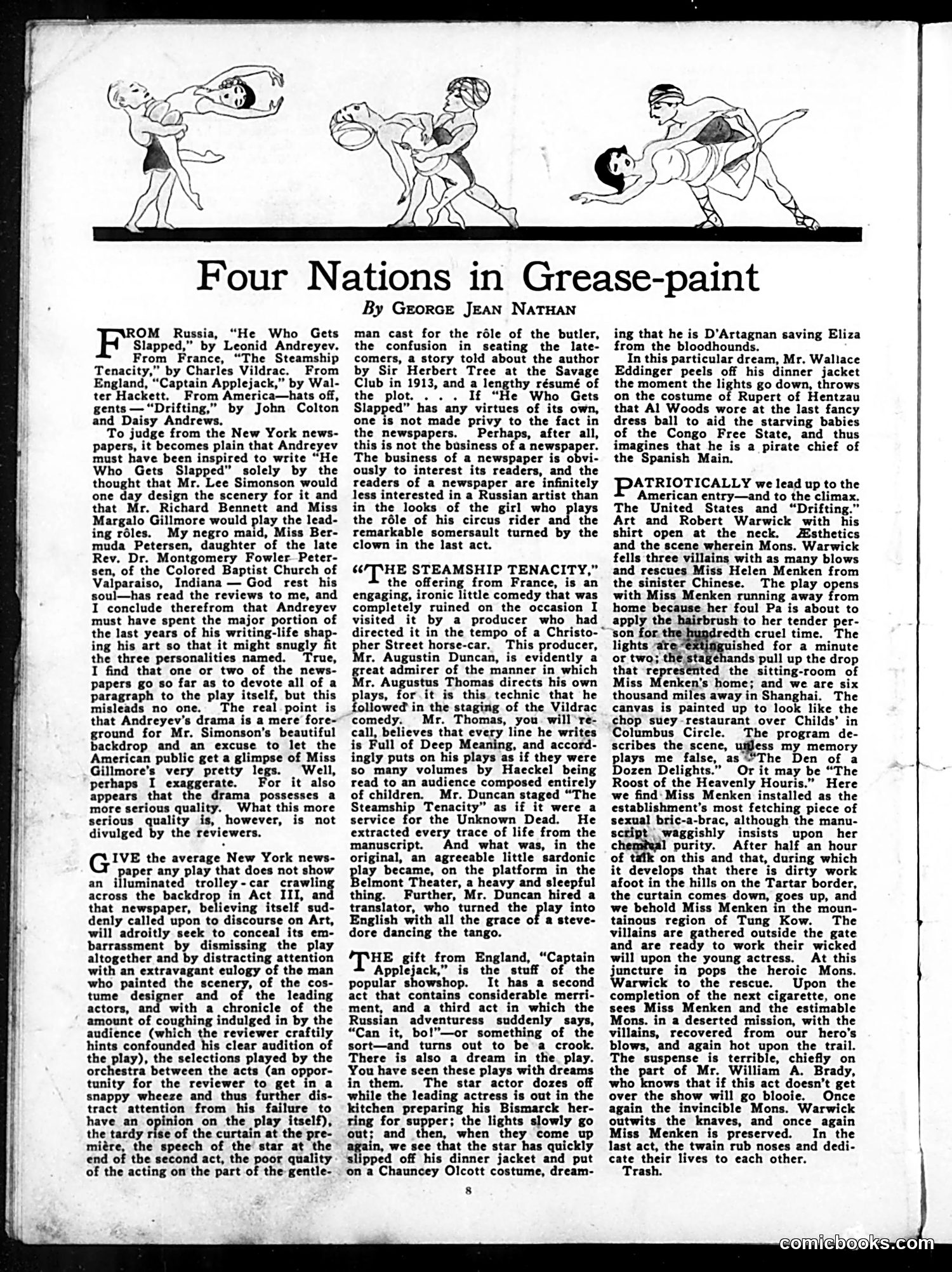
This page reviews four recent theatrical productions—one each from Russia ("He Who Gets Slapped"), France ("The Steamship Tenacity"), England ("Captain Applejack"), and America ("Drifting"). Critic George Jean Nathan satirizes New York theater reviewers for their superficiality. Rather than discussing plays on merit, reviewers obsess over scenic design, costume, actors' legs, and backstage anecdotes while ignoring actual theatrical quality. Nathan mocks this by sarcastically claiming Andreyev must have written his Russian play specifically to showcase the American set designer and actress. The cartoon illustrations (top) appear to depict theatrical scenes from these international productions, showing actors in various dramatic poses. Nathan's central joke: American newspaper critics care more about spectacle, gossip, and trolley cars in backdrops than genuine artistic critique—reducing serious international drama to entertainment column fodder.
📄 Transcribed text from this page (OCR, searchable)
Machine-transcribed from the original scan — historical spelling and the odd misread are preserved.
Four Nations in Grease-paint By Georce Jean NATHAN man cast for the réle of the butler, the confusion in seating the late- comers, a story told about the author by Sir Herbert Tree at the Savage OM Russia, “He Who Gets Slapped,” by Leonid Andreyev. From France, “The Steamship Tenacity,” by Charles Vildrac. From England, “Captain Applejack,” by Wal- ter Hackett. From America—hats off, gents — “Drifting,” by John Colton and Daisy Andrews. To judge from the New York news- papers, it becomes plain that Andreyev must have been inspired to write “He Who Gets Slapped” solely by the thought that Mr. Lee Simonson would one day design the scenery for it and that Mr. Richard Bennett and Miss Margalo Gillmore would play the lead- ing réles. My negro maid, Miss Ber- muda Petersen, daughter of the late Rev. Dr. Montgomery Fowler Peter- sen, of the Colored Baptist Church of Valparaiso, Indiana — God rest his soul—has read the reviews to me, and I conclude therefrom that Andreyev must have spent the major portion of the last years of his writing-life shap- ing his art so that it might snugly fit the three personalities named. True, I find that one or two of the news- papers go so far as to devote all of a paragraph to the play itself, but this misleads no one. The real point is that Andreyev’s drama is a mere fore~ ground for Mr. Simonson’s beautiful backdrop and an excuse to let the American public get a glimpse of Miss Gillmore’s very pretty legs. Well, perhaps I exaggerate. ‘or it also appears that the drama possesses a more serious quality. What this more serious quality is, however, is not divulged by the reviewers. IVE the average New York news- paper any play that does not show an illuminated trolley-car crawlin, across the backdrop in Act III, an that newspaper, believing itself sud- denly called upon to discourse on Art, will adroitly seek to conceal its em- barrassment by dismissing the play altogether and by distracting attention with an extravagant eulogy of the man who painted the scenery, of the cos- tume designer and of the leading actors, and with a chronicle of the amount of coughing indulged in by the audience (which the reviewer craftily hints confounded his clear audition of the play), the selections played by the orchestra between the acts (an oppor- tunity for the reviewer to get in a snappy wheeze and thus further dis- tract attention from his failure to have an opinion on the play itself), the tardy rise of the curtain at the pre- miére, the speech of the star at the end of the second act, the poor quality of the acting on the part of the gentle- Club in 1913, and a lengthy résumé of the plot. . .. If “He Who Gets Slapped” has any virtues of its own, one is not made privy to the fact in the newspapers. Perhaps, after all, this is not the business of a newspaper. The business of a newspaper is obvi- ously to interest its readers, and the readers of a newspaper are infinitely less interested in a Russian artist than in the looks of the girl who plays the réle of his circus rider and the remarkable somersault turned by the clown in the last act. 667 T.HE STEAMSHIP TENACITY,” the offering from France, is an engaging, ironic little comedy that was completely ruined on the occasion I visited it by a producer who had directed it in the tempo of a Christo-~ her Street horse-car. This producer, r. Augustin Duncan, is evidently a eat admirer of the manner in which r. Augustus Thomas directs his own plays, for it is this technic that he followed in the staging of the Vildrac comedy. Mr. Thomas, you. will ‘re- call, believes that every line he writes is Full of Deep Meaning, and accord- ingly puts on his plays as if they were so many volumes by Haeckel being read to an audience composed entirely of children. Mr. Duncan staged “The Steamship Tenacity” as if it were a service for the Unknown Dead. He extracted every trace of life from the manuscript. And what was, in the original, an agreeable little sardonic piv became, on the platform in the elmont Theater, a heavy and sleepful thing. Further, Mr. Duncan hired a translator, who turned the play into English with all the grace of a steve- dore dancing the tango. ‘THE gift from England, “Captain Applejack,” is the stuff of the popular showshop. It has a second act that contains considerable merri- ment, and a third act in which the Russian adventure: suddenly says, “Can it, bo!”—or something of the sort—and turns out to be a crook. There is also a dream in the play. You have seen these plays with dreams in them. The star actor dozes off while the leading actress is out in the kitchen preparing his Bismarck her- ring for supper; the lights slowly go out; and then, when they come up ‘in, we see that the star has quickly ‘slipped off his dinner jacket and put on a Chauncey Olcott costume, dream- 8 ing that he is D’Artagnan saving Eliza from the bloodhounds. In this particular dream, Mr. Wallace Eddinger peels off his dinner jacket the moment the lights go down, throws on the costume of Rupert of Hentzau that Al Woods wore at the last fancy dress ball to aid the starving babies of the Congo Free State, and thus imagines that he is a pirate chief of the Spanish Main. PATRIOTICALLY we lead up to the American entry—and to the climax. The United States and “Drifting.” Art and Robert Warwick with his shirt open at the neck. Esthetics and the scene wherein Mons. Warwick fells three villains with as many blows and rescues Miss Helen Menken from the sinister Chinese. The play opens with Miss Menken running away from home because her foul Pa is about to apply the hairbrush to her tender per- son for. the edth cruel time. The lights are” ished for a minute or two; thé,stagehands pull up the drop that represénted the sitting-room of Miss Menken's home; and we are six thousand miles away in Shanghai. The canvas is painted up to look like the chop suey-restaurant over Childs’ in Columbus Circle. The program de- scribes the scene, usfless my memory plays me false, as“*The Den of a jozen Delights.” Or it may be “The Roost of the Heavenly Houris.” Here we find: Miss Menken installed as the establishment’s most fetching piece of sexual bric-a-brac, although the manu- script waggishly insists upon her chemteal purity. After half an hour of tak on this and that, during which it develops that there is dirty work afoot in the hills on the Tartar border, the curtain comes down, goes up, and we behold Miss Menken in the moun- tainous region of Tung Kow. The villains are gathered outside the gate and are ready to work their wicked will upon the young actress. At this juncture in pops the heroic Mons. arwick to the rescue. Upon the completion of the next cigarette, one sees Mi: enken and the estimable Mons. in a deserted mission, with the villains, recovered from our hero's blows, and again hot upon the trail. The suspense is terrible, chiefly on the part of Mr. William A. Brady, who knows that if this act doesn’t get over the show will go blooie. Once again the invincible Mons. Warwick outwits the knaves, and once again Miss Menken is preserved. In the last act, the twain rub noses and dedi- cate their lives to each other. Trash.