
A complete issue · 32 pages · 1920
Judge — November 27, 1920
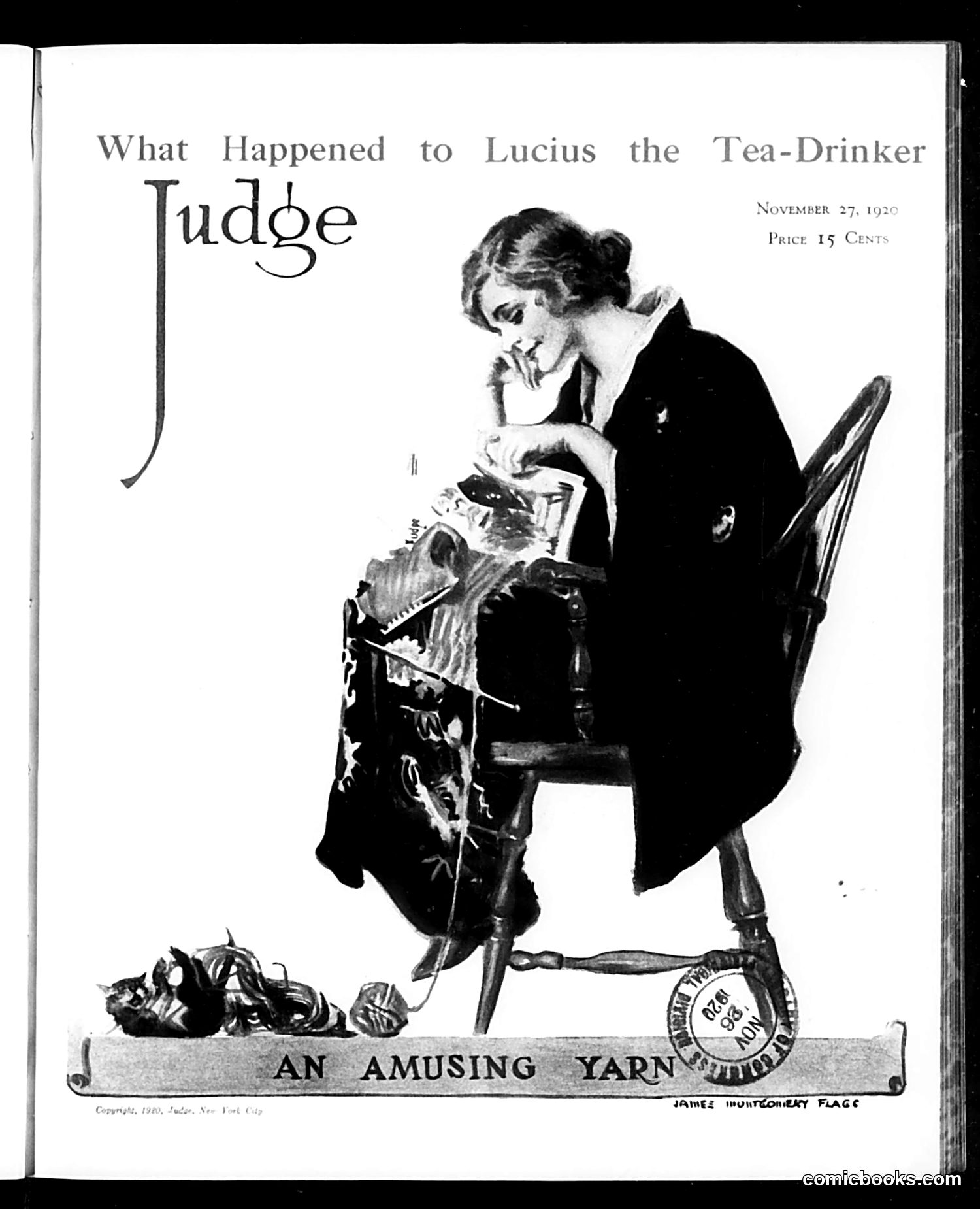
This satirical cover depicts a well-dressed man sitting on a chair while reading what appears to be a newspaper or document. The title "What Happened to Lucius the Tea-Drinker" and subtitle "An Amusing Yarn" suggest this is likely commentary on someone known for tea-drinking habits. The figure appears disheveled or distressed, with scattered papers or debris at the base of the chair. The scooter or wheeled device beneath labeled "JUDGE" serves as the publication's signature visual pun. Without additional context identifying who "Lucius the Tea-Drinker" references, the satire likely targets a public figure or social type of the 1920 period. The joke appears to involve ironic misfortune befalling this character, though the specific political or social reference remains unclear from the image alone.
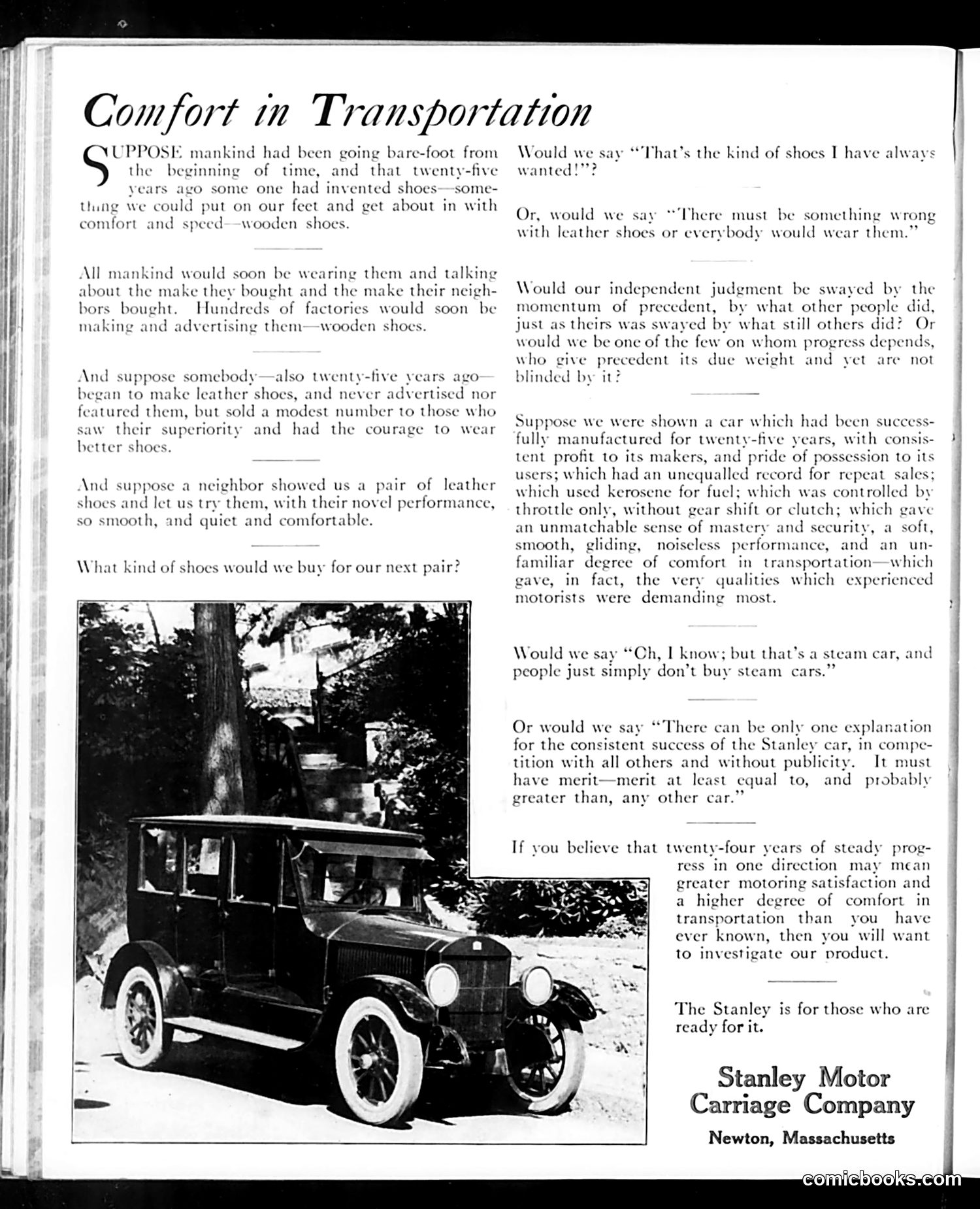
This page combines advertisement with satirical argument. The text uses an extended analogy: just as people eventually adopt superior shoes (leather over wooden), they should adopt superior cars (Stanley steamers over gasoline vehicles). The satire targets consumer behavior and herd mentality. It mocks the notion that people reject products based on merit alone—suggesting instead that precedent, peer pressure, and advertising sway purchasing decisions. The shoe example illustrates this irony: a *better* product (leather shoes) succeeds despite no advertising, while the gasoline car dominates through momentum and marketing, not necessarily superiority. The advertisement thus positions the Stanley steamer as objectively superior in comfort and performance, implying consumers' preference for gasoline cars is merely fashion-following rather than rational choice. The tone is gently satirical about American consumer culture itself.
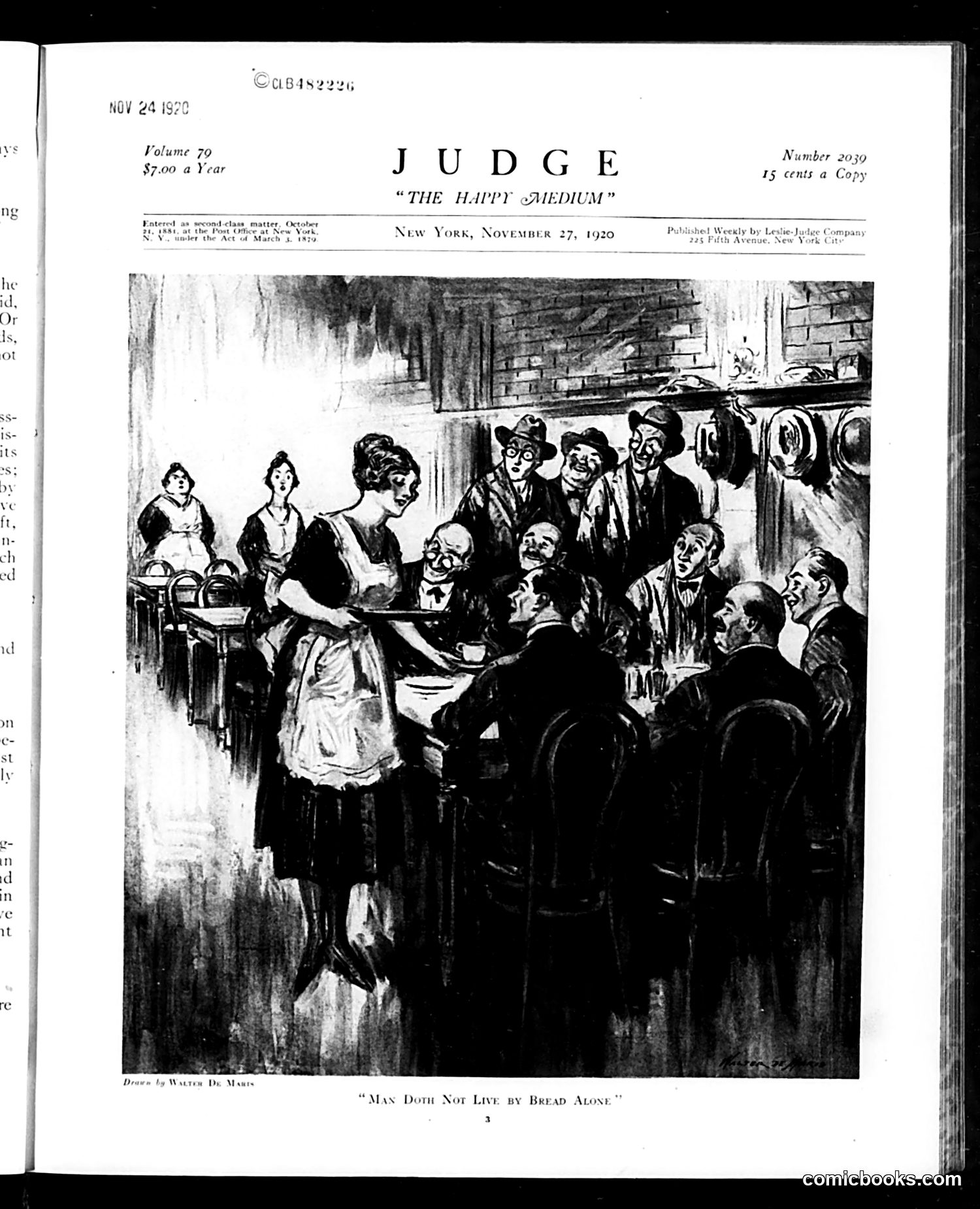
The cartoon, titled "Man Doth Not Live by Bread Alone," depicts a soup kitchen or charity meal scene. A woman serves food to a group of men in worn clothing, suggesting Depression-era or post-WWI poverty. The men's expressions range from grateful to sardonic. The caption's reference to living by "bread alone" implies social commentary on material deprivation versus spiritual or intellectual needs. Given the 1920 date (post-WWI, pre-Depression), this likely satirizes either: - Public charity and its adequacy for the poor - Labor conditions and worker welfare - The gap between material necessity and human dignity The drawing style by Walter De Maris is characteristic of Judge's satirical approach to social conditions of the era. The specific political message remains somewhat ambiguous without additional context.
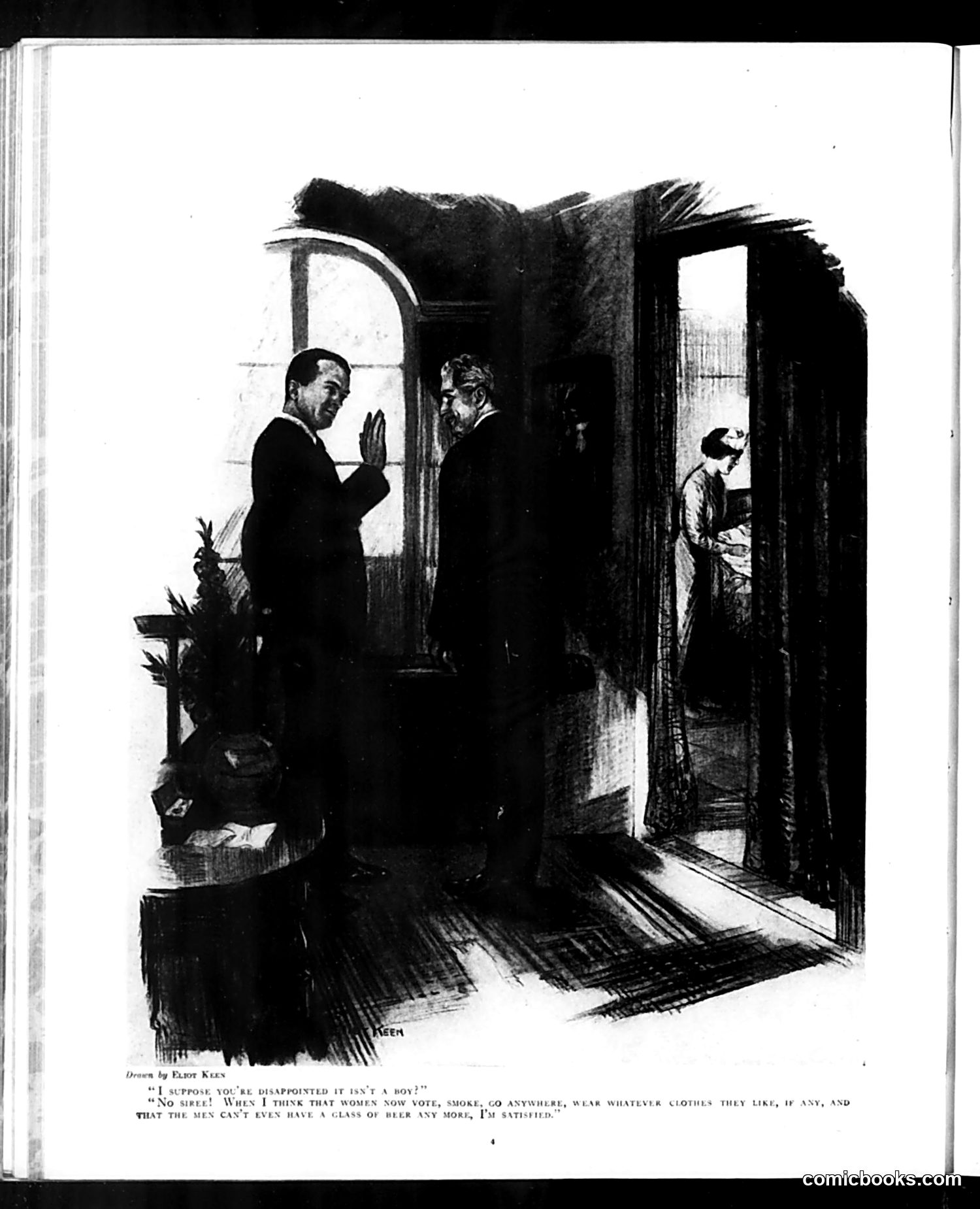
This cartoon by Eliot Kees depicts two well-dressed men in conversation at a doorway, with a third figure visible in the background. The caption presents a dialogue about women's changing social roles. The man on the left expresses satisfaction with contemporary women's freedoms—voting, smoking, going anywhere, wearing whatever clothes they choose. His companion appears skeptical or disapproving of these developments. **The satire targets**: Conservative male resistance to women's liberation and changing social norms, likely from the 1920s-1930s era (post-suffrage). The cartoon mocks the older generation's inability to accept women's newly won independence and equality. The joke hinges on the contrast between progressive acceptance and reactionary resistance to women's emancipation.
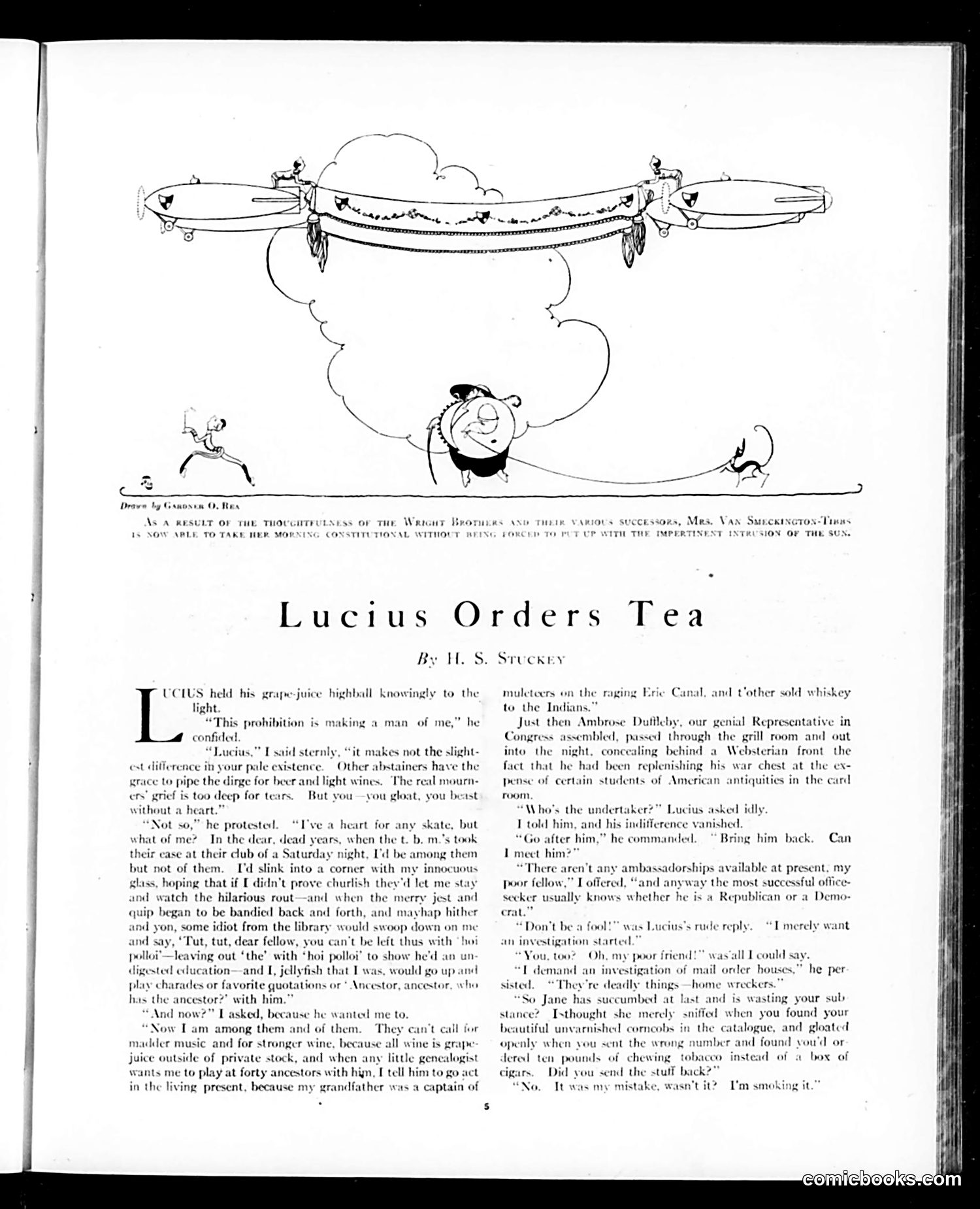
This satirical story by H.S. Stuckey mocks a character named Lucius, who appears to be a Prohibition-era hypocrite. The cartoon at top depicts him holding a grapefruit, with the caption suggesting he's exploiting loopholes in Prohibition law—specifically consuming grapefruit juice while smuggling alcohol through various channels (canal smugglers, whiskey sales to Native Americans). The narrative ridicules Lucius for his moral inconsistency: he claims Prohibition improves society while secretly obtaining contraband. References to "Mrs. Van Smeckington-Tibbs" and Congressional representatives suggest satirizing wealthy elites who publicly support Prohibition while privately violating it. The humor targets the widespread hypocrisy during America's Prohibition era (1920-1933), when affluent citizens routinely circumvented alcohol bans they publicly championed.
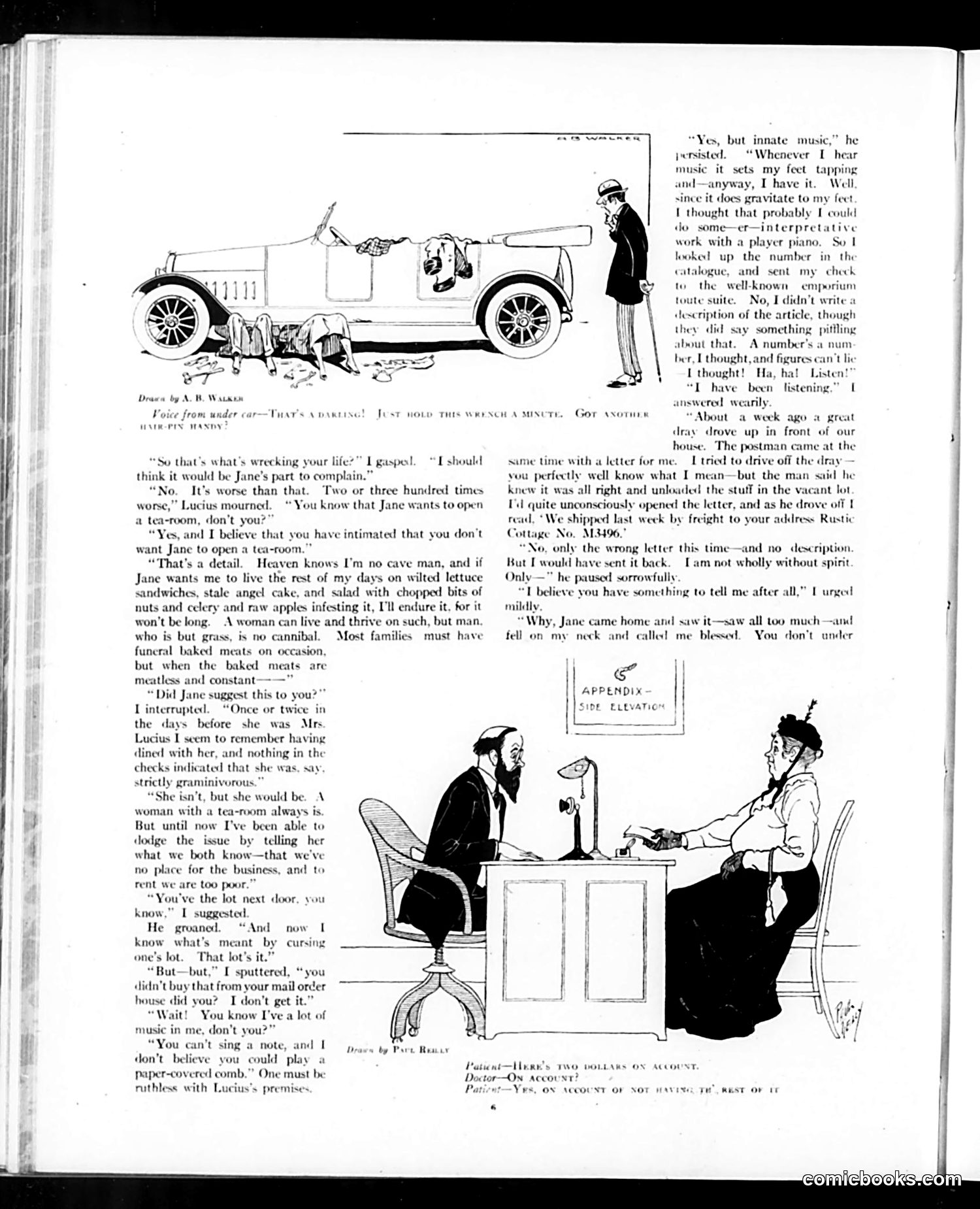
This page contains two cartoons satirizing domestic life and gender relations in early 20th-century America. **Top cartoon**: A woman confronts a man about his broken-down car, complaining he's "wrecking your life." The satire targets how women blamed men for financial mismanagement—here, a literal wrecked vehicle represents poor domestic decisions. **Bottom cartoon**: Titled "Here's Two Dollars on Account," it depicts a doctor and patient in conversation. The humor appears to center on unpaid medical bills and financial disputes between doctors and patients, with the patient offering partial payment ("two dollars"). Both cartoons reflect common domestic grievances of the era: marital conflict over money and consumer goods, and the struggle of working-class families to afford professional services. The satire assumes readers shared these financial anxieties.
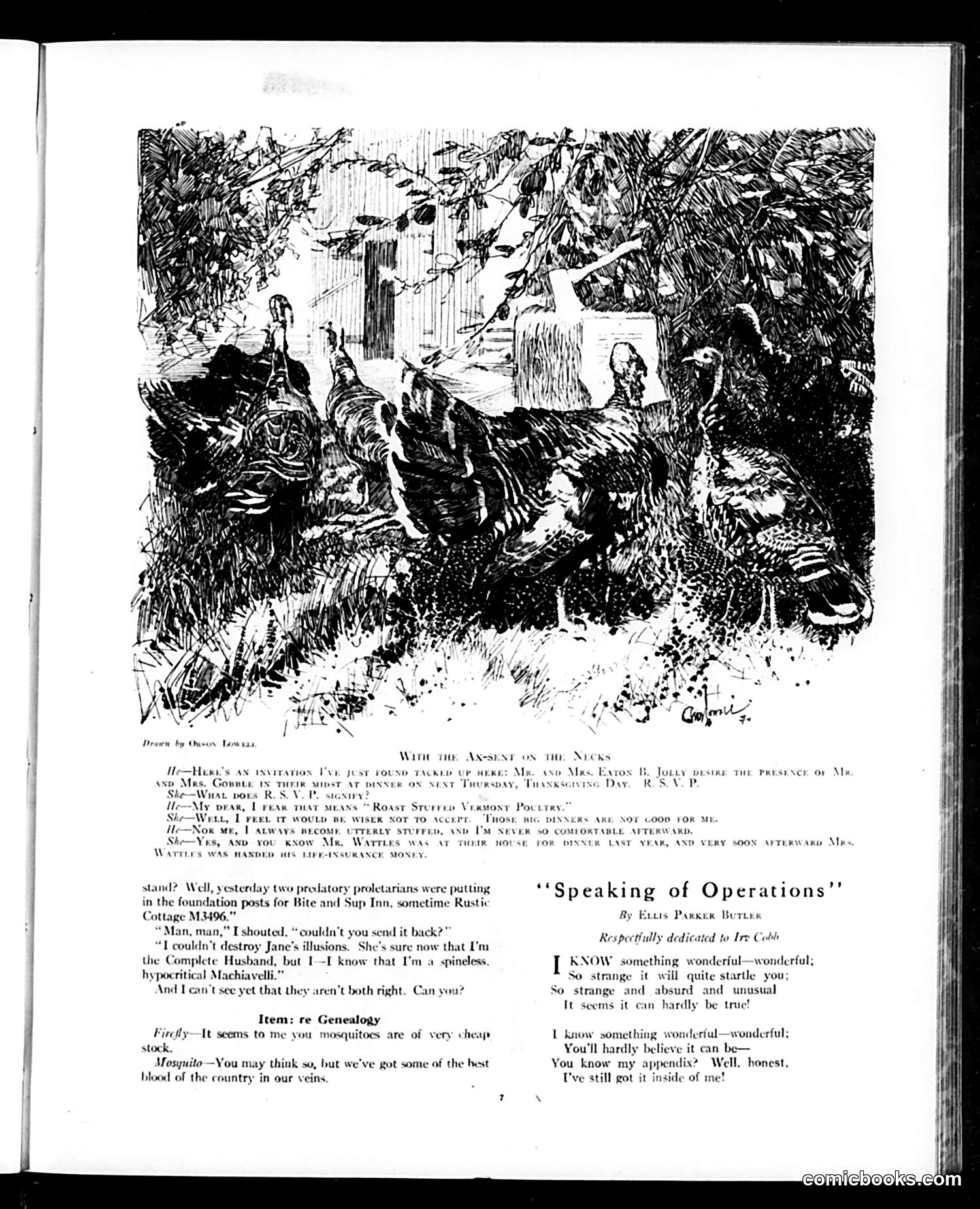
This *Judge* magazine page contains two satirical pieces mocking turn-of-the-century American social pretensions. **The main cartoon** depicts a couple receiving a formal dinner invitation with "R.S.V.P." (the French phrase for responding to invitations). The joke satirizes their anxiety: they recognize the invitation is prestigious—mentioning "Roast Stuffed Vermont Poultry"—but admit they overeat at fancy dinners and feel uncomfortable afterward. The satire targets the hypocrisy of the upwardly mobile class: they desperately want to appear refined and attend fashionable events, yet dread the actual experience. **"Item: re Genealogy"** is a brief joke where a mosquito claims distinguished ancestry—"the best blood of the country"—a pun on literal bloodsucking. It mocks how insects (and by extension, nouveaux riches Americans) claim social standing. Both pieces target the anxiety and pretension of social climbers trying to navigate elite etiquette while remaining fundamentally uncomfortable with their aspirations.
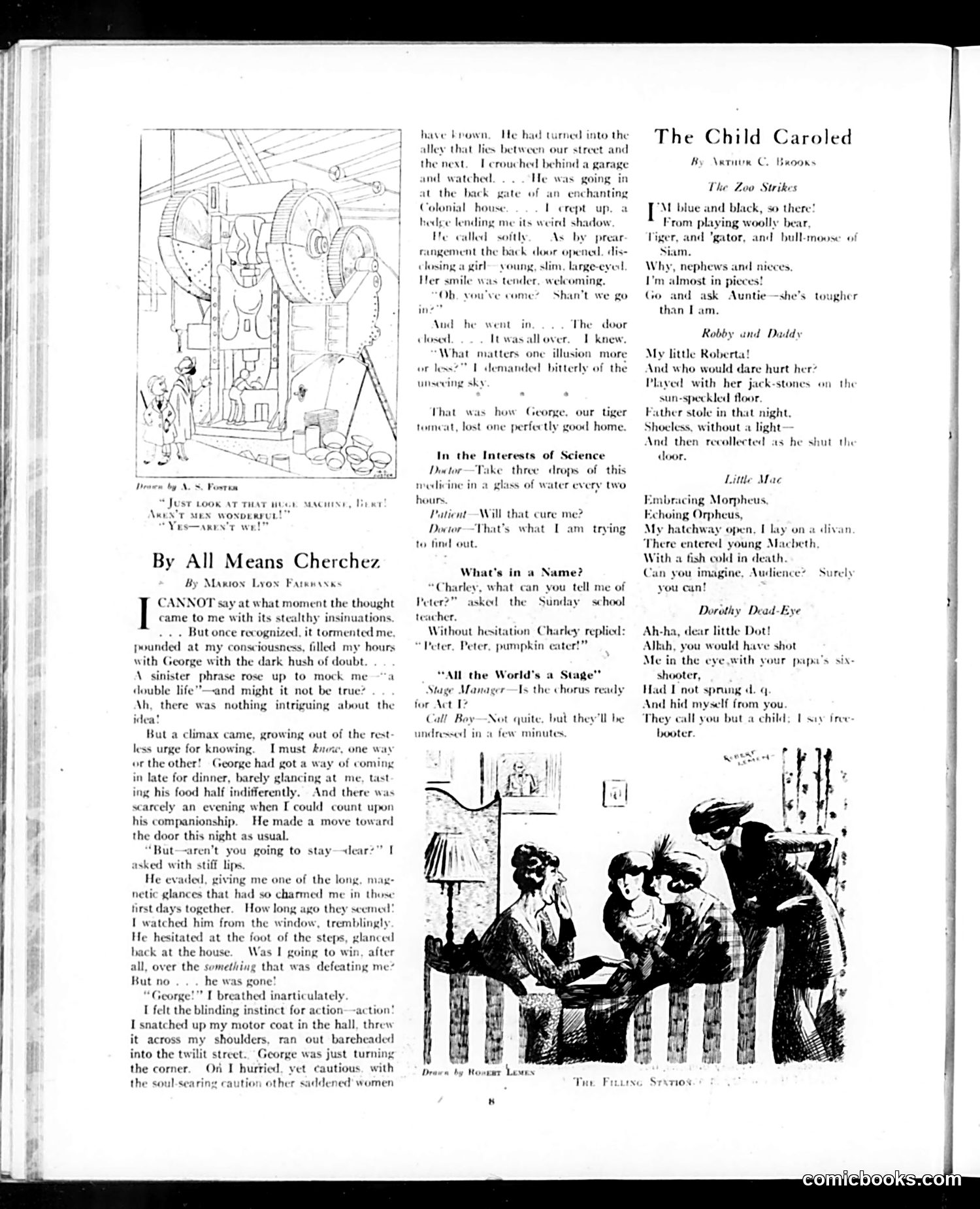
This page contains several humorous short pieces typical of Judge magazine's satirical content. **"By All Means Cherchez"** is a domestic comedy story about a suspicious wife who follows her husband George into an alley, convinced he's having an affair. The twist: George enters a Colonial house, but the revelation shows he was simply visiting their pet tiger, which they've apparently lost as a home because of George's secret visits. The satire mocks marital suspicion and the absurdity of jumping to conclusions. **The cartoon illustrations** include one showing what appears to be a machine or industrial device with figures, and another depicting people at what looks like a train station or public venue. **Additional brief pieces** include jokes about medical incompetence ("In the Interests of Science"), children's humor, and theatrical backstage comedy about chorus dancers. The content reflects Judge's focus on middle-class domestic life, romantic entanglements, and gentle social observation rather than hard-hitting political satire.
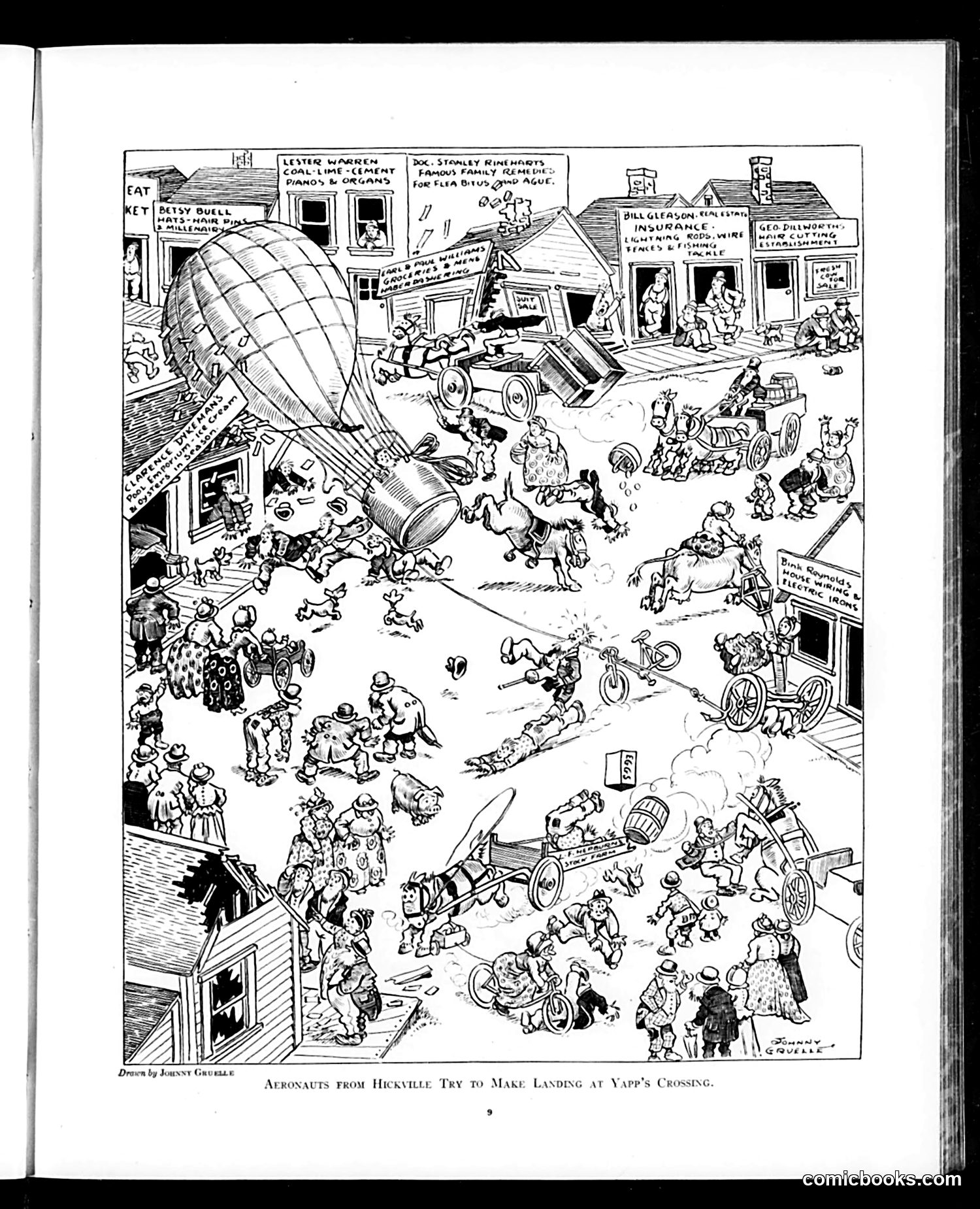
This is a humorous satirical cartoon depicting a chaotic scene where a hot-air balloon has crash-landed in a small town, scattering its occupants among the local population. The cartoon mocks rural life and small-town America through exaggerated detail—numerous townspeople, children, animals, and buildings surround the accident site in comedic confusion. The labeled storefronts (coal/cement supplier, patent medicine vendor, insurance office) parody small-town commercial enterprises. The cartoon satirizes both the novelty of aviation technology to rural Americans and the presumed chaos such an extraordinary event would cause in a backwoods community. The title "Hickville" directly invokes contemporary stereotypes about unsophisticated rural dwellers. The overall joke relies on contrasting "aeronauts" (sophisticated aviators) with provincial, bewildered townspeople.
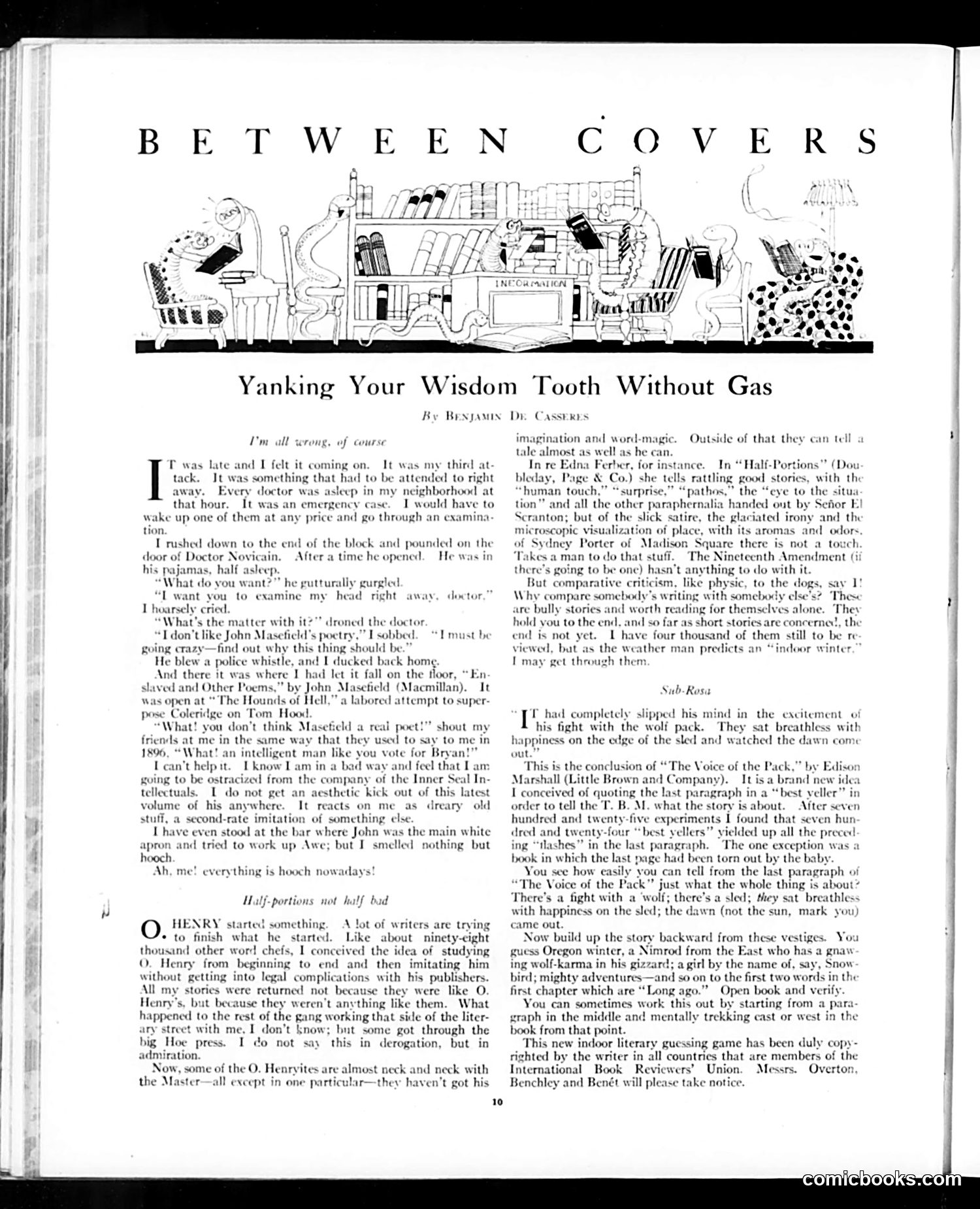
This page from *Judge* magazine contains two literary satire pieces. The main article, "Yanking Your Wisdom Tooth Without Gas," is Benjamin De Casseres critiquing poet John Masefield's recent work. De Casseres admits he dislikes Masefield's poetry (specifically "Enslaved and Other Poems"), which he views as derivative imitation—laboring to combine Coleridge with Tom Hood. He acknowledges this opinion isolates him from intellectuals who revere Masefield, comparing it to 1890s criticism of William Jennings Bryan supporters. The second section discusses O. Henry imitators and praises Edna Ferber's short story collection "Half-Portions," noting her work succeeds where other O. Henry-style writers fail—she possesses genuine storytelling skill despite lacking O. Henry's distinctive "imagination and word-magic." The satire targets literary trends and the difficulty of authentic imitation versus genuine talent. The cartoon header depicts a chaotic library/study scene, visually reinforcing the theme of literary chaos and competing voices.
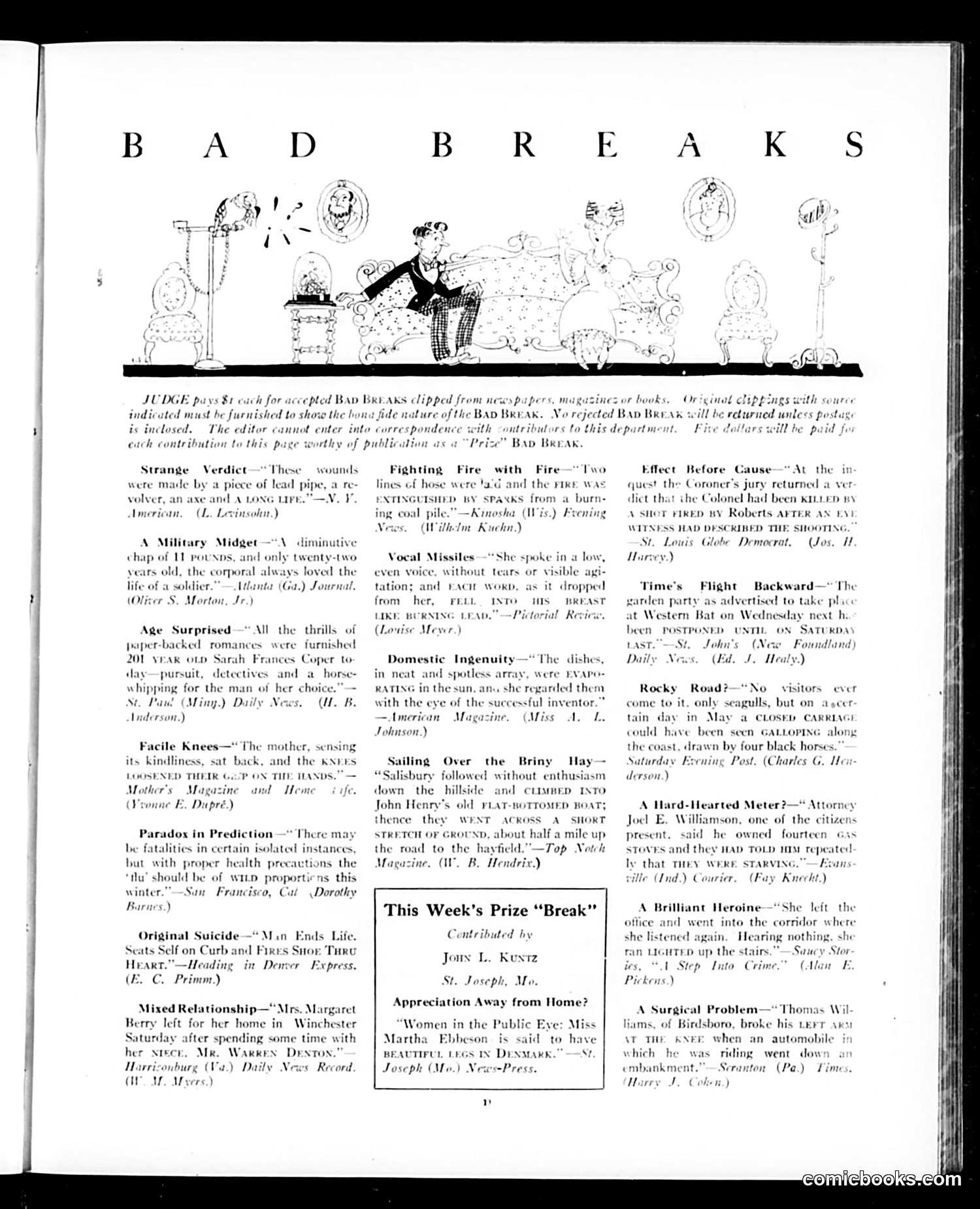
This page showcases **"Bad Breaks,"** Judge magazine's humor column featuring unintentionally funny errors from newspapers and other publications. The cartoon at top depicts a "judge" awarding these amusing excerpts. The humor derives from **grammatical ambiguities and absurd literal readings**. Examples include: - **"Effect Before Cause"**: A jury verdict stating a colonel was killed *by* a gunshot after it's fired (reversing causality) - **"Time's Flight Backward"**: An event "postponed until Saturday last" (paradoxically moving to the past) - **"Strange Verdict"**: Wounds made by "a piece of lead pipe, a revolver, an axe and a LONG RE[?]" (unclear final object) - **"Vocal Missiles"**: Words that "dropped from her, fell into his breast like burning lead" (treating speech as weapons) The satire mocks careless newspaper writing and editing of the era. The "Prize Break" section invites reader submissions. These columns were popular because they demonstrated how sloppy writing could produce unintentionally ridiculous meanings—targeting professional journalists' competence without requiring specific political context.
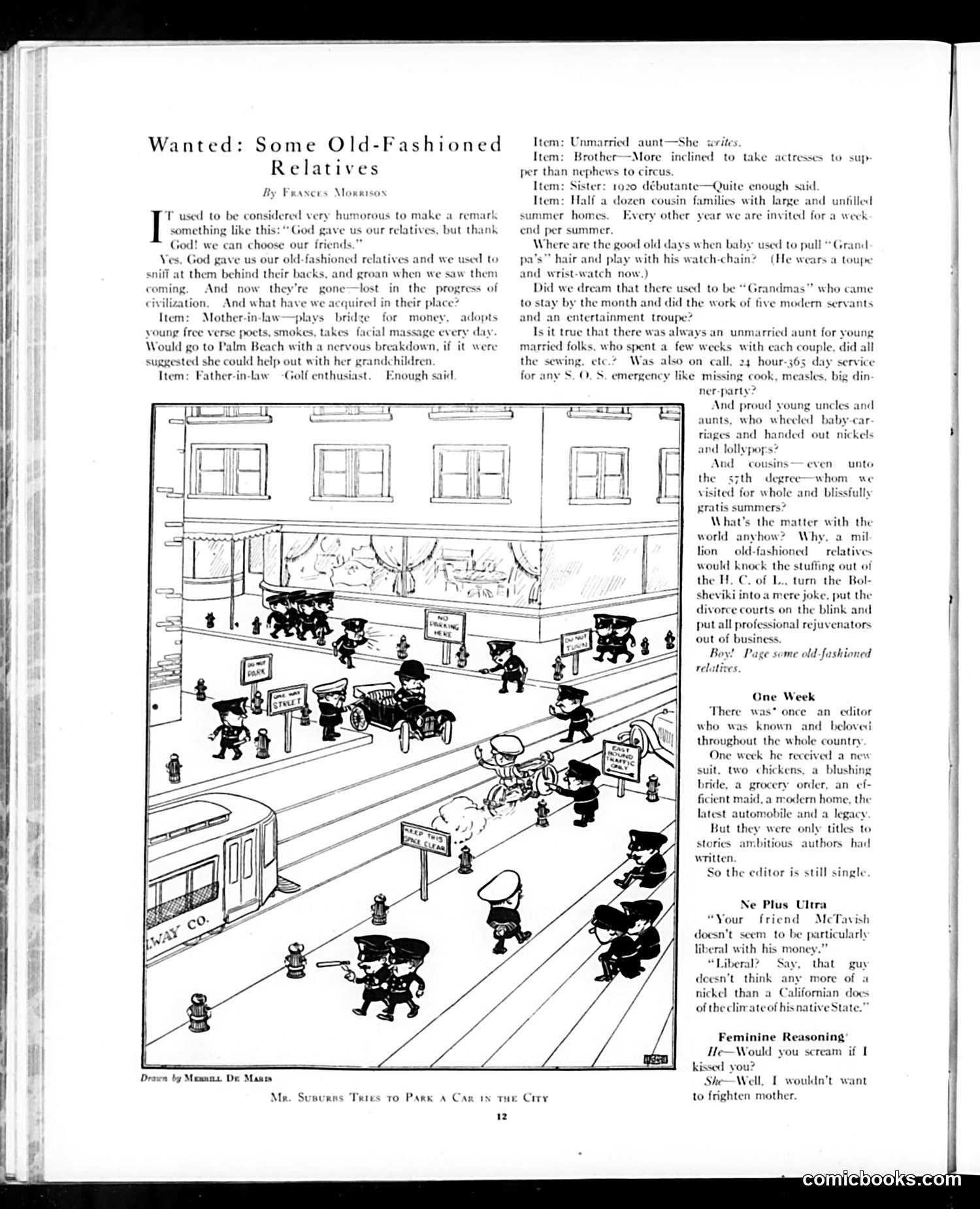
**Main Article: "Wanted: Some Old-Fashioned Relatives"** This satirical piece mourns the disappearance of multi-generational household involvement. The author contrasts idealized Victorian-era relatives—grandparents who engaged with grandchildren, unmarried aunts providing childcare and emergency services, extended cousins visiting for free summers—with 1920s modern relatives who are self-absorbed: mothers-in-law seeking spa treatments, fathers obsessed with golf, unmarried aunts writing poetry, sisters as "flapper" debutantes, and cousins owning empty summer homes. The satire's point: modern relatives are useless. The author facetiously claims that having millions of old-fashioned relatives would solve contemporary problems—inflation ("H.C. of L." = cost of living), Bolshevism, and divorce. **The Cartoon** ("Mr. Suburns Tries to Park a Car in the City") depicts a chaotic urban street scene with crowds of small figures, a streetcar, and someone attempting to park—likely satirizing the newfangled automobile's impracticality in crowded cities.
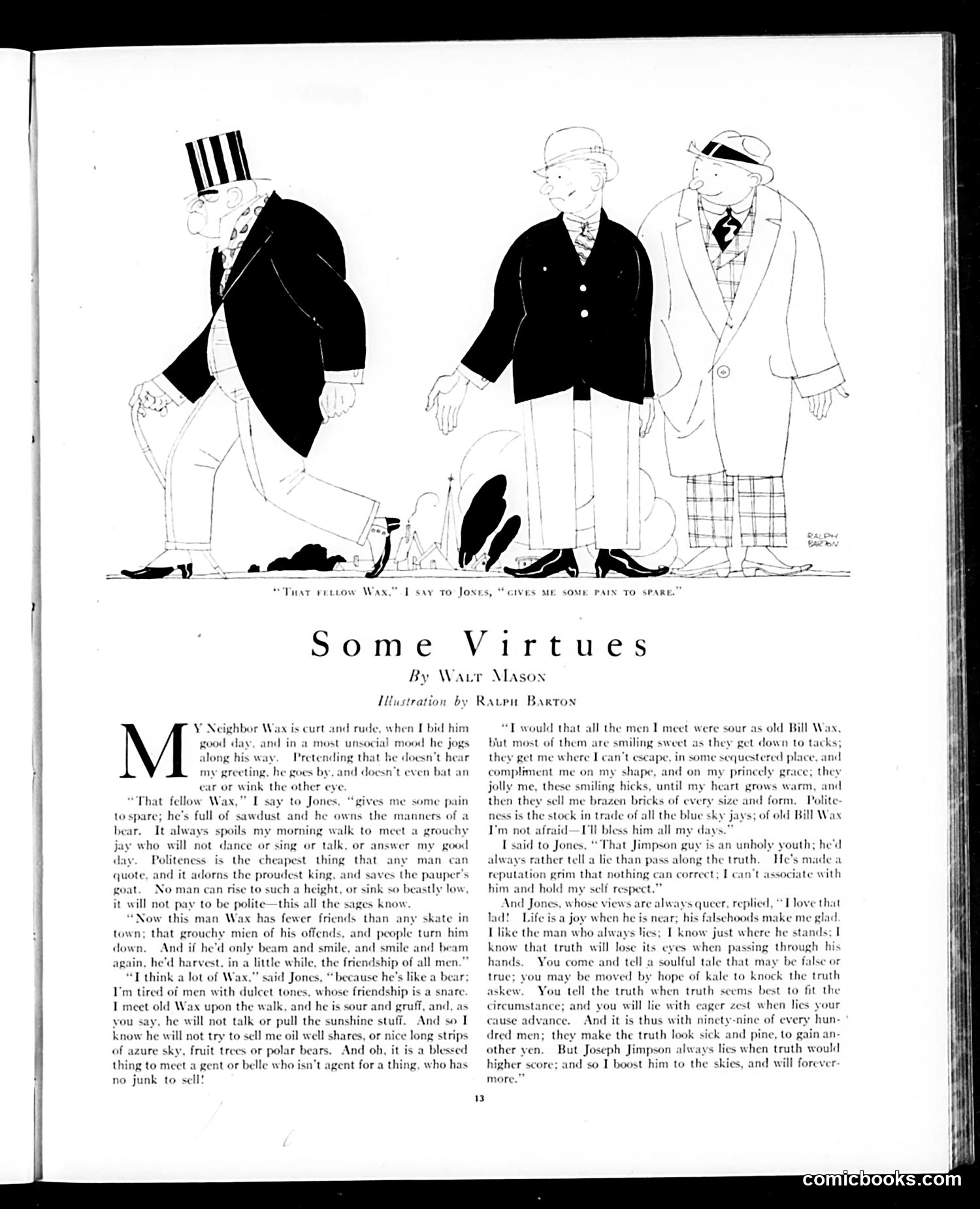
This satirical piece uses contrasting character sketches to mock social hypocrisy. The narrator complains that his grouchy neighbor Wax lacks politeness—a vice the narrator treats as obvious. However, his friend Jones defends Wax precisely *because* he's rude and won't sell him anything. Jones then extends this logic absurdly: he praises the habitual liar Jimpson because liars are predictable and harmless compared to "polite" people who flatter him into bad deals. The satire attacks the era's pervasive dishonest salesmanship and false courtesy. Jones argues that transparent rudeness or consistent lying is morally preferable to the manipulative politeness used by confidence men and hucksters to separate people from money. The cartoon illustrates three male types: the grouchy man (left), reasonable observer (center), and corpulent rogue (right)—visual shorthand for different social character types. The humor lies in inverting conventional virtue: politeness becomes villainous when used deceptively.
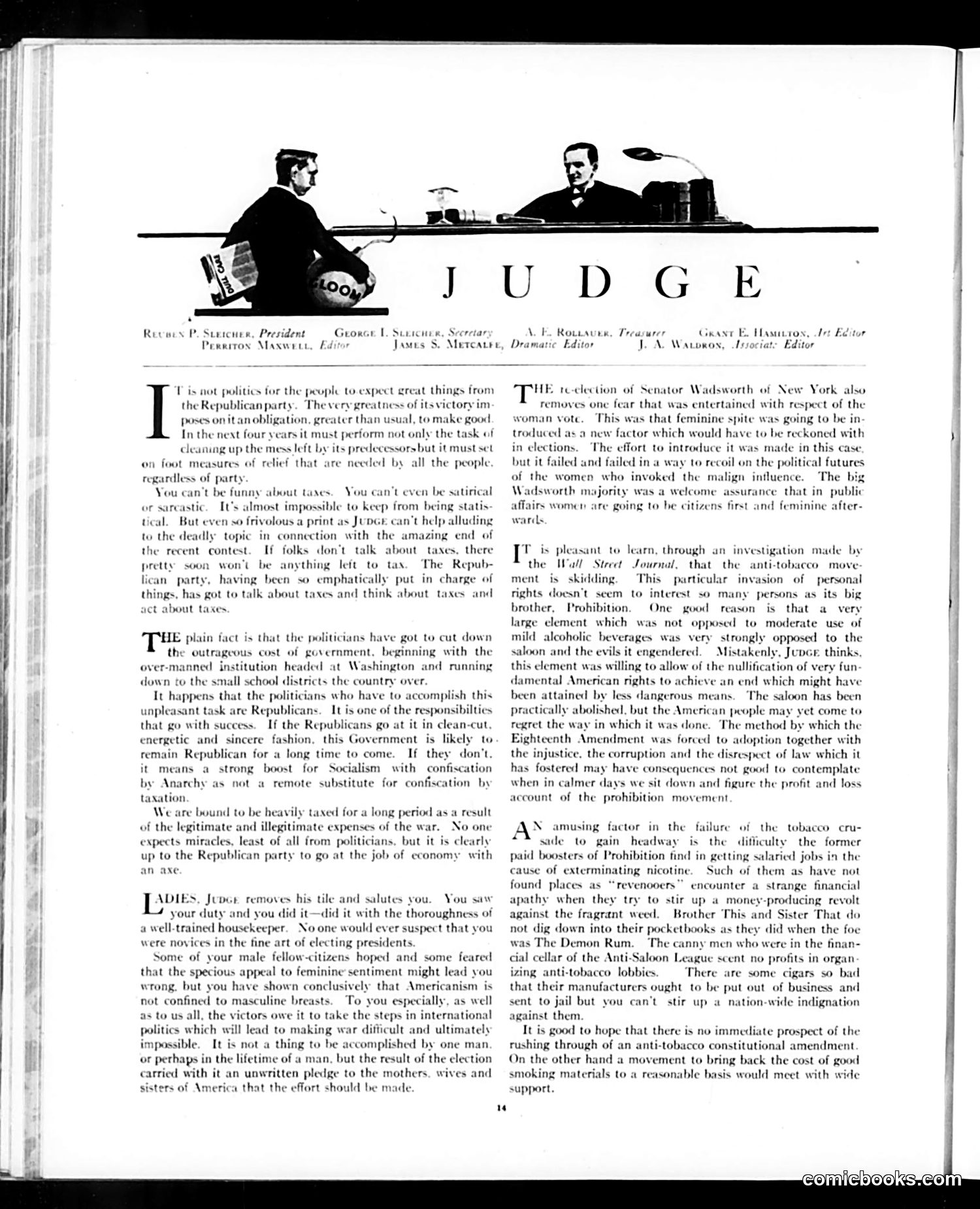
This page from *Judge* magazine contains political editorials addressing post-election Republican responsibilities, likely following a 1920 election victory (references to newly enfranchised women voters). **Main themes:** 1. **Tax Reform**: The editors pressure Republicans to cut government spending and address taxation, warning that failure could boost socialism or anarchy. 2. **Women's Suffrage**: Two editorials celebrate women voting responsibly rather than acting on "feminine spite." Senator Wadsworth's reelection is cited as proof women prioritize citizenship over personal grievances. 3. **Prohibition Skepticism**: A brief item mocks the failing anti-tobacco movement, defending personal liberty against prohibition advocates' "invasion of personal rights." The cartoons (showing two men at a desk, likely representing political figures) reinforce these conservative Republican positions: fiscal responsibility, women's rational participation in democracy, and skepticism toward moralistic regulation.
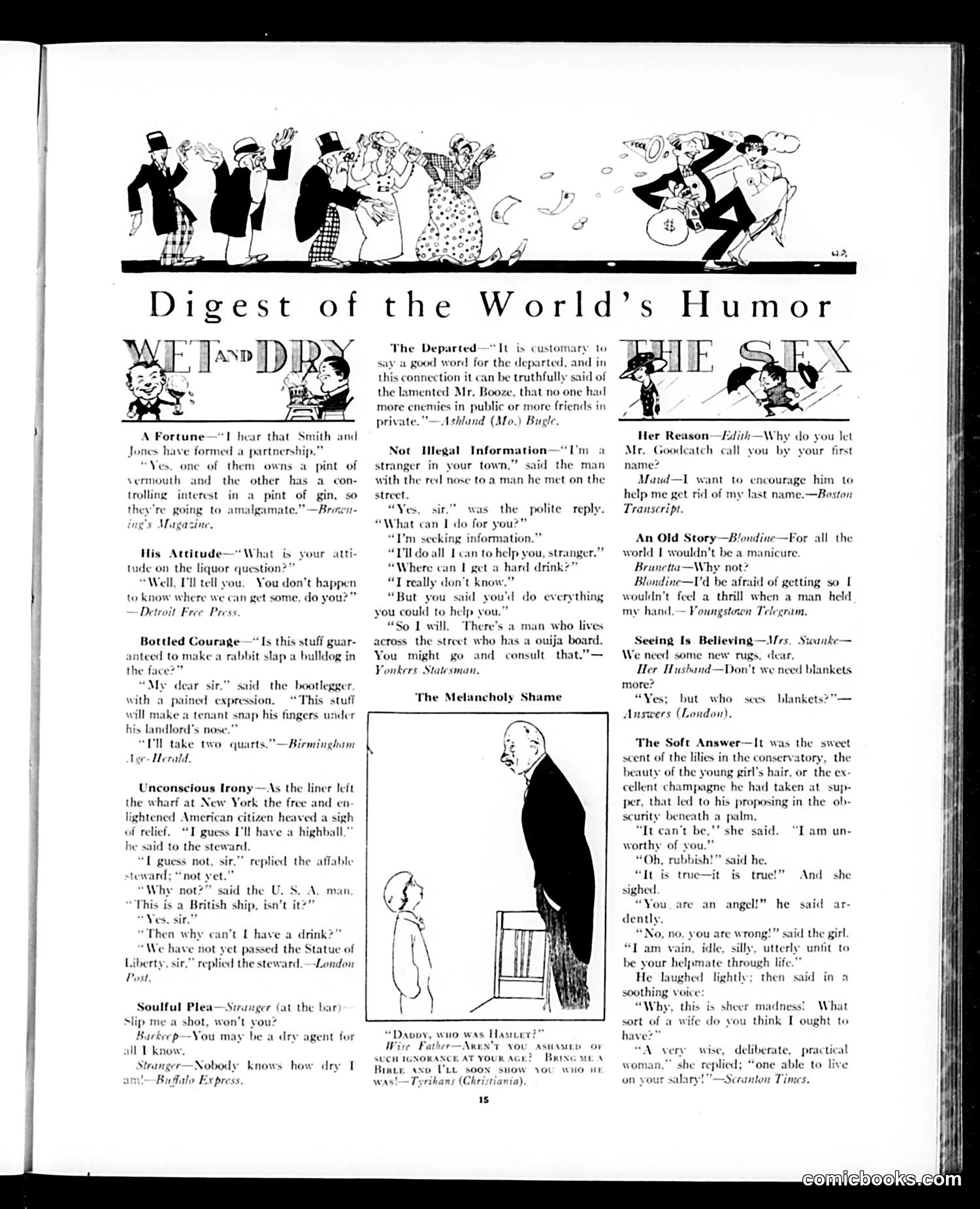
This page collects humorous anecdotes from *Judge* magazine, predominantly satirizing Prohibition (the ban on alcohol sales 1920-1933). The jokes mock: **Prohibition enforcement**: Multiple anecdotes feature characters seeking alcohol illegally or discussing bootleggers. "Bottled Courage" jokes that bootleg liquor gives tenants courage to defy landlords. "Unconscious Irony" depicts an American passenger assuming he can drink freely on a British ship, only to learn U.S. law applies—the absurdity being that Prohibition limits personal freedom even internationally. **Social hypocrisy**: "The Departed" sardonically eulogizes "Mr. Booze," noting he had "more enemies in public or more friends in private"—exposing widespread secret drinking despite official prohibition. The remaining anecdotes are unrelated social humor about courtship, marriage, and household dynamics, typical of the magazine's general comedic content. The overall page reflects American culture grappling with Prohibition's contradictions between law and widespread public desire for alcohol.
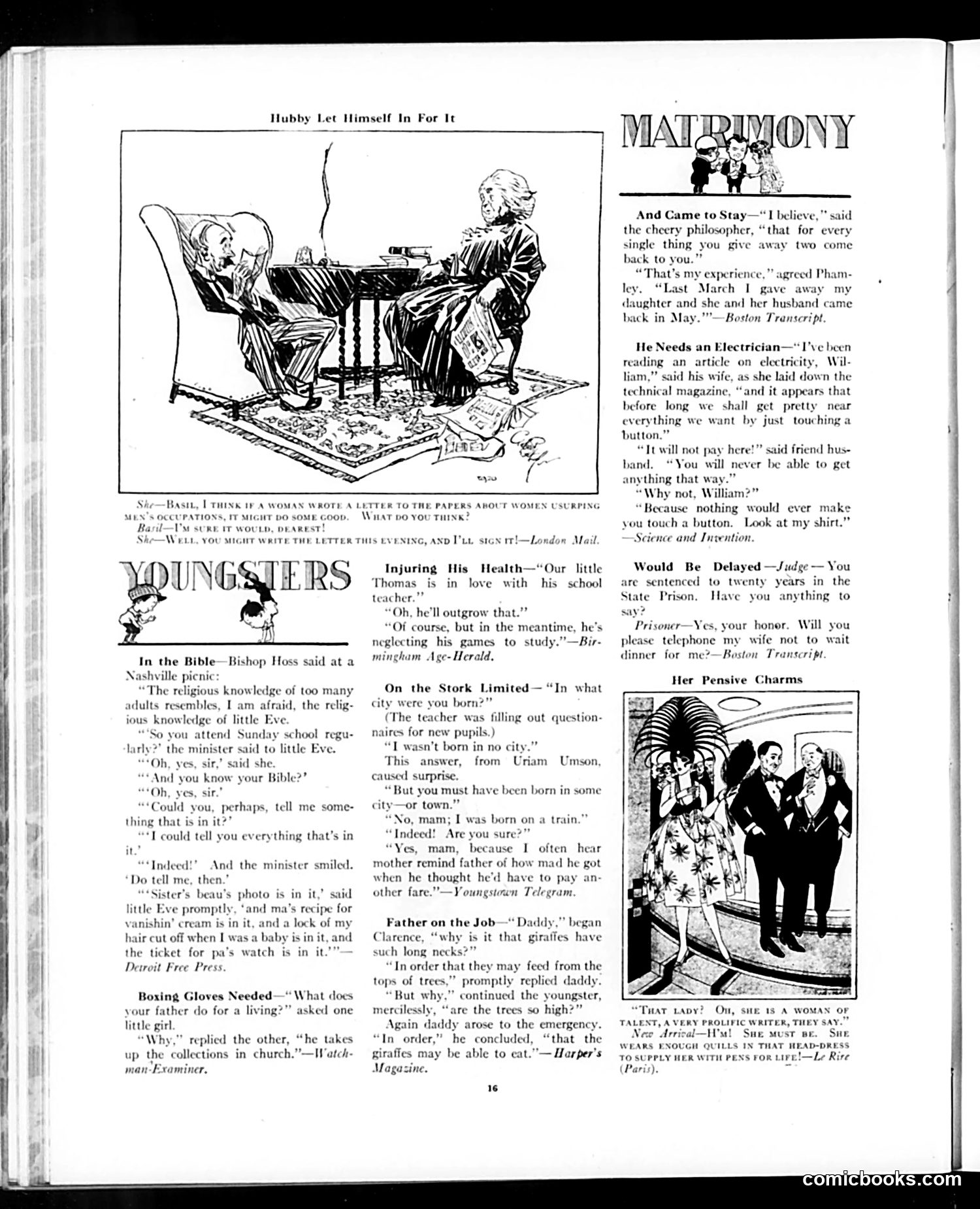
This page from *Judge* magazine contains multiple brief humorous anecdotes rather than a single political cartoon. The main cartoon at top shows a husband lounging while his wife suggests he write a letter to newspapers about women usurping men's occupations. The joke: she then suggests *he* write it—implying women should handle their own advocacy, not rely on men. The accompanying anecdotes mock: - **Religious education**: A child's "Bible knowledge" includes personal items stuffed inside the book, not actual scripture - **Childhood crushes**: A boy neglects school activities over infatuation with his teacher - **Birth certificates**: A child claims to be born "on a train" rather than in a city - **Paternal authority**: A father invents absurd explanations to his questioning son about giraffes' necks - **Prison sentencing**: A convict's primary concern is notifying his wife about dinner timing The final cartoon jokes that a female writer has so many quill pens in her elaborate hairstyle that she needs no others—conflating women's fashion excess with literary productivity. These represent typical early-20th-century domestic humor targeting family dynamics, gender roles, and children's innocence.
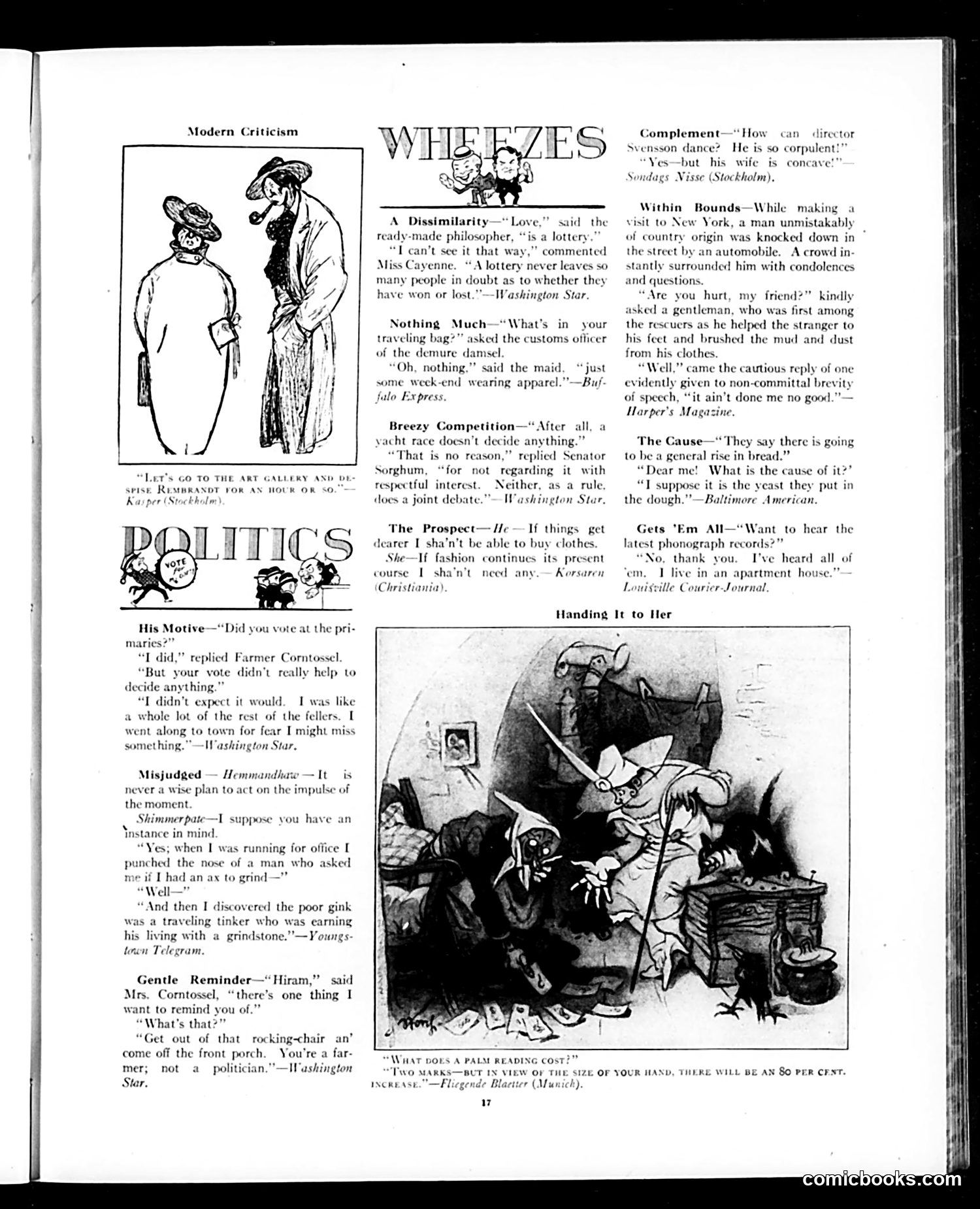
This page from Judge combines short satirical jokes with illustrations, typical of early 20th-century American humor magazines. The content targets: **Political satire**: References to voting primaries and a "Senator Sorghum" mock politicians' hollow rhetoric—even yacht races receive more serious debate than joint political debates. **Social commentary**: Rural/urban contrasts appear repeatedly (the country man knocked down in New York, farmer Corntossel confused for a politician). These jokes poke fun at unsophisticated country folk navigating modern life. **Gender humor**: Women's fashion anxieties and palm readers reflect period preoccupations. The "palm reading" cartoon's punchline about hand size correlating to cost is mildly suggestive humor. **General absurdism**: The "Modern Criticism" cartoon and various one-liners use non-sequiturs and logical reversals for comedy. The page reflects Judge's formula: breezy, topical humor aimed at educated urban readers, mixing mild political critique with stereotyping of rural Americans and women.
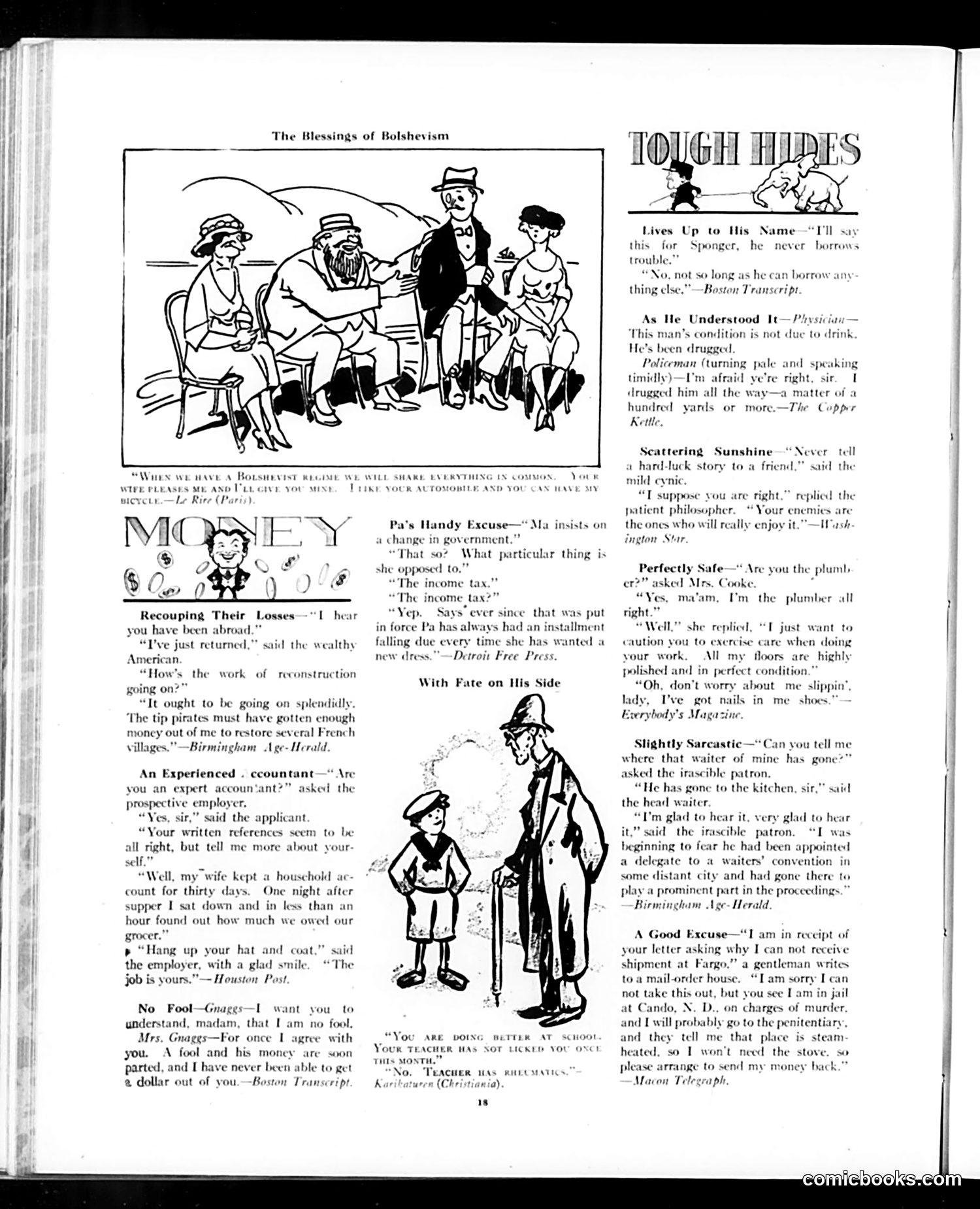
This page collects brief humorous anecdotes satirizing various American social issues, circa 1920s. **"The Blessings of Bolshevism"** references post-WWI anxieties about communist revolution, mocking fears that Bolshevism would destroy private property and traditional family structures. **"Recouping Their Losses"** satirizes wealthy Americans who profited from WWI reconstruction efforts in France, suggesting war profiteers disguised their gains as charitable contributions. **"With Fate on His Side"** jokes about corporal punishment in schools—a teacher hasn't beaten a student in a month, implying improved behavior results only from fear of violence. **Other brief jokes** mock: income taxes (wives opposing them), plumbers slipping on polished floors, incompetent accountants, and a jailed man refusing shipment delivery to a penitentiary. The overall tone reflects period anxieties about taxation, reconstruction, Bolshevism, and social change, using working-class characters and domestic situations for comedic effect.
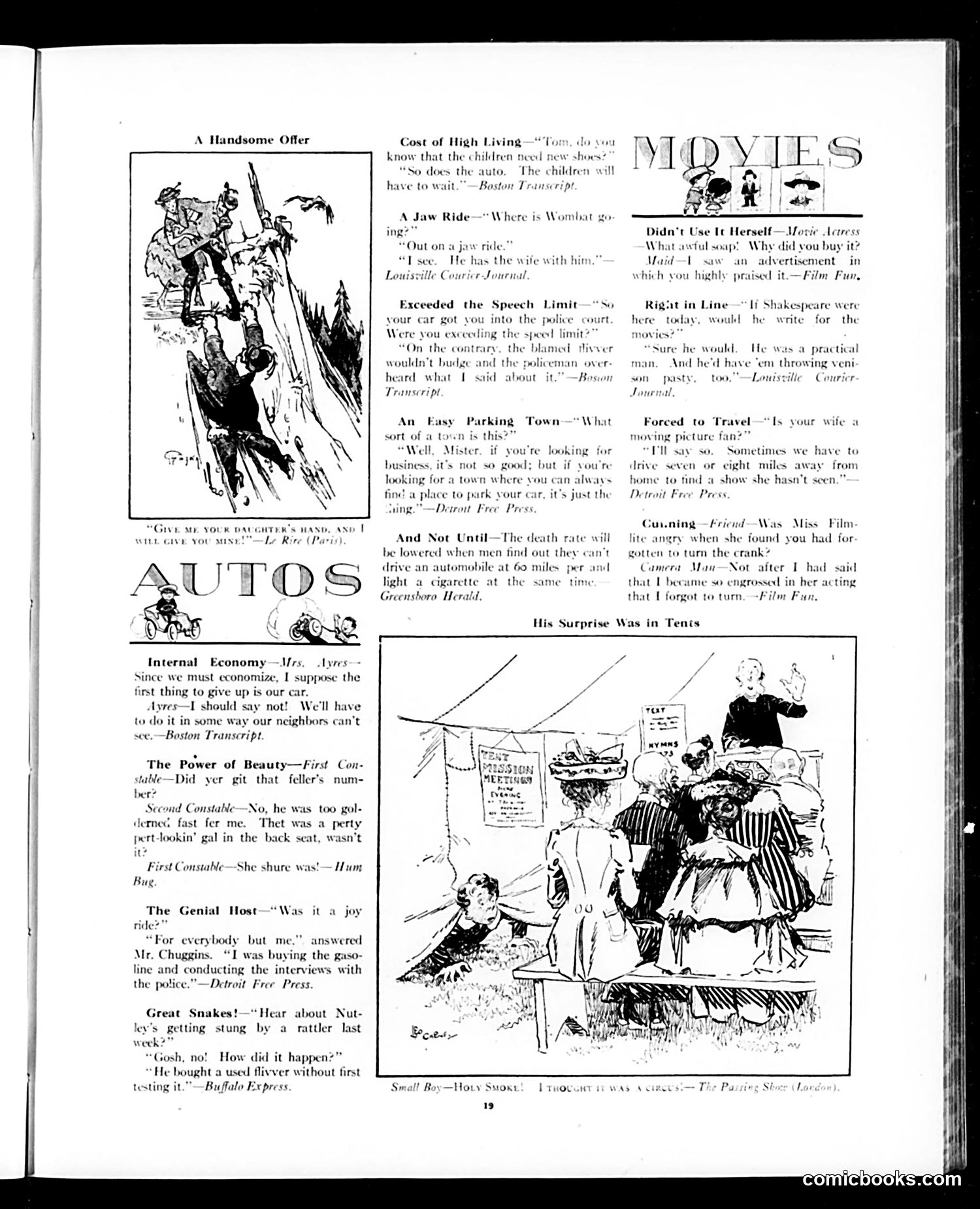
This page from *Judge* magazine collects brief humorous anecdotes about automobiles—a then-modern technology causing social disruption. The satire targets early-1900s car culture anxieties: **Key jokes:** - "Internal Economy": A wife wants to economize by cutting car expenses, not realizing neighbors will notice the sacrifice - "Exceeded the Speech Limit": A broken-down "flivver" (cheap car) won't move, so the driver curses the police officer who pulls him over - "Great Snakes": Buying a used car without inspection is compared to being bitten by a rattler snake - "Forced to Travel": A wife loves movies so much, the husband drives miles away to find one she hasn't seen **The satire's point**: Cars are becoming culturally mandatory despite financial strain, mechanical unreliability, and social embarrassment. The humor mocks both automobile dependence and the class anxieties surrounding conspicuous consumption—people sacrifice financially to maintain appearances of car ownership. The "His Surprise Was in Tents" cartoon (bottom) remains unclear from the visible text.
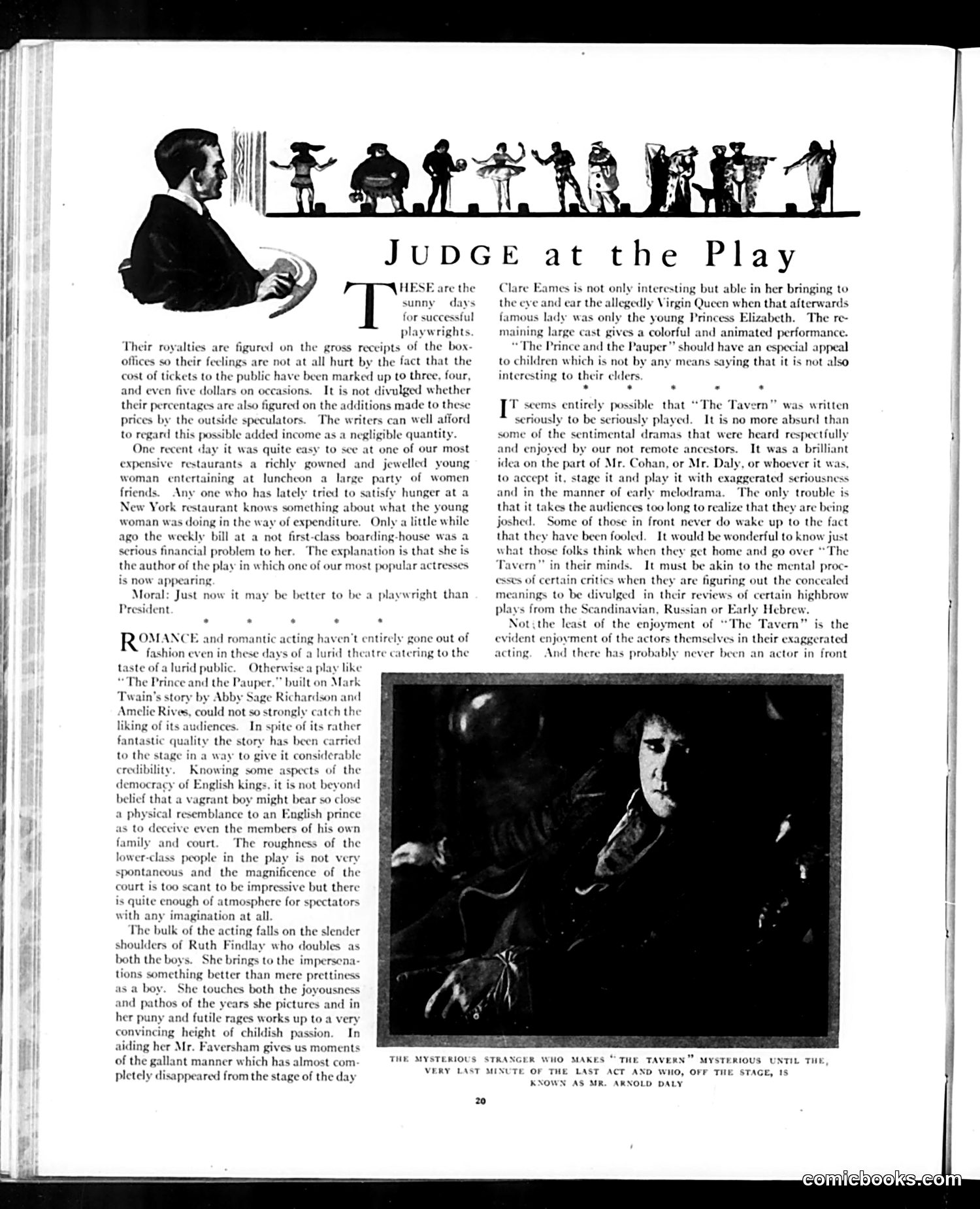
This page presents theater criticism from Judge magazine's drama section. The left sidebar shows a silhouetted man (the "judge" evaluating plays) observing theatrical figures. The critic discusses three productions: 1. **"The Prince and the Pauper"** — Adapted from Mark Twain's novel, praised for romantic appeal despite theatrical limitations. Ruth Findlay performs both title roles convincingly. 2. **"The Tavern"** — A melodrama the critic suggests *may* have been written seriously but is now performed with exaggerated seriousness, creating unintentional comedy. Some audience members don't realize they're being "joshed" (mocked). The opening moral satirizes playwrights' sudden wealth: a once-poor woman now entertains lavishly at expensive restaurants thanks to royalties from a successful play — implying it's currently better to be a successful playwright than President. The image shows "the mysterious stranger" character from "The Tavern," played by Arnold Daly, whose identity is revealed only in the final act.
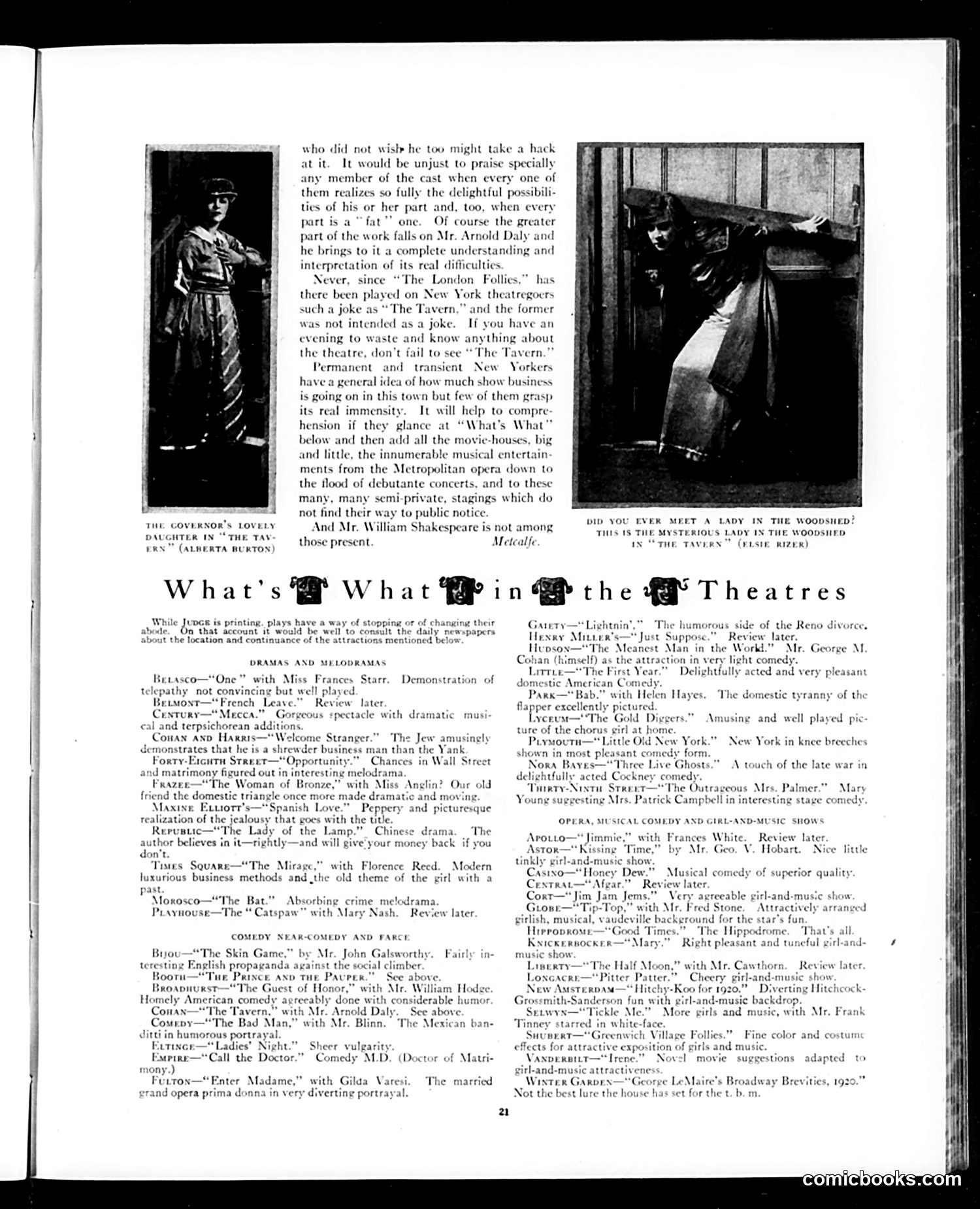
This page is primarily a theater review column cataloging New York stage productions circa 1920. The two photographs show scenes from "The Tavern," a theatrical comedy starring Arnold Daly and Alberta Burton. The main text praises "The Tavern" as an unexpectedly successful joke—the reviewer notes it's funny despite (or because) audiences didn't expect comedy from this production. The caption identifies Burton as "The Governor's Lovely Daughter" and references an actress named Elsie Rizer as "The Mysterious Lady in the Woodshed." The bulk of the page consists of capsule reviews of current Broadway productions across multiple genres: dramas, melodramas, comedies, operas, and musical shows. These are brief professional assessments noting plot, cast quality, and entertainment value—essentially a theater-goer's guide to what's playing in New York at that moment.
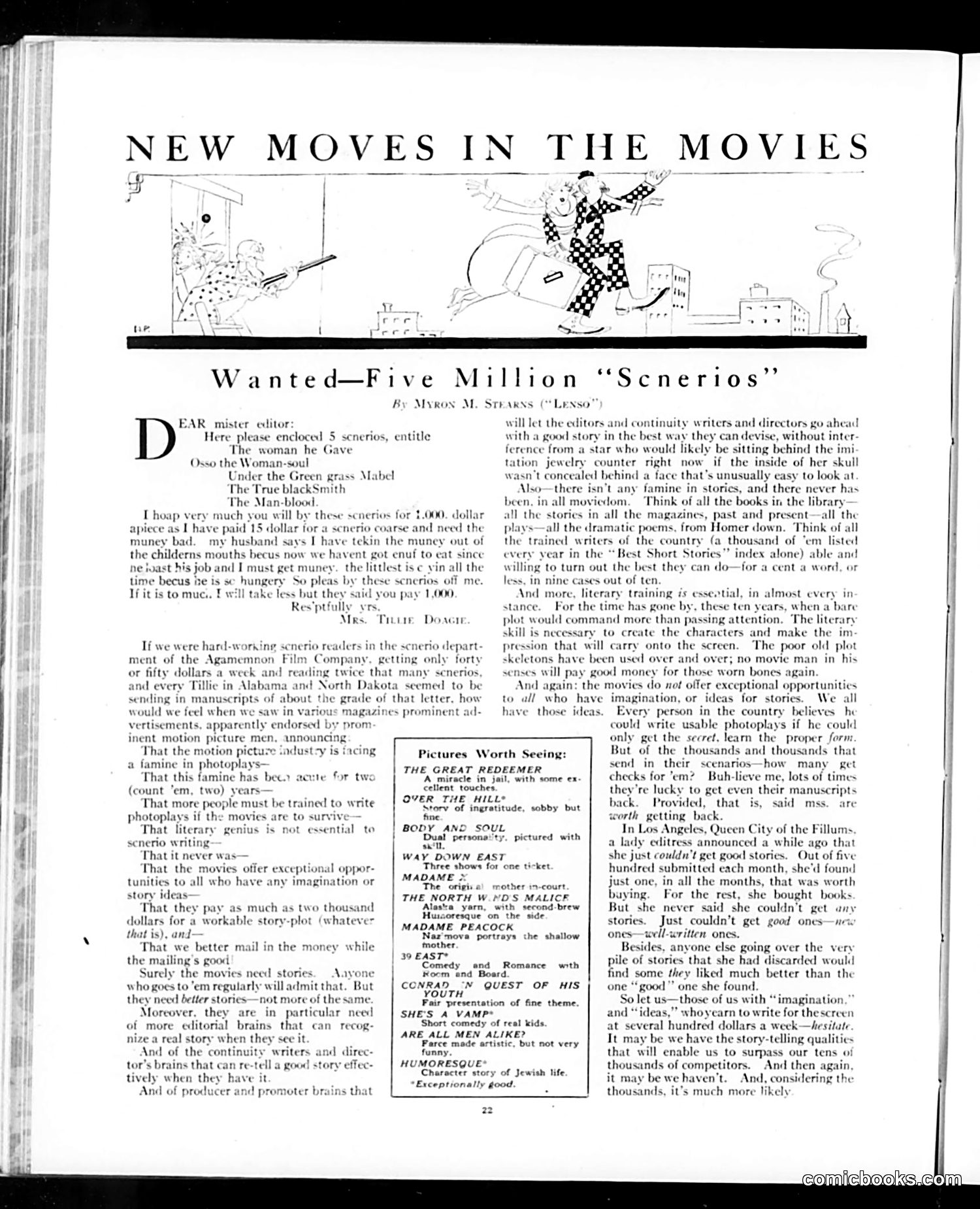
This page satirizes the film industry's claimed shortage of screenplay scenarios. The article mocks studios' public complaints that they desperately need writers, while the opening letter from "Mrs. Tillie Dough" exposes the hypocrisy: she's been submitting amateur scenarios hoping to sell them for $1,000 each to support her family, yet the industry simultaneously claims a "famine" in available stories. The satire's point: Hollywood manufactures artificial scarcity to justify underpaying writers while discouraging genuine literary talent. The "Pictures Worth Seeing" sidebar lists actual films with quality descriptions, implying good stories *do* exist—studios simply won't pay adequately for them or recognize quality when submitted. The cartoon at top shows exaggerated characters in comedic action, illustrating the absurdist gap between what studios claim they need and what they actually value. The piece criticizes the motion picture industry's exploitative recruitment practices and their dismissal of proper literary training.
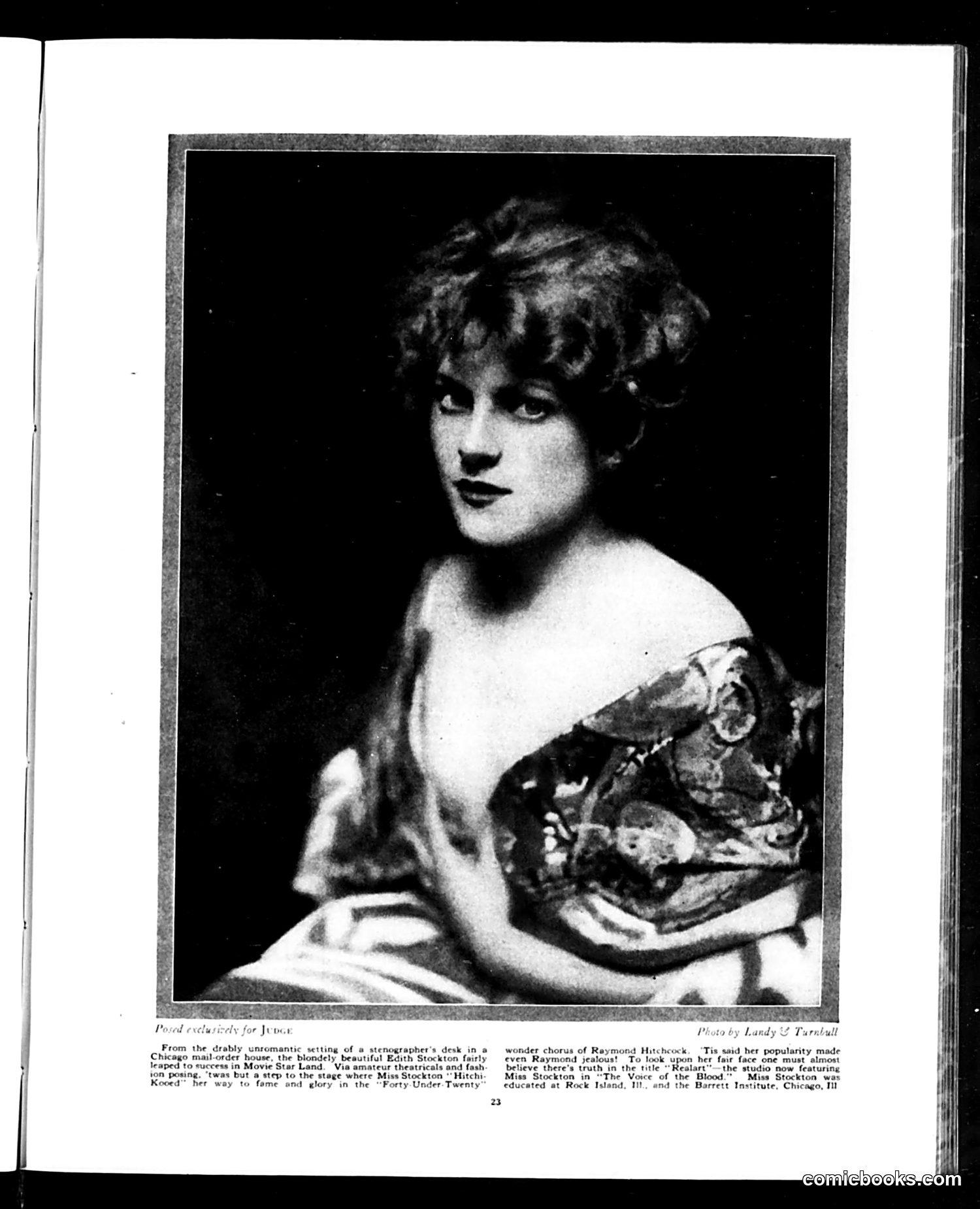
This page features a **biographical portrait and profile** of **Edith Stockton**, a silent film actress, rather than political satire. The image shows a glamorous studio photograph typical of 1920s Hollywood promotion. The text traces her rise from ordinary circumstances—working at a Chicago mail-order house desk—to stardom through amateur theater and fashion modeling, culminating in silent films. Judge magazine documents her success in movies for the "Realart" studio, including a film called *"The Voice of the Blood."* The tone is celebratory rather than satirical, typical of entertainment journalism of the era. It emphasizes the "rags to riches" narrative popular in Jazz Age America: an ordinary working girl achieving glamorous movie stardom. Her education in Illinois is noted to establish respectability. This represents Judge's coverage of contemporary celebrity culture and the new film industry.
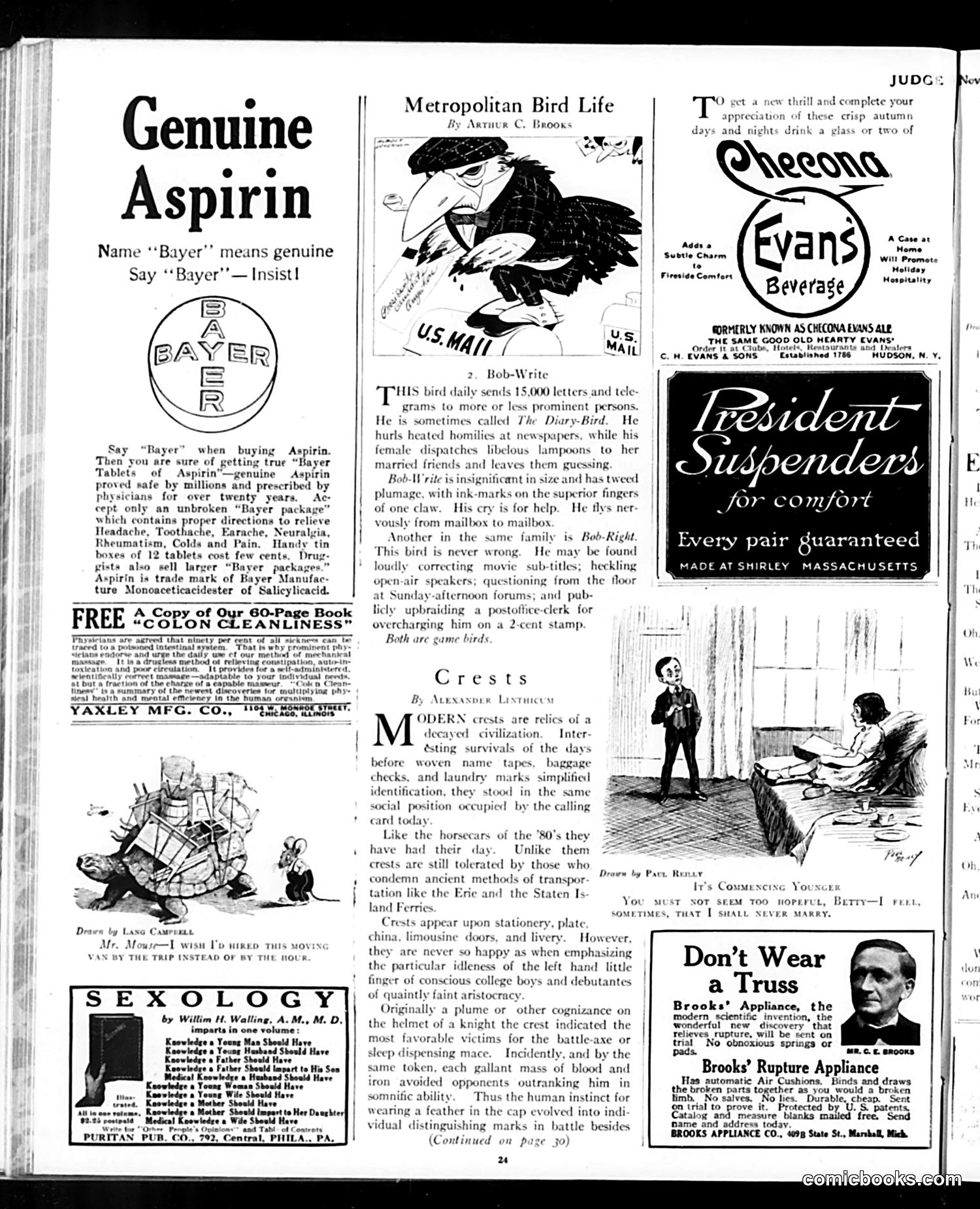
This page features a satirical illustration by Arthur C. Brooks titled "Metropolitan Bird Life," depicting two anthropomorphized birds engaged in mail-related activities. **The Figures:** "Bob-Write" and "Bob-Right" are personified birds representing types of letter-writers common in urban society—nuisances who flood prominent people with unsolicited correspondence. **The Satire:** Bob-Write sends 15,000 daily letters and telegrams, offering "heated homilies" to newspapers and "libelous lampoons" to married friends. Bob-Right is equally obnoxious, compulsively correcting movie subtitles, heckling speakers, and berating postal clerks over minor overcharges. **The Point:** The cartoon mocks busybodies and chronic complainers who abuse postal services to thrust their opinions on others. The humor lies in portraying these irritating social types as actual "game birds"—treating absurd human behavior as natural history, making their ridiculousness more apparent to readers familiar with such metropolitan pests.
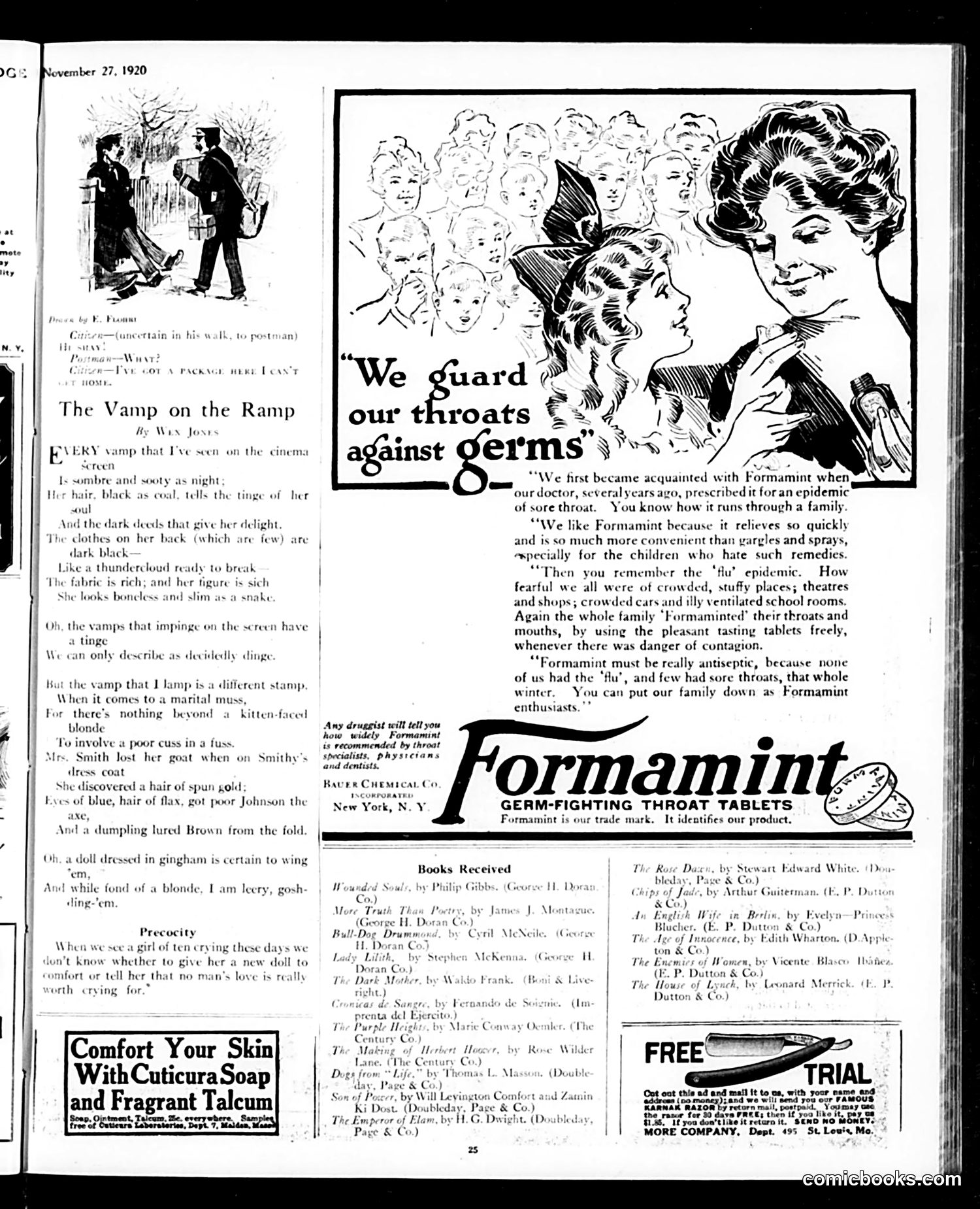
This page contains two satirical pieces and advertisements typical of Judge magazine. **"The Vamp on the Ramp"** by Wax Jones is a poem mocking cinema's portrayal of seductive women ("vamps"). The satire critiques how movie vamps are depicted as dark, dangerous temptresses, contrasting this with real-world "vamps" who cause domestic chaos over trivial matters—a wife finds a blonde hair on her husband's coat, triggering jealousy and marital strife. The joke undercuts the glamorous movie stereotype by suggesting actual women who wreck marriages are petty and vindictive rather than mysteriously alluring. **"Precocity"** is a brief social commentary on young girls crying over romantic disappointment, questioning whether to comfort them or tell them love isn't worth the emotional investment—satirizing premature romantic distress in children. The page is otherwise dominated by advertisements, including Formamint throat tablets (marketed during the post-1918 flu pandemic era) and Cuticura soap, reflecting contemporary consumer culture concerns.
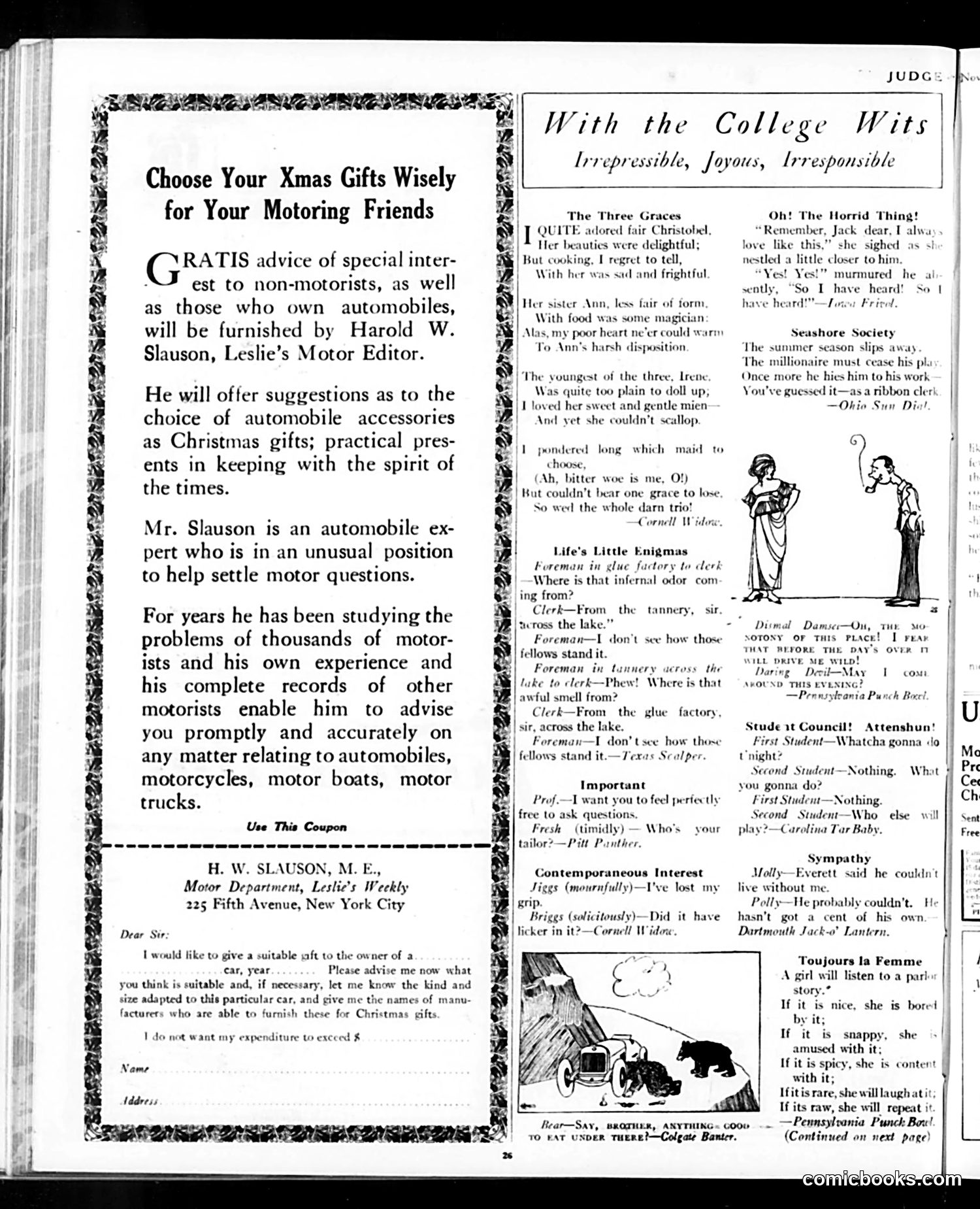
This page from *Judge* magazine combines two main elements: **advertising** and **humor columns**. The left side promotes Harold W. Slauson's motor-advice column via coupon, targeting Christmas gift-givers seeking automobile accessories—reflecting the early 20th-century novelty of car ownership as a status symbol. The right side features **college humor** and short comic vignettes typical of the era. The pieces satirize predictable social scenarios: "The Three Graces" jokes about choosing between three sisters (ultimately marrying all three); "Life's Little Enigmas" features a repetitive joke about factories across a lake; "Seashore Society" mocks wealthy men forced to work as ribbon clerks. The humor relies on **wordplay, puns, and exaggerated situations** rather than visual gags. "Toujours la Femme" stereotypes women as fundamentally indifferent—a misogynistic trope common to the period. The cartoons assume college-educated, automobile-owning male readers who'd find these observations amusing. The overall tone is lighthearted social commentary on emerging consumer culture and romantic conventions.
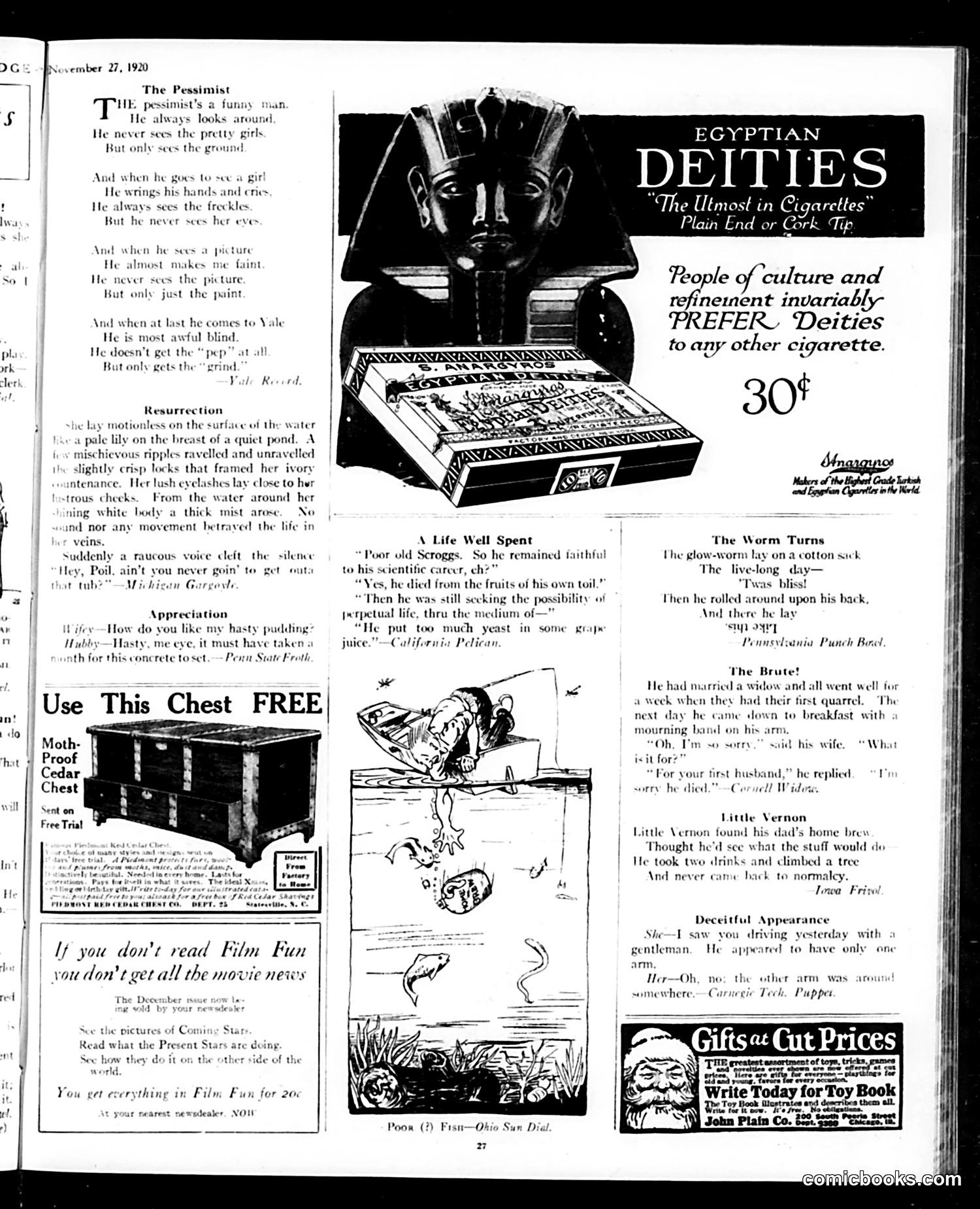
This page contains primarily **light humor and advertising** rather than political satire. The poems and jokes address domestic and social humor typical of the era: **"The Pessimist"** mocks a perpetually gloomy personality type who notices only flaws—missing beauty in girls, seeing only paint rather than artistry, and failing to appreciate Yale's social spirit ("pep"). **Short humor pieces** include marital jokes ("Appreciation," "The Brute!") playing on domestic discord and nagging wives—common period tropes. "Little Vernon" appears to joke about Prohibition-era home brewing and its consequences. The **Egyptian Deities cigarette advertisement** is the page's dominant commercial feature, using an Egyptian pharaoh bust to market cigarettes at 30¢, claiming cultured people prefer this brand. The **"Use This Chest FREE" advertisement** promotes a moth-proof cedar chest on trial. The overall tone reflects 1920s popular entertainment: domestic humor, light verse, and product promotion—not political commentary.
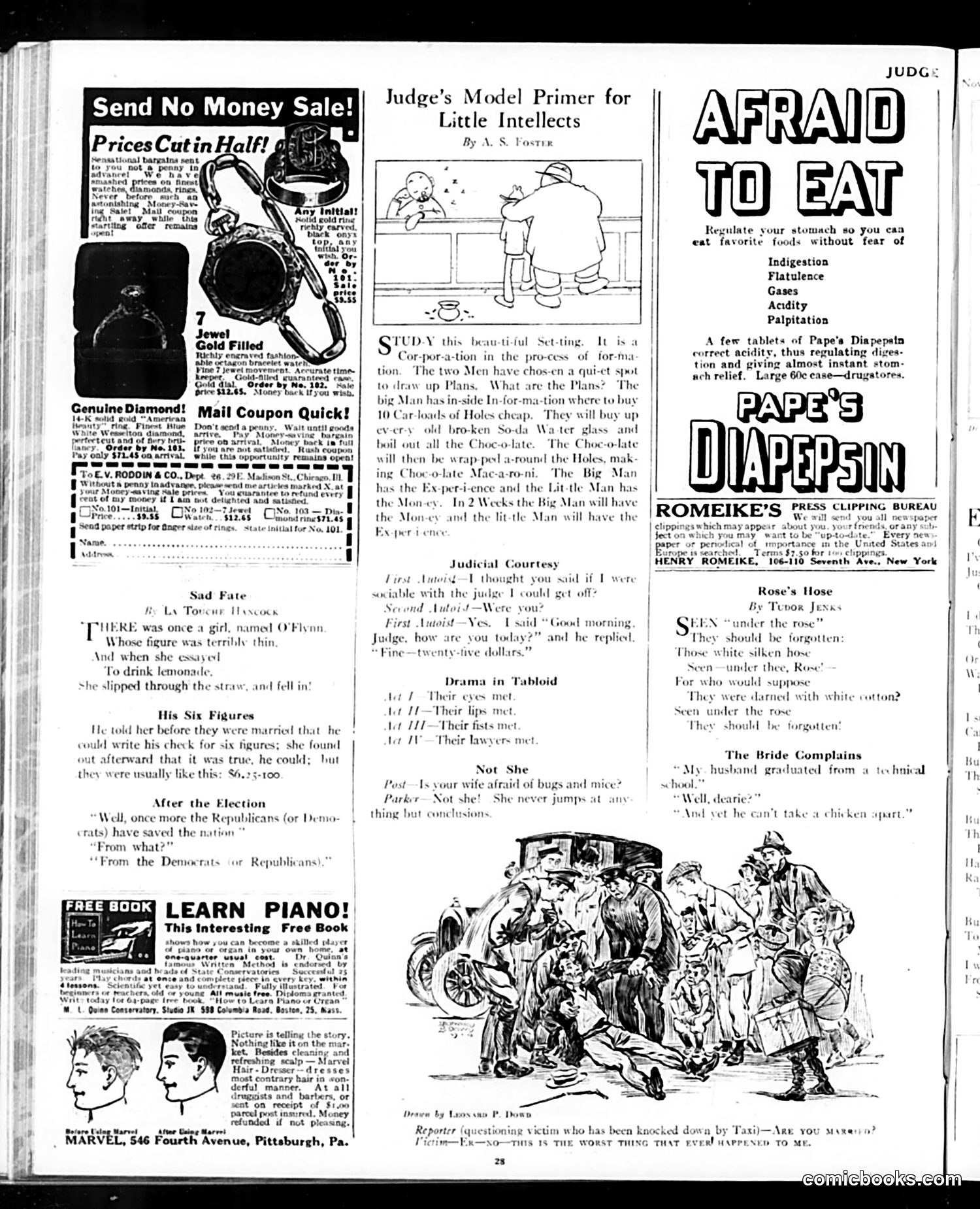
This page from *Judge* (a satirical weekly) contains multiple short humor pieces typical of early 20th-century American comedy: **"Judge's Model Primer for Little Intellects"** satirizes corporate fraud through mock-innocent language. It depicts two men creating a scheme: the "big man" with insider knowledge buys broken soda bottles cheaply, boils out chocolate residue, wraps it around the bottles as "chocolate macaroni," then profits while the naive "little man" investor loses his money and gains only "experience." The satire targets corporate corruption and exploitation dressed up as legitimate business. **Other brief jokes** mock common social situations: a thin woman falling through a straw, a man's check-writing skills being limited to small amounts, and post-election political finger-pointing between parties (suggesting both are equally worthless). **Advertisements** throughout (diamonds, piano lessons, hair treatment) are typical period marketing. The large cartoon at bottom (credited to Cesare P. Davis) appears to show a taxi accident victim, though context is unclear from the OCR text.
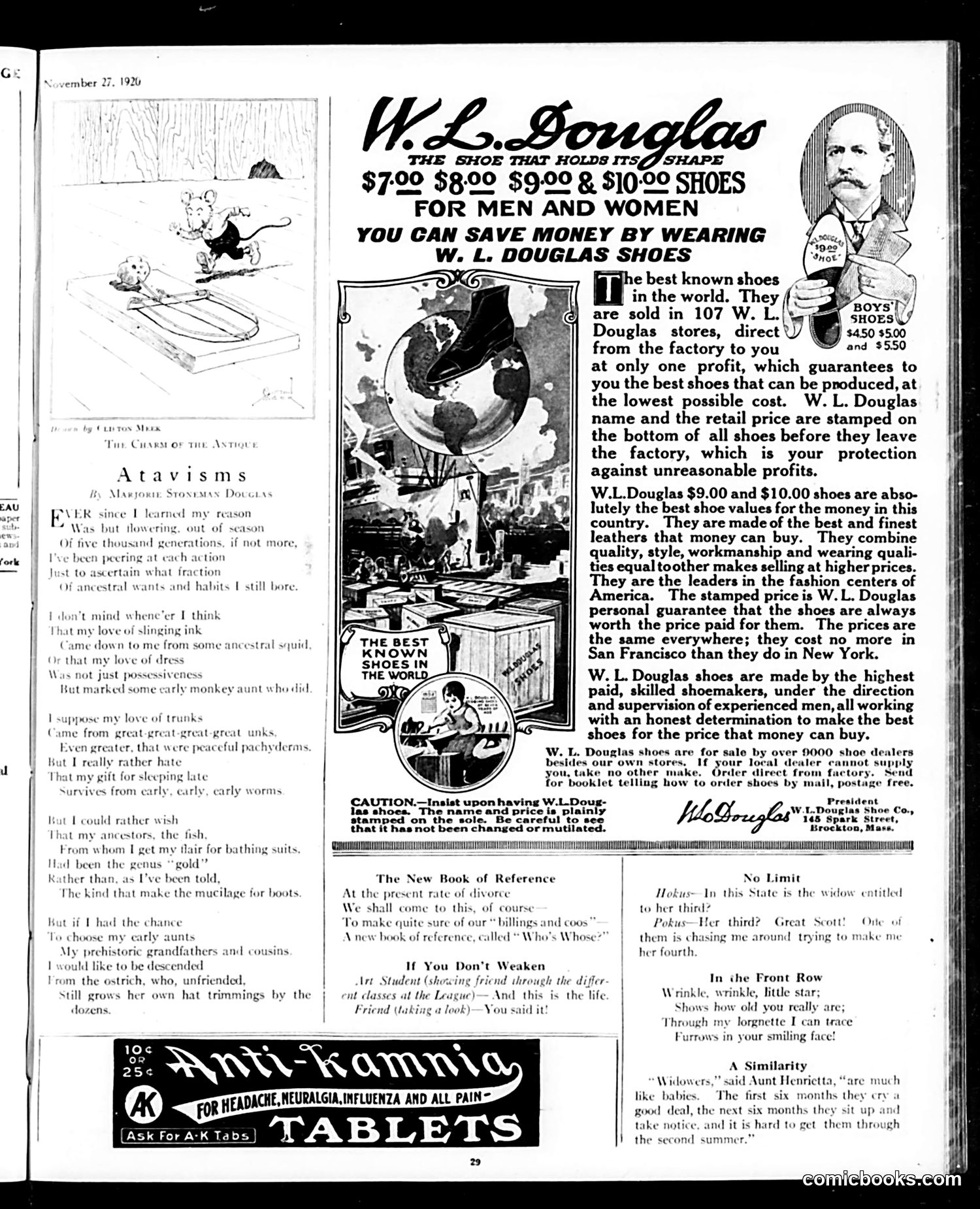
This page is primarily **advertising and filler content** rather than political satire. The dominant feature is a large **W.L. Douglas shoe advertisement** emphasizing factory-direct sales and stamped pricing as consumer protection—a selling point in an era of widespread product fraud. The left side contains a **poem titled "Atavisms"** by Marjorie Stokes Douglas, humorously exploring evolutionary ancestry. It jokes about inheriting traits from "ancestral squids," monkeys, and fish, culminating in a desire to descend from ostriches (for their natural hat feathers). This reflects 1920s popular interest in Darwinian evolution and pseudo-scientific discussions of inherited characteristics—treated here as light comedy rather than serious commentary. The bottom section includes brief **humorous snippets** about divorce rates, widow remarriage eligibility, and widowers acting like infants—typical light social humor of the period, likely poking gentle fun at changing post-WWI social customs. The **anti-Kamnia pain tablets advertisement** uses racist imagery (unclear exact nature in this reproduction) typical of early-20th-century advertising ethics. Overall: a dated advertising/humor compilation page with limited satirical content.
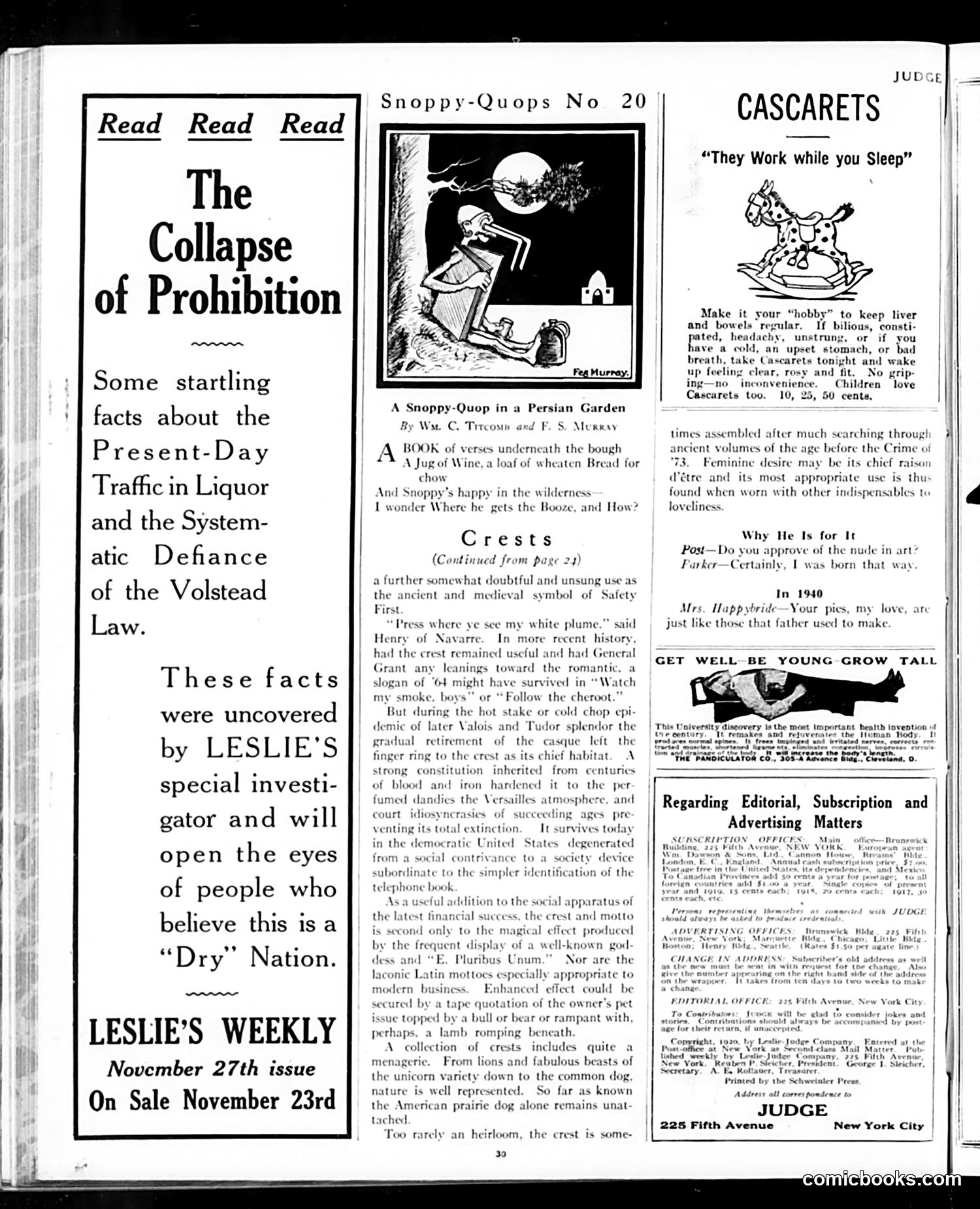
This page contains magazine promotional and advertising content rather than political satire. **Main Content:** The left side advertises Leslie's Weekly's upcoming November 27th issue, promising an exposé on Prohibition's failure—"The Collapse of Prohibition"—documenting widespread illegal liquor trafficking and defiance of the Volstead Law. This reflects genuine 1920s-era debates over Prohibition's ineffectiveness. **"Snoopy-Quoops No. 20":** A humorous poem (credited to Wu. C. Titcomb and F. S. Murray) parodies Omar Khayyam's famous verses about wine, wine, and bread in a Persian garden—but adds the joke: "And Snoppy's happy in the wilderness / I wonder Where he gets the Booze, and How?" This satirizes how Americans obtained alcohol illegally despite Prohibition. **Other Content:** The page also includes articles on heraldic crests, advertising for Cascarets laxative, and miscellaneous editorial notices—typical magazine filler material. The satire here is gentle: poking fun at Prohibition's obvious failure to prevent alcohol consumption, a timely topic during the 1920s-early 1930s.
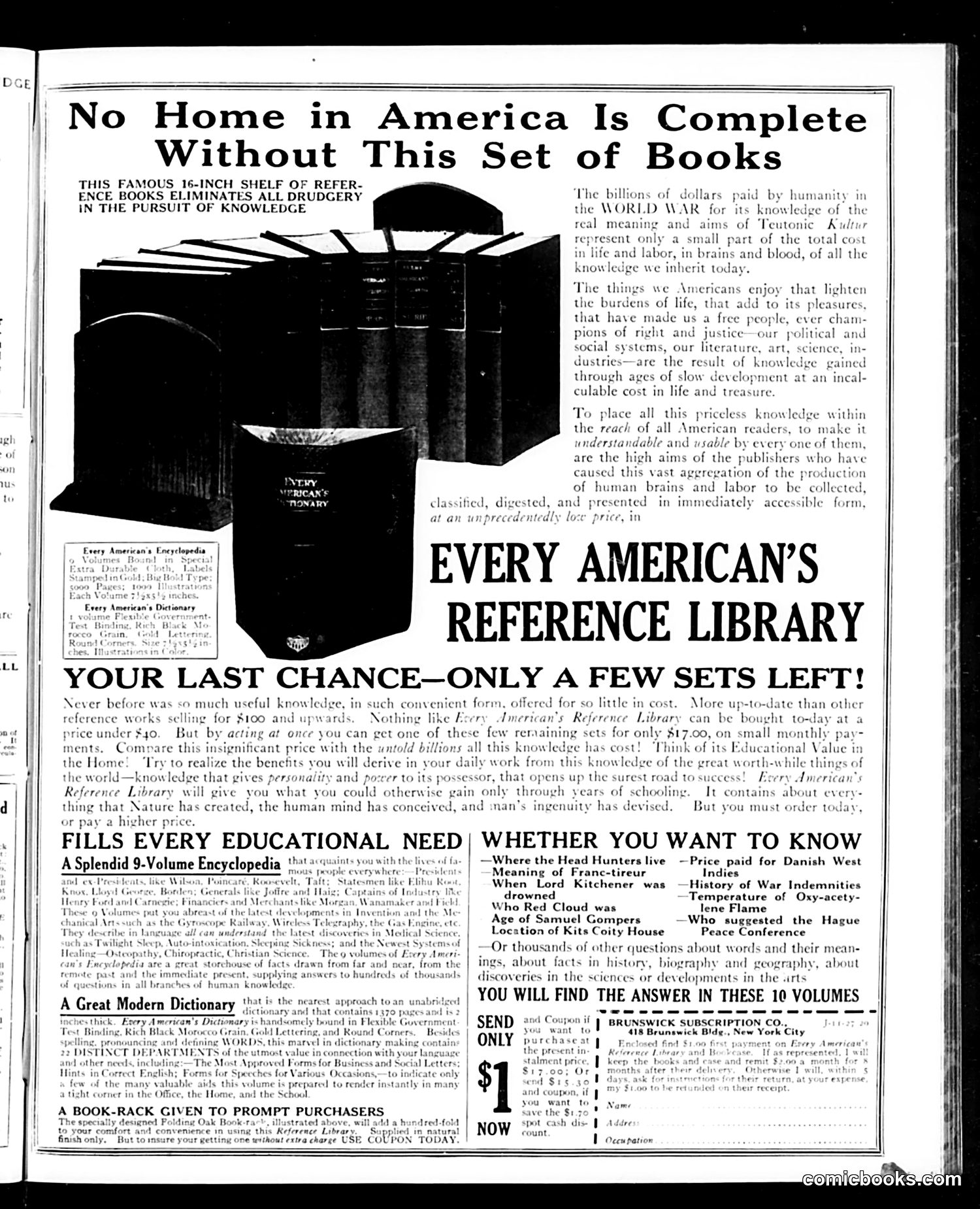
This is a **full-page advertisement**, not a political cartoon. It promotes "Every American's Reference Library," a 10-volume encyclopedia set marketed as essential for any home. The pitch appeals to post-WWI American nationalism: the text invokes sacrifice in "the WORLD WAR" and frames knowledge as the foundation of American freedom and progress. The ad claims this encyclopedia provides answers to questions about history, geography, science, and notable figures—positioning knowledge acquisition as a patriotic duty. The urgency tactic ("ONLY A FEW SETS LEFT!") and payment plan ($1 now, $17 total on monthly installments) target middle-class families. The list of sample topics—from "Head Hunters" to "Lord Kitchener" to "Samuel Gompers"—reflects early 20th-century interests in exploration, current events, and labor figures. The satire is implicit: the ad's grandiose claims that encyclopedias are civilization's foundation itself parody period advertising hyperbole. No actual satirical cartoon is present—this is sincere (if overwrought) commercial messaging typical of *Judge* magazine's revenue model.
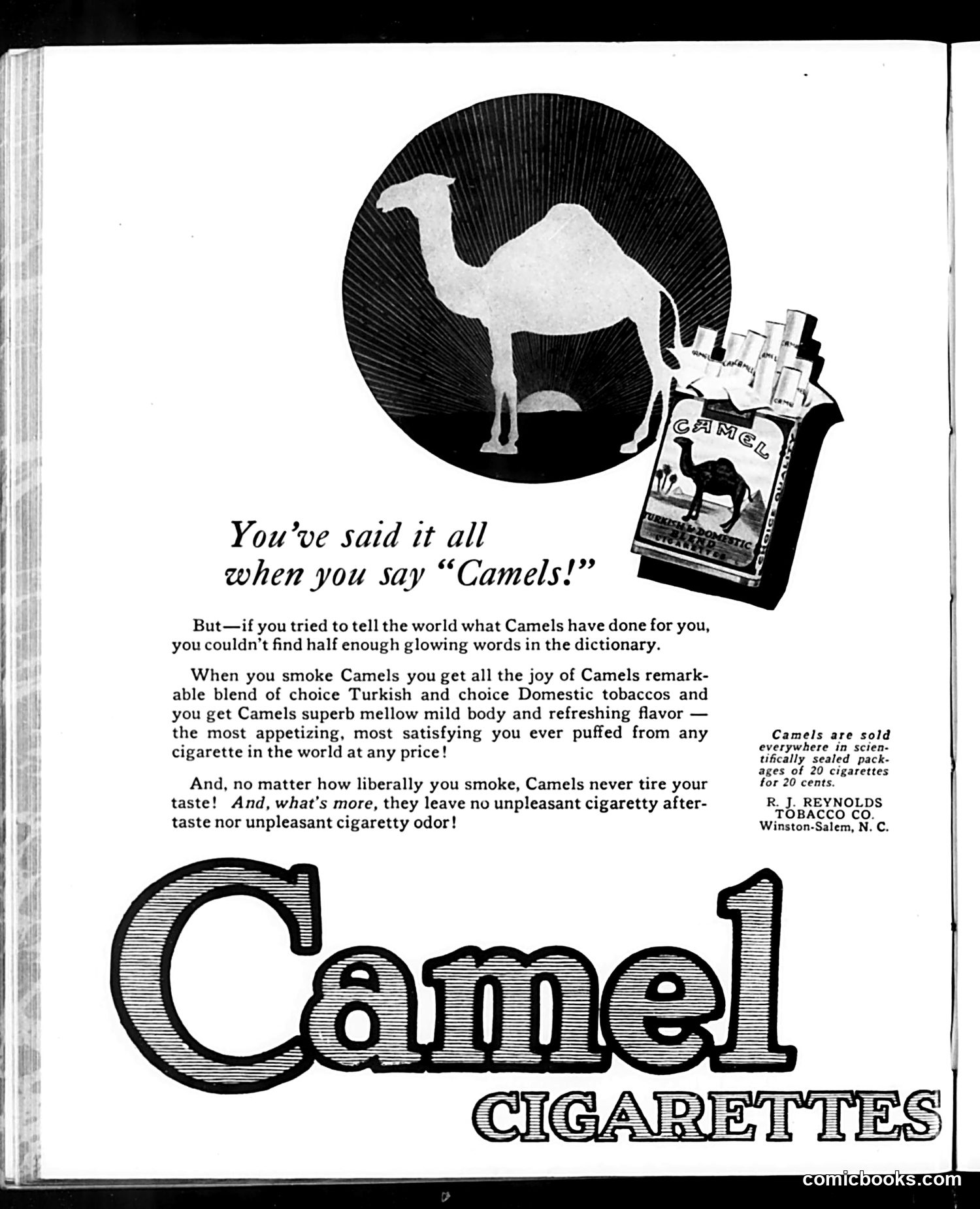
This is a **cigarette advertisement**, not satire or political commentary. It's a full-page Camel cigarettes ad from *Judge* magazine, featuring an illustration of a camel in a circular frame alongside a pack of Camels. The ad uses marketing hyperbole typical of early 20th-century tobacco advertising, making health claims modern readers would find shocking: that Camels won't tire your taste, leave no "unpleasant cigaretty" aftertaste or odor, and won't make smoking unpleasant no matter how much you smoke. The camel logo references the product's branding (Camel cigarettes were named for the exotic animal and featured a camel on their packaging). The ad emphasizes the "Turkish and choice Domestic tobaccos" blend and promotes the price point of 20 cents for 20 cigarettes, appealing to early 20th-century consumers. There is no satire intended—this is straightforward product promotion that would be illegal under modern advertising standards.