
Judge, 1920-11-27 · page 2 of 32
Judge — November 27, 1920 — page 2: what you’re looking at
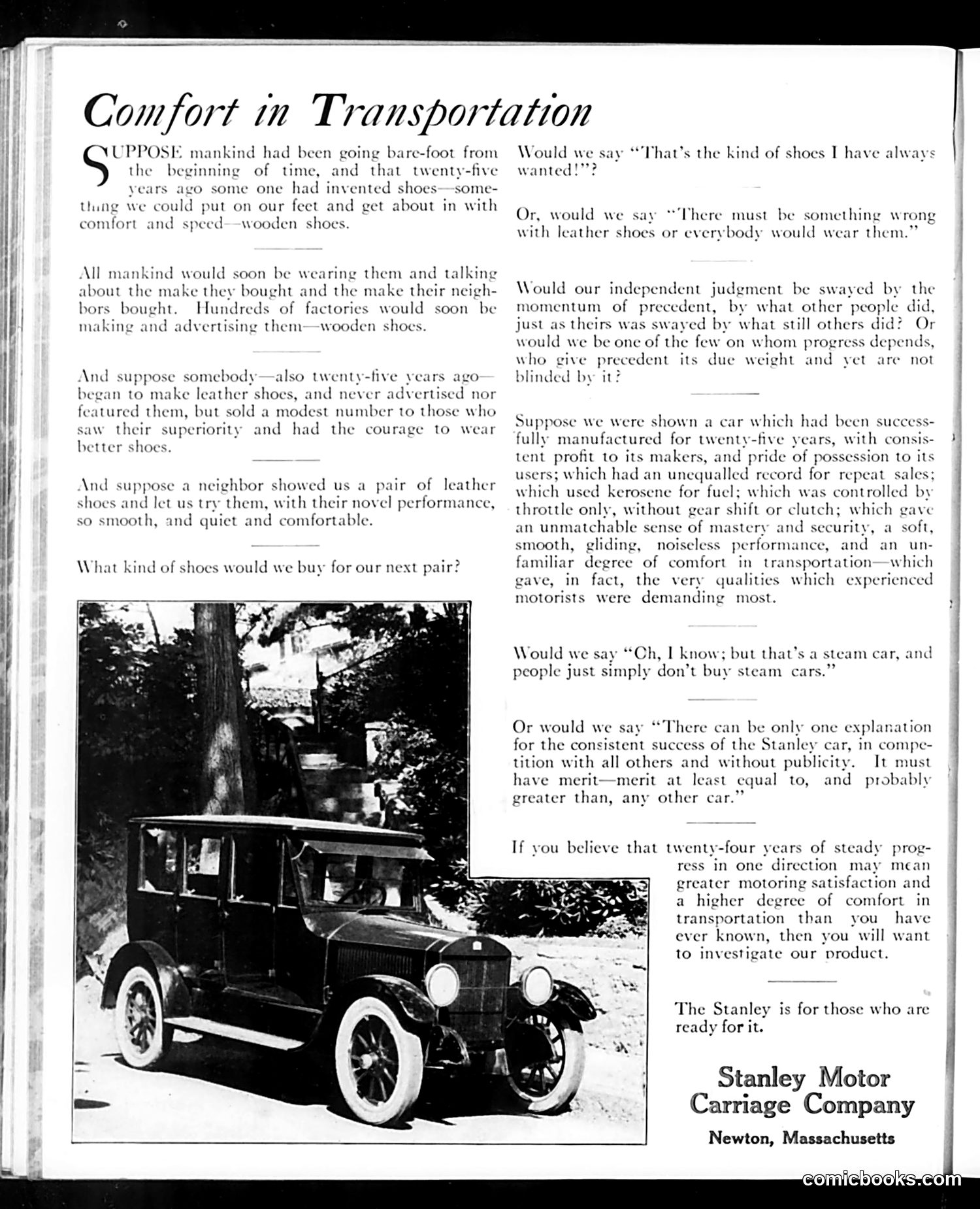
What you’re looking at
This page combines advertisement with satirical argument. The text uses an extended analogy: just as people eventually adopt superior shoes (leather over wooden), they should adopt superior cars (Stanley steamers over gasoline vehicles). The satire targets consumer behavior and herd mentality. It mocks the notion that people reject products based on merit alone—suggesting instead that precedent, peer pressure, and advertising sway purchasing decisions. The shoe example illustrates this irony: a *better* product (leather shoes) succeeds despite no advertising, while the gasoline car dominates through momentum and marketing, not necessarily superiority. The advertisement thus positions the Stanley steamer as objectively superior in comfort and performance, implying consumers' preference for gasoline cars is merely fashion-following rather than rational choice. The tone is gently satirical about American consumer culture itself.
📄 Transcribed text from this page (OCR, searchable)
Machine-transcribed from the original scan — historical spelling and the odd misread are preserved.
Comfort in Transportation the beginning of time, and that twenty-five years ago some one had invented shoes—some- thung we could put on our feet and get about in with wooden shoes. ‘eis PPOSE mankind had been going bare-foot from comfort and speed All mankind would soon be wearing them and talking about the make they bought and the make their neigh- Hundreds of factories would soon be wooden shoes. bors bought. making and advertising them And suppose somebody—also twenty-five years ago began to make leather shoes, and never advertised nor featured them, but sold a modest number to those who saw their superiority and had the courage to wear better shoes. And suppose a neighbor showed us a pair of leather shoes and let us try them, with their novel performance, so smooth, and quict and comfortable. What kind of shoes would we buy for our next pair? Would we Vhat’s the kind of shoes I have always wanted!""? Or, would we say “There must be something wrong with leather shoes or everybody would wear them.” Would our independent judgment be swayed by the momentum of precedent, by what other people did, just as theirs was swayed by what still others did? Or would we be one of the few on whom progress depends, who give precedent its due weight and yet are not blinded by it? Suppose we were shown a car which had been success- fully manufactured for twenty-five years, with consis- tent profit to its makers, and pride of possession to its users; Which had an unequalled record for repeat sales; which used kerosene for fuel; which was controlled by throttle only, without gear shift or clutch; which gave an unmatchable sense of mastery and security, a soft, smooth, gliding, noiseless performance, and an un- familiar degree of comfort in’ transportation—which gave, in fact, the very qualities which experienced motorists were demanding most. Would we say “Ch, I know; but that’s a steam car, and people just simply don’t buy steam cars.” Or would we say “There can be only one explanation for the consistent success of the Stanley car, in compe- tition with all others and without publicity. It must have merit—merit at least equal to, and probably ater than, any other car.” that twenty-four years of steady prog- ress in one direction may mean greater motoring satisfaction and a higher degree of comfort in transportation than you have ever known, then you will want to investigate our product. If vou believ The Stanley is for those who are ready for it. Stanley Motor Carriage Company Newton, Massachusetts