
Judge, 1920-11-27 · page 10 of 32
Judge — November 27, 1920 — page 10: what you’re looking at
What you’re looking at
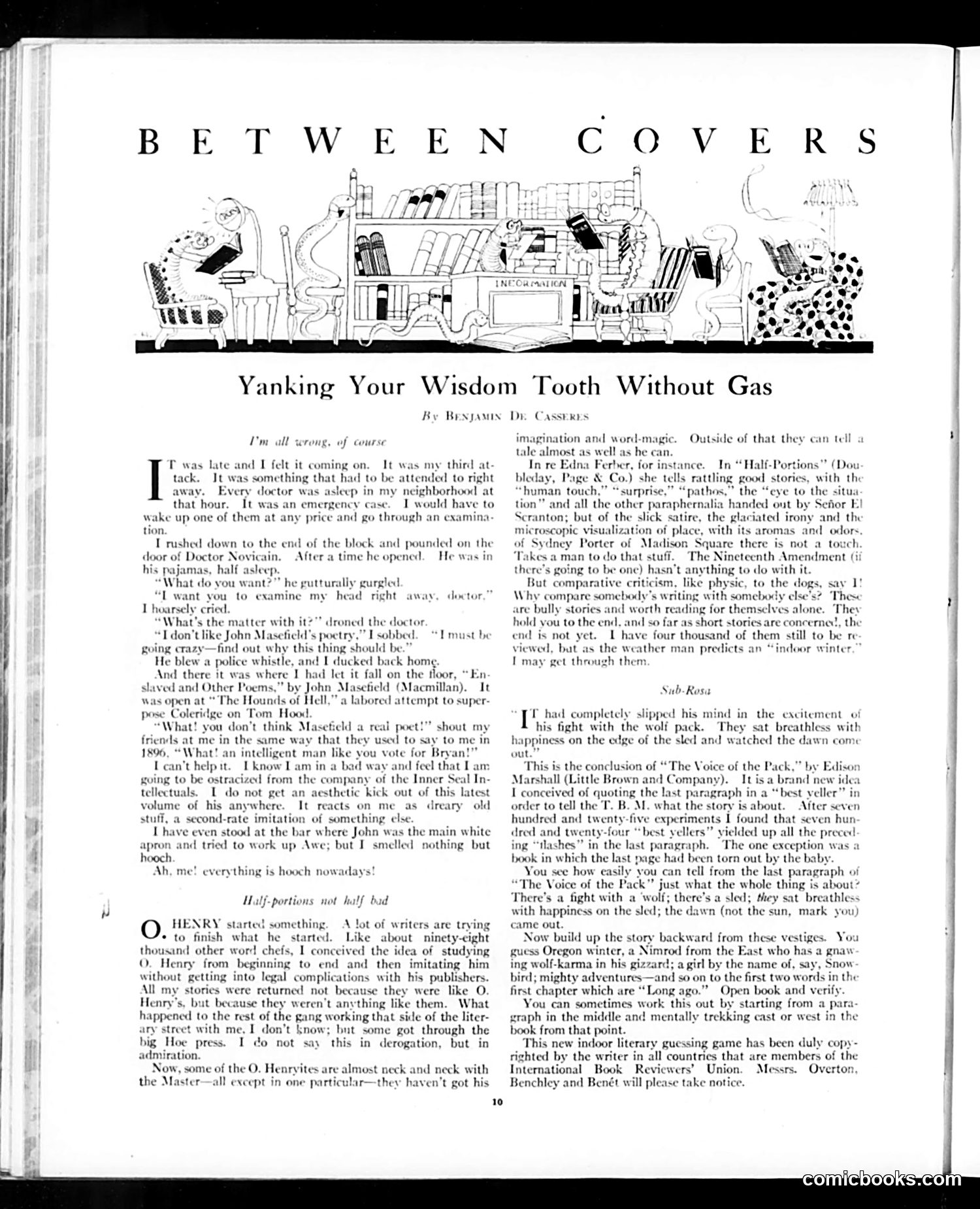
This page from *Judge* magazine contains two literary satire pieces. The main article, "Yanking Your Wisdom Tooth Without Gas," is Benjamin De Casseres critiquing poet John Masefield's recent work. De Casseres admits he dislikes Masefield's poetry (specifically "Enslaved and Other Poems"), which he views as derivative imitation—laboring to combine Coleridge with Tom Hood. He acknowledges this opinion isolates him from intellectuals who revere Masefield, comparing it to 1890s criticism of William Jennings Bryan supporters. The second section discusses O. Henry imitators and praises Edna Ferber's short story collection "Half-Portions," noting her work succeeds where other O. Henry-style writers fail—she possesses genuine storytelling skill despite lacking O. Henry's distinctive "imagination and word-magic." The satire targets literary trends and the difficulty of authentic imitation versus genuine talent. The cartoon header depicts a chaotic library/study scene, visually reinforcing the theme of literary chaos and competing voices.
📄 Transcribed text from this page (OCR, searchable)
Machine-transcribed from the original scan — historical spelling and the odd misread are preserved.
vw Yanking Your Wisdom Tooth Without Gas By Bexyawixn Di Casserrs I'm all wrong, of course T was late and I felt it coming on. It was my third at tack. Jt was something that had to be attended to right away. Every doctor was asleep in my neighborhood at that hour. It was an emergency case. I would have to wake up one of them at any price and go through an examina tion. T rushed down to the end of the block and pounded on the door of Doctor Novicain. After a time he opened. He was in his pajamas, half asleep “What do you want?” he gutturally gurgled. “L want you to examine my head right: away, doc I hoarsely cried “What's the matter with it?" droned the doctor. “I don’t like John Maseficld’s poetry,” I sobbed.“ Emust bx g crazy—find out why this thing should be.” He blew a police whistle, and I ducked back home. And there it was where I had let it fall on the floor, “En slaved and Other Poems,” by John Masefield (Macmillan). It was open at “The Hounds of Hell,” labored attempt to super. pose Coleridge on Tom Hood. “What! you don’t think Maseticld a real poet!’ shout my friends at me in the same way that they used to say to me in 1896, “What! an intelligent man like you vote for Bryan!” I can’t helpit. [know I am in a bad way and feel that I am going to be ostracized from the company the Inner Seal In- tellectuals. I do not get an aesthetic kick out of this latest volume of his anywhere. It reacts on me as dreary old stuff, a second-rate imitation of something else. I have even stood at the bar where John was the main white apron and tried to work up Awe; but I smelled nothing but hooch, Ah, me! everything is hooch nowadays! Halj-portions not half bad Oo HENRY started something. A fot of writers are trying to finish what he started. Like about ninety-cight thousind other word chefs, 1 conceived the idea of studying ©. Henry from beginning to end and then imitating him without getting into legal complications with his publishers. All my stories were returned not because they were like O. Henry's, but because they weren't anything like them. What happened to the rest of the gang working that side of the liter- ary street with me, I don’t know; but some got through the big Hoe press. I do not say this in derogation, but in admiration Now, some of the O. Henryites are almost neck and neck with the Master—all except in one particular—thev haven't got his imagination and word-magic. Outside of that they can tell a tale almost as well as he can. In re Edna Ferber, for instan In “Half-Portions” (Dou bleday, Page & Co.) she tells rattlin nod stories, with th “human touch,” “surpris pathos,” the “eye to the situa and all the other paraphernalia handed out by Scfor El but of the slick satire, the glaciated irony and the microscopic visua place, with its aromas and odors of Sydney Porter of ison Square there is not a touch ‘Takes a man to do that stuff. The Nineteenth Amendment (i there's going to be one) hasn't any do with it. But comparative criticism, like physic, to the dogs, say I! Why compare somebody’s writing with somebod: The« are bully stories and worth reading for themselv: hey hold you to the end, and so far as short stories are concerned, the end is not yet. I have four thousand of them still to be re viewed, bat as the weather man predicts an “indoor winter I may get through them tion Scrantor Sub-Rosa [' had completely slipped his mind in the excitement © his fight with the wolf pack. They sat breathless with happiness on the edge of the sled and watched the dawn come This is the conclusion of “The Voice of the Pack,” by Ediso: Marshall (Little Brown and Company). _ It is a brand new idea I conceived of quoting the last paragraph in a “best yeller” in order to tell the T. B. M. what the story is about. After seven hundred and twenty-five experiments I found that seven hun. dred and twenty-four “best yellers” yielded up all the prece: ing “lashes” in the last paragraph. “The one exception was book in which the last page had been torn out by the baby. You see how easily you can tell from the last paragraph of he Voice of the Pack” just what the whole thing is abou There’s a fight with a ‘wolf; there’s a sled; Mey sat breathless with happiness on the sled; the dawn (not the sun, mark you) came out ‘ow build up the story backward from these vestiges. Y guess Oregon winter, a Nimrod from the East who has a gnaw ing wolf-karma in his gizzard; a girl by the name of, say, Snow bird; mighty adventures—and so on to the first two words in the first chapter which are “Long ago.” Open book and verify You sometimes work this out by starting from a para graph in the middle and mentally trekking cast or west in the book from that point. This new indoor literary guessing game has been duly copy- righted by the writer in all countrics that are members of the International Book Reviewers’ Union. Messrs. Overton: Benchley and Benét will please take notice.