
Judge, 1920-11-27 · page 20 of 32
Judge — November 27, 1920 — page 20: what you’re looking at
What you’re looking at
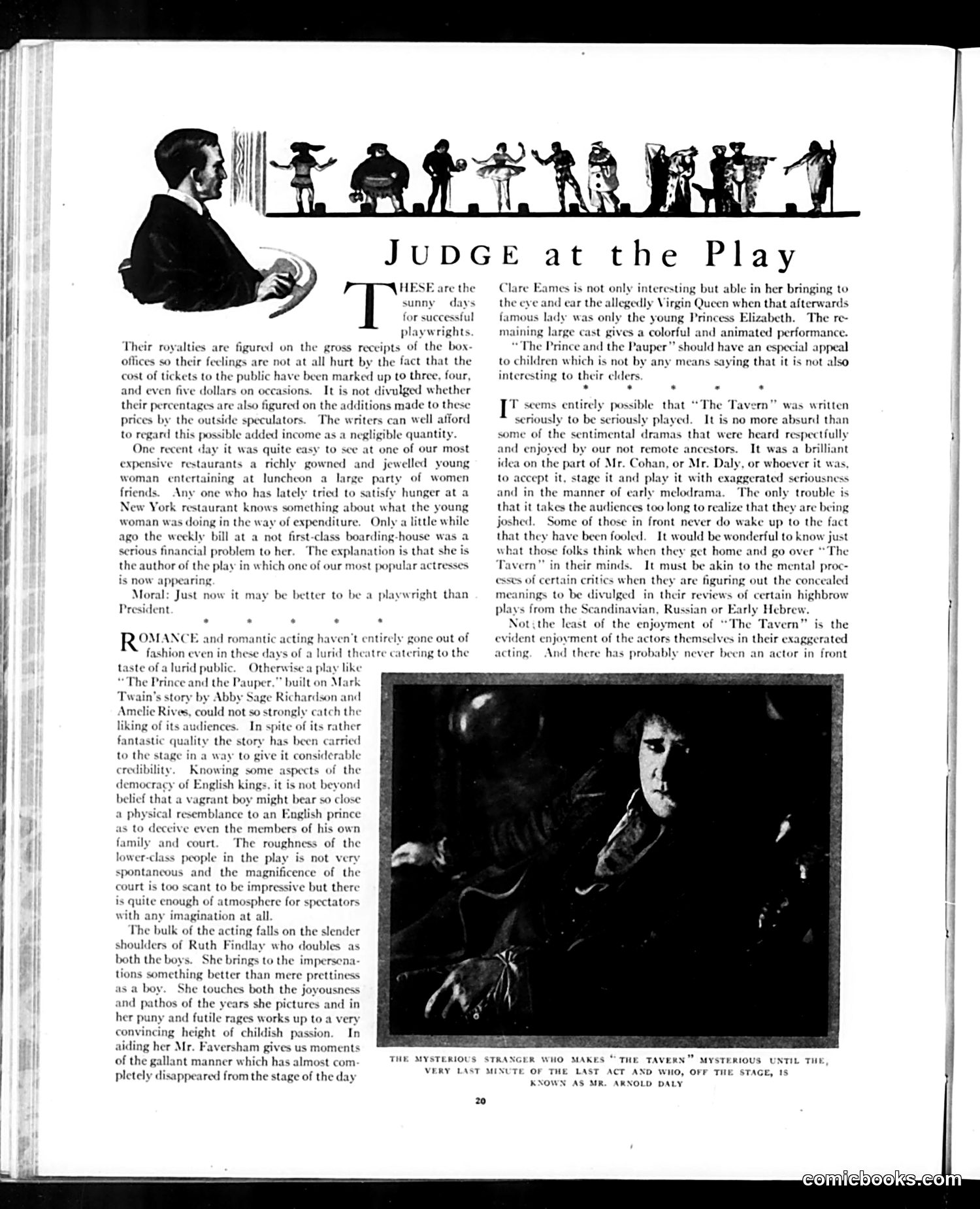
This page presents theater criticism from Judge magazine's drama section. The left sidebar shows a silhouetted man (the "judge" evaluating plays) observing theatrical figures. The critic discusses three productions: 1. **"The Prince and the Pauper"** — Adapted from Mark Twain's novel, praised for romantic appeal despite theatrical limitations. Ruth Findlay performs both title roles convincingly. 2. **"The Tavern"** — A melodrama the critic suggests *may* have been written seriously but is now performed with exaggerated seriousness, creating unintentional comedy. Some audience members don't realize they're being "joshed" (mocked). The opening moral satirizes playwrights' sudden wealth: a once-poor woman now entertains lavishly at expensive restaurants thanks to royalties from a successful play — implying it's currently better to be a successful playwright than President. The image shows "the mysterious stranger" character from "The Tavern," played by Arnold Daly, whose identity is revealed only in the final act.
📄 Transcribed text from this page (OCR, searchable)
Machine-transcribed from the original scan — historical spelling and the odd misread are preserved.
JUDG HESE are the sunny = days or successful playwrights. Their royalties are figured on the gross receipts of the box offices so their feelings are not at all hurt by the fact that the cost of tickets to the public have been marked up to three, four, and even five dollars on occasions. It is not divulged whether their percentages are also figured on the additions made to these prices by the outside speculators. The writers can well afford to regard this possible added income as a negligible quantity. One recent day it was quite easy to see at one of our most expensive restaurants a richly gowned and jewelled young woman entertaining at luncheon a large party of women friends. Any one who has lately tried to satisfy hunger at a w York restaurant knows something about what the young woman was doing in the way of expenditure. Only a little while ago the weekly bill at a not first-class boarding-house was a serious financial problem to her. The explanation is that she is the author of the play in which one of our most popular actresses is now appear Moral: Just now it may be better to be a playwright than President OMANCE and romantic acting haven't entirely gone out of ashion even in these days of a lurid theatre catering to the taste of a lurid public. Otherwise a play like The Prince and the Pauper,” built on Mark Twain's story by Abby Sage Richardson and Amelie Rives, could not so strongly catch the liking of its audiences. In 5 of its rather fantastic quality the story has been carried to the stage in a way to give it considerable credibility. Knowing some aspects of the democracy of English kings. it is not beyond belief that a vagrant boy might bear so close a physical resemblance to an English prince as to deceive even the members of his own family and court. The roughness of the lower-class people in the play is not very spontancous and the magnificence of the court is too scant to be impressive but there is quite enough of atmosphere with any imagination at all. The bulk of the acting falls on the slender shoulders of Ruth Findlay who doubles as both the boys. She brings to the impersena tions something better than mere prettiness 1s a boy. She touches both the joyousness and pathos of the years she pictures and in her puny and futile rages works up to a very convincing height of childish passion. In aiding her Mr. Faversham gives us moments of the gallant manner which has almost com pletely disappeared from the stage of the day r spectators THE MYSTERIOUS 20 E at the Play Clare Eames is not only interesting but able in her bringing to the eye and ear the allegedly Virgin Queen when that afterwards famous lady was only the young Princess Elizabeth. The re- colorful and animated performance. uper” should have an especial appeal ny means saying that it is not also maining large cast gives a ‘The Prince and the to children which is not b interesting to their elders. T seems entirely possible that “The Tavern” was written seriously to be seriously played. It is no more absurd than some of the sentimental dramas that were heard respectfully and enjoyed by our not remote ancestors. It was a brilliant idea on the part of Mr. Cohan, or Mr. Daly, or whoever it was, to accept it, stage it and play it with exaggerated seriousness and in the manner of early melodrama. The only trouble is that it takes the audiences too long to realize that they are being joshed. Some of those in front never do wake up to the fact that they have been fooled. It would be wonderful to know just what those folks think when they get home and go over “The Favern” in their minds. It must be akin to the mental proc- esses of certain critics when they are figuring out the concealed meanings to be divulged in their reviews of certain highbrow plays from the Scandinavian, Russian or Early Hebrew. Not,the least of the enjoyment of “The Tavern” is the evident enjoyment of the actors themselves in their exaggerated acting. And there has probably never been an actor in front STRANGER WHO MAKES “THE TAVERN” MYSTERIOUS UNTIL THE VERY LAST MINE © OF THE LAST ACT AND WHO, OFF THE STAGE, 1S KNOWN AS MR. ARNOLD DALY ] ]