
A complete issue · 36 pages · 1918
Judge — June 15, 1918
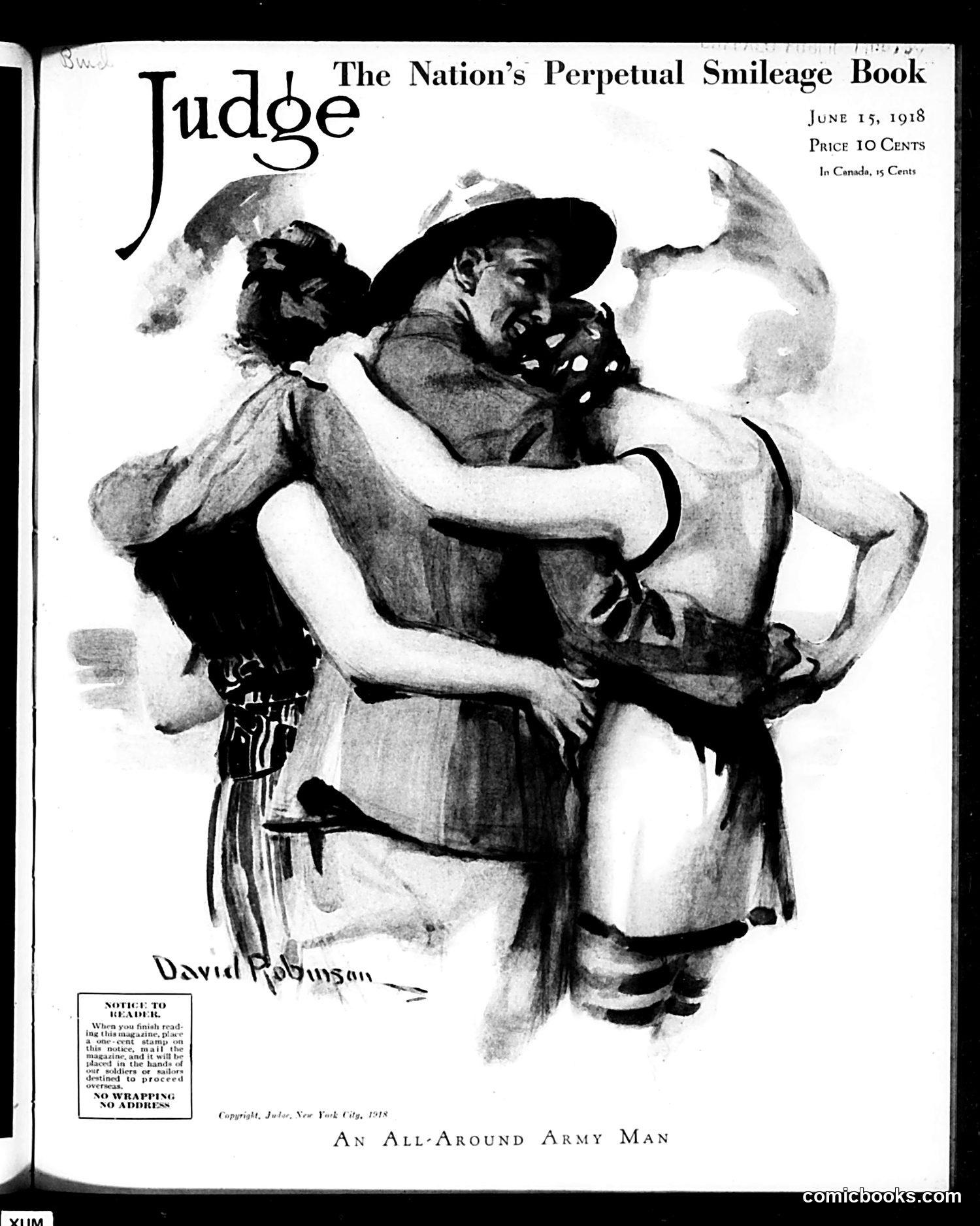
This Judge magazine cover from June 15, 1918 depicts a soldier being embraced by three women, illustrated by David Robinson. The title suggests satirical commentary on military life during World War I. The cartoon likely jokes about soldiers' romantic popularity—a common theme in WWI-era humor. The soldier, laden with military gear and appearing somewhat overwhelmed by the attention, represents the idealized "army man" receiving admiration from civilians (the women appear to represent different social classes or types, suggested by their varied dress). The satire probably comments on either soldiers' status as heroes worthy of attention, or conversely, the somewhat absurd or inconvenient nature of such public adulation during wartime. The "all-around" designation suggests he's considered desirable or worthy of universal approval.
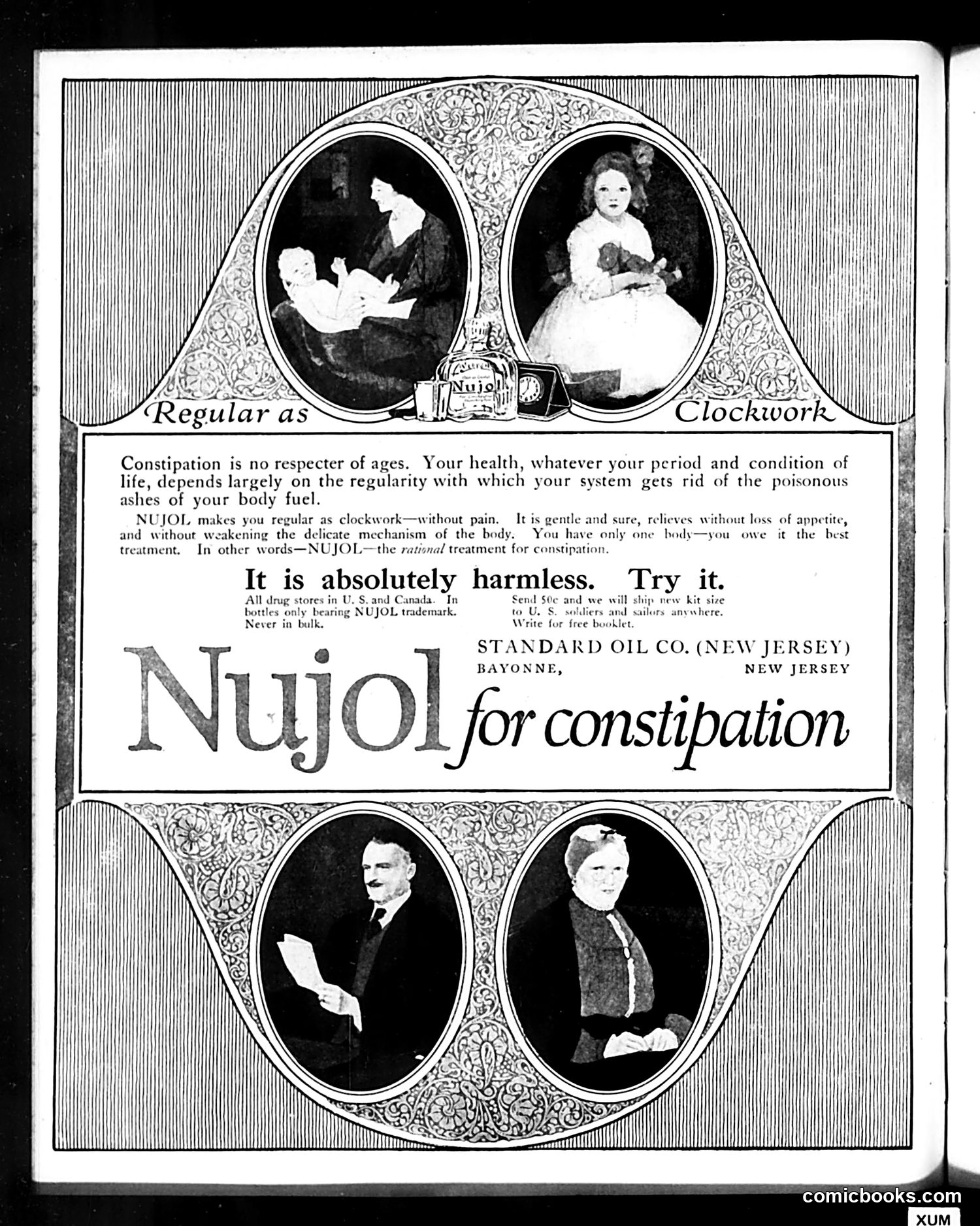
This is primarily a **product advertisement**, not political satire. It promotes "Nujol," a mineral oil laxative made by Standard Oil Company (New Jersey), for treating constipation. The ad uses four portrait photographs of unnamed individuals (two women at top, a man and woman at bottom) positioned as testimonials—a common advertising technique of the era. The text emphasizes that Nujol is "absolutely harmless" and works "like clockwork" (hence the title "Regular as Clockwork"), positioning it as a gentle, reliable remedy for constipation across all ages and conditions. The framing language about "poisonous ashes" of body fuel reflects early-20th-century medical beliefs about bowel regularity's importance to overall health. This appears to be a standard commercial advertisement rather than editorial cartoon content.
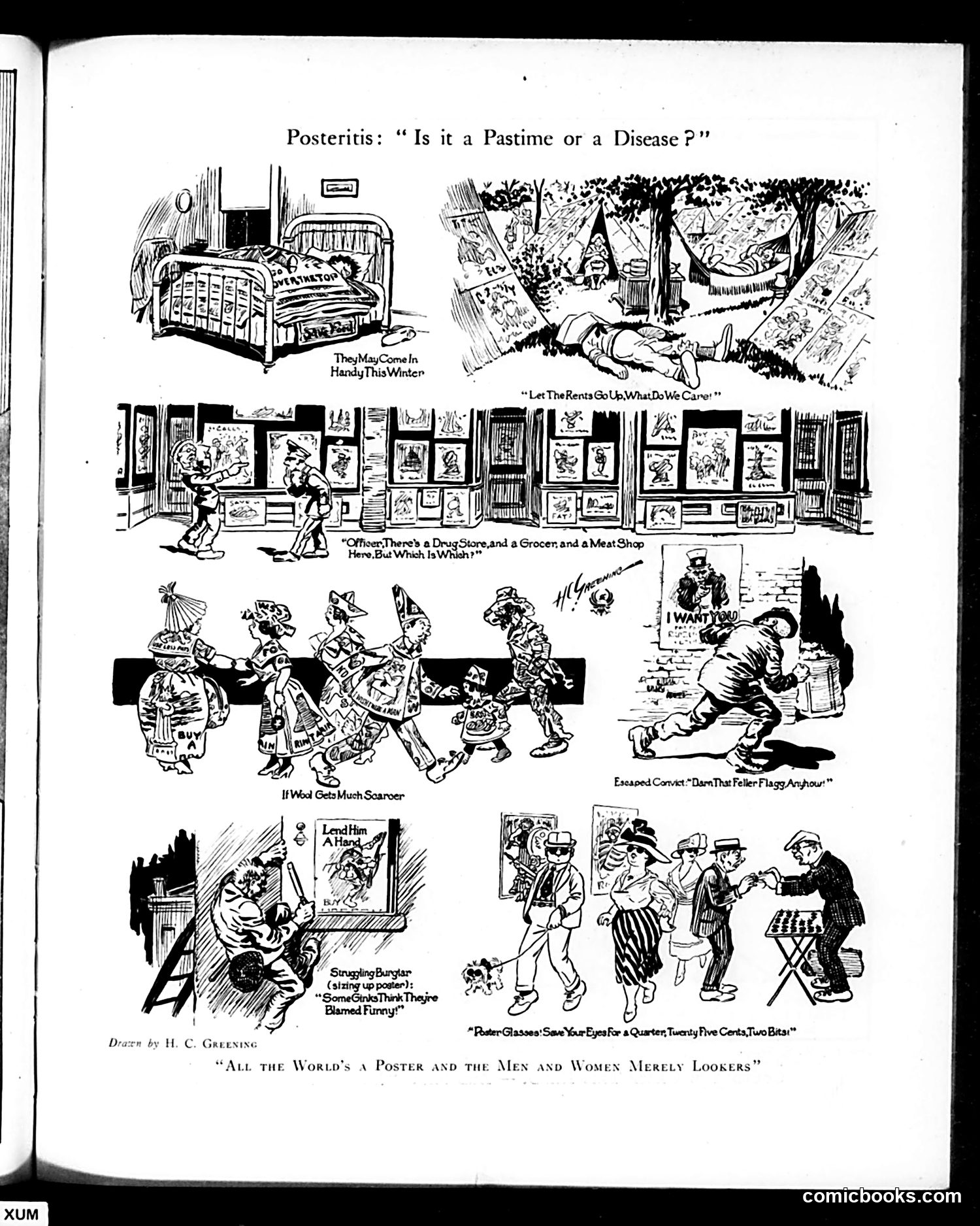
This satirical page by H.C. Greening mocks an apparent early 20th-century obsession with poster collecting and display. The cartoons depict the craze as compulsive behavior: a sickbed patient surrounded by posters, outdoor campers covered in poster advertisements, people spending rent money on posters instead of necessities, and a burglar stealing posters rather than valuables. The satire suggests poster collecting had become an excessive cultural phenomenon—people were so enamored with decorative posters (likely advertising and artistic prints that were popular at the time) that it consumed their finances and attention. The title's question—whether this is a hobby or illness—implies the collecting habit had reached pathological proportions among the general public.
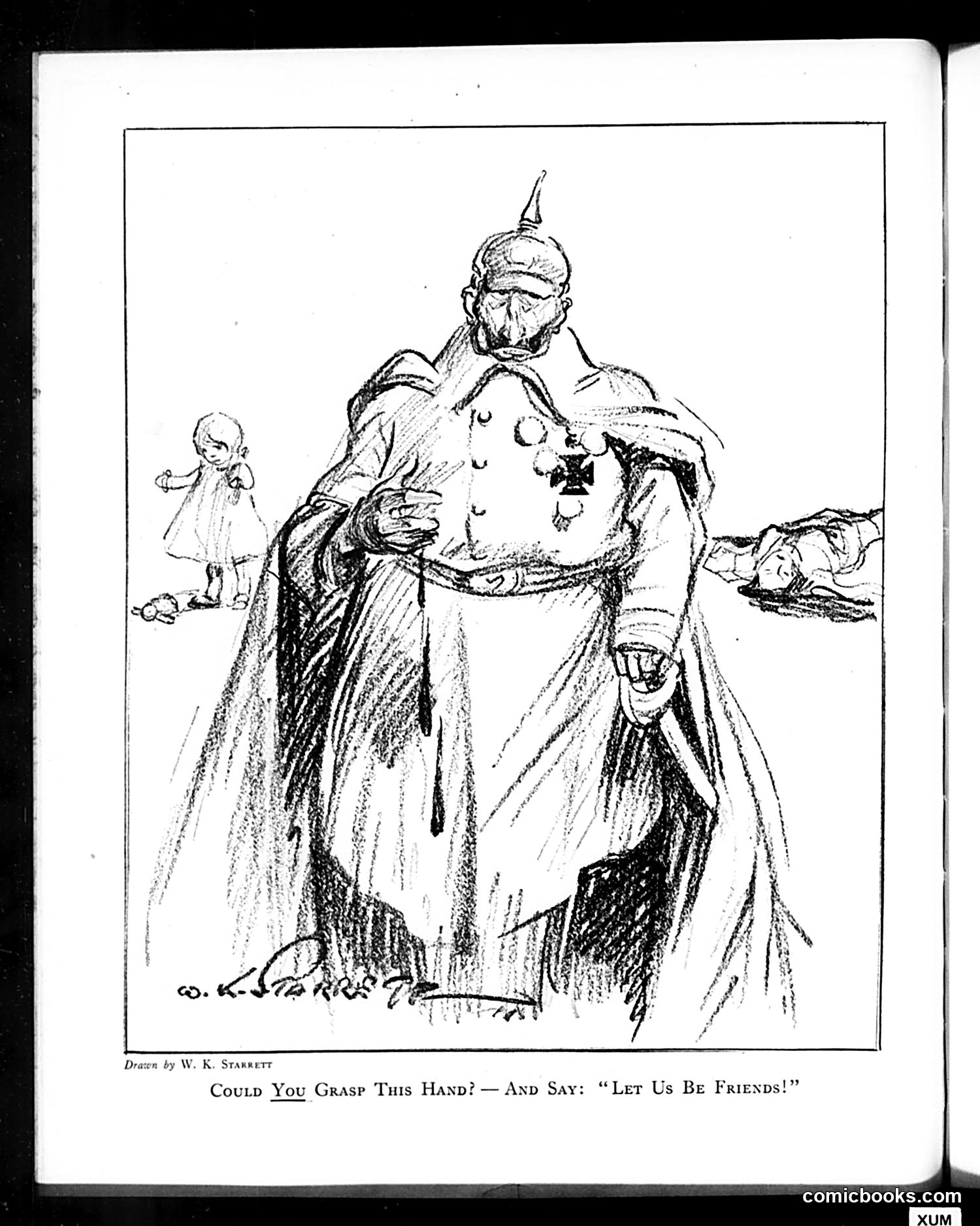
This W.K. Starrett cartoon from *Judge* magazine depicts a large German military officer (identifiable by the spiked Prussian helmet) extending his hand in friendship to a small child, while a dead body lies in the background. The caption reads: "Could You Grasp This Hand? — And Say: 'Let Us Be Friends!'" This is anti-German propaganda, likely from World War I, satirizing German peace overtures as hypocritical. The cartoon contrasts Germany's call for friendship with the violence it has committed (represented by the corpse and the militaristic figure). The small child represents innocence or perhaps neutral nations, emphasizing the moral contradiction of asking for friendship after causing destruction. The image critiques German military aggression masked by diplomatic gestures.
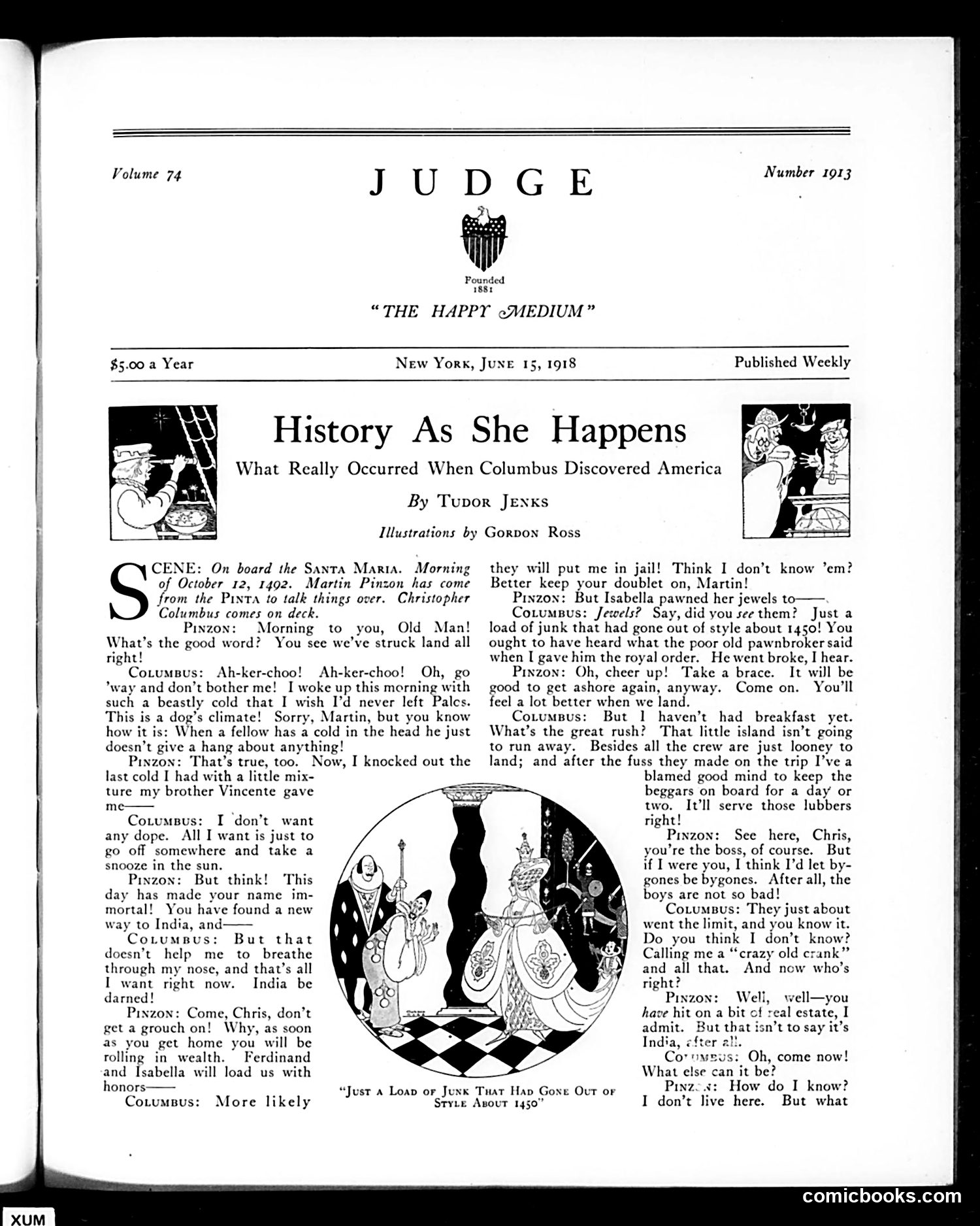
This Judge magazine piece satirizes Columbus's 1492 voyage through a dialogue between Columbus and Pinzon (likely Martín Alonso Pinzón, captain of the *Pinta*). The humor centers on anachronistic complaints: Columbus grumbles about cold weather and seasickness while Pinzon boasts about newfound wealth and titles. The central illustration shows a ship's hold filled with goods, captioned "Just a Load of Junk That Has Gone Out of Style About 1430." The satire mocks how Columbus's voyage—celebrated as a grand historical achievement—was actually driven by mundane commercial motives and personal gain rather than noble discovery. The contemporary (1918) audience would recognize this as deflating romanticism about historical "great men" through comic realism.
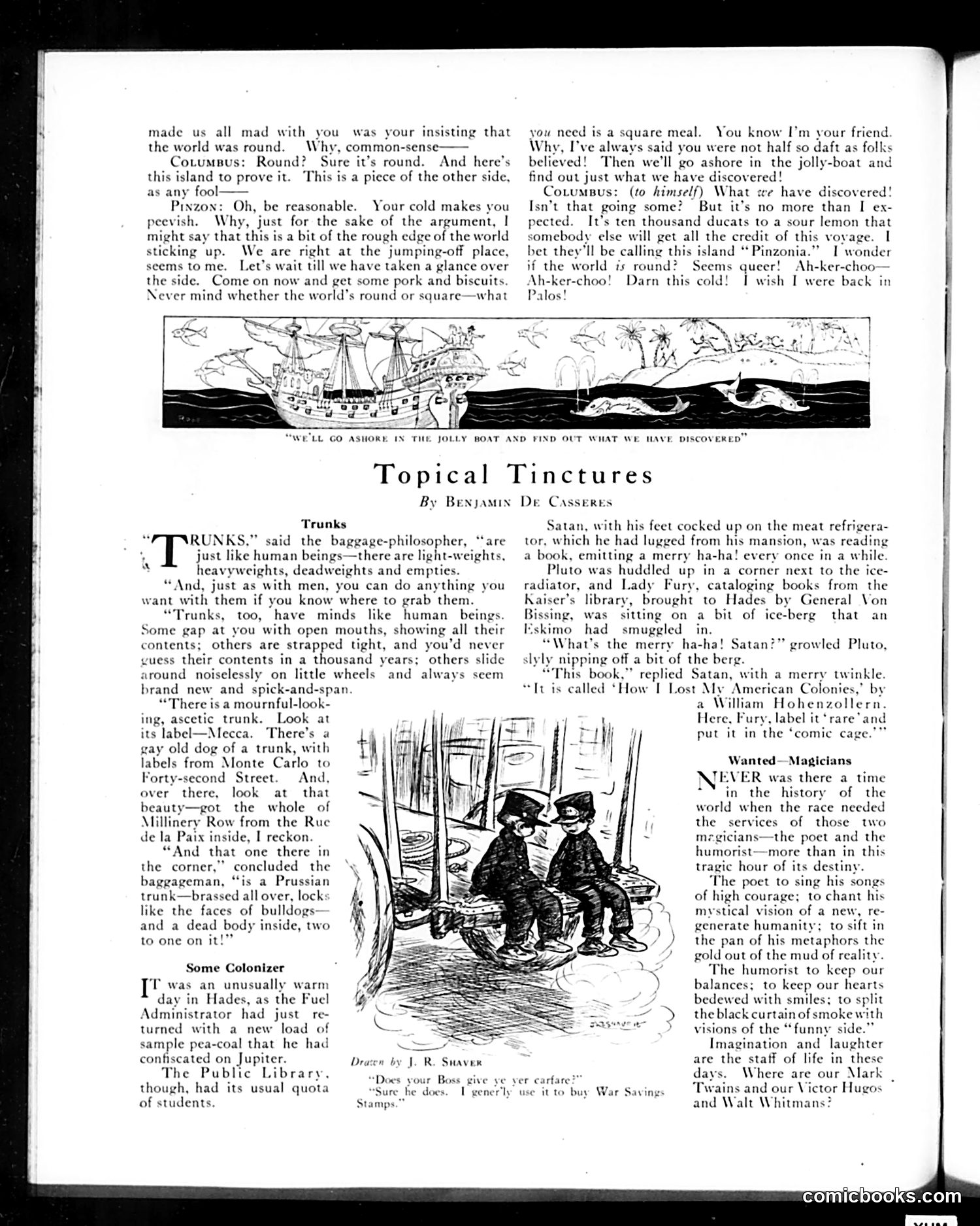
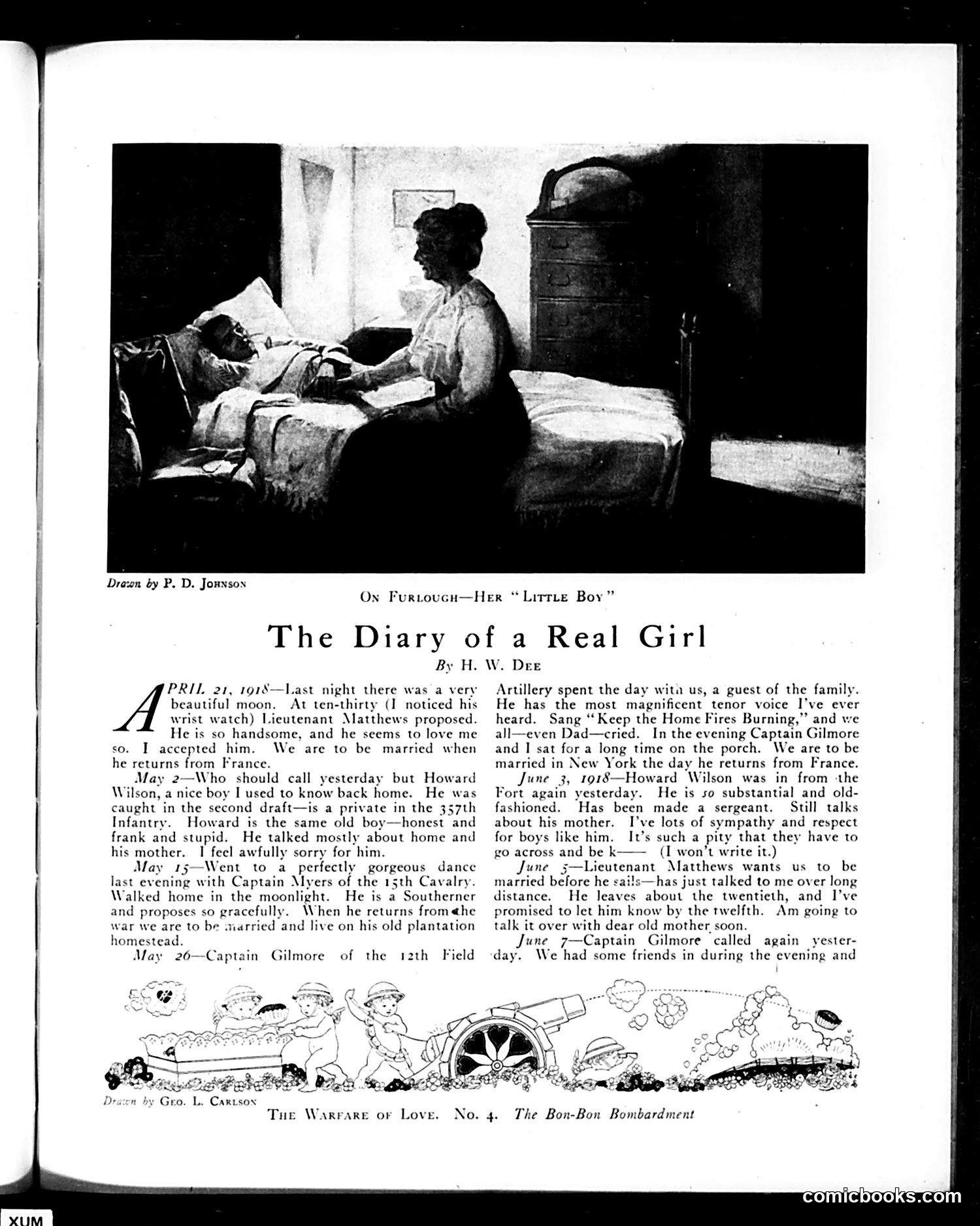
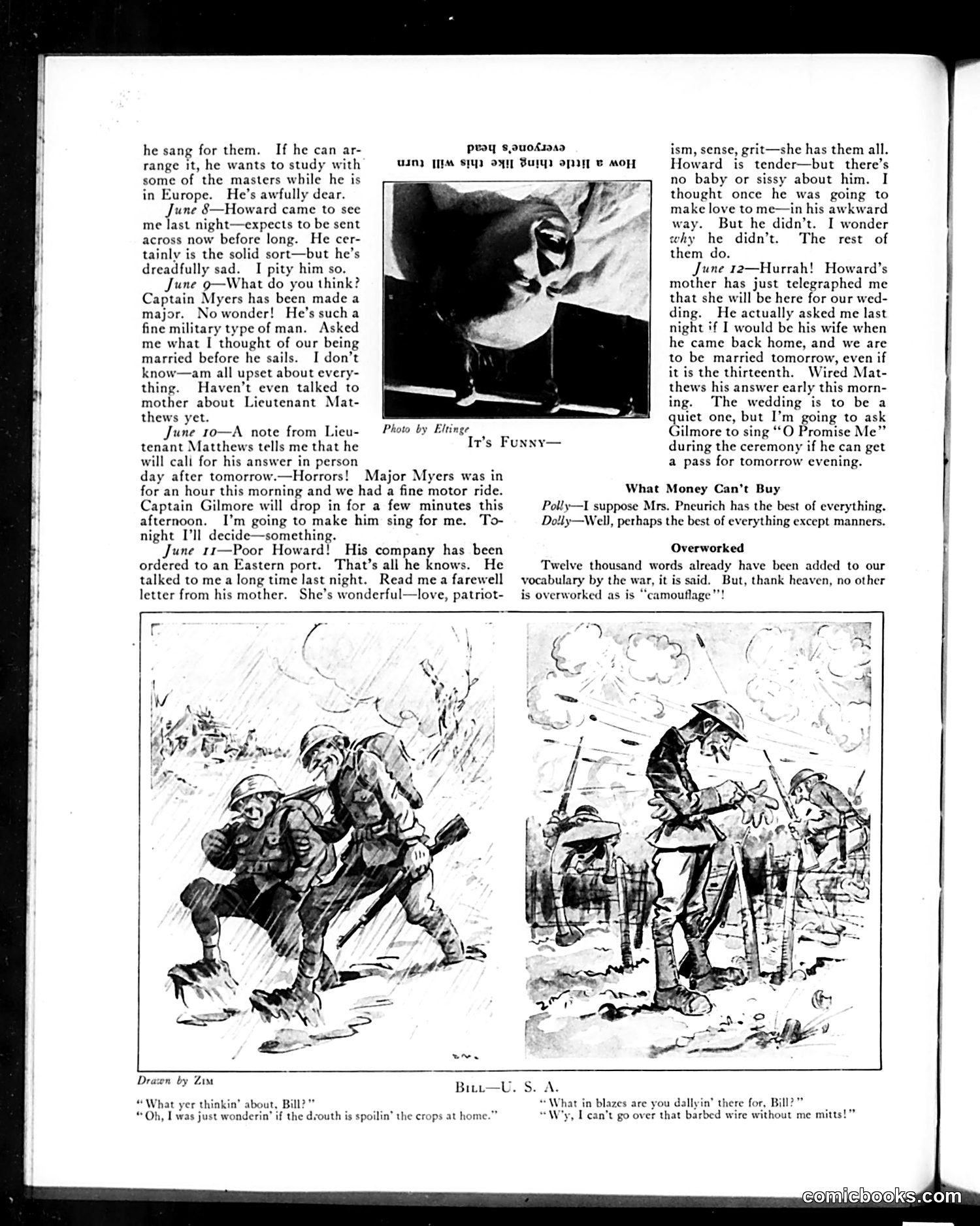
This satirical piece mocks young women's fickleness and romantic opportunism during World War I. The "diary" entries chronicle a girl who accepts marriage proposals from *multiple* officers—Lieutenant Matthews (April), Captain Myers (May), and Captain Gilmore (May-June)—each time claiming genuine affection. The satire targets several things: women's perceived superficiality (she's impressed by handsome uniforms and singing voices), the contrast between her dismissive treatment of a humble private soldier versus fawning over officers, and the absurdity of serial engagements. The implication is that she's a gold-digger exploiting wartime romance. The top illustration shows a woman attending to a wounded or ill soldier, captioned "Her 'Little Boy'"—likely sarcastically referencing her patronizing sympathy for common soldiers versus her romantic pursuit of officers. The humor relies on period stereotypes about women's unreliability and materialism during wartime.
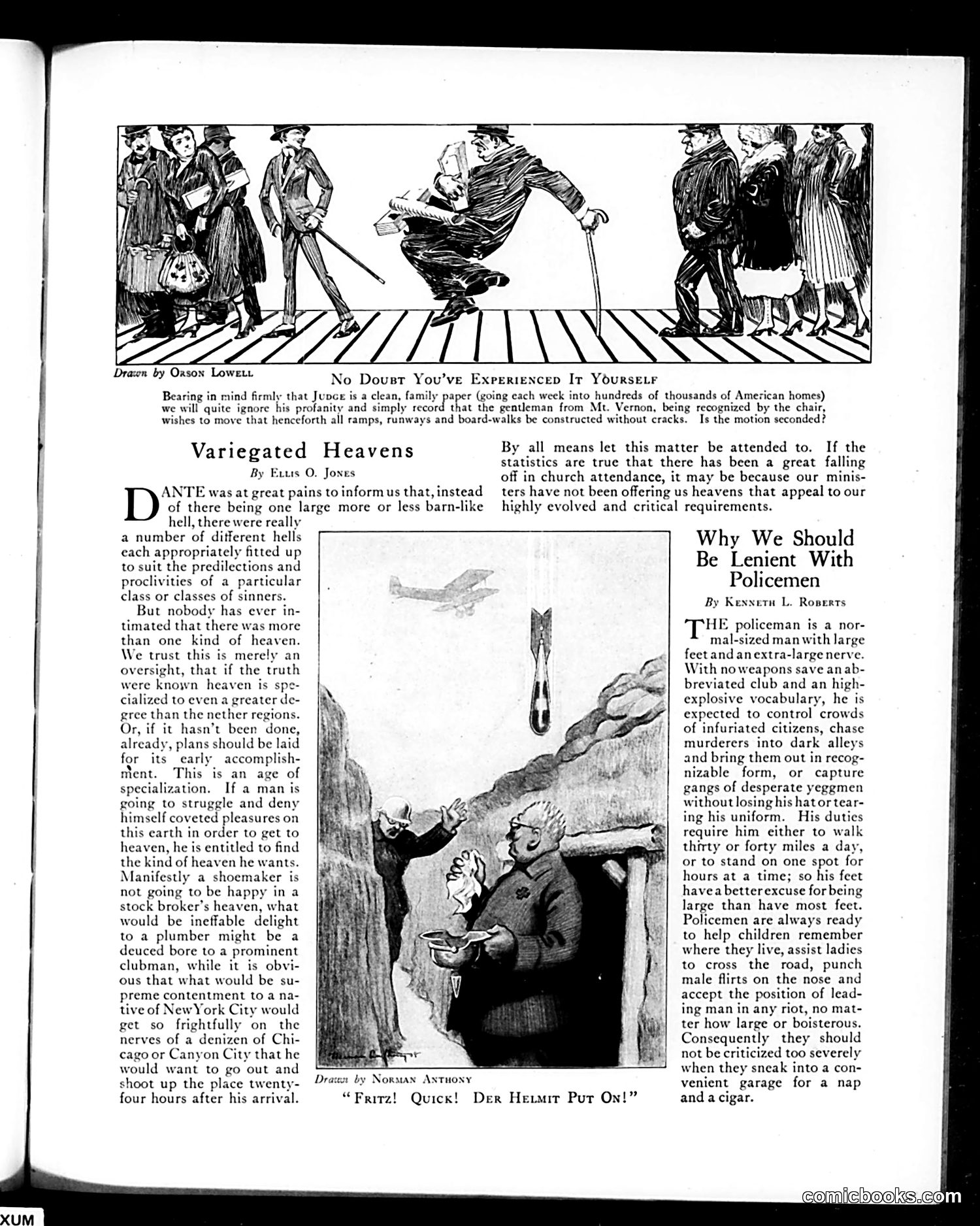
**Top Cartoon ("No Doubt You've Experienced It Yourself")** by Osbon Lowell depicts a congressman from Mount Vernon proposing that all ramps, runways, and boardwalks be constructed without cracks—an obvious absurdity. The satire mocks petty congressional legislation and the triviality of some legislative proposals, presented as if this were serious government business. **"Variegated Heavens"** by Ellis O. Jones is a humorous theological essay arguing that if hell has specialized compartments for different sinners, heaven should similarly be customized for different professions and classes. A shoemaker wouldn't enjoy a stockbroker's heaven, a New York City resident's paradise would torment someone from Chicago. The piece satirizes American society's obsession with specialization and class distinctions, even extending the concept absurdly to the afterlife. **"Why We Should Be Lenient With Policemen"** by Kenneth L. Roberts humorously defends police officers' shortcomings—their large feet, occasional napping in garages, explosive language—by cataloging their genuinely difficult duties. It's gentle satire encouraging public sympathy for working-class law enforcement.
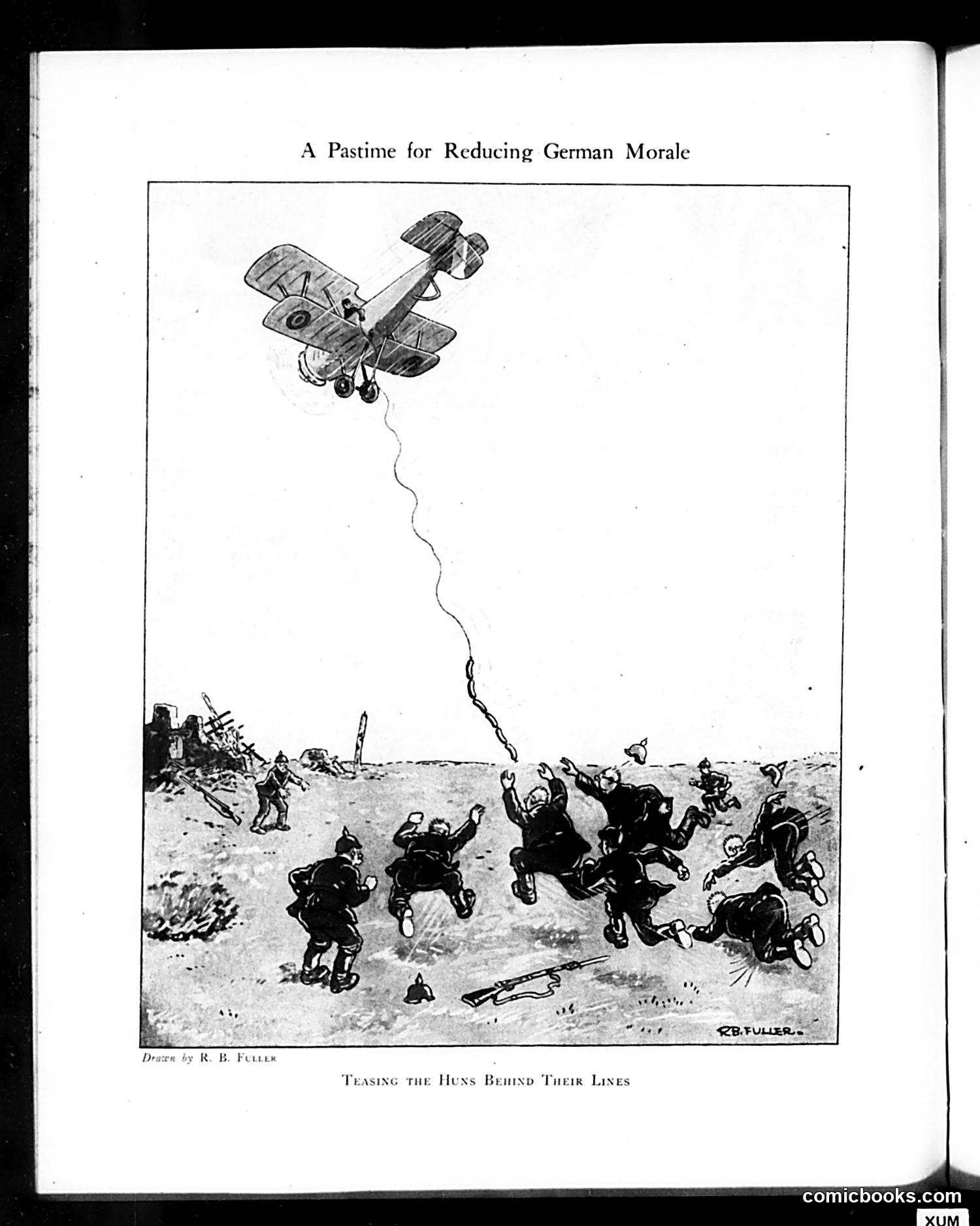
This is a World War I-era satirical cartoon by R.B. Fuller showing an Allied biplane dropping a bomb toward German soldiers ("Huns") scrambling in panic below. The title "A Pastime for Reducing German Morale" uses dark humor to depict aerial bombardment as entertainment. The cartoon reflects Allied propaganda portraying Germans dehumanistically as "Huns"—a common WWI slur. The image celebrates air superiority as a tool for psychological warfare and demoralizing enemy troops. The chaotic scene of soldiers fleeing emphasizes Allied military advantage and mocks German vulnerability. This represents typical Judge magazine wartime content: boosting American morale by depicting enemy fear and helplessness, while normalizing bombing as strategic sport rather than tragedy.
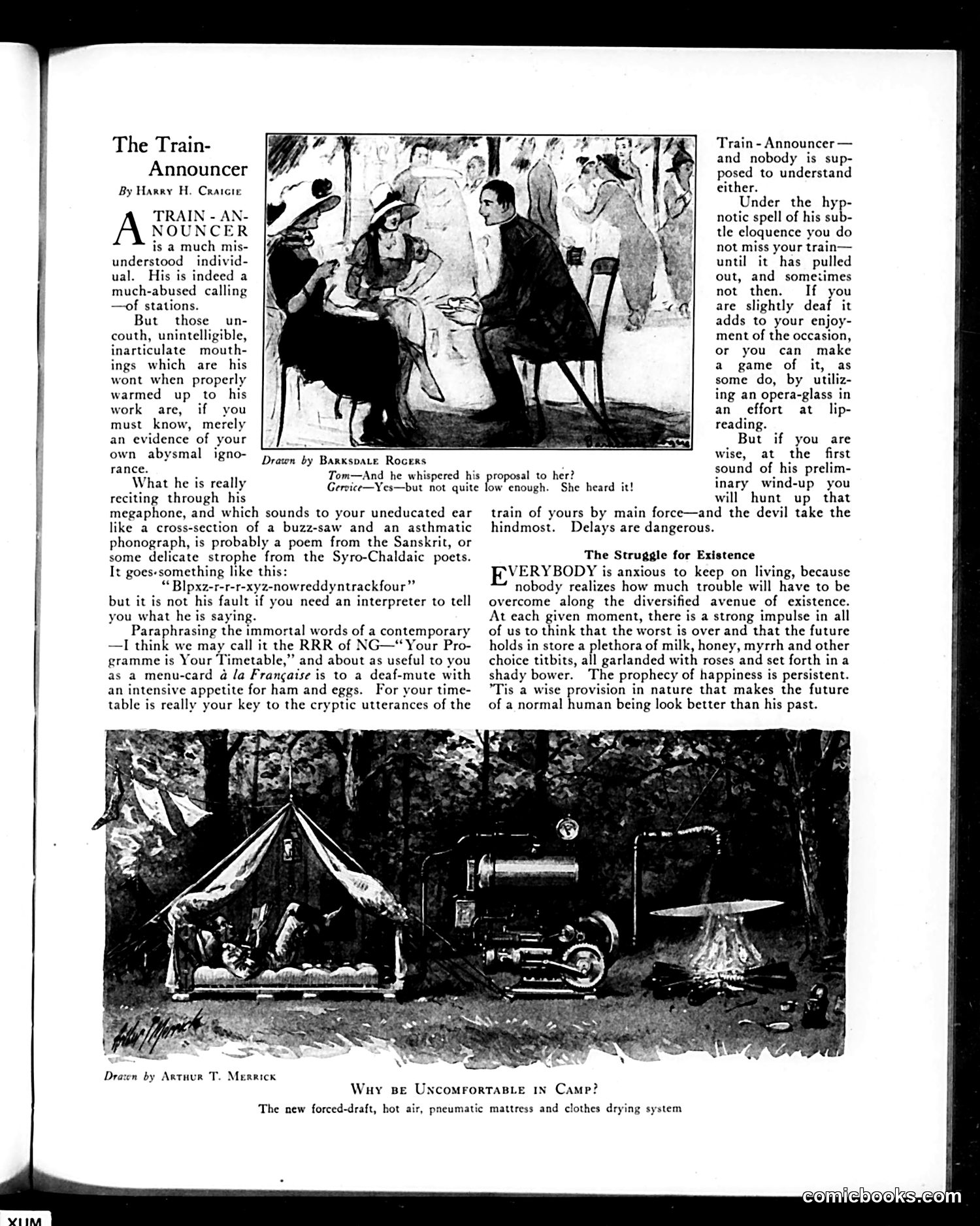
This page contains two separate humorous pieces mocking modern inconveniences. **"The Train-Announcer"** (top) satirizes railroad station announcers whose incomprehensible public-address announcements were apparently a widespread frustration. The satire pretends their garbled utterances ("Bipxz-r-r-r-xyz-nowreddyntrackfour") are actually sophisticated poetry in Sanskrit or ancient languages, mocking both the announcers' poor diction and passengers' inability to understand train information. The joke: if you're slightly deaf, at least you won't miss your train. The accompanying illustration shows a man proposing to a woman, inaudible even at close range. **"The Struggle for Existence"** (bottom) philosophically muses that humans naturally assume the worst is behind them and good times await, though life is actually difficult. The accompanying illustration depicts an uncomfortable camping setup with tent, machinery, and various contraptions for forced-air heating and clothes drying—technology meant to improve camp comfort but appearing cumbersome and impractical instead. Both pieces gently mock modern technology's failure to deliver promised convenience.
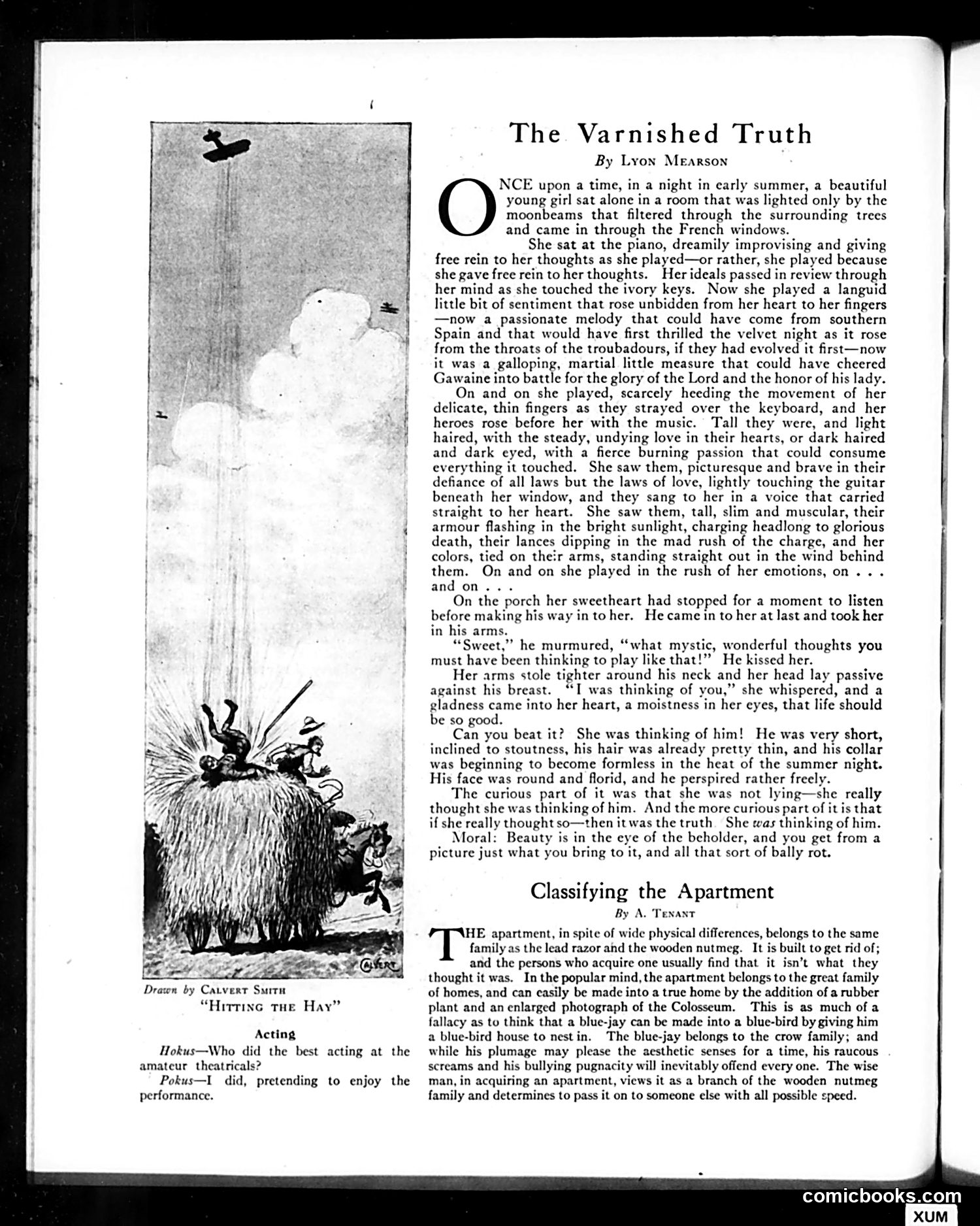
**"The Varnished Truth"** is a romantic satire about self-deception. A young woman plays piano and imagines herself surrounded by heroic, idealized suitors—tall, passionate knights and soldiers. When her actual boyfriend arrives—described as short, stout, balding, and perspiring—she claims she was thinking of him all along. The joke's bitter moral: she wasn't lying, because she genuinely convinced herself her mediocre reality matched her fantasy. "Beauty is in the eye of the beholder" and we see what we want to see. The cartoon (showing the imagined lovers) contrasts sharply with the text's deflating conclusion. **"Classifying the Apartment"** mocks the apartment as a deceptive housing product—grouped with frauds like the "lead razor" and "wooden nutmeg" (historical con-artist items). People buy apartments expecting a "true home" but get something fundamentally different. Adding plants or photos doesn't change what it actually is. The piece satirizes both the apartments themselves and buyers' wishful thinking. Both pieces target self-deception and false expectations—recurring themes in satirical commentary.
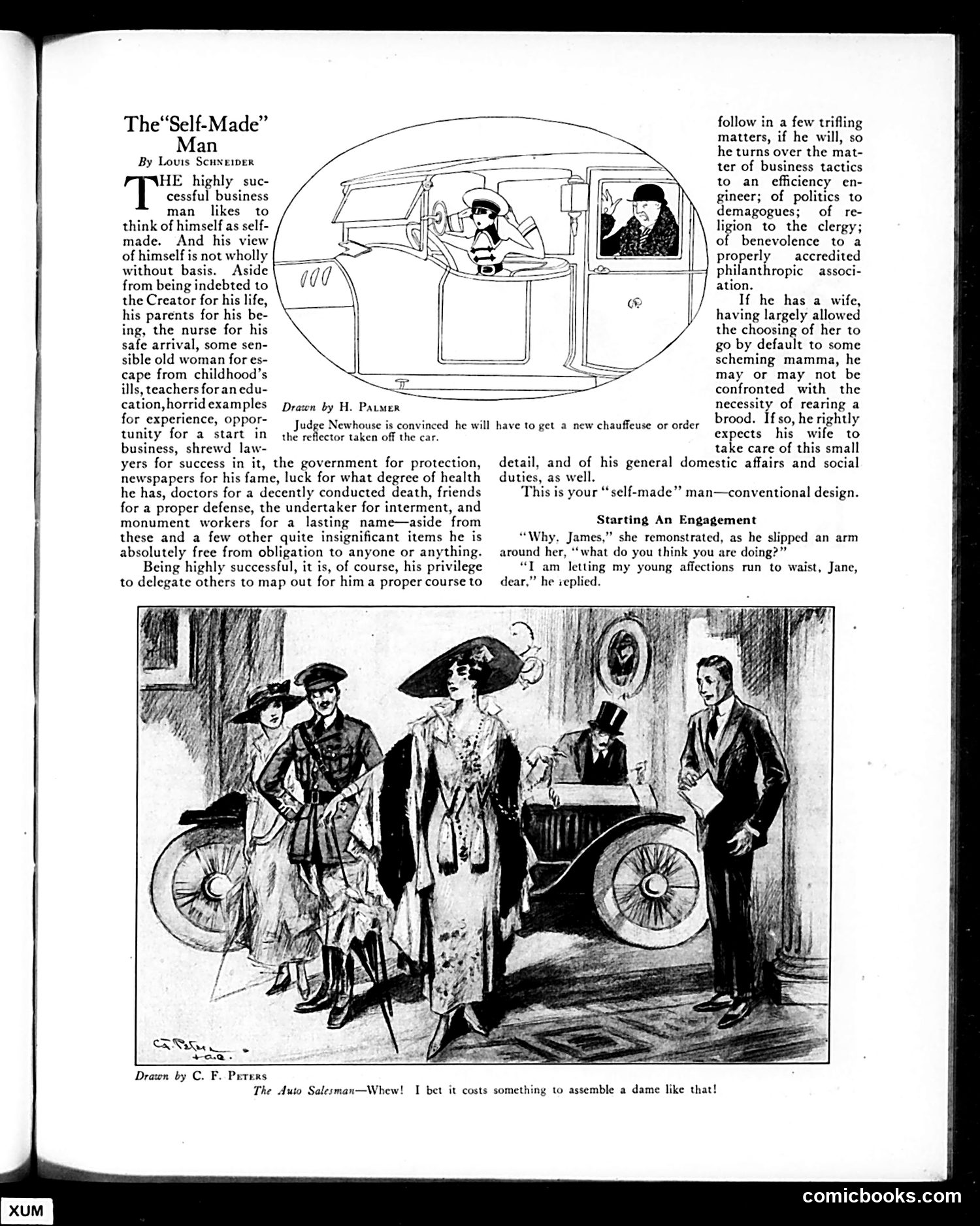
This page satirizes the American myth of the "self-made man" through Louis Schneider's essay and accompanying cartoons. **Main Article:** Schneider ironically catalogs all the help a supposedly "self-made" businessman actually receives—from parents, nurses, teachers, lawyers, government, newspapers, doctors, and undertakers—yet credits none of them. The satire shows how such men conveniently forget their debts while delegating responsibility for everything from politics to charity to wives. **Lower Cartoon:** Titled "The Auto Salesman," it depicts a car salesman marveling at an elaborately dressed woman, quipping that assembling "a dame like that" must cost something. This jokes about women as assemblages or possessions, fitting the article's theme of men taking credit while depending on others (here, wives they didn't "make"). **Context:** This reflects early 20th-century American debates about individualism versus social interdependence, alongside period attitudes about women's roles.
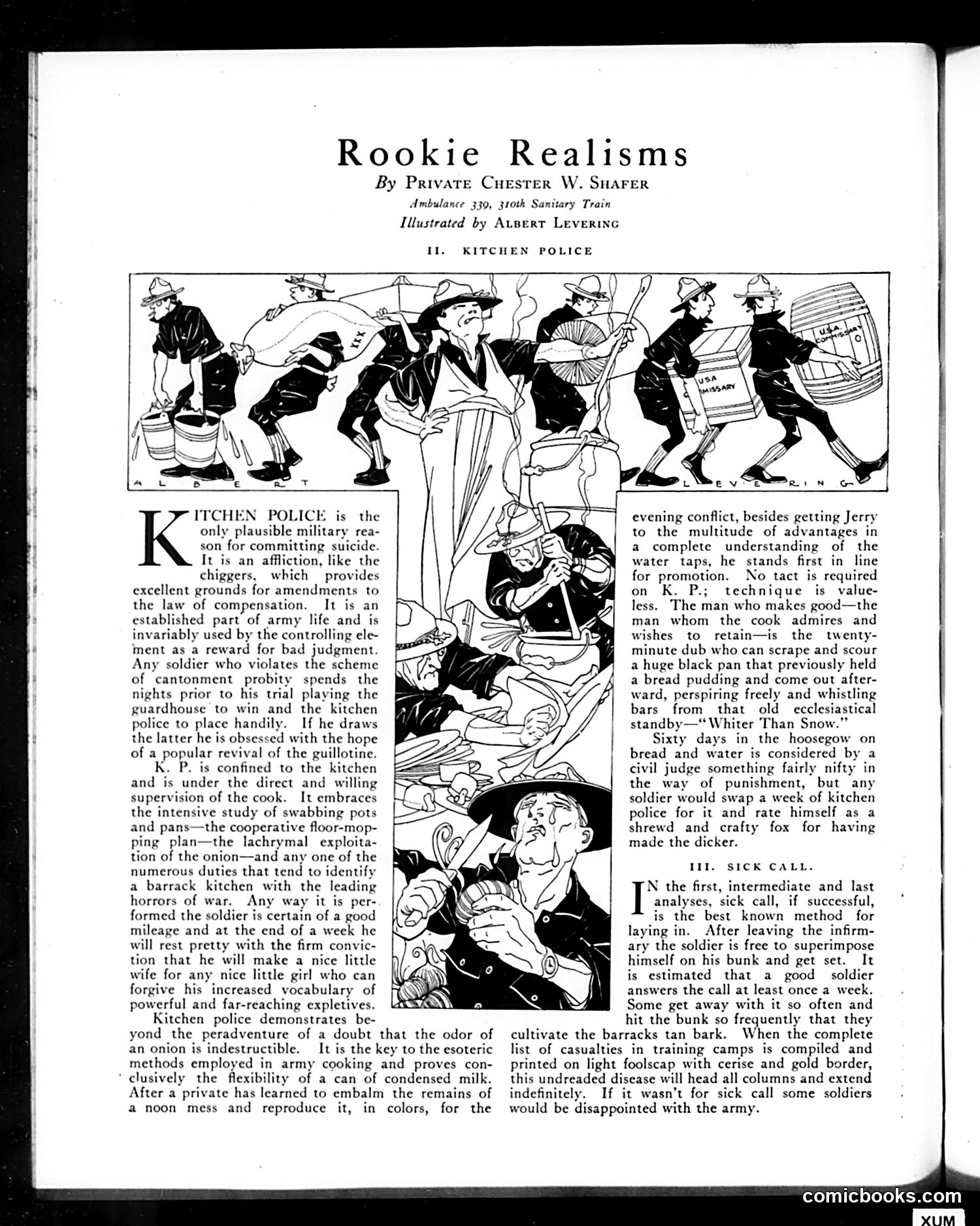
This WWI-era satirical piece by a soldier mocks army life through two common punishments/duties. "Kitchen Police" (K.P.) depicts soldiers assigned to kitchen duty as a consequence for breaking rules—scrubbing pots, mopping floors, and handling onions that permanently stain uniforms and bodies. The text sarcastically claims this odious punishment is preferable to worse consequences, and that soldiers emerging from K.P. would make decent wives due to their expanded profanity vocabulary. "Sick Call" ridicules soldiers who frequently fake illness to escape duty, lounging in the infirmary or barracks instead of working. The author estimates good soldiers visit sick call weekly, with some becoming so habitual that they develop a permanent "barracks tan" from lying around. Both segments present army discipline as absurd—using petty humiliations as control mechanisms—while celebrating soldiers' cunning workarounds. The humor targets military bureaucracy and the gap between official punishment and actual soldier behavior.
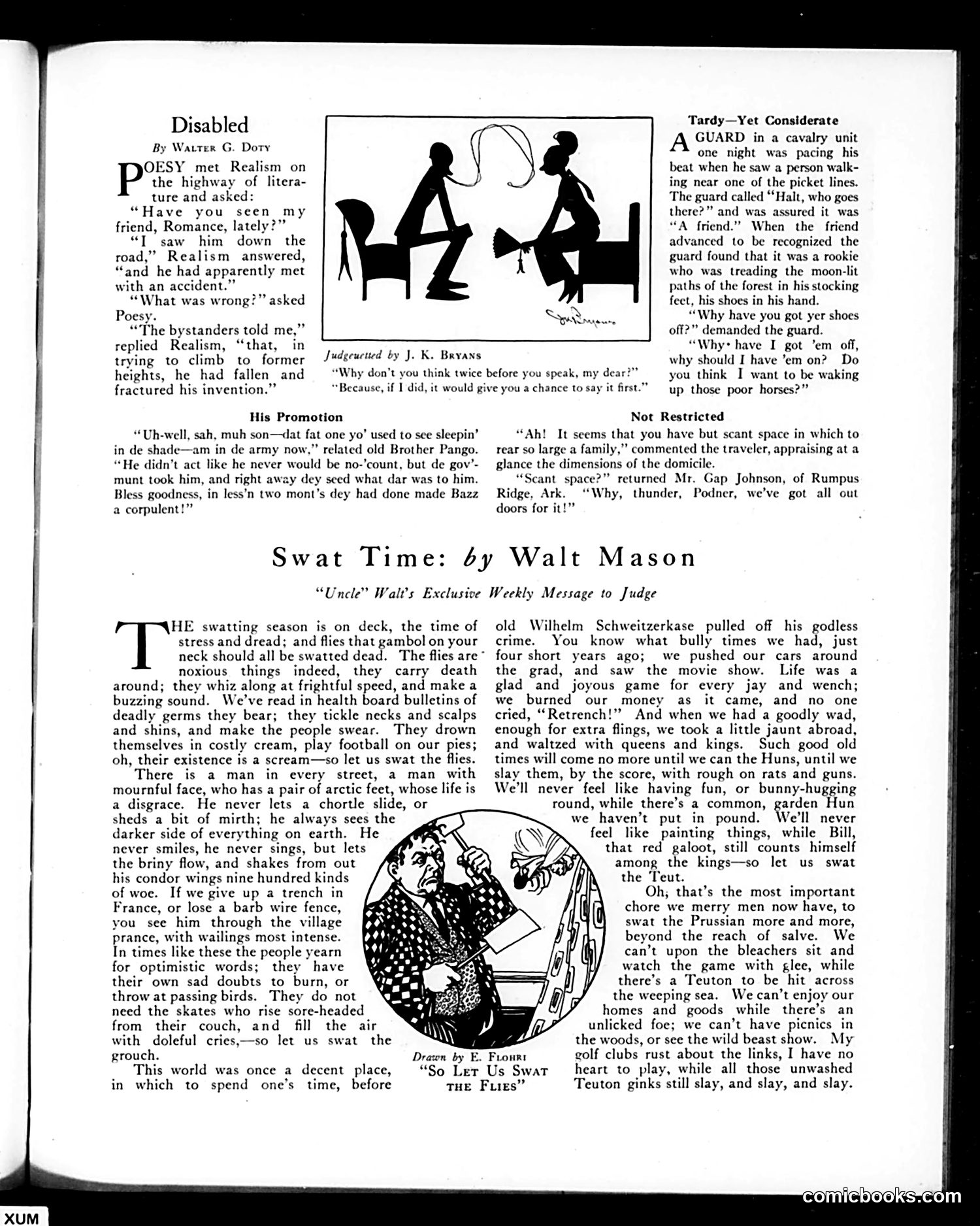
This **Judge magazine page** contains several WWI-era satirical pieces. The main content is Walt Mason's "Swat Time" column, which uses fly-swatting as a metaphor for dealing with wartime problems and negative attitudes. Mason directly references **Kaiser Wilhelm II** ("old Wilhelm Schweitzerkase"—a mocking pun on Swiss cheese), blaming Germany for destroying pre-war American contentment. The piece criticizes "the grouch"—pessimistic civilians who spread defeatism about trench warfare losses in France. The other brief comics mock everyday life: one jokes about a soldier conscript's unexpected promotion, another depicts a considerate rookie avoiding waking horses (gentle humor), and one presents rural simplicity about housing. The recurring theme: **wartime morale-building**. Mason urges readers to maintain optimism and "swat" both literal disease-carrying flies and metaphorical negativity, framing positive attitude as patriotic duty during WWI.
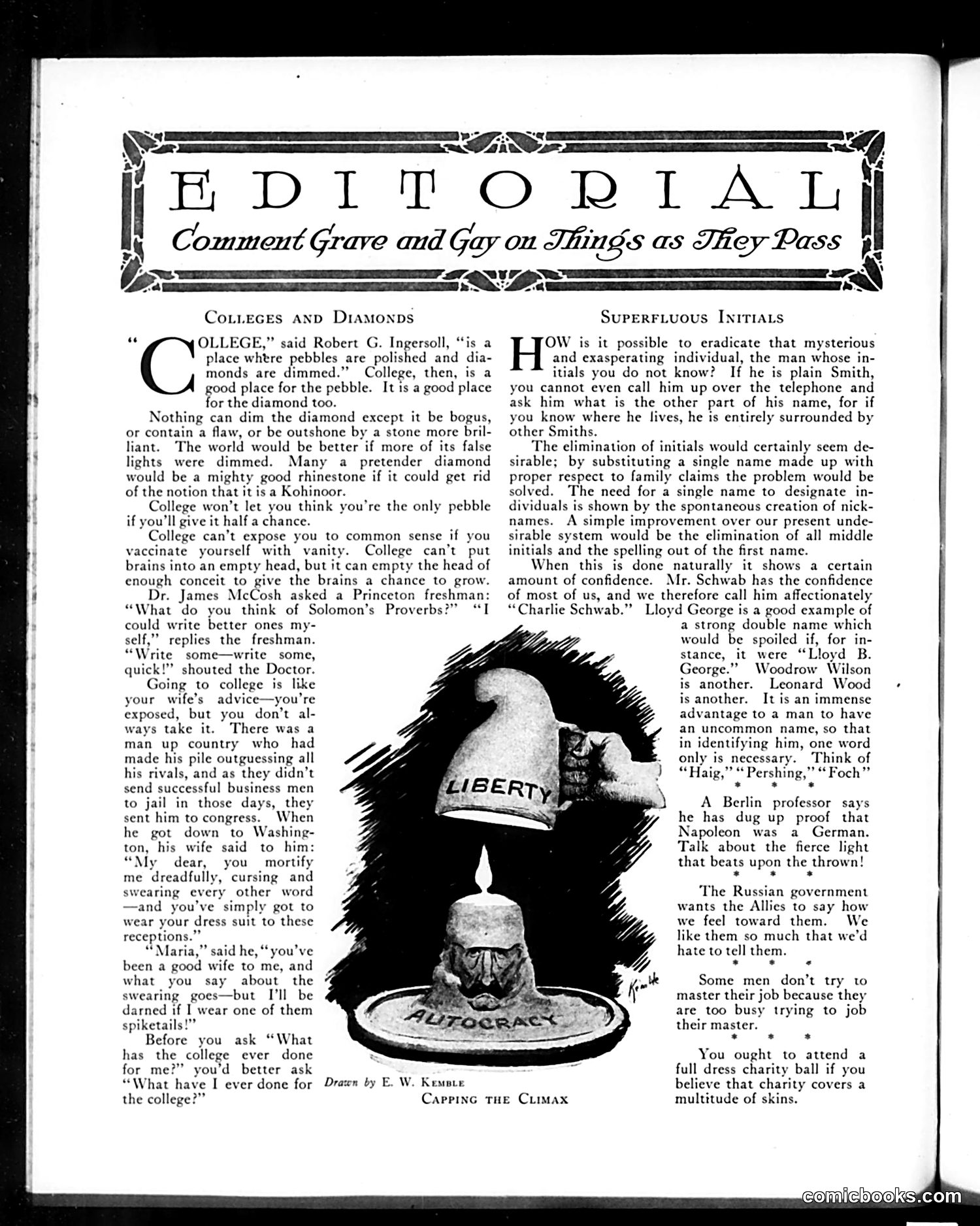
This is a satirical editorial page from Judge magazine featuring two sections and a political cartoon. **Main Editorial ("Colleges and Diamonds")**: Uses metaphors to critique American higher education and social pretension. It argues colleges should humble the arrogant ("pebbles") while not diminishing genuinely talented individuals ("diamonds"). The piece sarcastically notes that colleges expose students to good influences but can't force them to accept the lessons—comparing it to a wife's advice. **Cartoon ("Capping the Climax")**: Depicts Lady Liberty holding a candle labeled "LIBERTY" above what appears to be an autocracy symbol (the spiked helmet), suggesting the Allies' victory in World War I. This celebrates democratic triumph over militarism. **"Superfluous Initials" Column**: A humorous complaint about men identified only by initials (like "J. B. Smith"), making them impossible to contact or identify. It praises those with distinctive full names like Lloyd George and Woodrow Wilson. The page reflects post-WWI optimism about democracy's victory and American social commentary typical of Judge's satirical voice.
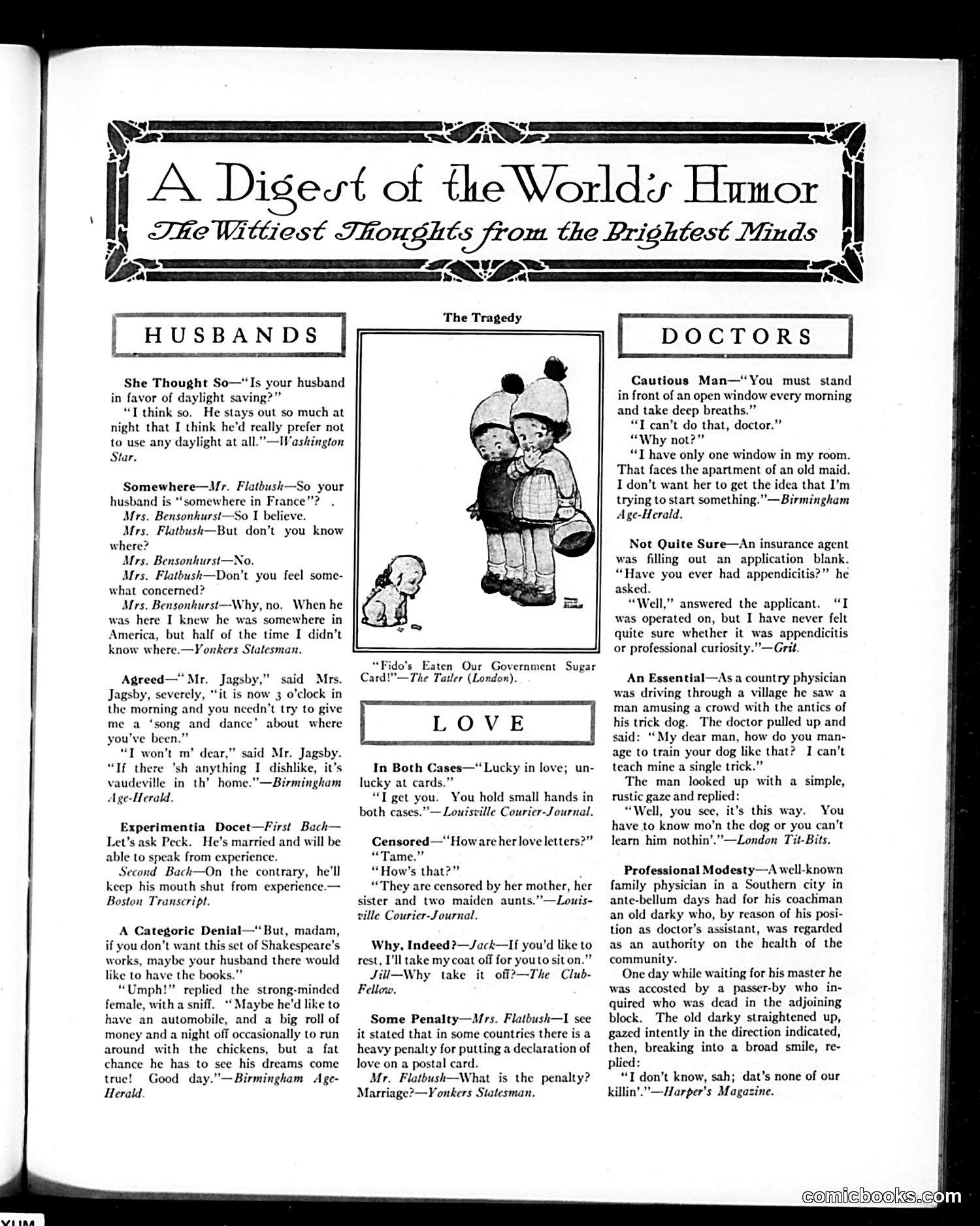
This page collects brief humorous anecdotes categorized as "Husbands," "Doctors," and "Love"—typical of early 20th-century magazine humor. The cartoons and jokes satirize domestic life and social conventions. The central illustration depicts a couple with a small dog, captioned "Fido's Eaten Our Government Sugar Card," referencing wartime rationing (likely WWI-era food controls). The jokes mock husbands for staying out late, wives for accepting ignorance of their whereabouts, and the awkwardness of married life. Doctors are ridiculed for simplistic advice or invasive curiosity. Love-related humor emphasizes censorship (letters screened by family) and the irony that getting engaged is a "penalty" for declaring love. The tone is lighthearted domestic comedy targeting middle-class audiences, with recurring characters like "Mr. Flatbush" suggesting ongoing social observation rather than specific political satire. The humor relies on gender stereotypes and marital discord as entertainment.
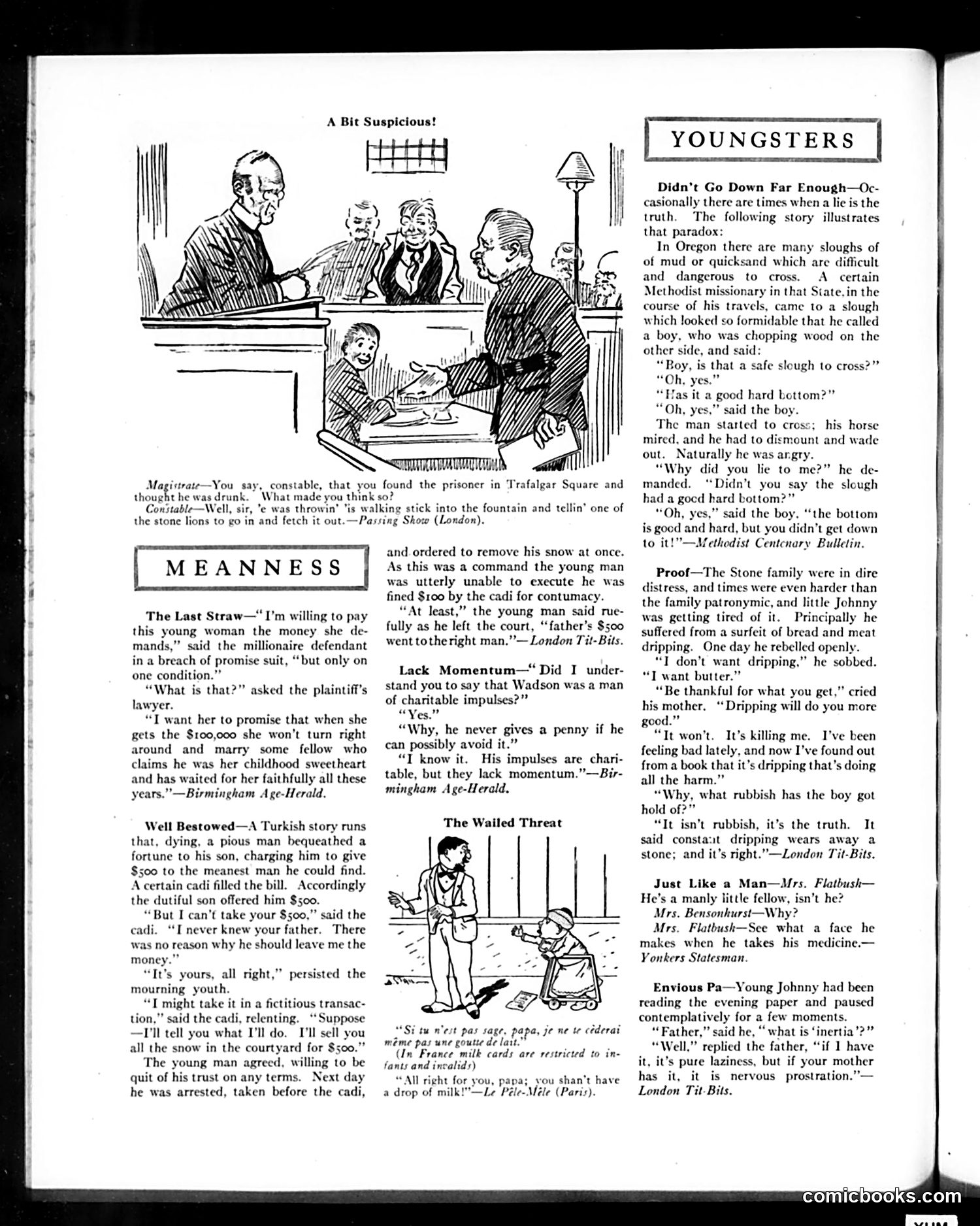
The top cartoon depicts a magistrate interrogating a constable about a prisoner found in Trafalgar Square. The constable reports the man was throwing his walking stick into a fountain and ordering stone lions to fetch it—behavior suggesting drunkenness or mental disturbance. The satire mocks the constable's literal-minded police work: he mistakes eccentric behavior for intoxication without considering other explanations. The joke relies on the absurdity of the situation and plays on period British attitudes about proper public conduct. The cartoon serves as social commentary on law enforcement competence and the gap between appearance and reality—a recurring theme in Judge magazine's satirical approach to contemporary life.
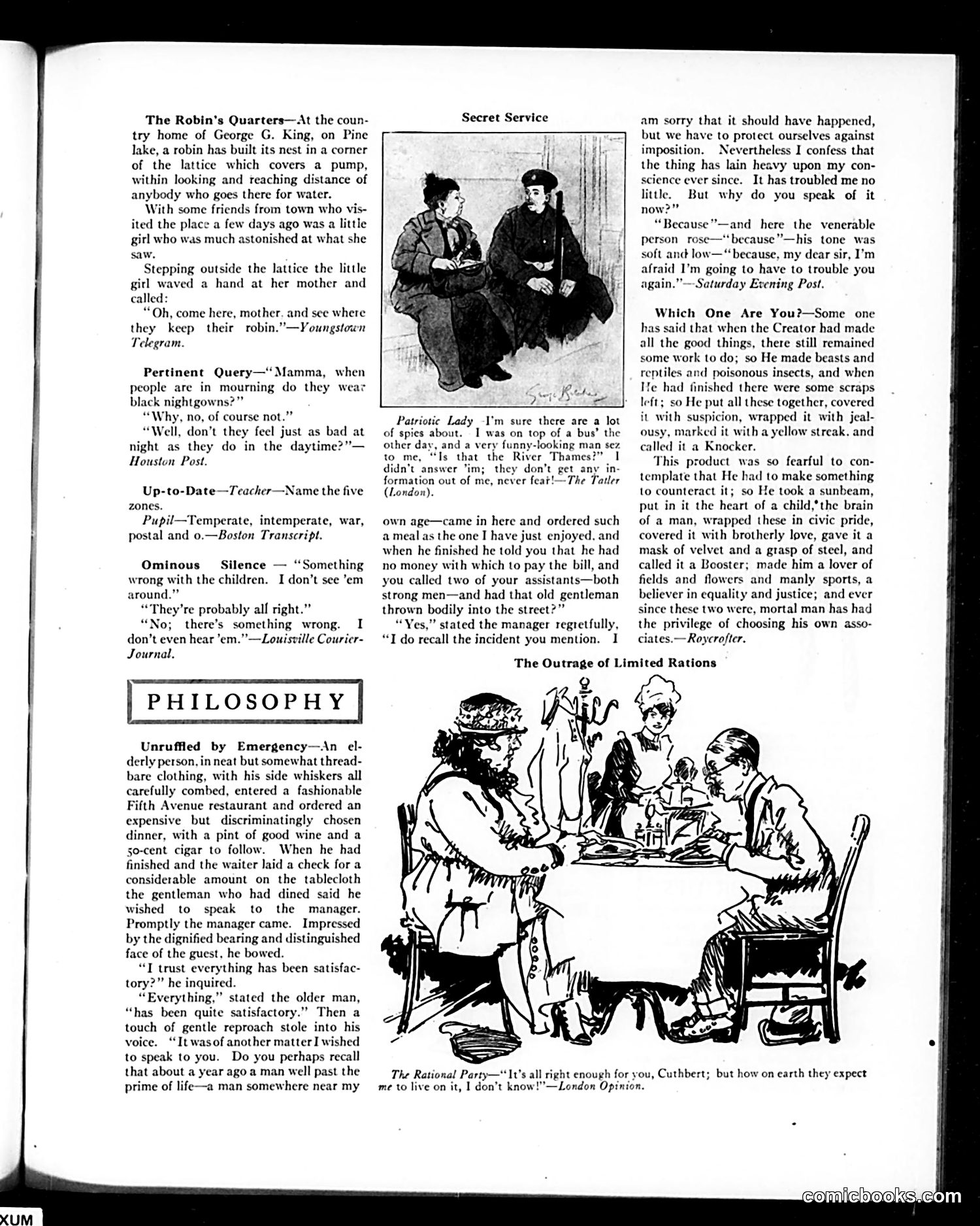
This page contains several brief humorous anecdotes and two cartoons typical of Judge's satirical style. **Top Cartoon ("Secret Service"):** Shows two women in conversation. The joke lampoons British paranoia about German spies during the pre-WWI period. A woman claims she refused to answer a suspicious "funny-looking man" who asked about the River Thames, believing him a spy gathering intelligence. The humor lies in the absurdity of treating casual tourism as espionage. **Bottom Cartoon ("The Outage of Limited Nations"):** Depicts what appears to be a dinner party or diplomatic gathering. The caption suggests tension among nations regarding resource allocation or economic burden-sharing, likely referencing post-WWI tensions or League of Nations disputes over colonial territories and reparations. **Accompanying Text:** Short jokes about children's logic, mourning etiquette, and a philosophical anecdote about a dignified poor man receiving the same harsh treatment from a restaurant manager twice—exploring themes of class, dignity, and conscience. The overall tone reflects Judge's focus on social commentary wrapped in humor.
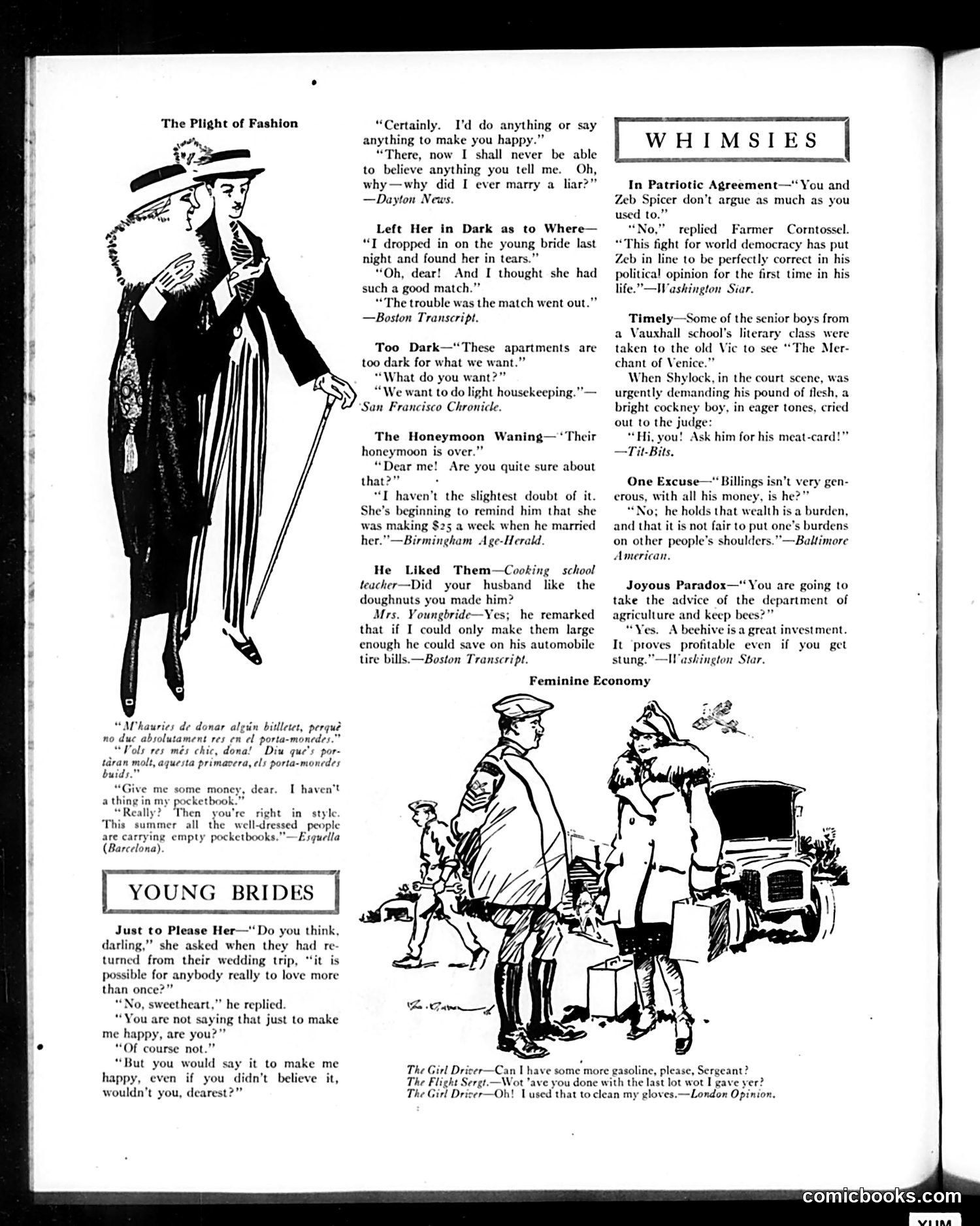
This satirical page from Judge mixes fashion commentary with domestic humor, likely from the World War I era (references to "world democracy" and rationing suggest early 1910s-20s). **"The Plight of Fashion"** mocks women carrying empty pocketbooks—a commentary on either poverty or frivolous spending habits among fashionable women. **"Young Brides"** section contains domestic jokes about newlyweds. One husband admits he'd lie to make his wife happy, undermining his credibility. Another bride cries because her match "went out"—a pun on both marriage and literal matchsticks. A third complains her cooking is so bad it could save her husband money on car repairs. **"Whimsies"** offers brief satirical observations: farmers agreeing during wartime, a boy demanding a "meat-card" (rationing reference), a stingy rich man, and beekeeping as investment. **"Feminine Economy"** depicts a female driver wasting gasoline by using it to clean gloves—absurd wartime waste. The overall tone critiques women's irresponsibility with money and household tasks, reflecting early 20th-century gender attitudes.
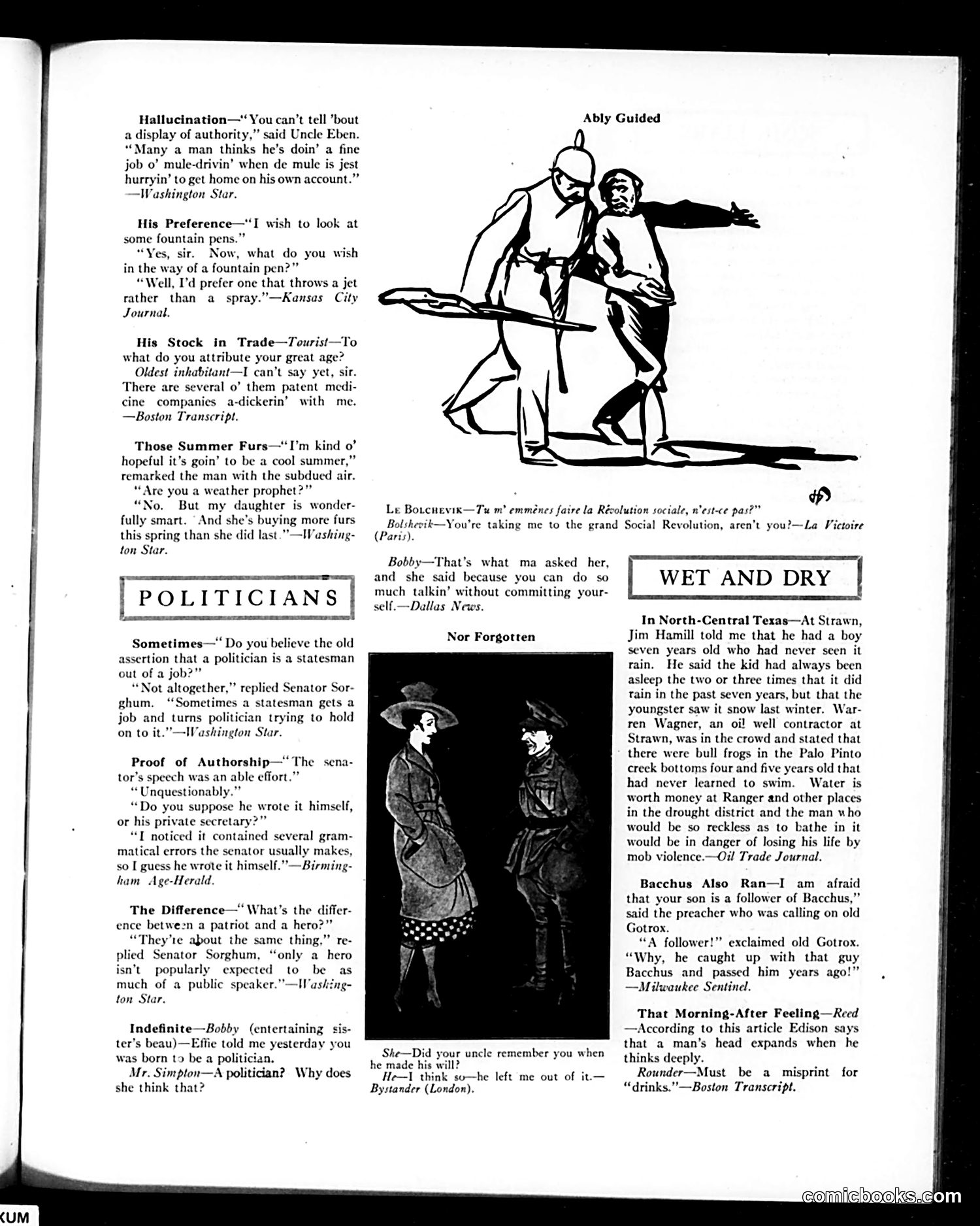
This page from **Judge** magazine contains several short humorous pieces satirizing American politics and society. The main cartoon shows **Le Bouchenevik** (a play on "Bolshevik"), depicting early 20th-century anxieties about socialist revolution in Europe. A figure appears to be leading another toward social upheaval, referencing post-WWI communist movements in Paris. The text jokes mostly target **politicians**, particularly a recurring character named Senator Sorghum, who embodies political hypocrisy: the difference between patriot and hero is that heroes aren't expected to be public speakers; politicians blur the line between statesman and opportunist. Other brief pieces mock everyday American life: drought conditions in Texas where animals never learned to swim; patent medicine companies pursuing the elderly; daughters' wasteful shopping habits; and the morning-after hangovers of "rounders" (drunks). The satire assumes readers' familiarity with contemporary politics and cultural anxieties about modernization, wealth inequality, and changing social values.
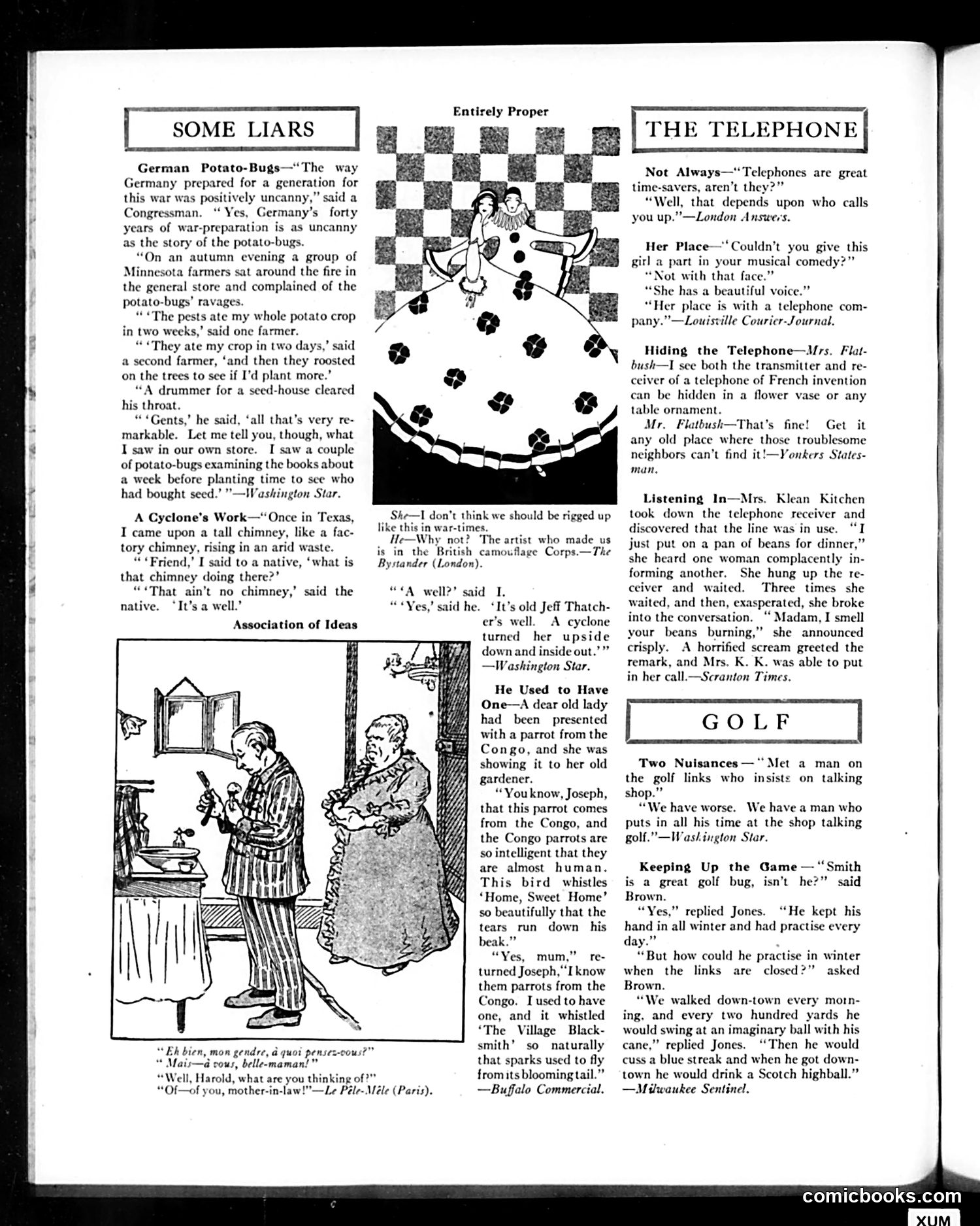
This page from the satirical magazine *Judge* collects brief humorous anecdotes mocking exaggeration and tall tales. **"Some Liars"** section features farmers and a salesman competing to tell increasingly absurd stories about potato bugs studying seed catalogs before planting—satirizing rural boasting and one-upmanship. **"Association of Ideas"** cartoon shows a man telling his mother-in-law he's thinking of her, a joke about marital anxiety. **"The Telephone"** section contains brief quips about telephone culture: that they save time only depending on who calls, that an unattractive singer should work for a phone company, that neighbors hide phones to avoid being found, and an anecdote about a woman eavesdropping on party lines and interrupting to comment on someone's burning beans—satirizing the new technology's social disruptions and the lack of privacy on shared telephone lines. The **"Golf"** section mocks golf obsessives who talk about golf constantly, even at work.
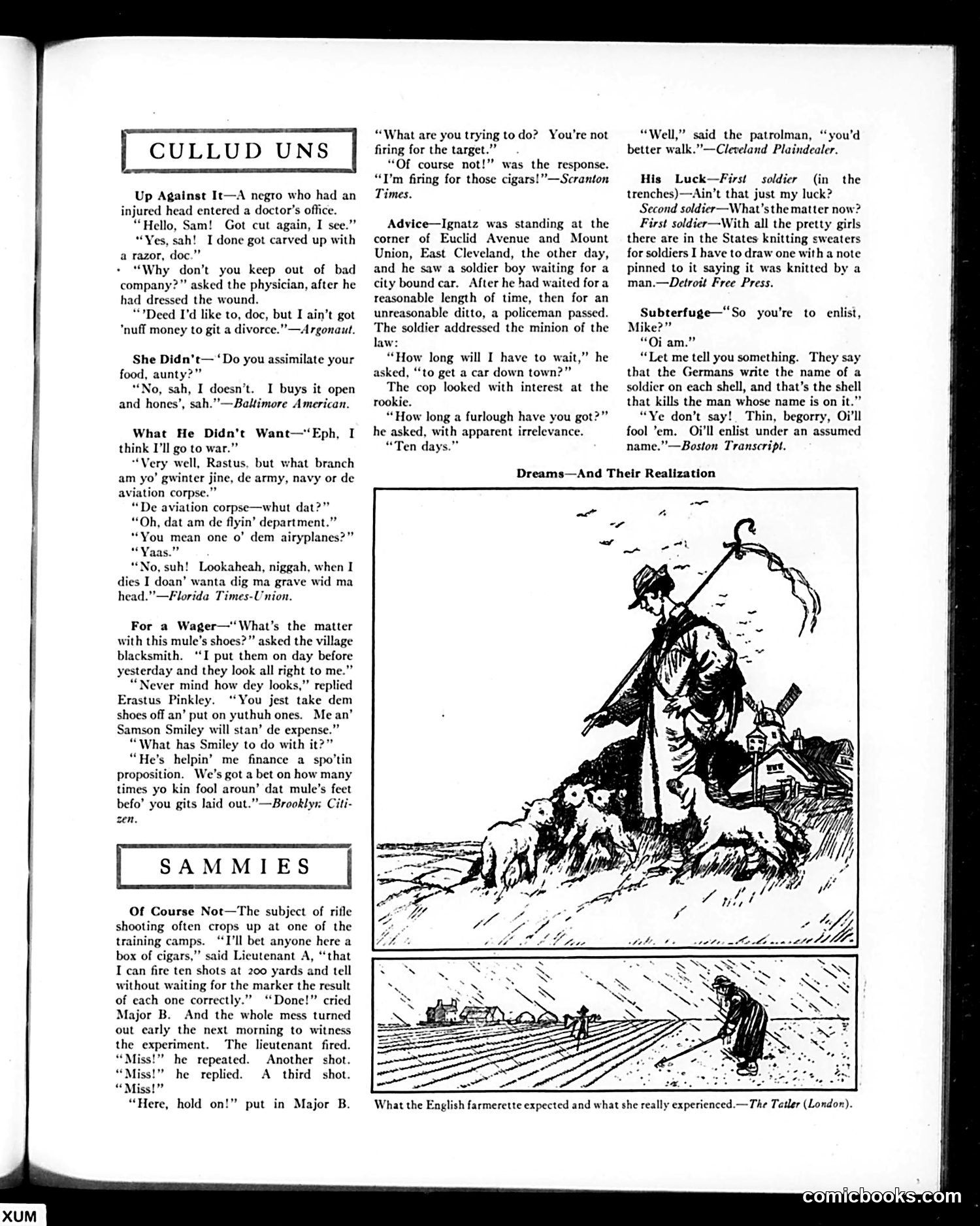
This page from Judge (likely WWI-era, given references to trenches and military training camps) contains several racist dialect jokes and military humor typical of the period. The main content comprises short humorous anecdotes, most employing heavy stereotypical Black dialect to mock African American characters. These jokes rely on period racial caricatures—portraying Black speakers as illiterate, violent, and foolish. The "Sammies" section shifts focus to WWI soldiers ("Sammies" was slang for American servicemen). These jokes mock military incompetence, training camp absurdities, and soldiers' anxieties about combat and romantic separation. The two illustrations below titled "Dreams—And Their Realization" satirize the gap between soldiers' romantic expectations and grim battlefield reality. **The satire's appeal lay in mocking both racial stereotypes and military bureaucratic incompetence**—humor that, while offensive today, reflected contemporary attitudes toward both Black Americans and the chaos of wartime mobilization.
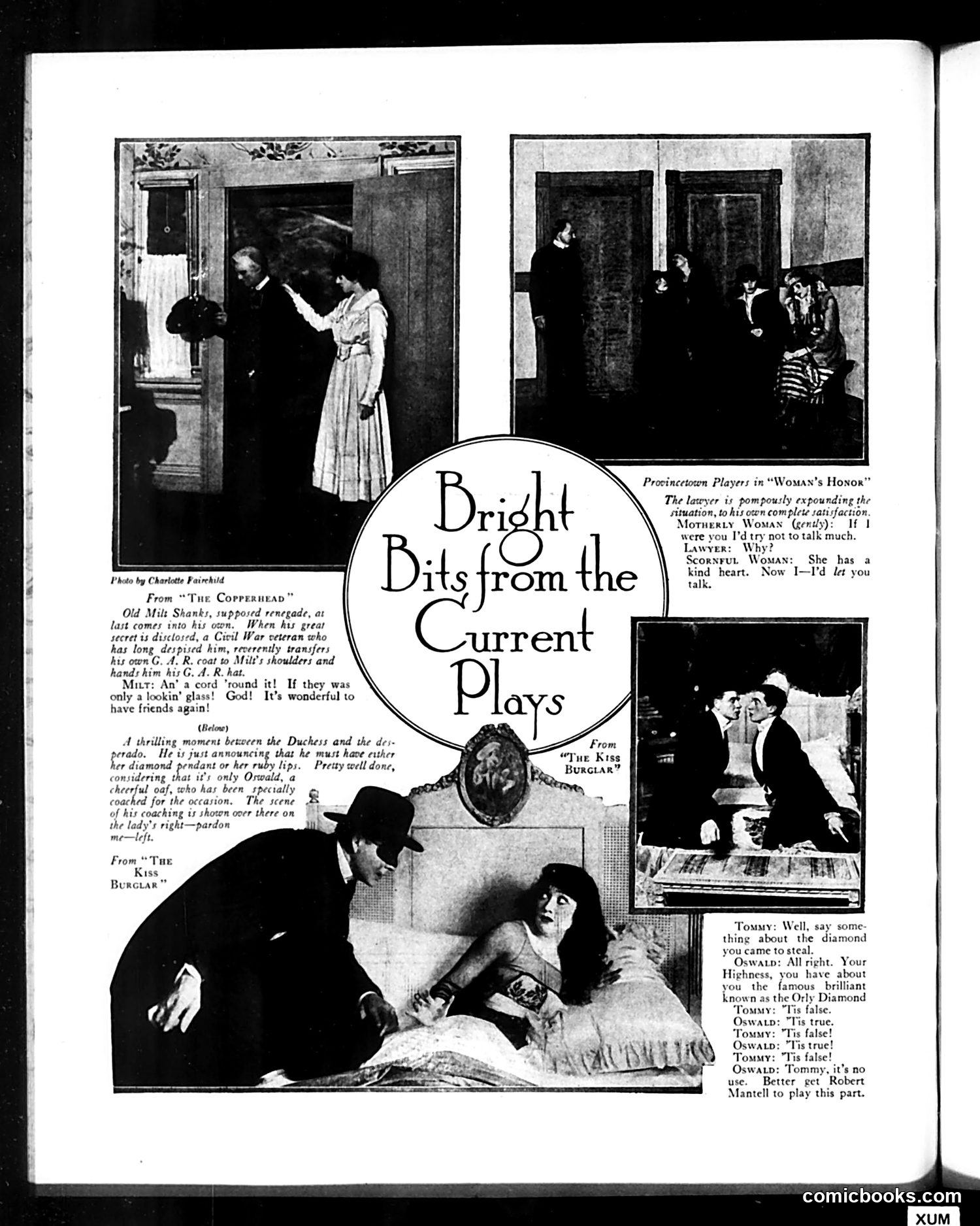
This page showcases scenes from contemporary theatrical productions, offering humorous commentary on stage performances of the era. The main subjects are three plays: "The Copperhead" (a Civil War drama where a former enemy gives a Union coat to an old veteran), "Woman's Honor" (featuring a pompous lawyer being gently mocked by a woman for talking too much), and "The Kiss Burglar" (a melodrama about a jewel thief). The satire centers on theatrical excess and amateur performances. In "The Kiss Burglar" sequence, the joke involves Oswald, a "cheerful oaf" who's been specially coached to play a desperate character, yet still delivers unconvincing lines about stealing a diamond. Tommy (likely the director or another character) repeatedly corrects him with "Tis false!" The punchline suggests hiring professional actor Robert Mantell instead—mocking both the amateur production's incompetence and theatrical pretension generally. The humor targets earnest but mediocre theater performances of the 1910s-1920s period.
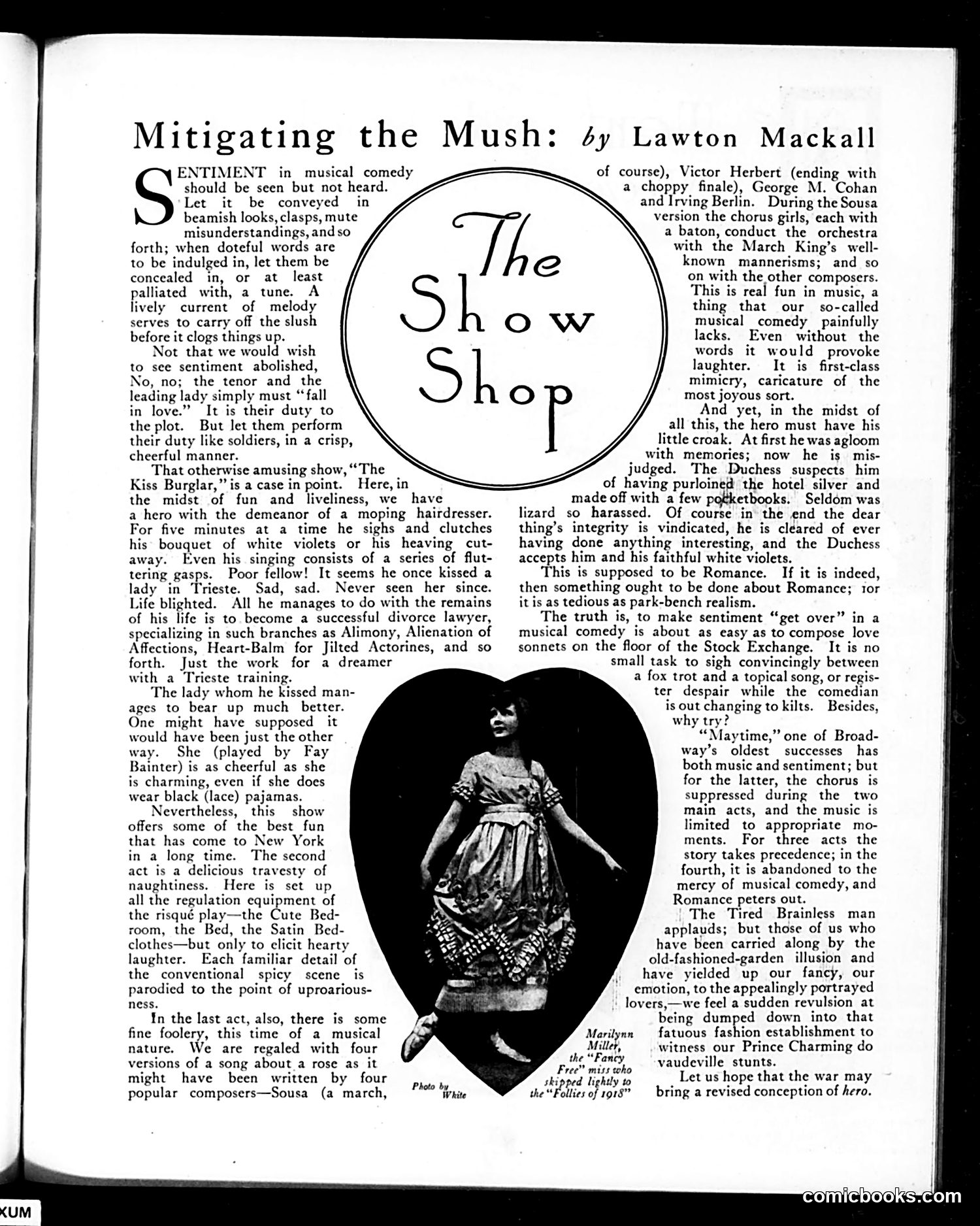
This is a theater review by Lawton Mackall critiquing sentimental excess in Broadway musical comedies. The piece attacks "The Kiss Burglar," a current show starring Fay Bainter, for undermining its comedy with melodramatic moping over a past romance in Trieste. Mackall argues that sentiment in musicals should be conveyed through action and expression, not prolonged emotional wallowing. He praises the show's clever second act (parodying bedroom farce tropes) and a brilliant finale featuring four composers (Sousa, Herbert, Cohan, Berlin) each scoring the same song differently, with chorus girls mimicking their conducting styles. The photograph shows Bainter in character costume. Mackall's core complaint: emotional sincerity and comic timing are fundamentally incompatible in musical theater—trying to achieve both simultaneously produces tedious bathos rather than genuine romance or laughter.
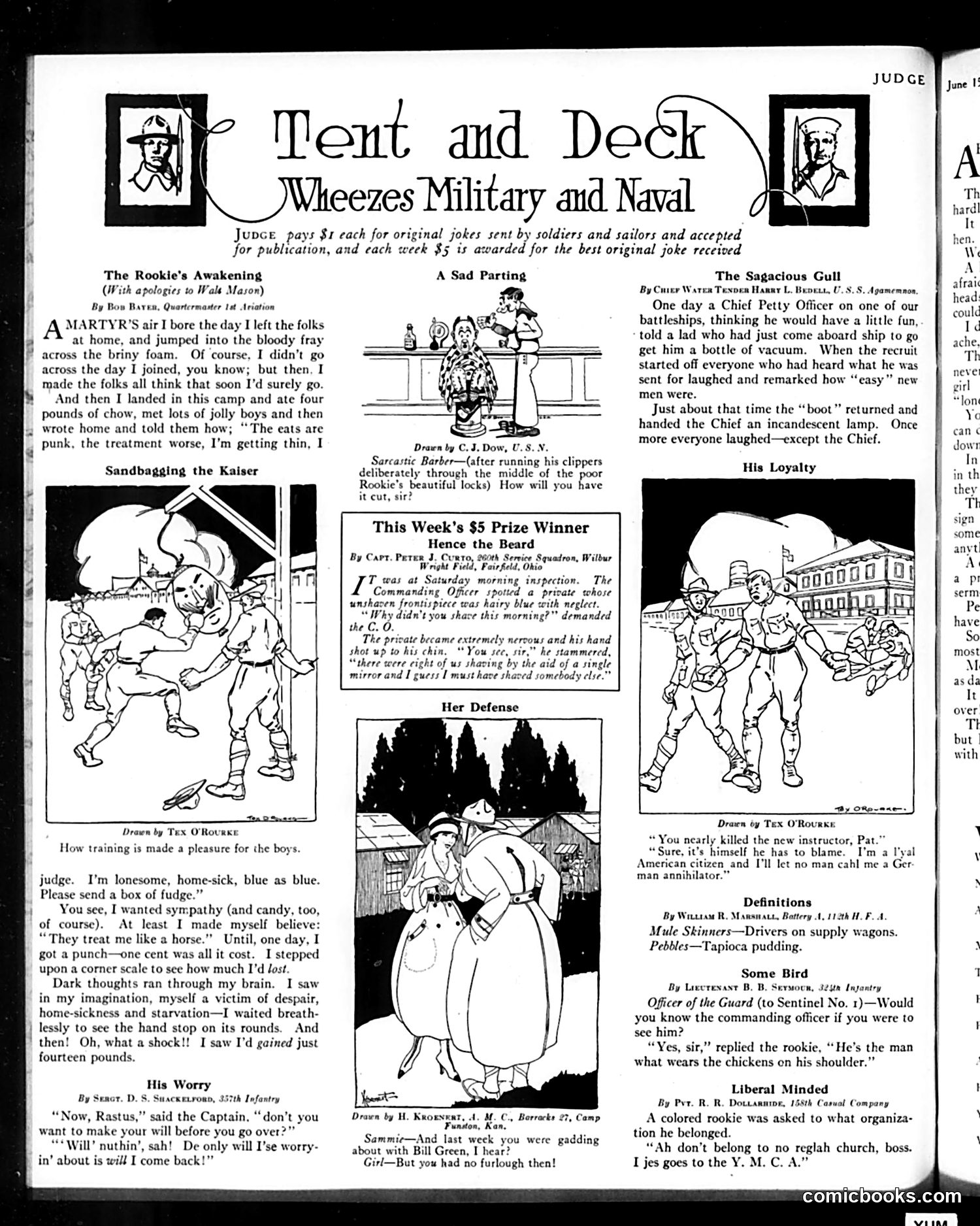
This is a collection of jokes and cartoons submitted by soldiers and sailors during World War I, with a $5 weekly prize for the best original submission. The humor reflects recruit experiences: homesickness, military discipline, and the gap between expectations and reality. Key jokes include: a rookie exaggerating hardships to get sympathy packages, then discovering he's gained weight from camp food; a barber deliberately giving a poor haircut; a private accidentally shaving someone else's face due to shared mirrors; and a recruit misunderstanding an officer's order for "vacuum" as a real item. The cartoons satirize basic training's transformation of civilians into soldiers—often through physical punishment disguised as "pleasure." The humor is gentle, focusing on confusion, minor indignities, and the absurdities of military life rather than serious critique. The magazine solicited these submissions to boost morale among troops.
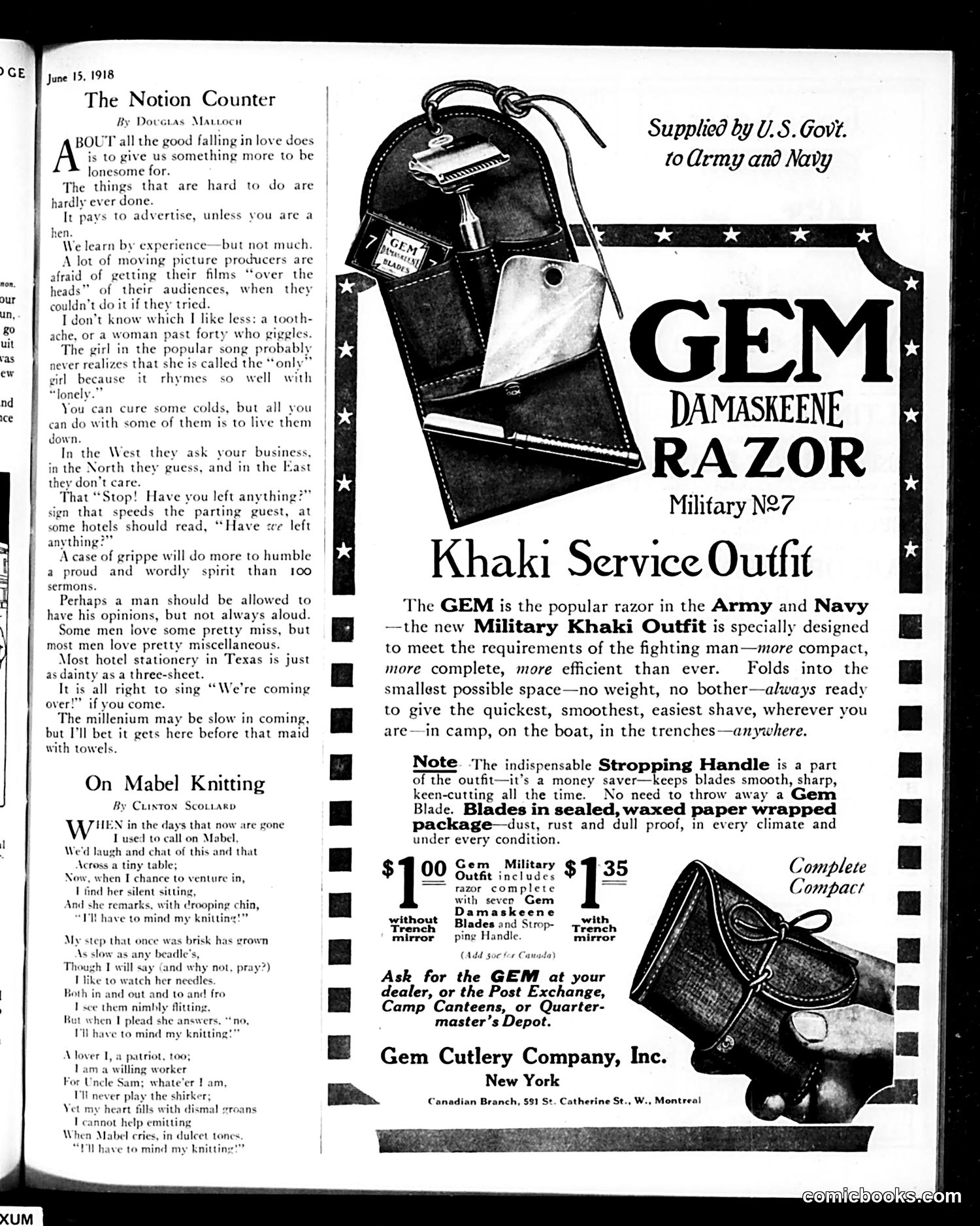
This page combines humor writing with wartime advertising. "The Notion Counter" by Douglas Malloch offers short, cynical observations about human nature—romantic disappointment, the uselessness of advice, regional differences in manners. It's light satirical commentary on everyday life. "On Mabel Knitting" is a poem about a suitor whose romantic visits are repeatedly interrupted because his girlfriend prioritizes knitting for the war effort. The joke reflects 1918 America: women were enlisted in patriotic home production (knitting socks, bandages for soldiers). The frustrated lover must yield to national duty—his romantic interest is literally subordinated to military supply needs. The poem plays this tension for both humor and patriotic sentiment. The Gem razor advertisement emphasizes military utility and government endorsement, targeting soldiers needing compact, reliable shaving equipment in field conditions. The page reflects wartime priorities: civilian leisure and romance are secondary to supporting troops.
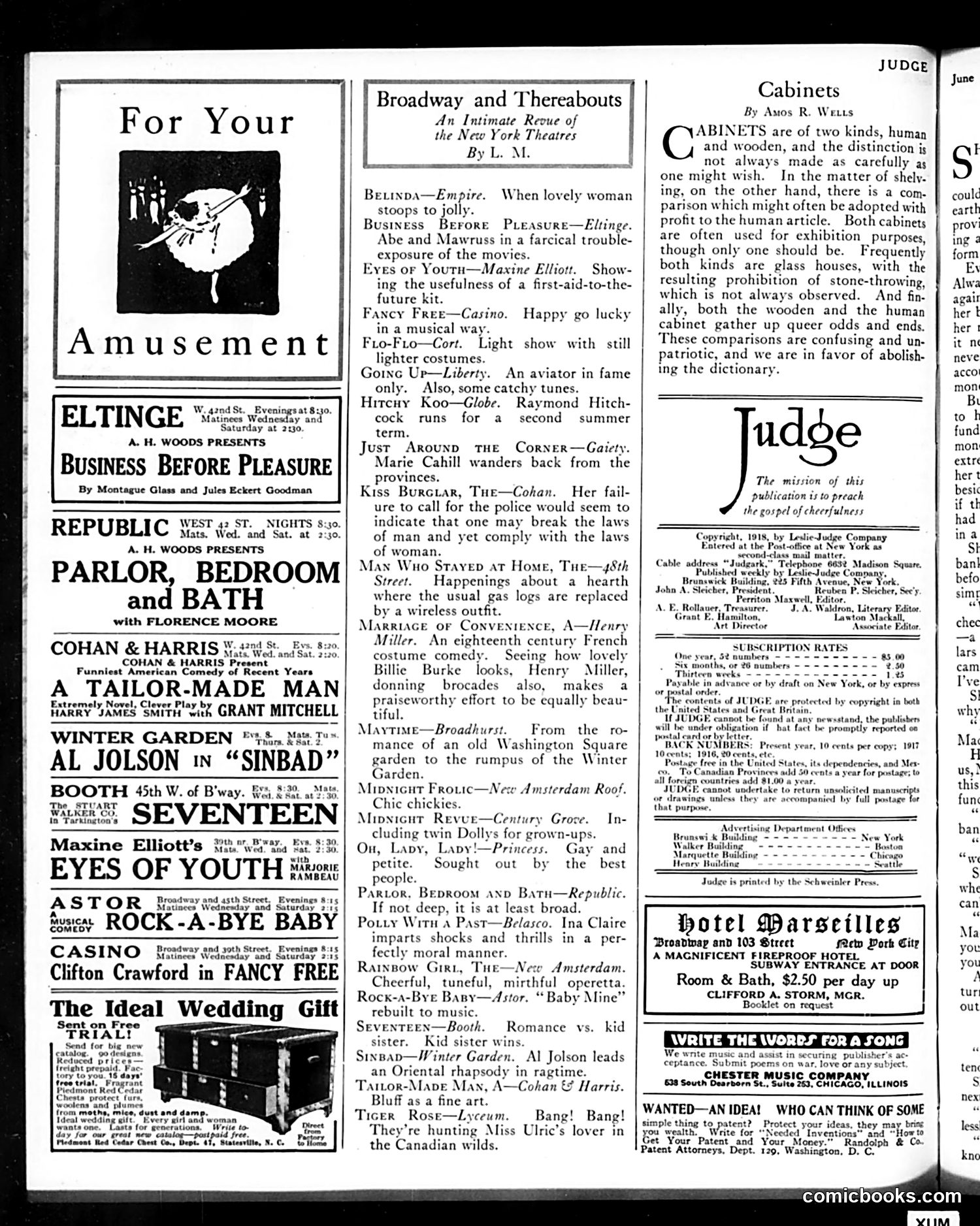
This is primarily a **theater advertisement and review page** from Judge magazine, circa 1918. The left side features Broadway theater advertisements for contemporary productions like Al Jolson's "Sinbad," "Seventeen," and "Eyes of Youth." The center contains a **theater column** reviewing current Broadway shows with brief, witty descriptions—typical of Judge's satirical style. For example, "Kiss Burglar" is mocked for its implausible premise that one can break human laws yet obey women's laws. The right side includes an editorial column on **cabinets** (human versus wooden storage furniture) making humorous comparisons about their similar purposes for displaying and organizing odds and ends. **No political cartoons appear on this page.** It's primarily advertising and light entertainment criticism, reflecting Judge's focus on urban, middle-class leisure activities during the early 20th century. The humor is gentle and domestic rather than satirically biting.
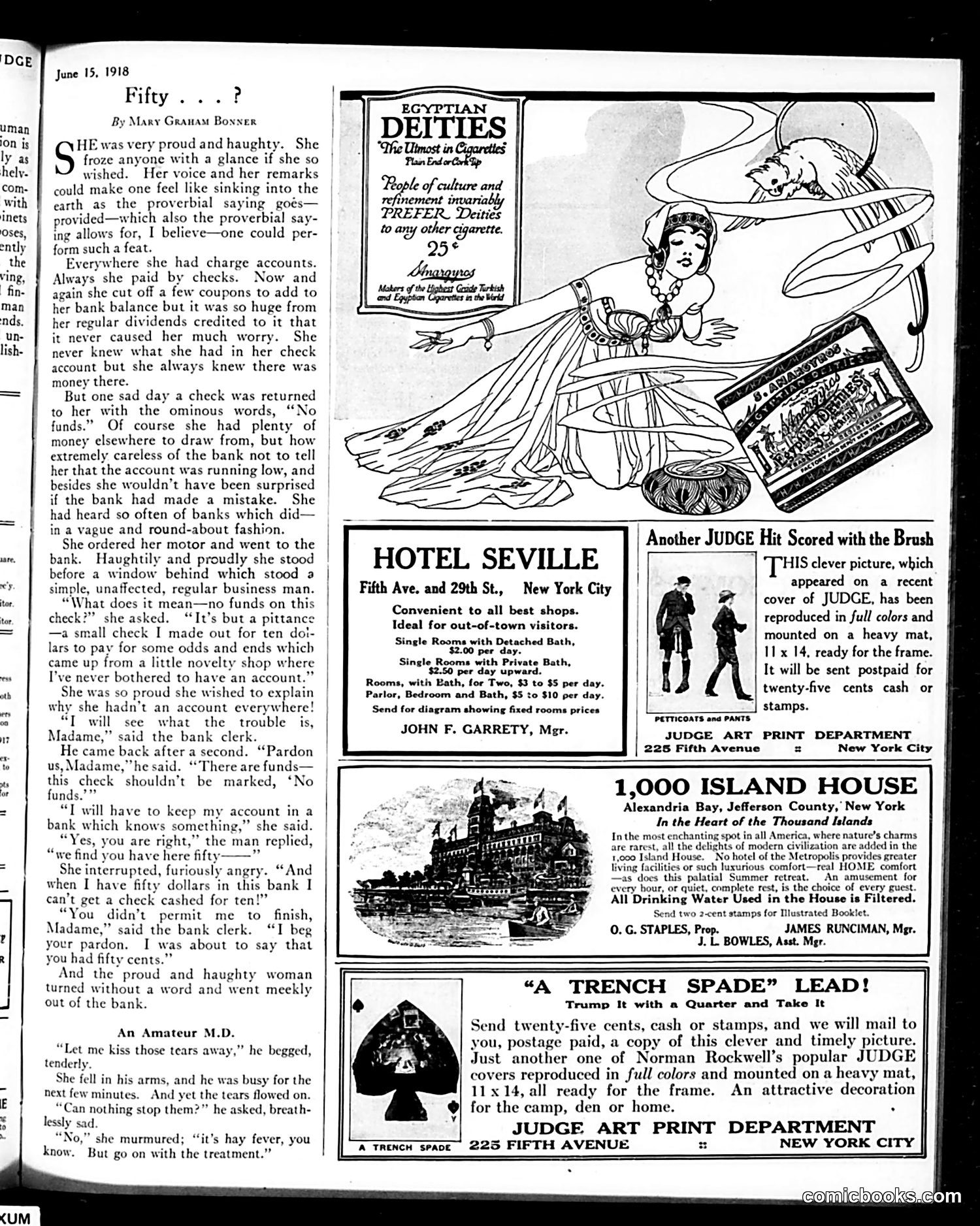
This story satirizes the deflation of upper-class pride through financial embarrassment. A wealthy, haughty woman—accustomed to charge accounts and dividend income—visits her bank after a check marked "No funds" is returned. She expects the bank clerk to apologize for the error; instead, he reveals she has only fifty *cents* remaining in her account, not the substantial balance she assumed. The satire targets her obliviousness about her own finances and her class-based expectation that service workers should manage her affairs. Her pride crumbles when confronted with reality: despite her wealth elsewhere, this particular account is depleted. She leaves "meekly," her haughtiness shattered by a simple bank clerk's matter-of-fact delivery of bad news. The humor relies on class inversion—a woman accustomed to "freezing" others with disdain is humbled by an ordinary working man. Published June 1918, it reflects wartime anxieties about economic uncertainty affecting even the wealthy.
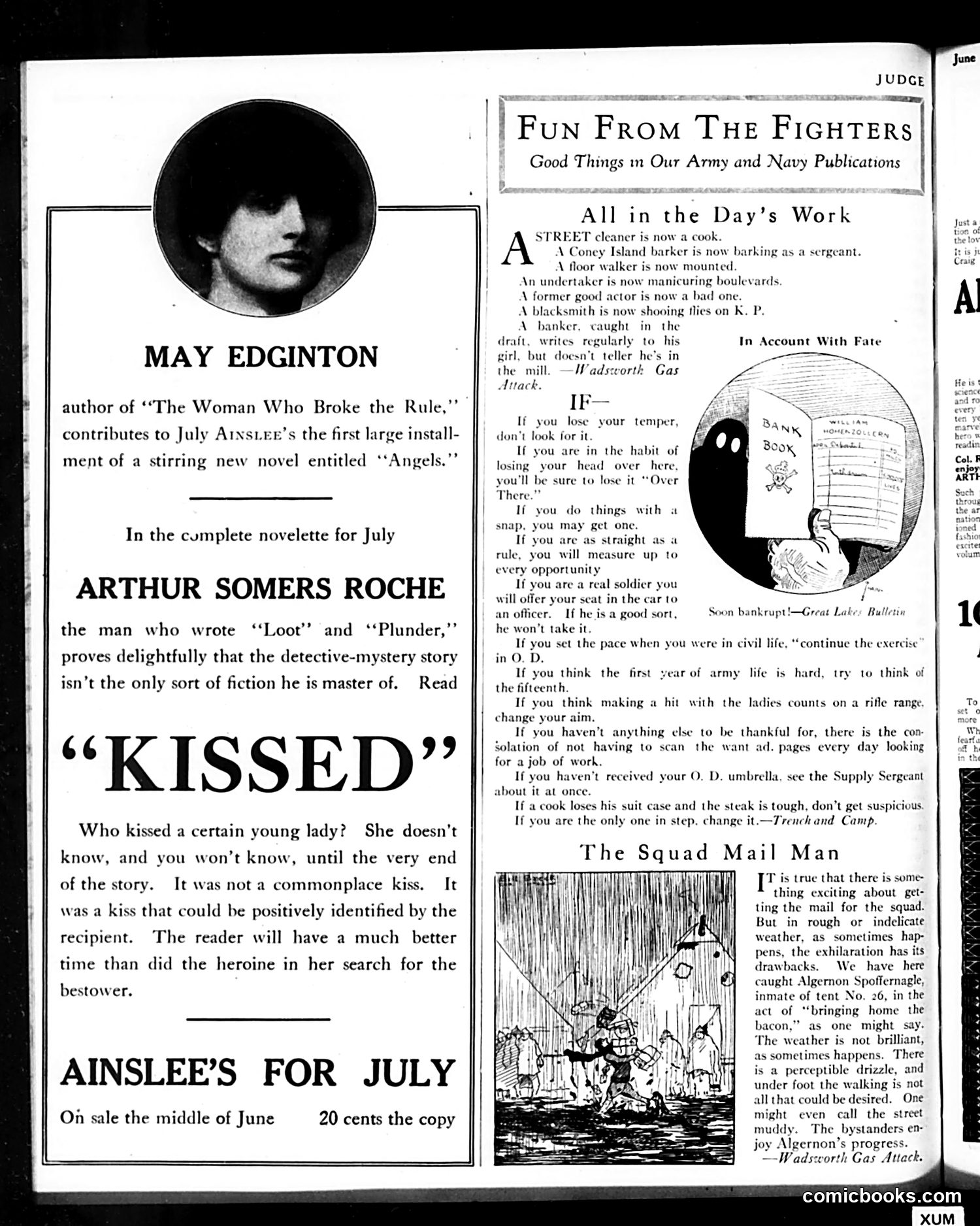
This is primarily **advertising and literary promotion** rather than political satire. The left side promotes upcoming fiction in *Ainslee's* magazine for July 1918, featuring authors May Edginton and Arthur Somers Roche, with a mystery story titled "Kissed." The right side contains **WWI-era military humor** from Army and Navy publications. The content includes: 1. **"All in the Day's Work"** — lighthearted observations about civilian workers conscripted into military roles (street cleaners becoming cooks, etc.), mocking the transition to wartime service. 2. **"The Squad Mail Man"** — a cartoon showing soldier Algernon Spoffernagle trudging through mud and rain to deliver mail, captioned "bringing home the bacon." The humor derives from the contrast between the romantic notion of mail delivery and the unglamorous reality of trudging through bad weather. Both sections reflect American WWI morale-building content, using gentle humor to depict soldiers' everyday experiences and adjust civilian expectations about military life.
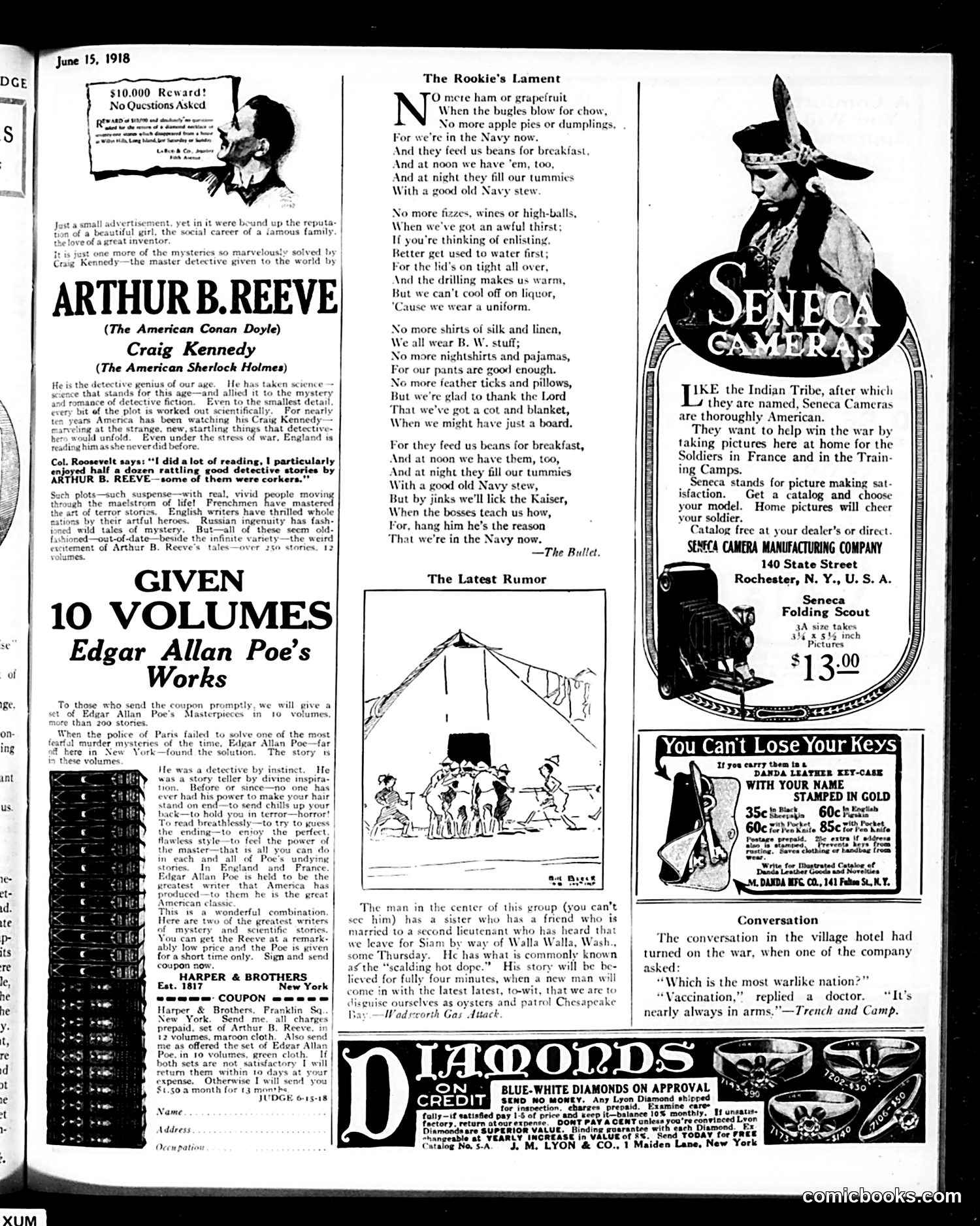
This page's main cartoon/poem satirizes the complaint of newly enlisted American sailors during World War I. The "rookie" laments the stark contrast between civilian and military life: no more ham, grapefruit, apple pies, alcohol, or comfortable clothing—replaced by beans, water, naval uniforms, and hard cots. The humor lies in the exaggerated melodrama of these mundane deprivations. The repeated refrain "That we're in the Navy now" emphasizes resignation to these sacrifices. There's a patriotic undercurrent—the soldier accepts discomfort as necessary wartime duty. **Context for modern readers:** This reflects 1918 America's massive military mobilization for WWI. The poem acknowledges real hardships enlisted men faced while maintaining that complaint itself was somewhat unpatriotic. The piece balances sympathy for recruits with gentle mockery of their homesickness, typical of wartime morale-building humor in *Judge* magazine.
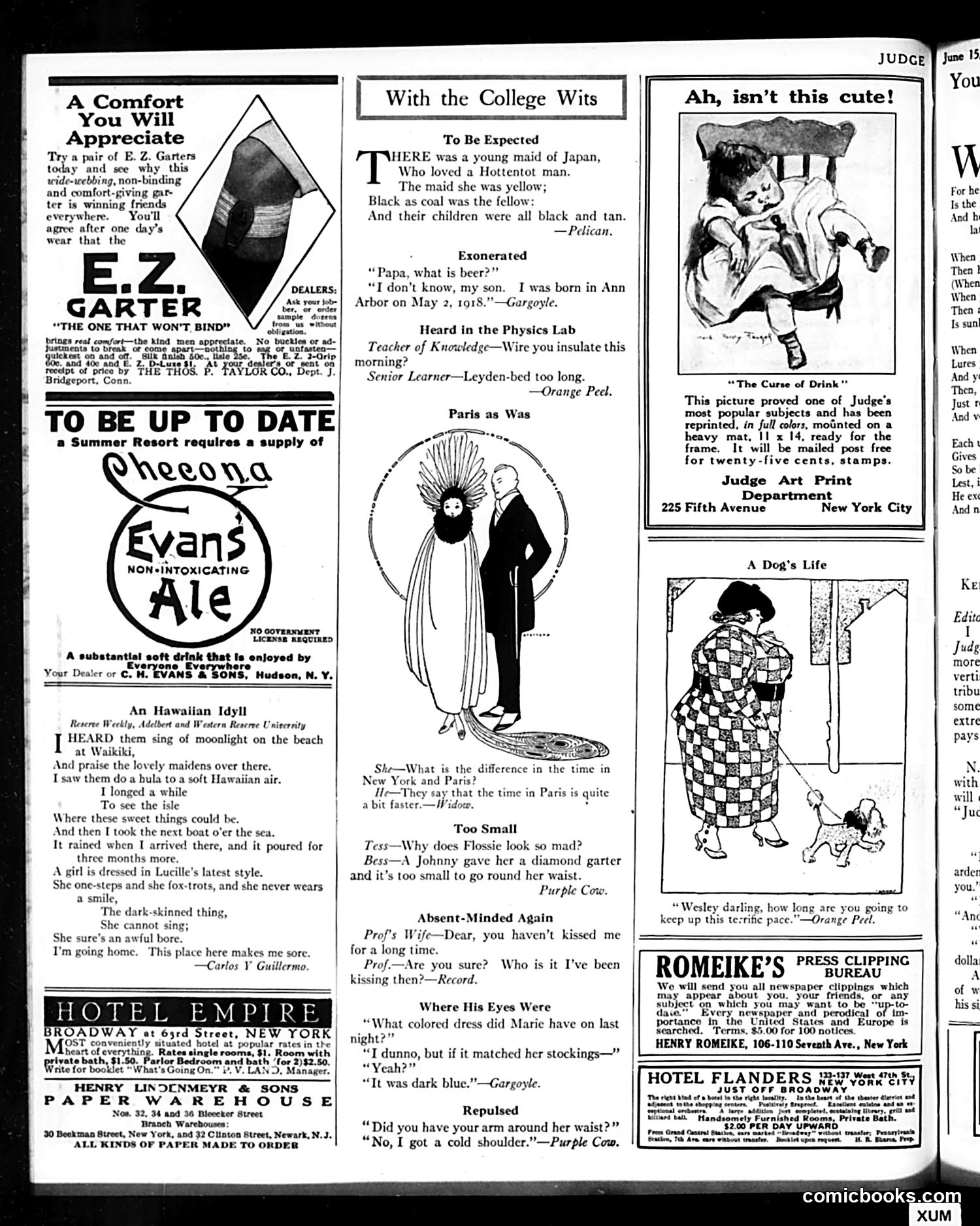
This page from Judge (a satirical weekly) contains mostly **humor columns, light verse, and advertisements**—typical filler content rather than political satire. **The notable cartoon** is "Paris as Was," showing a woman in an elaborate wedding dress beside a man. The accompanying joke plays on **time zone differences**: she asks about the time difference between New York and Paris; he suggests Paris time moves "faster" because "the time in Paris is quite a bit faster," implying the pace of life (or romance) there differs. This is genteel humor about cultural contrasts. **Other content** includes college jokes, humorous verses (like "An Hawaiian Idyll" romanticizing Hawaii), and quips about courtship and marriage. The piece "The Curse of Drink" appears to be about alcohol's effects on relationships. The **advertisements** (E.Z. Garters, Evans Ale, Hotel Empire, Henry Lindenmeyer paper warehouse) reflect early 20th-century consumer goods and services. Overall: **This is a humor/entertainment page with no significant political content**—typical light magazine fare from Judge's era.
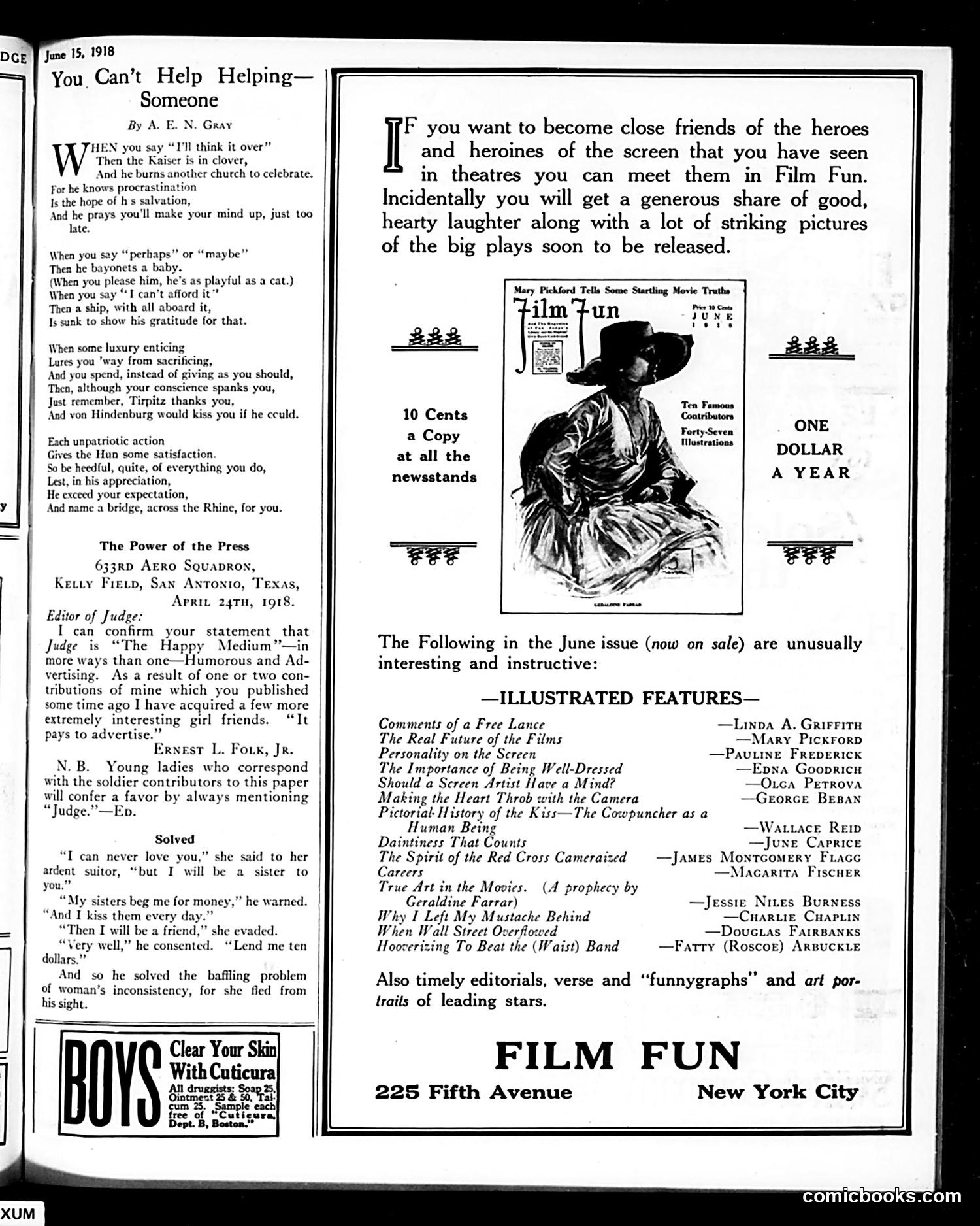
**The Main Content:** The left side presents a patriotic poem by A.E.N. Gray titled "You Can't Help Helping—Someone," directed at American civilians during WWI. It shames reluctance to sacrifice, claiming every hesitation helps "the Hun" (Germans). Each stanza depicts a specific reluctance—procrastination, cautious language, refusing to spend money—paired with consequences: the Kaiser celebrates, German generals are pleased, ships sink. The framing is visceral propaganda: delaying your decision means the Kaiser burns churches; saying "maybe" results in bayoneted babies. It weaponizes guilt, suggesting American inaction directly enables German atrocities. **Context:** Published April 1918 (printed June), America was actively fighting WWI. This reflects wartime messaging pressuring civilians toward maximum sacrifice—financial contributions, rationing, public support. The right side is advertising for *Film Fun* magazine, unrelated to the satire. This page exemplifies how *Judge* deployed patriotic poetry and emotional appeals to mobilize civilian commitment to the war effort.
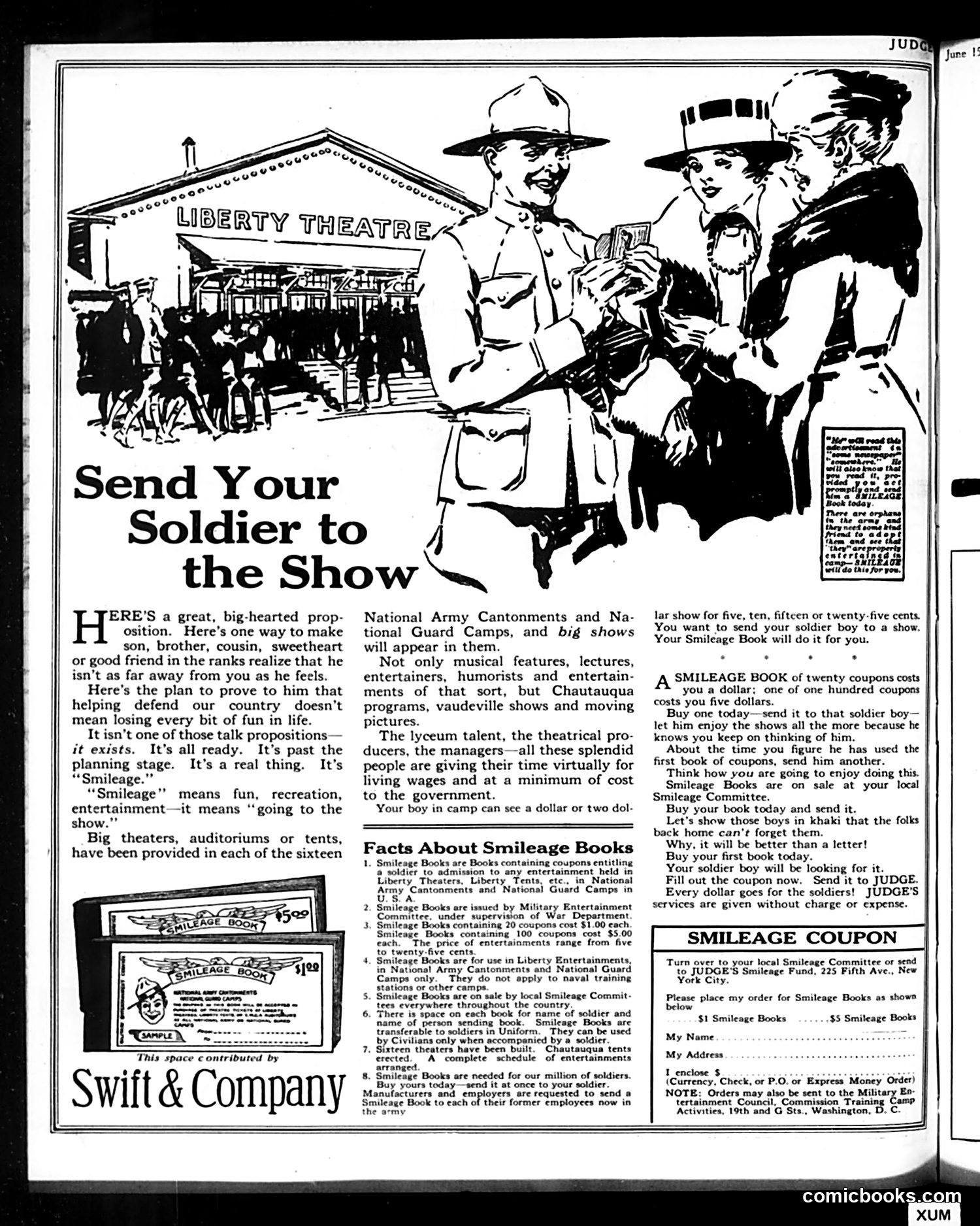
This is a WWI-era advertisement promoting "Smileage Books"—coupon booklets that allow soldiers in military camps to attend entertainments (theater, vaudeville, lectures) at reduced or free cost. The cartoon depicts a soldier in uniform being sent off to a show at the Liberty Theatre, with civilians presenting him entertainment options. The implicit message: sending your soldier loved one a Smileage Book is patriotic and emotionally meaningful—better than a letter. The "Facts About Smileage Books" section explains the practical details: $1 books contain 20 coupons; $5 books contain 100 coupons. These were sold by local committees and issued under War Department supervision. This reflects a broader WWI morale-boosting initiative to provide entertainment and recreation to troops at training camps. Swift & Company (a major meat packer) donated the advertisement space, a common corporate patriotic gesture of the era. The appeal combines emotional sentiment ("he isn't as far away from you as he feels") with practical philanthropy, positioning the purchase as both a gift and civic duty.
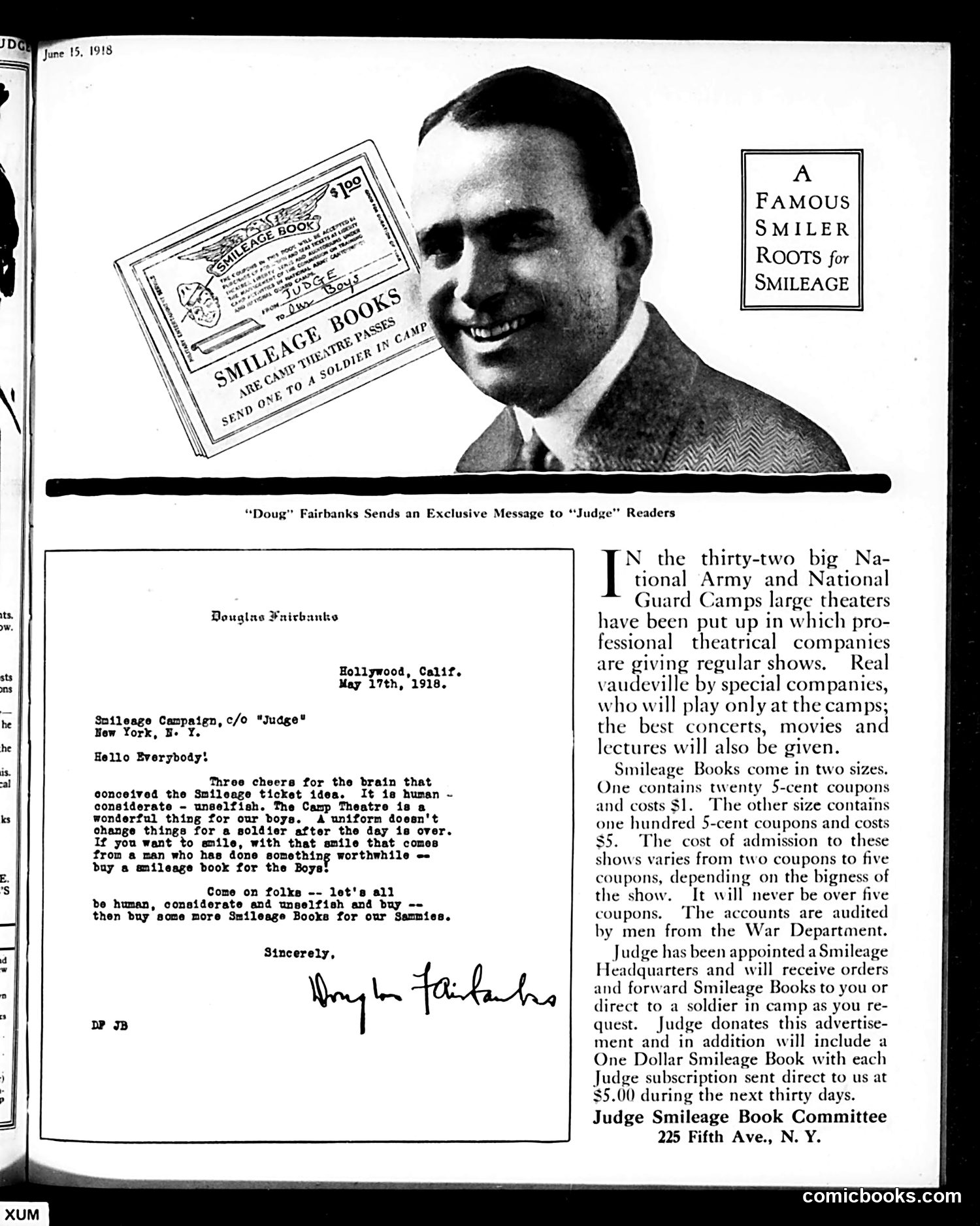
This page features actor **Douglas Fairbanks** endorsing the "Smileage" campaign—a wartime morale initiative for soldiers in WWI Army and National Guard camps. The campaign sold coupon booklets that funded entertainment (theater, vaudeville, concerts, movies) for enlisted men. Fairbanks, a famous silent-film star known for his broad smile and athletic charm, was an ideal celebrity spokesperson. His typed message appeals to patriotic sentiment: soldiers deserve morale-boosting entertainment after difficult days, and civilians should buy Smileage Books as an unselfish gesture. The accompanying text explains the logistics: booklets cost $1 (twenty 5-cent coupons) or $5 (hundred coupons), with War Department oversight. *Judge* magazine itself pledges to donate the advertisement and bundle a $1 book with subscriptions. This reflects 1918 homefront culture—mobilizing civilian support for troops through commercial patriotism and celebrity endorsement.
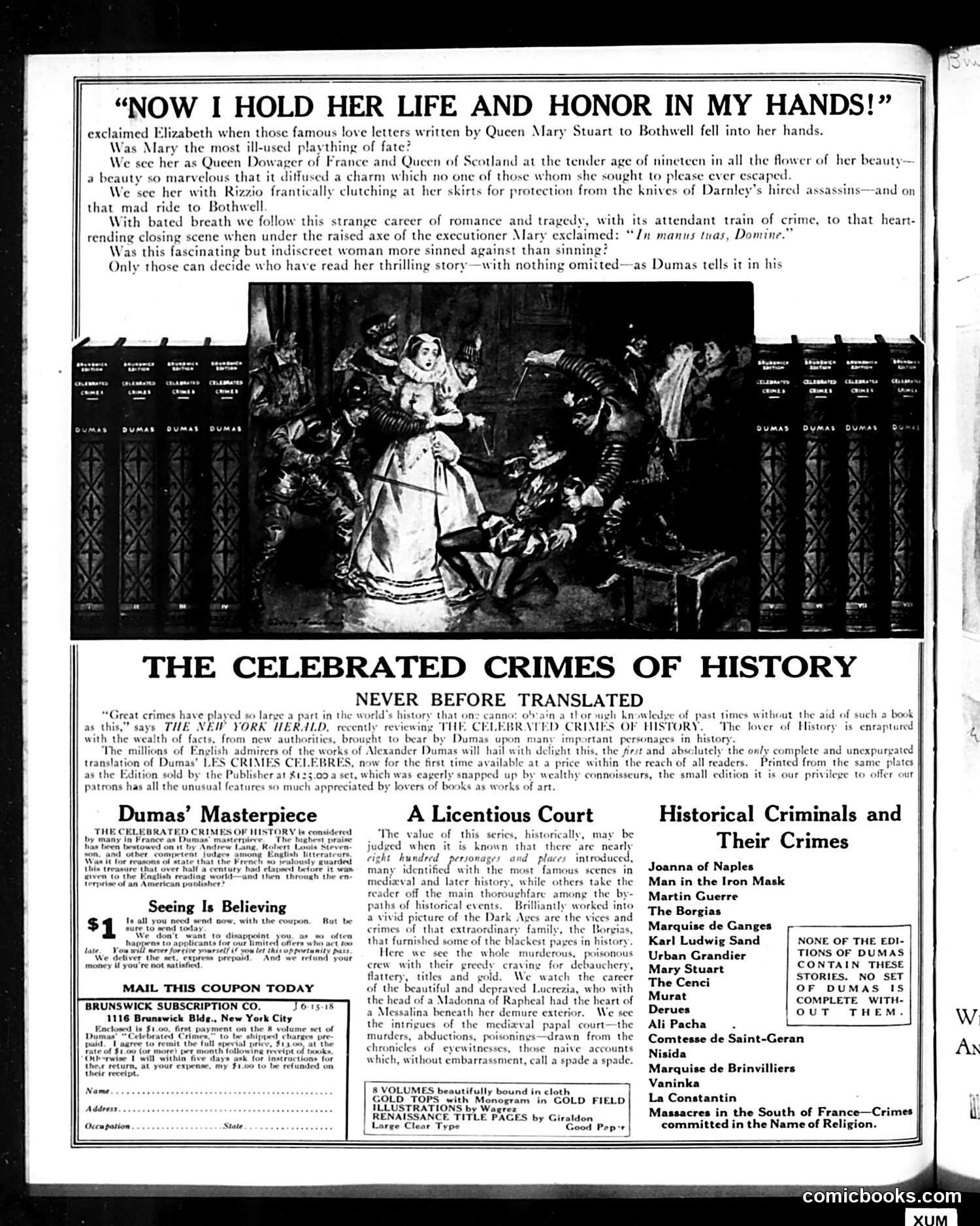
This is primarily a **book advertisement**, not political satire. It promotes Alexandre Dumas's *Celebrated Crimes of History*—a collection of historical crime narratives newly translated into English for the first time. The dramatic illustration depicts **Mary, Queen of Scots** at a moment of vulnerability, likely referencing her relationship with the Earl of Bothwell and the famous love letters that fell into Queen Elizabeth I's hands. The ad uses this sensational historical drama to sell the book series. The marketing emphasizes "never before translated" completeness and appeals to wealthy collectors ("small edition," "gold tops," "beautifully bound"). The list of crimes—the Borgias, the Cenci, poisonings, assassinations—highlights Dumas's appeal: lurid historical scandals presented as factual accounts. This reflects late 19th/early 20th-century taste for sensationalized history marketed as entertainment and luxury goods. The ad targets educated, affluent readers fascinated by crime and royal intrigue.