
Judge, 1918-06-15 · page 14 of 36
Judge — June 15, 1918 — page 14: what you’re looking at
What you’re looking at
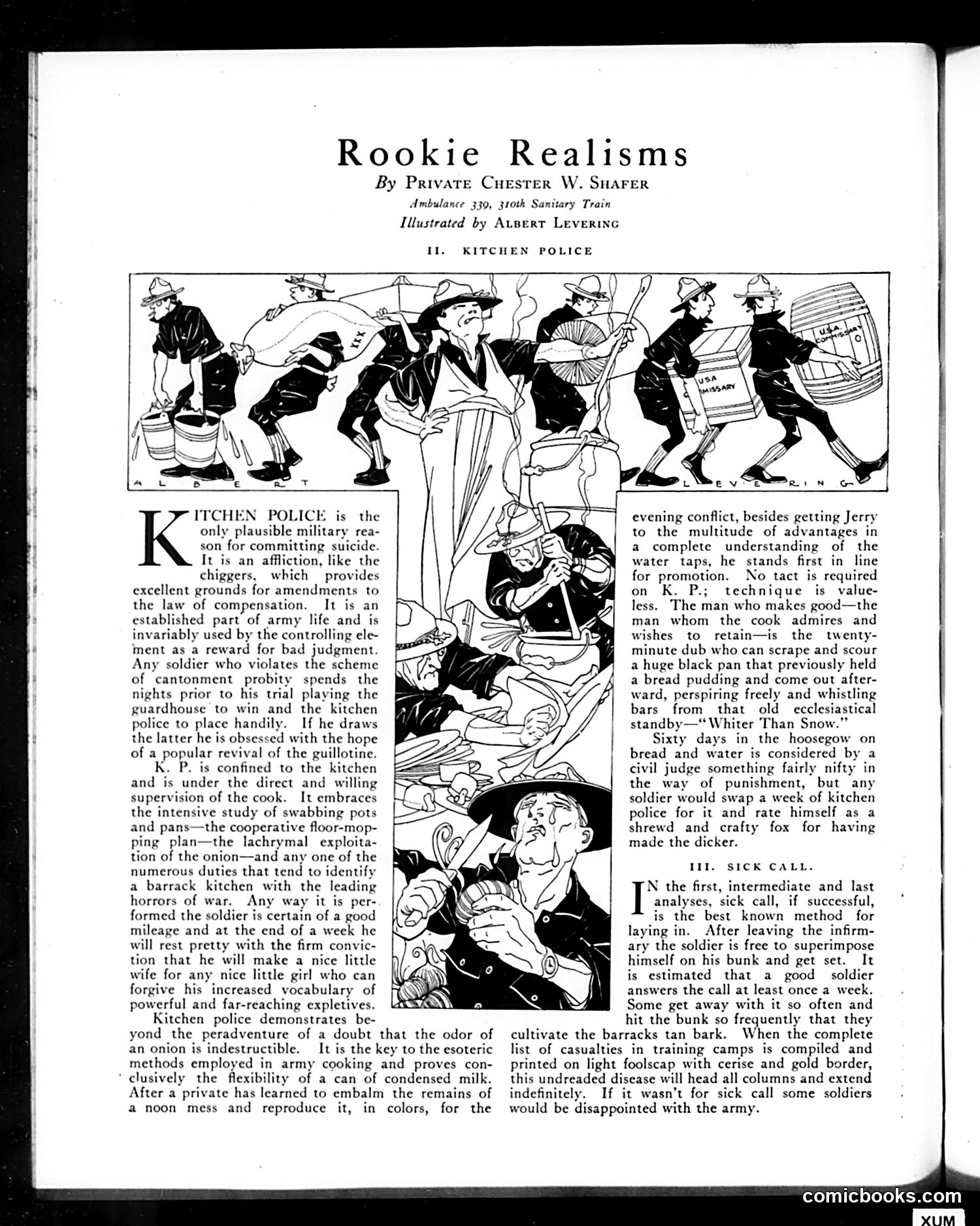
This WWI-era satirical piece by a soldier mocks army life through two common punishments/duties. "Kitchen Police" (K.P.) depicts soldiers assigned to kitchen duty as a consequence for breaking rules—scrubbing pots, mopping floors, and handling onions that permanently stain uniforms and bodies. The text sarcastically claims this odious punishment is preferable to worse consequences, and that soldiers emerging from K.P. would make decent wives due to their expanded profanity vocabulary. "Sick Call" ridicules soldiers who frequently fake illness to escape duty, lounging in the infirmary or barracks instead of working. The author estimates good soldiers visit sick call weekly, with some becoming so habitual that they develop a permanent "barracks tan" from lying around. Both segments present army discipline as absurd—using petty humiliations as control mechanisms—while celebrating soldiers' cunning workarounds. The humor targets military bureaucracy and the gap between official punishment and actual soldier behavior.
📄 Transcribed text from this page (OCR, searchable)
Machine-transcribed from the original scan — historical spelling and the odd misread are preserved.
Rookie Realisms By Private Cuester W. SHAFER Ambulance 330, 310th Sanitary Train Illustrated by Avpert LeveRInc Il. KITCHEN POLICE ITCHEN POLICE is the only plausible military rea- son for committing suicide. It is an affliction, like the chiggers, which provides excellent grounds for amendments to the law of compensation. It is an established part of army life and is invariably used by the controlling ele- ment as a reward for bad judgment. Any soldier who violates the scheme of cantonment probity spends the nights prior to his trial playing the guardhouse to win and the kitchen police to place handily. If he draws the latter he is obsessed with the hope of a popular revival of the guillotine. K. P. is confined to the kitchen and is under the direct and willing supervision of the cook. It embraces the intensive study of swabbing pots and pans—the cooperative floor-mop- ping plan—the lachrymal exploita- tion of the onion—and any one of the numerous duties that tend to identify a barrack kitchen with the leading horrors of war. Any way it is per- formed the soldier is certain of a good mileage and at the end of a week he will rest pretty with the firm convic- tion that he will make a nice little i) wife for any nice little girl who can forgive his increased vocabulary of ° iw Qo 4 powerful and far-reaching expletives. i& STON Kitchen police demonstrates be- yond the peradventure of a doubt that the odor of an onion is indestructible. It is the key to the esoteric methods employed in army cooking and proves con- * clusively the flexibility of a can of condensed milk. After a private has learned to embalm the remains of a noon mess and reproduce it, in colors, for the evening conflict, besides getting Jerry to the multitude of advantages in a complete understanding of the water taps, he stands first in line for promotion. No tact is required on K. P.; technique is value- less. The man who makes good—the man whom the cook admires and wishes to retain—is the twenty- minute dub who can scrape and scour a huge black pan that previously held a bread pudding and come out after- ward, perspiring freely and whistling bars from that old ecclesiastical standby—* Whiter Than Snow.” Sixty days in the hoosegow on bread and water is considered by a civil judge something fairly nifty in the way of punishment, but any soldier would swap a week of kitchen police for it and rate himself as a shrewd and crafty fox for having made the dicker. III, SICK CALL. N the first, intermediate and last I analyses, sick call, if successful, is the best known method for laying in. After leaving the infirm- ary the soldier is free to superimpose himself on his bunk and get set. It is estimated that a good soldier answers the call at least once a week. Some get away with it so often and hit the bunk so frequently that they cultivate the barracks tan bark. When the complete list of casualties in training camps is compiled and printed on light foolscap with cerise and gold border, this undreaded disease will head all columns and extend indefinitely. If it wasn’t for sick call some soldiers would be disappointed with the army. comicbooks.com XUM