
Judge, 1918-06-15 · page 25 of 36
Judge — June 15, 1918 — page 25: what you’re looking at
What you’re looking at
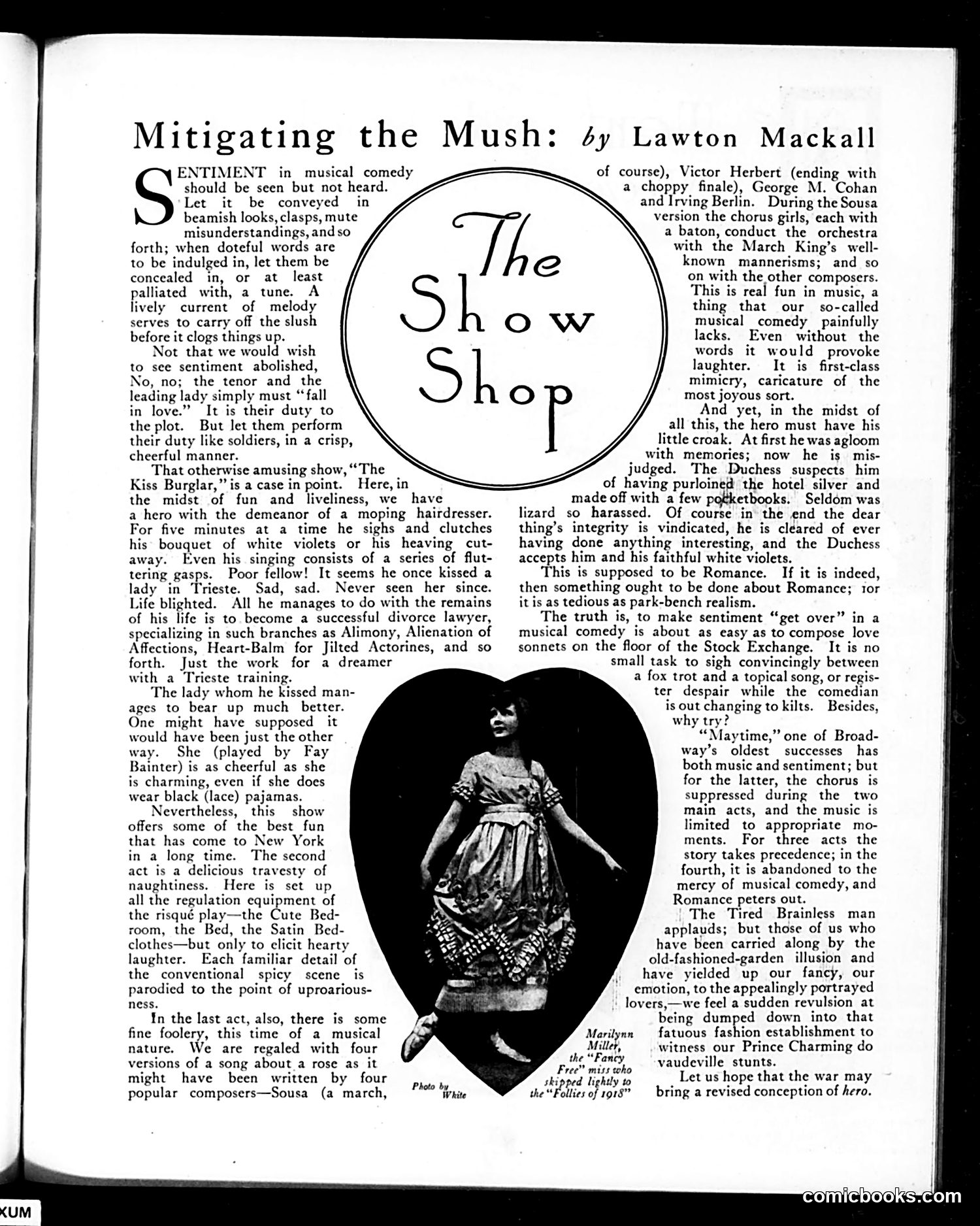
This is a theater review by Lawton Mackall critiquing sentimental excess in Broadway musical comedies. The piece attacks "The Kiss Burglar," a current show starring Fay Bainter, for undermining its comedy with melodramatic moping over a past romance in Trieste. Mackall argues that sentiment in musicals should be conveyed through action and expression, not prolonged emotional wallowing. He praises the show's clever second act (parodying bedroom farce tropes) and a brilliant finale featuring four composers (Sousa, Herbert, Cohan, Berlin) each scoring the same song differently, with chorus girls mimicking their conducting styles. The photograph shows Bainter in character costume. Mackall's core complaint: emotional sincerity and comic timing are fundamentally incompatible in musical theater—trying to achieve both simultaneously produces tedious bathos rather than genuine romance or laughter.
📄 Transcribed text from this page (OCR, searchable)
Machine-transcribed from the original scan — historical spelling and the odd misread are preserved.
ENTIMENT in musical comedy should be seen but not heard. Let it be conveyed in beamish looks, clasps, mute misunderstandings, and so forth; when doteful words are to be indulged in, let them be concealed in, or at least palliated with, a tune. A lively current of melody serves to carry off the slush before it clogs things up. Not that we would wish to see sentiment abolished, No, no; the tenor and the leading lady simply must “fall in love.” It is their duty to the plot. But let them perform their duty like soldiers, in a crisp, cheerful manner. That otherwise amusing show, “The Kiss Burglar,” is a case in point. Here, in the midst of fun and liveliness, we have a hero with the demeanor of a moping hairdresser. For five minutes at a time he sighs and clutches his bouquet of white violets or his heaving cut- away. Even his singing consists of a series of flut- tering gasps. Poor fellow! It seems he once kissed a lady in Trieste. Sad, sad. Never seen her since. Life blighted. All he manages to do with the remains of his life is to become a successful divorce lawyer, specializing in such branches as Alimony, Alienation of Affections, Heart-Balm for Jilted Actorines, and so forth. Just the work for a dreamer with a Trieste training. The lady whom he kissed man- ages to bear up much better. One might have supposed it would have been just the other way. She (played by Fay Bainter) is as cheerful as she is charming, even if she does wear black (lace) pajamas. Nevertheless, this show offers some of the best fun that has come to New York in a long time. The second act is a delicious travesty of naughtiness. Here is set up all the regulation equipment of the risqué play—the Cute Bed- room, the Bed, the Satin Bed- clothes—but only to clicit hearty laughter. Each familiar detail of the conventional spicy scene is parodied to the point of uproarious- ness. In the last act, also, there is some fine foolery, this time of a musical nature. We are regaled with four versions of a song about a rose as it might have been written by four popular composers—Sousa (a march, Photo by White Mitigating the Mush: 4y Lawton Mackall of course), Victor Herbert (ending with a choppy finale), George M. Cohan and Irving Berlin. During the Sousa version the chorus girls, each with a baton, conduct the orchestra with the March King’s well- known mannerisms; and so on with the other composers. This is real fun in music, a thing that our so-called musical comedy painfully lacks. Even without the words it would provoke laughter. It is first-class mimicry, caricature of the most joyous sort. And yet, in the midst of all this, the hero must have his little croak. At first he was agloom with memories; now he is mis- judged. The Duchess suspects him of having purloined the hotel silver and made off with a few potketbooks. Seldom was lizard so harassed. Of course in the end the dear thing’s integrity is vindicated, he is cleared of ever having done anything interesting, and the Duchess accepts him and his faithful white violets. This is supposed to be Romance. If it is indeed, then something ought to be done about Romance; tor it is as tedious as park-bench realism. The truth is, to make sentiment “get over” in a musical comedy is about as easy as to compose love sonnets on the floor of the Stock Exchange. It is no small task to sigh convincingly between a fox trot and a topical song, or regis- ter despair while the comedian is out changing to kilts. Besides, why try? “Maytime,” one of Broad- way’s oldest successes has both music and sentiment; but for the latter, the chorus is suppressed during the two main acts, and the music is limited to appropriate mo- ments. For three acts the story takes precedence; in the fourth, it is abandoned to the mercy of musical comedy, and Romance peters out. The Tired Brainless man applauds; but those of us who have been carried along by the old-fashioned-garden illusion and have yielded up our fancy, our emotion, to the appealingly portrayed lovers,—we feel a sudden revulsion at being dumped down into that fatuous fashion establishment to witness our Prince Charming do vaudeville stunts. Let us hope that the war may bring a revised conception of hero. Marilynn Milleb, the “Fancy Free” miss who shipped lightly to the “Follies of 1918”