
Judge, 1918-06-15 · page 17 of 36
Judge — June 15, 1918 — page 17: what you’re looking at
What you’re looking at
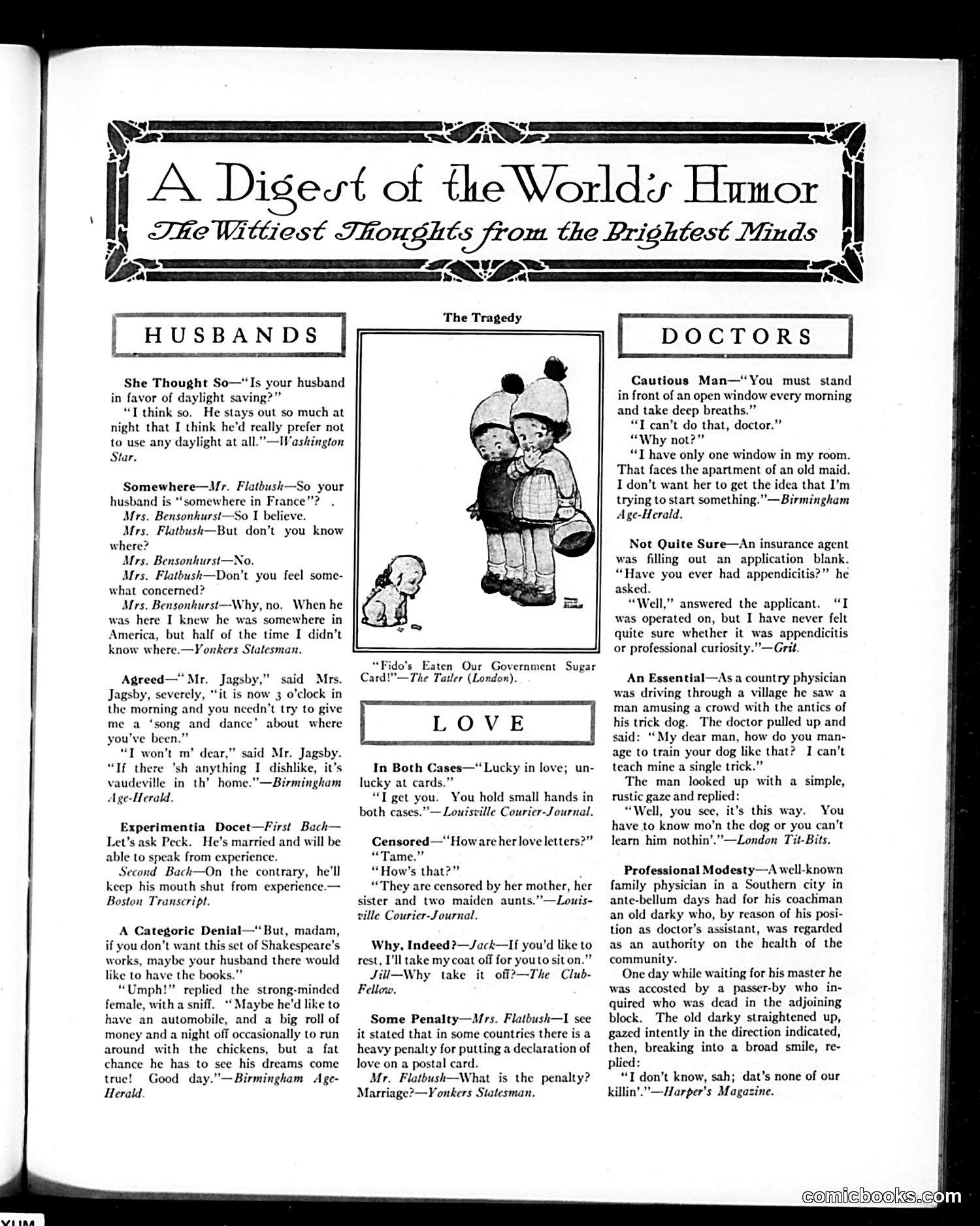
This page collects brief humorous anecdotes categorized as "Husbands," "Doctors," and "Love"—typical of early 20th-century magazine humor. The cartoons and jokes satirize domestic life and social conventions. The central illustration depicts a couple with a small dog, captioned "Fido's Eaten Our Government Sugar Card," referencing wartime rationing (likely WWI-era food controls). The jokes mock husbands for staying out late, wives for accepting ignorance of their whereabouts, and the awkwardness of married life. Doctors are ridiculed for simplistic advice or invasive curiosity. Love-related humor emphasizes censorship (letters screened by family) and the irony that getting engaged is a "penalty" for declaring love. The tone is lighthearted domestic comedy targeting middle-class audiences, with recurring characters like "Mr. Flatbush" suggesting ongoing social observation rather than specific political satire. The humor relies on gender stereotypes and marital discord as entertainment.
📄 Transcribed text from this page (OCR, searchable)
Machine-transcribed from the original scan — historical spelling and the odd misread are preserved.
= { iy: HUSBANDS She Thought So—"Is your husband in favor of daylight saving?” “I think so. He stays out so much at night that I think he'd really prefer not to use any daylight at all.” —IWashington Star. Somewhere—Mr. Flatbush—So your husband is ‘‘somewhere in France”? Mrs. Bensonhurst—So I believe. Mrs. Flatbush—But don’t you know where? Mrs. Bensonhurst—No. Mrs. Flatbush—Don't you feel some- what concerned? Mrs. Bensonhurst—Why, no. When he was here I knew he was somewhere in America, but half of the time I didn’t know where.—Yonkers Statesman. Jagsby,” said Mrs. ly, “it is now 3 o'clock in the morning and you ncedn’t try to give me a ‘song and dance’ about where you've been.” “T won't m’ dear,” said Mr. Jagsby. “Tf th ’sh anything I dishlike, it’s vaudeville in th’ home.”—Birmingham Age-Herald. Experimentia Docet—First Bach— Let’s ask Peck. He’s married and will be able to speak from experience. Second Bach—On the contrary, he'll keep his mouth shut from experience.— Boston Transcript. A Categoric Denial—“ But, madam, if you don’t want this set of Shakespeare’s works, maybe your husband there would like to have the books.” “Umph!” replied the strong-minded female, with a sniff. *‘ Maybe he'd like to have an automobile, and a big roll of money and a night off occasionally to run around with the chickens, but a fat chance he has to sce his dreams come truce! Good day.”—Birmingham Age- Herald. = Md BOSE. sS mas A Dis jest of the Worlds Einiortt By cme Whteoee THOT eh the Prightest Minds The Tragedy Eaten Our Government Sugar The Tatler (London). un- In Both Cases—“ Lucky in love; lucky at cards.” “T get you. You hold small hands in both cases.""— Louisville Courier-Journal. Censored—‘‘Howare her love letters?” “Tame.” “How’s that?” “They are censored by her mother, her sister and two maiden aunts.”—Louis- ville Courier-Journal. Why, Indeed ?—Jack—If you'd like to rest, I'll take my coat off for youto sit on.” Jill—Why take it off?—The Club- Fellow. Some Penalty—Mrs. Flatbush—I see it stated that in some countries there is a heavy penalty for putting a declaration of love on a postal card. Mr. Flatbush—What is the penalty? Marriage?—Yonkers Statesman. = =A DOCTORS Cautious Man—“You must stand in front of an open window every morning and take deep breaths.” “T can’t do that, doctor.” “Why not?” “T have only one window in my room. That faces the apartment of an old maid. I don’t want her to get the idea that I’m trying to start something.” —Birmingham Age-Herald. Not Quite Sure—An insurance agent was filling out an application blank. “Have you ever had appendicitis?” he asked. “Well,” answered the applicant. “I was operated on, but I have never felt quite sure whether it was appendicitis or professional curiosity.” —Grit. An Essential—As a country physician was driving through a village he saw a man amusing a crowd with the antics of his trick dog. The doctor pulled up and said: '‘My dear man, how do you man- age to train your dog like that? I can’t teach mine a single trick.” The man looked up with a simple, rustic gaze and replie “Well, you sce, it’s this way. You have to know mo’n the dog or you can’t learn him nothin’.”—London Tit-Bits. Professional Modesty—A well-known family physician in a Southern city in ante-bellum days had for his coacliman an old darky who, by reason of his posi- tion as doctor’s assistant, was regarded as an authority on the health of the community. One day while waiting for his master he was accosted by a passer-by who in- quired who was dead in the adjoining block. The old darky straightened up, gazed intently in the direction indicated, then, breaking into a broad smile, re- plied: “T don’t know, sah; dat’s none of our killin’.”—Harper’s Magazine. comichooks.