
Judge, 1918-06-15 · page 13 of 36
Judge — June 15, 1918 — page 13: what you’re looking at
What you’re looking at
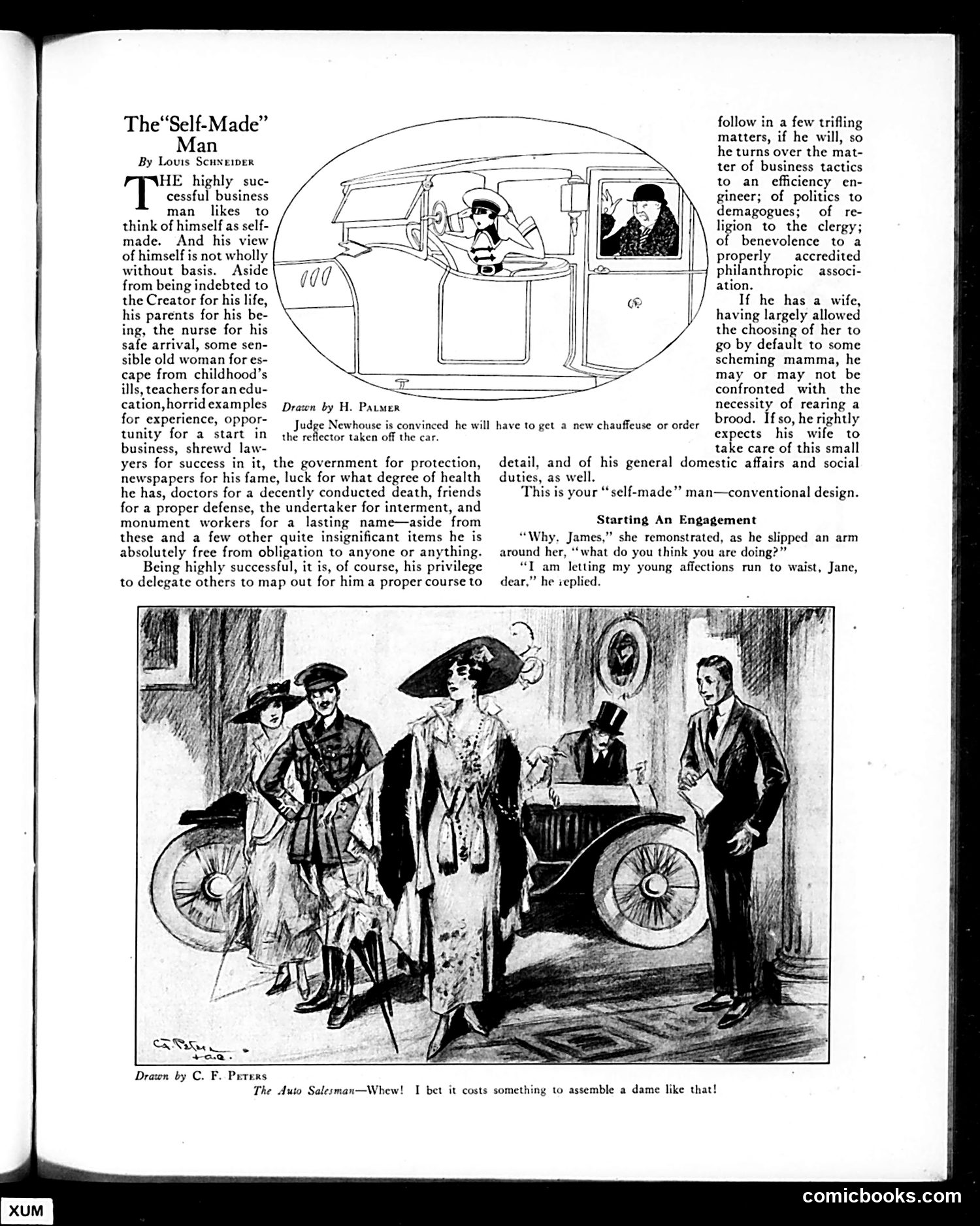
This page satirizes the American myth of the "self-made man" through Louis Schneider's essay and accompanying cartoons. **Main Article:** Schneider ironically catalogs all the help a supposedly "self-made" businessman actually receives—from parents, nurses, teachers, lawyers, government, newspapers, doctors, and undertakers—yet credits none of them. The satire shows how such men conveniently forget their debts while delegating responsibility for everything from politics to charity to wives. **Lower Cartoon:** Titled "The Auto Salesman," it depicts a car salesman marveling at an elaborately dressed woman, quipping that assembling "a dame like that" must cost something. This jokes about women as assemblages or possessions, fitting the article's theme of men taking credit while depending on others (here, wives they didn't "make"). **Context:** This reflects early 20th-century American debates about individualism versus social interdependence, alongside period attitudes about women's roles.
📄 Transcribed text from this page (OCR, searchable)
Machine-transcribed from the original scan — historical spelling and the odd misread are preserved.
The“‘Self-Made” Man By Louis Scuneiwer HE highly suc- | cessful business man likes to think of himself as self- made. And his view of himself is not wholly without basis. Aside from being indebted to the Creator for his life, his parents for his be- ing, the nurse for his safe arrival, some sen- sible old woman for es- follow in a few trifling matters, if he will, so he turns over the mat- ter of business tactics to an efficiency en- gineer; of politics to demagogues; of re- ligion to the clergy; of benevolence to a proper! accredited Philanthropic associ- ation. If he has a wife, having largely allowed the choosing of her to go by default to some scheming mamma, he may or may not be cape from childhood’s ills, teachers foranedu- cation, horrid examples for experience, oppor- tunity for a start in business, shrewd law- yers for success in it, the government for protection, newspapers for his fame, luck for what degree of health he has, doctors for a decently conducted death, friends for a proper defense, the undertaker for interment, and monument workers for a lasting name—aside from these and a few other quite insignificant items he is absolutely free from obligation to anyone or anything. Being highly successful, it is, of course, his privilege to delegate others to map out for hima proper course to Drawn by H. Parser the reflector taken off the car. Judge Newhouse is convinced he will have to get a new chauffeuse or order confronted with the necessity of rearing a brood. If so, he rightly expects his wife to take care of this small detail, and of his general domestic affairs and social duties, as well. This is your “self-made” man—conventional design. Starting An Engagement “Why, James,” she remonstrated, as he slipped an arm around her, “what do you think you are doing?” “T am letting my young affections run to waist, Jane, dear,” he ieplied. Drawn by C. F. Peters The Auto Salesman—Whew! I bet it costs something to assemble a dame like that! comicbooks.com