
Judge, 1918-06-15 · page 12 of 36
Judge — June 15, 1918 — page 12: what you’re looking at
What you’re looking at
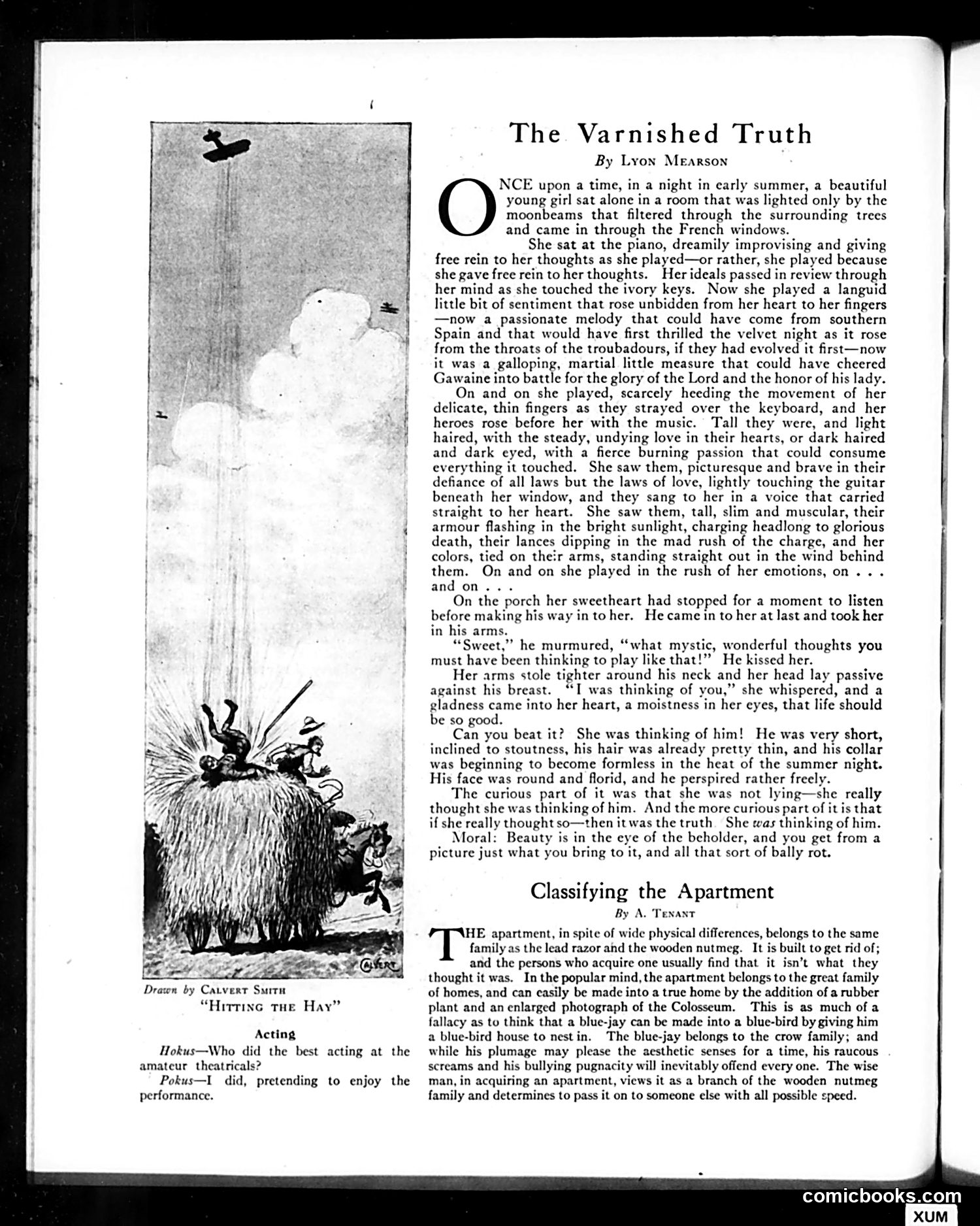
**"The Varnished Truth"** is a romantic satire about self-deception. A young woman plays piano and imagines herself surrounded by heroic, idealized suitors—tall, passionate knights and soldiers. When her actual boyfriend arrives—described as short, stout, balding, and perspiring—she claims she was thinking of him all along. The joke's bitter moral: she wasn't lying, because she genuinely convinced herself her mediocre reality matched her fantasy. "Beauty is in the eye of the beholder" and we see what we want to see. The cartoon (showing the imagined lovers) contrasts sharply with the text's deflating conclusion. **"Classifying the Apartment"** mocks the apartment as a deceptive housing product—grouped with frauds like the "lead razor" and "wooden nutmeg" (historical con-artist items). People buy apartments expecting a "true home" but get something fundamentally different. Adding plants or photos doesn't change what it actually is. The piece satirizes both the apartments themselves and buyers' wishful thinking. Both pieces target self-deception and false expectations—recurring themes in satirical commentary.
📄 Transcribed text from this page (OCR, searchable)
Machine-transcribed from the original scan — historical spelling and the odd misread are preserved.
The Varnished Truth By Lyon Mearson NCE upon a time, in a night in carly summer, a beautiful young girl sat alone in a room that was lighted only by the moonbeams that filtered through the surrounding trees and came in through the French windows. She sat at the piano, dreamily improvising and giving free rein to her thoughts as she played—or rather, she played because she gave free rein to her thoughts. Her ideals passed in review through her mind as she touched the ivory keys. Now she played a languid little bit of sentiment that rose unbidden from her heart to her fingers —now a passionate melody that could have come from southern Spain and that would have first thrilled the velvet night as it rose from the throats of the troubadours, if they had evolved it first—now it was a galloping, martial little measure that could have cheered Gawaine into battle for the glory of the Lord and the honor of his lady. On and on she played, scarcely heeding the movement of her delicate, thin fingers as they strayed over the keyboard, and her heroes rose before her with the music. Tall they were, and light haired, with the steady, undying love in their hearts, or dark haired and dark eyed, with a fierce burning passion that could consume everything it touched. She saw them, picturesque and brave in their defiance of all laws but the laws of love, lightly touching the guitar beneath her window, and they sang to her in a voice that carried straight to her heart. She saw them, tall, slim and muscular, their armour flashing in the bright sunlight, charging headlong to glorious death, their lances dipping in the mad rush of the charge, and her colors, tied on their arms, standing straight out in the wind behind them. On and on she played in the rush of her emotions, on... and on.. On the porch her sweetheart had stopped for a moment to listen before making his way in to her. He came in to her at last and took her in his arms. “Sweet,” he murmured, “what mystic, wonderful thoughts you must have been thinking to play like that!” He kissed her. Her arms stole tighter around his neck and her head lay passive against his breast. “I was thinking of you,” she whispered, and a gladness came into her heart, a moistness in her eyes, that life should be so good. Can you beat it? She was thinking of him! He was very short, inclined to stoutness, his hair was already pretty thin, and his collar was beginning to become formless in the heat of the summer night. His face was round and florid, and he perspired rather freely. The curious part of it was that she was not lying—she really thought she was thinking of him. And the more curious part of itis that if she really thought so—then itwas the truth. She was thinking of him. Moral: Beauty is in the eye of the beholder, and you get from a picture just what you bring to it, and all that sort of bally rot. Classifying the Apartment By A. Tenant HE apartment, in spite of wide physical differences, belongs to the same | family as the lead razor and the wooden nutmeg. It is built to get rid of; and the persons who acquire one usually find that it isn’t what they - thought it was. In the popular mind, the apartment belongs to the great family Drawn by Carvert Sait of homes, and can easily be made into a true home by the addition of a rubber “Hittinc tHe Hay” plant and an enlarged photograph of the Colosseum. This is as much of a fallacy as to think that a blue-jay can be made into a blue-bird by giving him Acting a blue-bird house to nest in. The blue-jay belongs to the crow family; and Hokus—Who did the best acting at the while his plumage may please the aesthetic senses for a time, his raucous amateur theatricals? screams and his bullying pugnacity will inevitably offend every one. The wise Pokus—I did, pretending to enjoy the man,in acquiring an apartment, views it as a branch of the wooden nutmeg performance, family and determines to pass it on to someone else with all possible speed. comicbooks.com