
Judge, 1918-06-15 · page 23 of 36
Judge — June 15, 1918 — page 23: what you’re looking at
What you’re looking at
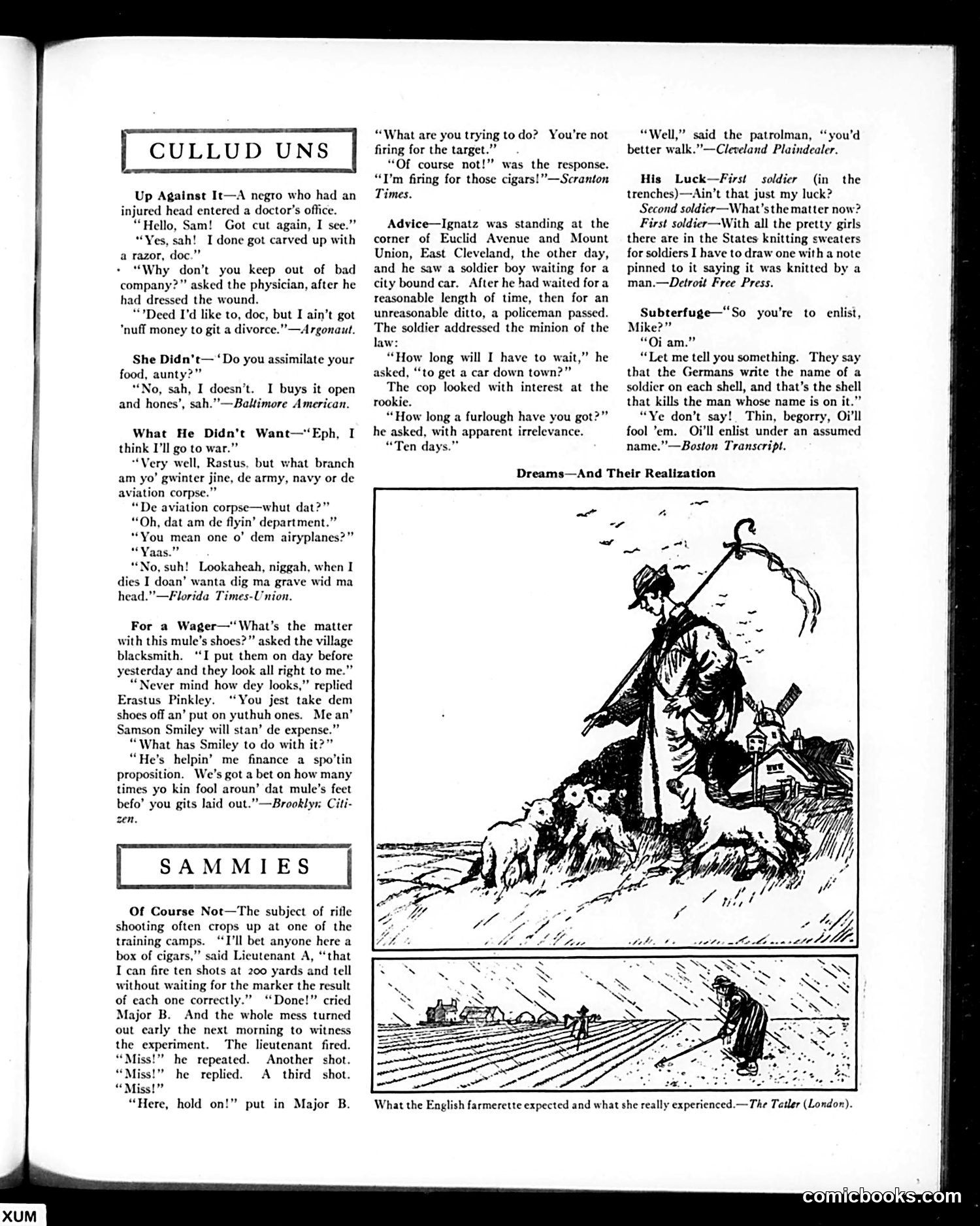
This page from Judge (likely WWI-era, given references to trenches and military training camps) contains several racist dialect jokes and military humor typical of the period. The main content comprises short humorous anecdotes, most employing heavy stereotypical Black dialect to mock African American characters. These jokes rely on period racial caricatures—portraying Black speakers as illiterate, violent, and foolish. The "Sammies" section shifts focus to WWI soldiers ("Sammies" was slang for American servicemen). These jokes mock military incompetence, training camp absurdities, and soldiers' anxieties about combat and romantic separation. The two illustrations below titled "Dreams—And Their Realization" satirize the gap between soldiers' romantic expectations and grim battlefield reality. **The satire's appeal lay in mocking both racial stereotypes and military bureaucratic incompetence**—humor that, while offensive today, reflected contemporary attitudes toward both Black Americans and the chaos of wartime mobilization.
📄 Transcribed text from this page (OCR, searchable)
Machine-transcribed from the original scan — historical spelling and the odd misread are preserved.
Up Against It—A negro who had an injured head entered a doctor’s office. “Hello, Sam! Got cut again, I see.” “Yes, sah! I done got carved up with a razor, doc.” “Why don’t you keep out of bad company?” asked the physician, after he had dressed the wound. “Deed I'd like to, doc, but I ain’t got ‘nuff money to git a divorce.” —Argonaut. She Didn’t— ‘Do you assimilate your food, aunty?” “No, sah, I doesn’t. I buys it open and hones’, sah.” —Bakimore American. What He Didn't Want—*Eph, I think I'll go to war.” “Very v Rastus, but what branch am yo’ gwinter jine, de army, navy or de aviation corpse.” “De aviation corpse—whut dat?” “Oh, dat am de flyin’ department.” “You mean one o’ dem airyplanes?” “Yaas.” “No, suh! Lookaheah, niggah, when I dies I doan’ wanta dig ma grave wid ma head.”"—Florida Times-Union. For a Wager—"What’s the matter with this mule’s shoes?” asked the village blacksmith. ‘I put them on day before yesterday and they look all right to me.” “Never mind how dey looks,” replied Erastus Pinkley. ‘‘You jest take dem shoes off an’ put on yuthuh ones. Mean’ Samson Smiley will stan’ de expense.” “What has Smiley to do with it?” “He's helpin’ me finance a spo'tin proposition. We’s got a bet on how many times yo kin fool aroun’ dat mule’s feet befo’ you gits laid out.”—Brooklyx Citi- zen. | SAMMIES | Of Course Not—The subject of rifle shooting often crops up at one of the training camps. “I'll bet anyone here a box of cigars,” said Licutenant A, “that I can fire ten shots at 200 yards and tell without waiting for the marker the result of each one correctly.” “Done!” cried Major B. And the whole mess turned out carly the next morning to witness the experiment. The lieutenant fired. “Miss!” he repeated. Another shot. “Miss!” he replied. A third shot. “Miss!” “Here, hold on!” put in Major B. “What are you trying todo? You're not firing for the target.” “Of course not!” was the response. “I’m firing for those cigars!”"—Scranton Times. Advice—Ignatz was standing at the corner of Euclid Avenue and Mount Union, East Cleveland, the other day, and he saw a soldier boy waiting for a city bound car. After he had waited fora reasonable length of time, then for an unreasonable ditto, a policeman passed. The soldier addressed the minion of the law: “How long will I have to wait,” he asked, “to get a car down town?” The cop looked with interest at the rookie. “How long a furlough have you got?” he asked, with apparent irrelevance. “Ten days. “Well,” said the patrolman, “you'd better walk.”’—Cleveland Plaindealer. His Luck—First soldier (in the trenches)—Ain’t that just my luck? Second soldier—What’sthe matter now? First soldier—With all the pretty girls there are in the States knitting sweaters for soldiers I have to draw one with a note pinned to it saying it was knitted by a man.—Detroit Free Press. Subterfuge—“‘So you're to enlist, Mike?” “Oi am.” “Let me tell you something. They say that the Germans write the name of a soldier on each shell, and that’s the shell that kills the man whose name is on it.” “Ye don’t say! Thin, begorry, Oi’ll fool ’em. i'll enlist under an assumed name.”—Boston Transcript. Dreams—And Their Realization