
Judge, 1918-06-15 · page 18 of 36
Judge — June 15, 1918 — page 18: what you’re looking at
What you’re looking at
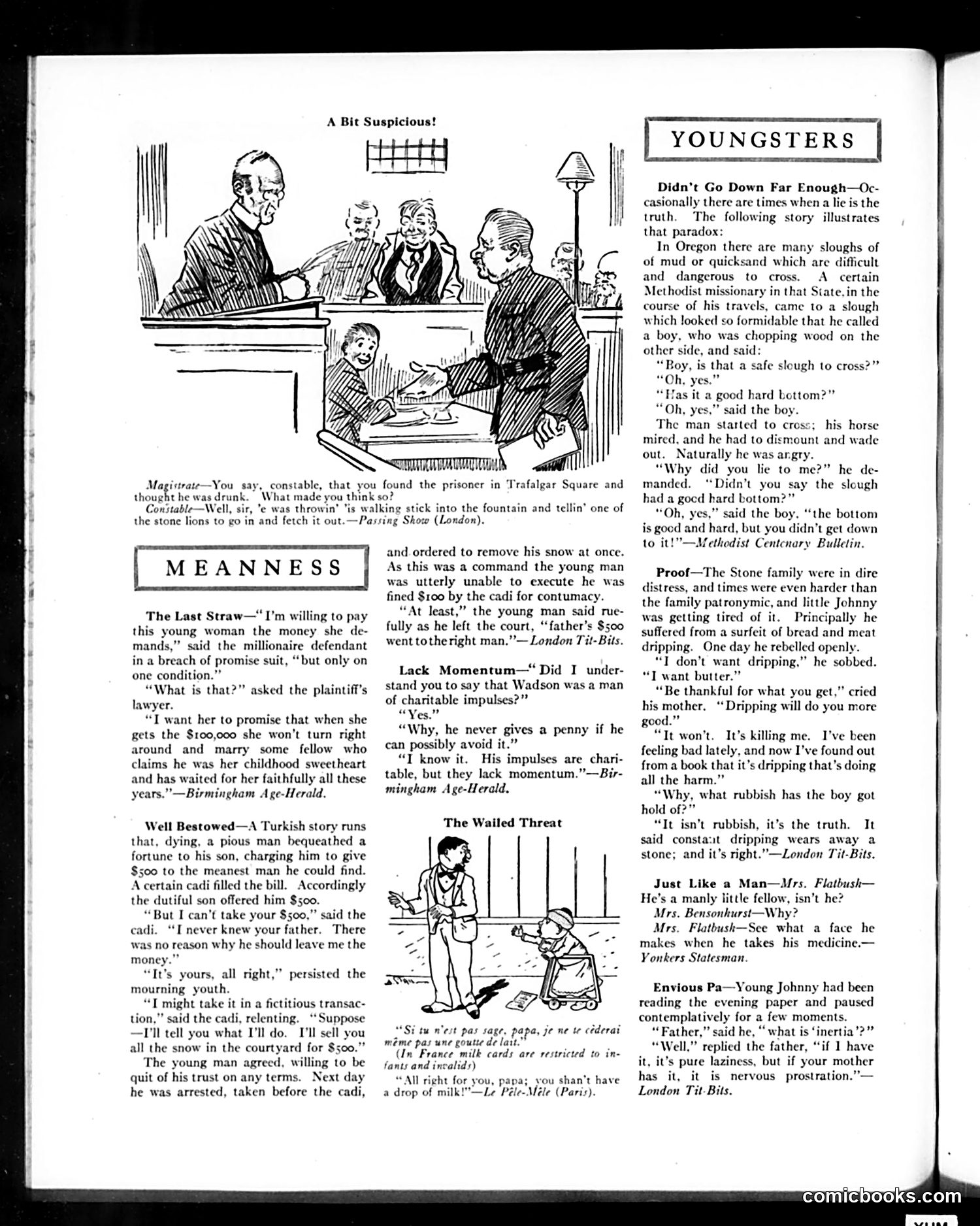
The top cartoon depicts a magistrate interrogating a constable about a prisoner found in Trafalgar Square. The constable reports the man was throwing his walking stick into a fountain and ordering stone lions to fetch it—behavior suggesting drunkenness or mental disturbance. The satire mocks the constable's literal-minded police work: he mistakes eccentric behavior for intoxication without considering other explanations. The joke relies on the absurdity of the situation and plays on period British attitudes about proper public conduct. The cartoon serves as social commentary on law enforcement competence and the gap between appearance and reality—a recurring theme in Judge magazine's satirical approach to contemporary life.
📄 Transcribed text from this page (OCR, searchable)
Machine-transcribed from the original scan — historical spelling and the odd misread are preserved.
A Bit Suspicious! Magistrate—You say, constable, that you found the prisoner in ‘Trafalgar Square and thought he was drunk. What made you Constable—Well, sir, "e was throwin’ ? walking stick into the fountain and tellin’ one of the stone lions to go in and fetch it out.—Passing Show (London). | MEANNESS The Last Straw—" I'm willing to pay this young woman the money she de- mands,” said the millionaire defendant in a breach of promise suit, “but only on one condition.” “What is that?” asked the plaintiff's lawyer. “TI want her to promise that when she gets the $100,000 she won't turn right around and marry some fellow who claims he was her childhood sweetheart and has waited for her faithfully all these years.” —Birmingham Age-Herald. Well Bestowed—A Turkish story runs that, dying, a pious man bequeathed a fortune to his son, charging him to give $500 to the meanest man he could find. A certain cadi filled the bill. Accordingly the dutiful son offered him $500. “But I can’t take your $500,” said the cadi. “I never knew your father. There was no reason why he should leave me the money.” “It’s yours, all right,”’ persisted the mourning youth. “T might take it in a fictitious transac- tion,” said the cadi, relenting. “Suppose —I'll tell you what I'll do. I'll sell you all the snow in the courtyard for $500.” The young man agreed, willing to be quit of his trust on any terms. Next day he was arrested, taken before the cadi, and ordered to remove his snow at once. As this was a command the young man was utterly unable to execute he was fined $100 by the cadi for contumacy. “At least,” the young man said rue- fully as he left the court, “father’s $500 went totheright man.”— London Tit-Bits. Lack Momentum—* Did I under- stand you to say that Wadson was a man of charitable impulses?” “Yes.” “Why, he never gives a penny if he can possibly avoid it.” “T know it. His impulses are chari- table, but they lack momentum.”—Bir- mingham Age-Herald. The Wailed Threat “Si tu n'est pas sage, papa, je ne te céderai meme pas une goutte de lait.” (In France milk cards are restricted to in- fants and invalids) “All right for you, papa; vou shan’t have a drop of milk!"—Le Péle-Méle (Paris). | YOUNGSTERS Didn't Go Down Far Enough—Oc- casionally there are times when a lie is the truth. The following story illustrates that paradox: In Oregon there are many sloughs of of mud or quicksand which are difficult and dangerous to cross. A_ certain Methodist missionary in that Siate.in the course of his travels, came to a slough which looked so formidable that he called a boy, who was chopping wood on the and said: that a safe slough to cross?” “Fas it a good hard bottom?” “Oh, yes,” said the boy. The man started to cross; his horse mired, and he had to dismount and wade out. Naturally he was angry. “Why did you lie to me?” he de- manded. ‘Didn't you say the slough had a gocd hard bottom?” “Oh, yes,” said the boy, “the bottom is good and hard, but you didn’t get down to it!" —Methodist Centenary Bulletin. Proof—The Stone family were in dire distress, and times were even harder than the family patronymic, and little Johnny was getting tired of it. Principally he suffered from a surfeit of bread and meat dripping. One day he rebelled openly. “I don’t want dripping,” he sobbed. “IT want butter.” “Be thankful for what you get,” cried his mother, “Dripping will do you more good.” “Tt won't. It’s killing me. I've been feeling bad lately, and now I've found out from a book that it’s dripping that’s doing all the harm.” “Why, what rubbish has the boy got hold of?” “It isn’t rubbish, it’s the truth. It said constant dripping wears away a stone; and it’s right.”—London Tit-Bits. Just Like a Man—Mrs. Flatbush— He's a manly little fellow, isn’t he? Mrs. Bensonhurst—Why? Mrs. Flatbush—See what a face he makes when he takes his medicine.— Yonkers Statesman. Envious Pa—Young Johnny had been reading the e' ng paper and paused contemplatively for a few moments. “Father,” said he, “ what is ‘inertia’?”” “Well,” replied the father, “if 1 have it, it’s pure laziness, but if your mother has it, it is nervous prostration.”— London Tit Bits.