
Judge, 1918-06-15 · page 16 of 36
Judge — June 15, 1918 — page 16: what you’re looking at
What you’re looking at
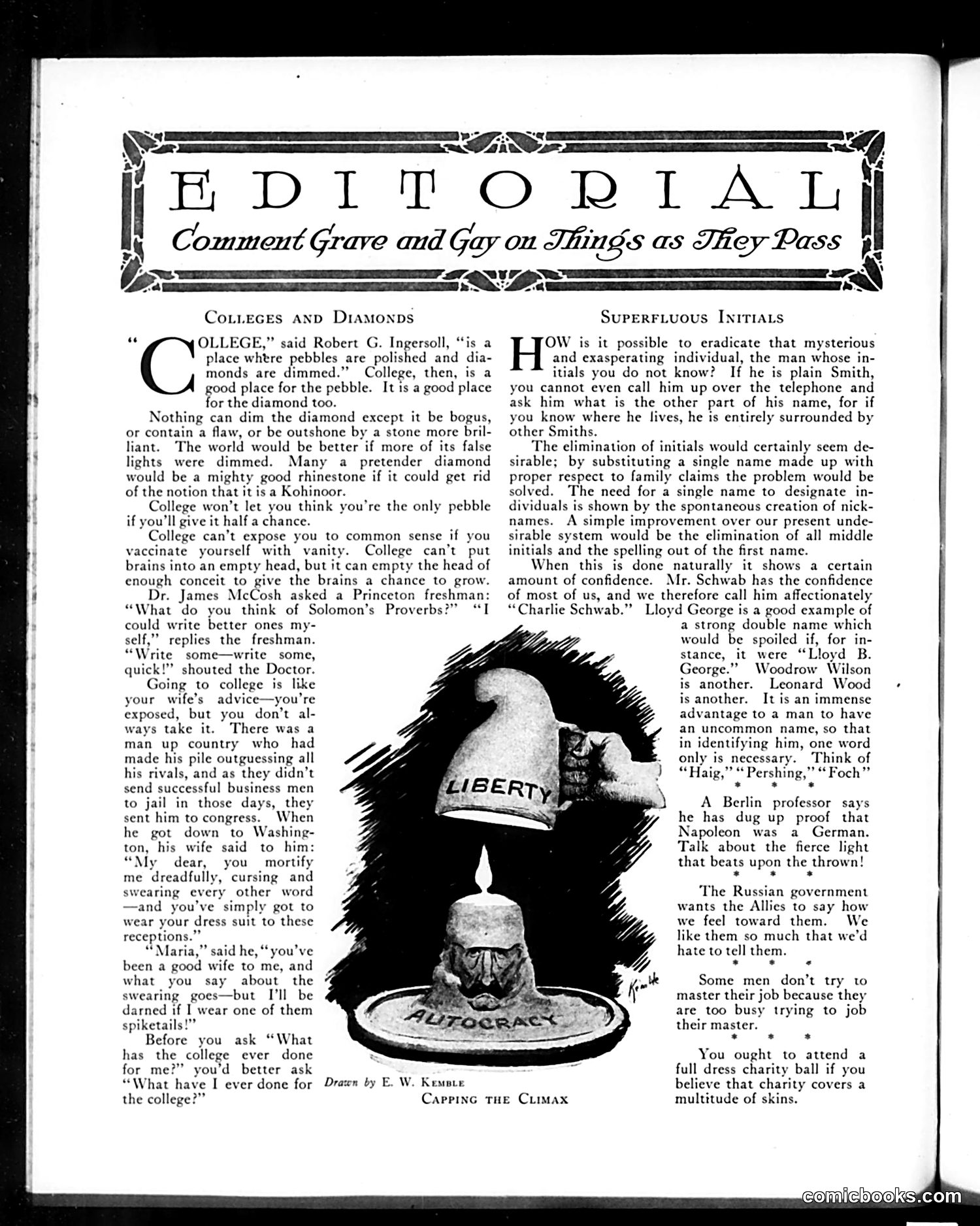
This is a satirical editorial page from Judge magazine featuring two sections and a political cartoon. **Main Editorial ("Colleges and Diamonds")**: Uses metaphors to critique American higher education and social pretension. It argues colleges should humble the arrogant ("pebbles") while not diminishing genuinely talented individuals ("diamonds"). The piece sarcastically notes that colleges expose students to good influences but can't force them to accept the lessons—comparing it to a wife's advice. **Cartoon ("Capping the Climax")**: Depicts Lady Liberty holding a candle labeled "LIBERTY" above what appears to be an autocracy symbol (the spiked helmet), suggesting the Allies' victory in World War I. This celebrates democratic triumph over militarism. **"Superfluous Initials" Column**: A humorous complaint about men identified only by initials (like "J. B. Smith"), making them impossible to contact or identify. It praises those with distinctive full names like Lloyd George and Woodrow Wilson. The page reflects post-WWI optimism about democracy's victory and American social commentary typical of Judge's satirical voice.
📄 Transcribed text from this page (OCR, searchable)
Machine-transcribed from the original scan — historical spelling and the odd misread are preserved.
— [EDITORIAL Comment Grave and Ca ou aia as They Pass bx CoLLeGEs AND DIAMONDS OLLEGE,” said Robert G. Ingersoll, “is a place whtre pebbles are polished and dia- monds are dimmed.” College, then, is a good place for the pebble. It is a good place for the diamond too. Nothing can dim the diamond except it be bogus, or contain a flaw, or be outshone by a stone more bril- liant. The world would be better if more of its false lights were dimmed. Many a pretender diamond would be a mighty good rhinestone if it could get rid of the notion that it is a Kohinoor. College won’t let you think you’re the only pebble if you'll give it half a chance. College can’t expose you to common sense if you vaccinate yourself with vani College can’t put brains into an empty head, but it can empty the head of enough conceit to give the brains a chance to grow. Dr. James McCosh asked a Princeton freshman: “What do you think of Solomon’s Proverbs?” “I could write better ones my- self,” replies the freshman. “Write some—write some, quick!” shouted the Doctor. Going to college is like your wife’s advice—you’re exposed, but you don’t al- ways take it. There was a man up country who had made his pile outguessing all his rivals, and as they didn’t send successful business men to jail in those days, they sent him to congress. When he got down to Washing- ton, his wife said to him: “My dear, you mortify me dreadfully, cursing and swearing every other word —and you've simply got to wear your dress suit to these receptions.” “Maria,” said he, “you've been a good wife to me, and what you say about the swearing goes—but I'll be darned if I wear one of them spiketails!”” Before you ask “What has the college ever done for me?” you’d better ask “What have I ever done for the college?” Drawn by E. W. Kespre Cappinc THE CLimax = | <A STN 7 SuperF.uous InirIats OW is it possible to eradicate that mysterious and exasperating individual, the man whose in- itials you do not know? If he is plain Smith, you cannot even call him up over the telephone and ask him what is the other part of his name, for if you know where he lives, he is entirely surrounded by other Smiths. The elimination of initials would certainly seem de- sirable; by substituting a single name made up with proper respect to family claims the problem would be solved. The need for a single name to designate in- dividuals is shown by the spontaneous creation of nick- names. A simple improvement over our present unde- sirable system would be the elimination of all middle initials and the spelling out of the first name. When this is done naturally it shows a certain amount of confidence. Mr. Schwab has the confidence of most of us, and we therefore call him affectionately “Charlie Schwab.” Lloyd George is a good example of a strong double name which would be spoiled if, for in- stance, it were “Lloyd B. George.”” Woodrow Wilson is another. Leonard Wood is another. It is an immense advantage to a man to have an uncommon name, so that in identifying him, one word only is necessary. Think of “Haig,” “ Pershing,” “Foch” . * . A Berlin professor says he has dug up proof that Napoleon was a German. Talk about the fierce light that beats upon the thrown! * * * The Russian government wants the Allies to say how we feel toward them. We like them so much that we'd hate to tell them. * * . Some men don’t try to master their job because they are too busy trying to job their master. * . * You ought to attend a full dress charity ball if you believe that charity covers a multitude of skins.