
A complete issue · 36 pages · 1918
Judge — May 25, 1918
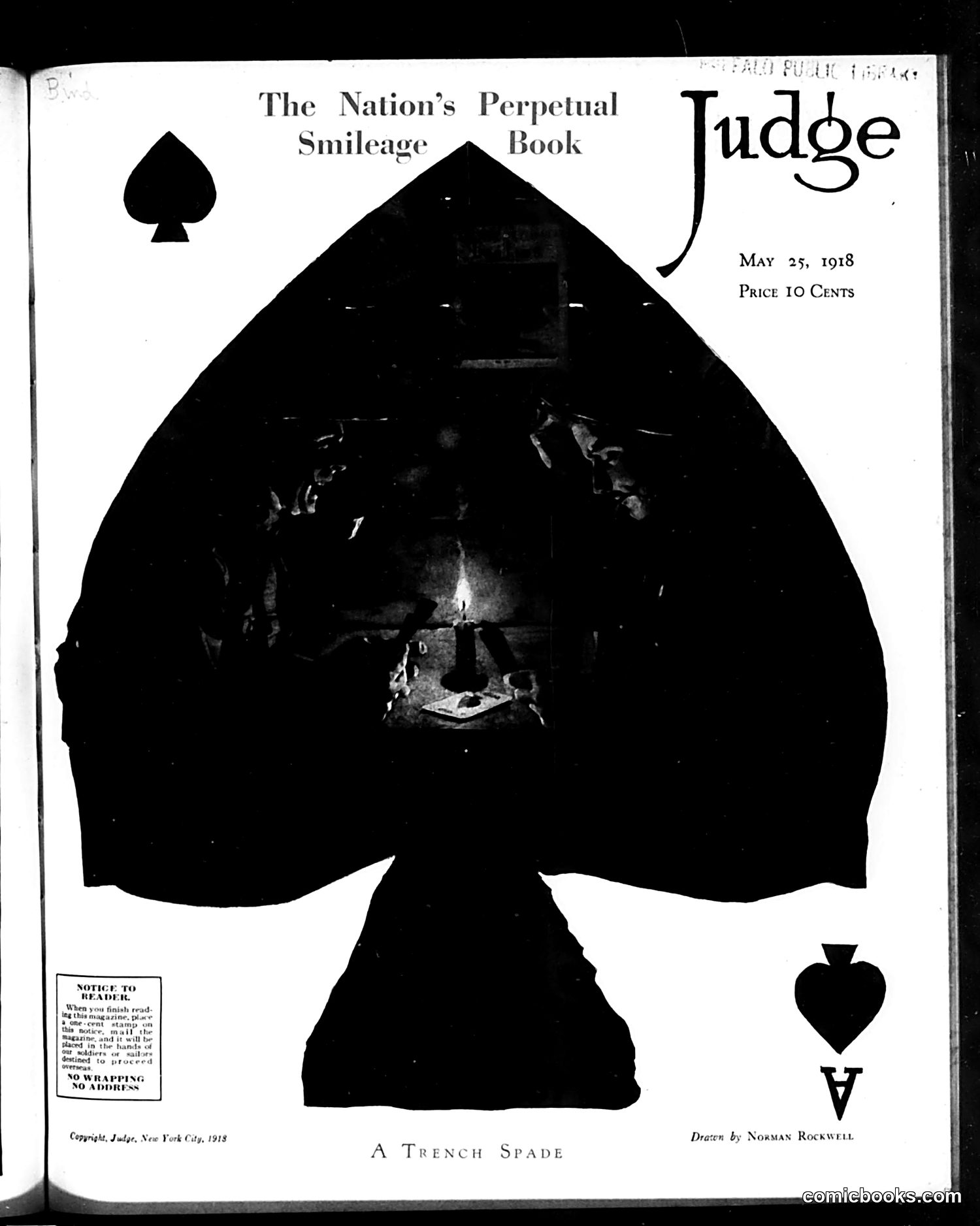
This Norman Rockwell illustration satirizes World War I trench warfare. The spade-shaped silhouette contains soldiers in a trench, illuminated by what appears to be artillery fire or explosions. The image is dark and ominous—quite different from Rockwell's later cheerful style. In 1918, America was actively fighting in WWI (1917-1918). The cartoon likely critiques the brutal conditions soldiers faced in trenches—the mud, confined spaces, and constant bombardment that defined trench warfare on the Western Front. By embedding soldiers within the very tool they used to dig trenches, Rockwell suggests how completely the war consumed soldiers' lives. The playing-card format (spade suit) frames this grim reality as part of darker "games" of war.
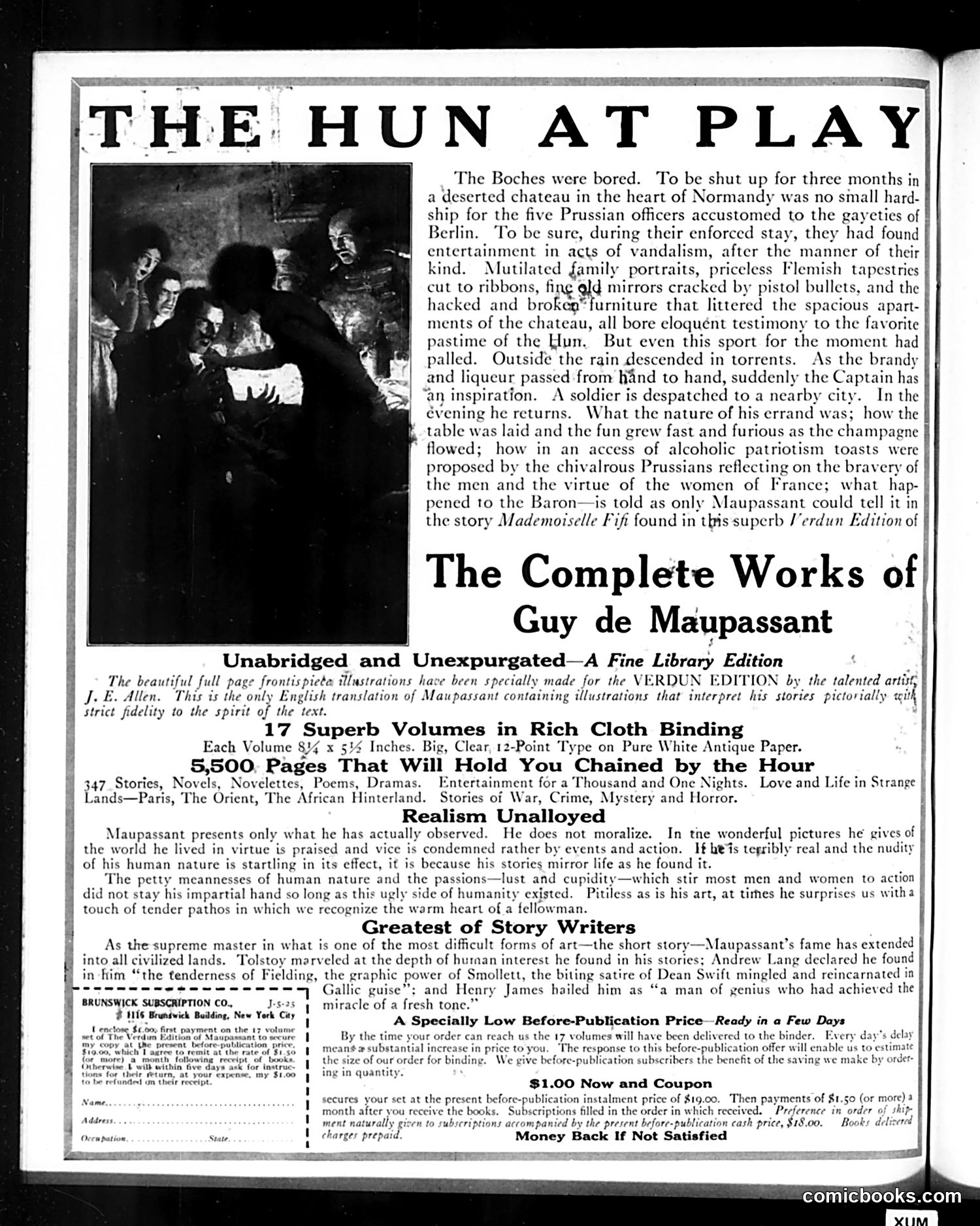
This page is primarily **advertising**, not political satire. It promotes "The Complete Works of Guy de Maupassant"—a 17-volume book set in cloth binding. The image at top left appears to be an illustration from one of Maupassant's stories, likely depicting a scene from "The Hun at Play" (referenced in the text), which seems to describe Prussian officers' behavior during occupation of a French château. The advertisement emphasizes Maupassant as a "Greatest of Story Writers," comparing him favorably to Tolstoy and Andrew Lang. The text celebrates his unflinching realism about human nature—"virtue is praised and vice is condemned rather by events and action." The bottom section offers subscription details: $1.00 down payment, then $1.50 monthly installments for the complete set. This is essentially a book advertisement using literary reputation-building rather than political commentary.
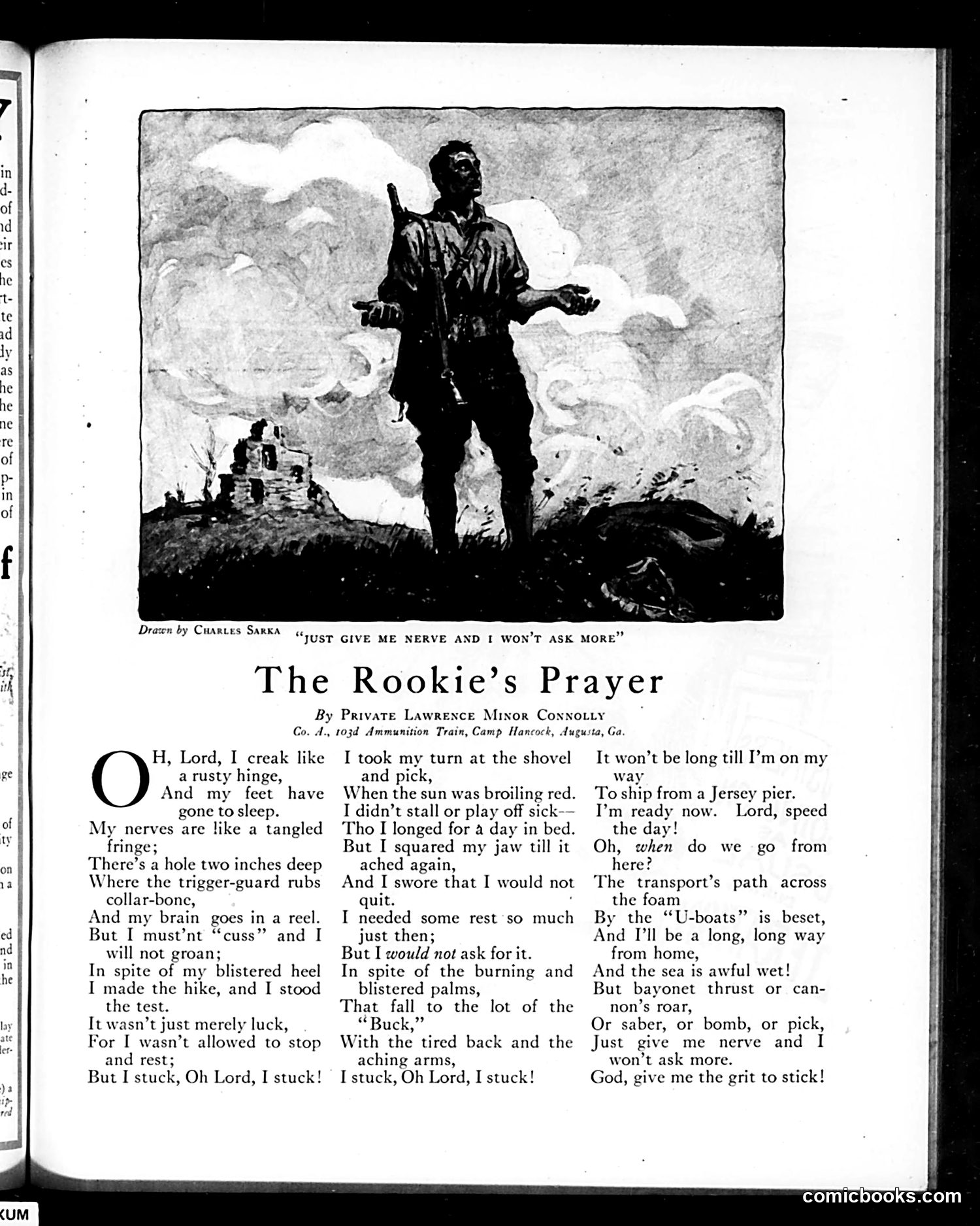
This is a World War I poem by Private Lawrence Minor Connolly from the 1st Ammunition Train, Camp Hancock, Augusta, Georgia. The illustration by Charles Sarka shows a young soldier standing resolute on a battlefield, silhouetted against clouds of smoke and explosions. The poem presents a new recruit's raw, honest prayer—mixing fear with determination. The soldier is exhausted from training (blistered feet, aching arms) but resolves to endure combat without complaint. The refrain "Just give me nerve and I won't ask more" captures the modest hope of an inexperienced soldier facing the unknown horrors of trench warfare. The piece validates soldiers' suffering while celebrating their stoic courage, appearing designed to boost morale or honor enlisted men's sacrifices during WWI.
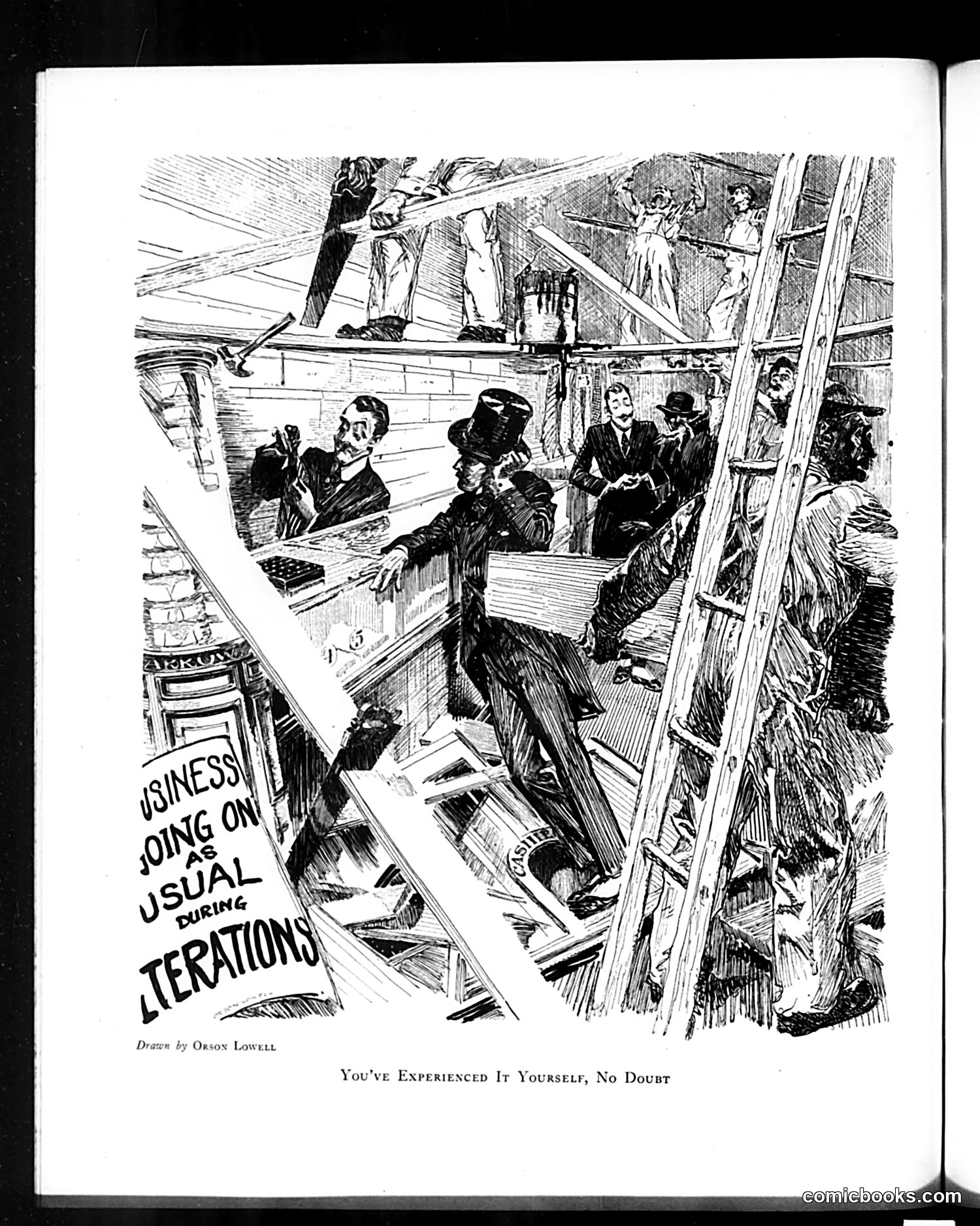
This Orson Lowell cartoon depicts a construction or industrial site during "alterations." The caption "You've Experienced It Yourself, No Doubt" suggests the cartoon satirizes a common, frustrating experience. The scene shows workers on scaffolding above and businessmen/suited figures below, apparently unable to conduct normal business amid the chaos and disruption of ongoing construction work. The visible text fragment reads "BUSINESS GOING ON AS USUAL DURING ALTERATIONS"—clearly ironic, as nothing appears "usual." The satire targets the disconnect between what companies claim (business proceeding normally) and reality (complete disruption). This likely comments on a specific historical renovation or institutional overhaul, though without dating information, the exact reference remains unclear. The humor relies on readers' shared frustration with construction delays.
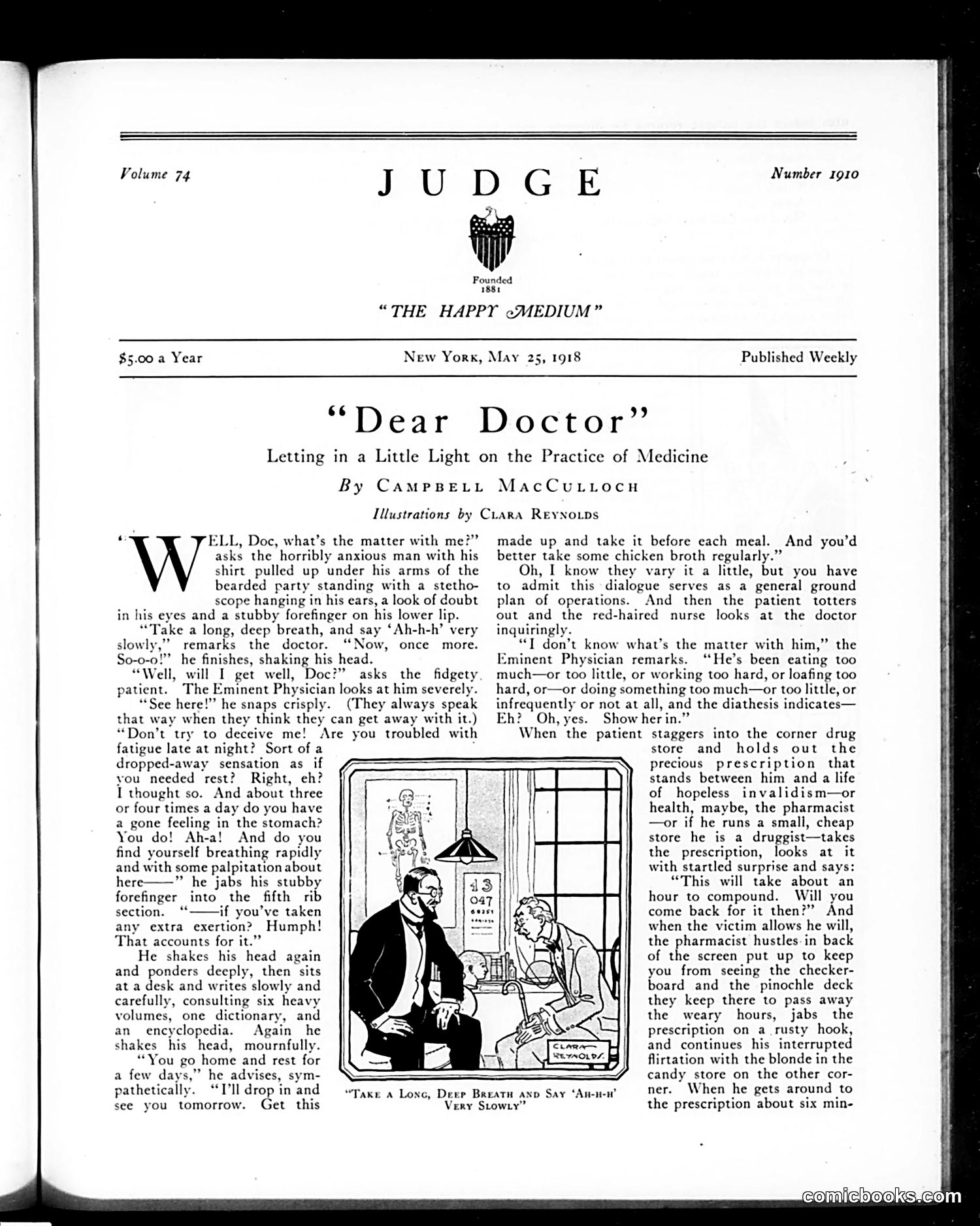
This satirical piece by Campbell MacCulloch mocks the medical profession's diagnostic practices circa 1918. The cartoon depicts a doctor examining an anxious patient, illustrating the accompanying article's critique of physicians' vague or unhelpful advice. The satire targets doctors who blame patients' ailments on lifestyle factors (fatigue, poor eating, inadequate rest, breathing) rather than providing specific diagnoses or treatments. The patient's visible anxiety and the doctor's dismissive demeanor suggest the frustration of seeking medical help only to receive generic prescriptions for rest and fresh air—common physician advice of this era. The piece satirizes the medical establishment's tendency toward oversimplification and the gap between patient expectations and actual medical care, presenting a humorous but pointed critique of early 20th-century medical practice.
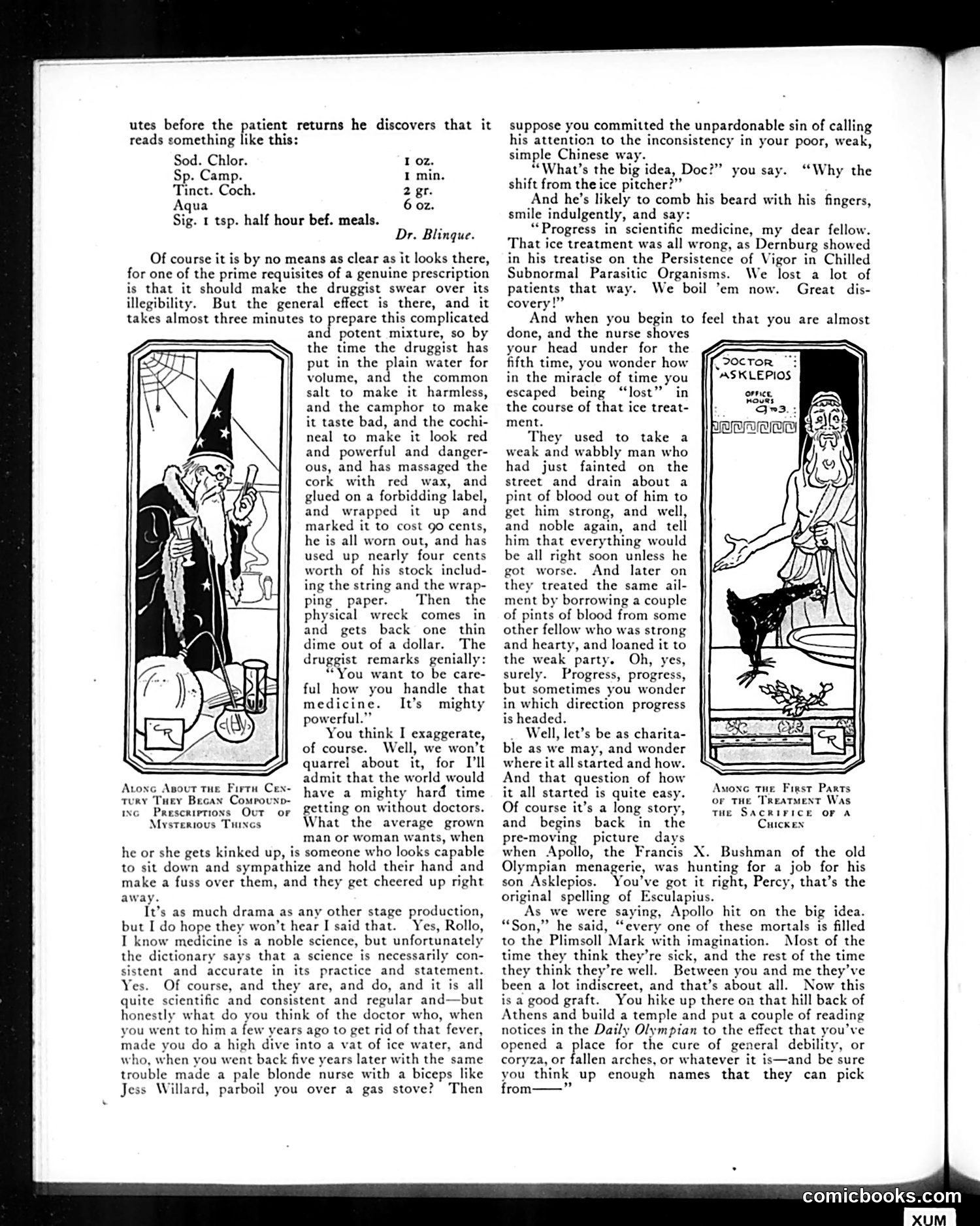
**Left Cartoon:** Depicts a wizard-like figure in a starred robe advertising a patent medicine. The accompanying text mocks the deceptive marketing of "genuine prescriptions" that are actually worthless compounds. The druggist admits the elaborate preparation takes three minutes and costs mere pennies, yet sells for dollars—satirizing the patent medicine industry's fraudulent profit margins and consumer deception. **Right Cartoon:** Shows "Doctor Aesculapios" (referencing the Greek god of medicine), apparently dispensing dubious medical advice. The text criticizes physicians who recommend unproven treatments like ice-water immersion for serious ailments, using blood transfusions as an example of medical progress sometimes heading in questionable directions. **Overall Point:** Sharp satire of late 19th/early 20th-century medical quackery and the pseudoscience plaguing both patent medicines and licensed practitioners.
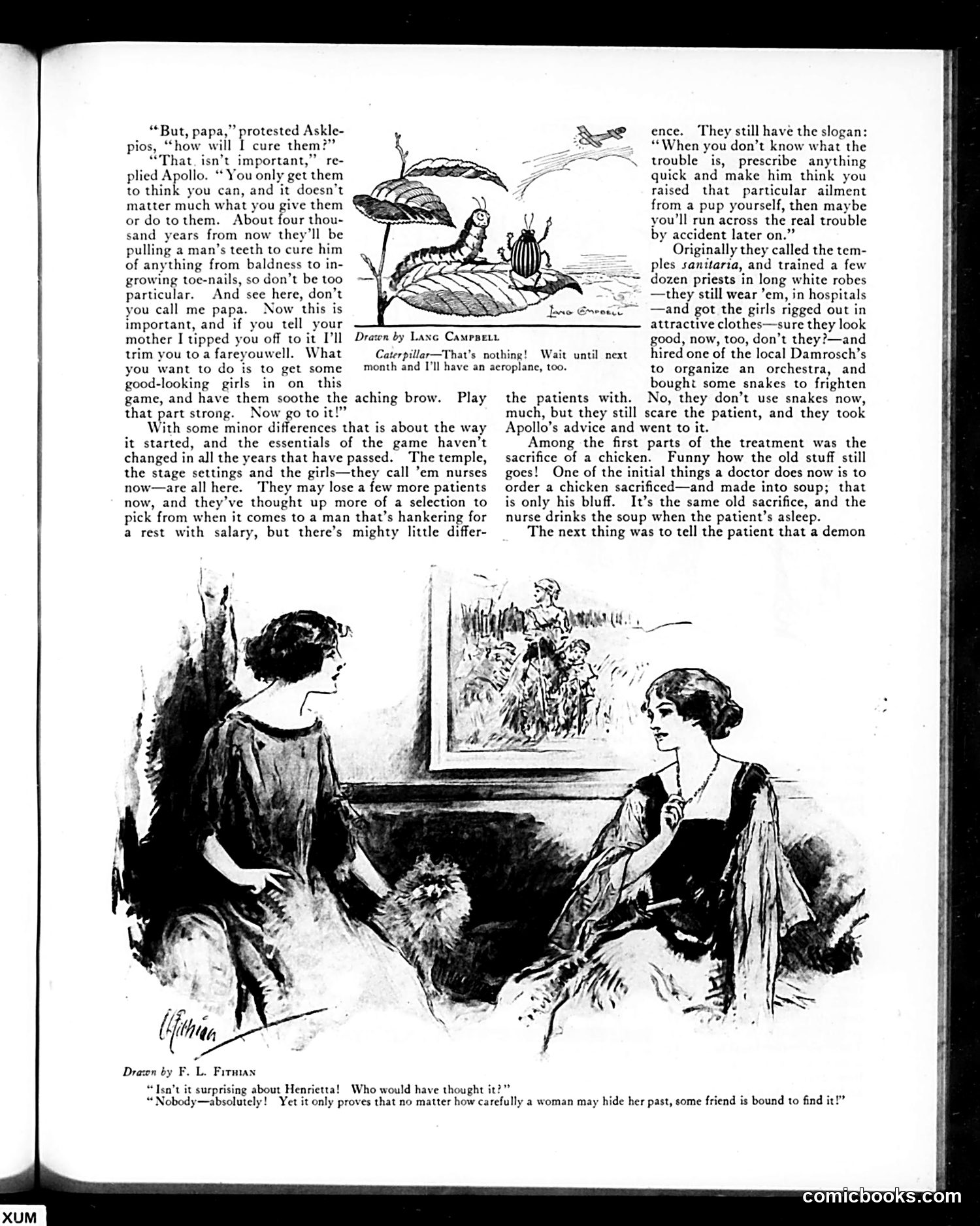
This page contains two satirical pieces from *Judge* magazine: **Top cartoon (Lane Campbell):** A humorous dialogue between Apollo and Asclepios (Greek god of medicine and his son) mocking medical practice. Apollo cynically advises that doctors don't need to actually cure patients—merely making them *think* treatment works matters. The satire suggests this ancient wisdom remains unchanged: modern medicine still relies on attractive nurses, impressive settings, and psychological suggestion rather than real efficacy. References to tooth-pulling for baldness and the "slogan" about prescribing anything when diagnosis is uncertain mock contemporary medical ignorance. **Bottom cartoon (F.L. Fitman):** An unrelated society joke about a woman named Henrietta whose past has been discovered, illustrated by two women gossiping. The humor depends on the era's social anxiety about women's reputations—the punchline suggests that hiding one's past is futile. Both pieces reflect early 20th-century skepticism toward medical authority and Victorian-era attitudes toward women's propriety.
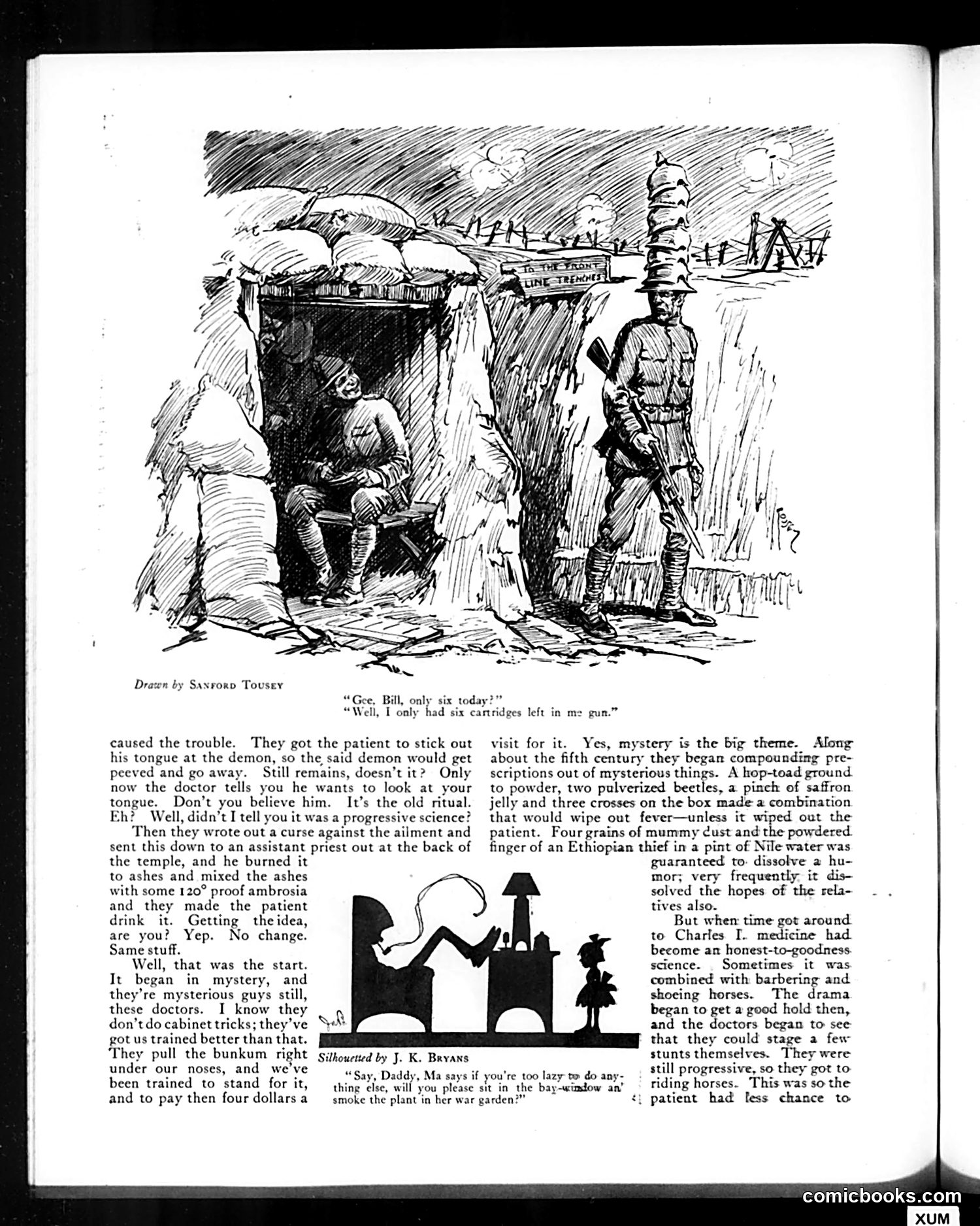
**Top Cartoon (Sanford Tousey):** A WWI-era trench scene showing two soldiers discussing ammunition. One reports killing only six enemy soldiers because he had only six cartridges. This satirizes military efficiency—the soldier's restraint or accuracy, or possibly critiques wasteful ammunition usage during the war. **Bottom Cartoon (J.K. Bryans):** A domestic scene where a mother asks her lazy husband to sit in the bay window and "smoke the plant in her war garden"—likely tobacco or another plant grown for the war effort. This mocks men avoiding productive work while women contribute to wartime agricultural efforts during WWI. **Main Text:** A satirical history of medicine claiming doctors use "mystery" and ritual (like tongue examination) descended from ancient temple priests and medieval superstitions. It mocks modern doctors for perpetuating theatrical nonsense while charging fees—suggesting medicine remains fundamentally unchanged shamanism dressed in scientific language. The page collectively satirizes WWI-era inefficiency and doctors' pretended expertise.
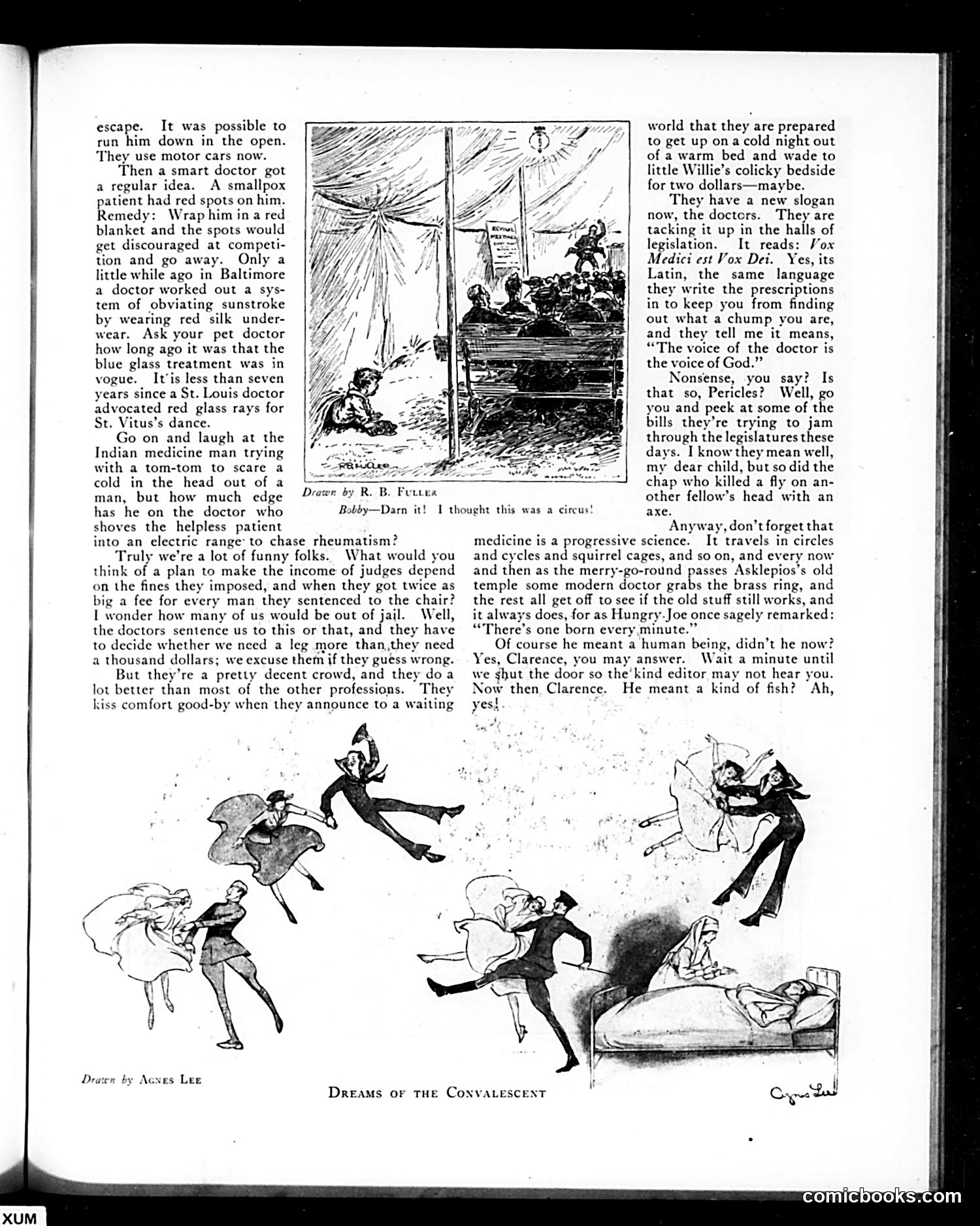
This page satirizes both medical practice and doctors' legislative lobbying in early 20th-century America. The main text mocks doctors for advocating absurd treatments—red blankets for smallpox, red silk underwear against sunstroke, blue glass for St. Vitus's dance—while claiming medical authority. It criticizes their new Latin slogan "Vox Medici est Vox Dei" ("The voice of the doctor is the voice of God"), presented as propaganda in legislative halls. The author argues doctors use obscure prescriptions to confuse patients and charge high fees ($2 house calls). He compares their power to judges profiting from fines—both professions sentence people without accountability. The bottom illustration, "Dreams of the Convalescent," depicts a fevered patient's surreal hallucinations. The satire targets medical paternalism and doctors' growing political influence over healthcare legislation during a period of significant medical transition.
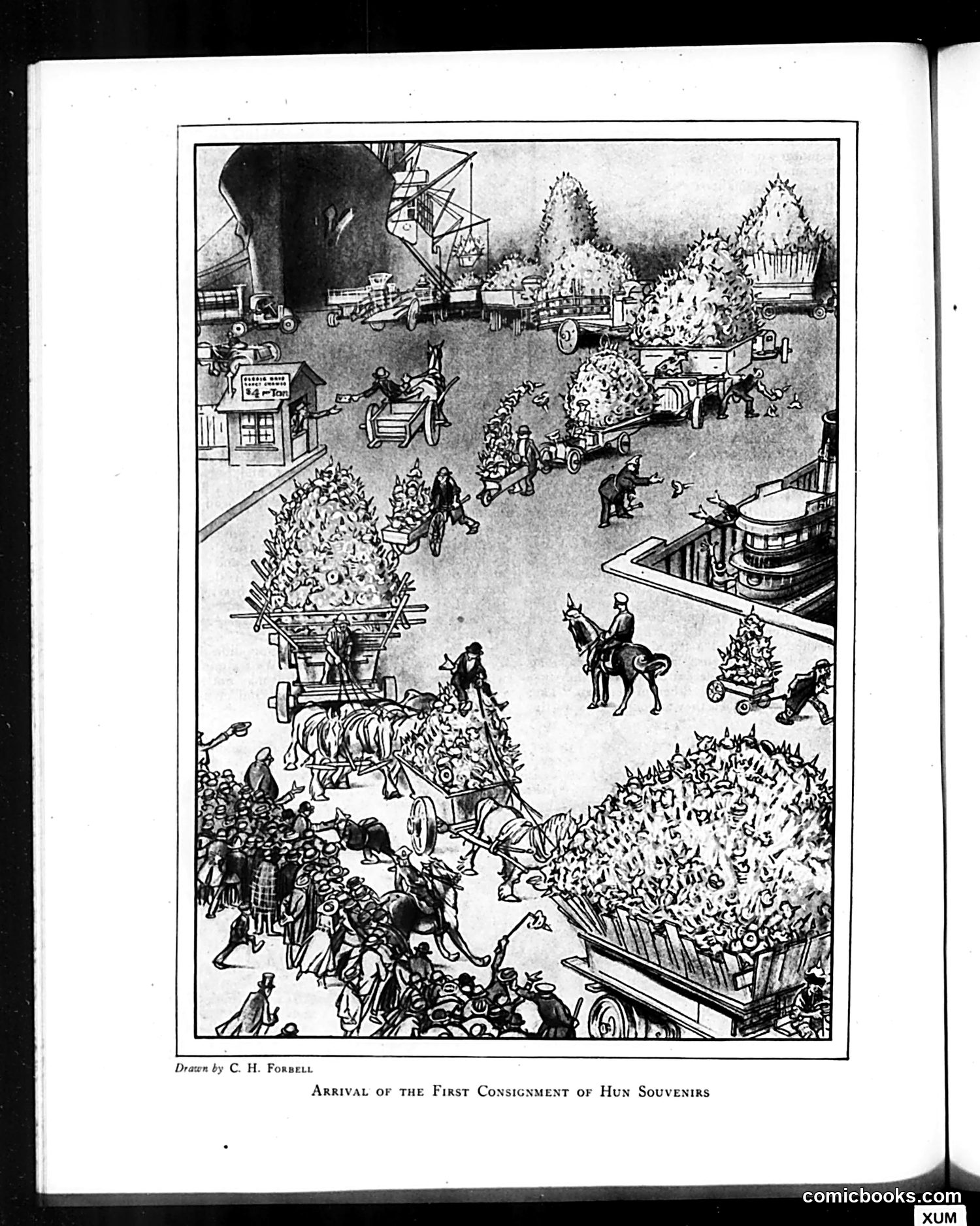
This is a satirical illustration from *Judge* magazine titled "Arrival of the First Consignment of Hun Souvenirs." The cartoon depicts a chaotic marketplace scene where German military equipment and war materiel—presumably captured from WWI combat—are being auctioned or sold to American civilians as novelty items. The "Huns" refers to derogatory wartime terminology for Germans. The satire mocks American commercialism and opportunism: rather than treating captured enemy weapons as serious military artifacts, they're being packaged as souvenirs for public consumption, complete with crowds eagerly bidding on cannons, tanks, and military vehicles. The illustrated crowd and carnival-like atmosphere emphasize the absurdity of treating instruments of death as entertainment commodities. The cartoon likely critiques post-war profiteering and American consumer culture's transformation of warfare into spectacle.
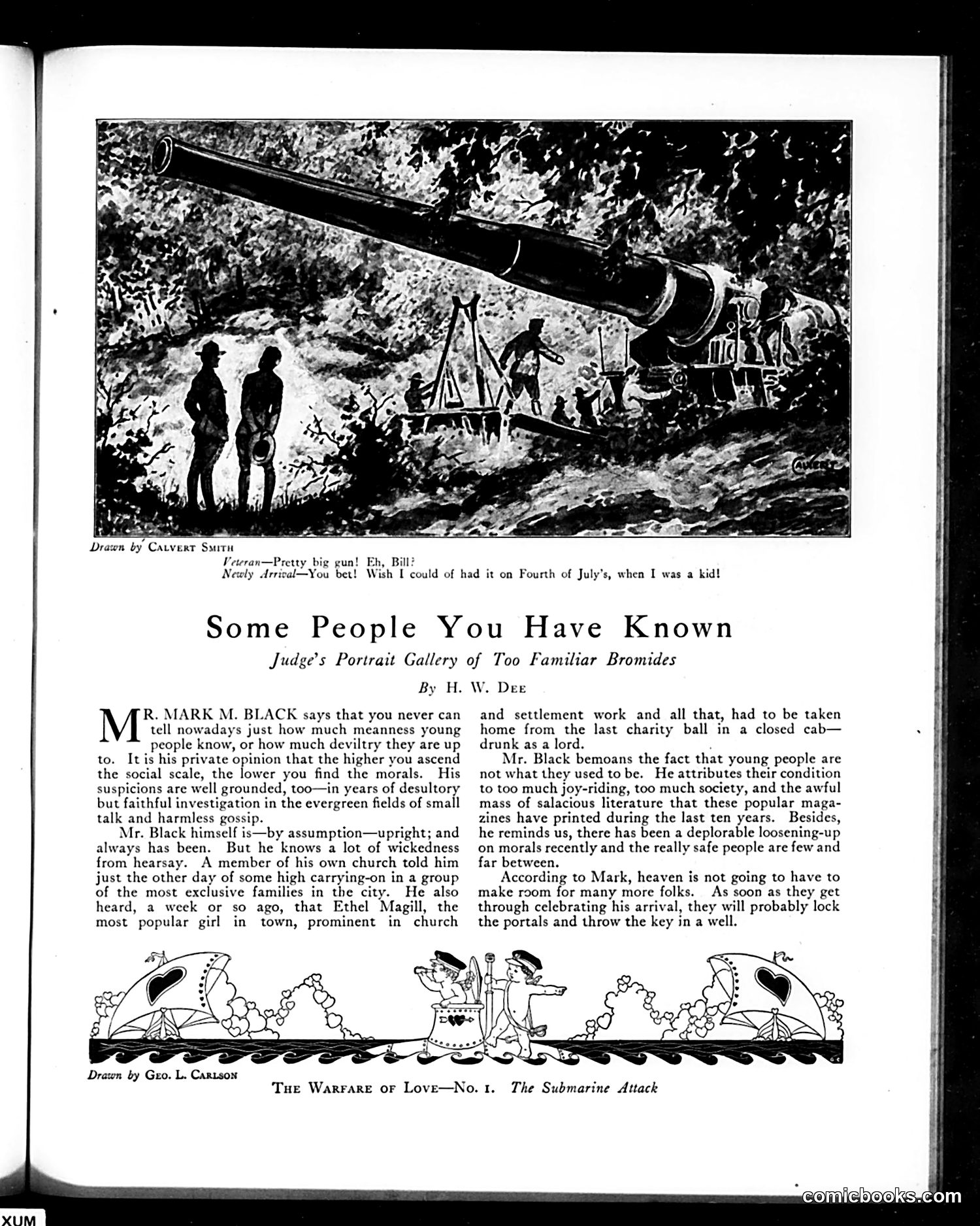
**Top Cartoon (Calvert Smith):** Two men observe a large cannon. The "veteran" remarks it's a "pretty big gun," while the "newly arrived" man wishes he'd had it on the Fourth of July as a kid. This appears to be WWI-era commentary—likely satirizing Americans' fascination with military hardware or nostalgia for simpler times, contrasted with modern warfare's destructive scale. **Main Article (H.W. Dee):** A satirical portrait of "Mr. Mark M. Black," a self-righteous gossip who claims moral superiority while spreading rumors about young people's supposed moral decay. He spreads hearsay about Ethel Magill, a prominent churchwoman, allegedly coming home drunk from a charity ball. The piece mocks hypocritical moralists who judge others while admitting their own "wickedness from hearsay." The closing joke—that heaven won't need much room after Mark arrives—is cutting social satire targeting sanctimonious busybodies. **Bottom Cartoon (Geo. L. Carlson):** "The Warfare of Love—No. 1. The Submarine Attack" (caption only visible; content unclear from description).
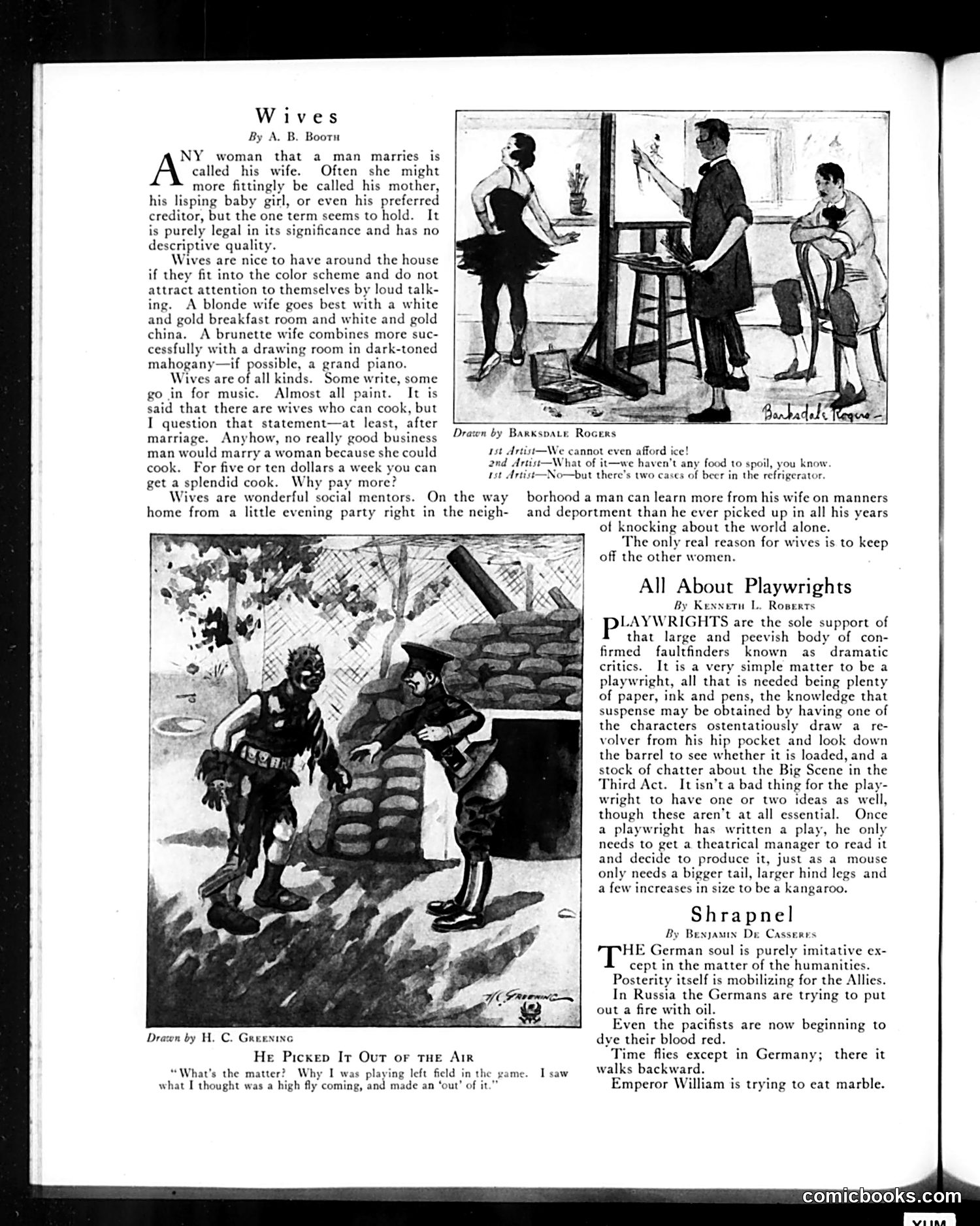
This page contains three satirical pieces typical of early 20th-century Judge humor: **"Wives"** by A.B. Boorn mocks the institution of marriage through exaggerated misogyny—presenting wives as decorative objects matching home décor, incapable of cooking despite being married for that reason, and valued primarily for preventing infidelity. The humor relies on absurdist logic and deliberately unflattering characterizations. **The cartoon by H.C. Greening** shows two impoverished artists discussing their empty refrigerator containing only beer—a joke about struggling creative workers during economically difficult times. **"All About Playwrights"** satirizes theatrical writers as producing formulaic work requiring only paper, revolvers brandished on stage, and discussion of "the Big Scene in Act Three"—mocking the melodramatic conventions of contemporary theater. **"Shrapnel"** by Benjamin De Casseres contains brief, cynical observations about World War I: German imitation, Russian strategy failures, and mocking references to Kaiser Wilhelm II—contemporary wartime political commentary typical of Judge's satirical approach.
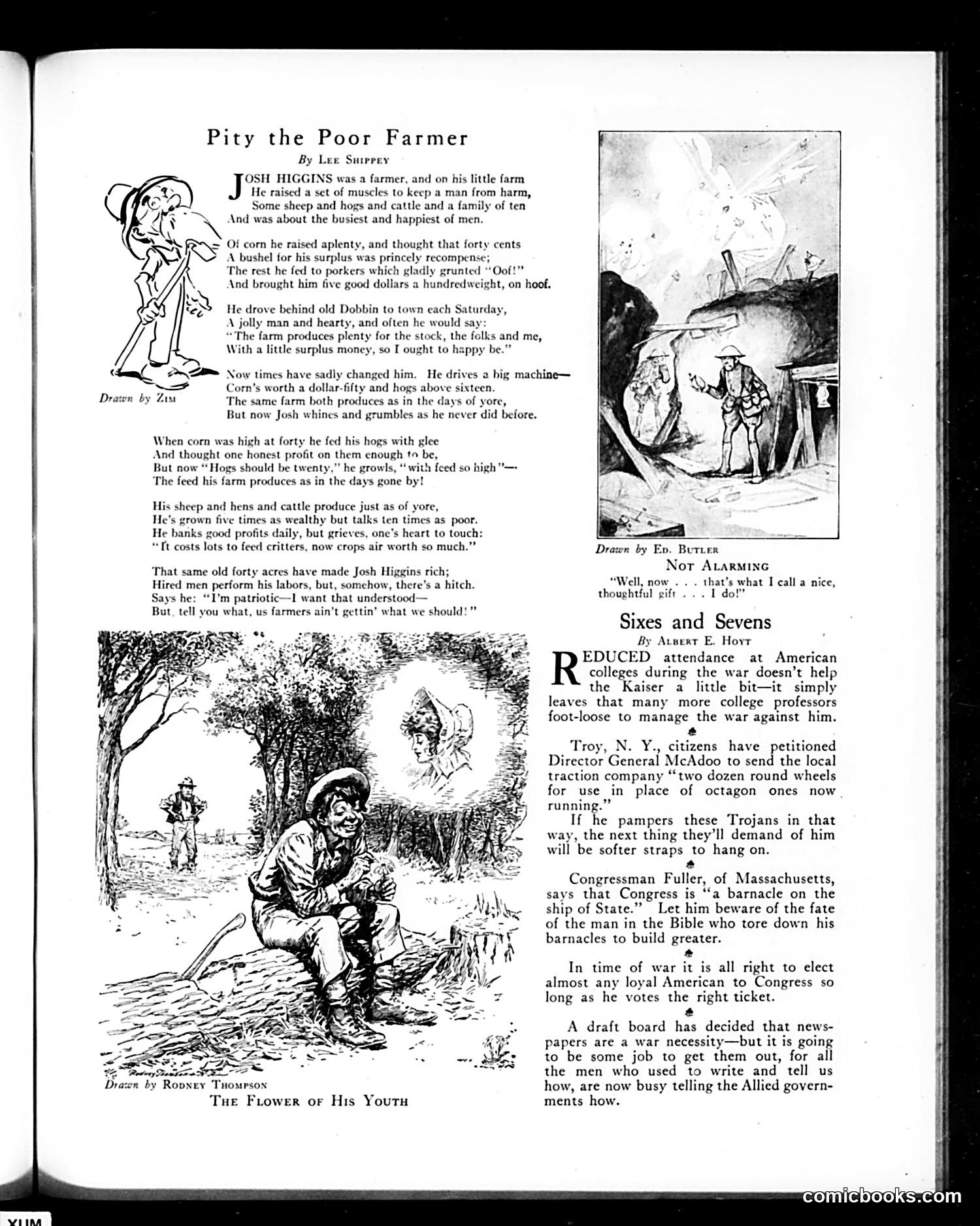
This poem satirizes farmer complaints about wartime prosperity. Josh Higgins operates the same modest farm that once made him content—40 acres producing corn, hogs, and cattle. When corn sold for 40 cents per bushel and hogs for $5 per hundredweight, he was happily satisfied with honest profits. Now wartime inflation has reversed the equation: corn costs $1.50 per bushel, hogs bring over $16 per hundredweight. Josh has grown "five times as wealthy" yet complains constantly that farmers "ain't gettin' what we should." The satire targets farmer hypocrisy—they benefit enormously from war-driven commodity prices yet persistently claim victimization, demanding even higher returns despite genuine prosperity. The poem critiques ingratitude and shifting moral standards: farmers want patriotic credit while maximizing profits at consumers' expense during a national emergency.
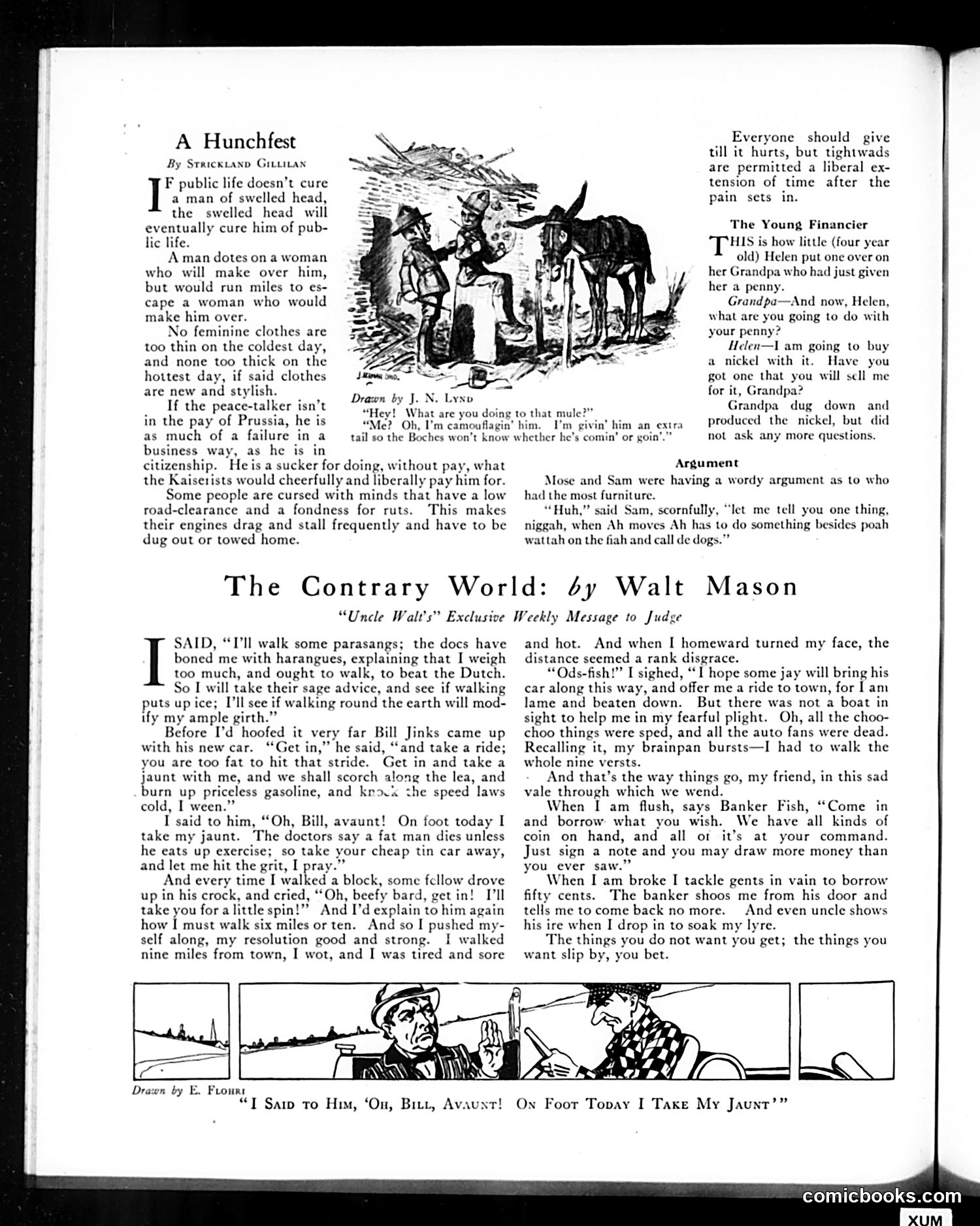
This page contains three satirical pieces typical of Judge's early-20th-century humor: **"A Hunchfest"** presents cynical observations on human nature—politicians, gender relations, fashion, and pacifists. A cartoon shows someone "camouflaging" a mule by adding an extra tail so the Germans ("Boches") won't know which direction it's going. This references WWI-era military deception tactics, satirizing both wartime absurdity and the resourcefulness of soldiers. **"The Young Financier"** is a brief joke where a four-year-old tricks her grandfather into trading a penny for a nickel—depicting precocious childhood cunning. **"The Contrary World" by Walt Mason** uses ironic verse to mock a fat man's exercise regime. Despite doctors' orders to walk, he's constantly interrupted by friends offering car rides, then abandoned when he actually needs one after his nine-mile journey leaves him exhausted and sore. It satirizes both the contradiction between modern convenience and health advice, and the fickle nature of friends. The "Argument" section uses racist dialect to depict two Black men debating furniture ownership—period stereotyping common in Judge.
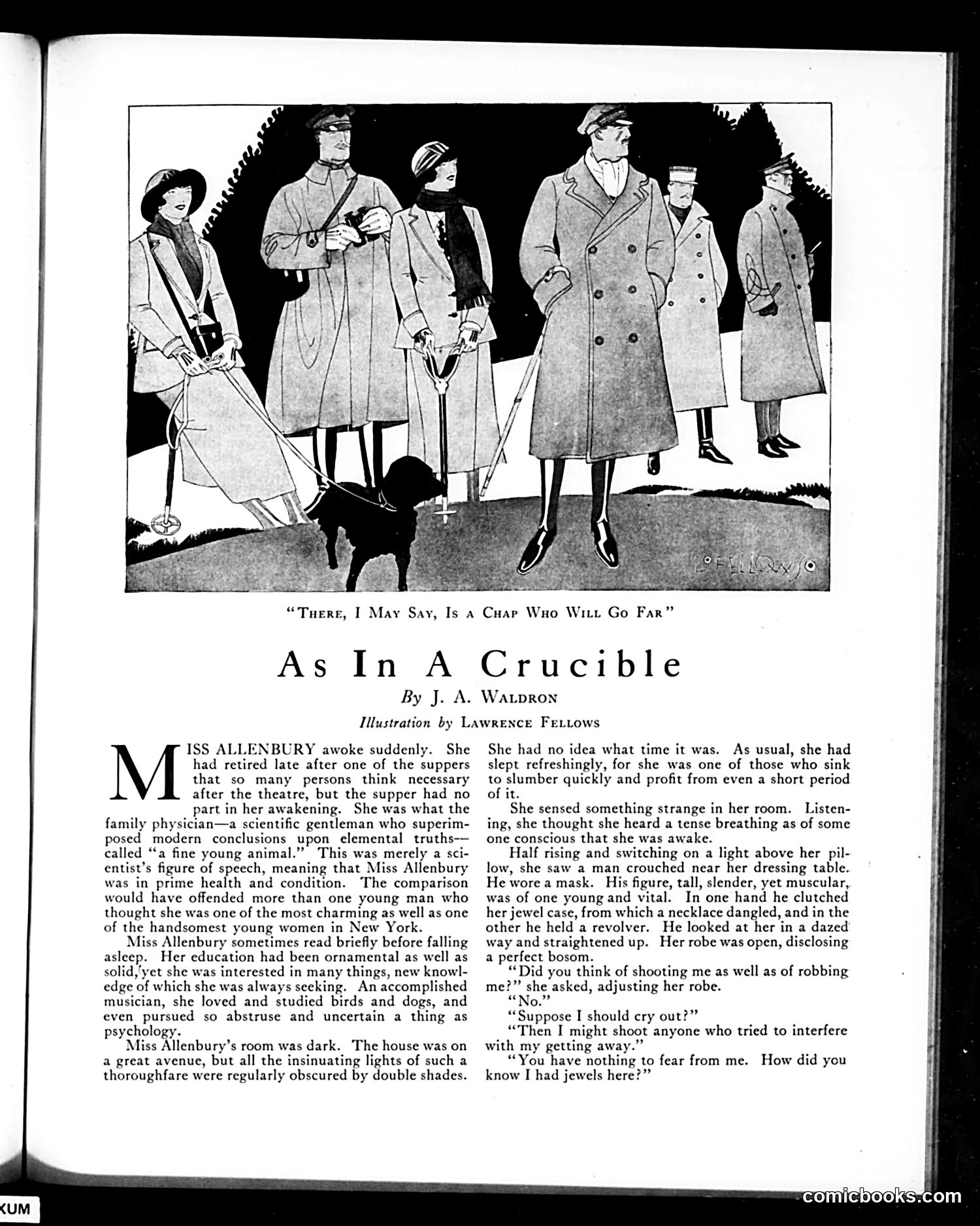
This page opens a short story titled "As In A Crucible" by J.A. Waldron, illustrated by Lawrence Fellows. The illustration depicts fashionable 1920s women and men in coats and hats—likely depicting upper-class New Yorkers, based on the text's reference to "one of the most charming...young women in New York." The story itself concerns Miss Allenbury, a wealthy, educated, cultured woman ("accomplished musician," interested in "psychology") who awakens to find a masked burglar in her bedroom stealing her jewels. Rather than panic or cry out, she calmly questions him about how he knew she had jewelry and why he didn't shoot her. The narrative appears to be satirizing the "New Woman" of the 1920s—educated, composed, unconventional—who responds to a dangerous intrusion with intellectual curiosity rather than hysteria. The story's title, "As In A Crucible," suggests the burglar encounter will test her character. The illustration's caption, "There, I May Say, Is a Chap Who Will Go Far," suggests ironic approval of the burglar's bold initiative.
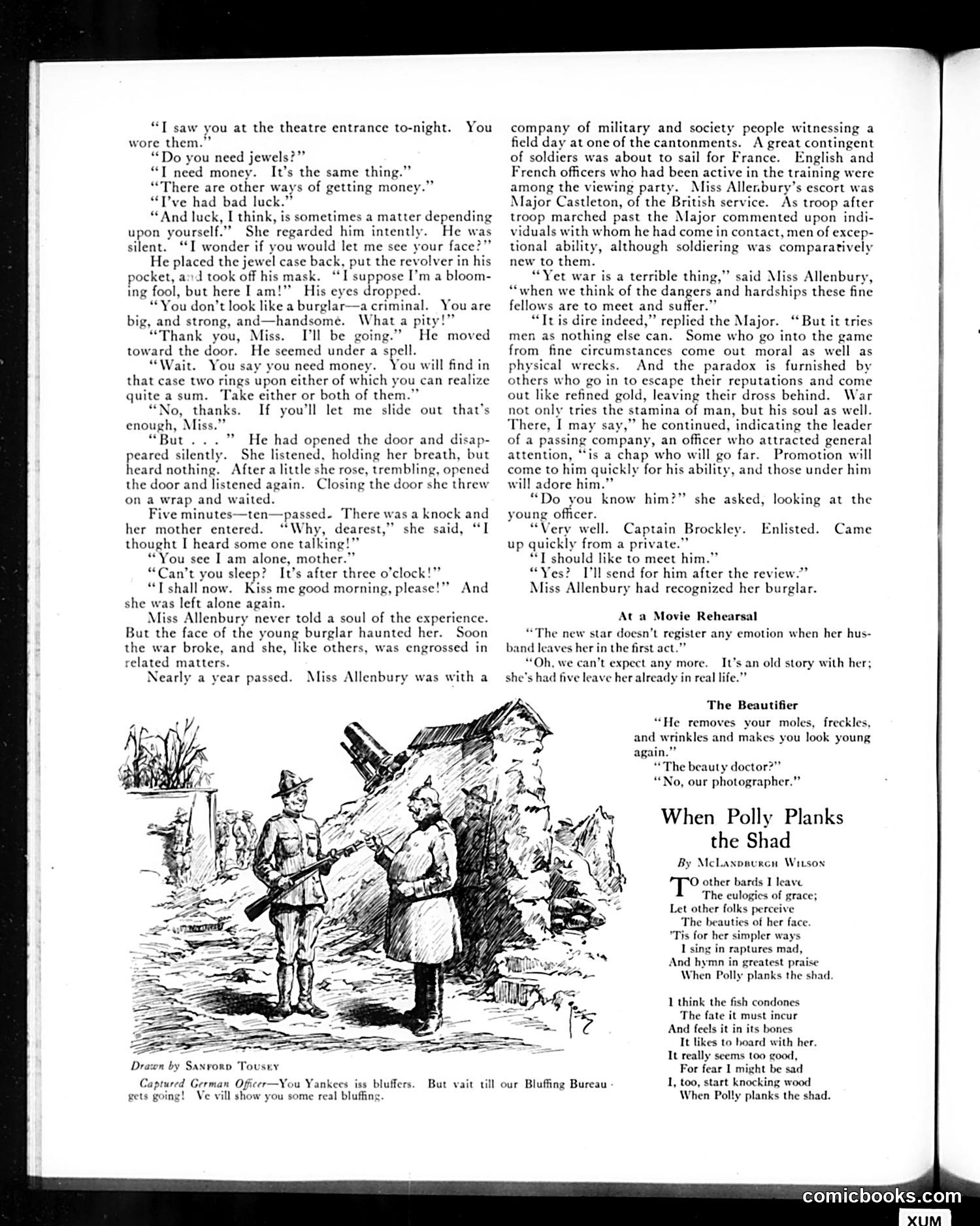
This page contains two distinct satirical pieces: **Main Story/Serial**: A romantic melodrama about Miss Allenbury encountering a gentleman burglar who needs money. A year later, at a military field day, she recognizes him as Captain Brockley, now a decorated officer. The satire suggests that war service can rehabilitate even criminals—a common WWI-era narrative about how military duty "redeems" flawed men. **Cartoon (bottom)**: Drawn by Sanford Tousey, shows a captured German officer boasting that "Yankees is bluffers" and threatening "real bluffing" from Germany's "Bluffing Bureau." This mocks German military confidence and propaganda during WWI, portraying German officers as blustering and overconfident despite American military capability. The humor relies on suggesting Germany's threats are mere bluster compared to American strength. **Context**: Published during WWI, both pieces reflect American confidence in military virtue and dismissal of German military posturing—typical Judge magazine themes of the period.
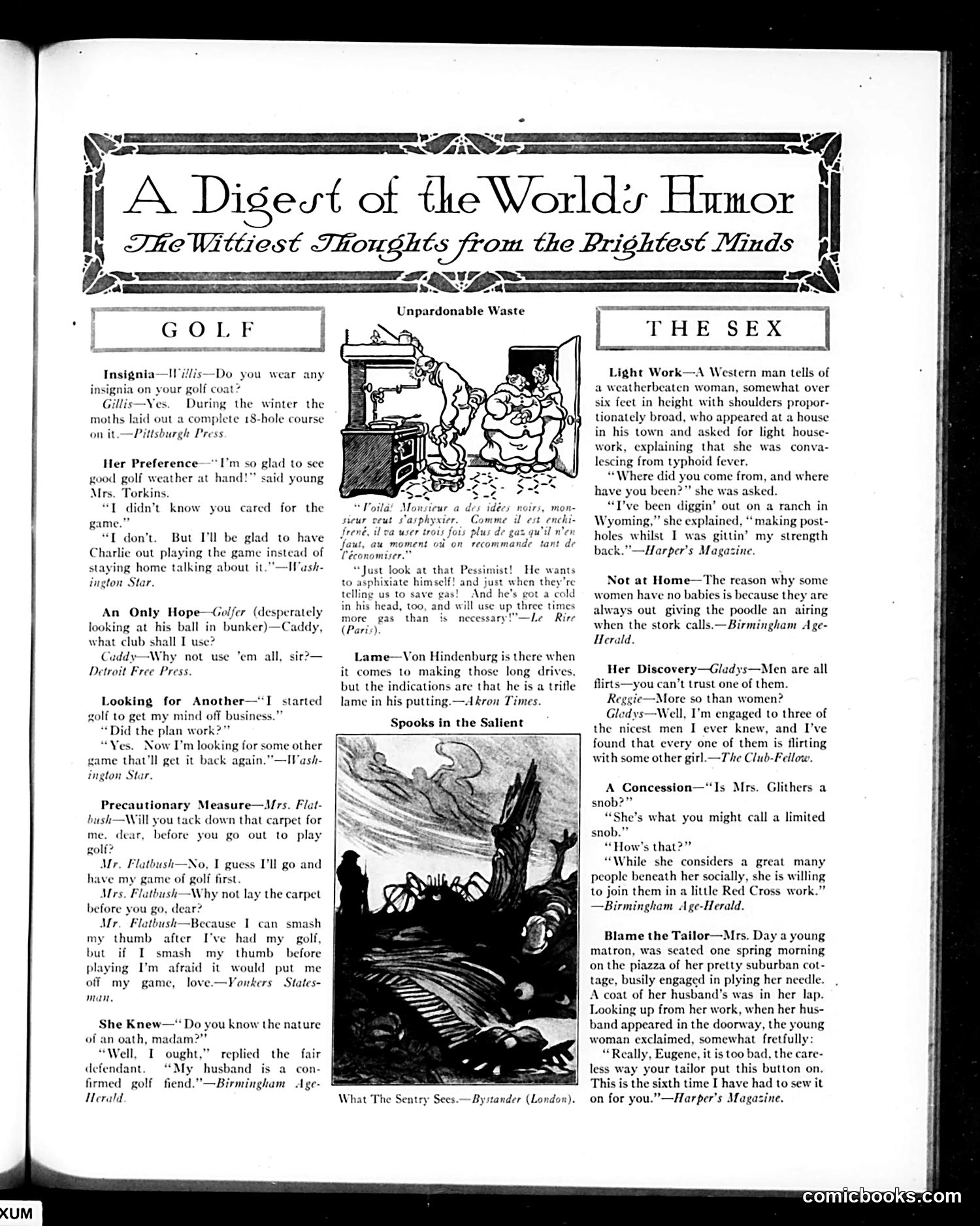
This page from Judge presents a humor digest organized by topic. The GOLF section features light jokes about the sport's absurdities—moths eating holes in a golfer's coat, someone wanting to play golf to escape business worries, and a man delaying carpet repairs to protect his golf game. These satirize golf's obsessive popularity among American men of the era. The central cartoon, "What The Sentry Sees," appears to reference WWI combat, showing a soldier observing ghostly or supernatural figures—likely satirizing trench warfare's psychological horrors or soldiers' stress-induced hallucinations. The SEX section contains jokes mocking gender stereotypes: a woman claiming she can't trust men while engaged to three simultaneously; a socialite's snobbery ("limited snob"); and a wife repeatedly resewing her husband's coat buttons. These target women's perceived fickleness and men's obliviousness, reflecting period gender attitudes. Overall, this represents typical early-20th-century American humor mixing sports obsession, wartime anxiety, and gender role comedy.
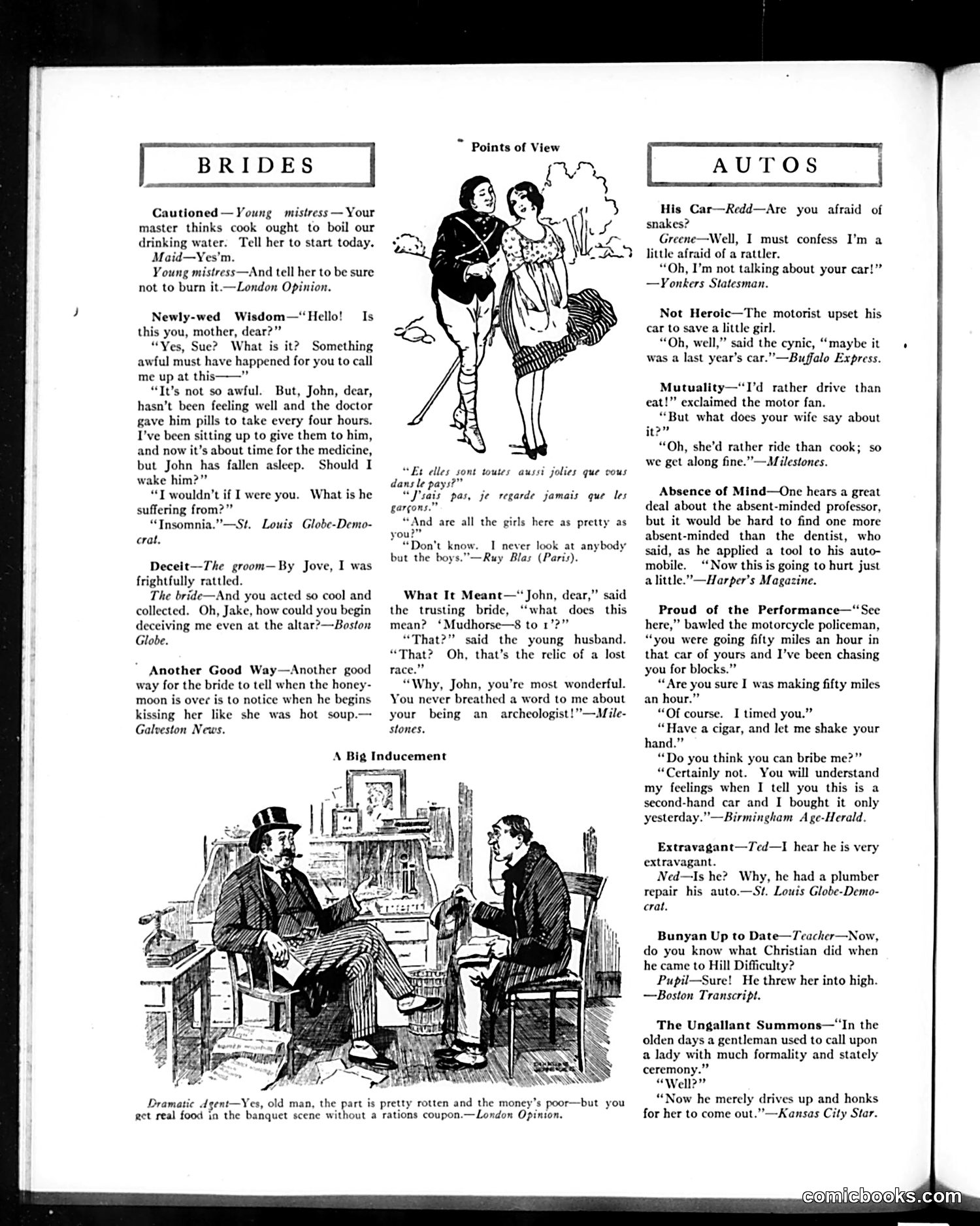
This page contains satirical humor sections on newlyweds and automobiles, reflecting early 20th-century social anxieties. The **BRIDES section** mocks newly married women as naive or intellectually limited. One newlywed calls her mother about giving her husband pills, not realizing he needs sleep rather than medicine. Another bride mistakes betting odds ("Mudhorse—8 to 1") for an archaeological reference, praising her husband's false expertise. The humor targets women's perceived gullibility and dependence on male authority. The **AUTOS section** satirizes the automobile's rapid cultural integration. Jokes reference cars as status symbols (a cynic suggests old cars are disposable) and the motorist's bribery attempt using a second-hand vehicle as excuse. One joke compares the dentist's tool application to a car repair—treating the automobile as almost human. "Bunyan Up to Date" mocks modern courtship, where men "honk" for dates rather than formally calling—suggesting cars have made romance crude and impersonal. Together, these sections satirize how new technologies and social shifts (automobiles, changing gender dynamics) are disrupting traditional courtship and marriage conventions.
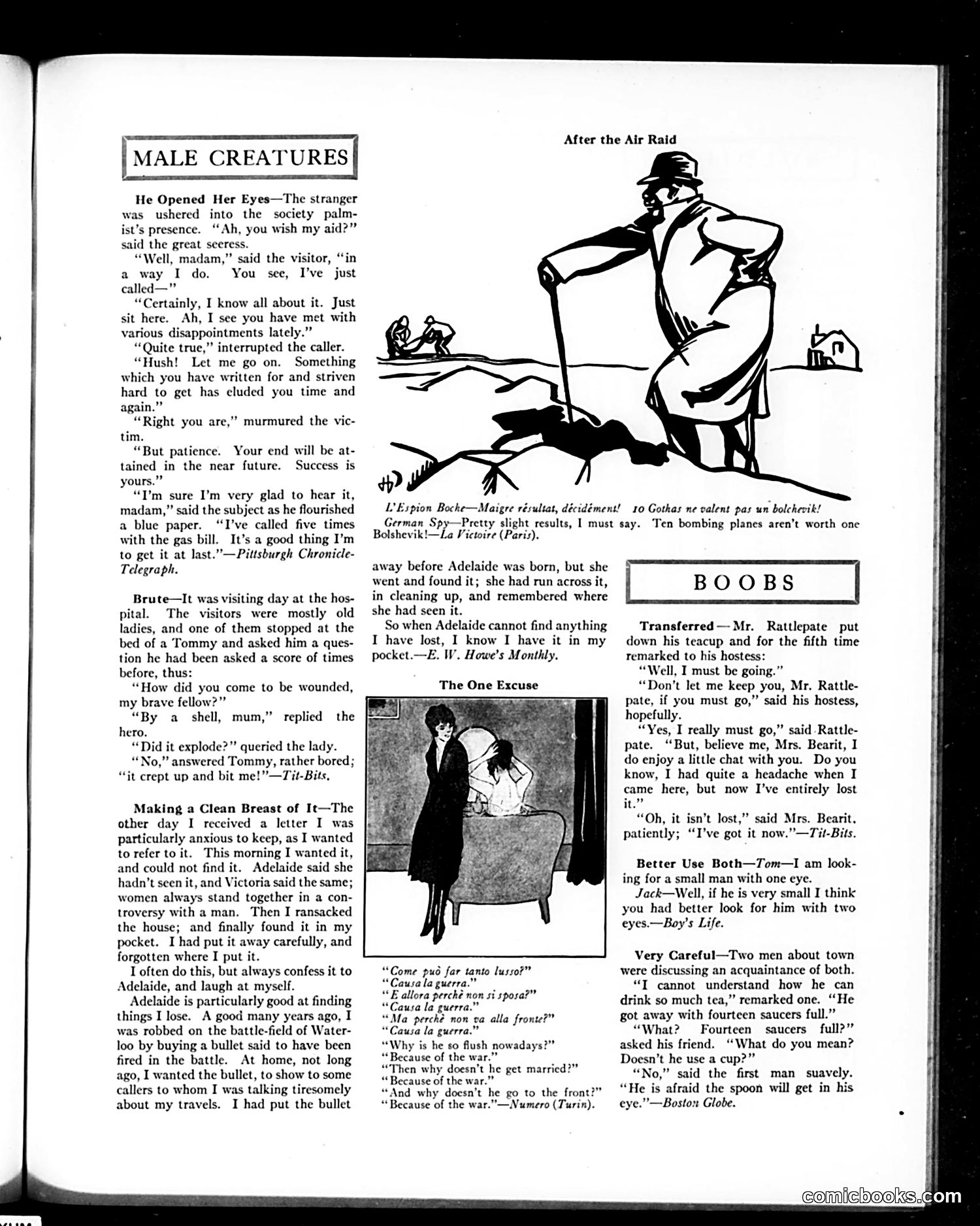
This page from Judge magazine contains several brief satirical pieces and cartoons: **"After the Air Raid"** cartoon mocks a German spy lamenting that ten bombing planes aren't worth one Bolshevik—likely referencing WWI-era anxieties about both aerial warfare and communist revolutionary threats. **"The One Excuse"** satirizes wartime profiteering and avoidance. A man claims "the war" as justification for prosperity, refusing to marry or enlist—exposing how some exploited wartime circumstances for personal gain while avoiding sacrifice. **"BOOBS" section** contains brief humorous anecdotes mocking social awkwardness and literal-mindedness—a recurring feature in Judge. The other longer pieces ("He Opened Her Eyes," "Brute," "Making a Clean Breast of It") are comic stories about fortune tellers, hospital visits, and domestic forgetfulness, typical of Judge's lighthearted male-oriented humor. The overall tone reflects WWI-era concerns: anxiety about modern warfare, skepticism toward those profiting from conflict, and gentle domestic satire.
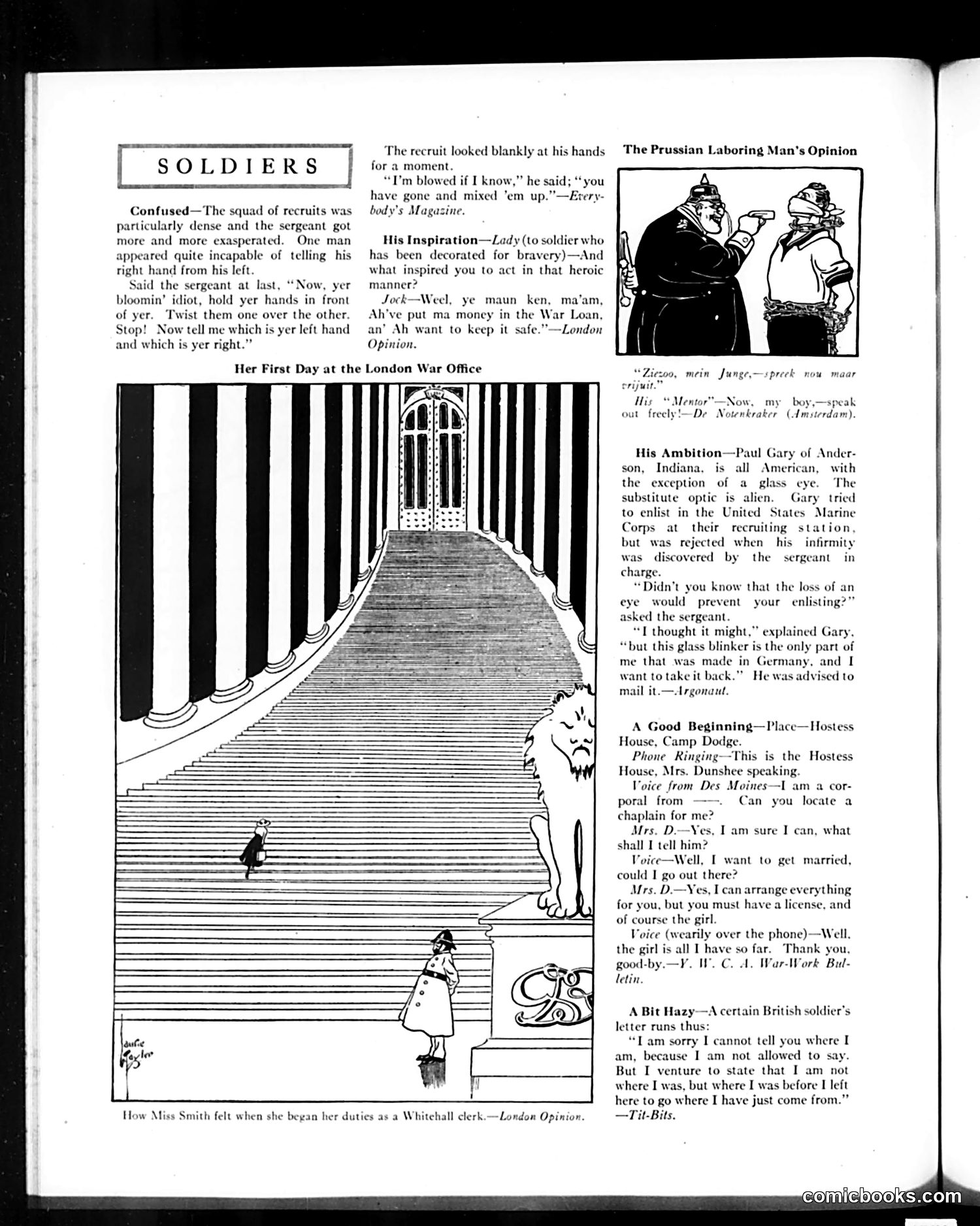
This page contains multiple brief satirical pieces about soldiers during World War I, mocking both military life and the home front: **"Confused"** jokes about a recruit unable to distinguish left from right—typical "dumb soldier" humor. **"His Inspiration"** features a Scottish soldier ("Jock") who reveals he acts bravely to protect his War Loan investment—satirizing financial self-interest masquerading as patriotism. **"Her First Day at the London War Office"** shows a woman's overwhelming first experience at a government office, reflecting women's new wartime workplace roles. **"The Prussian Laboring Man's Opinion"** is anti-German propaganda, depicting a Prussian worker speaking broken English, reinforcing enemy stereotypes. **"His Ambition"** tells of an American wanting to enlist despite a glass eye—satirizing patriotic determination and dark humor about disability. The remaining pieces mock soldiers' inability to communicate locations and wartime romance bureaucracy. Overall, the page reflects WWI-era popular humor: poking fun at military incompetence, questioning true motives for heroism, and stereotyping enemies and allies alike.
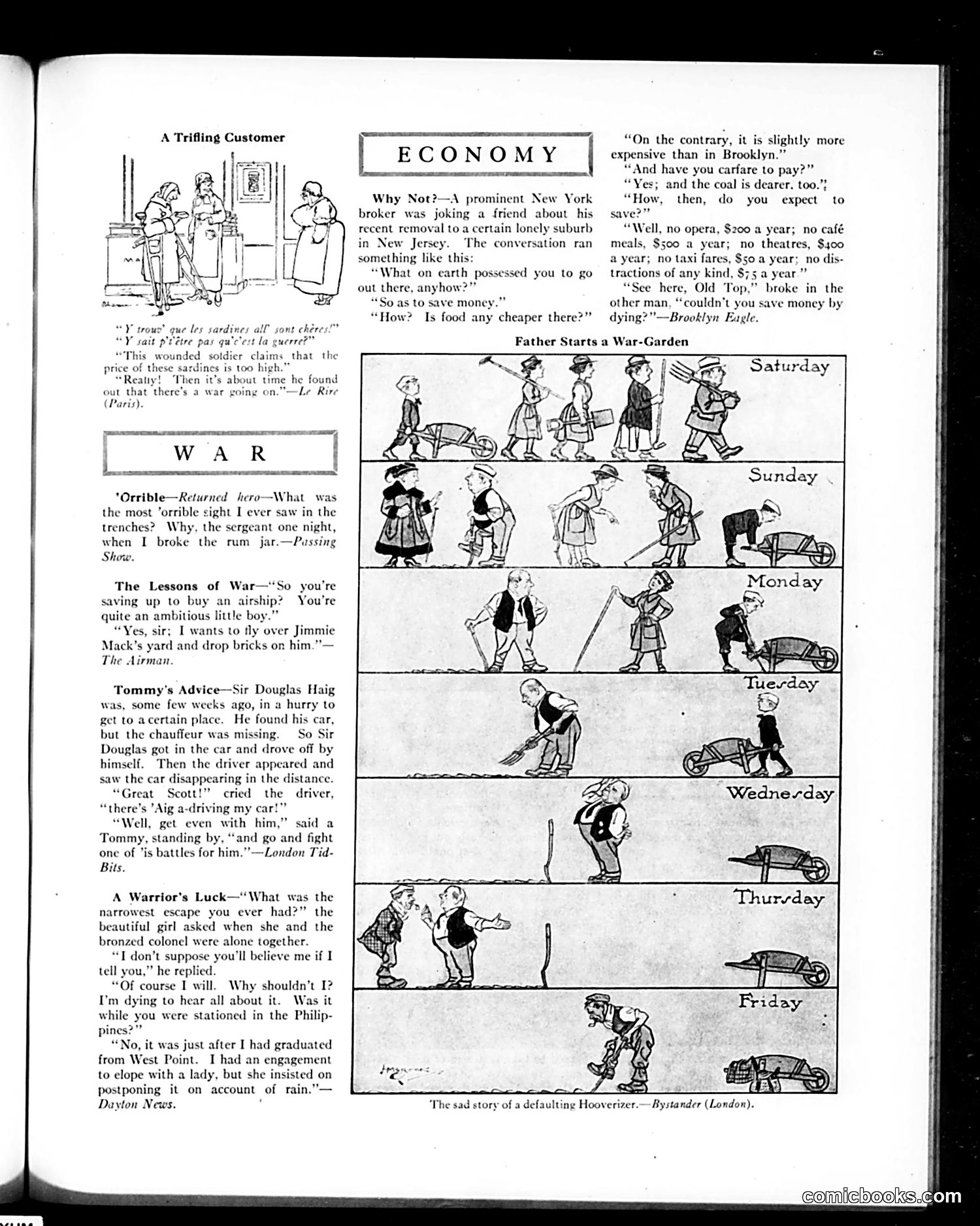
This page contains three war-related humor sections and one domestic economy joke, all from WWI era. **"A Trifling Customer" and "Economy"**: A broker jokes with a friend who moved to rural New Jersey to save money. The friend admits everything costs *more*—food, coal, carfare—but saves by having "no opera, no café meals, no theatres, no taxi fares, no distractions." The punchline: "couldn't you save money by dying?" This satirizes the absurdity of penny-pinching that eliminates all quality of life. **War section anecdotes**: Dark humor about WWI soldiers and leadership. One jokes about a sergeant catching a soldier breaking the rum jar; another has a child wanting to drop bricks on a neighbor from an airship; a third portrays Private "Tommy" advice to General Douglas Haig (actual British commander) about fighting battles after Haig took his car. A colonel's "narrowest escape" was postponing an elopement due to rain—trivial compared to war dangers. **"Father Starts a War-Garden"**: A seven-day comic strip showing progressive vegetable-garden work, ending with a collapsed wheelbarrow, mocking the "Hooveriz" (food-conservation) movement.
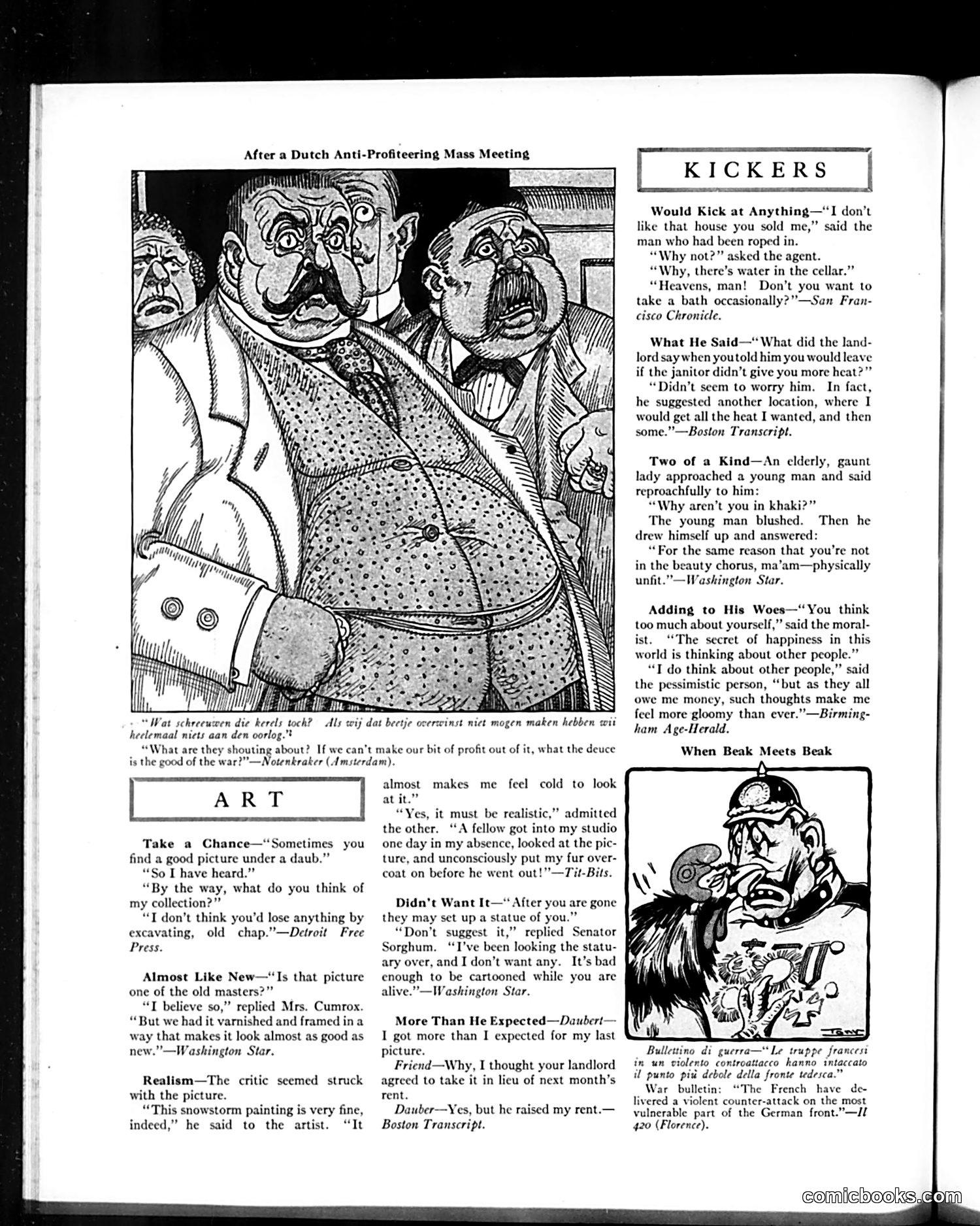
The top cartoon satirizes Dutch war profiteers during WWI. It depicts businessmen at an anti-profiteering mass meeting complaining that if they can't make profits from the war, what's the point of it? The irony is sharp: these merchants are so focused on personal gain that they've inverted normal values—the war exists to serve their profits, not vice versa. The Dutch caption (from Amsterdam's *Notenkraker*) emphasizes this is about actual Dutch industrialists exploiting wartime economics. The page's remaining content are humor shorts and art commentary with no political significance. The bottom cartoon uses WWI military bulletins: French and German language sources both describe the same battle action (French counterattack on weak German positions), but the Italian publication notes the identical tactical reality receives different spin depending on which side reports it—subtle commentary on wartime propaganda and how opposing nations frame identical military facts.
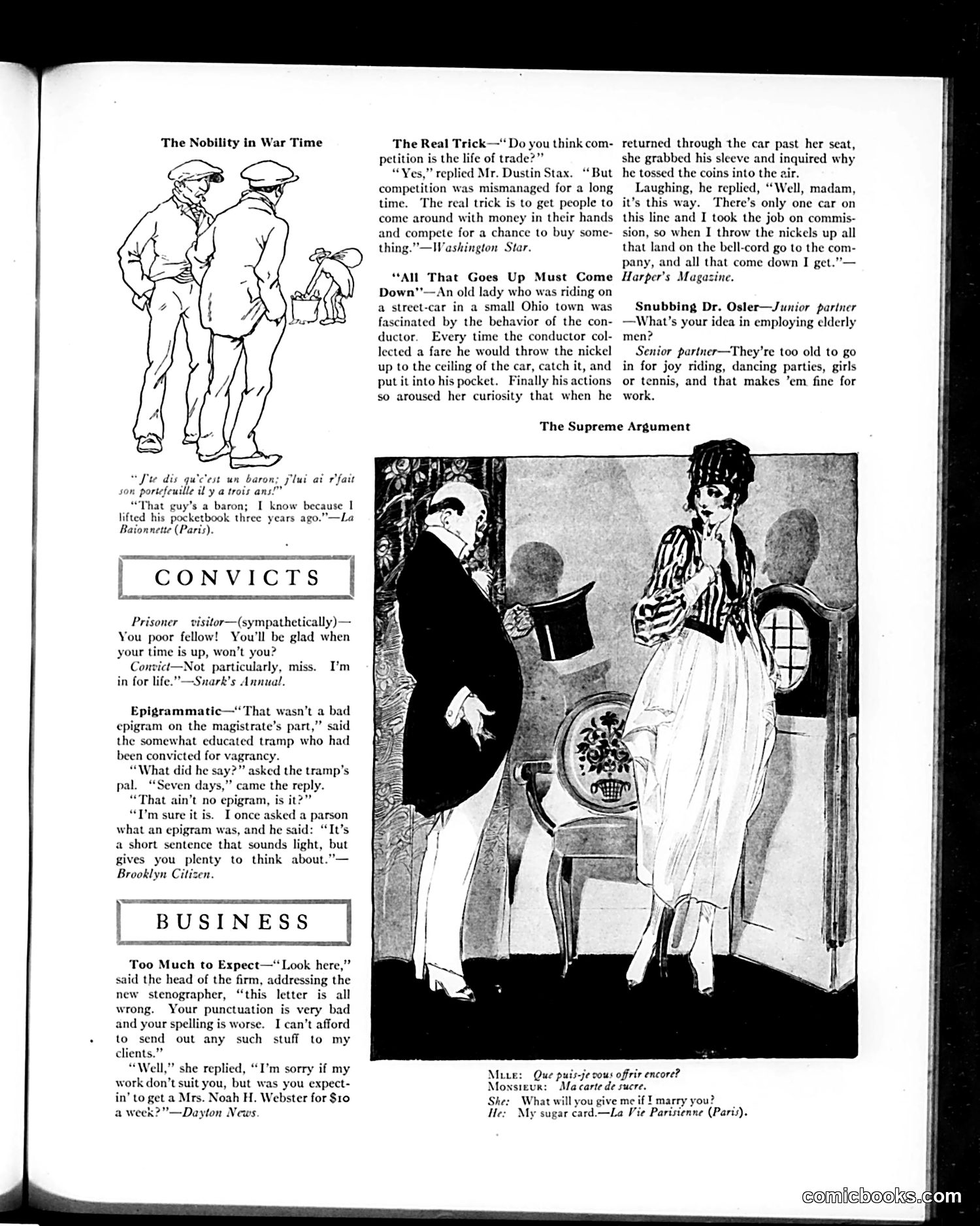
This page contains several brief satirical items and one cartoon, typical of Judge's early-20th-century format: **"The Nobility in War Time"** (top): A French quote mocks European aristocracy—a criminal recognizes a "baron" because he robbed him years ago, suggesting the nobility's wealth is ill-gotten. **"Convicts" section**: Three short anecdotes about prisoners and criminals, using wordplay and irony. The "Epigrammatic" joke plays on "seven days" as a punchy sentence. **"Business" section**: A stenographer defends her poor work by sarcastically asking if her employer expected a competent employee for $10/week—commentary on wage exploitation. **"The Real Trick"**: A conductor admits to pocketing fallen coins from his commission scheme—commentary on worker dishonesty and incentive systems. **"The Supreme Argument"** (right cartoon): A French illustration shows a woman demanding payment (a sugar ration card, valuable during wartime) in exchange for marriage—satirizing wartime scarcity and transactional romance. The page reflects post-WWI skepticism about institutions, class, and commerce.
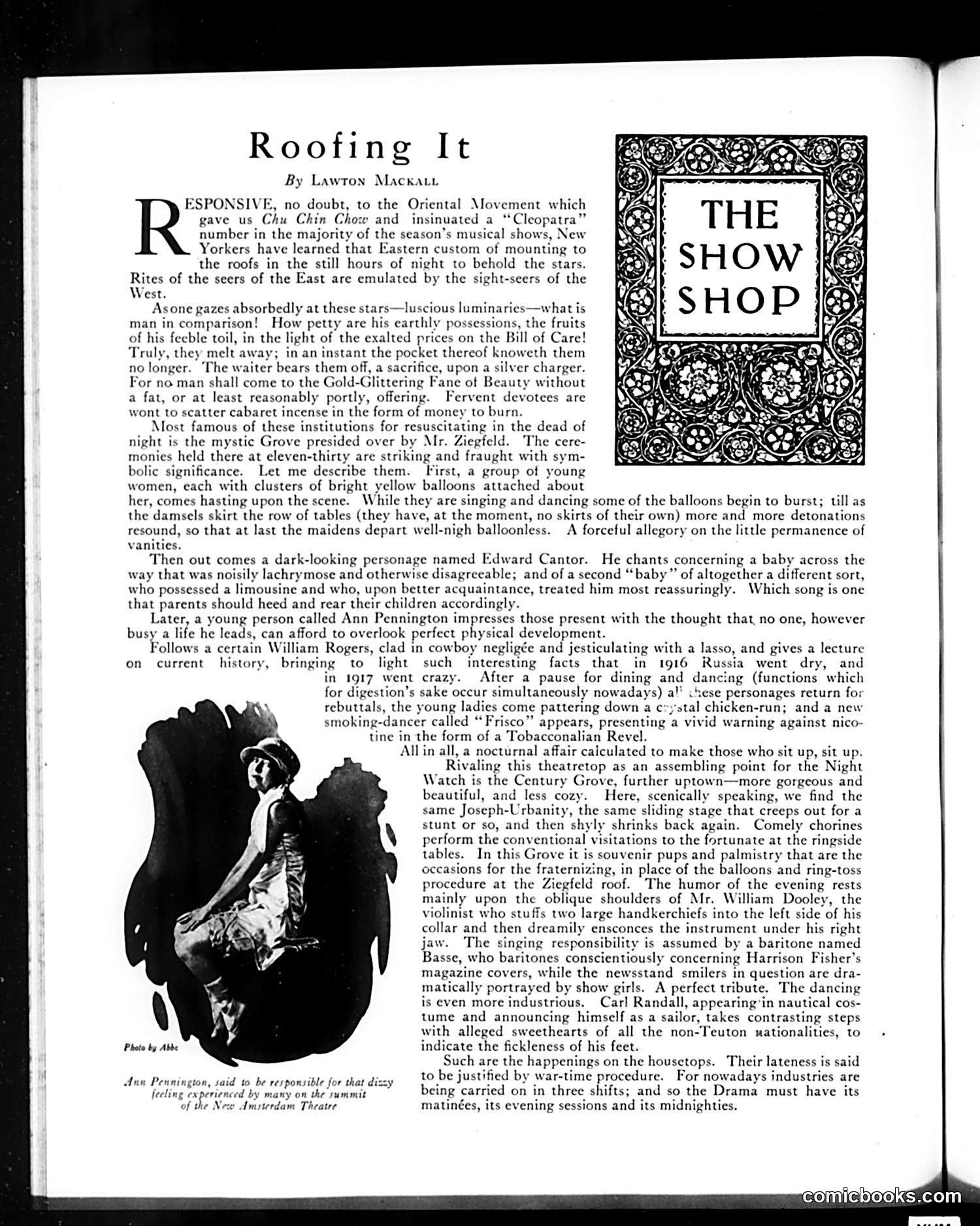
This article by Lawton Mackall satirizes the fashionable trend of wealthy New Yorkers visiting rooftop cabarets, particularly those run by impresario Florenz Ziegfeld. The piece mocks both the pretentious spirituality patrons affect ("gazing at stars") and the venues' actual commercialism—expensive meals and entertainment designed to extract money from the wealthy. The article describes specific performers and acts at Ziegfeld's rooftop theater, including Eddie Cantor (comedian), Ann Pennington (dancer), and Will Rogers (humorist/lasso performer). It satirizes the shows' thin moralism through absurdist descriptions—young women with yellow balloons that burst (representing "vanity"), Rogers's historical "facts" about Russia's 1916-1917 troubles. The photograph shows a silhouetted couple on a rooftop, visually capturing the era's rooftop culture. The satire ultimately mocks New Yorkers' willingness to spend lavishly on entertainment while pretending to sophisticated, almost spiritual pursuits.
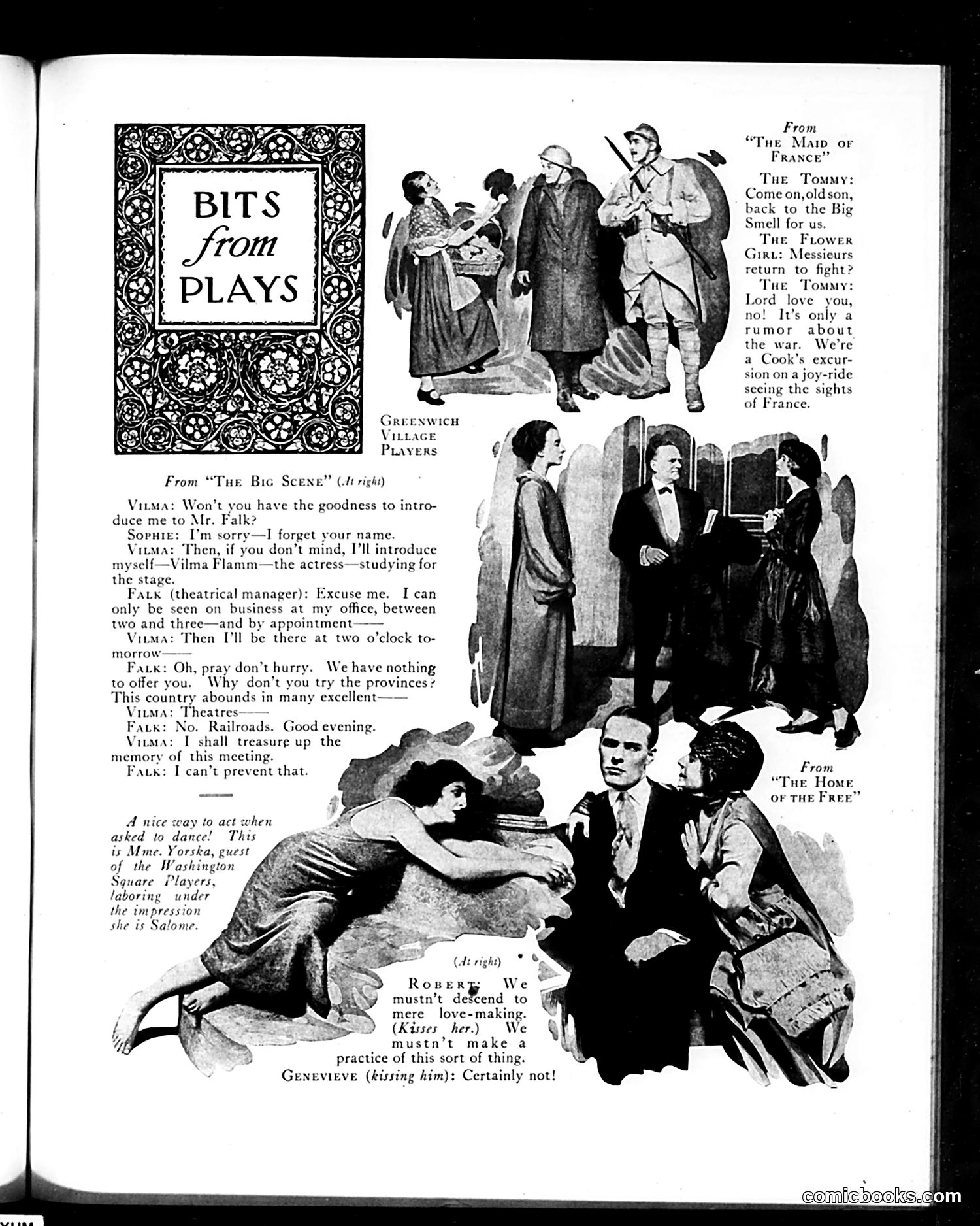
This page collects satirical excerpts from three theatrical productions, mocking both actors and audience pretensions. **"The Big Scene"** ridicules an aspiring actress (Vilma Flamm) desperately seeking work from a dismissive theatrical manager (Falk) who claims he's always busy and suggests she try the provinces—or rather, their railroads, implying no theaters exist there. **"The Maid of France"** satirizes British soldiers on a pleasure tour of France, joking they're merely sightseeing rather than genuinely engaged in war efforts—a commentary on tourism masquerading as patriotic duty during WWI. **"The Home of the Free"** mocks romantic hypocrisy: a couple discusses avoiding "mere love-making," yet immediately kiss—exposing the gap between stated moral principles and actual behavior. The humor targets theatrical vanity, wartime tourism, and social pretense typical of Judge's satirical approach.
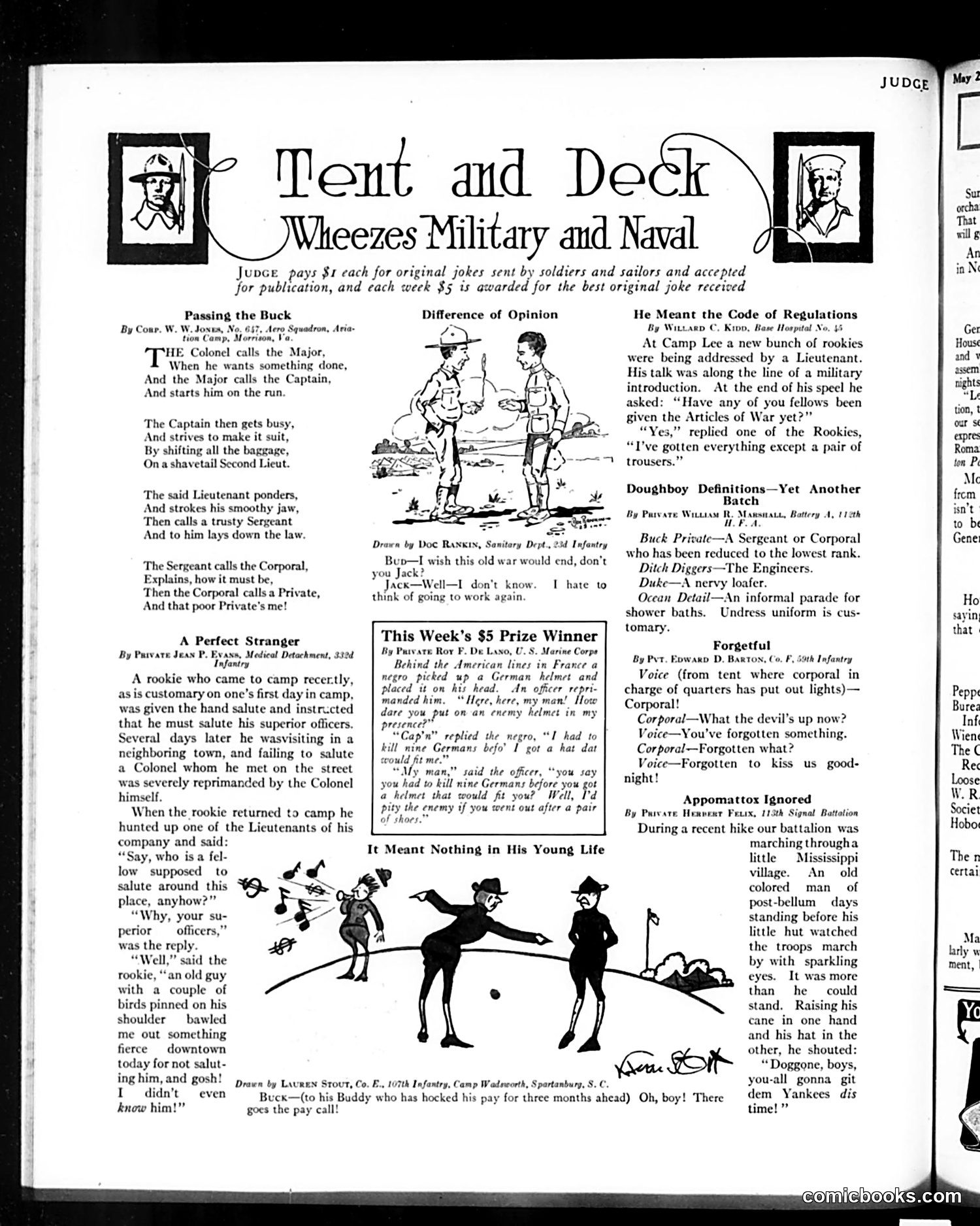
This is a WWI-era humor page from *Judge* magazine featuring jokes and cartoons submitted by soldiers and sailors. The content satirizes military bureaucracy and camp life. **Key pieces:** - **"Passing the Buck"**: Mocks the chain of command, where orders cascade downward until a lowly Private bears all responsibility. - **"A Perfect Stranger"**: A rookie salutes the wrong officer (a Colonel he doesn't know) off-base, humorously illustrating confusion over military protocol. - **"Difference of Opinion"**: Two soldiers debate ending the war; one dreads returning to civilian work. - **Prize-winning joke**: A Black soldier's quip about killing nine Germans to find a helmet that fits—edgy racial humor typical of the era, framed as wit. - **"It Meant Nothing in His Young Life"**: A polo cartoon, likely about officer leisure activities. The page's overall theme: the absurdities of military life, strict hierarchies, and adjustment to army discipline—humor for soldiers themselves.
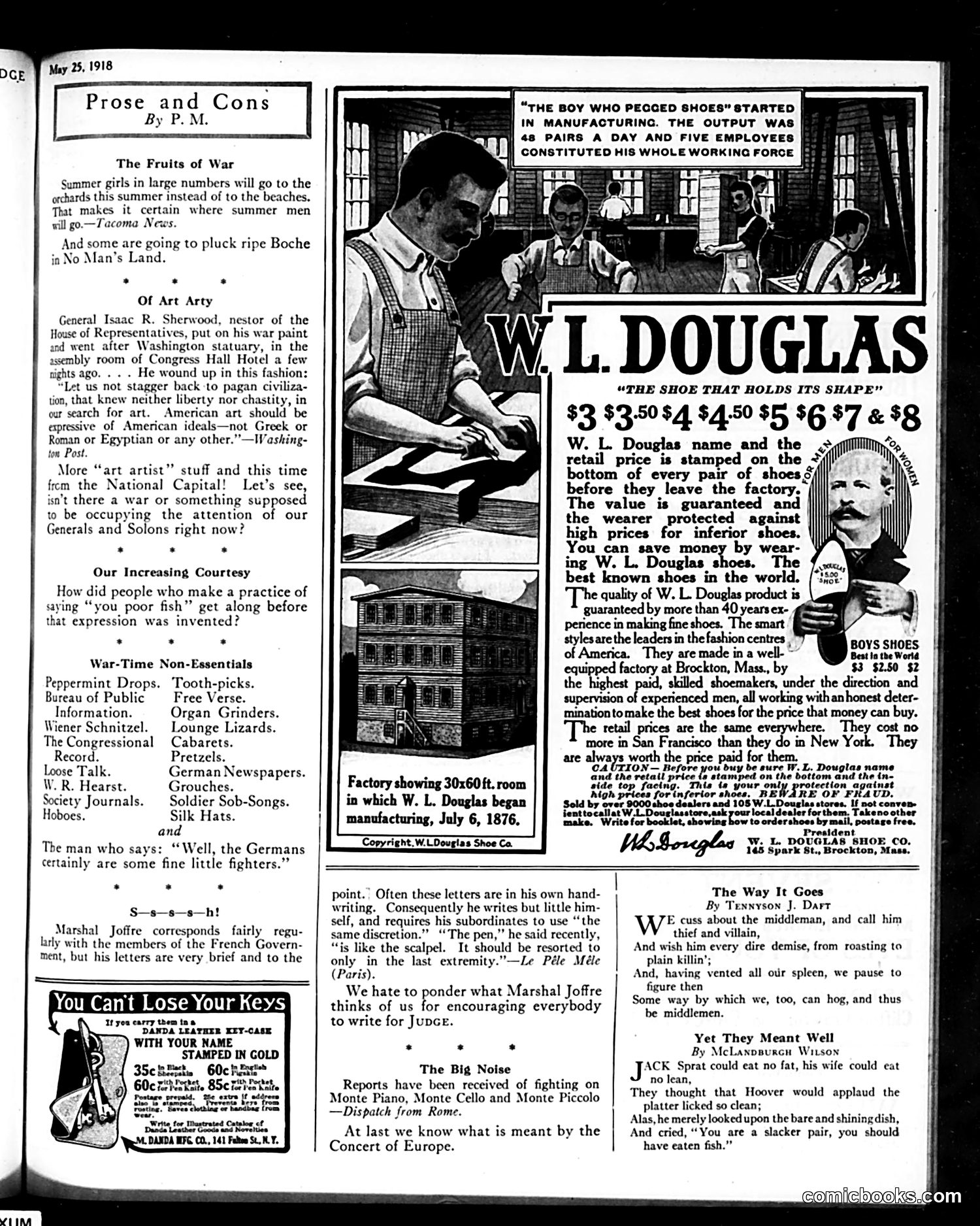
This page mixes wartime satire with advertising. The left column ("Prose and Cons") contains brief, sharp jabs at American society during World War I: **Key satire points:** - "The Fruits of War": Jokes about summer girls going to orchards instead of beaches, implying young men will be killed in combat ("pluck ripe Boche" = kill German soldiers). - "Of Art Arty": Mocks General Isaac Sherwood for giving grandiose speeches about American art while a war demands national attention. - "War-Time Non-Essentials": Lists items supposedly frivolous during wartime (silk hats, loose talk, German newspapers, W.R. Hearst's publications). **The dominant feature is a large W.L. Douglas shoe advertisement**, featuring the company founder's portrait and promoting shoes at various price points ($3-$8), emphasizing their guaranteed quality and value—a pitch designed for wartime consumer consciousness. **Marshal Joffre reference**: A brief note about the French military commander's terse correspondence habits, presented as admirable brevity during wartime. The page reflects 1918 American attitudes: patriotic concerns about war production, suspicion of frivolity, and skepticism toward German-sympathetic media figures like Hearst.
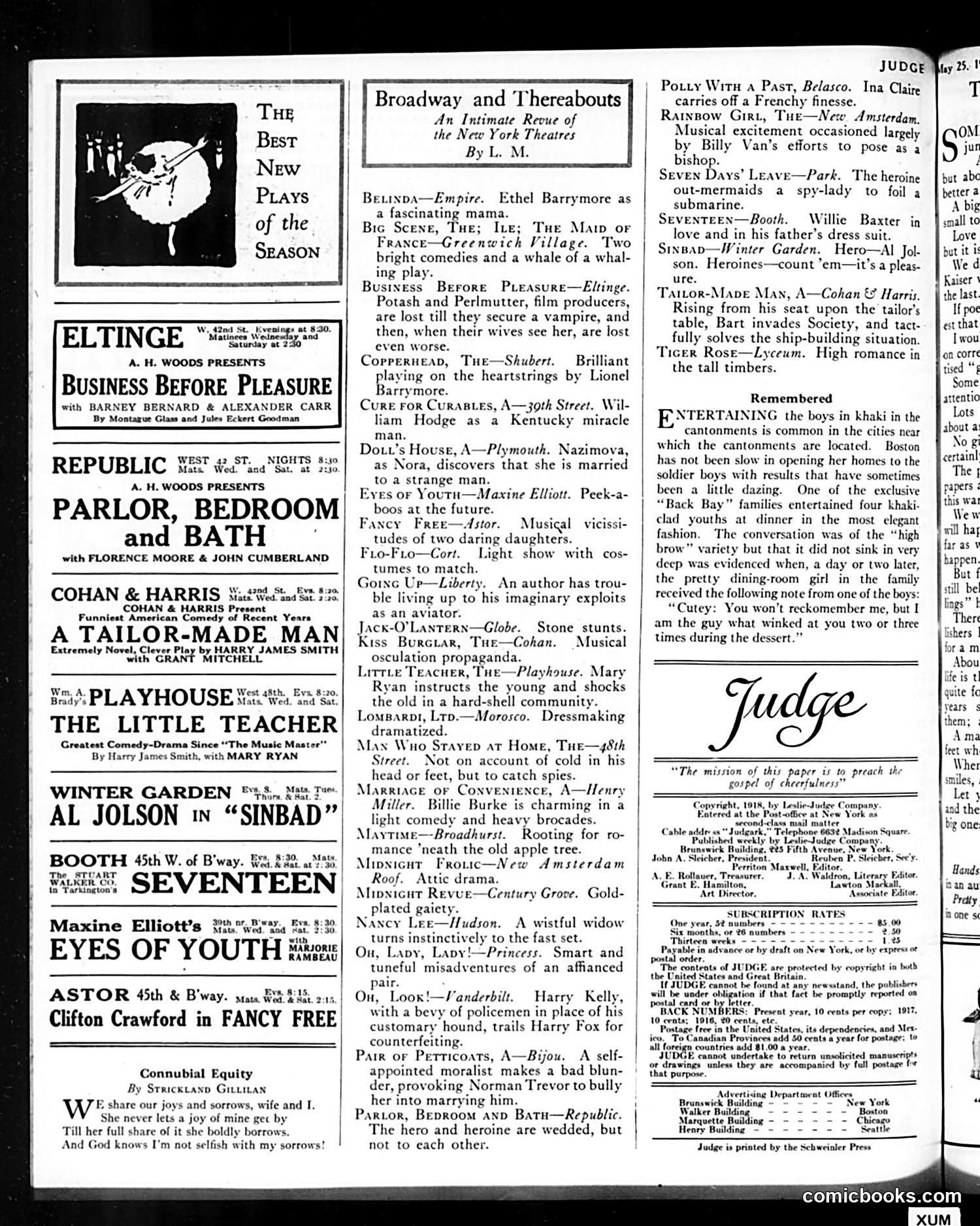
This page is primarily **theater advertising and reviews**, not political satire. It consists of: **Left side:** Broadway theater advertisements listing current productions (Business Before Pleasure, Parlor Bedroom and Bath, A Tailor-Made Man, etc.) with venues and showtimes. **Center:** "Broadway and Thereabouts" — brief capsule reviews of New York theatrical productions, written by L.M. These are lighthearted synopses: Ethel Barrymore in a romantic drama, comedies about film producers and Kentucky con men, musical shows, etc. **Right side:** A short anecdote titled "Remembered" about Boston society entertaining soldier boys in World War I military cantonments. A soldier, impressed by a young woman at a fancy dinner, later sends an illiterate note saying he's "the guy what winked at you." **The satire:** Gentle mockery of social class — contrasting the "high brow" pretensions of an exclusive "Back Bay" family with the soldier's crude, misspelled admiration. The joke targets both upper-class affectation and working-class manners.
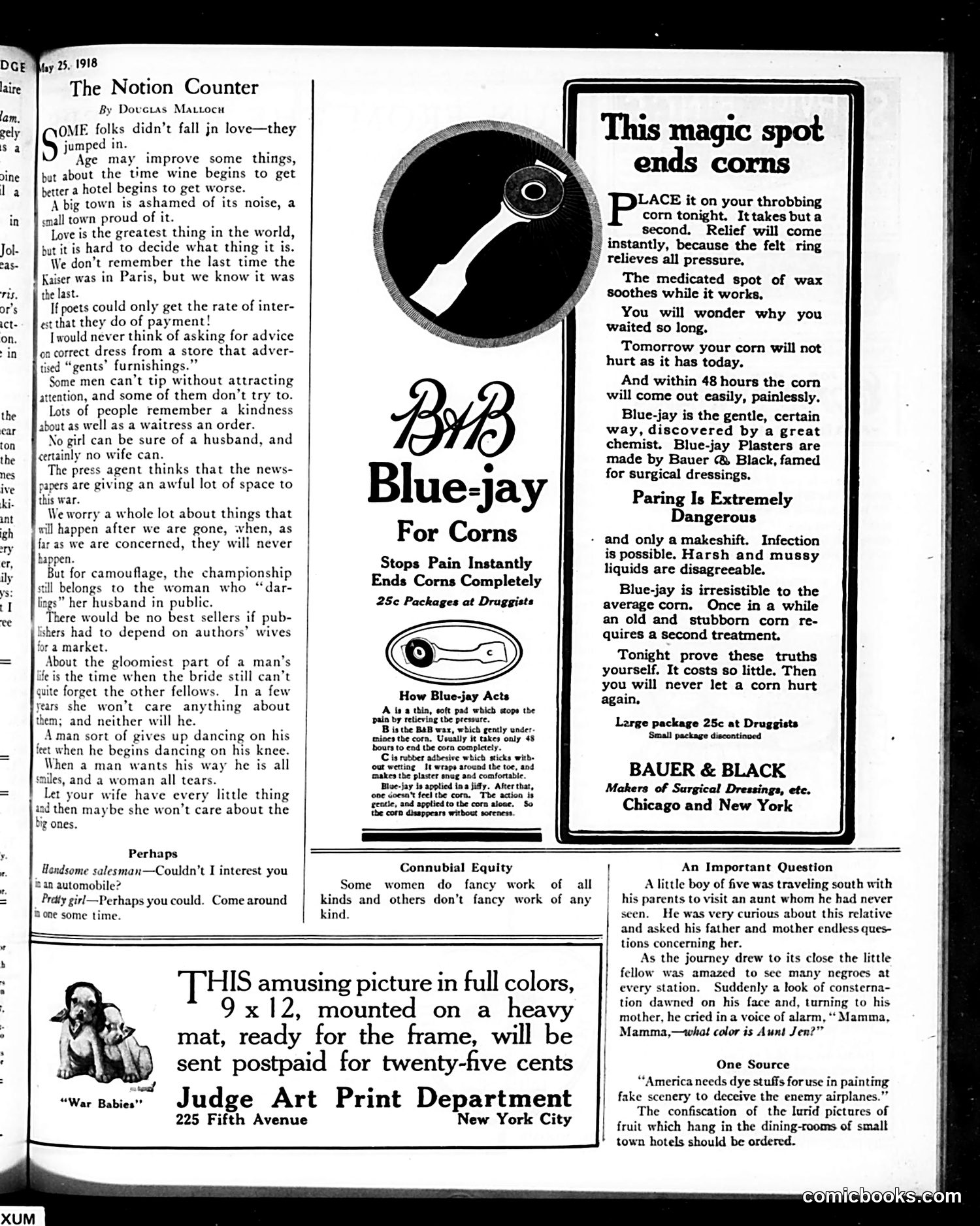
This page from *Judge* magazine (May 25, 1918) contains two distinct elements: **"The Notion Counter" column** is a collection of brief satirical observations about love, marriage, human nature, and WWI-era society. Examples include quips about newlyweds, the futility of poets seeking payment, and a joke about a woman who calls her husband "darling" in public as marital "camouflage." One topical reference mentions the Kaiser in Paris, referencing the ongoing World War I. **The dominant content** is actually advertising—a full-page advertisement for Blue-jay corn plasters by Bauer & Black. This product promised painless corn removal within 48 hours using medicated wax pads. The ad emphasizes the dangers of traditional corn-paring (infection risk) and markets Blue-jay as a gentler alternative. The page reflects early 20th-century concerns (foot care remedies were major advertised products) and wartime anxieties, but is primarily a commercial advertisement rather than political satire.
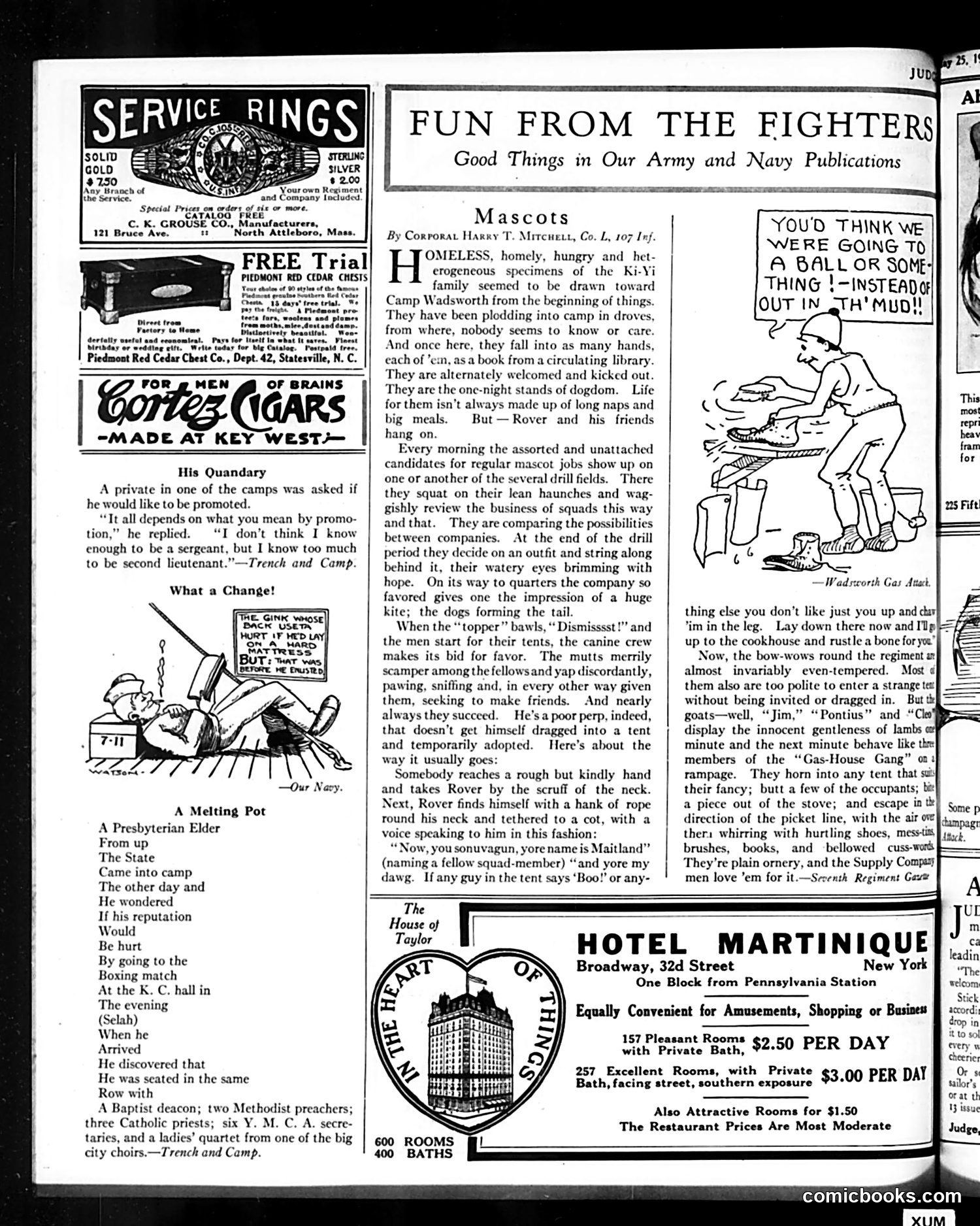
This Judge magazine page contains WWI-era military humor from Army and Navy publications. The main content includes: **"Mascots"** - A humorous account of stray dogs adopting themselves to soldiers at Camp Wadsworth. The piece describes how unattached mongrels show up at drill fields daily, seeking adoption by individual soldiers who name and claim them as company mascots. The satire plays on soldiers' sentimentality—tough soldiers become sentimental pet owners, tethering dogs to cots and promising them scraps from the cookhouse. **"His Quandary"** and **"A Melting Pot"** are brief jokes: the first mocks military rank confusion; the second humorously notes how army camps brought together people of different religions and backgrounds who wouldn't normally socialize. The cartoons depict soldiers in camp life situations. The page is primarily **advertising and entertainment content** rather than political satire, reflecting how Judge mixed humor about soldiers' everyday experiences with commercial advertisements.
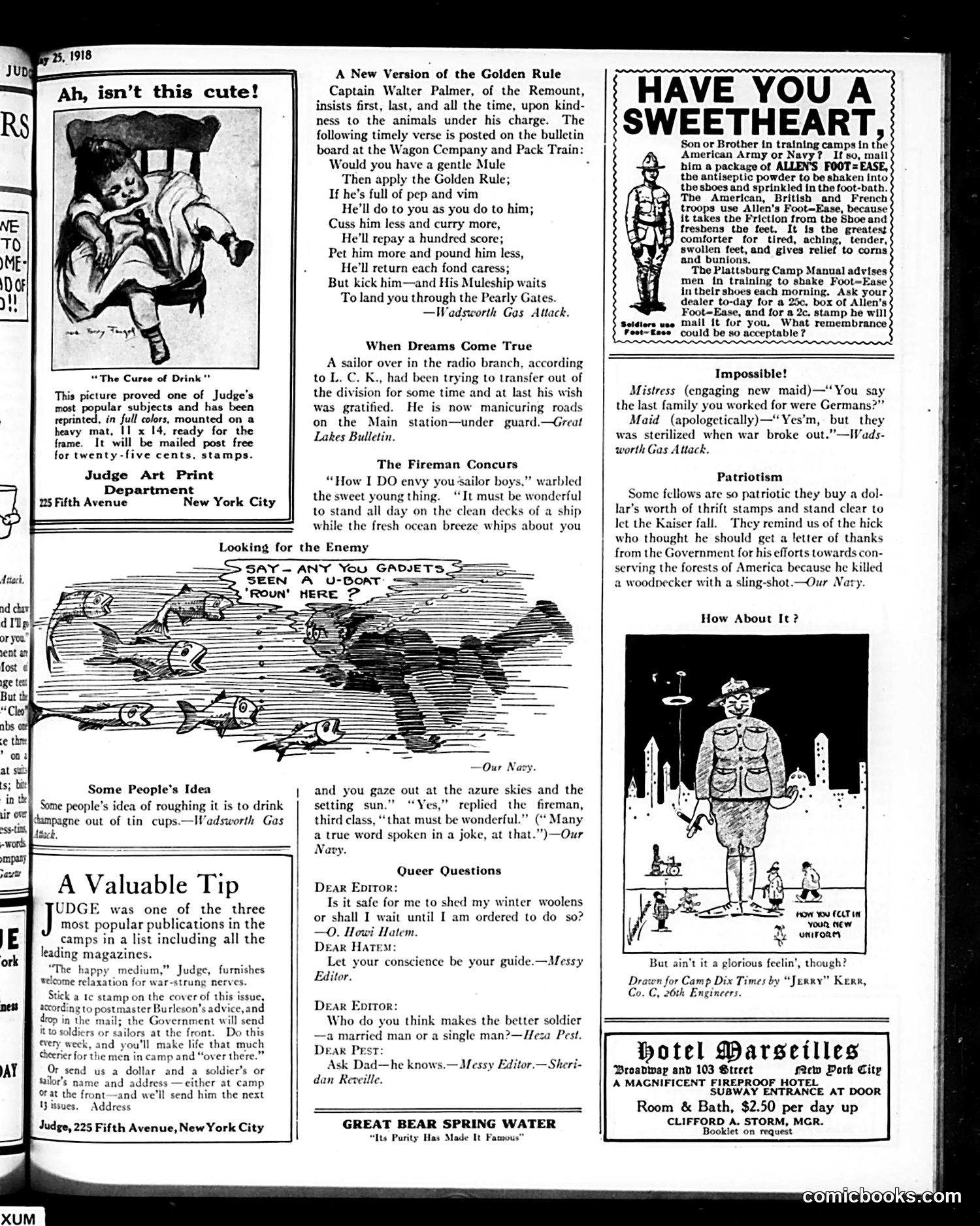
This page from Judge, a WWI-era satirical magazine, contains several items satirizing military life and the home front: **"The Curse of Drink"** advertises a popular print depicting the dangers of alcohol—a temperance-era moral concern. **"A New Version of the Golden Rule"** humorously advises soldiers at a Remount (cavalry supply unit) to treat mules kindly, using verse to suggest mules will reciprocate good treatment or deadly revenge. **Military anecdotes** mock enlisted life: a sailor's transfer wish backfires when he's assigned to road maintenance under guard; a fireman ironically envies sailors' deck duties while romance-minded women idealize naval life. **"Looking for the Enemy"** depicts sailors searching for German U-boats—referencing real submarine threats to American shipping. **Patriotic appeals** encourage readers to mail Judge magazines to soldiers, framing it as morale support. The page's tone balances humor with gentle mockery of military bureaucracy and romantic illusions about service, while reinforcing patriotic messaging about supporting troops.
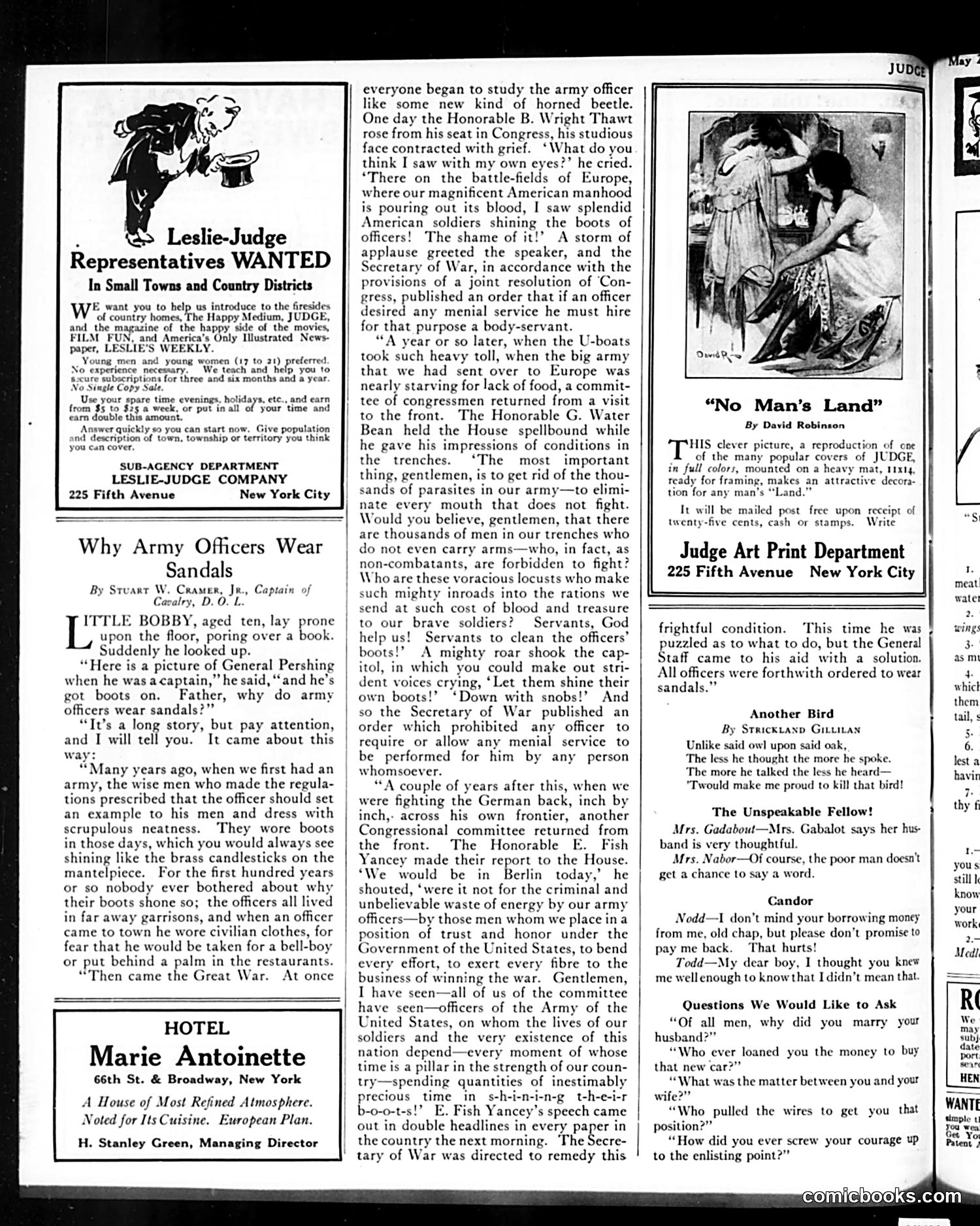
This Judge magazine page contains satirical commentary on WWI-era military policy. The main article, "Why Army Officers Wear Sandals," uses a father-son dialogue to mock Congressional hypocrisy regarding military efficiency. The satire works as follows: A congressman (B. Wright Thawt) dramatically denounces soldiers polishing officers' boots as wasteful during wartime, securing a ban on officer servants. Shortly after, another congressman (G. Water Bean) complains about "parasites" in the army—revealing the original servants were still employed, just now hired privately rather than assigned. The joke: the reform accomplished nothing except shifting blame. The piece mocks Congress for performative outrage and ineffectual legislation while soldiers starved due to supply shortages. Officers' vanity remained unchanged; only the bureaucratic mechanism changed. The page also includes recruitment advertising for Judge magazine subscriptions—mainstream content for the era.
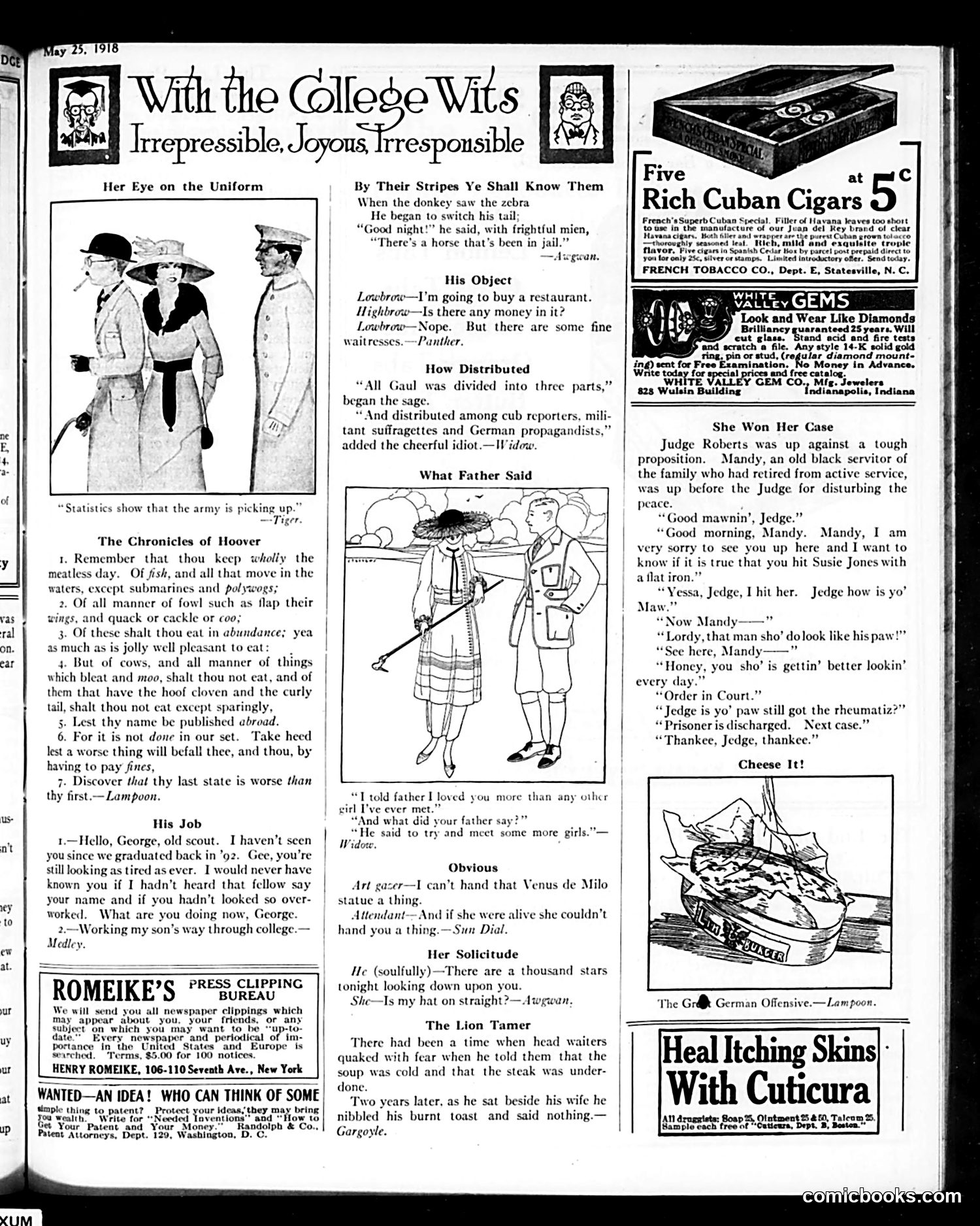
This is a humor/joke collection from *Judge* magazine, a satirical weekly. The cartoons and short jokes target college life and social conventions of 1918 America. **Key content:** - "Her Eye on the Uniform" satirizes women pursuing military men - "The Chronicles of Hoover" mocks WWI-era food rationing (likely referencing Herbert Hoover's food administration) - Brief jokes target college life, dating, relationships, and social pretension - "She Won Her Case" features dialect humor with an elderly Black domestic servant ("Mandy"), reflecting the era's casual racism in humor publications - Various one-liners mock intellectualism and social climbing The satire is light and domestic—targeting vanity, romance, and wartime restrictions—rather than political. The page also carries period advertisements (Cuban cigars, fake diamonds, skin treatment) typical of such magazines.
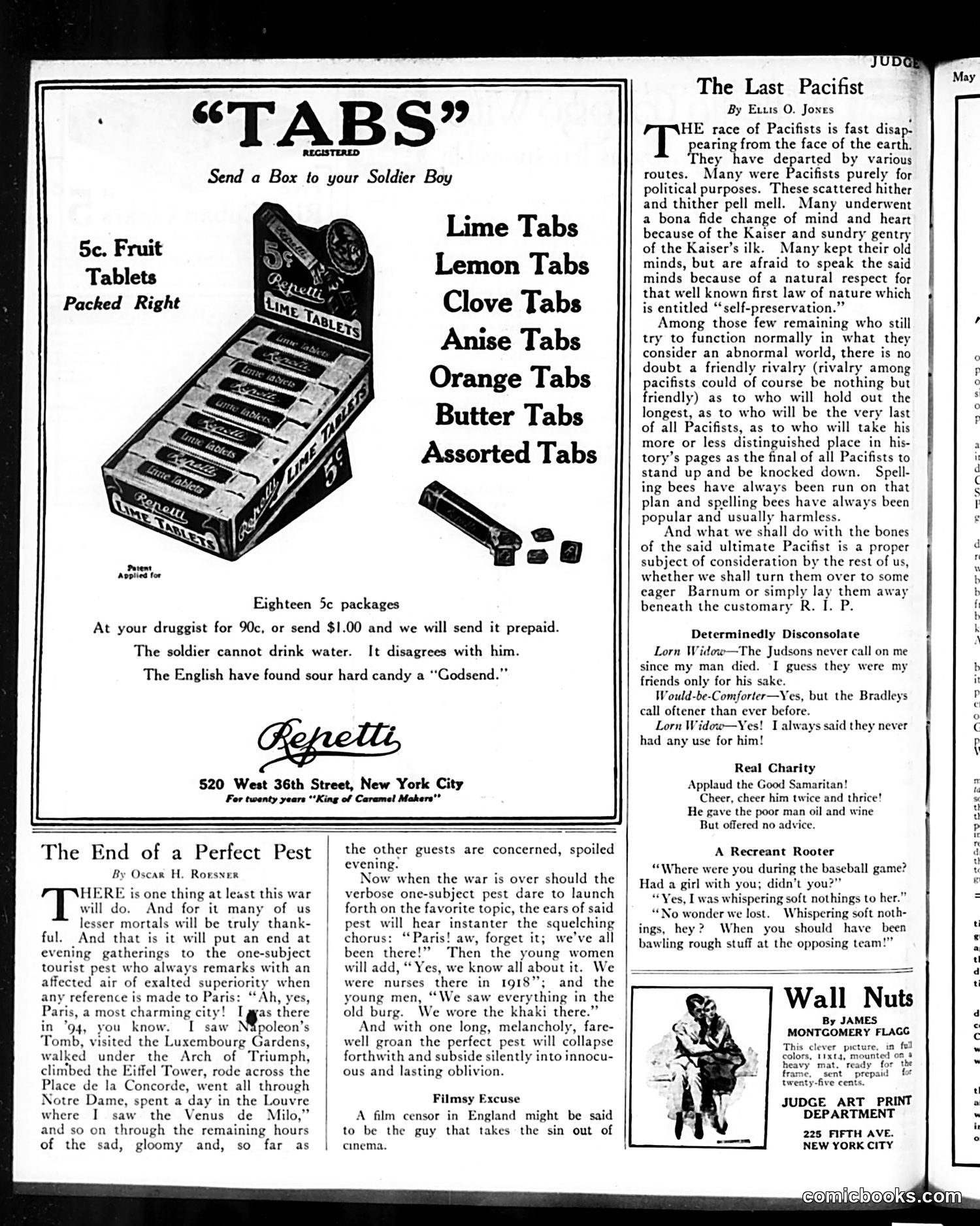
This page from **Judge** (a WWI-era satirical magazine) contains mostly **advertisements and humor pieces**, not political cartoons. The **Tabs advertisement** promotes candy tablets for soldiers, addressing a practical wartime concern: soldiers couldn't safely drink water in trenches, so hard candy provided morale and sustenance. The **"End of a Perfect Pest"** satirizes the pre-war tourist bore—the annoying dinner guest who constantly brags about visiting Paris. The joke is that WWI will finally silence these bores: when they try their tired anecdote post-war, younger people who actually served as nurses or soldiers in France can dismiss them with "we've all been there." **"The Last Pacifist"** mocks the disappearing peace movement during WWI, suggesting pacifists either changed their minds due to German aggression ("the Kaiser") or now stay silent from social pressure and self-preservation instinct. It treats pacifism with sardonic humor rather than respect. The remaining pieces are brief satirical jokes about war-related topics. The page reflects American wartime attitudes: practical support for soldiers, mockery of pacifists, and lighthearted commentary on social change.
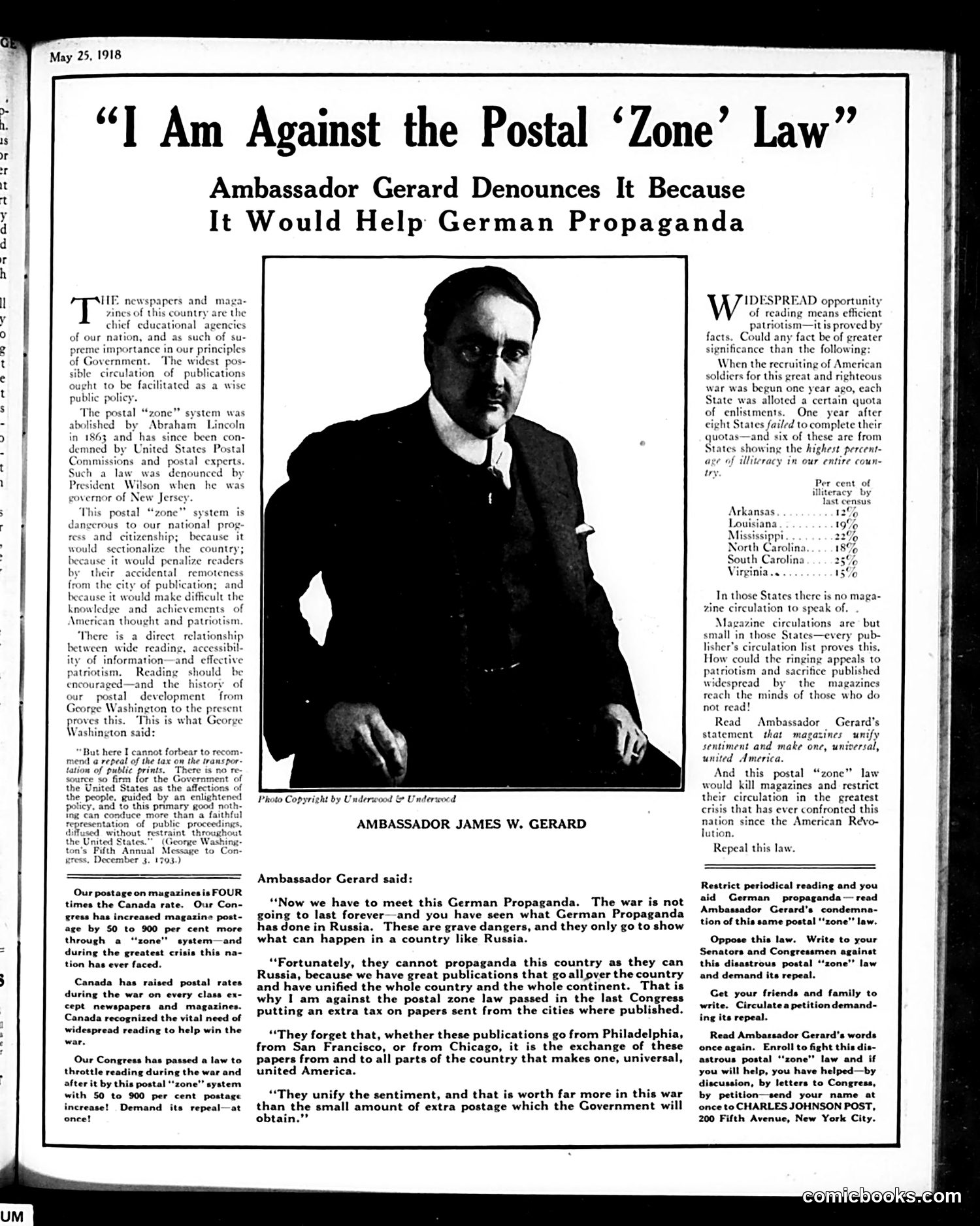
This 1918 **Judge** magazine page argues against the postal "Zone Law"—legislation that charged higher postage rates for magazines and newspapers based on delivery distance. **The Figure:** Ambassador James W. Gerard, former U.S. Ambassador to Germany, is the authority cited opposing the law. **The Political Context:** During World War I, Gerard warns that the Zone Law would weaken America by reducing nationwide magazine circulation. He argues magazines unify the country and counter German propaganda—a real concern after the Russian Revolution, where he suggests propaganda had destabilized the nation. **The Satire's Point:** The page uses patriotic language to argue that restricting magazine distribution actually helps the *enemy*. It cites illiteracy rates in Southern states (framed as proof magazines are essential) and notes Canada *lowered* postage on newspapers during wartime, while Congress raised American rates. The argument: weakening mass media circulation during wartime is strategically foolish and unpatriotic, potentially opening Americans to enemy influence.
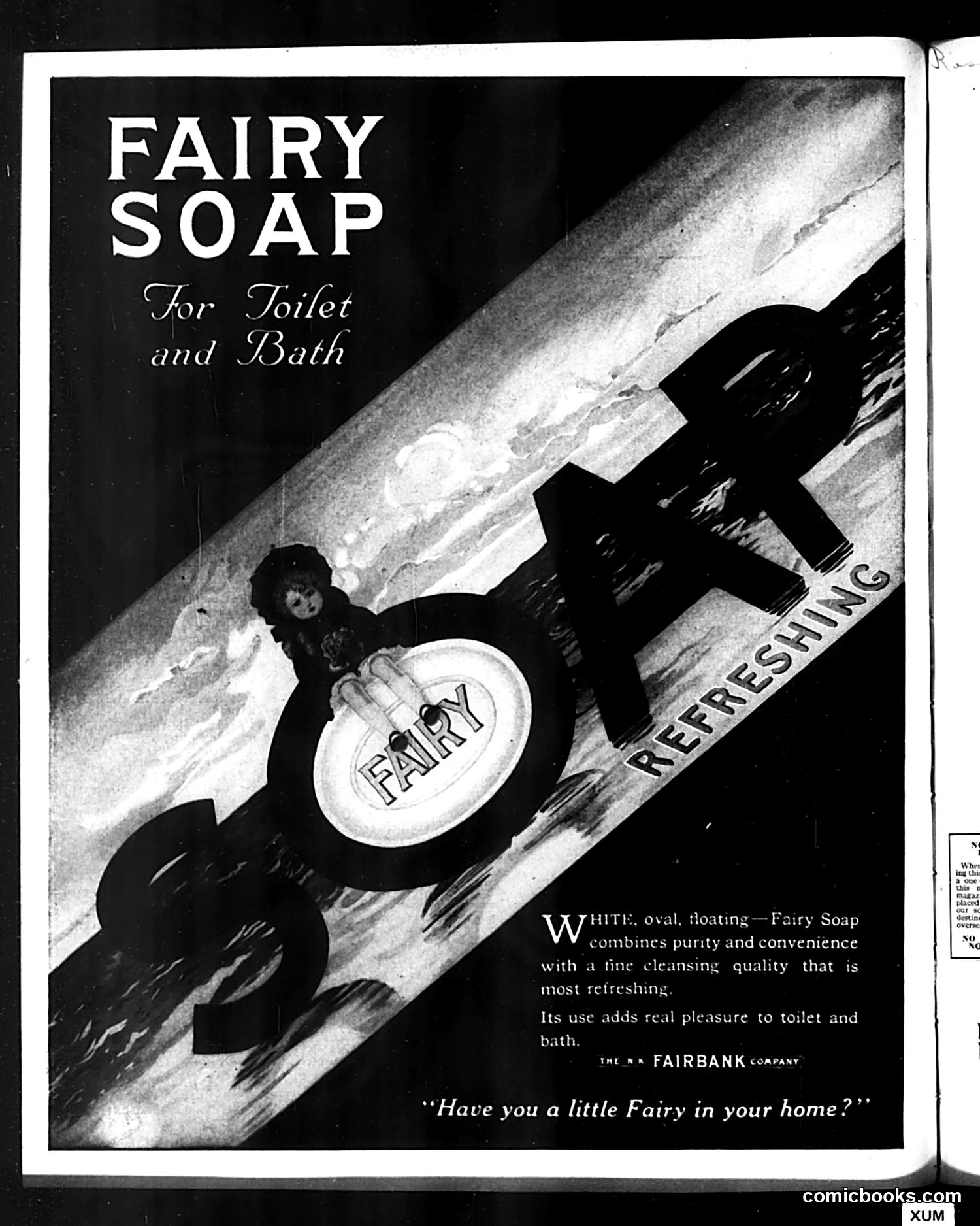
This is a **product advertisement, not political satire**. It promotes Fairy Soap by the Fairbank Company, marketed for toilet and bath use. The image shows a figure (likely a fairy or cherub) holding a bar of oval, floating soap against a stylized background. The ad emphasizes the soap's purity, convenience, and refreshing cleansing qualities. The tagline "Have you a little Fairy in your home?" uses whimsical branding to suggest that owning the product adds pleasure to daily hygiene. This represents early 20th-century consumer advertising in *Judge* magazine—commercial messaging rather than editorial cartooning or political commentary.