
Judge, 1918-05-25 · page 13 of 36
Judge — May 25, 1918 — page 13: what you’re looking at
What you’re looking at
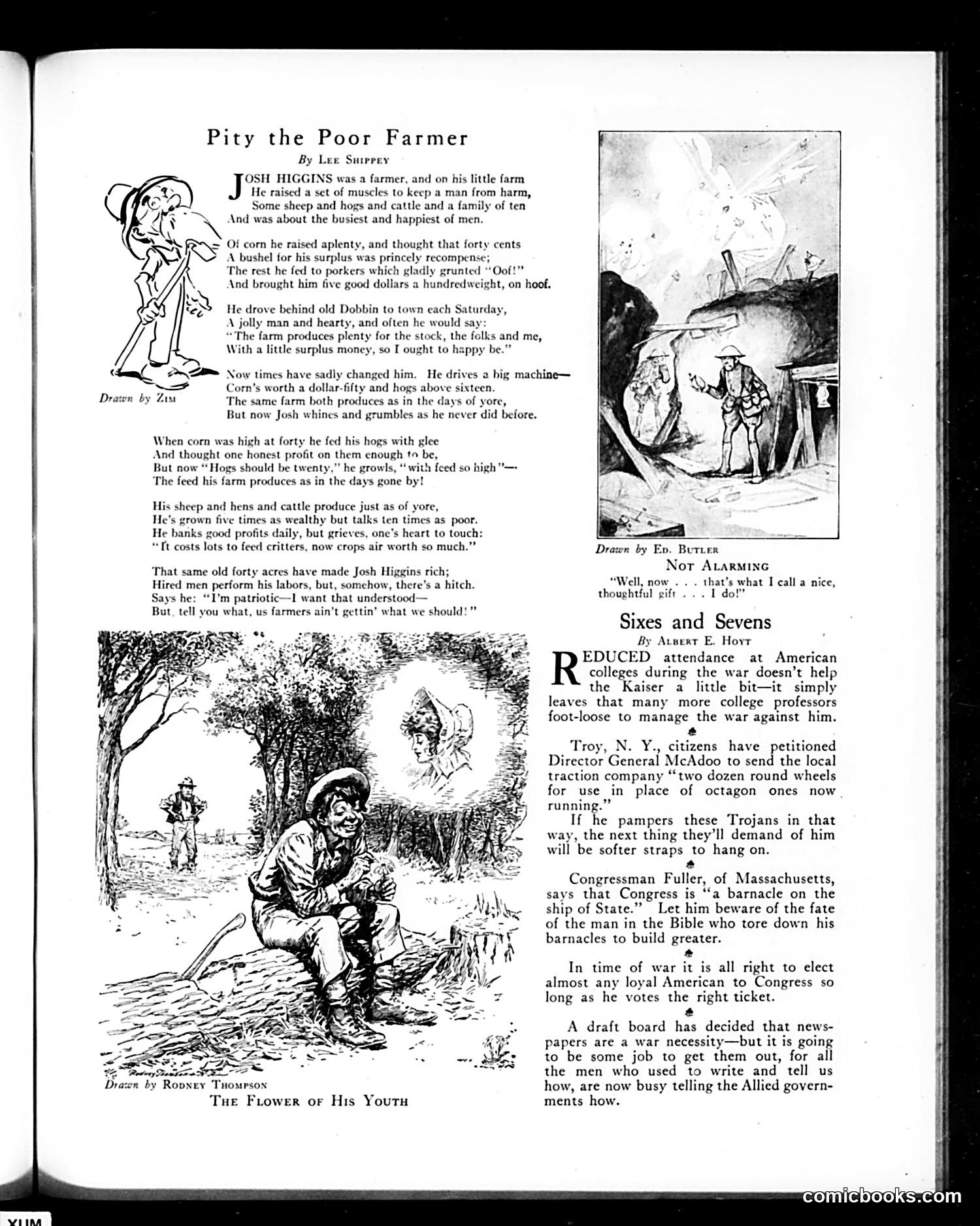
This poem satirizes farmer complaints about wartime prosperity. Josh Higgins operates the same modest farm that once made him content—40 acres producing corn, hogs, and cattle. When corn sold for 40 cents per bushel and hogs for $5 per hundredweight, he was happily satisfied with honest profits. Now wartime inflation has reversed the equation: corn costs $1.50 per bushel, hogs bring over $16 per hundredweight. Josh has grown "five times as wealthy" yet complains constantly that farmers "ain't gettin' what we should." The satire targets farmer hypocrisy—they benefit enormously from war-driven commodity prices yet persistently claim victimization, demanding even higher returns despite genuine prosperity. The poem critiques ingratitude and shifting moral standards: farmers want patriotic credit while maximizing profits at consumers' expense during a national emergency.
📄 Transcribed text from this page (OCR, searchable)
Machine-transcribed from the original scan — historical spelling and the odd misread are preserved.
Pity the Poor Farmer By Lee Suipeey OSH HIGGINS was a farmer, and on his little farm He raised a set of muscles to keep a man from harm, Some sheep and hogs and cattle and a family of ten And was about the busiest and happiest of men. = Of corn he raised aplenty, and thought that forty cents A bushel for his surplus was princely recompense; The rest he fed to porkers which gladly grunted “Oof!” And brought him five good dollars a hundredweight, on hoof. He drove behind old Dobbin to town each Saturday, \ jolly man and hearty, and often he would say: “The farm produces plenty for the stock, the folks and me, With a little surplus money, so I ought to happy be.” < PSP™ Now times have sadly changed him. He drives a big machine— ~— Corn’s worth a dollar-fifty and hogs above sixteen. Draven by Zis The same farm both produces as in the days of yore, But now Josh whines and grumbles as he never did before. When corn was high at forty he fed his hogs with glee And thought one honest profit on them enough to be, But now “Hogs should be twenty,” he growls, “with feed so high”— The feed his farm produces as in the days gone by! His sheep and hens and cattle produce just as of yor He’s grown five times as wealthy but talks ten times as. poor. He banks good profits daily, but grieves, one’s heart to touc! “Tt costs lots to feed critters, now crops air worth so much. Drawn by Ep. Butier Nor ALARMING “Well, now . . . that’s what I call a nice, thoughtful gift... I do!” That same old forty acres have made Josh Higgins rich; Hired men perform his labors, but, somehow, there's a hitch. Says he: “I’m patriotic—I want that understood— But, tell you what, us farmers ain’t gettin’ what we should!” Sixes and Sevens By Aveert E. Hoyt EDUCED attendance at American colleges during the war doesn’t help the Kaiser a little bit—it simply leaves that many more college professors foot-loose to manage the war against him. e Troy, N. Y., citizens have petitioned Director General McAdoo to send the local traction company “two dozen round wheels for use in place of octagon ones now running.” he pampers these Trojans in that way, the next thing they’ll demand of him will be softer straps to hang on. ea Congressman Fuller, of Massachusetts, says that Congress is ‘‘a barnacle on the ship of State.” Let him beware of the fate of the man in the Bible who tore down his barnacles to build greater. 2 In time of war it is all right to elect almost any loyal American to Congress so long as he votes the right ticket. 2 A draft board has decided that news- papers are a war necessity—but it is going to be some job to get them out, for all the men who used to write and tell us PHOMPSON how, are now busy telling the Allied govern- Tue Frower or His Youtu ments how. Drawn by Rovxe