
Judge, 1918-05-25 · page 32 of 36
Judge — May 25, 1918 — page 32: what you’re looking at
What you’re looking at
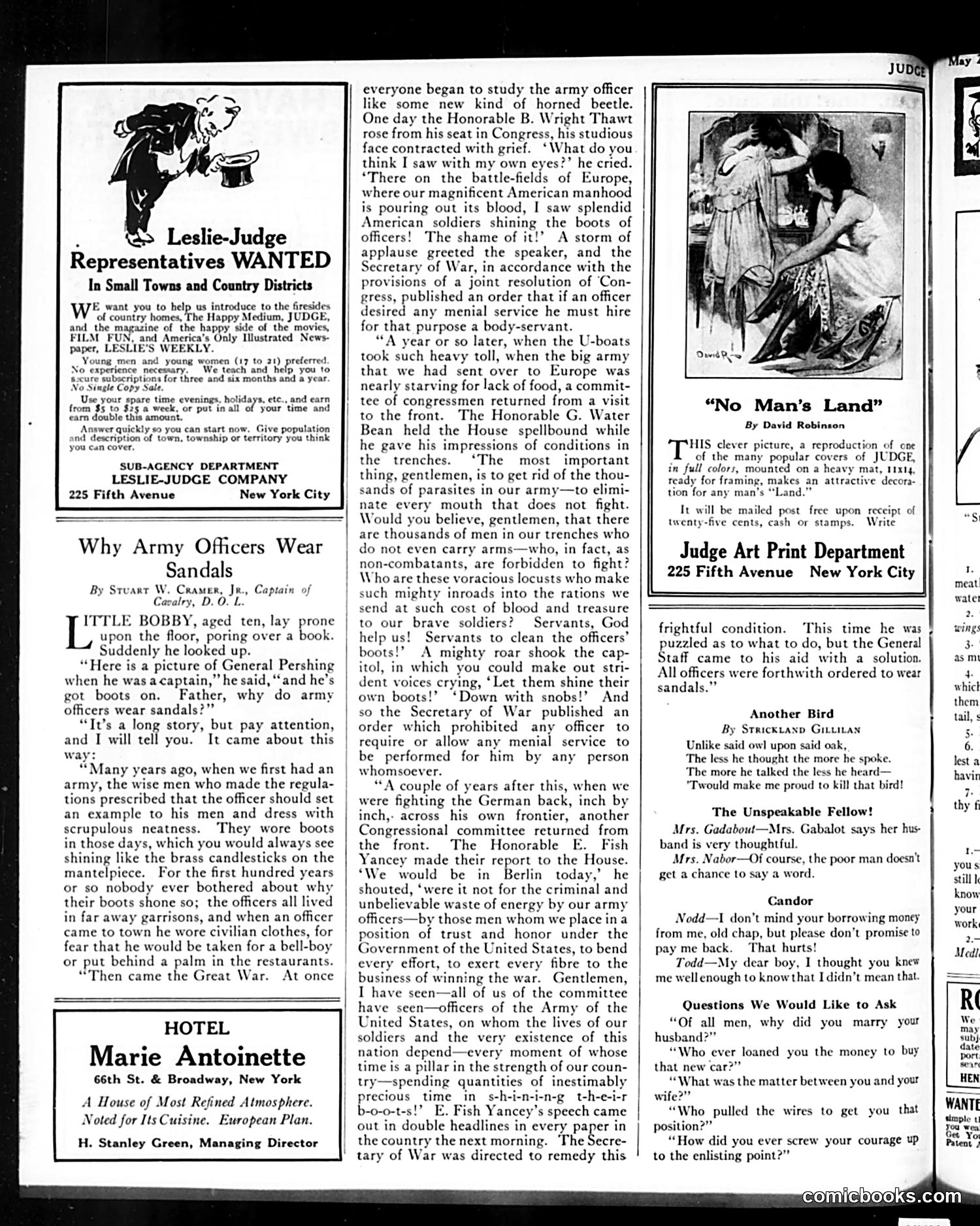
This Judge magazine page contains satirical commentary on WWI-era military policy. The main article, "Why Army Officers Wear Sandals," uses a father-son dialogue to mock Congressional hypocrisy regarding military efficiency. The satire works as follows: A congressman (B. Wright Thawt) dramatically denounces soldiers polishing officers' boots as wasteful during wartime, securing a ban on officer servants. Shortly after, another congressman (G. Water Bean) complains about "parasites" in the army—revealing the original servants were still employed, just now hired privately rather than assigned. The joke: the reform accomplished nothing except shifting blame. The piece mocks Congress for performative outrage and ineffectual legislation while soldiers starved due to supply shortages. Officers' vanity remained unchanged; only the bureaucratic mechanism changed. The page also includes recruitment advertising for Judge magazine subscriptions—mainstream content for the era.
📄 Transcribed text from this page (OCR, searchable)
Machine-transcribed from the original scan — historical spelling and the odd misread are preserved.
Leslie-Judge Representatives WANTED In Small Towns and Country Districts E want you to help us introduce to the firesides of country homes, The Happy Medium, JUDGE, and the magazine of the happy side of the movies, FILM FUN, and America’s Only Illustrated News- paper, LESLIE'S WEEKLY. Young men and young women (17 to 21) preferred. perience necessary. We teach and help you to S:cure subscriptions for three and six months and a year. No Single Copy Sale. Use your spare time evenings. holidays, etc.. and earn from $5 to $25 a week, or put in all of your time and earn double this amount. Answer quickly so you can start now. Give population nd description of town, township of territory you think you can cover, SUB-AGENCY DEPARTMENT LESLIE-JUDGE COMPANY 225 Fifth Avenue New York City Why Army Officers Wear Sandals By Stvant W. Cramer, Jn, Captain of Cavalry, D. O: L. ITTLE BOBBY, aged ten, lay prone UE upon the floor, poring over a book. Suddenly he looked up. “Here is a picture of General Pershing when he was acaptain,” he said, “and he’s got boots on. Father, why do army officers wear sandals?” “It’s a long story, but pay attention, and I will tell you. It came about this way: “Many years ago, when we first had an army, the wise men who made the regula- tions prescribed that the officer should set an example to his men and dress with scrupulous neatness. They wore boots in those days, which you would always see shining like the brass candlesticks on the mantelpiece. For the first hundred years or so nobody ever bothered about why their boots shone so; the officers all lived in far away garrisons, and when an officer came to town he wore civilian clothes, for fear that he would be taken for a bell-boy or put behind a palm in the restaurants. “Then came the Great War. At once HOTEL Marie Antoinette 66th St. & Broadway, New York A House of Most Refined Atmosphere. Noted for Its Cuisine. European Plan. H. Stanley Green, Managing Director everyone began to study the army officer like some new kind of horned beetle. One day the Honorable B. Wright Thawt rose from his seat in Congress, his studious face contracted with grief. ‘What do you think I saw with my own eyes?’ he cried. ‘There on the battle-fields of Europe, where our magnificent American manhood is pouring out its blood, I saw splendid American soldiers shining the boots of officers! The shame of it!’ A storm of applause greeted the speaker, and the Secretary of War, in accordance with the provisions of a joint resolution of ‘Con- gress, published an order that if an officer desired any menial service he must hire for that purpose a body-servant. ‘A year or so later, when the U-boats took such heavy toll, when the big army that we had sent over to Europe was nearly starving for lack of food, a commit- tee of congressmen returned from a visit to the front. The Honorable G. Water Bean held the House spellbound while he gave his impressions of conditions in the trenches. ‘The most important thing, gentlemen, is to get rid of the tho sands of parasites in our army—to elim nate every mouth that does not fight. Would you believe, gentlemen, that there are thousands of men in our trenches who do not even carry arms—who, in fact, as non-combatants, are forbidden to fight? Who are these voracious locusts who make such mighty inroads into the rations we send at such cost of blood and treasure to our brave soldiers? Servants, God help us! Servants to clean the officers’ boots!” A mighty roar shook the cap- itol, in which you could make out stri- dent voices ng, ‘Let them shine their own boots!’ ‘Down with snobs!’ And so the Secretary of War published an order which prohibited any officer to require or allow any menial service to be performed for him by any person whomsoever. “A couple of years after this, when we were fighting the German back, inch by inch,- across his own frontier, another Congressional committee returned from the front. The Honorable E. Fish Yancey made their report to the House. ‘We would be in erlin today,’ he shouted, ‘were it not for the criminal and unbelievable waste of energy by our army officers—by those men whom we place ina position of trust and honor under the Government of the United States, to bend every effort, to exert every fibre to the business of winning the war. Gentlemen, I have seen—all of us of the committee have seen—officers of the Army of the United States, on whom the lives of our soldiers and the very existence of this nation depend—every moment of whose time is a pillar in the strength of our coun- t pending quantities of inestimably precious time in s-h-i-n-i-n-g_ t-h-e-i-r b-o-o-t-s!’ E. Fish Yancey’s speech came out in double headlines in every paper in the country the next morning. ‘The Secre- tary of War was directed to remedy this By David Robinson S clever picture, a reproduction of one HI Tie many popular covers of JUDGE, in full colors, mounted on a heavy mat, 11x14, ready for framing, makes an attractive decora- tion for any man’s “Land.” It w twenty ill be mailed post free upon receipt of -five cents, cash or stamps. Write Judge Art Print Department 225 Fifth Avenue New York City frightful condition. ‘ “No Man’s Land” This time he was | puzzled as to what to do, but the General Staff came to his aid with a solution. All officers were forthwith ordered to wear sandal Another Bird By Stricktanp Gittiran Unlike said owl upon said oak, The less he thought the more he spoke. The more he talked the less he heard— ‘Twould make me proud to kill that bird! Mrs. band is Mrs. get a chance to say a word. Nodd—I don’t mind your borrowing money from me, old chap, but ple: pay me The Unspeakable Fellow! Gadabout—Mrs. Gabalot says her hus- very thoughtful. Nabor—Of course, the poor man doesn't yous still | know your work Candor se don’t promise to back. That hurt Meal Todd—My dear boy, I thought you knew me well enough to know that I didn’t mean that. Qu “Of estions We Would Like to Ask all men, why did you marry your husband?” “Who ever loaned you the money to buy that new ca: “What was the matter between you and your wife? Who pulled the wires to get you that sition? “How did you ever screw your courage Up to the enlisting point?”