
Judge, 1918-05-25 · page 17 of 36
Judge — May 25, 1918 — page 17: what you’re looking at
What you’re looking at
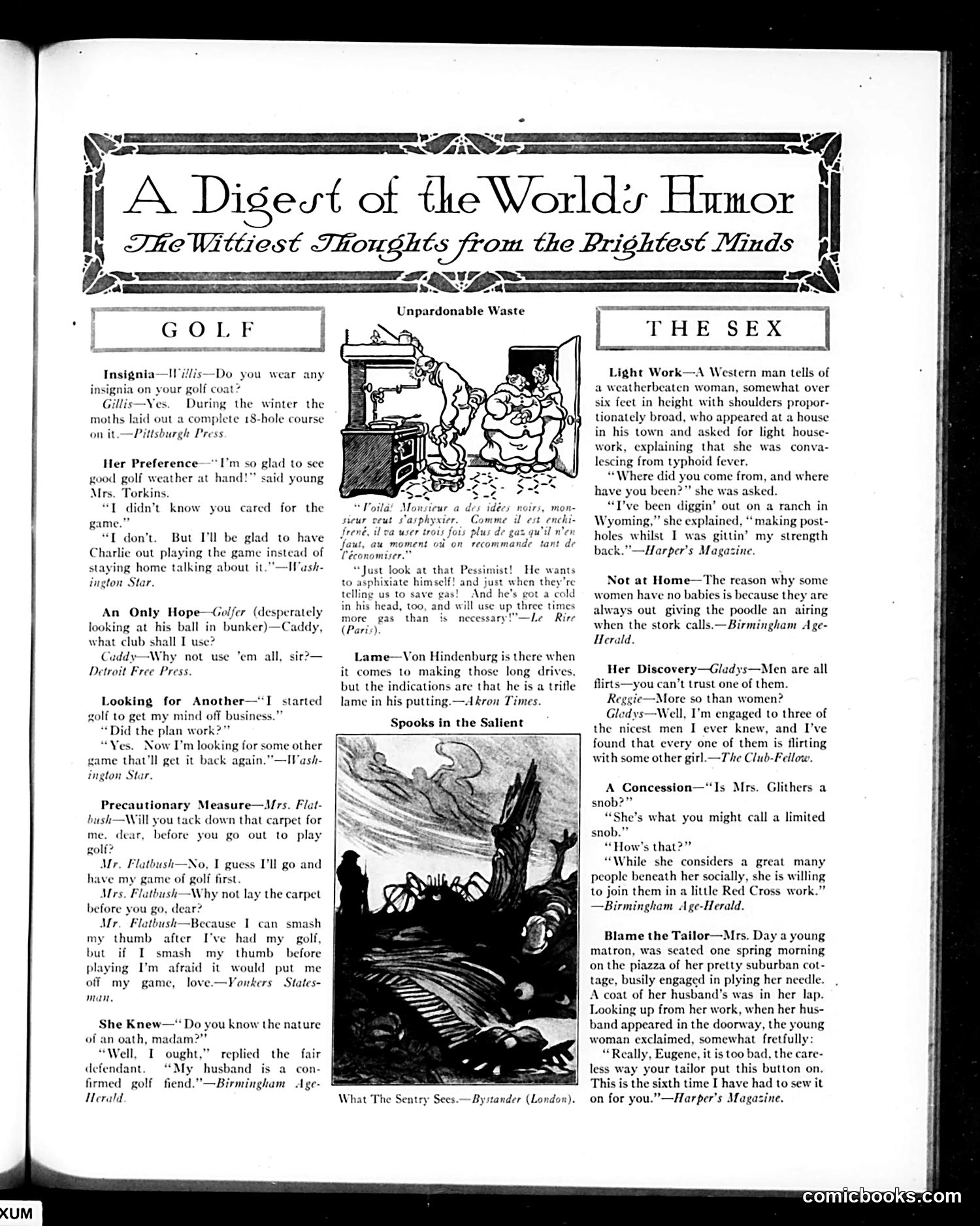
This page from Judge presents a humor digest organized by topic. The GOLF section features light jokes about the sport's absurdities—moths eating holes in a golfer's coat, someone wanting to play golf to escape business worries, and a man delaying carpet repairs to protect his golf game. These satirize golf's obsessive popularity among American men of the era. The central cartoon, "What The Sentry Sees," appears to reference WWI combat, showing a soldier observing ghostly or supernatural figures—likely satirizing trench warfare's psychological horrors or soldiers' stress-induced hallucinations. The SEX section contains jokes mocking gender stereotypes: a woman claiming she can't trust men while engaged to three simultaneously; a socialite's snobbery ("limited snob"); and a wife repeatedly resewing her husband's coat buttons. These target women's perceived fickleness and men's obliviousness, reflecting period gender attitudes. Overall, this represents typical early-20th-century American humor mixing sports obsession, wartime anxiety, and gender role comedy.
📄 Transcribed text from this page (OCR, searchable)
Machine-transcribed from the original scan — historical spelling and the odd misread are preserved.
CS we ‘a i; A Diseut ot the Worldis Hmtor i 4 The Wittiest Thoughts from the Brightest Minds 5 Fg NY yd no GOLF | Insignia—IVi//is—Do you wear any insignia on your golf coat? Gillis—Ves. During the winter the moths laid out a complete 18-hole course on it. Pittsburgh Press glad to see id young Her Preference—* I'm s good golf weather at hand! Mrs. Torkins. “T didn’t know you cared for the don't. But I'll be glad to have Charlie out playing the game instead of staying home talking about it.”’—IVash- ington Star. An Only Hope—Golfer (desperately looking at his ball in bunker)—Caddy, what club shall I use? Caddy—Why not use ‘em all, sir?— Detroit Free Press. Looking for Another—"I started golf to get my mind off business. “Did the plan work?” “Yes. Now I’m looking for some other game that'll get it back again.”—IVash- ington Star. Precautionary Measure—Mrs. Flat- bush—Will you tack down that carpet for me. dear, before you go out to play golf? Mr, Flatbush—No, 1 guess V'll go and have my game of golf first Mrs. Flathush—Why not lay the carpet before you go, dear? Mr. Flatbush—Because 1 can smash my thumb after I've had my golf, but if I smash my thumb before playing I'm afraid it’ would put- me off my game, love.—Yonkers States- man, She Knew—“ Do you know the nature of an oath, madam?” “Well, I ought,” replied the fair defendant. “My husband is a con- firmed golf fiend.”—Birmingham Age- Nerald Unpardonable Waste tant de Pessimist! He wants when they’ g us to save gas! And he's got a cc s head, too, and will use up three times more gas than is necessary!"—Le Rire (Paris) Lame—Von Hindenburg is there when it comes to making those long drives, but the indications are that he is a trifle lame in his putting.—Akron Times. Spooks in the Salient What The Sentry Sees.— Bystander (London). | THE SEX nara acme Light Work—A Western man tells of a weatherbeaten woman, somewhat over six feet in height with shoulders propor- tionately broad, who appeared at a house in his town and asked for light house- work, explaining that she was conva- lescing from typhoid fever. “Where did you come from, and where have you been?” she was asked. “T’ve been diggin’ out on a ranch in Wyoming,” she explained, “making post- holes whilst I was gittin’ my strength back.”"—Harper’s Magazine. Not at Home—The reason why some women have no babies is because they are always out giving the poodle an airing when the stork calls.—Birmingham Age- Herald. Her Discovery—Gladys—Men are all you can’t trust one of them. More so than women? 's—Well, I'm engaged to three of the nicest. men I ever knew, and I’ve found that every one of them is flirting with some other girl.—The Club-Fellow. A Concession—‘‘Is Mrs. Glithers a snob?” “She's what you might call a limited snob.” “How's that?” “While she considers a great_ many people bencath her socially, she is willing to join them in a little Red Cross work.” —Birmingham Age-Herald. Blame the Tailor—Mrs. Day a young matron, was seated one spring morning on the piazza of her pretty suburban cot- tage, busily engaged in plying her needle. A coat of her husband’s was in her lap. Looking up from her work, when her hus- band appeared in the doorway, the young woman exclaimed, somewhat fretfully: “Really, Eugene, it is too bad, the care- less way your tailor put this button on. This is the sixth time I have had to sew it on for you.”—Harper’s Magazine.