
Judge, 1918-05-25 · page 15 of 36
Judge — May 25, 1918 — page 15: what you’re looking at
What you’re looking at
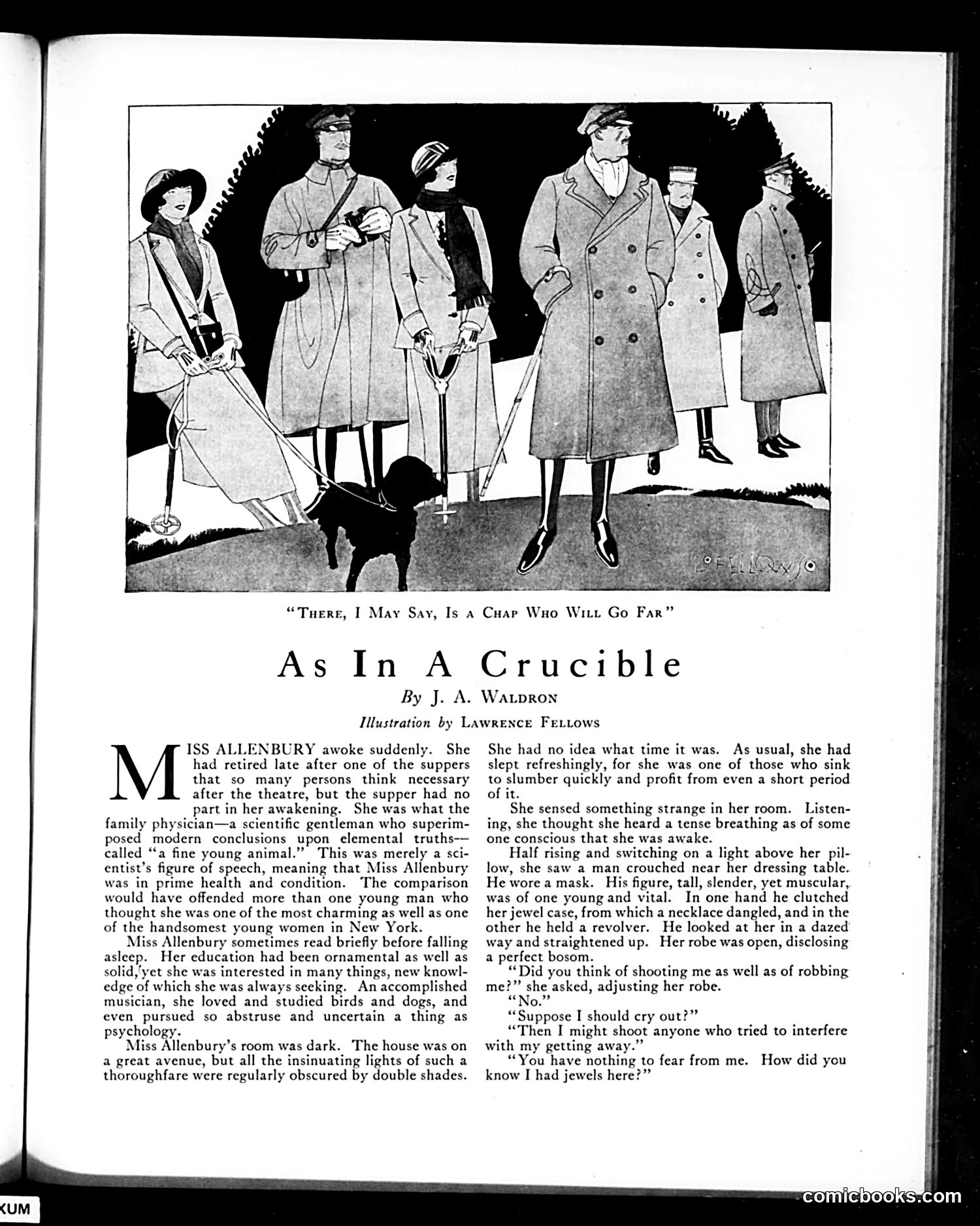
This page opens a short story titled "As In A Crucible" by J.A. Waldron, illustrated by Lawrence Fellows. The illustration depicts fashionable 1920s women and men in coats and hats—likely depicting upper-class New Yorkers, based on the text's reference to "one of the most charming...young women in New York." The story itself concerns Miss Allenbury, a wealthy, educated, cultured woman ("accomplished musician," interested in "psychology") who awakens to find a masked burglar in her bedroom stealing her jewels. Rather than panic or cry out, she calmly questions him about how he knew she had jewelry and why he didn't shoot her. The narrative appears to be satirizing the "New Woman" of the 1920s—educated, composed, unconventional—who responds to a dangerous intrusion with intellectual curiosity rather than hysteria. The story's title, "As In A Crucible," suggests the burglar encounter will test her character. The illustration's caption, "There, I May Say, Is a Chap Who Will Go Far," suggests ironic approval of the burglar's bold initiative.
📄 Transcribed text from this page (OCR, searchable)
Machine-transcribed from the original scan — historical spelling and the odd misread are preserved.
“There, I May Say, Is a Cuap Woo Witt Go Far” As In A Crucible By J. A. Watpron Tllustration by Lawrence FELtows ISS ALLENBURY awoke suddenly. She had retired late after one of the suppers that so many persons think necessary after the theatre, but the supper had no part in her awakening. She was what the family physician—a scientific gentleman who superim- posed modern conclusions upon elemental truths— called ‘“‘a fine young animal.” This was merely a sci- entist’s figure of speech, meaning that Miss Allenbury was in prime health and condition. The comparison would have offended more than one young man who thought she was one of the most charming as well as one of the handsomest young women in New York. Miss Allenbury sometimes read briefly before falling asleep. Her education had been ornamental as well as solid,’yet she was interested in many things, new knowl- edge of which she was always seeking. An accomplished musician, she loved and studied birds and dogs, and even pursued so abstruse and uncertain a thing as psychology. Miss Allenbury’s room was dark. The house was on a great avenue, but all the insinuating lights of such a thoroughfare were regularly obscured by double shades. She had no idea what time it was. As usual, she had slept refreshingly, for she was one of those who sink to slumber quickly and profit from even a short period of it. She sensed something strange in her room. Listen- ing, she thought she heard a tense breathing as of some one conscious that she was awake. Half rising and switching on a light above her pil- low, she saw a man crouched near her dressing table. He wore a mask. His figure, tall, slender, yet muscular, was of one young and vital. In one hand he clutched her jewel case, from which a necklace dangled, and in the other he held a revolver. He looked at her in a dazed way and straightened up. Her robe was open, disclosing a perfect bosom. “Did you think of shooting me as well as of robbing me?” she asked, adjusting her robe. “No.” “Suppose I should cry out?” “Then I might shoot anyone who tried to interfere with my getting away.” “You have nothing to fear from me. know I had jewels here?” How did you