
Judge, 1918-05-25 · page 6 of 36
Judge — May 25, 1918 — page 6: what you’re looking at
What you’re looking at
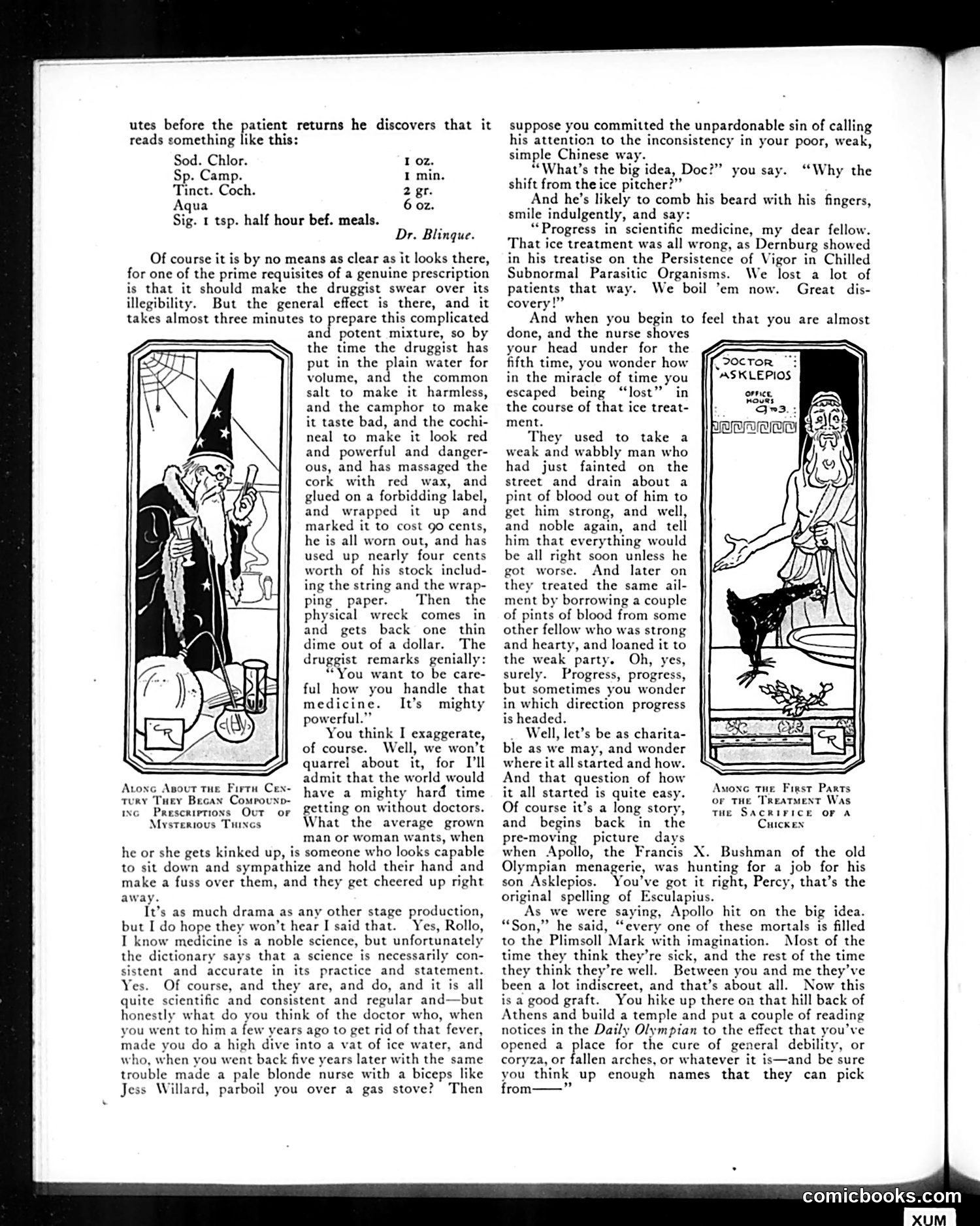
**Left Cartoon:** Depicts a wizard-like figure in a starred robe advertising a patent medicine. The accompanying text mocks the deceptive marketing of "genuine prescriptions" that are actually worthless compounds. The druggist admits the elaborate preparation takes three minutes and costs mere pennies, yet sells for dollars—satirizing the patent medicine industry's fraudulent profit margins and consumer deception. **Right Cartoon:** Shows "Doctor Aesculapios" (referencing the Greek god of medicine), apparently dispensing dubious medical advice. The text criticizes physicians who recommend unproven treatments like ice-water immersion for serious ailments, using blood transfusions as an example of medical progress sometimes heading in questionable directions. **Overall Point:** Sharp satire of late 19th/early 20th-century medical quackery and the pseudoscience plaguing both patent medicines and licensed practitioners.
📄 Transcribed text from this page (OCR, searchable)
Machine-transcribed from the original scan — historical spelling and the odd misread are preserved.
utes before the patient returns he discovers that it reads something like this: Sod. Chlor. Sp. Camp. Tinct. Coch. Aqua Sig. 1 tsp. half hour bef. meals. 1 02. I min. 2 gr. 6 oz. Dr. Blinque. Of course it is by no means as clear as it looks there, for one of the prime requisites of a genuine prescription is that it should make the druggist swear over its illegibility. But the general effect is there, and it takes almost three minutes to prepare this complicated and potent mixture, so by the time the druggist has put in the plain water for volume, and the common salt to make it harmless, and the camphor to make it taste bad, and the cochi- neal to make it look red and powerful and danger- ous, and has massaged the cork with red wax, and glued on a forbidding label, and wrapped it up and marked it to cost 90 cents, he is all worn out, and has used up nearly four cents worth of his stock includ- ing the string and the wrap- ping paper. Then the physical wreck comes in and gets back one thin dime out of a dollar. The druggist remarks genially: “You want to be care- ful how you handle that medicine. It’s mighty powerful.” You think I exaggerate, of course. Well, we won’t quarrel about it, for I'll admit that the world would have a mighty hard time getting on without doctors. What the average grown man or woman wants, when he or she gets kinked up, is someone who looks capable to sit down and sympathize and hold their hand and make a fuss over them, and they get cheered up right away. It’s as much drama as any other stage production, but I do hope they won’t hear I said that. Yes, Rollo, I know medicine is a noble science, but unfortunately the dictionary says that a science is necessarily con- sistent and accurate in its practice and statement. Yes. Of course, and they are, and do, and it is all quite scientific and consistent and regular and—but honestly what do you think of the doctor who, when you went to him a few years ago to get rid of that fever, made you do a high dive into a vat of ice water, and who, when you went back five years later with the same trouble made a pale blonde nurse with a biceps like Jess Willard, parboil you over a gas stove? Then Avoxe Asout tue Firtn Cex- tury Tuey Becax Compounn- inc Prescriptions Out or Mysterious Tunes suppose you committed the unpardonable sin of calling his attention to the inconsistency in your poor, weak, simple Chinese way. “What’s the big idea, Doc?” you say. ‘Why the shift from the ice pitcher?” And he’s likely to comb his beard with his fingers, smile indulgently, and say: “Progress in scientific medicine, my dear fellow. That ice treatment was all wrong, as Dernburg showed in his treatise on the Persistence of Vigor in Chilled Subnormal Parasitic Organisms. We lost a lot of patients that way. We boil ’em now. Great dis- covery!” And when you begin to feel that you are almost done, and the nurse shoves your head under for the fifth time, you wonder how in the miracle of time you escaped being “lost” in the course of that ice treat- ment. They used to take a weak and wabbly man who had just fainted on the street and drain about a pint of blood out of him to get him strong, and well, and noble again, and tell him that everything would be all right soon unless he got worse. And later on they treated the same ail- ment by borrowing a couple of pints of blood from some other fellow who was strong and hearty, and loaned it to the weak party. Oh, yes, surely. Progress, progress, but sometimes you wonder in which direction progress is headed. Well, let’s be as charita- ble as we may, and wonder where it all started and how. And that question of how it all started is quite easy. Of course it’s a long story, and begins back in the Cur pre-moving picture days when Apollo, the Francis X. Bushman of the old Olympian menagerie, was hunting for a job for his son Asklepios. You've got it right, Percy, that’s the original spelling of Esculapius. As we were saying, Apollo hit on the big idea. “Son,” he said, “every one of these mortals is filled to the Plimsoll Mark with imagination. Most of the time they think they’re sick, and the rest of the time they think they’re well. Between you and me they’ve been a lot indiscreet, and that’s about all. Now this is a good graft. You hike up there oa that hill back of Athens and build a temple and put a couple of reading notices in the Datly Olympian to the effect that you've opened a place for the cure of general debility, or coryza, or fallen arches, or whatever it is—and be sure you think up enough names that they can pick from - (20CcTOR ASKLEPIOS once. moves Bes. : PAIRED Astoxe tue First Parts or THe Treatment Was tue SACRIFICE OF A comicbooks.com