
Judge, 1918-05-25 · page 24 of 36
Judge — May 25, 1918 — page 24: what you’re looking at
What you’re looking at
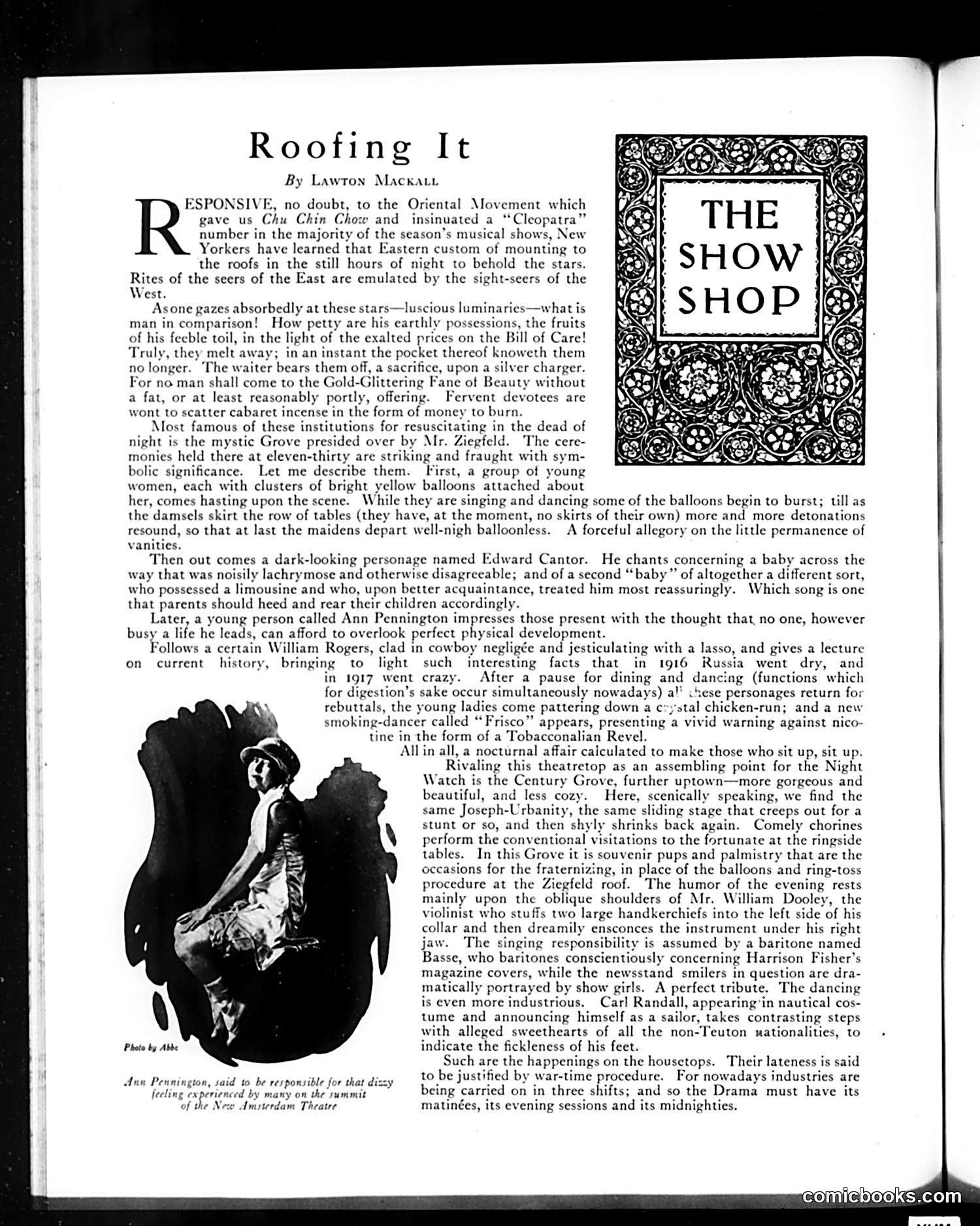
This article by Lawton Mackall satirizes the fashionable trend of wealthy New Yorkers visiting rooftop cabarets, particularly those run by impresario Florenz Ziegfeld. The piece mocks both the pretentious spirituality patrons affect ("gazing at stars") and the venues' actual commercialism—expensive meals and entertainment designed to extract money from the wealthy. The article describes specific performers and acts at Ziegfeld's rooftop theater, including Eddie Cantor (comedian), Ann Pennington (dancer), and Will Rogers (humorist/lasso performer). It satirizes the shows' thin moralism through absurdist descriptions—young women with yellow balloons that burst (representing "vanity"), Rogers's historical "facts" about Russia's 1916-1917 troubles. The photograph shows a silhouetted couple on a rooftop, visually capturing the era's rooftop culture. The satire ultimately mocks New Yorkers' willingness to spend lavishly on entertainment while pretending to sophisticated, almost spiritual pursuits.
📄 Transcribed text from this page (OCR, searchable)
Machine-transcribed from the original scan — historical spelling and the odd misread are preserved.
Roofing It By Lawton Mackatt ESPONSIVE, no doubt, to the Oriental Movement which gave us Chu Chin Chow and insinuated a “Cleopatra” number in the majority of the season’s musical shows, New Yorkers have learned that Eastern custom of mounting to the roofs in the still hours of night to behold the stars. Rites of the seers of the East are emulated by the sight-seers of the West. Asone gazes absorbedly at these stars—luscious luminaries—what is man in comparison! How petty are his earthly possessions, the fruits of his feeble toil, in the light of the exalted prices on the Bill of Care! Truly, they melt away; in an instant the pocket thereof knoweth them no longer. The waiter bears them off, a sacrifice, upon a silver charger. For no man shall come to the Gold-Glittering Fane of Beauty without a fat, or at least reasonably portly, offering. Fervent devotees are wont to scatter cabaret incense in the form of money to burn. Most famous of these institutions for resuscitating in the dead of night is the mystic Grove presided over by Mr. Ziegfeld. The cere- monies held there at eleven-thirty are striking and fraught with sym- bolic significance. Let me describe them. First, a group of young women, each with clusters of bright yellow balloons attached about her, comes hasting upon the scene. While they are singing and dancing some of the balloons begin to burst; till as the damsels skirt the row of tables (they have, at the moment, no skirts of their own) more and more detonations resound, so that at last the maidens depart well-nigh balloonless. A forceful allegory on the little permanence of vanities. Then out comes a dark-looking personage named Edward Cantor. He chants concerning a baby across the way that was noisily lachrymose and otherwise disagreeable; and of a second “baby” of altogether a different sort, who possessed a limousine and who, upon better acquaintance, treated him most reassuringly. Which song is one that parents should heed and rear their children accordingly. Later, a young person called Ann Pennington impresses those present with the thought that, no one, however busy a life he leads, can afford to overlook perfect physical development. Follows a certain William Rogers, clad in cowboy negligée and jesticulating with a lasso, and gives a lecture on current history, bringing to light such interesting facts that in 1916 Russia went dry, and in 1917 went crazy. After a pause for dining and dancing (functions which for digestion’s sake occur simultaneously nowadays) a!’ ¢ personages return for rebuttals, the young ladies come pattering down a czystal chicken-run; and a new smoking-dancer called “Frisco” appears, presenting a vivid warning against nico- tine in the form of a Tobacconalian Revel. Allin all, a nocturnal affair calculated to make those who sit up, sit up. Rivaling this theatretop as an assembling point for the Night Watch is the Century Grove, further uptown—more gorgeous and beautiful, and less cozy. Here, scenically speaking, we find the same Joseph-Urbanity, the same sliding stage that creeps out for a stunt or so, and then shyly shrinks back again. Comely chorines perform the conventional visitations to the fortunate at the ringside tables. In this Grove it is souvenir pups and palmistry that are the occasions for the fraternizing, in place of the balloons and ring-tos procedure at the Ziegfeld roof. The humor of the evening rests mainly upon the oblique shoulders of Mr. William Dooley, the violinist who stuffs two large handkerchiefs into the left side of his collar and then dreamily ensconces the instrument under his right jaw. The singing responsibility is assumed by a baritone named Basse, who baritones conscientiously concerning Harrison Fisher’s magazine covers, while the newsstand smilers in question are dra- matically portrayed by show girls. A perfect tribute. The dancing is even more industrious. Carl Randall, appearing’in nautical cos- tume and announcing himself as a sailor, takes contrasting steps with alleged sweethearts of all the non-Teuton xationalities, to indicate the fickleness of his feet. Such are the happenings on the housetops. Their lateness is said Ann Pennington, said to be responsible for that diszy to be justified by war-time procedure. For nowadays industries are d'by make on the summit being carried on in three shifts; and so the Drama must have its » Theatre matinées, its evening sessions and its midnighties.