
Judge, 1918-05-25 · page 35 of 36
Judge — May 25, 1918 — page 35: what you’re looking at
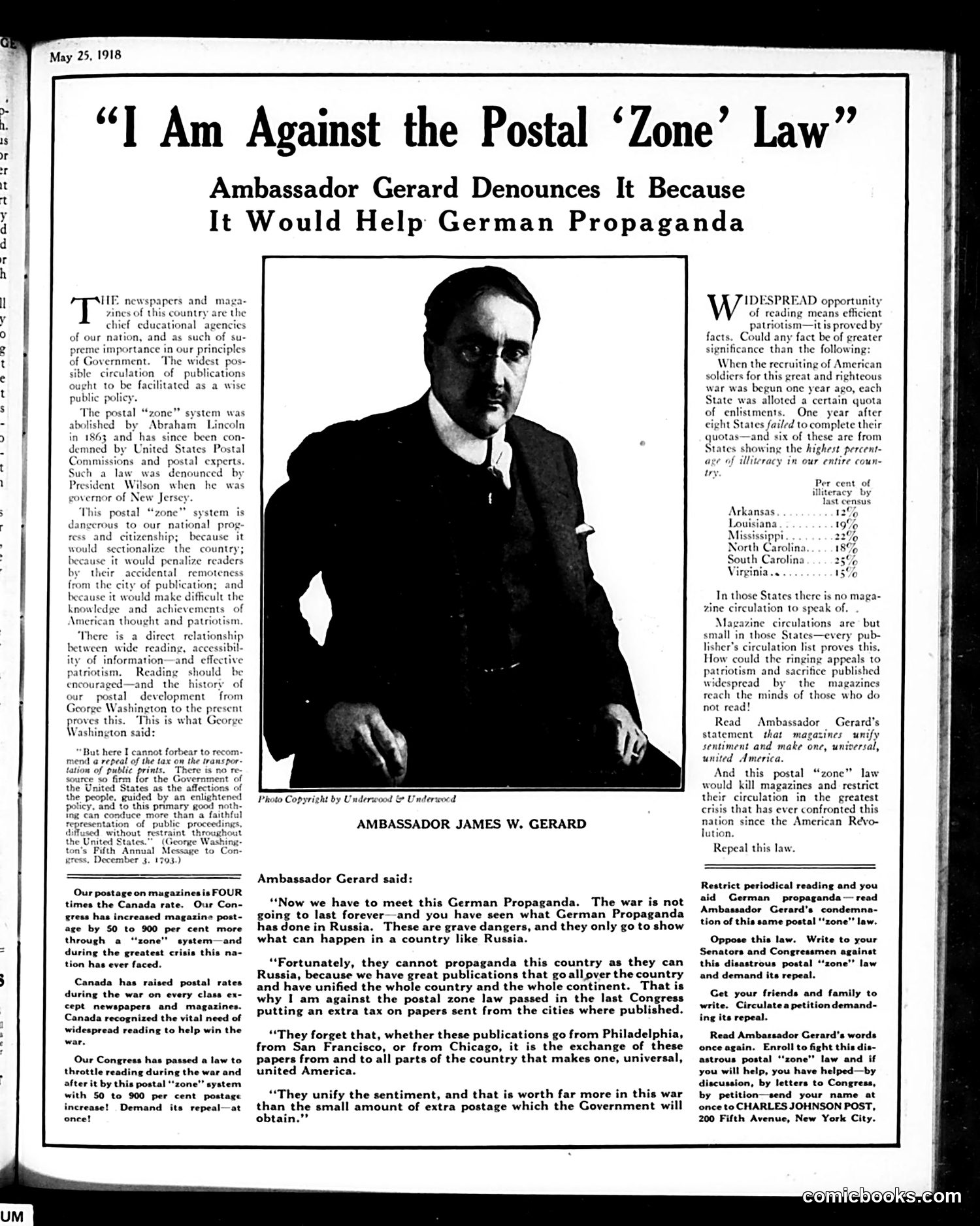
What you’re looking at
This 1918 **Judge** magazine page argues against the postal "Zone Law"—legislation that charged higher postage rates for magazines and newspapers based on delivery distance. **The Figure:** Ambassador James W. Gerard, former U.S. Ambassador to Germany, is the authority cited opposing the law. **The Political Context:** During World War I, Gerard warns that the Zone Law would weaken America by reducing nationwide magazine circulation. He argues magazines unify the country and counter German propaganda—a real concern after the Russian Revolution, where he suggests propaganda had destabilized the nation. **The Satire's Point:** The page uses patriotic language to argue that restricting magazine distribution actually helps the *enemy*. It cites illiteracy rates in Southern states (framed as proof magazines are essential) and notes Canada *lowered* postage on newspapers during wartime, while Congress raised American rates. The argument: weakening mass media circulation during wartime is strategically foolish and unpatriotic, potentially opening Americans to enemy influence.
📄 Transcribed text from this page (OCR, searchable)
Machine-transcribed from the original scan — historical spelling and the odd misread are preserved.
May 25, 1918 “T Am Against the Postal ‘Zone’ Law” Ambassador Gerard Denounces It Because It Would Help German Propaganda IIE newspapers and mag vines of this country are the chief educational agencies of our nation, and as such of su- in our principles wernment. The widest pos- circulation of publications ht to be facilitated as a wise public policy The postal “zone” syste: ished by Abraham Lincoln 1863 and has since been con- d by United States Postal issions and postal experts. law was denounced by President Wilson when he was governor of New Jerse This postal “2c dangerous to our national prog- and citizenship; b it would sectionalize the country; because it would penalize readers by their accidental remote from the city of publication: 4 because it would make difficult the knowledge and f system is achievements. of American thought and patriotism There is a dire between wide ity of informatio patriotism. Readi encouraged—and the history of postal development from George Washington to the present proves this. This is what George Washington said: “But here I cannot forbear to ndl a repeal of the tax om the trans por om of public prints. and effective should be representation of pul ail Our postage on mugazinesis FOUR times the Canada rate. Our Con- gress has increased magazine post- age by $0 to 900 per cent more through a ‘zone’? during the greatest tion has ever faced. Canada has raised postal rates during the war on every class ex- cept newspapers and magazines. Canada recognized the vital need of widespread reading to help win the war. Our Congress has passed a law to throttle reading during the w after it by this postal with 50 to 900 per cent pos! increase! Demand its repeal—at once! Photo Copyright by Underwood & Und AMBASSADOR JAMES W. GERARD Ambassador Gerard said: “Now we have to meet this German Propaganda. The war is not going to last forever—and you have seen what German Propaganda has done in Russia. These are grave dangers, and they only go to show what can happen in a country like Russia. “Fortunately, they cannot propaganda this country as they can Russia, because we have great publications that goallover the country and have unified the whole country and the whole continent. That is why I am against the postal zone law passed in the last Congress putting an extra tax on papers sent from the cities where published. “They forget that, whether these publications go from Philadelphia, from San Francisco, or from Chicago, it is the exchange of these papers from and to all parts of the country that makes one, universal, united America. “They unify the sentiment, and that is worth far more in this war small amount of extra postage which the Government will SPREAD opportunity ing means efficient otism—it is proved by Id any fact be of greater cance than the followin When the recruiting of American soldiers for this great and righteous war was begun one year ag State was alloted a certain quota of enlistments. One year af cight States failed to complete their quotas—and six of these are from States showing the highest percent- age of illiteracy in our entire coun- try Arkansas Louisiana Mississippi 2 North C na 18% South Carolina 25% Virginia. 15% In those States there is no maga- ine ci jon to speak of. e circulations are but small in those States—every pub- lisher’s circulation list proves this. How could the ringing appeals to patriotism and sacrifice published lespread by the magazines reach the minds of those who do not read! Read — Ambassador statement that ma: sentiment and make o united America. And this postal “zone” law would kill magazines and restrict their circulation in the greatest crisis that has ever confronted this nation since the American Revo- lution, Repeal this law. Gerard’s ines unify , universal, Restrict periodical reading and you aid German propaganda — read Ambassador Gerard's condemna- tion of this same postal ‘‘zone" law. Oppose this law. Write to your Senators and Congressmen this disastrous postal “zon and demand ite repeal. Get your friends and family to write. Circulatea petitiondemand- ing its repeal Read Ambassador Gerard's words once again. Enroll to fight this dis- astrous postal “zone” law and if you will help, you have helped—by discussion, by letters to Congress, by petition—send your name at once to CHARLES JOHNSON POST, 200 Fifth Avenue, New York City.