
A complete issue · 38 pages · 1918
Judge — May 4, 1918
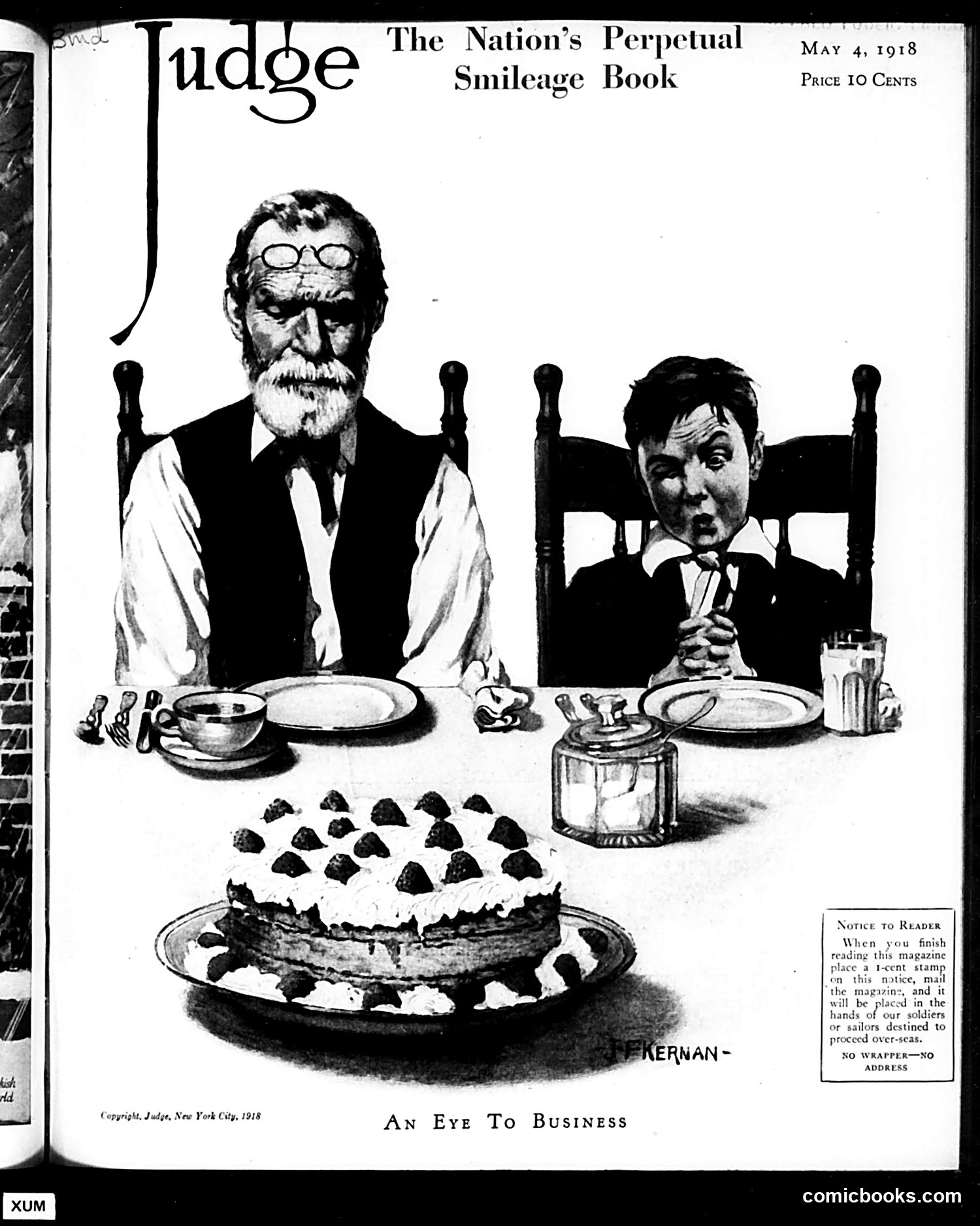
This Judge magazine cover from May 4, 1918 presents a satirical cartoon by Kernan depicting two figures at a dining table with an elaborate cake between them. The title "An Eye to Business" suggests commentary on profiteering or opportunism during World War I (the U.S. had entered in 1917). The older man with glasses appears to represent an established businessman or authority figure, while the younger man displays an exaggerated, somewhat predatory expression—likely symbolizing wartime profiteers or speculators. The elaborate cake may represent war contracts, government spending, or resources being divided. The satire critiques how certain individuals were enriching themselves through the war effort while others sacrificed.
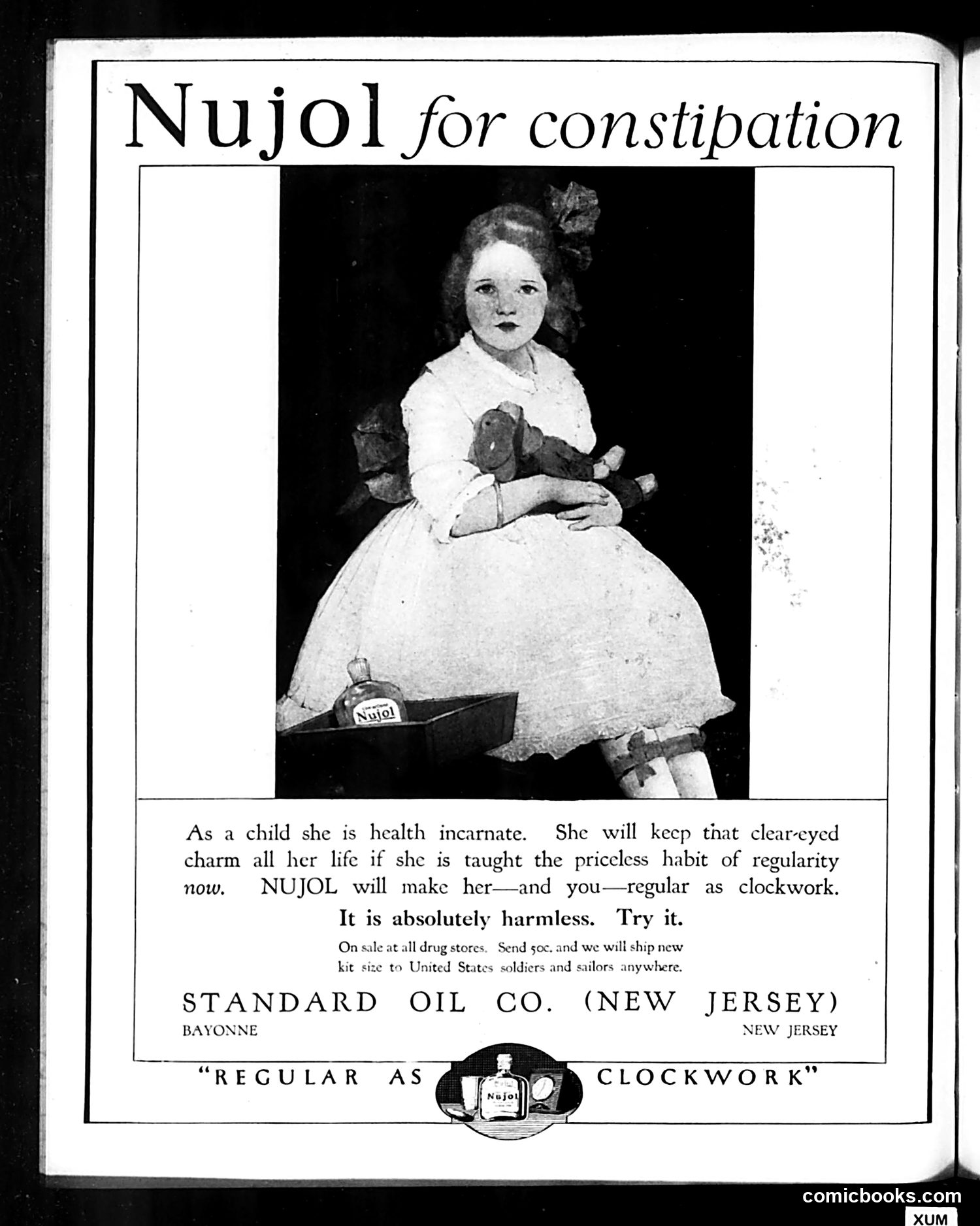
This is a **advertisement, not satire**—specifically for Nujol, a mineral oil laxative product made by Standard Oil Company (New Jersey). The ad uses a young girl holding a doll to market constipation relief to parents. The messaging emphasizes that establishing regular bowel habits in childhood ensures lifelong health. The tagline "Regular as Clockwork" pairs the product name with promises of mechanical regularity. A notable detail: the text mentions "kit size to United States soldiers and sailors anywhere," indicating this ran during wartime (likely WWI or WWII era based on *Judge* magazine's publication period). By modern standards, the ad's focus on children's digestive health and its frank discussion of bowel regularity would seem unusually direct for mainstream advertising.
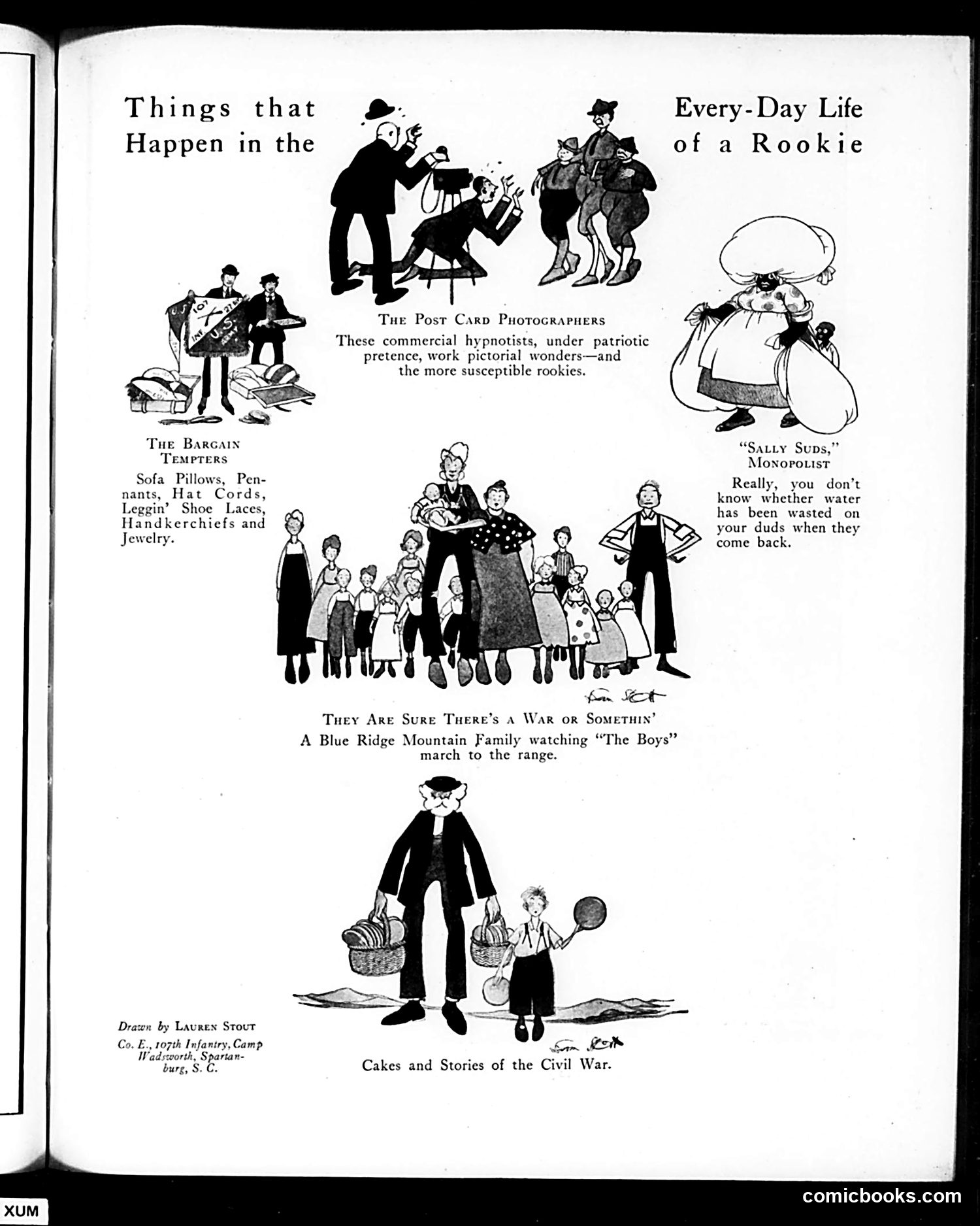
This WWI-era satire from Judge magazine depicts common scams and annoyances targeting inexperienced soldiers ("rookies"). **The schemes shown include:** - **Bargain Tempers**: Con artists selling worthless items (pillows, shoe laces, jewelry) - **Post Card Photographers**: "Commercial hypnotists" exploiting gullible soldiers' desire for photographs - **"Sally Suds" Monopolist**: Satirizing water waste concerns - **Family Expectations**: Soldiers' families assume wartime means their sons are fighting ("There's a War or Somethin'") - **Cakes and Stories**: Civilians profiting from Civil War nostalgia The cartoons mock both predatory merchants targeting vulnerable young soldiers and civilians' disconnection from actual military life. The humor relies on depicting rookies as naive victims of exploitation—a common theme in wartime satirical commentary about the gap between home-front expectations and soldier realities.
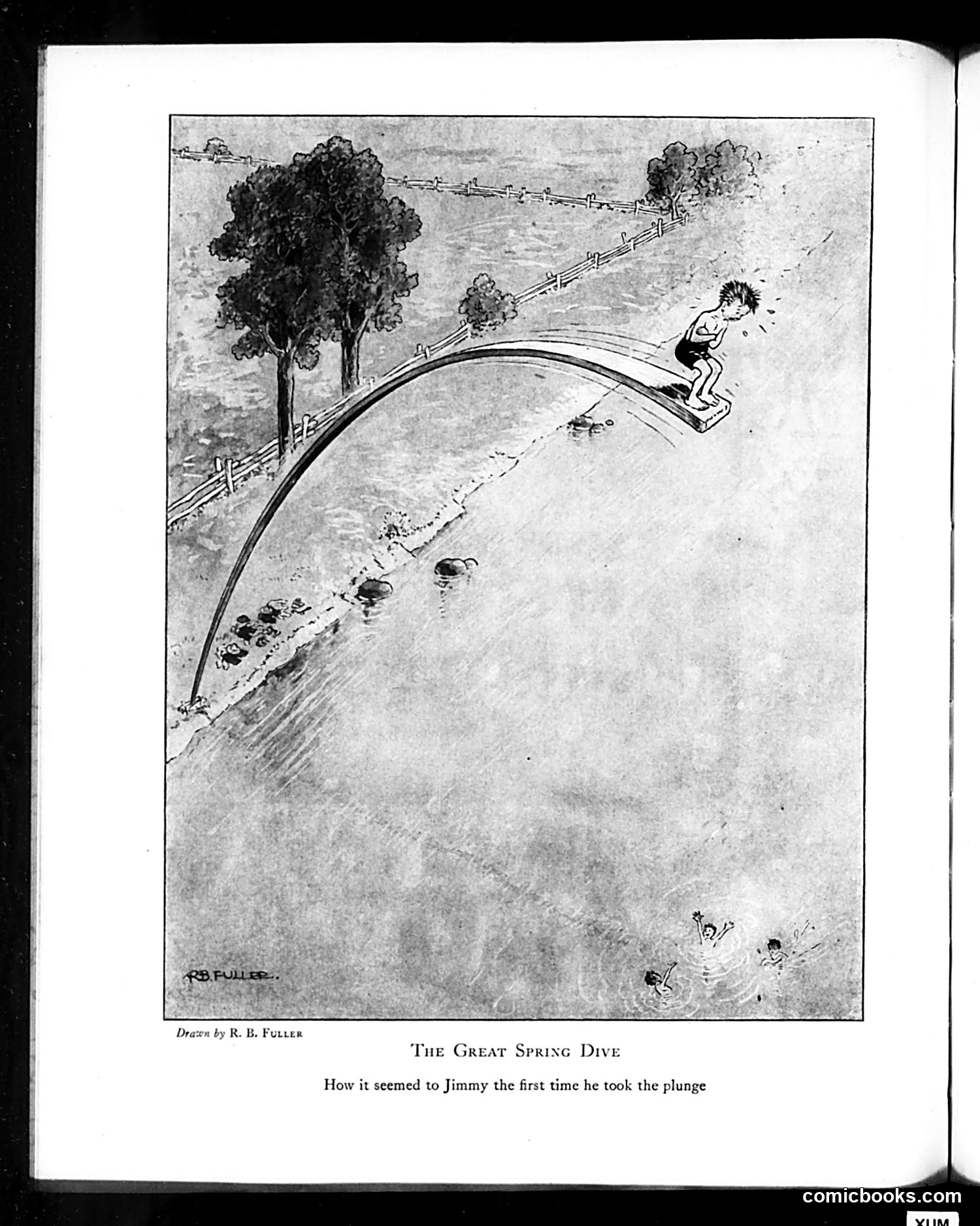
This illustration by R.B. Fuller depicts a child named Jimmy diving into a spring (likely a natural water source or creek). The caption reads: "How it seemed to Jimmy the first time he took the plunge." The cartoon uses exaggerated perspective to humorously convey a child's perception—what appears to Jimmy as an enormous, dramatic dive into a vast body of water is actually a modest spring or small stream. The distant landscape shows a fence and trees, establishing scale. This is likely a gentle, humorous piece about childhood perspective: how children perceive ordinary experiences as grand adventures. The "great spring dive" plays on both the season and the child's sense of daring, without apparent political or social satire.
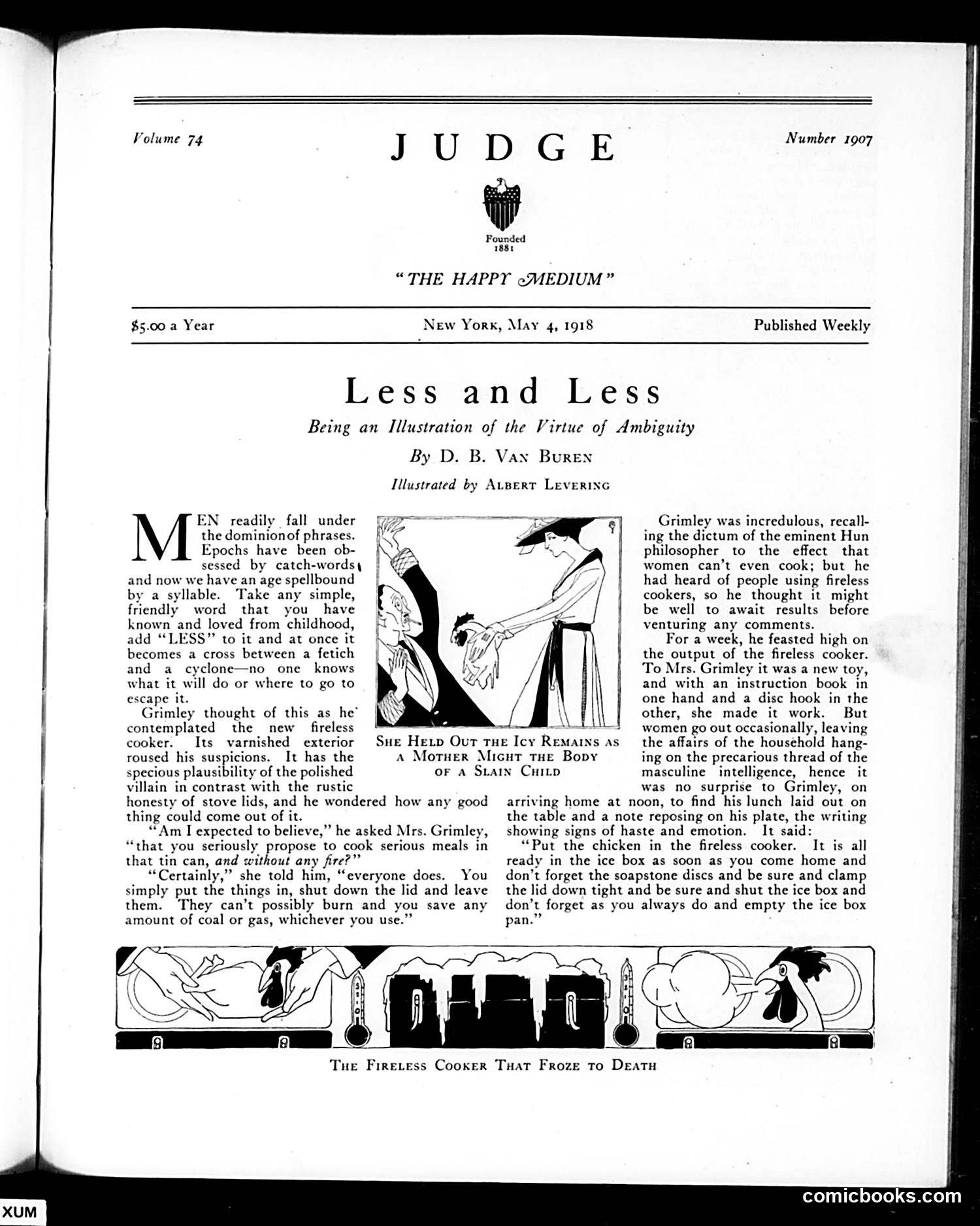
This satirical piece mocks the "fireless cooker"—an early insulated cooking device requiring no fuel. The humor centers on **ambiguity**: the phrase "less and less" describes both the cooker's supposed efficiency *and* its ultimate failure. The story follows Mr. Grimley, who skeptically tests this newfangled appliance on chicken. Following instructions to seal it tightly, he discovers his lunch frozen solid—the cooker worked *too well*, becoming an unintended deep-freezer rather than an actual cooking vessel. The satire targets both **overhyped consumer technology** and **gullible consumers** eager to embrace innovations. Published during WWI (note the coal/gas conservation angle), it reflects period anxieties about wartime rationing and dubious "scientific" solutions marketed to the home.
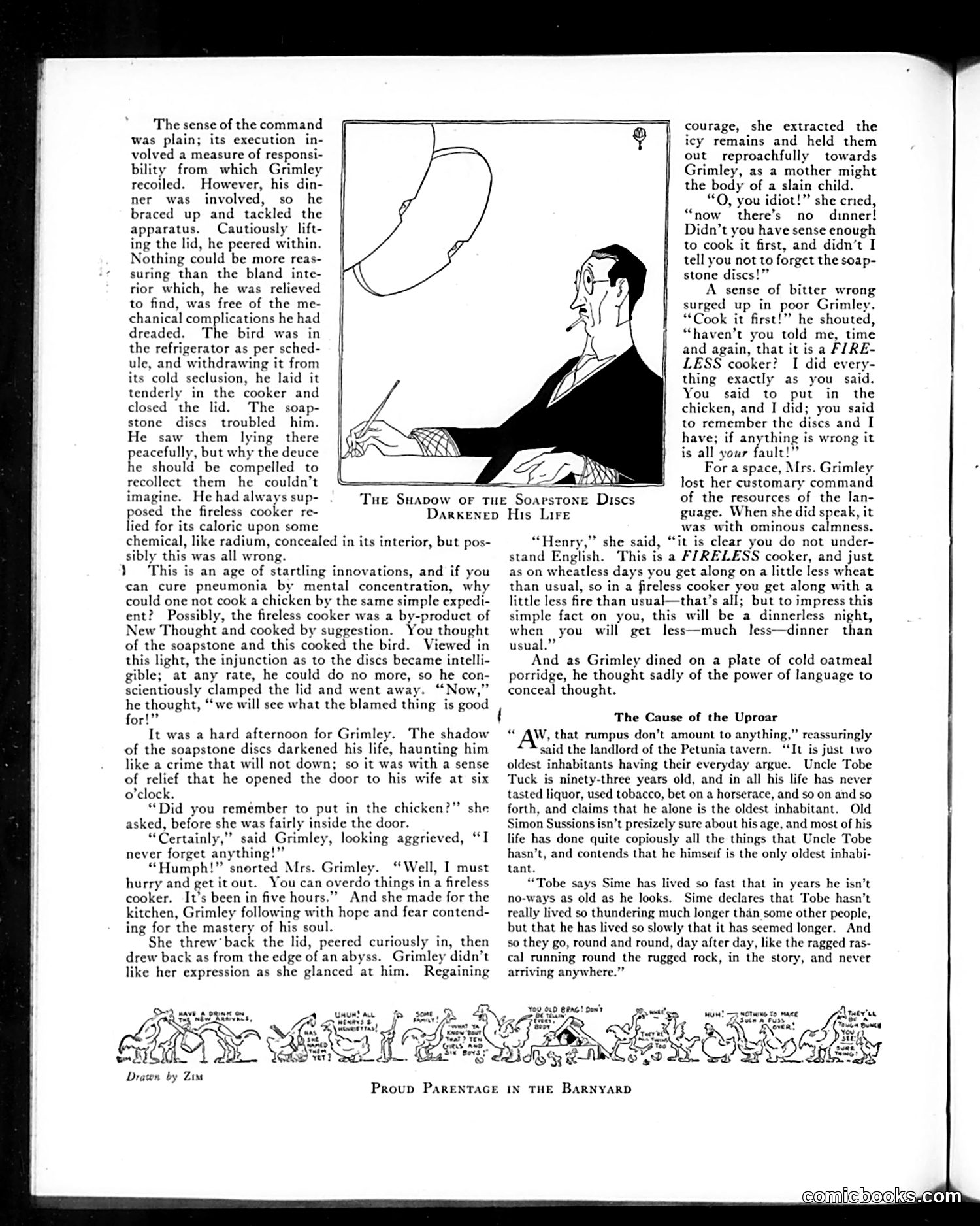
This page contains a domestic comedy story about a husband (Grimley) and wife arguing over a fireless cooker—an early 20th-century cooking device using retained heat rather than active flames. The wife, frustrated that Grimley forgot to cook a chicken first, sarcastically calls it a "fireless cooker" that requires "fireless" days of waiting. Grimley defensively explains the cooker's logic, while she mocks his "English" (suggesting pretentiousness). The satire targets both newfangled kitchen technology and marital dynamics: the wife's exasperation with impractical modern inventions and the husband's pedantic explanations. The bottom section, "The Cause of the Uproar," is a separate humorous piece about elderly country inhabitants debating ages. The small cartoon at the bottom appears unrelated social commentary.
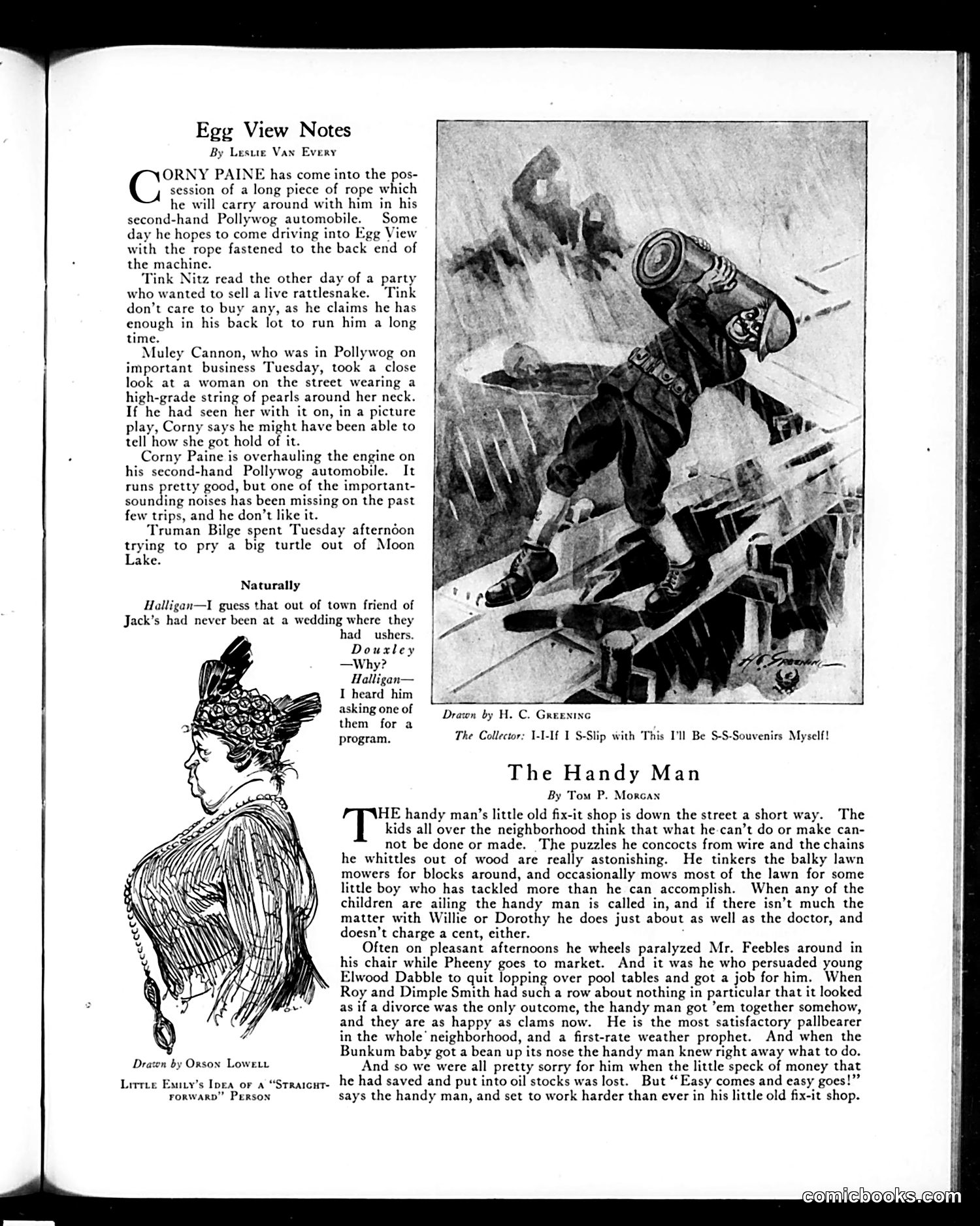
This page contains three separate pieces of light humor from Judge magazine: **"Egg View Notes"** presents gossipy anecdotes about small-town characters with comedic names (Corny Paine, Tink Nitz, Muley Cannon). The jokes are gentle observations about local eccentricities—a man planning to drag a rope behind his car, another man complaining about rattlesnakes on his property. The subheading "Naturally" includes a short dialogue joke: an out-of-town wedding guest didn't understand what "ushers" were for. **"The Handy Man"** is a sentimental profile of a neighborhood jack-of-all-trades who fixes things, helps sick children, counsels troubled couples, and serves as a pallbearer—asking nothing in return. The moral punch comes at the end: despite losing his savings in oil stocks, he remains philosophical ("easy comes and easy goes") and continues his service. Both pieces exemplify Judge's focus on American small-town life and character-based humor rather than political satire. The sentiment is affectionate rather than satirical.
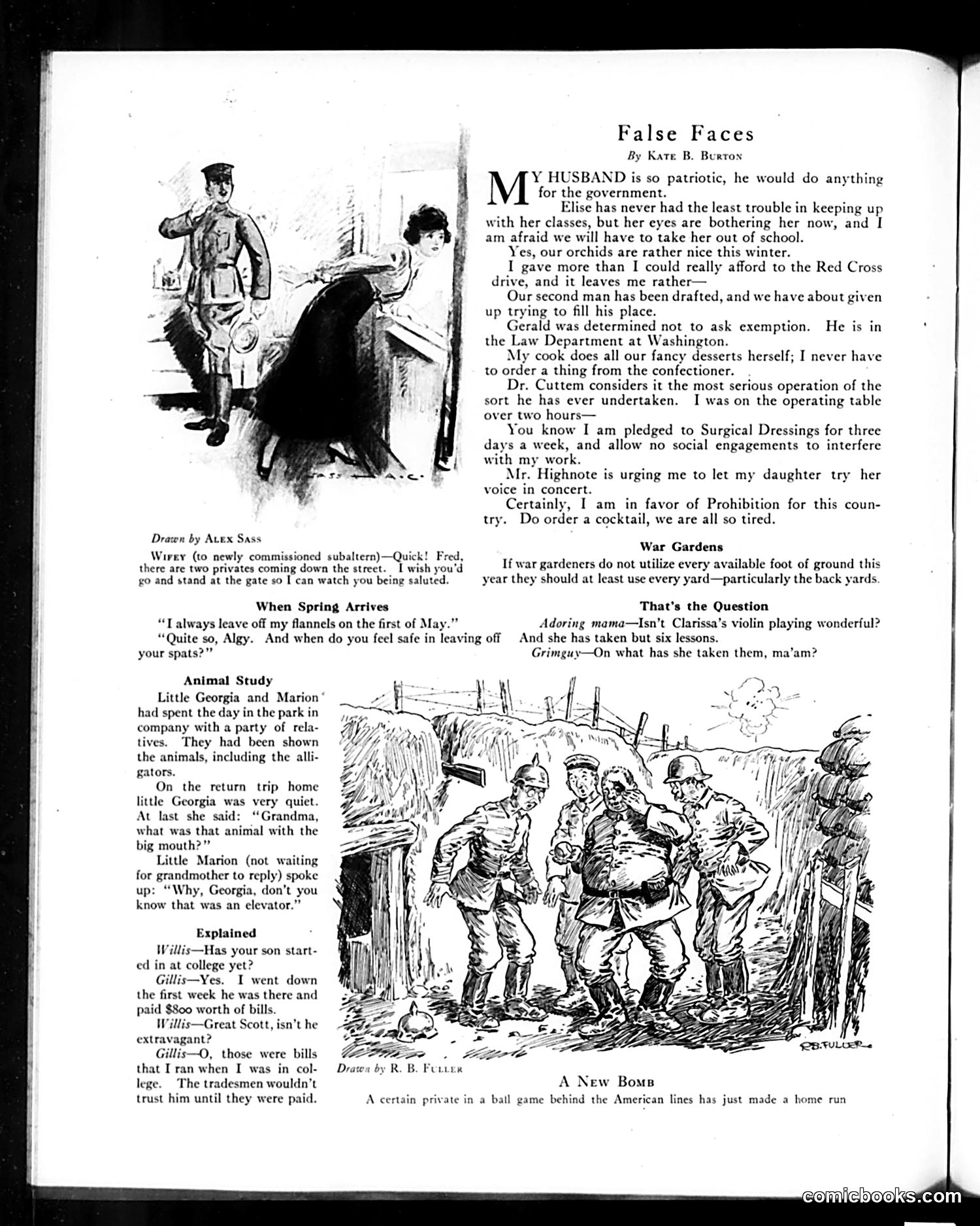
This satirical piece exposes upper-class hypocrisy during wartime (likely WWI, given references to the Red Cross drive and draft). The author presents a series of overheard boasts from wealthy women, each claiming patriotic sacrifice while revealing their actual self-interest: - A woman claims her husband is patriotic, but she's removing her daughter from school due to "bothering eyes" - Another brags about donating to Red Cross while admitting financial strain - A third speaks of losing their servant to the draft while complaining about replacing him - One claims to refuse confectioner services (implying self-sufficiency/sacrifice) while spending hours in surgery - The final jab: someone advocates for Prohibition while ordering a cocktail, claiming exhaustion The satire targets the gap between public patriotic posturing and private entitlement—women performing wartime commitment while prioritizing comfort and convenience. Their "false faces" are the respectable personas they present to society.
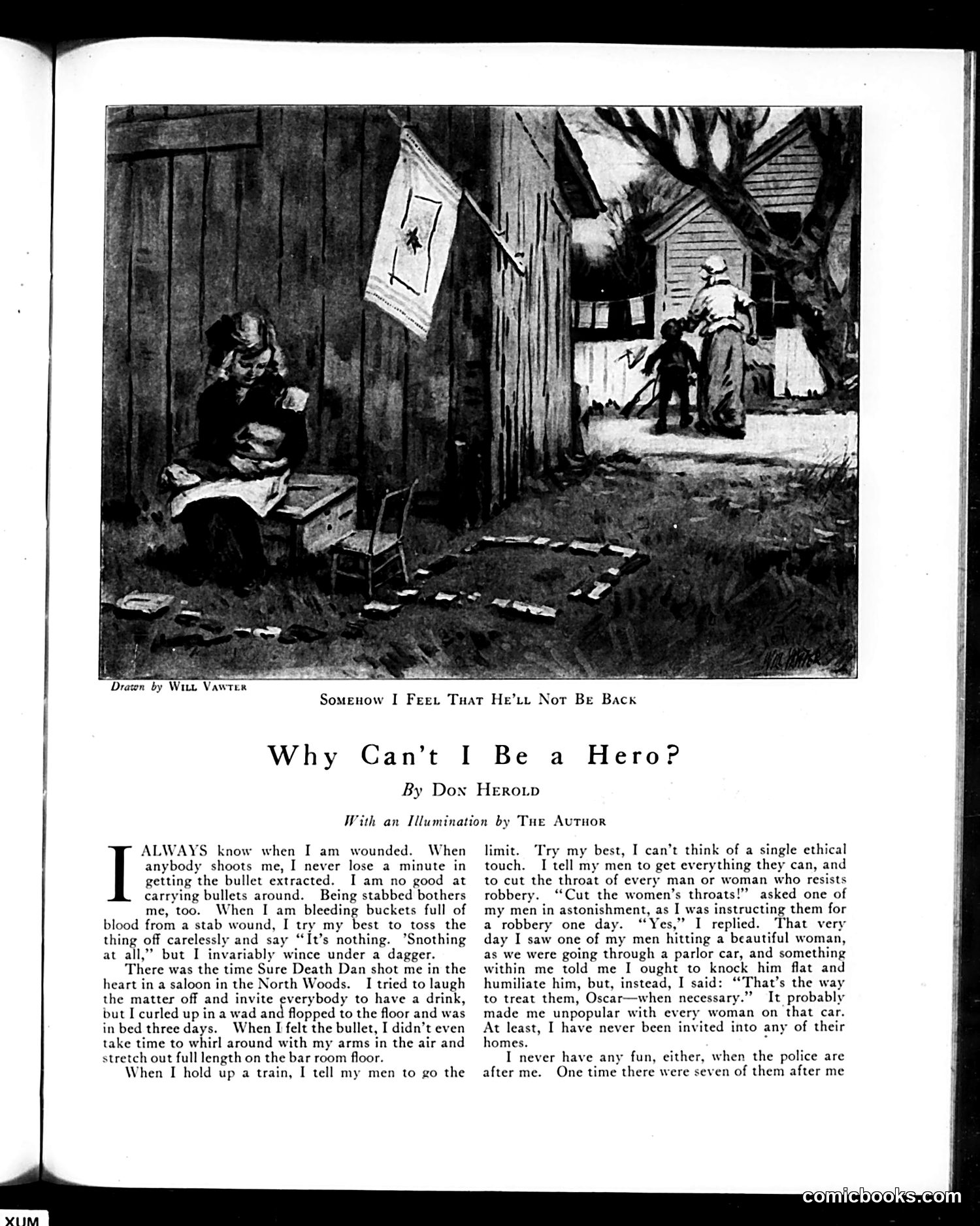
This story by Don Herold satirizes the literary archetype of the "hard-boiled outlaw hero" popular in early 20th-century pulp fiction and adventure stories. The unnamed narrator is a criminal—a train robber and murderer—who complains he cannot achieve heroic stature despite his violent exploits. The satire's point: the narrator fails at villainy because basic human decency keeps intruding. He winces at wounds instead of laughing them off. He wants to brutalize women during robberies but feels compelled toward chivalry instead. He cannot enjoy criminal success because conscience and social propriety undermine his criminal persona. Herold mocks both the unrealistic heroes of popular fiction (who shrug off mortal wounds) and society's genteel expectations, which prevent even outlaws from fully embracing lawlessness. The cartoon illustration shows a woman with a child watching a man depart, reinforcing themes of domestic feeling disrupting criminal mythology.
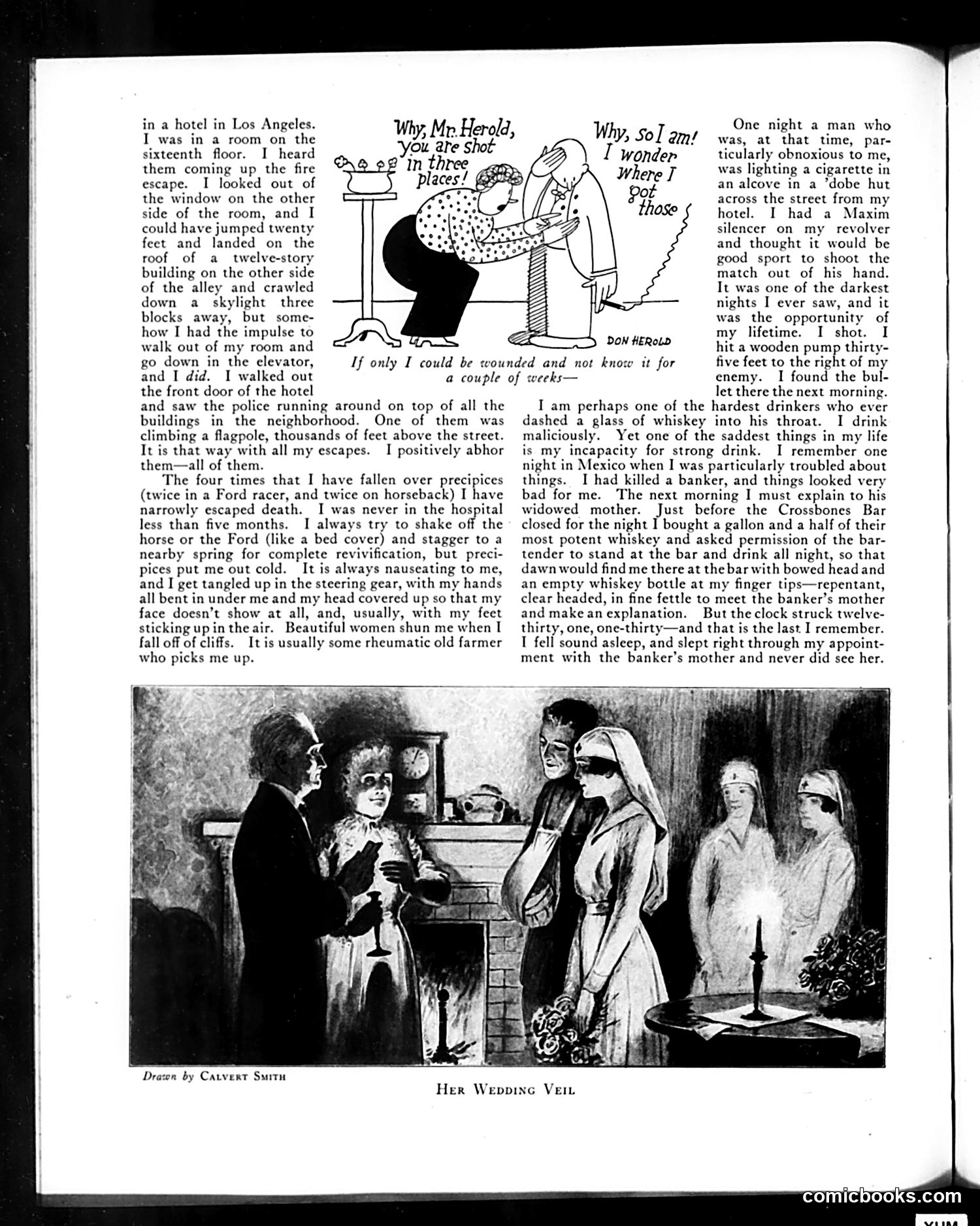
This page contains a humorous first-person narrative (likely satirical fiction) by someone describing themselves as recklessly accident-prone and a heavy drinker. The small cartoon at top shows "Mr. Herold" being shot, with the caption suggesting he wishes he could be wounded without knowing it. The illustration titled "Her Wedding Veil" appears unrelated to the main text—it shows a bride in a wedding scene with masked figures, likely depicting a separate comedic or dramatic story. The narrator's anecdotes—including falling off cliffs, escaping hotel fires, shooting at a man's cigarette with a silencer (missing by 35 feet), and the dark joke about killing a banker—are presented in deadpan style, suggesting satire of adventure stories or reckless masculine bravado popular in early 20th-century magazines. The humor relies on the gap between the narrator's self-image as daring and his actual incompetence.
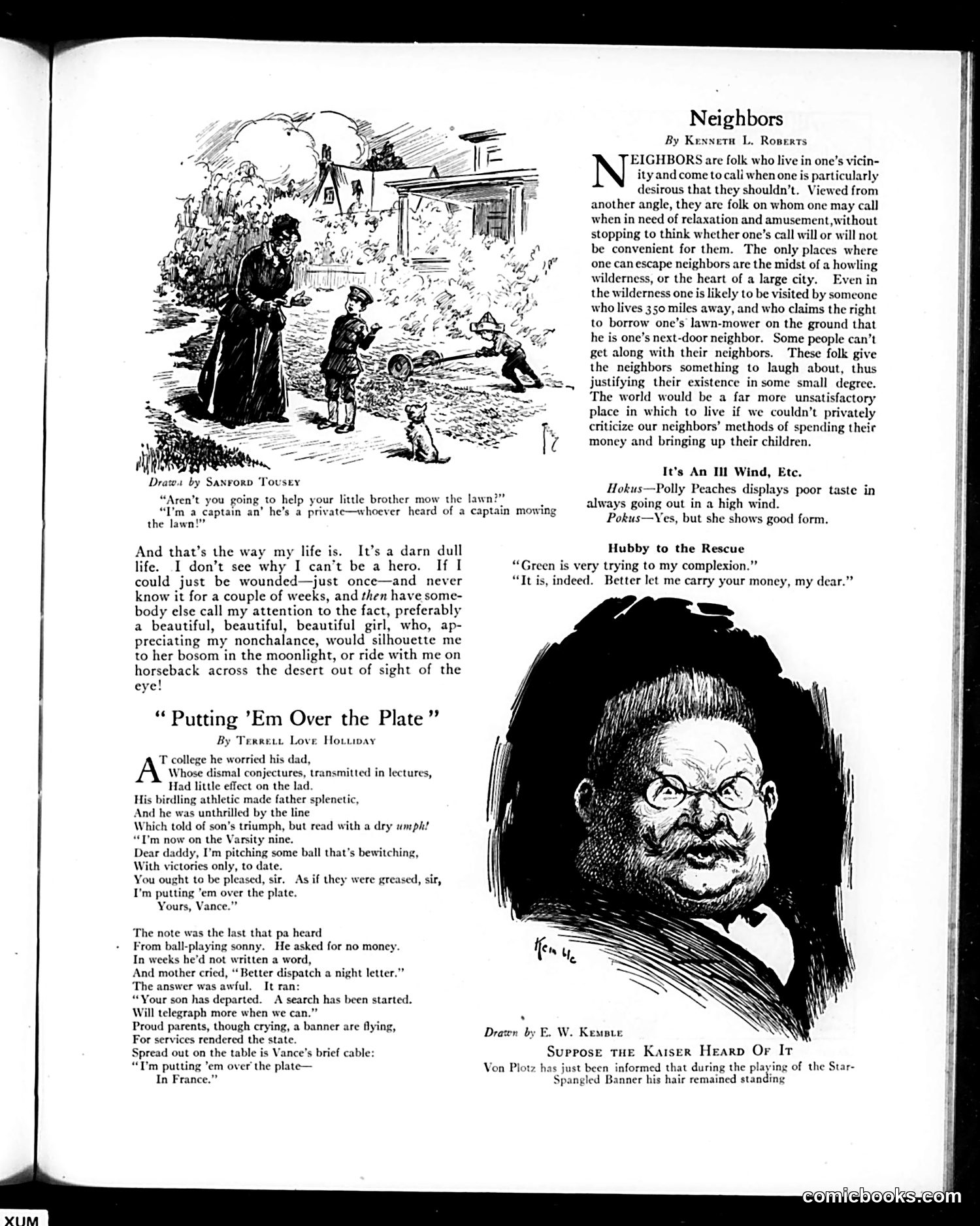
This page contains three satirical pieces typical of WWI-era American humor: **"Putting 'Em Over the Plate"** is the most significant—a poem about a college athlete son who writes home about his baseball success, then reveals he's enlisted and is now fighting in France ("putting 'em over the plate—In France"). The pun transforms sports achievement into military service, playing on parental pride mixed with wartime anxiety. **"Neighbors"** is a humorous essay defining neighbors as simultaneously unavoidable and often intrusive—people who borrow lawnmowers yet justify their existence by providing social comedy. **"Suppose the Kaiser Heard Of It"** references Von Plotz's hair remaining standing during the Star-Spangled Banner—likely mocking German patriotism or pride, implying even the Kaiser's representative would be impressed or disturbed by American patriotic fervor. The cartoons and text collectively reflect 1917-1918 American attitudes: pride in military service, gentle domestic comedy, and anti-German sentiment during WWI.
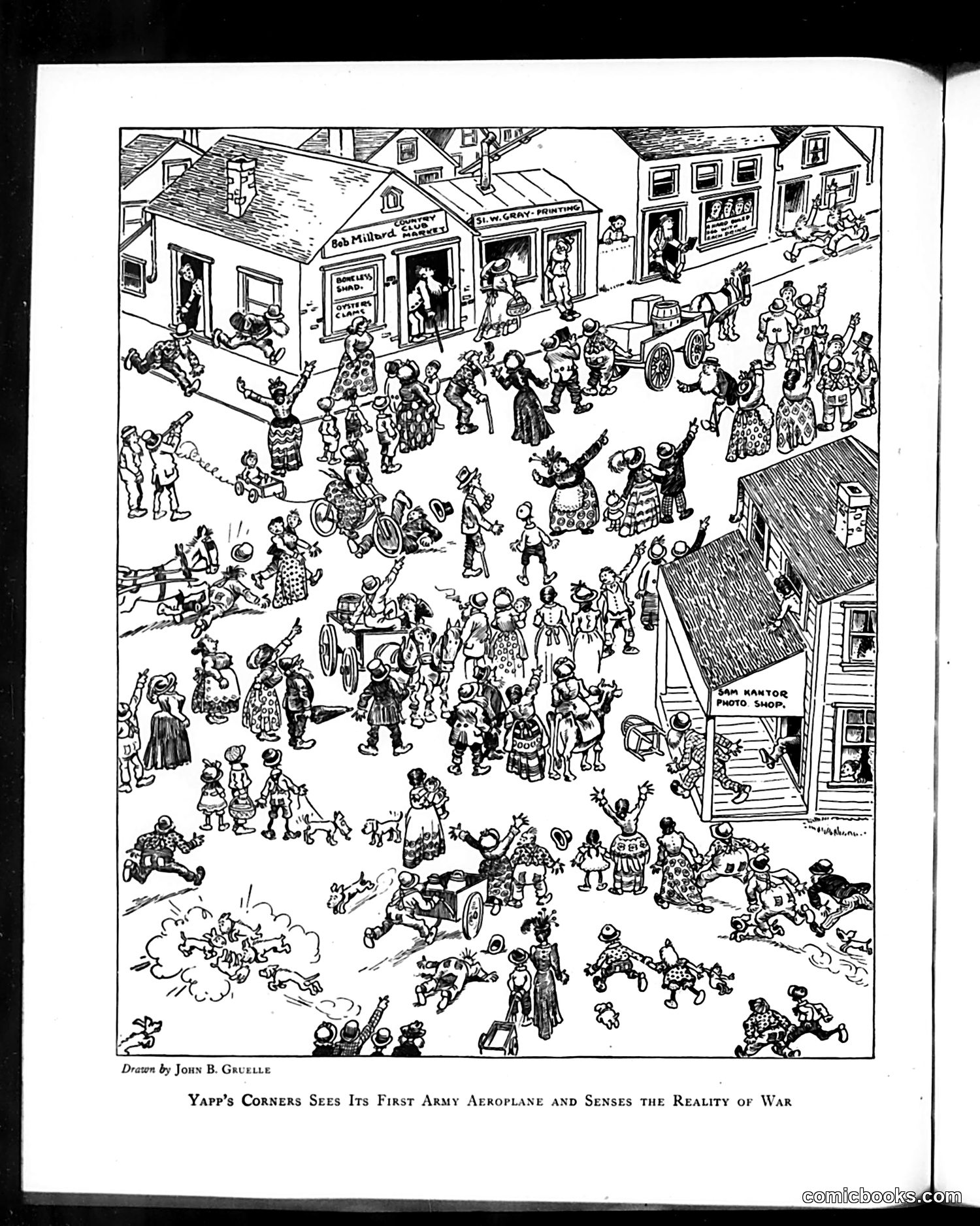
This cartoon depicts a small rural town in chaos as residents react to seeing a military airplane—apparently their first encounter with aviation warfare technology. The drawing shows townspeople in various states of panic: fleeing, falling, gesturing wildly, and generally disrupted from daily activities like shopping and socializing. The satire targets American civilian attitudes toward World War I. While distant from combat, small-town Americans suddenly confront the reality that modern warfare—specifically aerial bombardment—could reach even remote communities. The cartoon suggests the disconnect between patriotic enthusiasm for war and the genuine terror its new technologies inspire. The exaggerated pandemonium mocks how unprepared ordinary citizens were for twentieth-century warfare's implications.
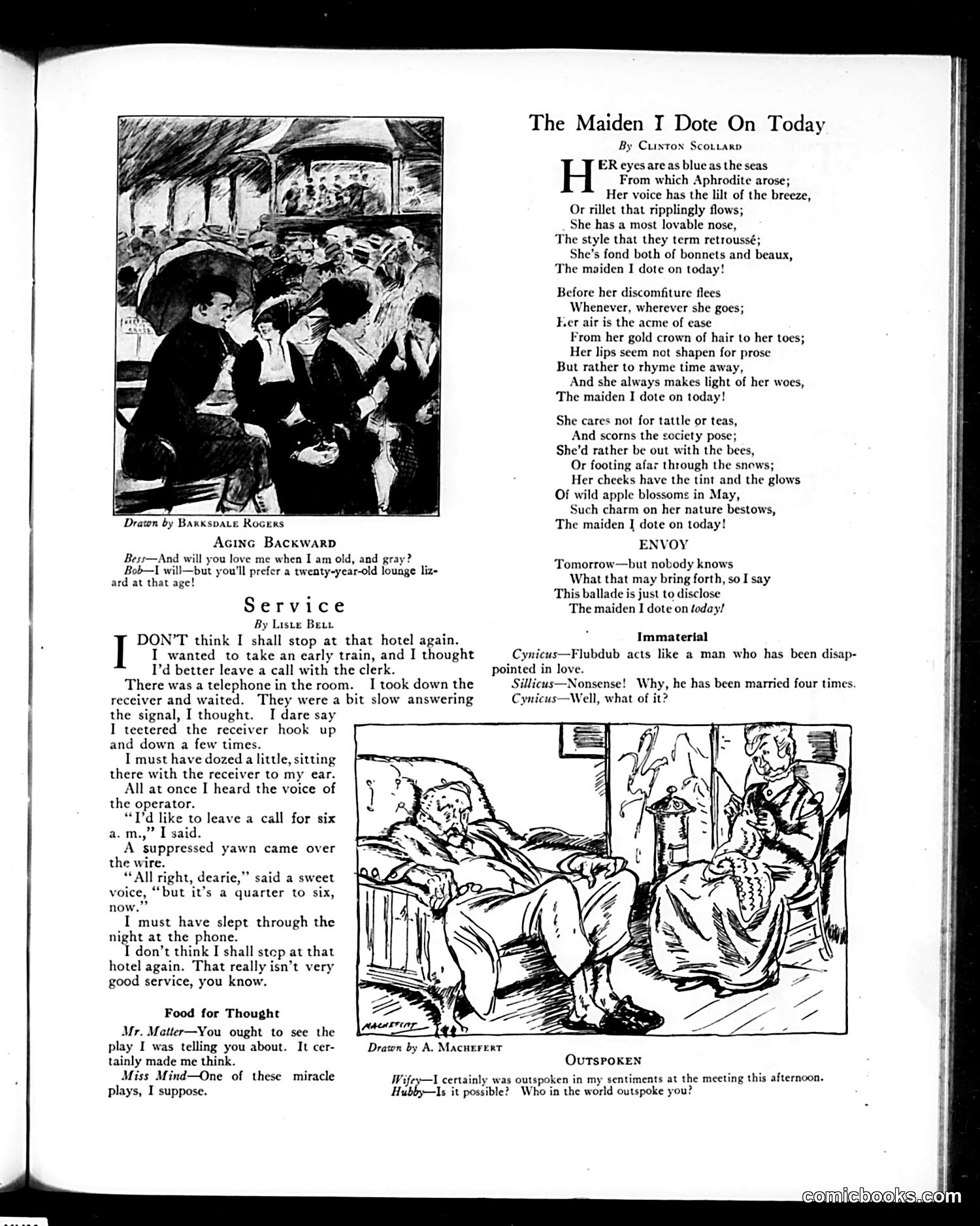
This page contains several humorous vignettes typical of early 20th-century satirical magazines: **"Aging Backward"** satirizes changing romantic standards—a young woman asks if her partner will love her when old and gray; he admits he'll prefer a younger "lounge lizard" (idle young man), mocking both male fickleness and the era's youth-obsessed dating culture. **"Service"** jokes about poor hotel telephone service. A man requests a 6 a.m. wake-up call but falls asleep holding the receiver; the operator informs him it's already 5:45 a.m., suggesting he slept through the night unnoticed. The satire targets inadequate hotel staff responsiveness. **"The Maiden I Dote On Today"** is a romantic poem in classical ballade form, celebrating an idealized woman—beautiful, spirited, outdoorsy rather than socially pretentious. **"Immaterial"** and **"Outspoken"** are brief joke exchanges about marriage: one mocks a lovelorn man who's been married four times; another features a wife bragging about dominating a meeting, with the husband quipping no one could outspeak her. All reflect period attitudes toward courtship, marriage, and gender relations.
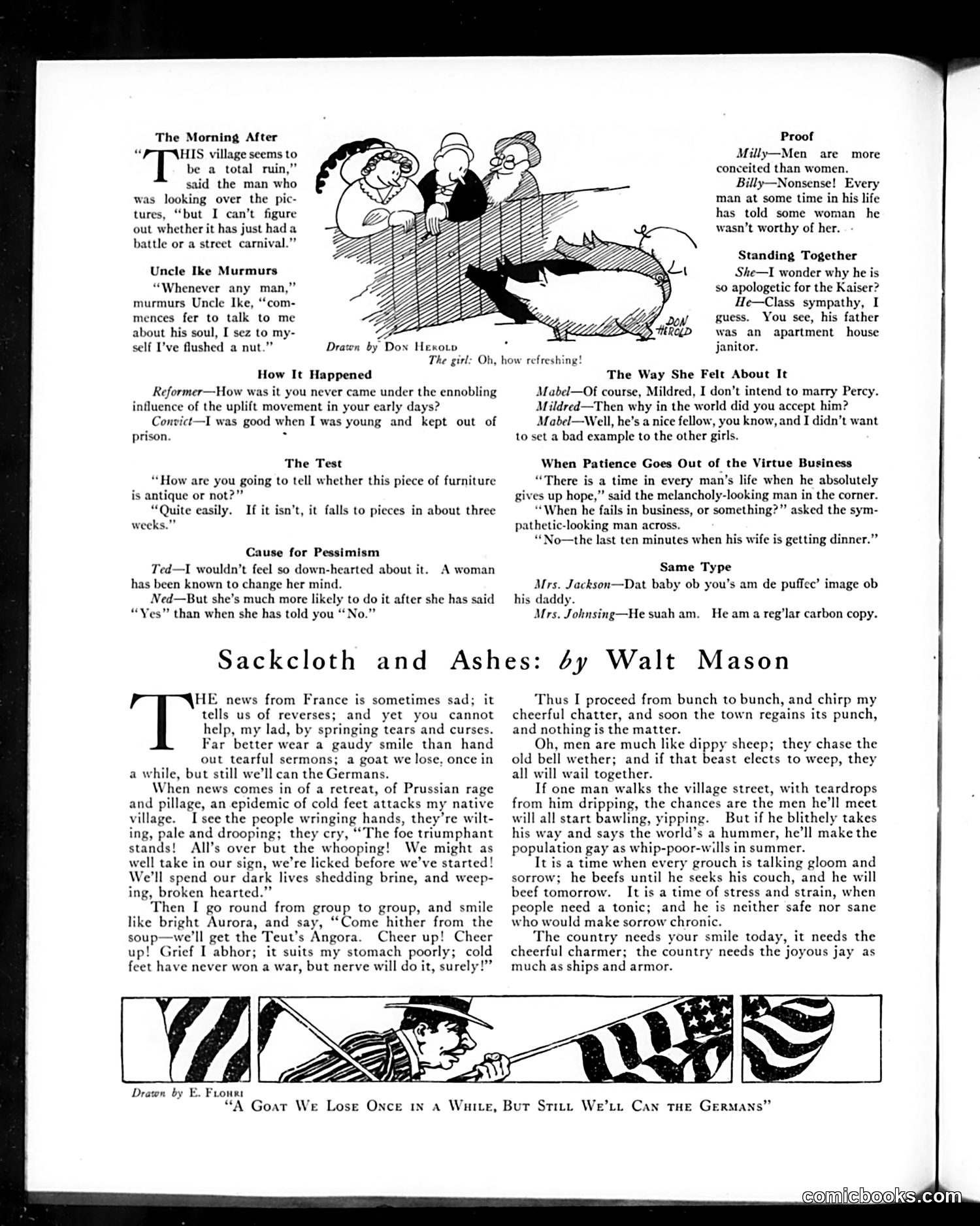
This page contains various short humorous pieces and one substantial essay, all reflecting World War I-era American attitudes. The cartoon at top (by Dox Herold) shows three figures on a damaged building, with the caption "The girl: Oh, how refreshing!" The humor appears to reference war damage—likely European village destruction from the war. The essay "Sackcloth and Ashes" by Walt Mason addresses French military retreats and Prussian advances. Mason argues against defeatist despair, urging villagers to maintain morale and cheerfulness rather than spread pessimism ("men are much like dippy sheep"). The message: civilian morale matters; optimism is patriotic duty during wartime. The smaller comedic pieces focus on domestic life—marriage, courtship, class commentary (the Kaiser apologist's father is a janitor). They're largely apolitical. The bottom illustration (by E. Florse) shows American flags, likely patriotic imagery supporting the pro-morale message. Overall, this page advocates emotional fortitude and public optimism as home-front contributions to the war effort.
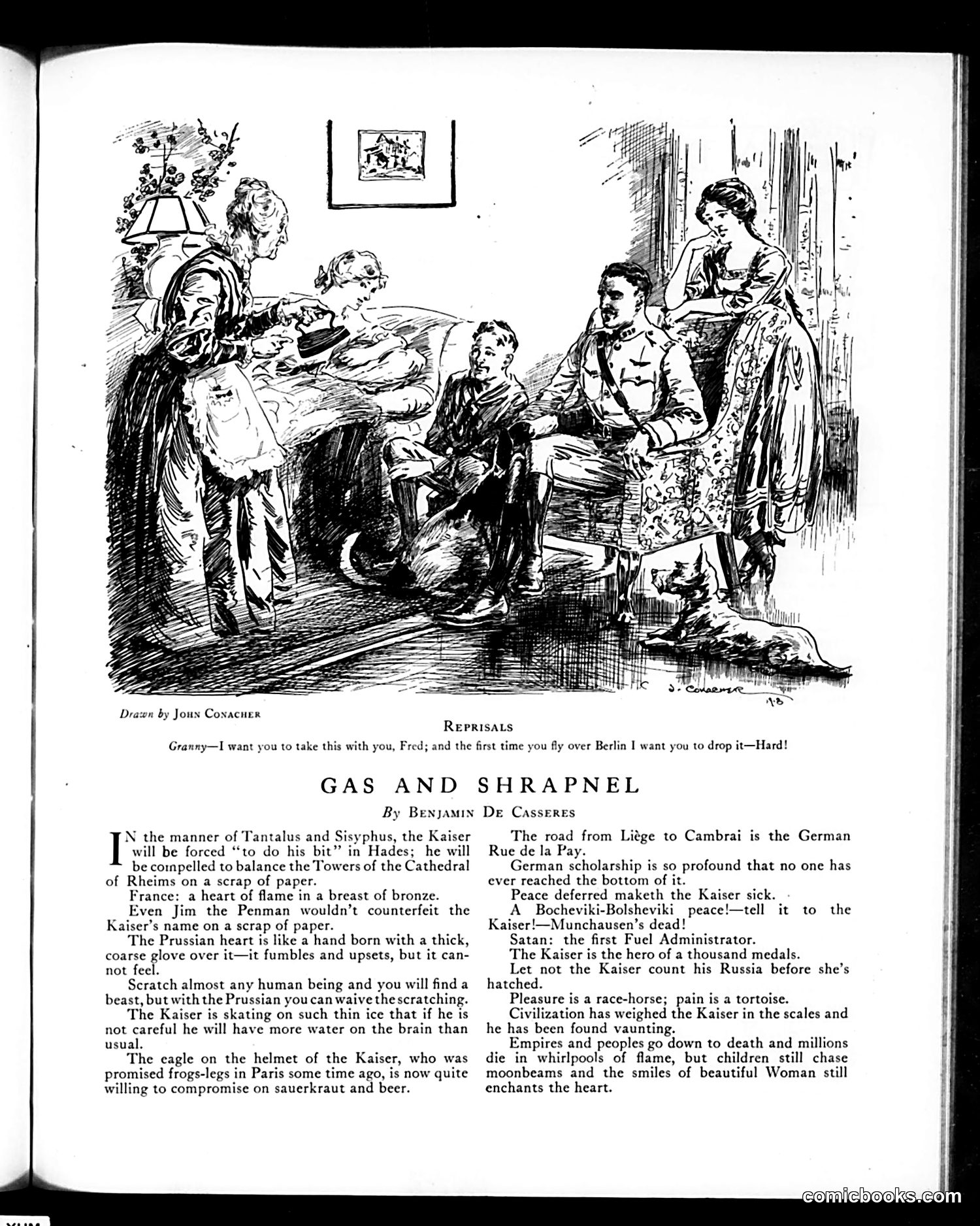
This page contains two separate satirical pieces targeting Kaiser Wilhelm II and Germany during World War I. **The Cartoon ("Reprisals"):** Shows a grandmother instructing her grandson Fred (a pilot) to drop a package over Berlin during bombing runs. The joke relies on wartime aerial bombardment—a then-novel form of warfare—and suggests civilians weaponizing ordinary objects as retaliation. **"Gas and Shrapnel" Essay:** A caustic collection of aphorisms mocking the Kaiser's intellect, morality, and military prospects. References include: - The *Reims Cathedral* destruction (actual German war crime) - The failed promise of conquering Paris ("frogs-legs") - Germany's failed invasion/occupation (Liège to Cambrai) - Implied Russian defeat or surrender - General contempt for Prussian character The piece uses extended metaphors (the Kaiser "skating on thin ice") and classical allusions to belittle German leadership while celebrating Allied resilience, particularly France's "heart of flame in a breast of bronze." This is propagandistic wartime satire from *Judge* magazine, designed to boost American morale by ridiculing the enemy.
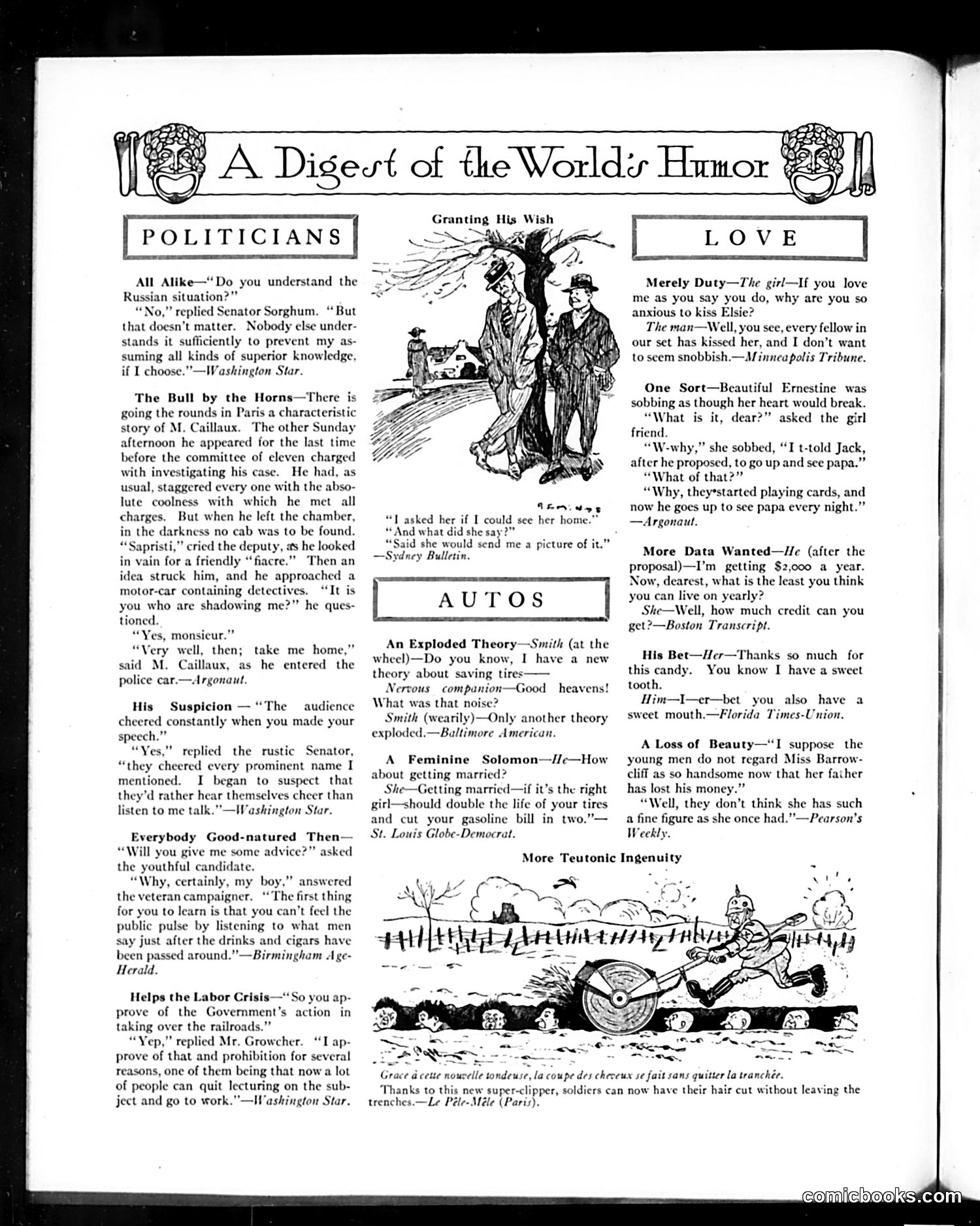
This is a humor digest page from *Judge* magazine featuring satirical jokes about politicians, automobiles, and romance circa 1914-1918 (based on references to tire-saving, labor crises, and government railroad takeover). **Key content:** **Politicians section**: Mockery of senators' pretentious ignorance (Senator Sorghum claiming expertise on Russia he doesn't understand); anecdote about French politician Caillaux's audacity in asking his police shadows for a ride home. **Autos section**: Early car humor—theories about tire-saving that "explode," and a woman's practical observation that marriage should "cut your gasoline bill in two." **Love section**: Period dating humor—a man kisses his girlfriend's rival to avoid seeming "snobbish"; a woman's practical question after a proposal: "how much credit can you get?" (implying she'll overspend). **Bottom cartoon**: A soldier getting a haircut in the WWI trenches using a novel clipper device—satirizing German military "ingenuity" for practical battlefield solutions. The humor reflects pre-WWI social attitudes: gender stereotypes, class anxiety, and early automobile culture.
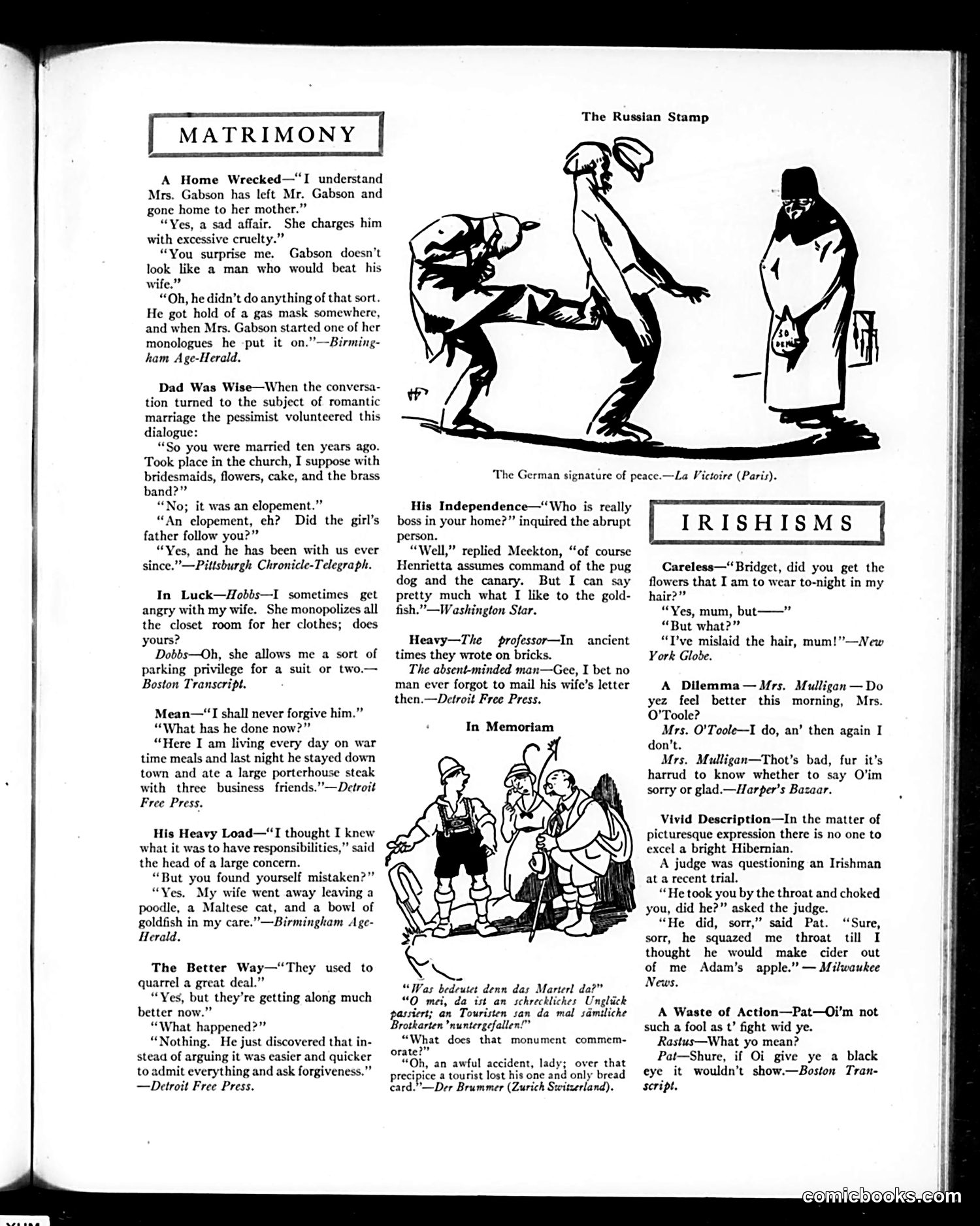
This page contains humorous short jokes organized by topic. The **"Matrimony"** section satirizes married life—wives monopolizing closets, husbands escaping nagging wives with gas masks (a WWI reference), and the discovery that admitting fault prevents arguments. These joke at domestic tensions common to the era. **"The Russian Stamp"** is a political cartoon showing two figures fighting while a third official watches. The caption references the "German signature of peace," likely commenting on WWI peace negotiations and Russia's separate peace treaty (Treaty of Brest-Litovsk, 1918), portraying the conflict as brutal and the peace as imposed rather than genuine. The **"Irishisms"** section relies on ethnic stereotypes popular in early 20th-century American humor, depicting Irish characters (Bridget, Pat, Mrs. O'Toole) through exaggerated dialect and malapropisms. The jokes play on supposed Irish illogic and colorful speech patterns—considered entertainment at the time. The **"In Memoriam"** section (in German) references rationing during WWI, joking about a tourist losing precious bread cards.
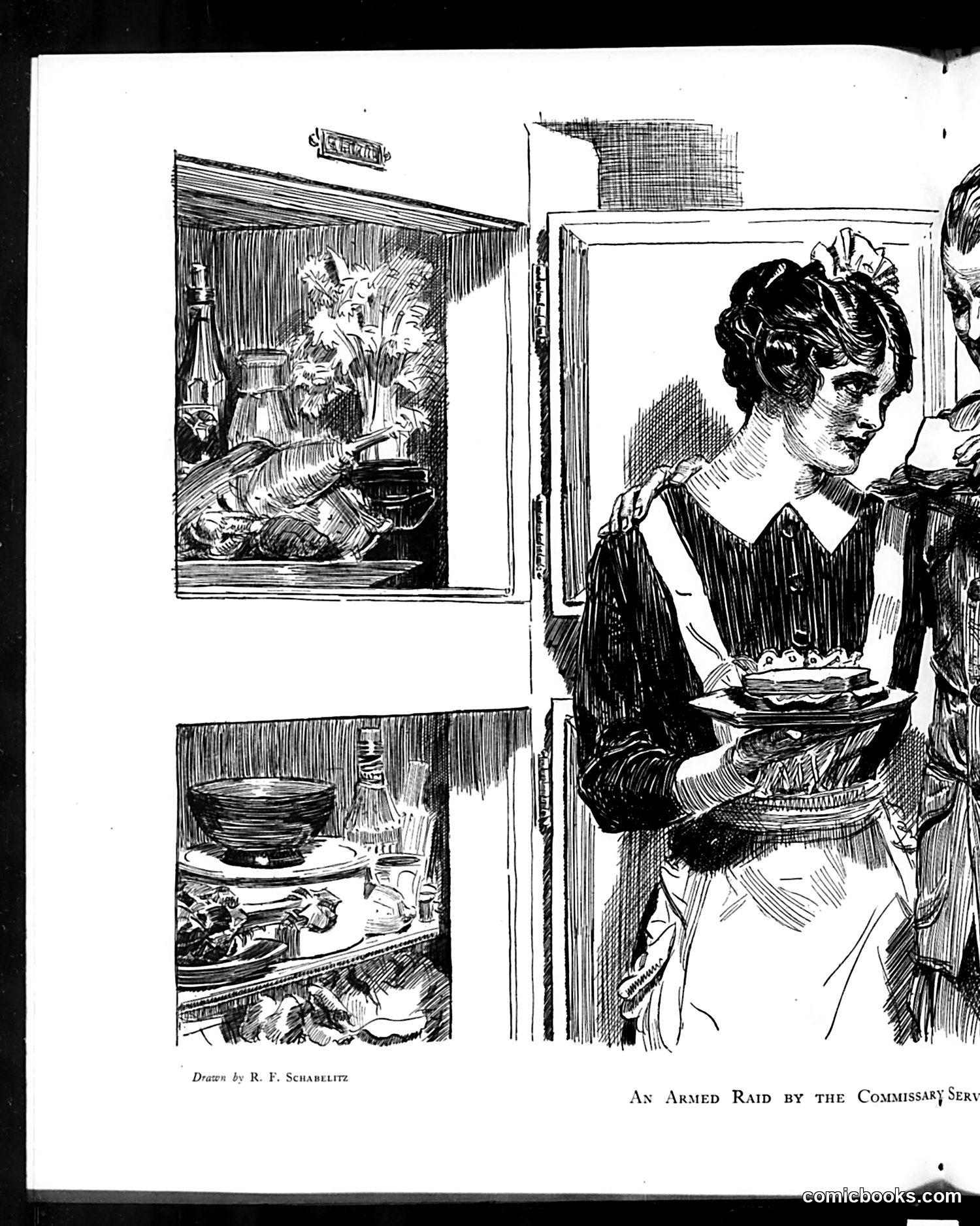
This appears to be a satirical illustration about food service or provisioning, likely military-related given the title's reference to "Commissary Serv[ice]." The cartoon shows a woman holding food items, with smaller panels depicting kitchen/dining scenes. The "armed raid" appears to be a humorous critique of aggressive food rationing, procurement, or distribution practices—possibly commenting on wartime or institutional food shortages and the desperate measures taken to obtain provisions. The title's wordplay on "armed" (military/weapon-related) versus the domestic kitchen setting creates the satirical contrast. The specific historical context and which conflict this references remains unclear without additional dating information from the magazine. Drawn by R.F. Schabelitz.
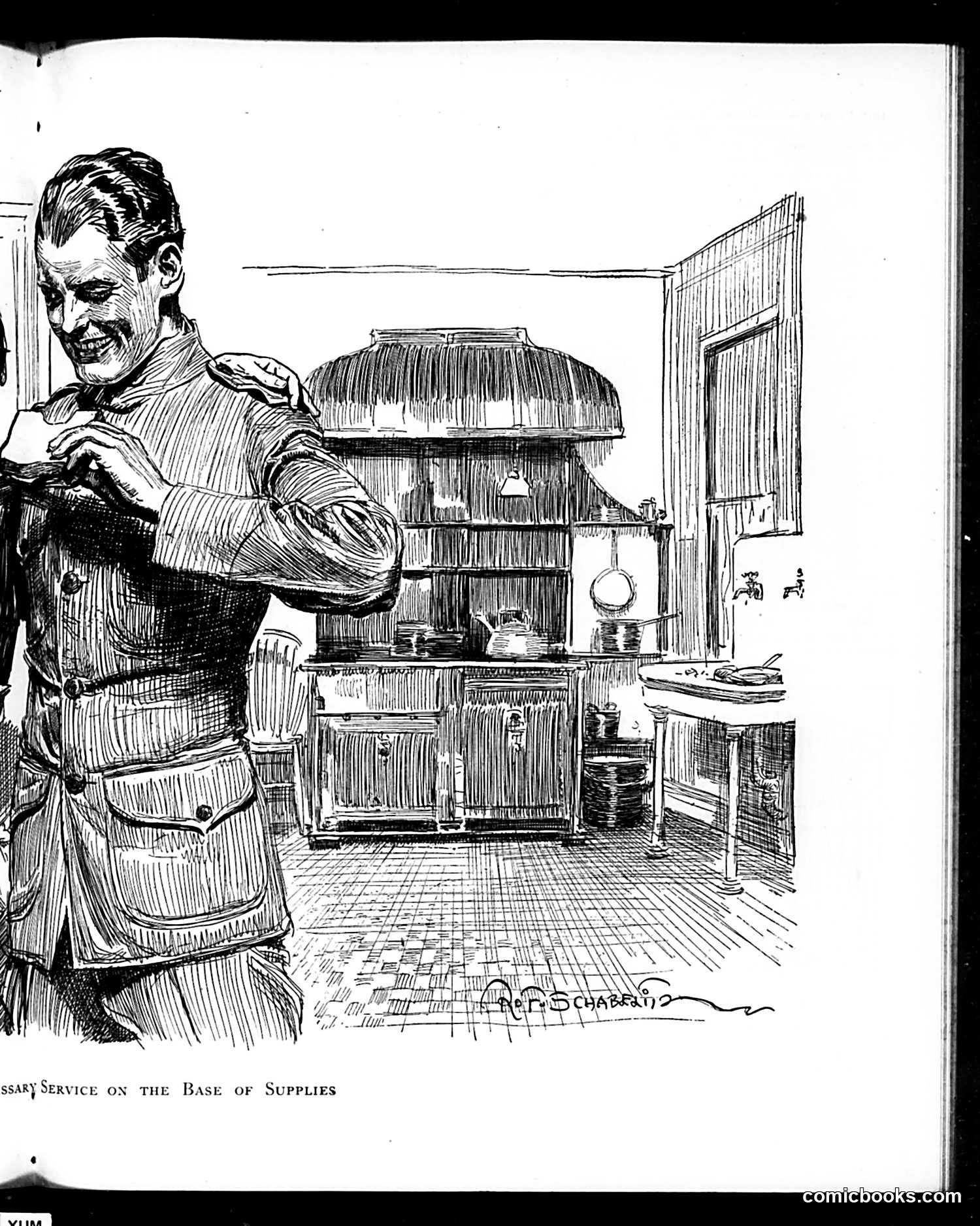
This appears to be a military-themed cartoon titled "Necessary Service on the Base of Supplies." The image shows a uniformed military officer in a kitchen, smiling while handling cooking equipment and supplies. The setting depicts a military base kitchen with stoves, shelving, and food preparation areas. The satire likely critiques or comments on the role of supply and provisioning services in military operations—suggesting that cooking/food service, while essential to military function, was sometimes undervalued or treated as a less prestigious duty compared to combat roles. The officer's exaggerated, satisfied expression may be ironically celebrating this "necessary" but unglamorous work. The cartoon appears designed for readers familiar with military hierarchy and base operations during an era when Judge magazine was active (likely early-to-mid 20th century).
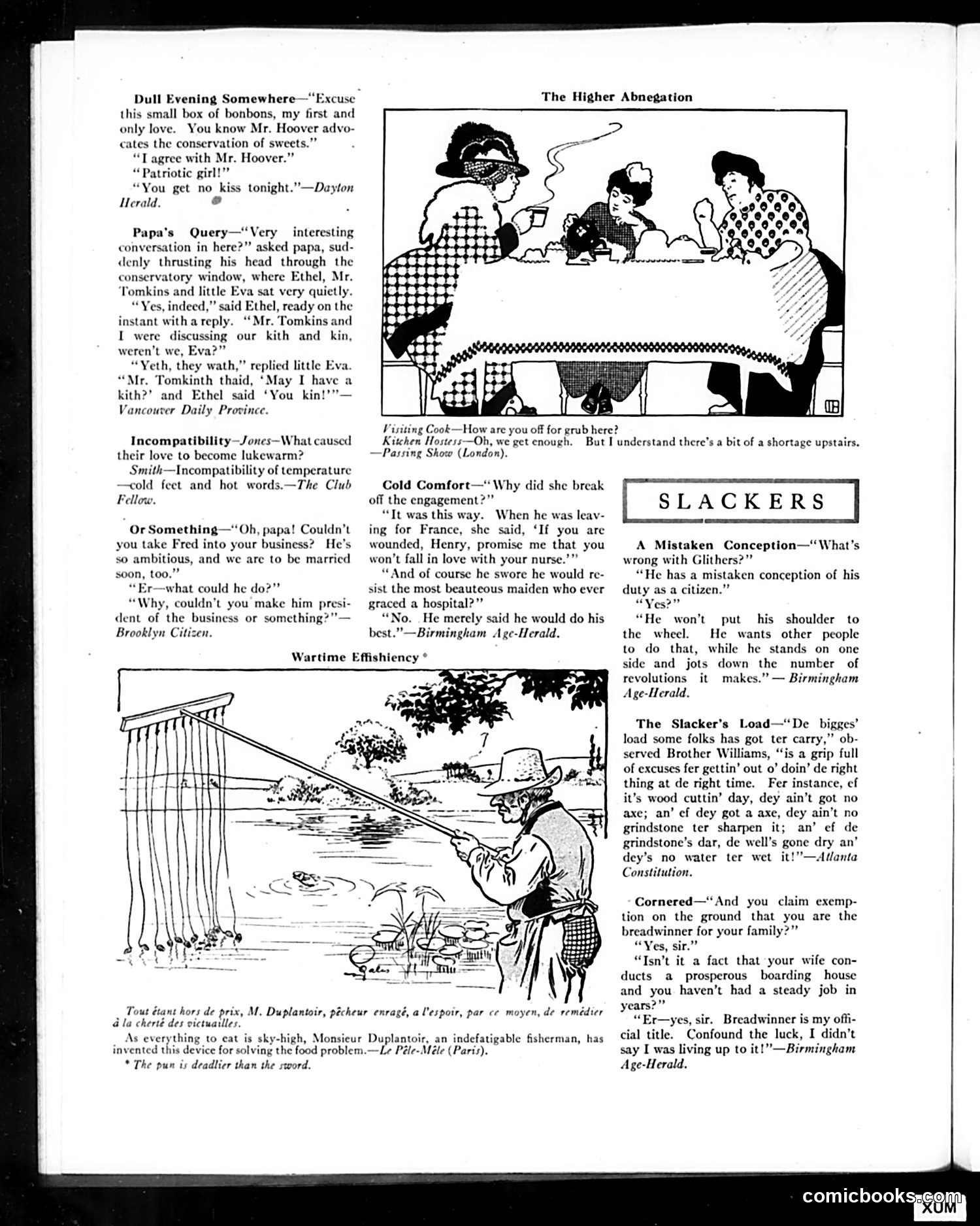
This page contains multiple short humorous items satirizing WWI-era American society, particularly targeting "slackers"—men avoiding military service. The main cartoon depicts a fisherman's wartime efficiency device, illustrating how scarcity drives creative (if absurd) solutions during wartime shortages. The "SLACKERS" section contains three jokes mocking men shirking civic duty: 1. **"A Mistaken Conception"** ridicules a man who refuses to contribute labor, instead merely observing others' work. 2. **"The Slacker's Load"** uses dialect humor (Brother Williams) to enumerate transparent excuses men make to avoid work—lacking tools, having broken equipment—suggesting habitual avoidance. 3. **"Cornered"** depicts a man claiming exemption as family "breadwinner" when actually his wife runs a boarding house and he's unemployed, exposing his dishonesty about military/civic obligations. The scattered anecdotes above (about sweets conservation, engagements, etc.) provide lighter social commentary unrelated to wartime issues. The French caption references food price inflation affecting civilians.
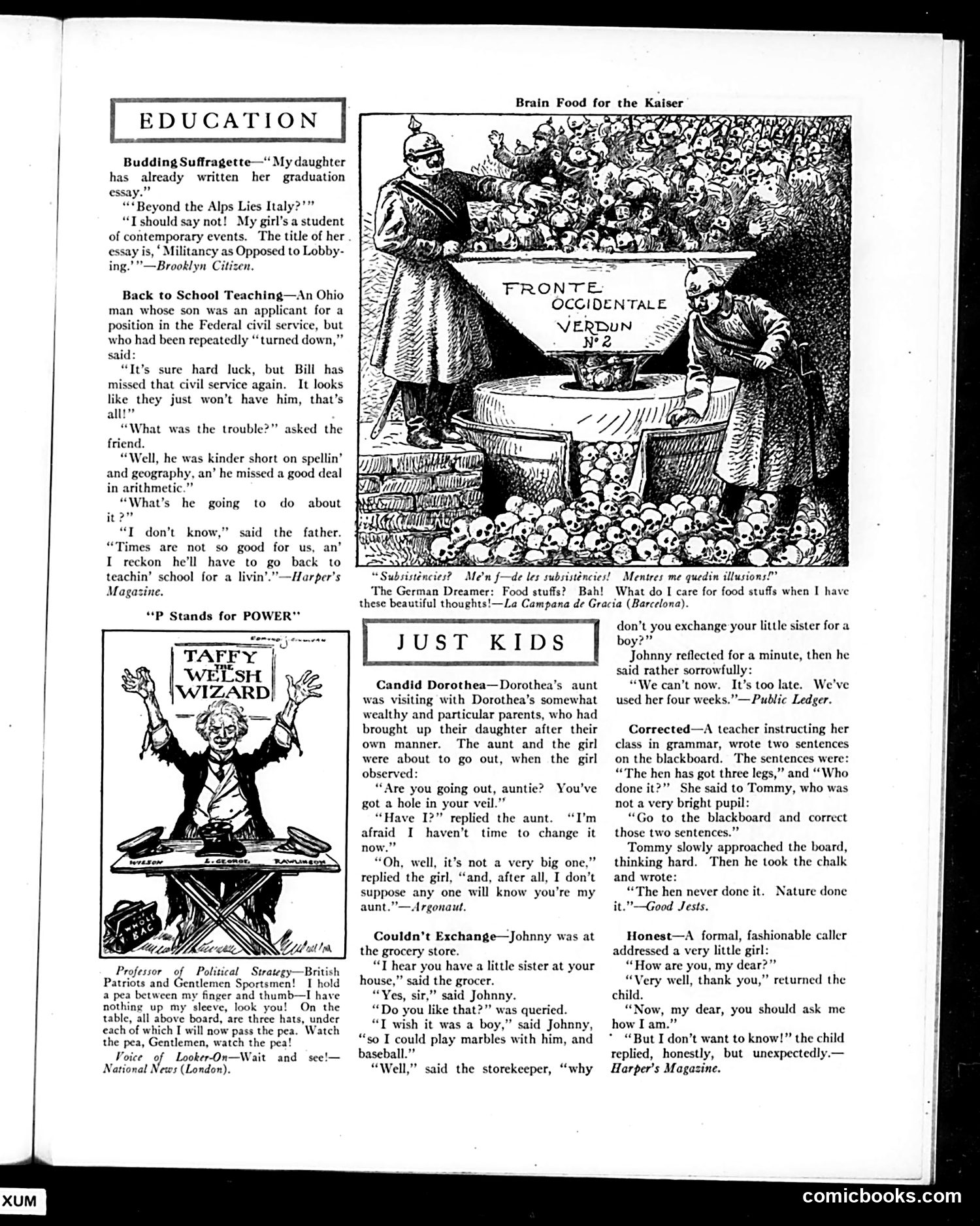
This page contains satirical commentary on education and social issues circa early 20th century. The top cartoon, "Brain Food for the Kaiser," mocks German militarism through a caricatured German officer feeding troops "beautiful thoughts" instead of food—a jab at German idealism disconnected from material reality during WWI era tensions. The "Taffy for the Welsh Wizard" cartoon (lower left) likely references Lloyd George, the Welsh political figure, with "P Stands for POWER" suggesting critique of political manipulation and sleight-of-hand tactics. The "Just Kids" section contains humorous anecdotes about children and education: a girl's militant suffragette essay, Johnny's practical but unflattering view of his sister, and a pupil's literalist correction of grammar. These jokes mock both progressive education movements and children's innocent logic. The "Back to School Teaching" anecdote satirizes inadequate civil service hiring practices and economic hardship forcing failed applicants into teaching—implying teaching was a fallback profession. Overall, the page critiques education quality, political duplicity, and social pretension through humor.
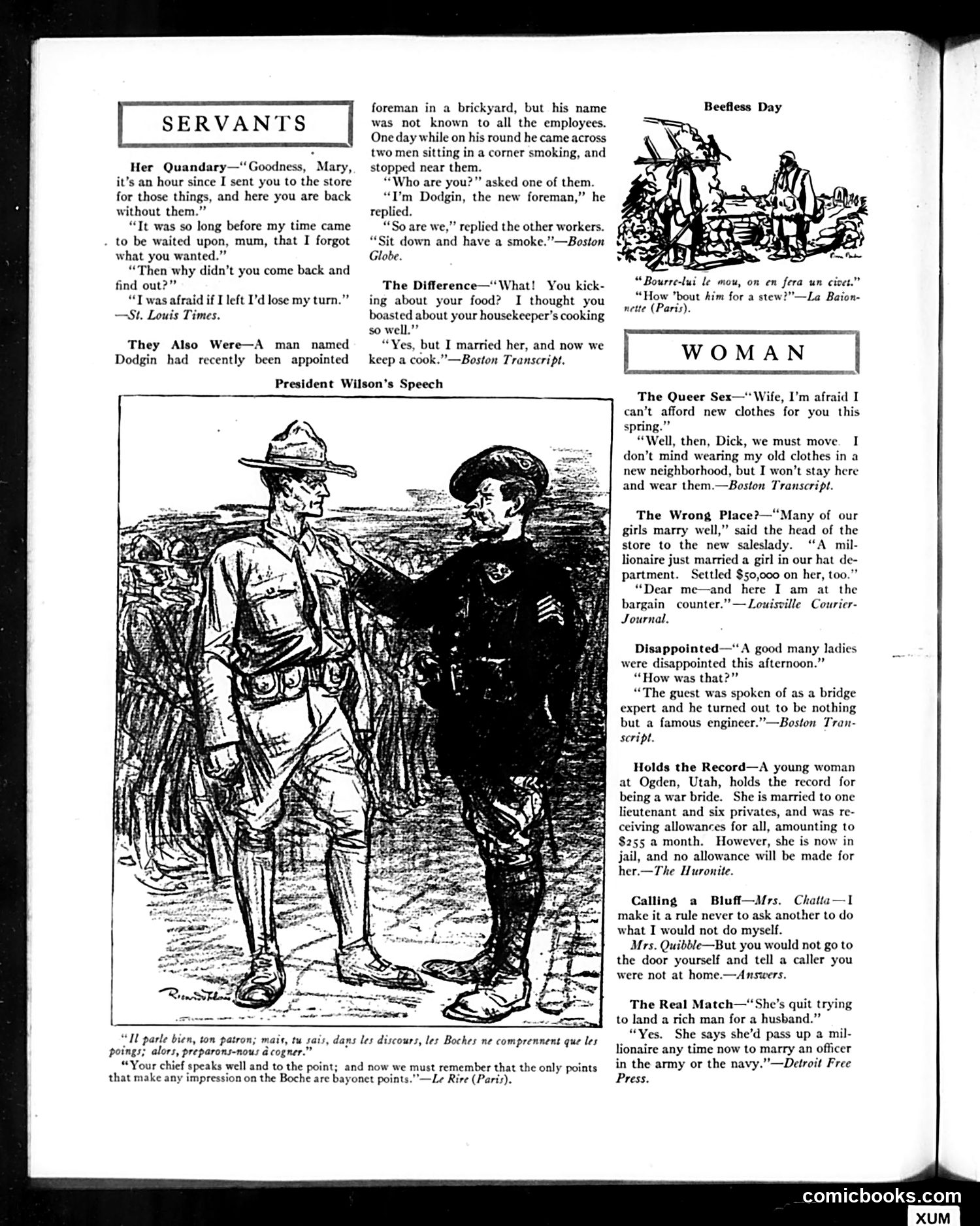
This page from Judge contains brief humorous anecdotes and a significant political cartoon about President Wilson's WWI messaging. **The Main Cartoon:** depicts Wilson (identifiable by his military uniform and profile) speaking with what appears to be a French soldier. The French captions reveal the satire: while Wilson's speeches sound eloquent, the French note that Germans only understand "fists" and "bayonet points"—suggesting Wilson's rhetoric, however well-intentioned, must be backed by military force to be effective against Germany. **The Anecdotes:** mostly mock domestic life and gender relations—servants' confusion, marriage disillusionment, and women's priorities. One notably dark item describes a Utah woman married to seven soldiers simultaneously for their military allowances, now jailed for fraud. **Context:** Published during WWI, the page reflects American debate over whether diplomatic speech alone could stop German aggression, while home-front humor satirizes wartime social disruptions and profiteering.
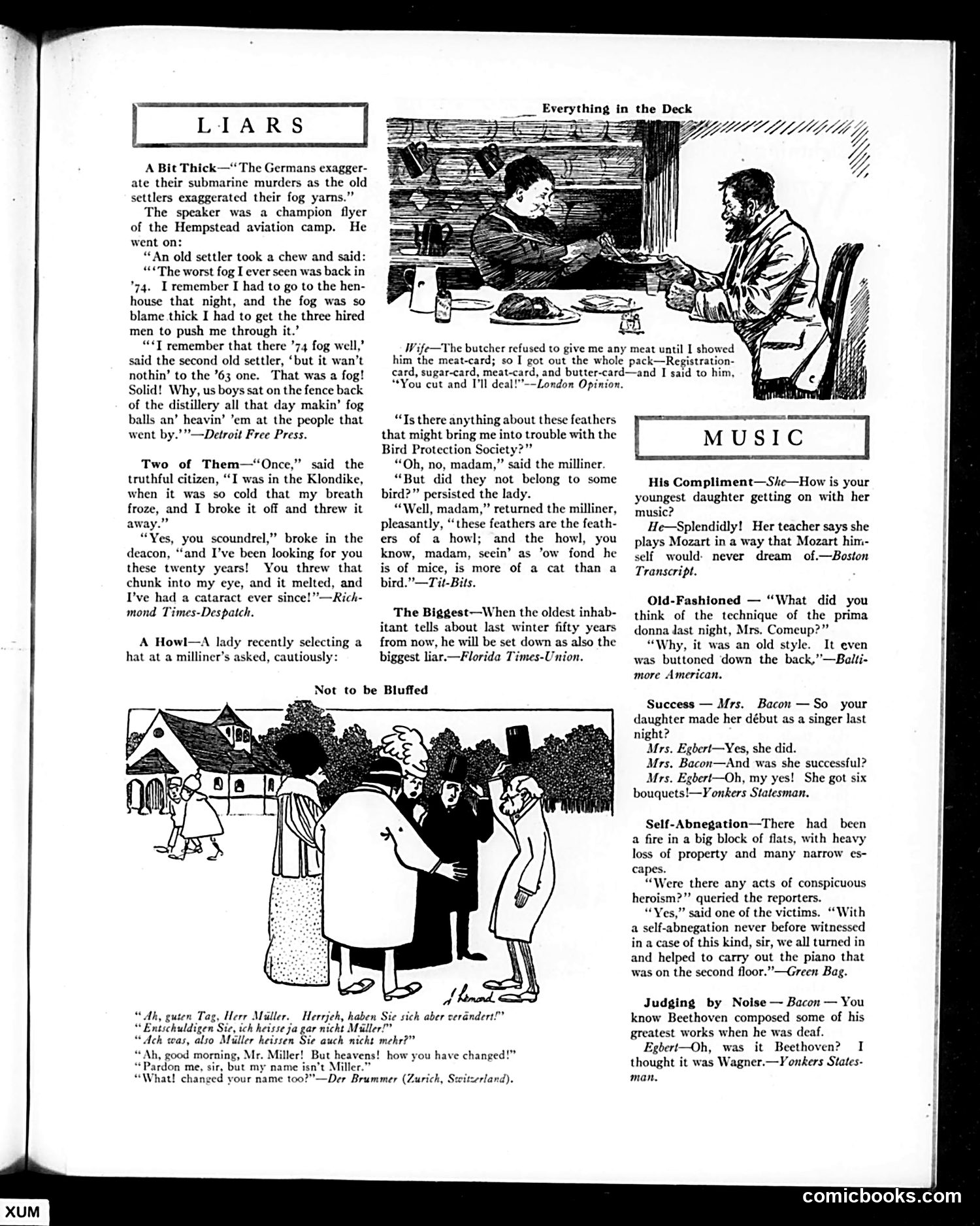
This page from Judge magazine contains multiple short humorous anecdotes satirizing exaggeration and dishonesty. The main cartoon ("Not to be Bluffed") depicts a German man confronting someone about changing his name, illustrated with German dialogue. The surrounding text pieces mock various forms of lying: settlers exaggerating tall tales about fog; someone claiming frozen breath caused another's cataract decades later; a milliner calling owl feathers "howl" to avoid bird protection laws; and a woman using her ration cards as poker chips with her butcher. The "Wife" cartoon references World War I-era British rationing (meat-cards, sugar-cards, butter-cards), using card-dealing slang to joke about food scarcity. The page satirizes petty dishonesty across social classes—from rural yarn-spinners to wartime profiteers to those evading regulations. The humor assumes readers recognize common excuses and loopholes people exploit. The overall message: everyone lies, from working-class to middle-class citizens, in trivial and serious ways alike.
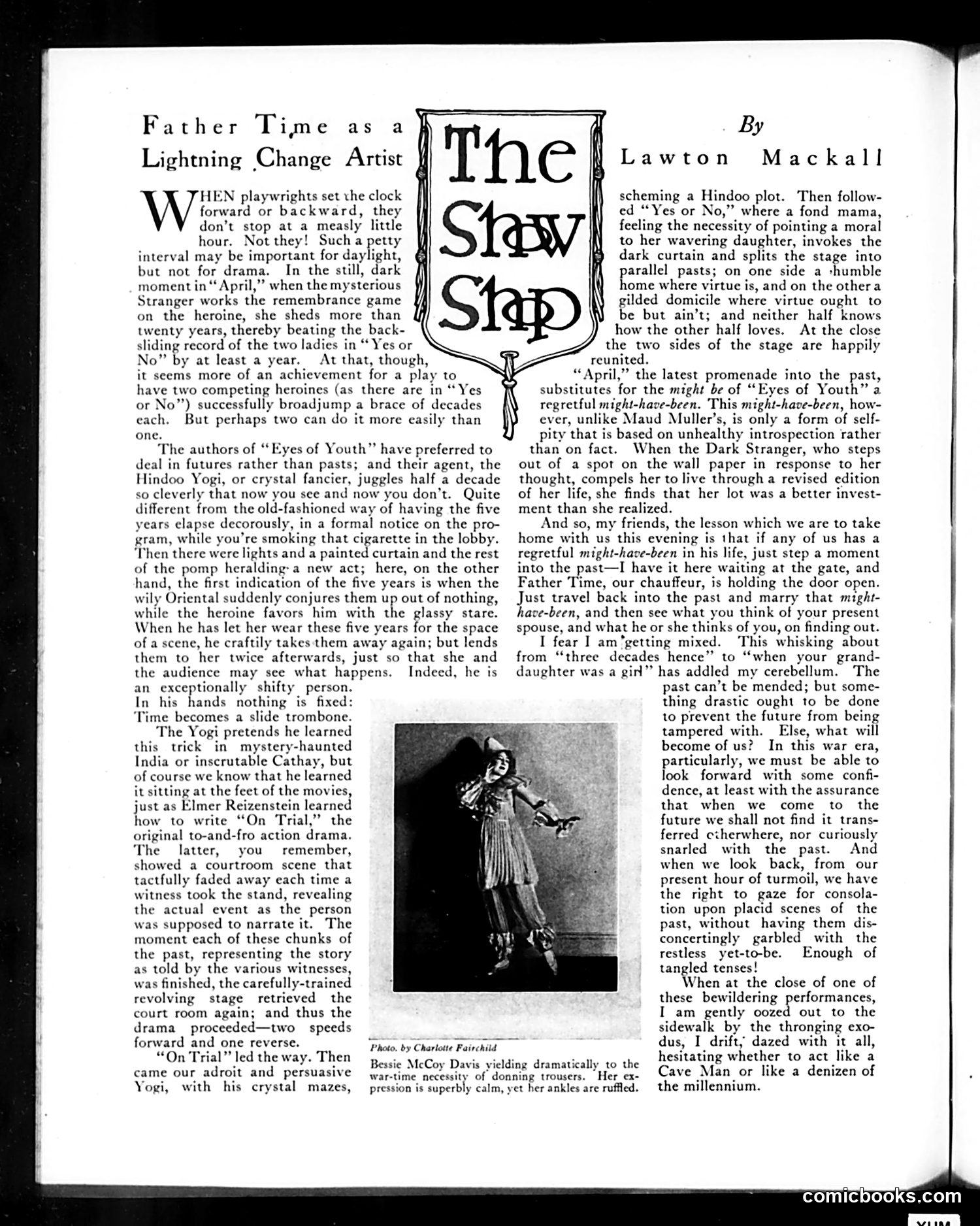
This article by Lawton Mackall critiques contemporary Broadway plays that manipulate time through staging tricks. The author satirizes how playwrights use elaborate scenic devices—revolving stages, lighting effects, painted curtains—to compress or expand decades into moments, rather than relying on traditional intermission conventions. Mackall specifically mocks three plays: "Eyes of Youth" (featuring a Yogi who conjures five-year jumps), "Yes or No" (splitting the stage into parallel moral timelines), and "April" (using a mysterious "Dark Stranger" to reveal alternate pasts). He argues these techniques derive from film editing, citing "On Trial" as the original stage-to-screen adaptation example. The photograph shows actress Bessie McCoy Davis in dramatic pose, illustrating the theatrical spectacle under discussion. Mackall's tone is gently satirical—he admires the technical cleverness while mocking the pretension of treating stage time like a "slide trombone."
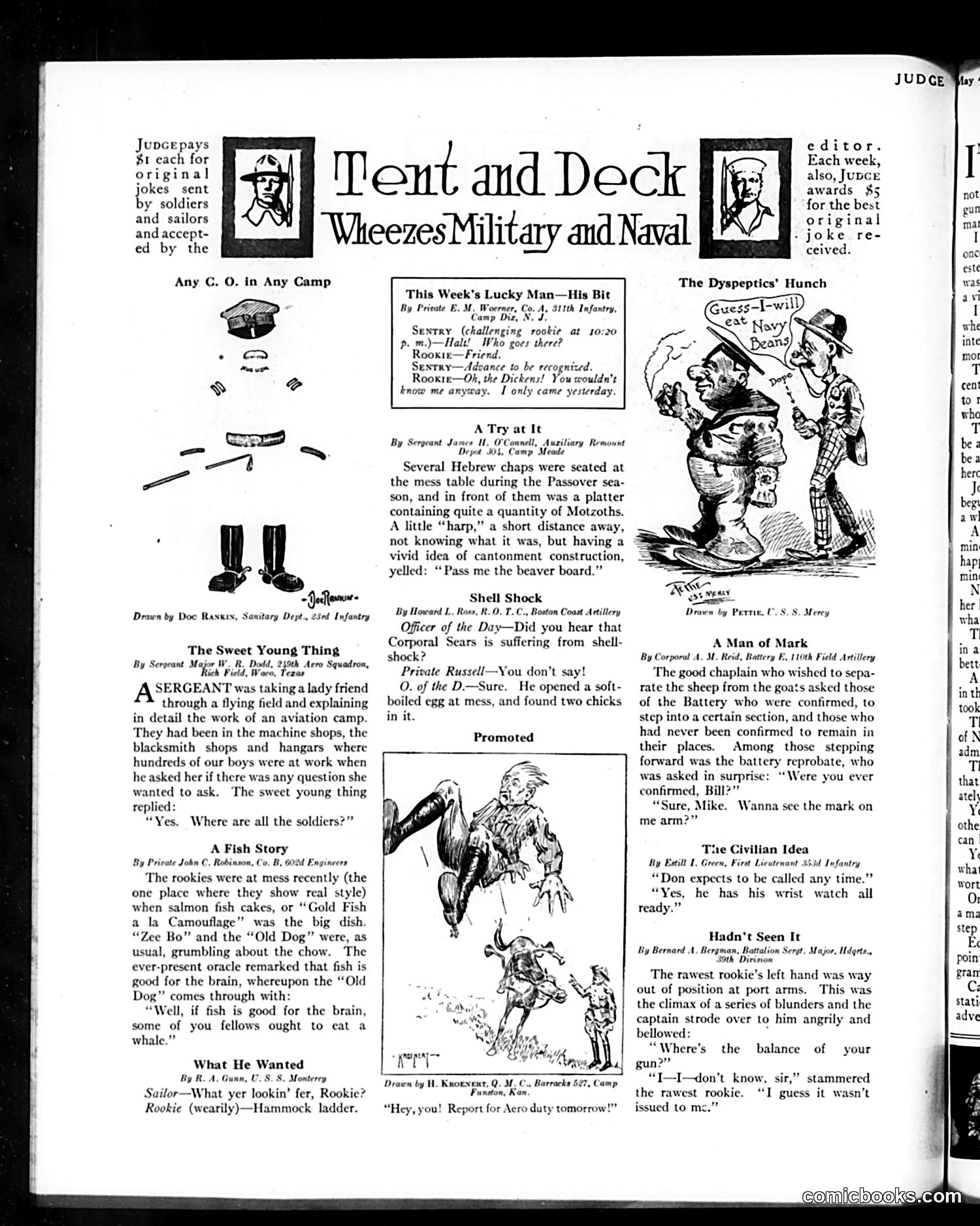
This is a humor page from *Judge* magazine featuring jokes and cartoons submitted by soldiers and sailors during World War I. The page shows camp life satirized through various scenarios: **Key jokes include:** - A sergeant's lady friend asking where "all the soldiers" are after touring an active airfield—mocking civilians' disconnect from military reality - Soldiers complaining about camp food (fish cakes), with a retort that those criticizing should "eat a whale" - A rookie sentinel challenged at night who reveals he arrived yesterday - Hebrew soldiers at Passover confused about "matzos," mishearing it as "beaver board" (construction material) - A soldier claiming shell-shock from finding chicks in a soft-boiled egg The humor relies on **military camp absurdities**: incompetent recruits, inedible food, overcrowded conditions, and the gap between military procedure and chaotic reality. The cartoons mock both green soldiers and military bureaucracy, while readers—soldiers themselves—could identify with these shared frustrations.
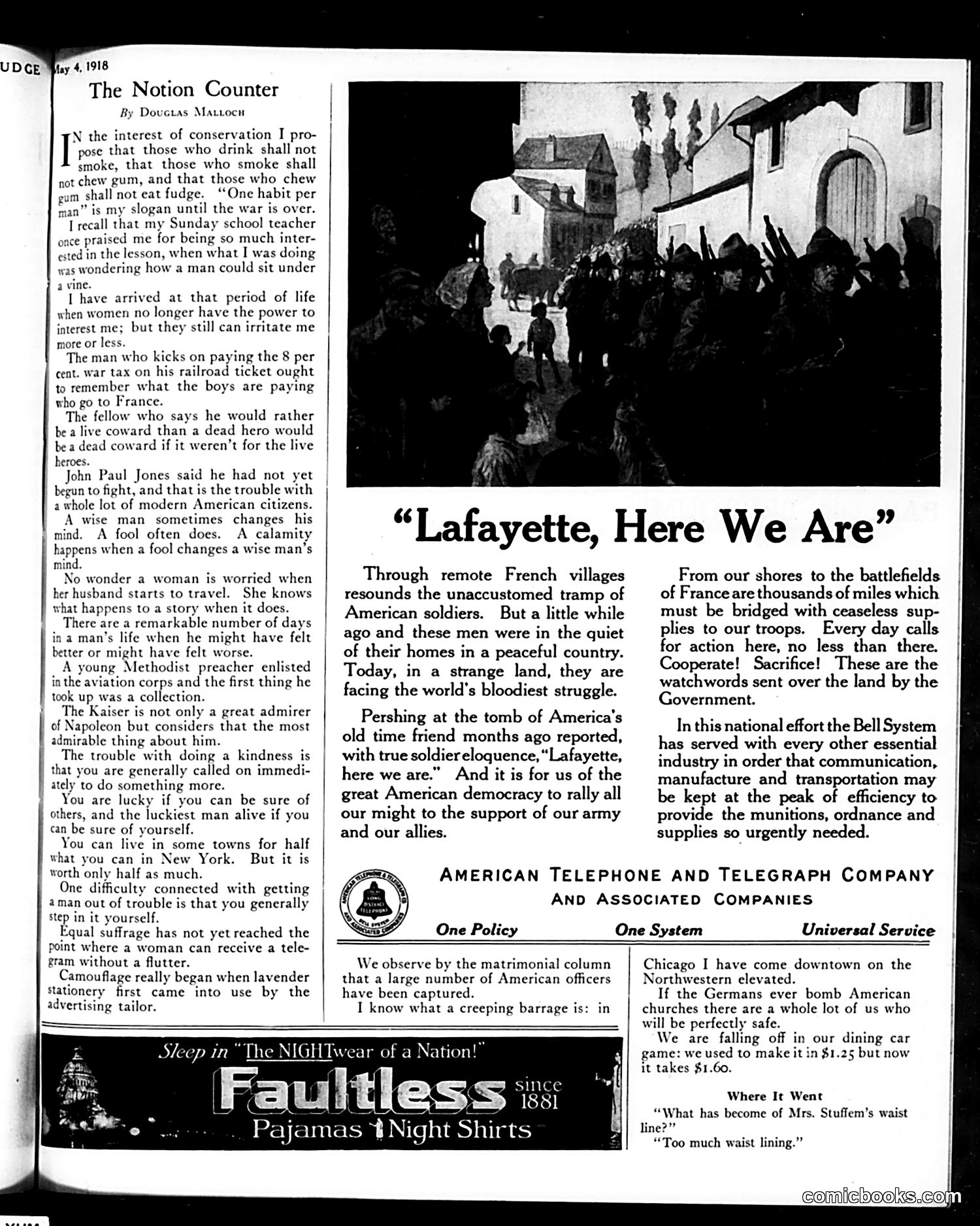
This May 1918 *Judge* page mixes satirical commentary with patriotic wartime messaging. **"The Notion Counter"** by Douglas Malloch offers homespun wartime philosophy—conservation quips, observations about human nature, and jibes at war-shirkers. The final jabs mock those avoiding military service ("live coward") and reference John Paul Jones to shame American reluctance to fight. **"Lafayette, Here We Are"** is a propaganda piece celebrating American Expeditionary Forces in France, referencing General Pershing's famous statement at Lafayette's tomb. It frames U.S. involvement as fulfilling America's debt to France's Revolutionary War ally. The accompanying photograph shows American troops in a French village. **The Bell System advertisement** wraps itself in patriotic language, claiming the telephone company supports the war effort through infrastructure—a classic corporate wartime PR move. The page reflects 1918 America: active military mobilization, nationalist sentiment, and corporate cooperation with government war aims. Humor targets civilian apathy rather than the war itself.
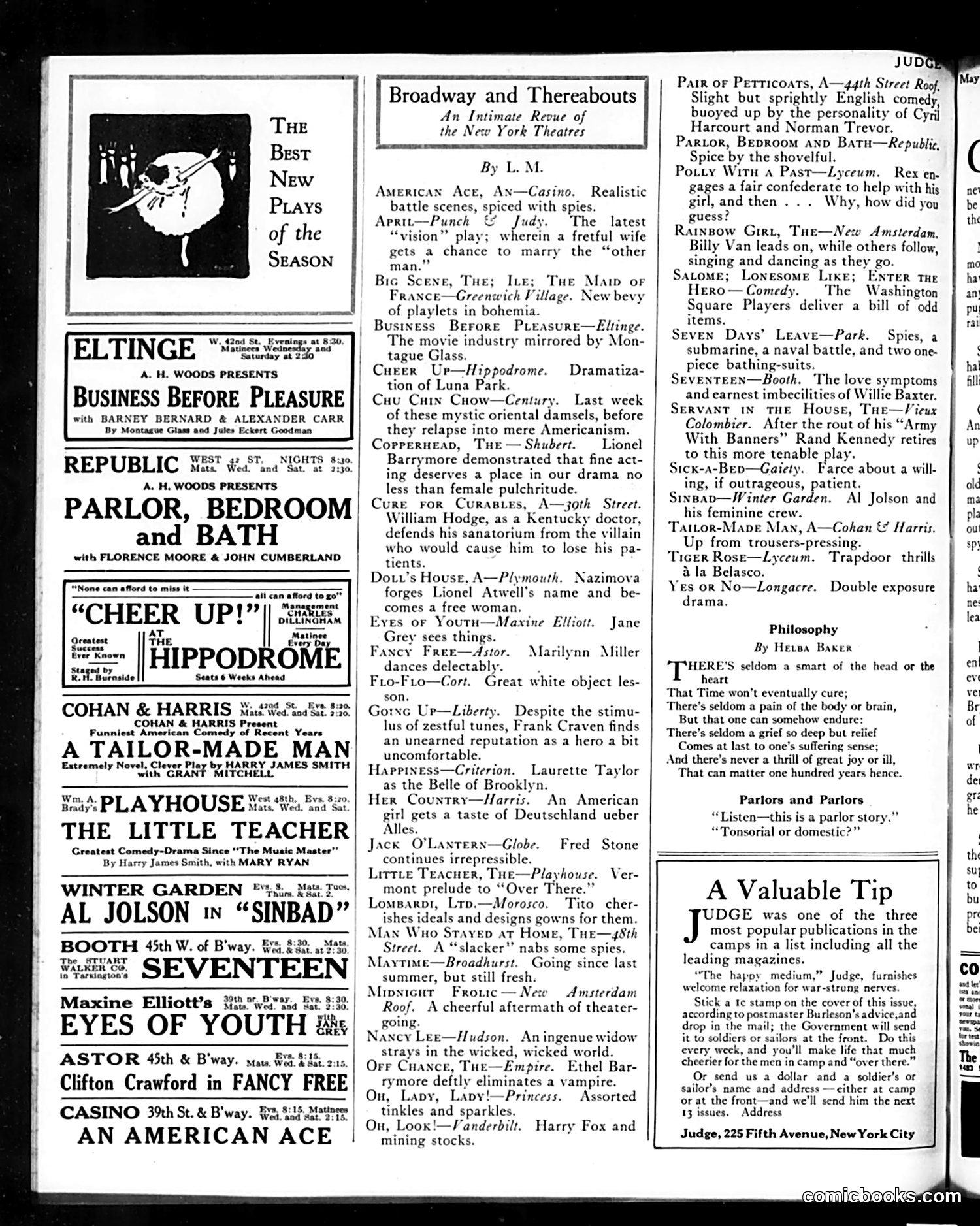
This page is primarily **theatrical advertising and reviews** rather than political satire. It lists Broadway shows currently running, with brief critical descriptions by "L.M." The top section, "The Best New Plays of the Season," features a decorative woodcut illustration (unrelated to specific content) and reviews approximately 30 theatrical productions. Notable context: Many titles reference **World War I themes**—"The Man Who Stayed at Home" (addressing "slackers"), "Her Country" (patriotic sentiment), and "Going Up" suggest this page dates to the WWI era, when such themes dominated American entertainment. The reviews use casual, gossipy language typical of the period ("Assorted tinkles and sparkles," "spice by the shovelful") and focus on star power and plot summary rather than critical analysis. The bottom half contains standard Broadway theater advertisements listing venues, times, and cast names—essentially a theatrical listing service for readers planning evening entertainment.
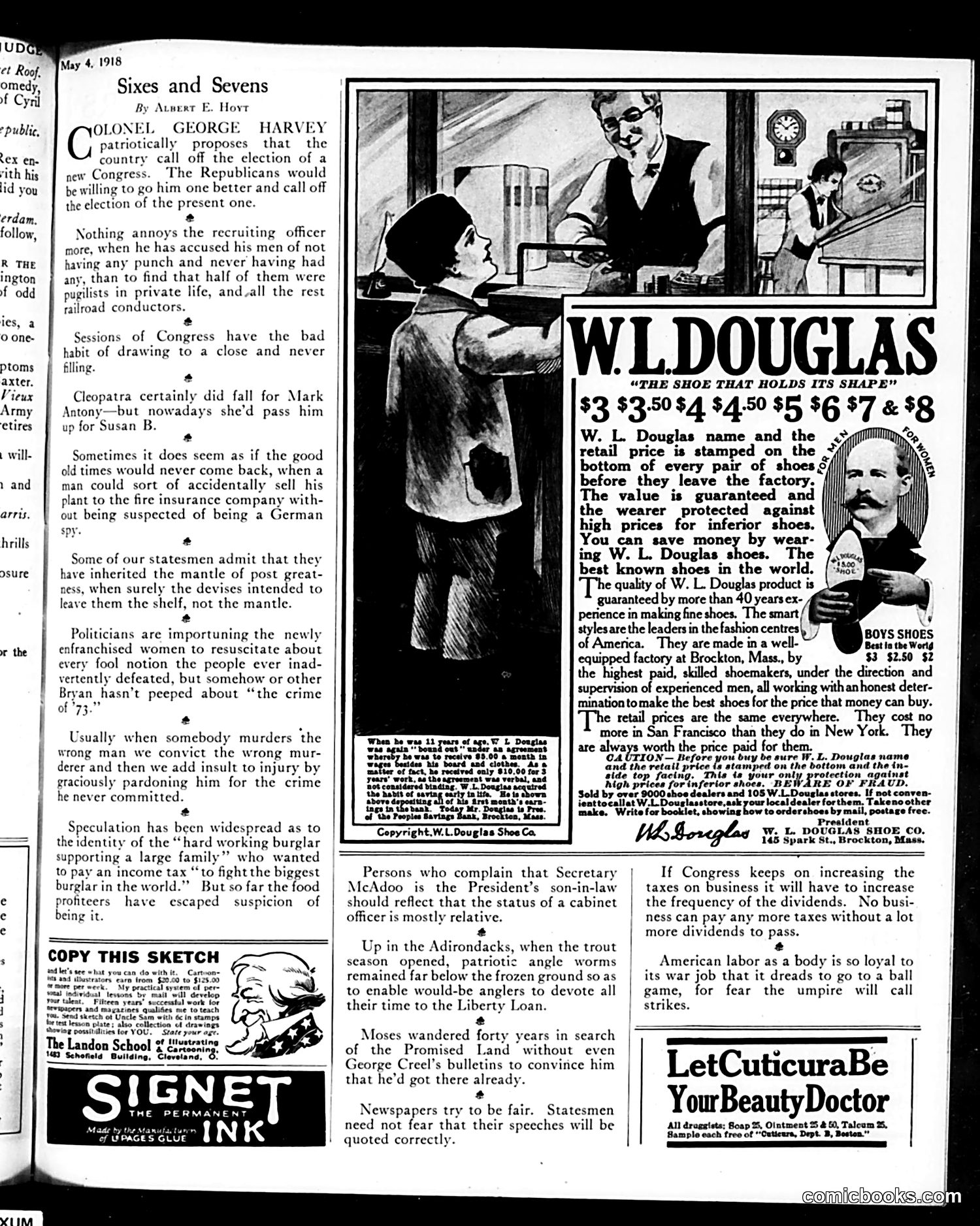
This page features political commentary by Colonel George Harvey (identifiable from the text) during World War I. The main satire targets Congress and Republican politics: **Key Points:** - Harvey proposes canceling Congressional elections; Republicans supposedly want to go further and eliminate the sitting Congress entirely—satirizing Congressional gridlock and unpopularity. - References to newly enfranchised women (19th Amendment context, 1920) being courted by politicians to resurrect failed policies. - A jab at Bryan's silence on "the crime of '73'" (the 1873 demonetization of silver that Bryan famously opposed). - Mockery of an "income tax burglar" quote—likely referencing war profiteers escaping suspicion while ordinary people face taxation. **The Advertisement:** The bulk of the page is a W.L. Douglas shoe advertisement (a major contemporary brand), featuring the manufacturer's portrait and guaranteed pricing—typical of 1918 magazine content. The humor relies on readers' familiarity with recent political debates, Congressional unpopularity, and the income tax controversy of the era.
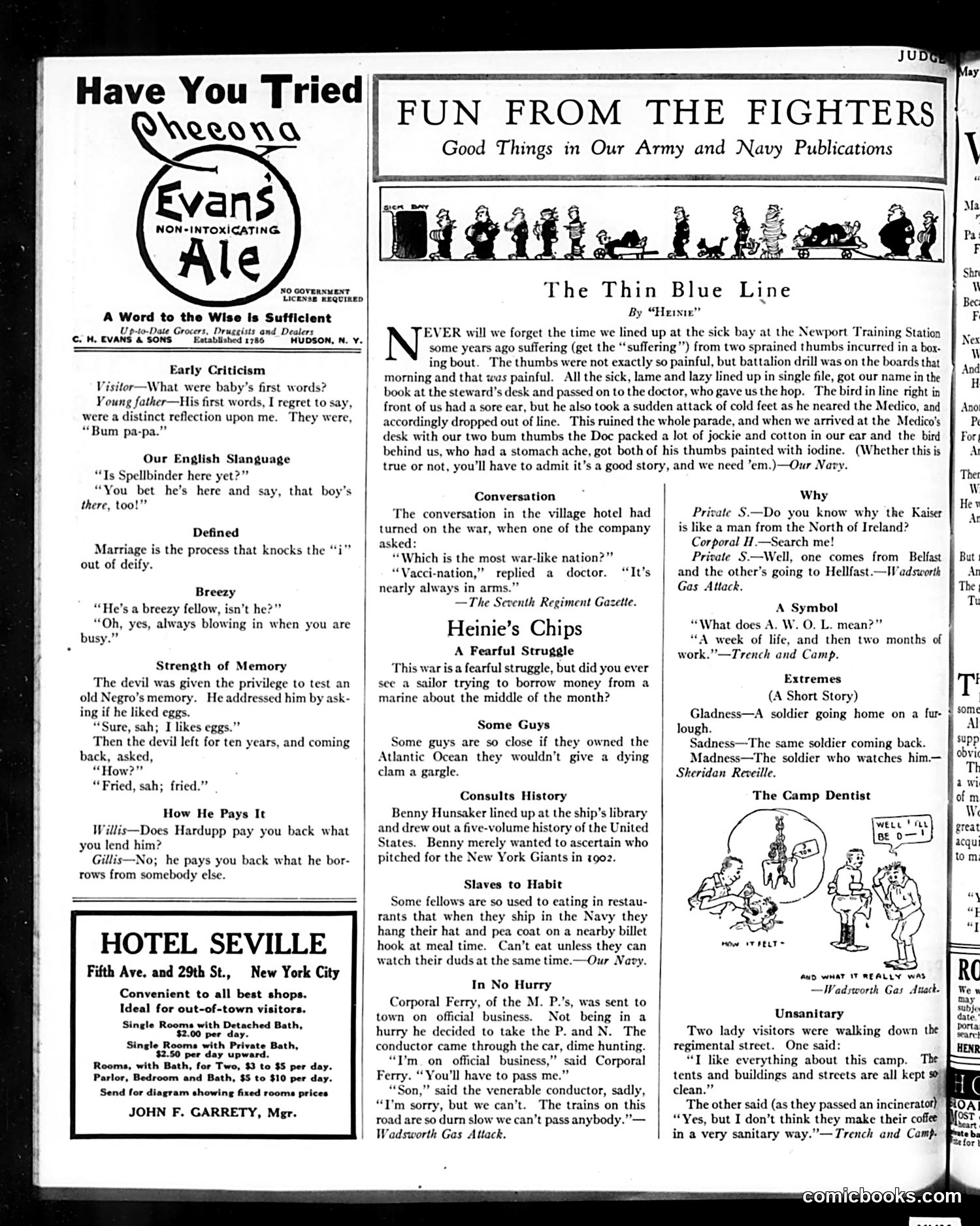
This page from Judge magazine contains **military humor and light satire** aimed at soldiers and sailors during what appears to be **World War I era** (references to "Heinie's Chips" and the Kaiser suggest this period). The "Fun from the Fighters" section republishes jokes from Army and Navy publications. Key content includes: - **"The Thin Blue Line"**: A humorous anecdote about soldiers at Newport Training Station gaming the sick bay system—soldiers with minor injuries (sprained thumbs, sore ear, stomach ache) line up for medical attention to avoid parade drill, but the scheme backfires comically. - **Military jokes**: Satirizing sailor stinginess ("Heinie's Chips"), soldiers' habits (eating in restaurants), and recruits' ignorance (confusing "vaccination" with "war-like nation"). The humor targets **military life's absurdities**—bureaucracy, malingering, and cultural clashes between Army and Navy personnel. The page also includes period advertising (Evans Ale, Hotel Seville) and unrelated civilian jokes about marriage and memory.
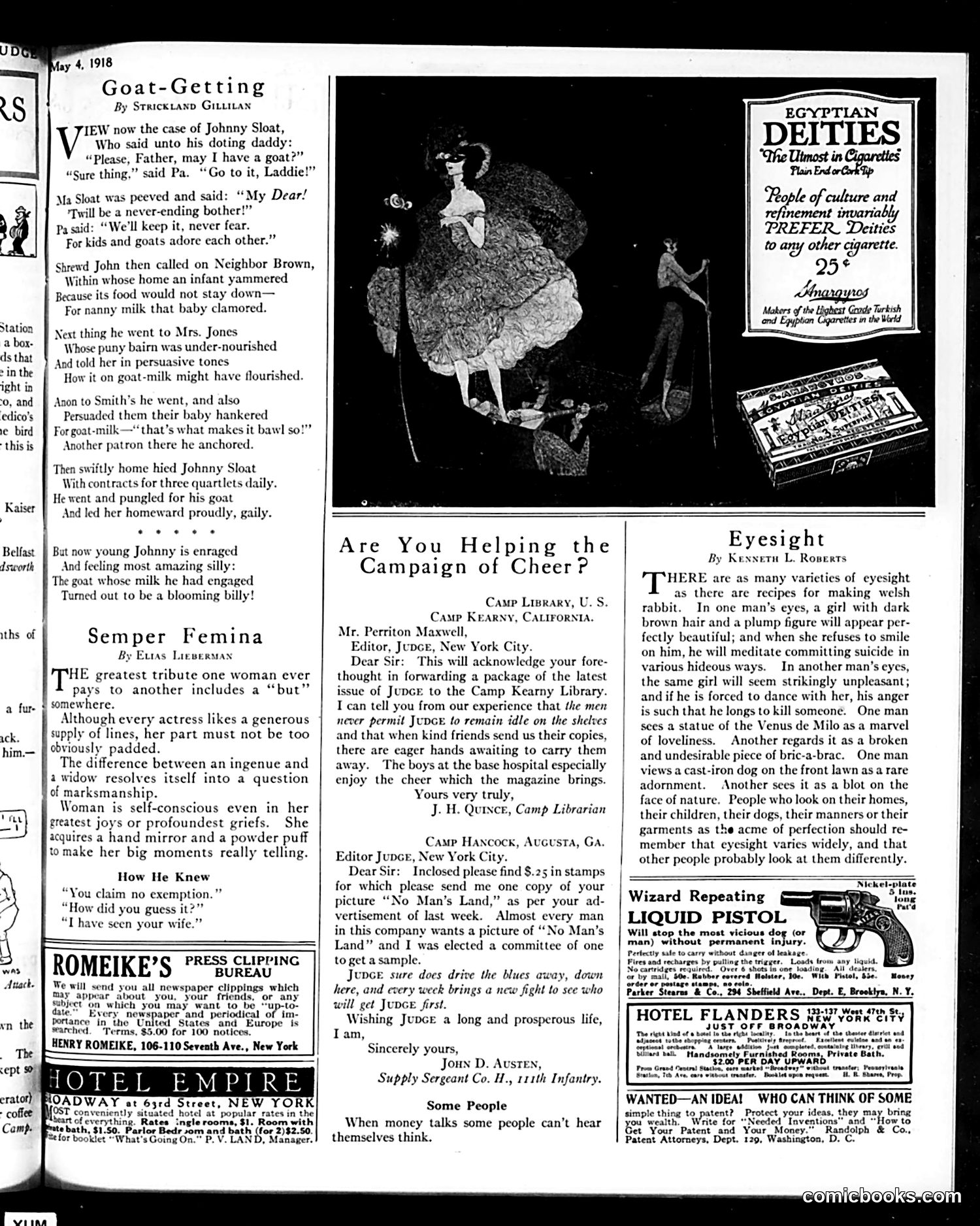
**Main Cartoon: "Goat-Getting" by Strickland Gillilan** This is a humorous poem about young Johnny Sloat who convinces his father to buy a goat. Johnny's real motive becomes clear: he shrewdly visits neighbors with sickly babies and persuades them that goat's milk would cure their ailments. He then returns home with contracts for three daily quarts of milk—a profitable scheme. The punchline: the goat he purchased is male ("a billy"), not a nanny, making the milk supply impossible. The joke satirizes both childhood entrepreneurship and the folk belief that goat's milk cured infant digestive problems—a common 19th-early 20th century remedy. It also mocks gullible neighbors easily swayed by a clever child's sales pitch. **Page Context**: The remainder consists primarily of advertisements, military camp correspondence praising Judge magazine, and advice columns—typical for wartime 1918 Judge issues, which promoted patriotic morale-boosting content for troops.
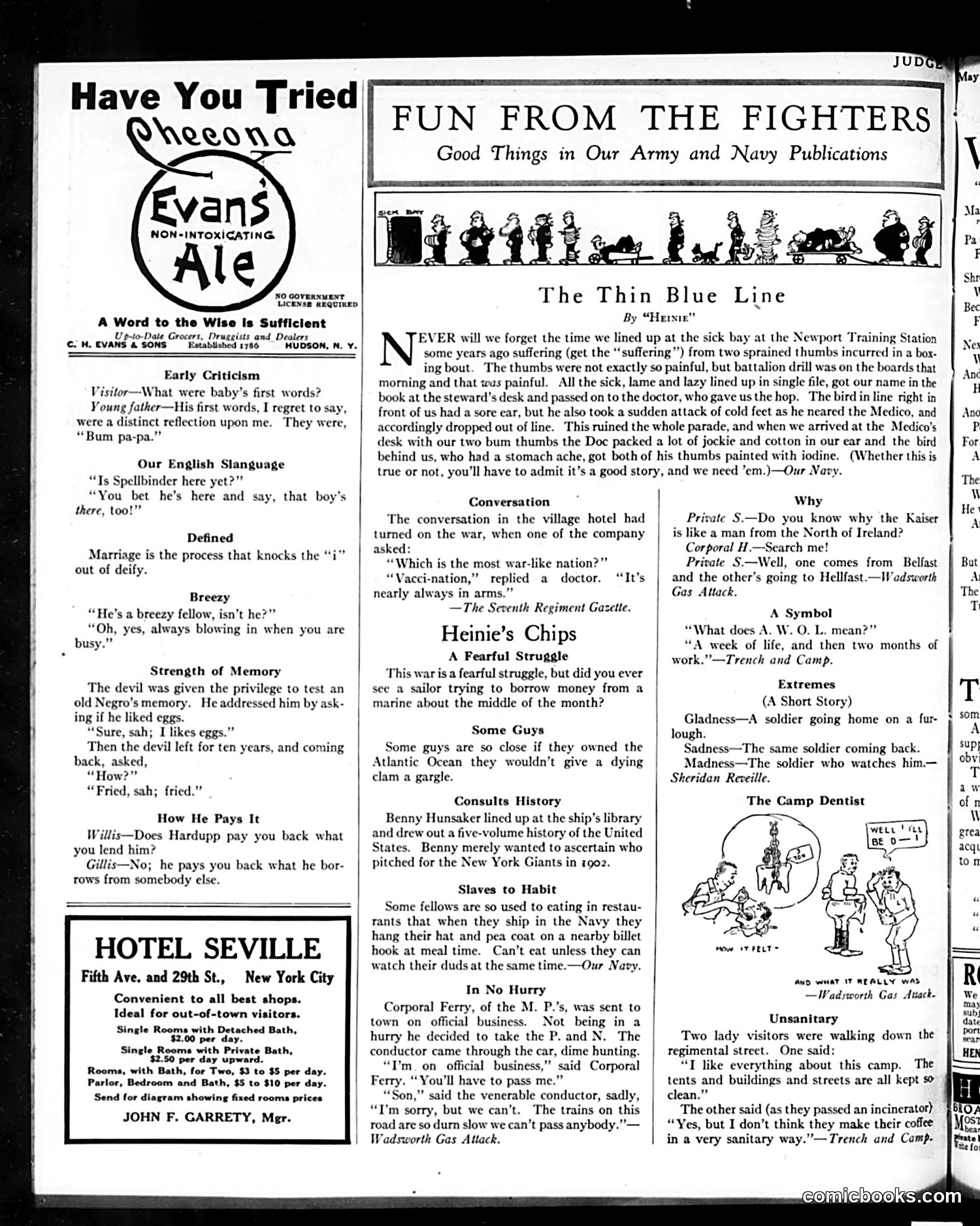
This page from *Judge* magazine contains military humor from World War I era, mixing advertisements with soldiers' anecdotes. The main content is "Fun from the Fighters"—comic stories supposedly from Army and Navy publications. **Key pieces:** - **"The Thin Blue Line"** describes a training station sick call where soldiers with minor ailments (sore ear, stomach ache) line up, but their complaints get comically misdiagnosed or crossed—the humor relies on military bureaucratic chaos and soldiers malingering. - **"Heinie's Chips"** uses "Heinie" (a derogatory WWI term for Germans) as a section title; jokes include sailors' poverty and close-fistedness. - **Military humor** throughout mocks soldier behavior: borrowing money, eating habits, avoiding drills. - The **side jokes** ("Early Criticism," "Our English Slanguage") are period wordplay with no political content. The page essentially presents soldiers' barracks humor, reflecting how *Judge* packaged military content for civilian audiences during wartime. The tone is affectionate mockery rather than satirical critique.
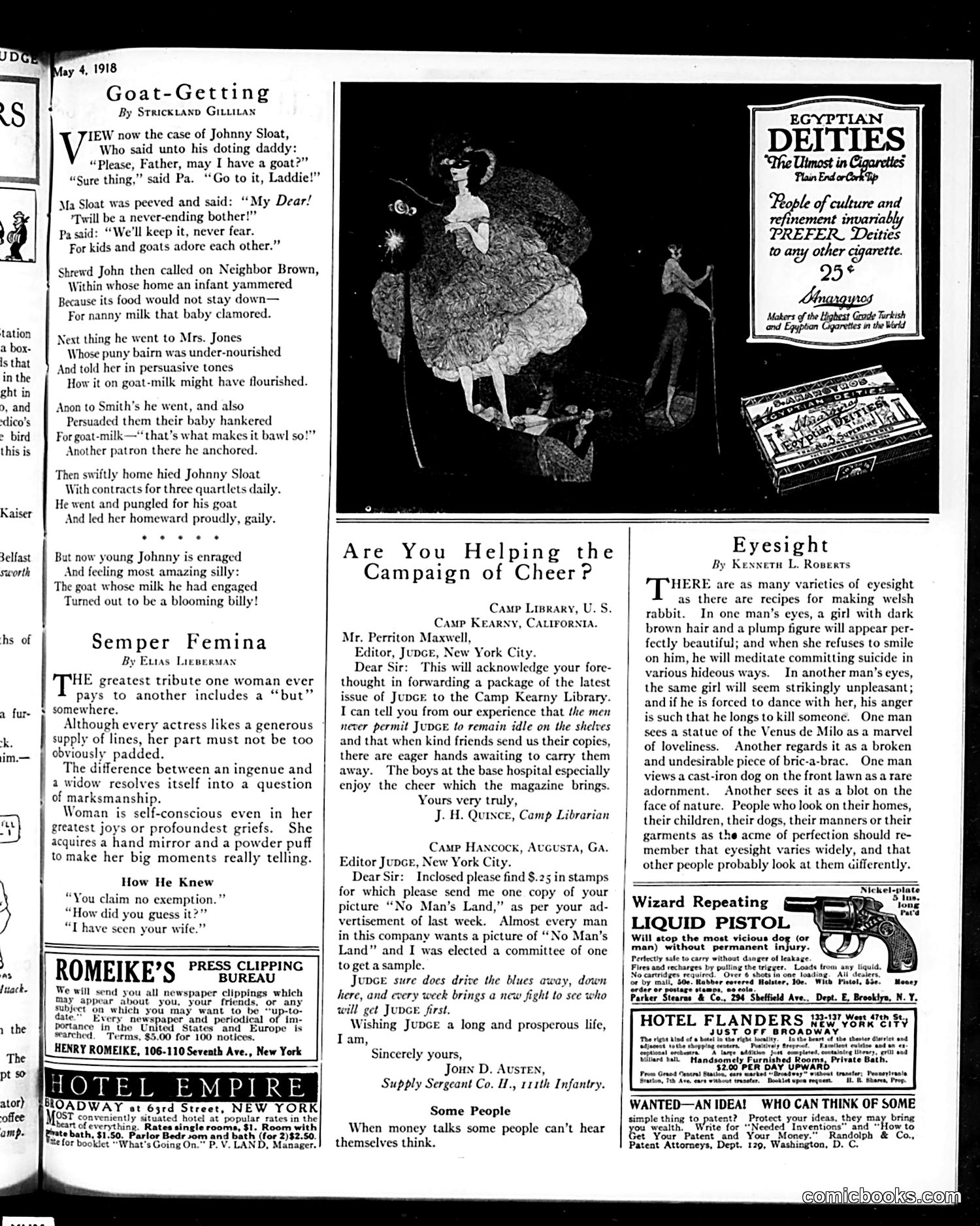
This comic narrative by Strickland Gillilan satirizes a boy's entrepreneurial naivety. Johnny Sloat persuades neighbors that their fussy babies need goat's milk for health, securing lucrative milk contracts. He purchases a goat and proudly brings it home—only to discover it's a male (a "billy"), not a milk-producing female (a "nanny"). The joke mocks both Johnny's overconfidence in his sales pitch and his failure to verify basic facts before investing. The satire likely resonates with wartime (May 1918) anxieties about hasty decisions and misrepresentation. The final line—"Turned out to be a blooming billy!"—delivers the punchline with mild vulgarity typical of Judge's era. The surrounding page contains patriotic appeals to send Judge magazines to troops at camps, contextualizing this lighter fare within WWI-era publication content.
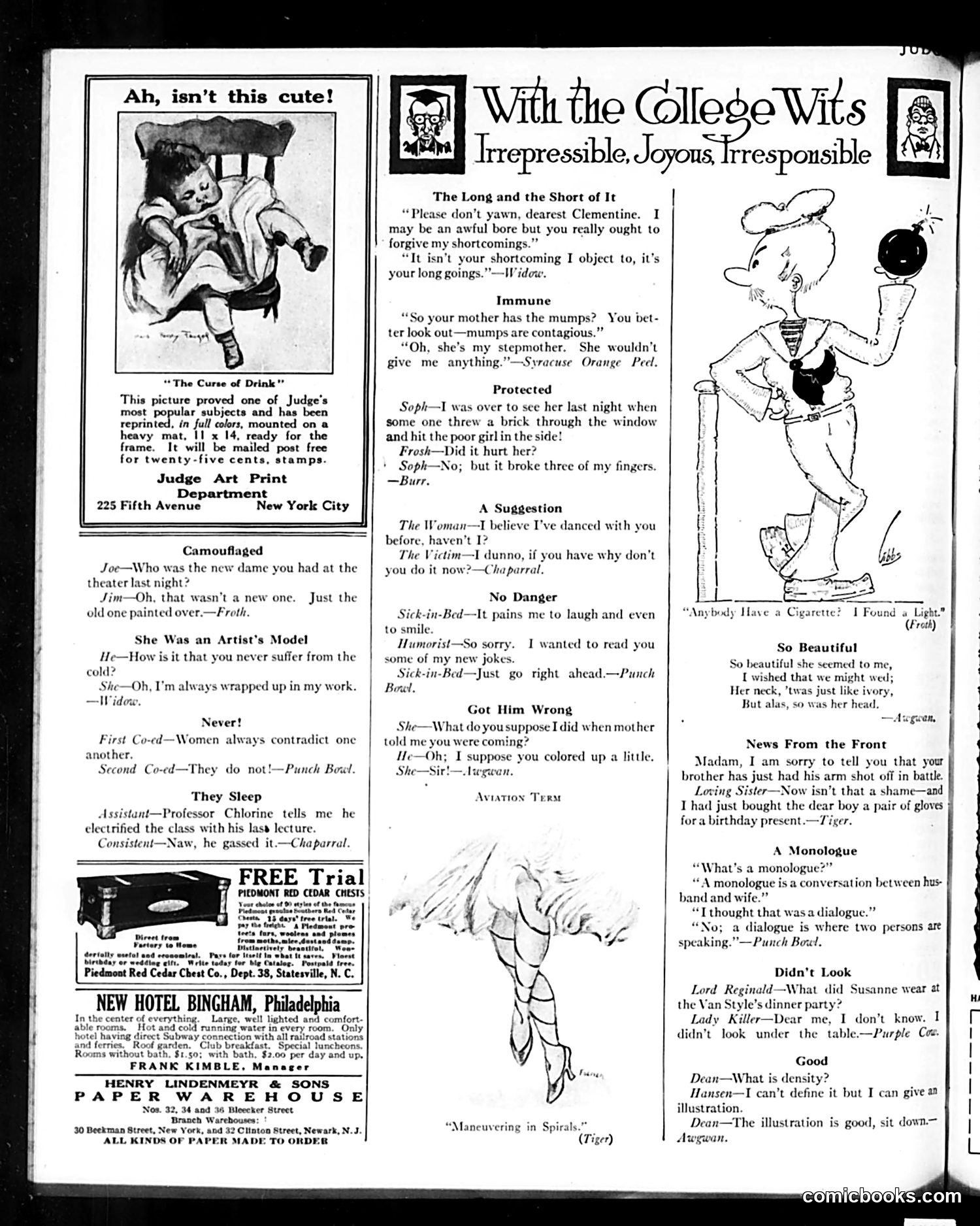
This page collects brief jokes and witty exchanges targeting college students and social situations of the early 20th century. The humor relies on wordplay and unexpected reversals: "The Curse of Drink" (left) advertises a popular satirical print showing a drunk man—likely critiquing alcohol's social damage, a concern of the era. The jokes mock conventional attitudes: women's contradictions, college romances, classroom pretension ("gassed" a lecture), and dating dynamics. Several target stepparents and family relations with dark humor ("She wouldn't give me anything"). The humor is notably sexist by modern standards—jokes about women's appearance ("her neck...like ivory, / But alas, so was her head") and the "Lord Killer" joke implying impropriety under tablecloths. Overall, this represents Judge's satirical approach: punching at social hypocrisy, romantic folly, and academic pomposity through rapid-fire quips rather than sustained commentary. The advertising surrounding the content reflects Judge's business model.
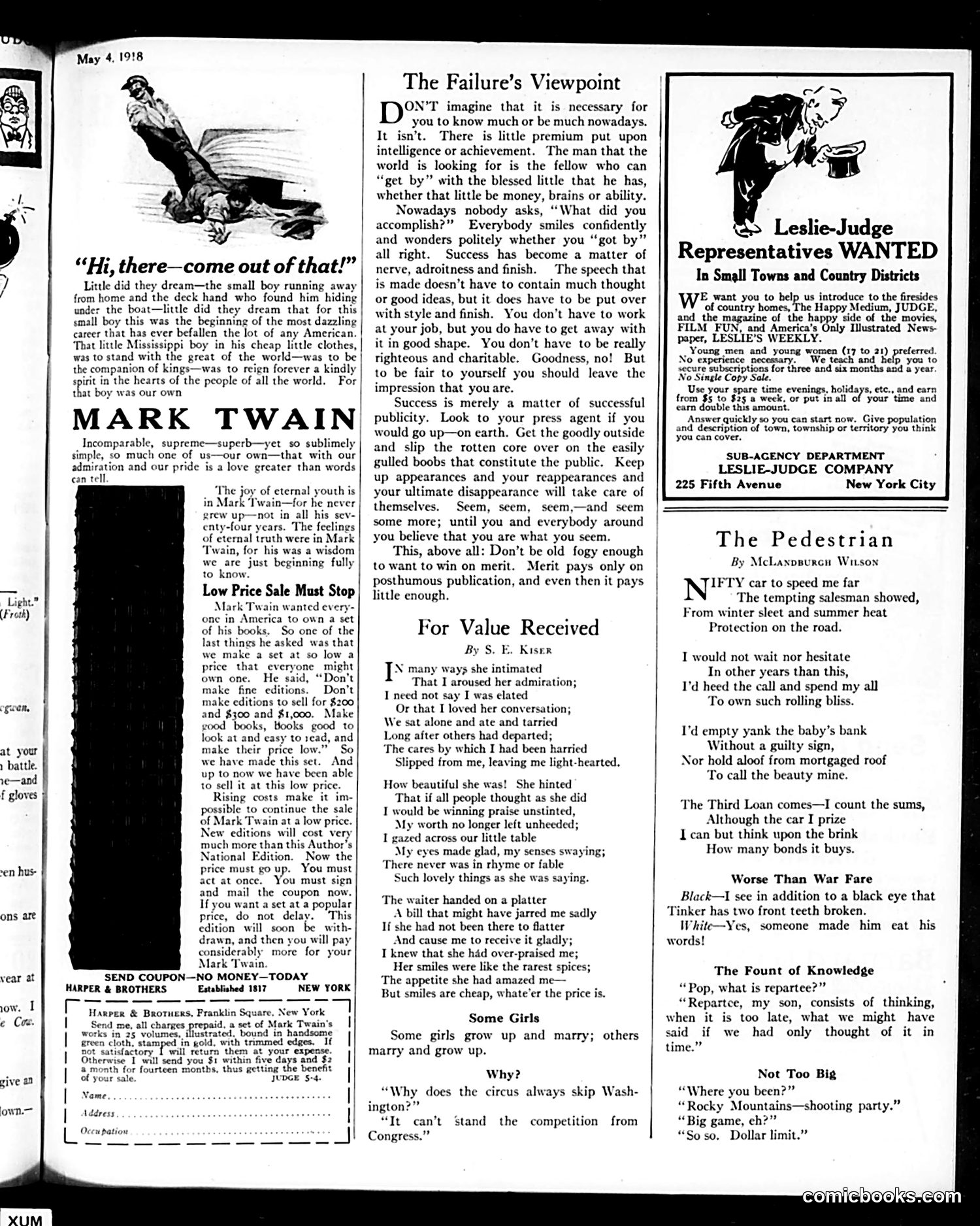
This page contains a sardonic editorial attacking early-20th-century American culture's obsession with appearance over substance. The piece argues that success no longer requires intelligence or genuine achievement—only the ability to "get by" through nerve, style, and effective publicity. The satire targets what the author sees as moral decay: people needn't be truly righteous, just appear so; speeches need not contain real thought if delivered convincingly; workers need only look productive, not be so. The core critique is that a "press agent" and good "appearances" matter more than actual merit. This reflects post-WWI anxieties about modern consumer culture, advertising's growing power, and perceived American superficiality. The accompanying Mark Twain tribute on the same page—celebrating his authenticity and timeless wisdom—implicitly contrasts genuine American character with this shallow, publicity-driven present.
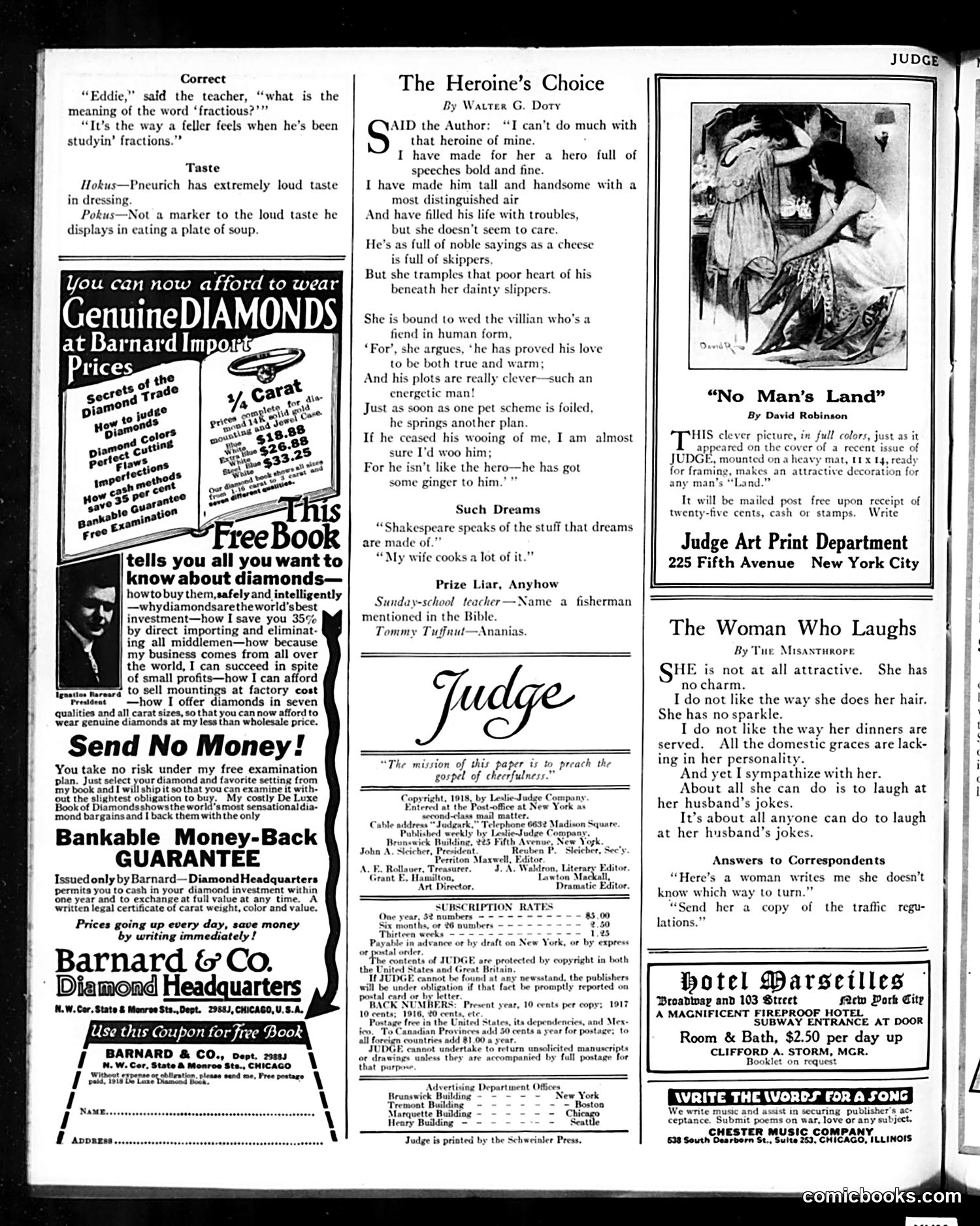
This page contains **"The Heroine's Choice,"** a humorous poem by Walter G. Doty satirizing romantic fiction tropes. The author-character complains that his heroine rejects the noble, heroic hero despite his fine speeches and good looks, preferring instead the villainous man because he shows actual passion and constantly devises new schemes. The satire critiques overstuffed romantic conventions—the predictable "handsome hero with distinguished air" versus the dramatically flawed but energetic antagonist. The heroine's pragmatic preference for cunning action over hollow nobility inverts reader expectations. The page also includes brief humor pieces ("Prize Liar" mocking Bible knowledge, "Taste" poking fun at loud manners) alongside advertisements for diamonds, a hotel, and print services. The advertisements suggest *Judge's* 1918 readership was moderately affluent.
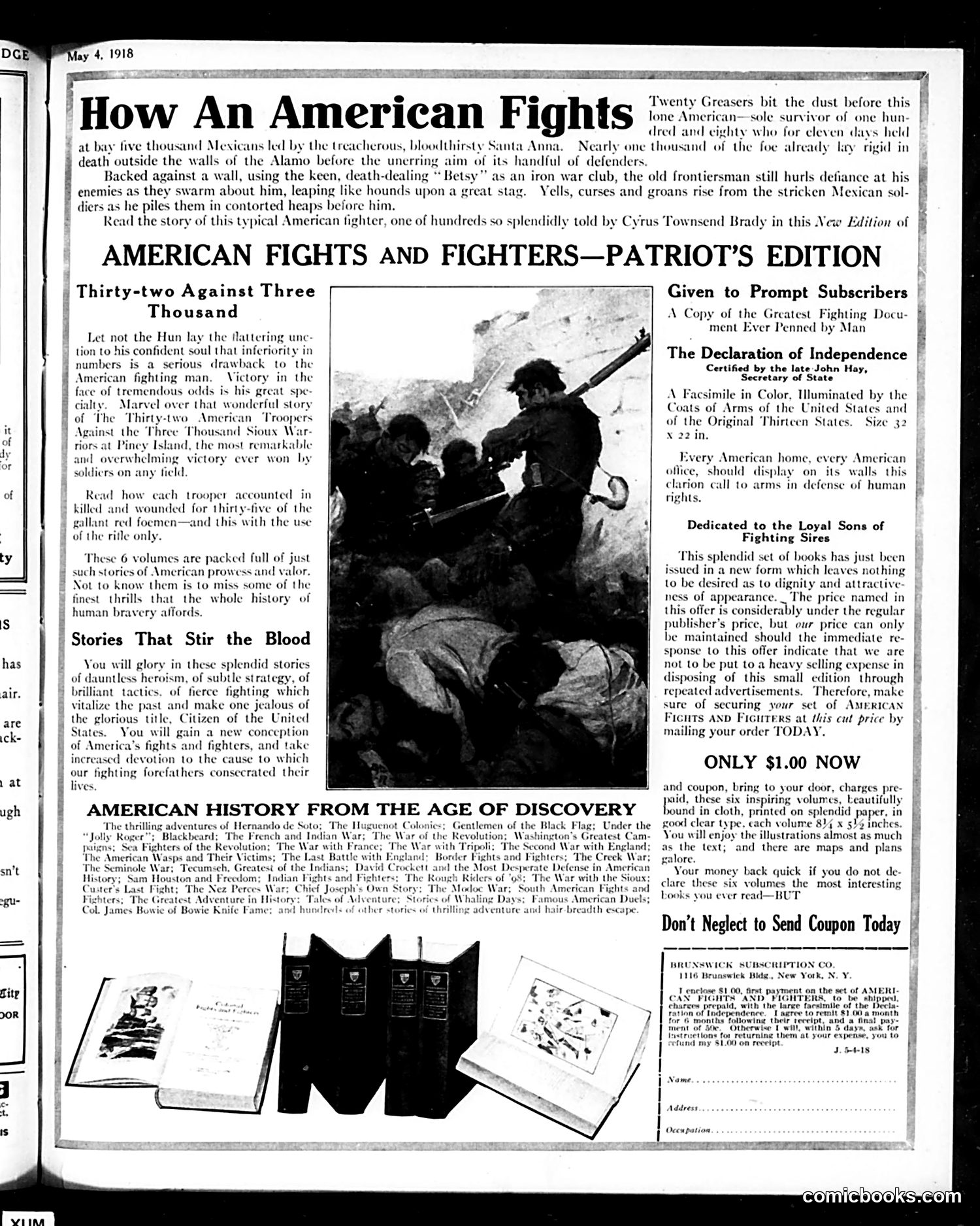
This is primarily an advertisement for a book series titled "American Fights and Fighters—Patriot's Edition," published during World War I. The page uses patriotic framing to sell six volumes of American military history. The central image depicts a frontier fighter (likely referencing the Alamo) defending against overwhelming odds—a visual metaphor. The text emphasizes Americans' supposed superiority in combat despite numerical disadvantage, citing examples like "Thirty-two Against Three Thousand" soldiers defeating Sioux warriors. The propaganda purpose is clear: in 1918, with America engaged in WWI, Judge presents these historical narratives as proof of American fighting prowess and invincibility. The accompanying offer of a facsimile Declaration of Independence reinforces nationalist messaging, framing the book purchase as a patriotic duty for "every American home." The racial language ("Greasers," "Huns," indigenous peoples) reflects period attitudes. The advertisement exploits wartime fervor to market nostalgia for frontier mythology as inspiration for current soldiers.
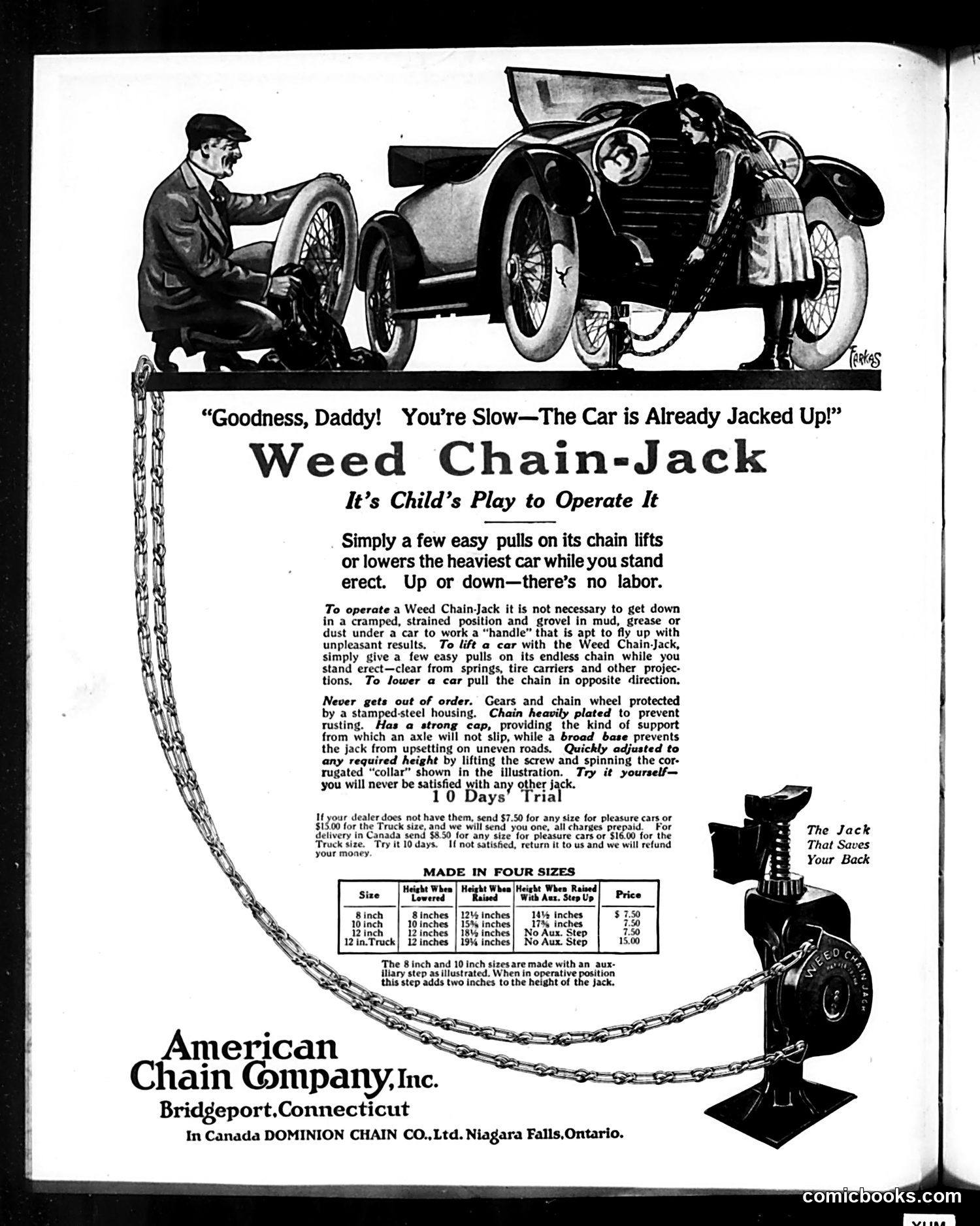
This is primarily a **product advertisement**, not political satire. The "cartoon" is a humorous illustration promoting the Weed Chain-Jack, a mechanical lifting device for automobiles. **The Setup:** A man labors to change a car tire using an old jack while his impatient child mocks him: "Goodness, Daddy! You're Slow—The Car is Already Jacked Up!" **The Point:** The ad humorously contrasts the *hard work* of traditional jacking methods (requiring a man to crouch in mud and grease) with the *ease* of the Weed Chain-Jack (operated standing upright by simple chain pulls—so easy "a child's play to operate it"). **Historical Context:** In the early automobile era, jacking a car was genuinely arduous and uncomfortable labor. This ad targets 1920s-30s car owners by promising to eliminate backbreaking work. The child's impatience satirizes male pride—suggesting even kids find the old method embarrassingly slow. No political figures or events are referenced. It's straightforward commercial messaging using humor and a relatable family scenario.