
Judge, 1918-05-04 · page 16 of 38
Judge — May 4, 1918 — page 16: what you’re looking at
What you’re looking at
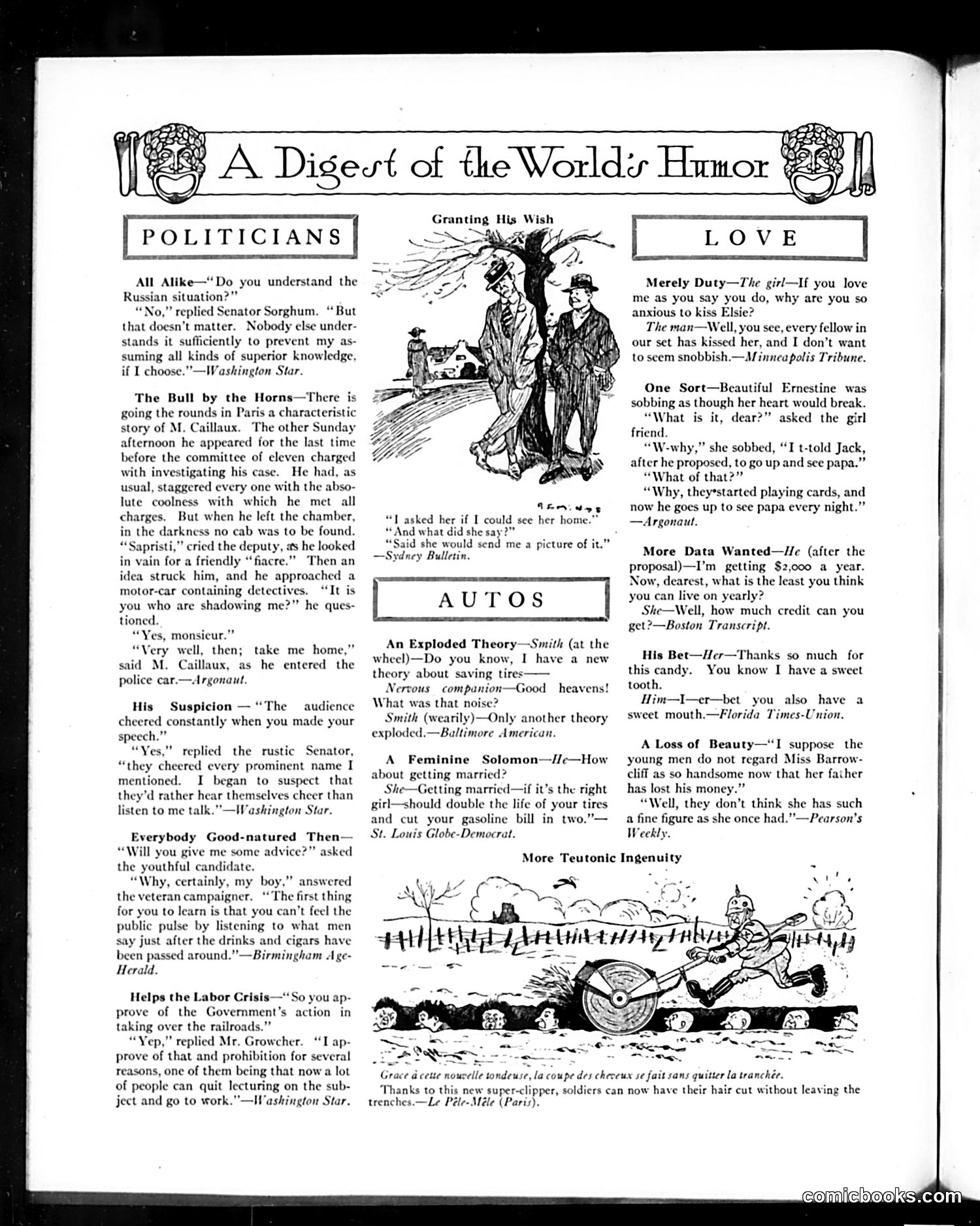
This is a humor digest page from *Judge* magazine featuring satirical jokes about politicians, automobiles, and romance circa 1914-1918 (based on references to tire-saving, labor crises, and government railroad takeover). **Key content:** **Politicians section**: Mockery of senators' pretentious ignorance (Senator Sorghum claiming expertise on Russia he doesn't understand); anecdote about French politician Caillaux's audacity in asking his police shadows for a ride home. **Autos section**: Early car humor—theories about tire-saving that "explode," and a woman's practical observation that marriage should "cut your gasoline bill in two." **Love section**: Period dating humor—a man kisses his girlfriend's rival to avoid seeming "snobbish"; a woman's practical question after a proposal: "how much credit can you get?" (implying she'll overspend). **Bottom cartoon**: A soldier getting a haircut in the WWI trenches using a novel clipper device—satirizing German military "ingenuity" for practical battlefield solutions. The humor reflects pre-WWI social attitudes: gender stereotypes, class anxiety, and early automobile culture.
📄 Transcribed text from this page (OCR, searchable)
Machine-transcribed from the original scan — historical spelling and the odd misread are preserved.
POLITICIANS | All Alike—“Do you understand the Russian situation Senator Sorghum. “But unde: ently to prevent my suming all kinds of superior knowledge, if I choose.”"—Washington Star. The Bull by the Horns—There is going the rounds in Paris a characteristic story of M. Caillaux. The other Sunday afternoon he appeared for the last time before the committee of eleven charged with investigating his case. He had, as usual, staggered every one with the abso- lute coolness with which he met all charges. But when he left the chamber, in the darkness no cab was to be found. “Sapristi,” cried the deputy, as he looked in n for a friendly “fiacre.””. Then an idea struck him, and he approached a motor-car containing detectives. ‘It is you who are shadowing me?” he ques- tioned. monsicur.”” ery well, then; take me home,” said M. laux, as he entered the police car.—Argonaut. His Suspicion — “The audience cheered constantly when you made your speech.” “Yes,” replied the rustic Senator, cheered every prominent name I mentioned. I began to suspect that they’d rather hear themselves cheer than listen to me talk." —Washington Star. Everybody Good-natured Then— “Will you give me some advice?” asked the youthful candidate. “Why, certainly, my boy,” answered the veteran campaigner. ‘The first thing for you to learn is that you can’t feel the public pulse by listening to what men say just after the drinks and cigars have been passed around.”—Birmingham Age- Herald. Helps the Labor Crisis— prove of the Government's taking over the railroad “Yep,” replied Mr. Growcher. “TI ap- prove of that and prohibition for several reasons, one of them being that now a lot of people can quit lecturing on the sub- ject and go to work.” —IWashington Star. 0 you ap- action in “I asked her if I could see her home.” “And what did she say?” “Said she would send me a picture of it.” —Sydney Bulletin. An Exploded Theory—Smith (at the wheel)—Do you know, I have a new theory about saving tires—— Nervous companion—Good What was that noise? Smith (wearily)—Only another theory exploded.—Baltimore American. heavens! A Feminine Solomon—He—How about getting married? She—Getting marricd—if it’s the right girl—should double the life of your tires and cut your gasoline bill in two.”— St. Louis Globe-Democrat. Merely Duty—The girl—If you love me as you say you do, why are you so anxious to kiss Elsie? The man—Well, you see, every fellow in our set has kissed her, and I don’t want to seem snobbish.—M innea polis Tribune. One Sort—Beautiful Ernestine was sobbing as though her heart would break. “What is it, dear?” asked the girl friend “W-why,” she sobbed, “TI t-told Jack, after he proposed, to go up and see papa.” “What of that?” “Why, they*started playing cards, and now he goes up to see papa every night.” —Argonaut. More Data Wanted—/e (after the proposal)—I’m getting $2,000 a year. Now, dearest, what is the least you think you can live on yearly? She—Well, how much credit can you get?—Boston Transcript. His Bet—Her—Thanks so much for this candy. You know I have a sweet tooth. Him—I—er—bet you also have a sweet mouth.—Florida Times-Union. A Loss of Beauty—“I suppose the young men do not regard Miss Barrow- cliff as so handsome now that her father has lost his money.” “Well, they don’t think she has such a fine figure as she once had.”"—Pearson’s Weekly. More Teutonic Ingenuity Grace a cette nouvelle tonde: we la coupe des cheveux se fait sans quitter la tranchée. ‘Thanks to this new super-clipper, soldiers can now have their hair cut without leaving the trenches.—Le Péle-Méle (Paris).