
Judge, 1918-05-04 · page 35 of 38
Judge — May 4, 1918 — page 35: what you’re looking at
What you’re looking at
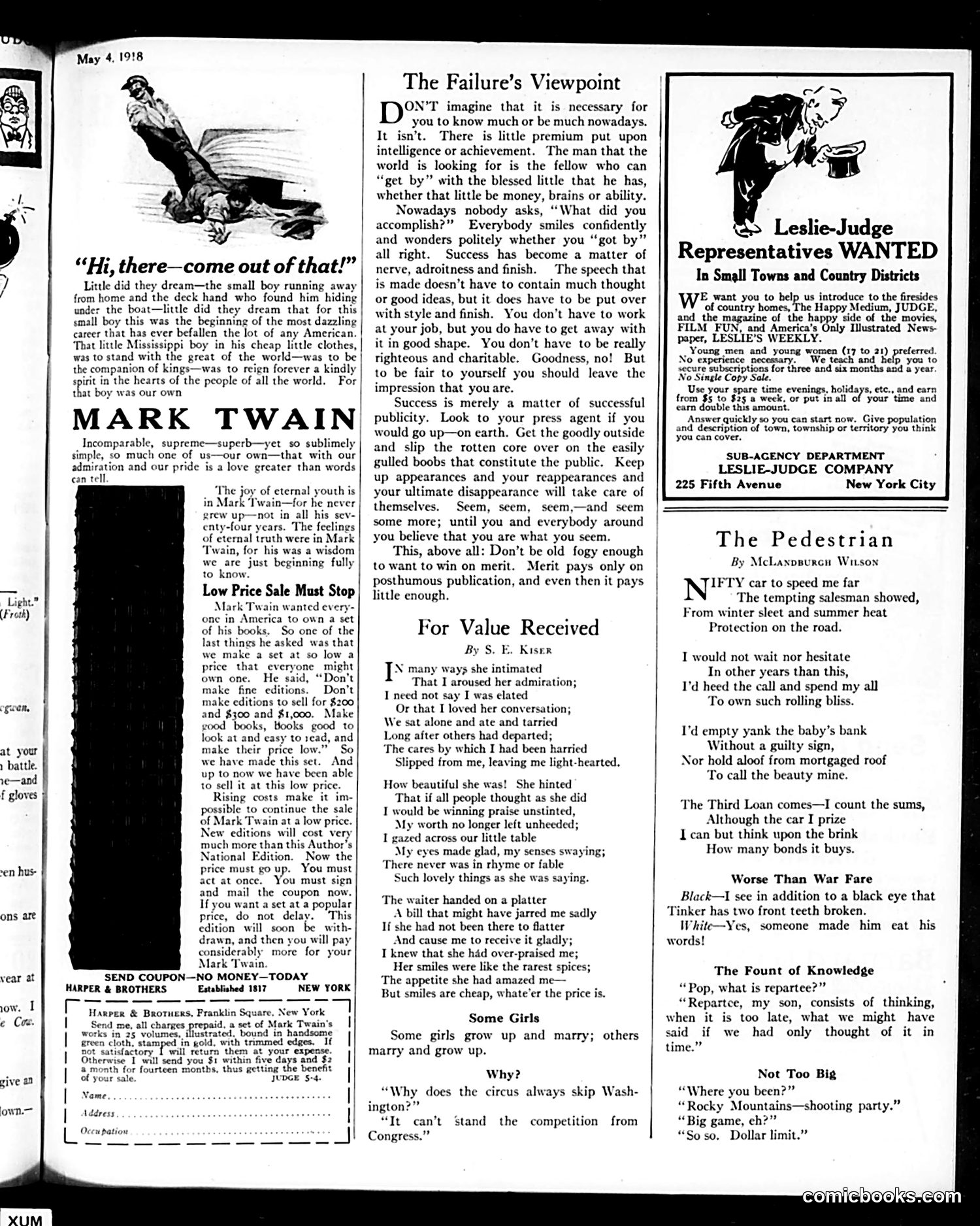
This page contains a sardonic editorial attacking early-20th-century American culture's obsession with appearance over substance. The piece argues that success no longer requires intelligence or genuine achievement—only the ability to "get by" through nerve, style, and effective publicity. The satire targets what the author sees as moral decay: people needn't be truly righteous, just appear so; speeches need not contain real thought if delivered convincingly; workers need only look productive, not be so. The core critique is that a "press agent" and good "appearances" matter more than actual merit. This reflects post-WWI anxieties about modern consumer culture, advertising's growing power, and perceived American superficiality. The accompanying Mark Twain tribute on the same page—celebrating his authenticity and timeless wisdom—implicitly contrasts genuine American character with this shallow, publicity-driven present.
📄 Transcribed text from this page (OCR, searchable)
Machine-transcribed from the original scan — historical spelling and the odd misread are preserved.
se "Light (Froth) at your | 1 battle. | re—and f gloves 7 ven hus ons are vear at ow. I e Cos. give 22 lown.— 4 99 “Hi, there—come out of that! Little did they dream—the small boy running away from home and the deck hand who found him hiding under the boat—little did they dream that for this small boy this was the beginning of the most dazzling career that has ever befallen the lot of any American. ‘That little Mississippi boy in his cheap little clothes, was to stand with the great of the world—was to be the companion of kings—was to reign forever a kindly spirit in the hearts of the people of all the world. For that boy was our own MARK TWAIN Incomparable, supreme—superb—yet so sublimely simple, so much one of us—our own—that with our admiration and our pride is a love greater than words can tell ‘The joy of eternal youth is in Mark Twain—for he never | grew up—not in all his sev- enty-four years. The feelings of eternal truth were in Mark Twain, for his was a wisdom we are just beginning fully to know. Low Price Sale Must Stop Mark Twain wanted every- one in America to own a set of his books, So one of the last things he asked was that we make a set at so lo’ price that everyone m own one. He said, “Don't make fine editions. Don’t make editions to sell for $200 and $300 and $1,000. Make zood books, Books good to look at and easy to 1¢ad, and make their price low.” So we have made this set. And up to now we have been able to sell it at this low price Rising costs make it im possible to continue the sale of Mark Twain at a low price. New editions will cost very much more than this Author's National Edition. Now the price must go up. You must act at once. You must sign and mail the coupon now. If you want a set at a popular price, do not delay. This edition will soon be with- drawn, and then you will pay considerably more for your Mark Twain. SEND COUPON—NO MONEY—TODAY HARPER & BROTHERS — Established 1817 NEW YORK peiersloeeaiasieaieg ster teatenr teeters | Harper & Brotuens, Franklin S me, all changes prepaid. a set of Mark Twain's 3 in 25 volumes, illustrated, bound in handsome | green cloth’ stamped in gold, with trimmed edges. not satisfactory f will return them at | Otherwise I will send you $1 within five d | pre mth for fourteen months, thus getting JUpe! Name eas sa eveinile dy \ddress The Failure’s Viewpoint ON’T imagine that it is necessary for you to know much or be much nowadays. It isn’t. There is little premium put upon intelligence or achievement. The man that the world is looking for is the fellow who can “get by” with the blessed little that he has, whether that little be money, brains or ability. Nowadays nobody asks, “What did you accomplish?” Everybody smiles confidently and wonders politely whether you “got by” all right. Success has become a matter of nerve, adroitness and finish. The speech that is made doesn’t have to contain much thought or good ideas, but it does have to be put over with style and finish. You don’t have to work at your job, but you do have to get away with it in good shape. You don’t have to be really righteous and charitable. Goodness, no! But to be fair to yourself you should leave the impression that you are. Success is merely a matter of successful publicity. Look to your press agent if you would go up—on earth. Get the goodly outside and slip the rotten core over on the easily gulled boobs that constitute the public. Keep up appearances and your reappearances and your ultimate disappearance will take care of Leslie-Judge Representatives WANTED In Small Towns and Country Districts We. want you to help us introduce to the firesides of country homes, The Happy Medium, JUDGE, and the magazine of the happy side of the movies, FILM FUN, and America's Only Illustrated News- paper, LESLIE’S WEEKLY. Young men and young women (17 to 21) preferred. No experience necessary. We teach and h sure subscriptions for three No Single Copy Sale. Use your spare time evenings, holidays, etc., and earn from $5 to $25 a week, or put inall of your ‘time and earn double this amount. Answer quickly so you can start now. Give population and description of town, township or territory you think you can cover. SUB-ACENCY DEPARTMENT LESLIE-JUDGE COMPANY 225 Fifth Avenue New York City themselves. Seem, seem, seem,—and seem some more; until you and everybody around you believe that you are what you seem. This, above all: Don’t be old fogy enough to want to win on merit. Merit pays only on posthumous publication, and even then it pays litle enough. For Value Received By S. E. Kiser N many ways she intimated That I aroused her admiration; I need not say I was elated Or that I loved her conversation; We sat alone and ate and tarried Long after others had departed; The cares by which I had been harried Slipped from me, leaving me light-hearted. How beautiful she was! She hinted That if all people thought as she did I would be winning praise unstinted, My worth no longer left unheeded; I gazed across our little table My eyes made glad, my senses swaying; There never was in rhyme or fable Such lovely things as she was saying. The waiter handed on a platter A bill that might have jarred me sadly If she had not been there to flatter And cause me to receive it gladly; I knew that she had over-praised me; Her smiles were like the rarest spices; The appetite she had amazed me— But smiles are cheap, whate’er the price is. Some Girls Some girls grow up and marry; others marry and grow up. Why? “Why does the circus always ington?” “It can’t Congress.” kip Wash- Stand the competition from The Pedestrian By McLaxpsurcu Witson IFTY car to speed me far The tempting salesman showed, From winter sleet and summer heat Protection on the road. I would not wait nor hesitate In other years than this, I'd heed the call and spend my all To own such rolling bliss. I'd empty yank the baby’s bank Without a guilty sign, Nor hold aloof from mortgaged roof To call the beauty mine. The Third Loan comes—I count the sums, Although the car I prize I can but think upon the brink How many bonds it buys. Worse Than War Fare Black—I see in addition to a black eye that Tinker has two front teeth broken. White—Yes, someone made him eat his words! The Fount of Knowledge “Pop, what is repartee?” “Repartce, my son, consists of thinking, when it is too late, what we might have said if we had only thought of it in time.” Not Too Big “Where you been?” “Rocky Mountains—shooting party.” “Big game, eh?” “So so. Dollar limit.”