
Judge, 1918-05-04 · page 14 of 38
Judge — May 4, 1918 — page 14: what you’re looking at
What you’re looking at
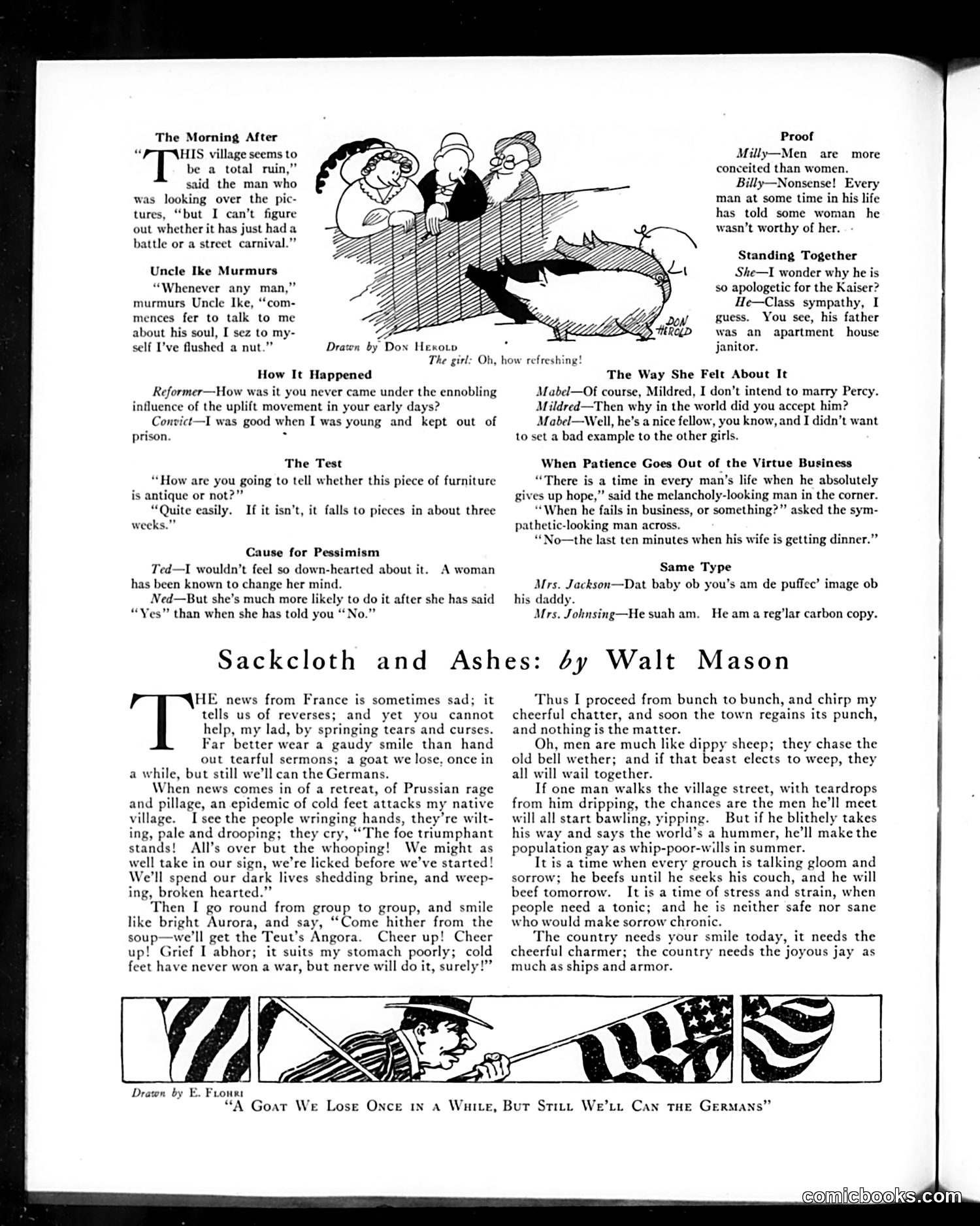
This page contains various short humorous pieces and one substantial essay, all reflecting World War I-era American attitudes. The cartoon at top (by Dox Herold) shows three figures on a damaged building, with the caption "The girl: Oh, how refreshing!" The humor appears to reference war damage—likely European village destruction from the war. The essay "Sackcloth and Ashes" by Walt Mason addresses French military retreats and Prussian advances. Mason argues against defeatist despair, urging villagers to maintain morale and cheerfulness rather than spread pessimism ("men are much like dippy sheep"). The message: civilian morale matters; optimism is patriotic duty during wartime. The smaller comedic pieces focus on domestic life—marriage, courtship, class commentary (the Kaiser apologist's father is a janitor). They're largely apolitical. The bottom illustration (by E. Florse) shows American flags, likely patriotic imagery supporting the pro-morale message. Overall, this page advocates emotional fortitude and public optimism as home-front contributions to the war effort.
📄 Transcribed text from this page (OCR, searchable)
Machine-transcribed from the original scan — historical spelling and the odd misread are preserved.
The Morning After « HIS village seems to | a total ruin,” id the man who was looking over the pic- tures, “but I can’t figure out whether it has just had a battle or a street carnival.” \ : Uncle Ike Murmurs “Whenever any man,” murmurs Uncle Ike, ‘‘com- mences fer to talk to me about his soul, I sez to my- self I've flushed a nut.”” NU Z ZZ \\S Draten by Dox Hexorn Proof Milly—Men are more conceited than women. Billy—Nonsense! Every man at some time in his life has told some woman he wasn’t worthy of her. Standing Together She—I wonder why he is so apologetic for the Kaiser? He—Class sympathy, I guess. You see, his father was an apartment house janitor. The girl: Oh, how refreshing! How It Happened Reformer—How it you never came under the ennobling influence of the uplift movement in your early days? Convict—I was good when I was young and kept out of prison. z The Test “How are you going to tell whether this piece of furniture is antique or not?” “Quite easily. weeks.” If it isn’t, it falls to pieces in about three Cause for Pessimism Ted—I wouldn’t feel so down-hearted about it. has been known to change her mind. Ned—But she’s much more likely to do it after she has said “Yes” than when she has told you “No.” A woman The Way She Felt About It Mabel—Of course, Mildred, I don’t intend to marry Percy. Mildred—Then why in the world did you accept him? Mabel—Well, he’s a nice fellow, you know, and I didn’t want to set a bad example to the other girls. When Patience Goes Out of the Virtue Business “There is a time in every man’s life when he absolutely gives up hope,” said the melancholy-looking man in the corner. When he fails in business, or something?” asked the sym- pathetic-looking man across. “No—the last ten minutes when his wife is getting dinner.” Same Type Mrs. Jackson—Dat baby ob you’s am de puffec’ image ob his daddy. Mrs. Johnsing—He suah am. He am a reg’lar carbon copy. Sackcloth and Ashes: 6y Walt Mason HE news from France is sometimes sad; it tells us of reverses; and yet you cannot help, my lad, by springing tears and curses. Far better wear a gaudy smile than hand out tearful sermons; a goat we lose, once in a while, but still we'll can the Germans. When news comes in of a retreat, of Prussian rage and pillage, an epidemic of cold feet attacks my native village. Isee the people wringing hands, they’re wilt- ing, pale and drooping; they cry, “The foe triumphant stands! All’s over but the whooping! We might as well take in our sign, we're licked before we've started! We'll spend our dark lives shedding brine, and weep- ing, broken hearted.” Then I go round from group to group, and smile like bright Aurora, and say, “Come hither from the soup—we'll get the Teut’s Angora. Cheer up! Cheer up! Grief I abhor; it suits my stomach poorly; cold feet have never won a war, but nerve will do it, surely! Draton by E. Frone Thus I proceed from bunch to bunch, and chirp my cheerful chatter, and soon the town regains its punch, and nothing is the matter. Oh, men are much like dippy sheep; they chase the old bell wether; and if that beast elects to weep, they all will wail together. If one man walks the village street, with teardrops from him dripping, the chances are the men he’ll meet will all start bawling, yipping. But if he blithely takes his way and says the world’s a hummer, he’ll make the population gay as whip-poor-wills in summer. It is a time when every grouch is talking gloom and sorrow; he beefs until he seeks his couch, and he will beef tomorrow. It is a time of stress and strain, when people need a tonic; and he is neither safe nor sane who would make sorrow chronic. The country needs your smile today, it needs the cheerful charmer; the country needs the joyous jay as much as ships and armor. “A Goat We Lose Once in a Waite, Bur Stitt We’tt Can tHe Germans”