
Judge, 1918-05-04 · page 23 of 38
Judge — May 4, 1918 — page 23: what you’re looking at
What you’re looking at
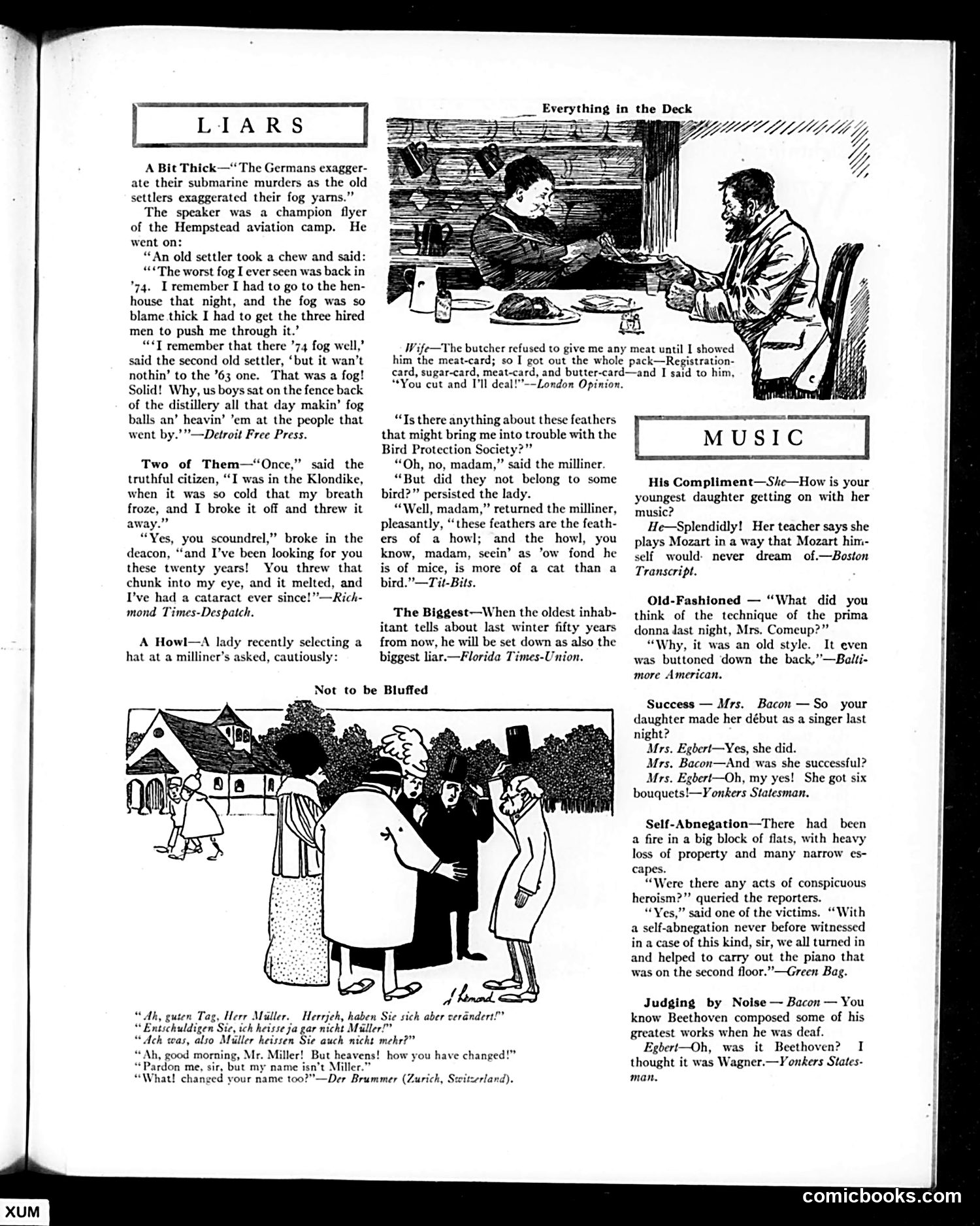
This page from Judge magazine contains multiple short humorous anecdotes satirizing exaggeration and dishonesty. The main cartoon ("Not to be Bluffed") depicts a German man confronting someone about changing his name, illustrated with German dialogue. The surrounding text pieces mock various forms of lying: settlers exaggerating tall tales about fog; someone claiming frozen breath caused another's cataract decades later; a milliner calling owl feathers "howl" to avoid bird protection laws; and a woman using her ration cards as poker chips with her butcher. The "Wife" cartoon references World War I-era British rationing (meat-cards, sugar-cards, butter-cards), using card-dealing slang to joke about food scarcity. The page satirizes petty dishonesty across social classes—from rural yarn-spinners to wartime profiteers to those evading regulations. The humor assumes readers recognize common excuses and loopholes people exploit. The overall message: everyone lies, from working-class to middle-class citizens, in trivial and serious ways alike.
📄 Transcribed text from this page (OCR, searchable)
Machine-transcribed from the original scan — historical spelling and the odd misread are preserved.
| LIARS | A Bit Thick—“ The Germans exagger- ate their submarine murders as the old settlers exaggerated their fog yarns.” The speaker was a champion flyer of the Hempstead aviation camp. He went on: “An old settler took a chew and said: “The worst fog I ever seen was back in ’74. I remember I had to go to the hen- house that night, and the fog was so blame thick I had to get the three hired men to push me through it.’ ““T remember that there fog well,’ said the second old settler, ‘but it wan’t nothin’ to the ’63 one. That was a fog! Solid! Why, us boys sat on the fence back of the distillery all that day makin’ fog balls an’ heavin’ ’em at the people that went by.’”—Detroit Free Press. Two of Them—“Once,” said the truthful citizen, “I was in the Klondike, when it was so cold that my breath froze, and I broke it off and threw it away.” “Yes, you scoundrel,” broke in the deacon, ‘‘and I’ve been looking for you these twenty years! You threw that chunk into my eye, and it melted, and I’ve had a cataract ever since!”—Rich- mond Times-Despatch. A Howl—A lady recently selecting a hat at a milliner’s asked, cautiously: __— Everything in the Deck Yuli CL Mtllé fy _Wife—The butcher refused to give me any meat until 1 showed him the meat-card; so I got out the whole pack—Registration- card, sugar-card, meat-card, and butter-card—and I said to him, “You cut and I'll deal!"’-—-London Opinion. “Ts there anything about these feathers that might bring me into trouble with the Bird Protection Society?” “Oh, no, madam,” said the milliner. “But did they not belong to some bird?” persisted the lady. “Well, madam,” returned the milliner, pleasantly, “these feathers are the feath- ers of a howl; and the howl, you know, madam, seein’ as ‘ow fond he is of mice, is more of a cat than a bird.” —Tit-Bits. The Biggest—When the oldest inhab- itant tells about last winter fifty years from now, he will be set down as also the biggest liar.—Florida Times-Union. Not to be Bluffed * Ah, guten Tag, Herr Miller. Herrjeh, haben Sie sich aber verandert!” Ensschuldigen Sie, ich heisse ja gar nicht Miller!” “Ach was, also Muller heissen Sie auch nicht mehr?” “Ah, good morning, Mr. Miller! But heavens! how you have changed!” “Pardon me, sir, but my name isn’t Miller.” “What! changed your name too?”—Der Brummer (Zurich, Switzerland). His Compliment—She—How is your youngest daughter getting on with her music? He—Splendidly! Her teacher says she plays Mozart in a way that Mozart him- self would) never dream of.—Boston Transcript. Old-Fashioned — “What did you think of the technique of the prima donna dast night, Mrs. Comeup?”’ “Why, it was an old style. It even was buttoned down the back,”—Balti- more American. Success — Mrs. Bacon —So your daughter made her début as a singer last night? Mrs. Egbert—Yes, she did. Mrs. Bacon—And was she successful? Mrs. Egber!—Oh, my yes! She got six bouquets!—Yonkers Statesman. Self-Abnegation—There had been a fire in a big block of flats, with heavy loss of property and many narrow es- capes. “Were there any acts of conspicuous heroism?” queried the reporters. “Yes,” said one of the victims. “With a self-abnegation never before witnessed in a case of this kind, sir, we all turned in and helped to carry out the piano that was on the second floor.”—Green Bag. Judging by Noise — Bacon — You know Beethoven composed some of his greatest works when he was deaf. Egbert—Oh, was it Beethoven? I thought it was Wagner.—VYonkers States- man. comicbooks.com