
Judge, 1918-05-04 · page 11 of 38
Judge — May 4, 1918 — page 11: what you’re looking at
What you’re looking at
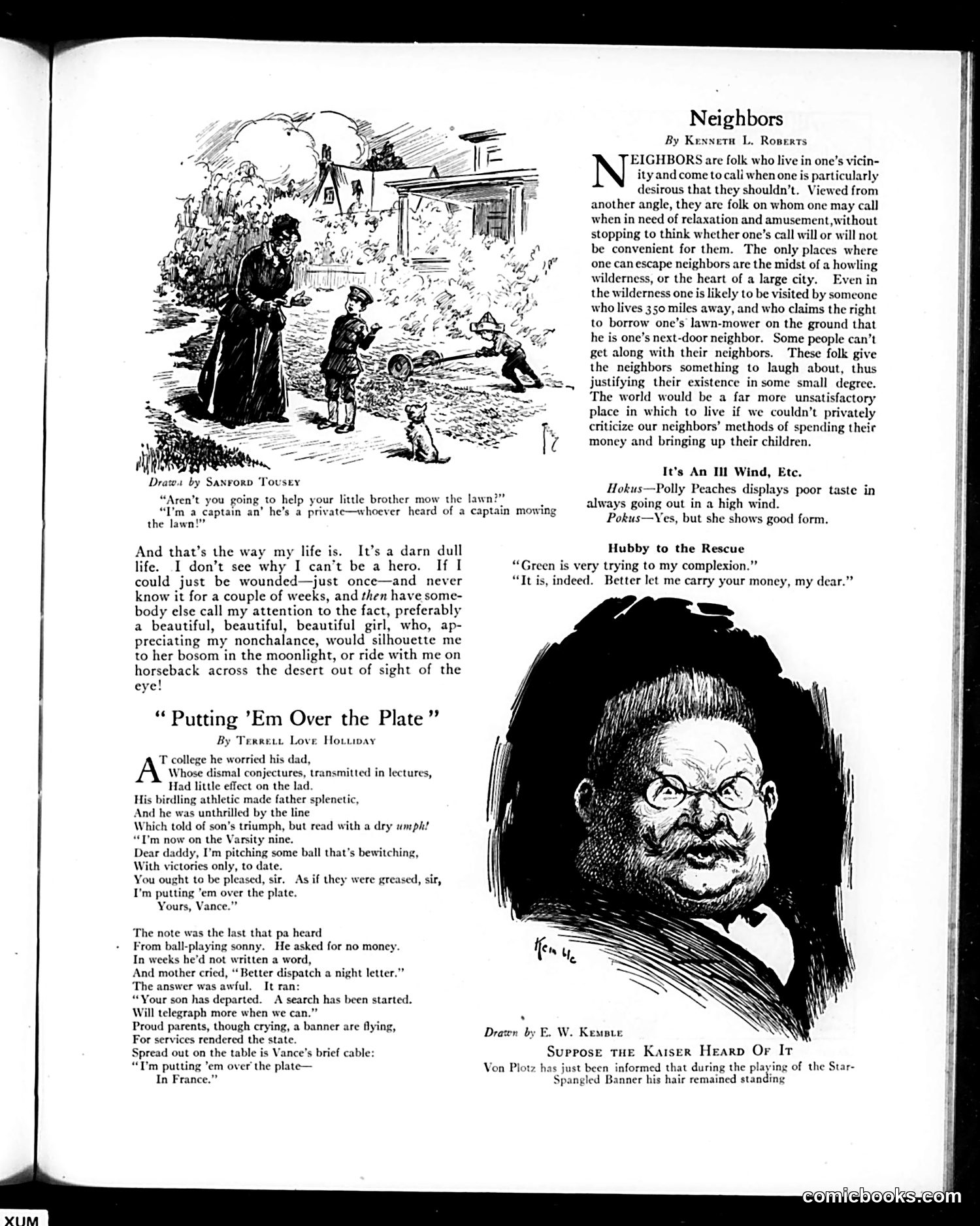
This page contains three satirical pieces typical of WWI-era American humor: **"Putting 'Em Over the Plate"** is the most significant—a poem about a college athlete son who writes home about his baseball success, then reveals he's enlisted and is now fighting in France ("putting 'em over the plate—In France"). The pun transforms sports achievement into military service, playing on parental pride mixed with wartime anxiety. **"Neighbors"** is a humorous essay defining neighbors as simultaneously unavoidable and often intrusive—people who borrow lawnmowers yet justify their existence by providing social comedy. **"Suppose the Kaiser Heard Of It"** references Von Plotz's hair remaining standing during the Star-Spangled Banner—likely mocking German patriotism or pride, implying even the Kaiser's representative would be impressed or disturbed by American patriotic fervor. The cartoons and text collectively reflect 1917-1918 American attitudes: pride in military service, gentle domestic comedy, and anti-German sentiment during WWI.
📄 Transcribed text from this page (OCR, searchable)
Machine-transcribed from the original scan — historical spelling and the odd misread are preserved.
Drates by SaxrorD Tousey “Aren't you going to help your little brother mow the lawn?” ; “I'm a captain an’ he’s a private—whoever heard of a captain mowing the lawn! And that’s the way my life is. It’s a darn dull life. I don’t see why I can’t be a hero. If I could just be wounded—just once—and never know it for a couple of weeks, and then have some- body else call my attention to the fact, preferably a beautiful, beautiful, beautiful girl, who, ap- preciating my nonchalance, would silhouette me to her bosom in the moonlight, or ride with me on horseback across the desert out of sight of the eye! “Putting Em Over the Plate” By Terrect Love Hottipay T college he worried his dad, Whose dismal conjectures, transmitted in lectures, Had little effect on the lad. His birdling athletic made father splenetic, And he was unthrilled by the line Which told of son’s triumph, but read with a dry umph! “‘['m now on the Varsity nine. Dear daddy, I’m pitching some ball that’s bewitching, With victories only, to date. You ought to be pleased, sir. As if they were greased, sir, I'm putting ‘em over the plate. Yours, Vance.” The note was the last that pa heard From ball-playing sonny. He asked for no money. In weeks he’d not written a word, And mother cried, ‘Better dispatch a night letter.” The answer was awful. It ran: “Your son has departed. A search has been started. Will telegraph more when we can.” Proud parents, though crying, a banner are flying, For services rendered the state. Spread out on the table is Vance’s brief cable: “T'm putting ’em over the plate— In France.” Neighbors By Ke N= are folk who live in one’s vicin= net L, Roperts ityand come to cali when one is particularly desirous that they shouldn’t. Viewed from another angle, they are folk on whom one may call when in need of relaxation and amusement, stopping to think whether one’s call will or wi be convenient for them. The only places where one can escape neighbors are the midst of a howling wilderness, or the heart of a large city. Even in the wilderness one is likely to be visited by someone who lives 350 miles away, and who claims the right to borrow one’s lawn-mower on the ground that he is one’s next-door neighbor. Some people can’t get along with their neighbors. These folk give the neighbors something to laugh about, thus justifying their existence in some small degree. The world would be a far more unsatisfactory place in which to live if we couldn’t privately criticize our neighbors’ methods of spending their money and bringing up their children. It’s An Ill Wind, Ete. Hokus—Polly Peaches displays poor taste in always going out in a high wind. Pokus—Yes, but she shows good form. \ Hubby to the Rescue “Green is very trying to my complexion.” “It is, indeed. Better let me carry your money, my dear.” Drawen by FE. W. Keaare, Suppose THE Kaiser Hearp OF Von Plotz has just been informed that during the playing of the Star- Spangled Banner his hair remained standing