
Judge, 1918-05-04 · page 24 of 38
Judge — May 4, 1918 — page 24: what you’re looking at
What you’re looking at
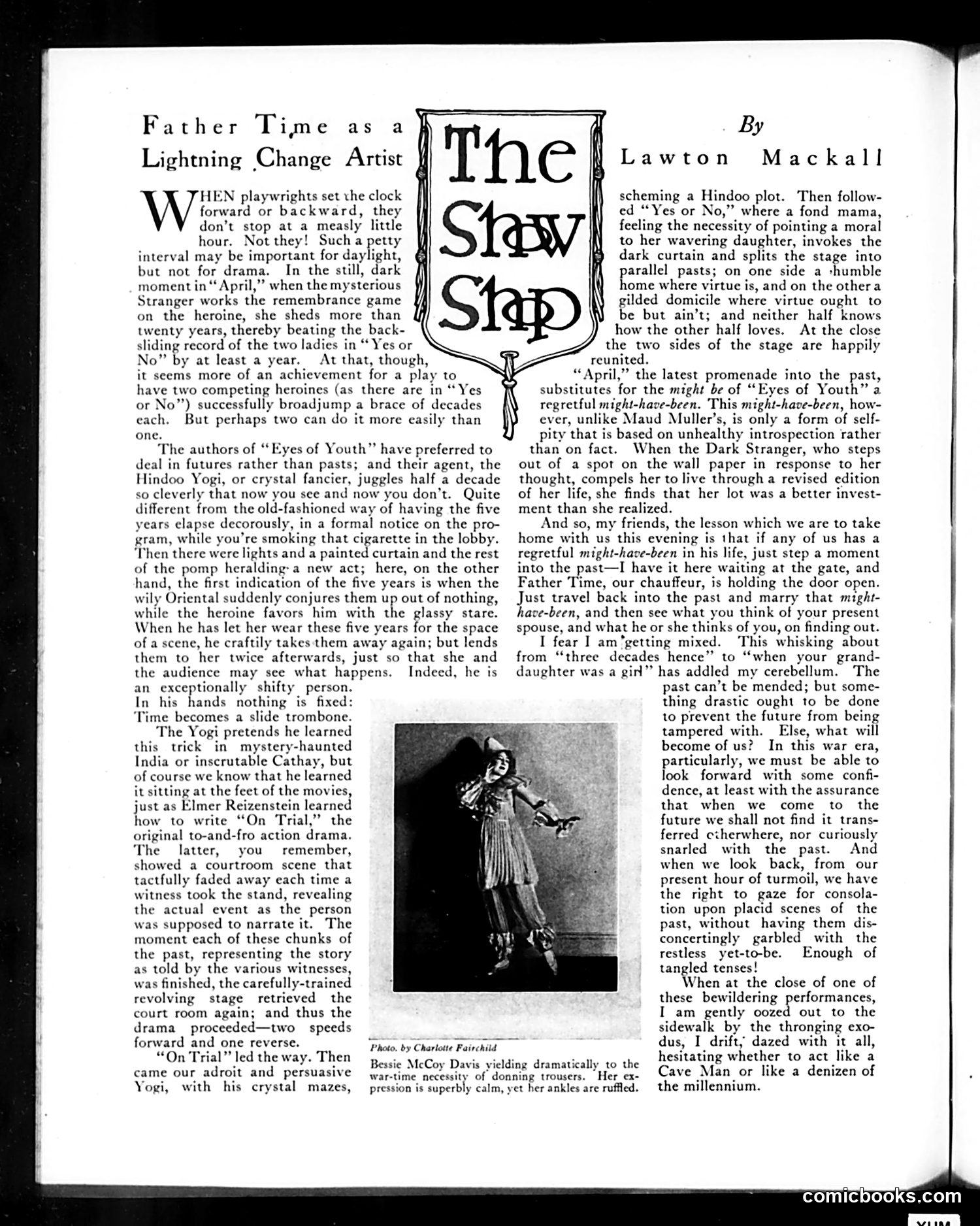
This article by Lawton Mackall critiques contemporary Broadway plays that manipulate time through staging tricks. The author satirizes how playwrights use elaborate scenic devices—revolving stages, lighting effects, painted curtains—to compress or expand decades into moments, rather than relying on traditional intermission conventions. Mackall specifically mocks three plays: "Eyes of Youth" (featuring a Yogi who conjures five-year jumps), "Yes or No" (splitting the stage into parallel moral timelines), and "April" (using a mysterious "Dark Stranger" to reveal alternate pasts). He argues these techniques derive from film editing, citing "On Trial" as the original stage-to-screen adaptation example. The photograph shows actress Bessie McCoy Davis in dramatic pose, illustrating the theatrical spectacle under discussion. Mackall's tone is gently satirical—he admires the technical cleverness while mocking the pretension of treating stage time like a "slide trombone."
📄 Transcribed text from this page (OCR, searchable)
Machine-transcribed from the original scan — historical spelling and the odd misread are preserved.
Father Time as a Lightning Change Artist H playwrights set the clock forward or backward, they don’t stop at a measly little hour. Not they! Such a petty interval may be important for daylight, but not for drama. In the still, dark moment in “April,” when the mysterious Stranger works the remembrance game on the heroine, she sheds more than twenty years, thereby beating the back- sliding record of the two ladies in “ Yes or No” by at least a year. At that, though, it seems more of an achievement for a play to have two competing heroines (as there are in “Yes or No”) successfully broadjump a brace of decades each. But perhaps two can do it more easily than one. Phe authors of “Eyes of Youth” have preferred to deal in futures rather than pasts; and their agent, the Hindoo Yogi, or crystal fancier, juggles half a decade so cleverly that now you see and now you don’t. Quite different from the old-fashioned way of having the five years elapse decorously, in a formal notice on the pro- gram, while you’re smoking that cigarette in the lobby. ‘Then there were lights and a painted curtain and the rest of the pomp heralding: a new act; here, on the other hand, the first indication of the five years is when the wily Oriental suddenly conjures them up out of nothing, while the heroine favors him with the glassy stare. When he has let her wear these five years for the space of a scene, he craftily takes them away again; but lends them to her twice afterwards, just so that she and the audience may see what happens. Indeed, he is an exceptionally shifty person. In his hands nothing is fixed: ‘Time becomes a slide trombone. The Yogi pretends he learned this trick in mystery-haunted India or inscrutable Cathay, but of course we know that he learned it sitting at the feet of the movies, just as Elmer Reizenstein learned how to write “On Trial,” the original to-and-fro action drama. The latter, you remember, showed a courtroom scene that tactfully faded away each time a witness took the stand, revealing the actual event as the person was supposed to narrate it. The moment each of these chunks of the past, representing the story as told by the various witnesses, was finished, the carefully-trained revolving stage retrieved the court room again; and thus the drama_proceeded—two speeds forward and one reverse. Photo. by Charlotte Fairchild By Mackall Lawton scheming a Hindoo plot. Then follow- ed “Yes or No,” where a fond mama, feeling the necessity of pointing a moral to her wavering daughter, invokes the dark curtain and splits the stage into parallel pasts; on one side a shumble ome where virtue is, and on the othera gilded domicile where virtue ought to be but ain’t; and neither half knows how the other half loves. At the close the two sides of the stage are happily reunited. “April,” the latest promenade into the past, substitutes for the might be of “Eyes of Youth” a regretful might-have-been. This might-have-been, how- ever, unlike Maud Muller’s, is only a form of self- pity that is based on unhealthy introspection rather than on fact. When the Dark Stranger, who steps out of a spot on the wall paper in response to her thought, compels her to live through a revised edition of her life, she finds that her lot was a better invest- ment than she realized. And so, my friends, the lesson which we are to take home with us this evening is that if any of us has a regretful might-have-been in his life, just step a moment into the past—I have it here waiting at the gate, and Father Time, our chauffeur, is holding the door open. Just travel back into the past and marry that mught- have-been, and then see what you think of your present spouse, and what he or she thinks of you, on finding out. I fear I] am’getting mixed. This whisking about from “three decades hence’? to “when your grand- daughter was a gin” has addled my cerebellum. The past can’t be mended; but some- thing drastic ought to be done to prevent the future from being tampered with. Else, what will become of us? In this war era, particularly, we must be able to look forward with some confi- dence, at least with the assurance that when we come to the future we shall not find it trans- ferred ciherwhere, nor curiously snarled with the past. And when we look back, from our present hour of turmoil, we have the right to gaze for consola- tion upon placid scenes of the past, without having them dis- concertingly garbled with the restless yet-to-be. Enough of tangled tenses! When at the close of one of these bewildering performances, I am gently oozed out to the sidewalk by the thronging exo- dus, I drift, dazed with it all, hesitating whether to act like a “On Trial” led the way. Then came our adroit and persuasive Yogi, with his crystal mazes, Bessie McCoy Davis yielding dramatically to the war-time necessity of donning trousers. Her ex- pression is superbly calm, yet her ankles are ruffled. Cave Man or like a denizen of the millennium. comicbooks.com