
Judge, 1918-05-04 · page 17 of 38
Judge — May 4, 1918 — page 17: what you’re looking at
What you’re looking at
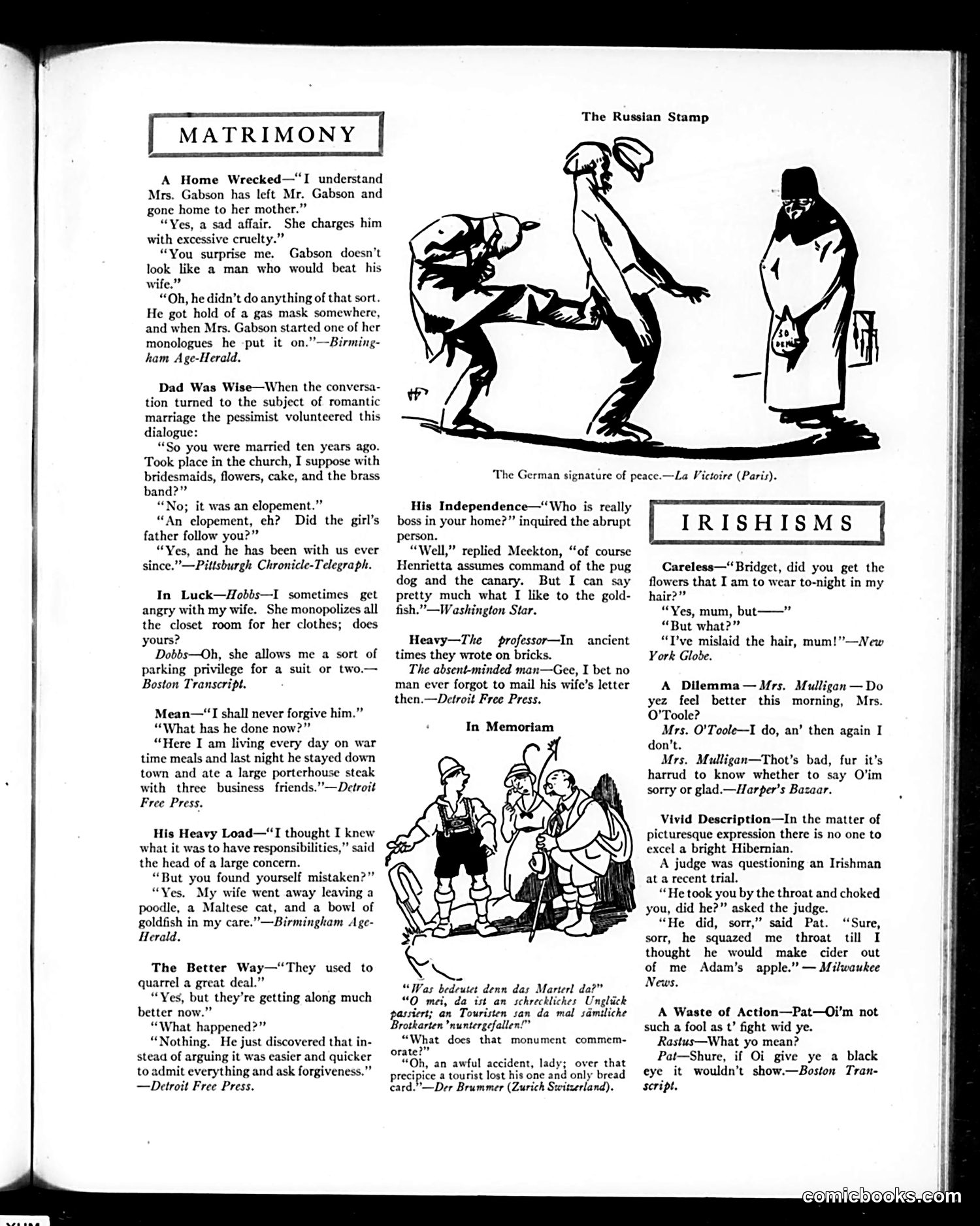
This page contains humorous short jokes organized by topic. The **"Matrimony"** section satirizes married life—wives monopolizing closets, husbands escaping nagging wives with gas masks (a WWI reference), and the discovery that admitting fault prevents arguments. These joke at domestic tensions common to the era. **"The Russian Stamp"** is a political cartoon showing two figures fighting while a third official watches. The caption references the "German signature of peace," likely commenting on WWI peace negotiations and Russia's separate peace treaty (Treaty of Brest-Litovsk, 1918), portraying the conflict as brutal and the peace as imposed rather than genuine. The **"Irishisms"** section relies on ethnic stereotypes popular in early 20th-century American humor, depicting Irish characters (Bridget, Pat, Mrs. O'Toole) through exaggerated dialect and malapropisms. The jokes play on supposed Irish illogic and colorful speech patterns—considered entertainment at the time. The **"In Memoriam"** section (in German) references rationing during WWI, joking about a tourist losing precious bread cards.
📄 Transcribed text from this page (OCR, searchable)
Machine-transcribed from the original scan — historical spelling and the odd misread are preserved.
| MATRIMO | A Home Wrecked—“I understand Mrs. Gabson has left Mr. Gabson and gone home to her mother.” “Yes, a sad affair. She charges him with excessive cruelty.” “You surprise me. Gabson doesn’t look like a man who would beat his wife.” “Oh, he didn’t do anything of that sort. He got hold of a gas mask somewhere, and when Mrs. Gabson started one of her monologues he -put it on.”’—Birming- ham Age-Herald. Dad Was Wise—When the conversa- tion turned to the subject of romantic marriage the pessimist volunteered this dialogue: “So you were married ten years ago. Took place in the church, I suppose with bridesmaids, flowers, cake, and the brass band?” “No; it was an elopement.” “An clopement, ch? Did the girl's father follow you?” “Yes, and he has been with us ever since.” —Pittsburgh Chronicle-Telegraph. In Luck—Hobbs—I sometimes get angry with my wife. She monopolizes all the closet room for her clothes; does yours? Dobbs—Oh, she allows me a sort of parking privilege for a suit or two.— Boston Transcript. Mean—“T shall never forgive him.” “What has he done now?” “Here I am living every day on war time meals and last night he stayed down town and ate a large porterhouse steak with three business friends.”’—Detroit Free Press. His Heavy Load—“I thought I knew what it was to have responsibilities,” said the head of a large concern. “But you found yourself mistaken?” “Yes. My wife went away leaving a poodle, a Maltese cat, and a bowl of goldfish in my care.”—Birmingham A ge- Herald. The Better Way—‘They used to quarrel a great deal.” “Yes, but they’re getting along much better now.” “What happened?” “Nothing. He just discovered that in- stead of arguing it was easier and quicker to admit everything and ask forgiveness.” —Detroit Free Press. The Russian Stamp ‘The German signature of peace.—La Victoire (Paris). His Independence—“Who is really boss in your home?” inquired the abrupt erson. “Well,” replied Meekton, “of course Henrietta assumes command of the pug dog and the canary. But I can say pretty much what I like to the gold- fish.”’—Washington Star. Heavy—The professor—In ancient times they wrote on bricks. The absent-minded man—Gee, I bet no man ever forgot to mail his wife’s letter then.—Detroit Free Press. In Memoriam “Was bedeutet denn das Marterl da?” “O mei, da ist an schreckliches Unglick passiert; an Touristen san da mal samiliche Brotkarten nuntergefallen!” “What does that monument commem- orate?” “Oh, an awful accident, lady; over that precipice a tourist lost his one and only bread card.” —Der Brummer (Zurich Switzerland). | IRISHISMS | Careless—“ Bridget, did you get the flowers that I am to wear to-night in my hair?” “Yes, mum, but——’ “But what?” “T’ve mislaid the hair, mum!"”—New York Globe. A Dilemma— Mrs. Mulligan —Do yez feel better this morning, Mrs. O'Toole? Mrs. O’Toole—I do, an’ then again I don’t. Mrs. Mulligan—Thot’s bad, fur it’s harrud to know whether to say O’im sorry or glad.—Harper’s Bazaar. Vivid Description—In the matter of picturesque expression there is no one to excel a bright Hibernian. A judge was questioning an Irishman at a recent trial. “He took you by the throat and choked you, did he?” asked the judge. “He did, sorr,” said Pat. “Sure, sorr, he squazed me throat till I thought he would make cider out of me Adam’s apple.” — Milwaukee News. A Waste of Action—Pat—Oi’m not such a fool as t’ fight wid ye. Rastus—What yo mean? Pat—Shure, if Oi give ye a black eye it wouldn’t show.—Boston Tran- script.