
A complete issue · 36 pages · 1918
Judge — April 27, 1918
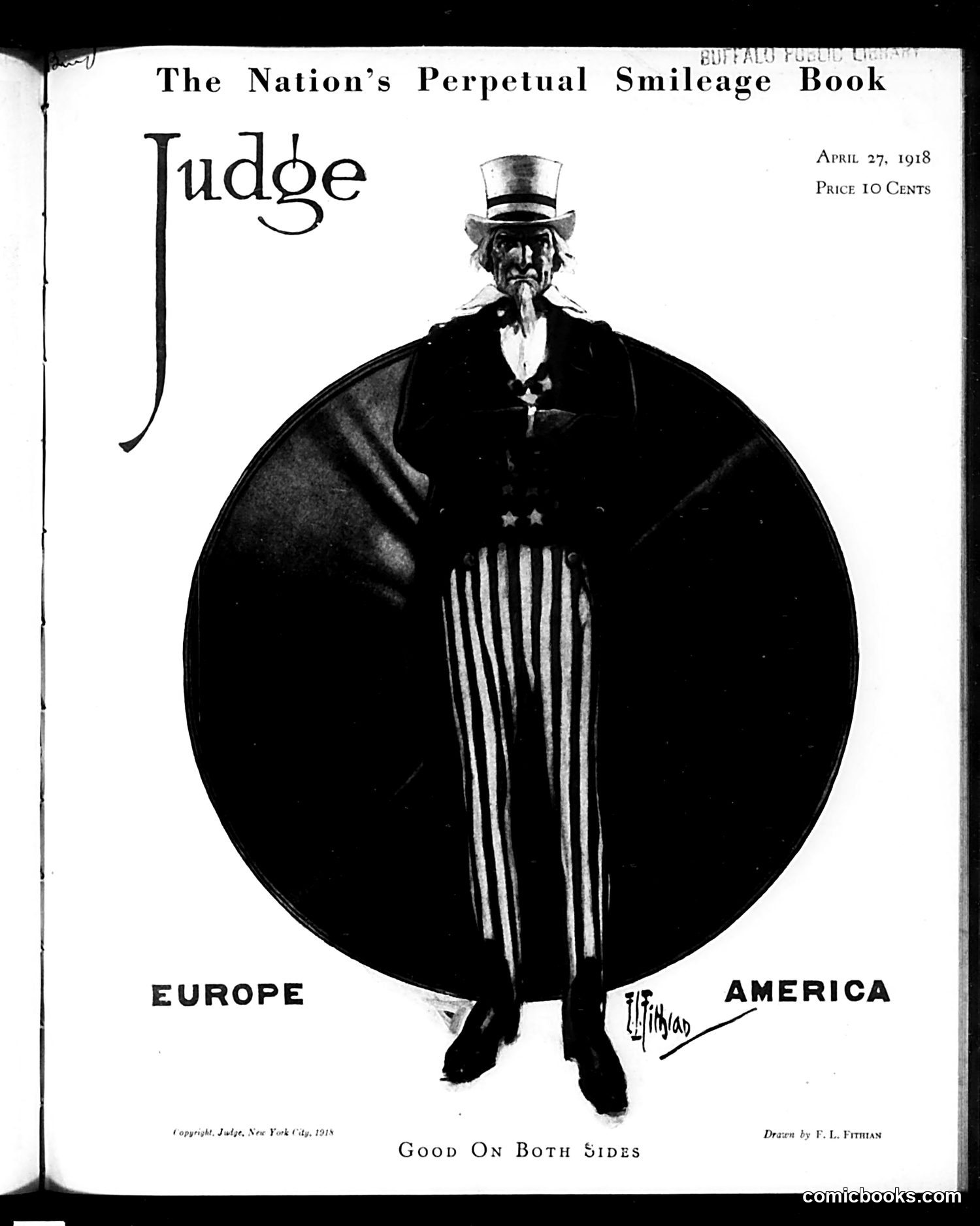
This satirical cover depicts Uncle Sam (identifiable by the top hat and stars-and-stripes waistcoat) as an impartial judge presiding over World War I. The massive circular backdrop likely represents the scales of justice or a judicial forum. The labels "EUROPE" and "AMERICA" on either side suggest the cartoon addresses America's role in evaluating or judging the European conflict. Published in April 1918, this reflects the U.S. involvement in WWI (since April 1917) and America's perceived position as arbiter of global affairs. The subtitle "Good On Both Sides" appears ironic—likely critiquing either American neutrality claims or the complexity of assigning blame in the war. The image positions America as moral authority overseeing the international crisis.
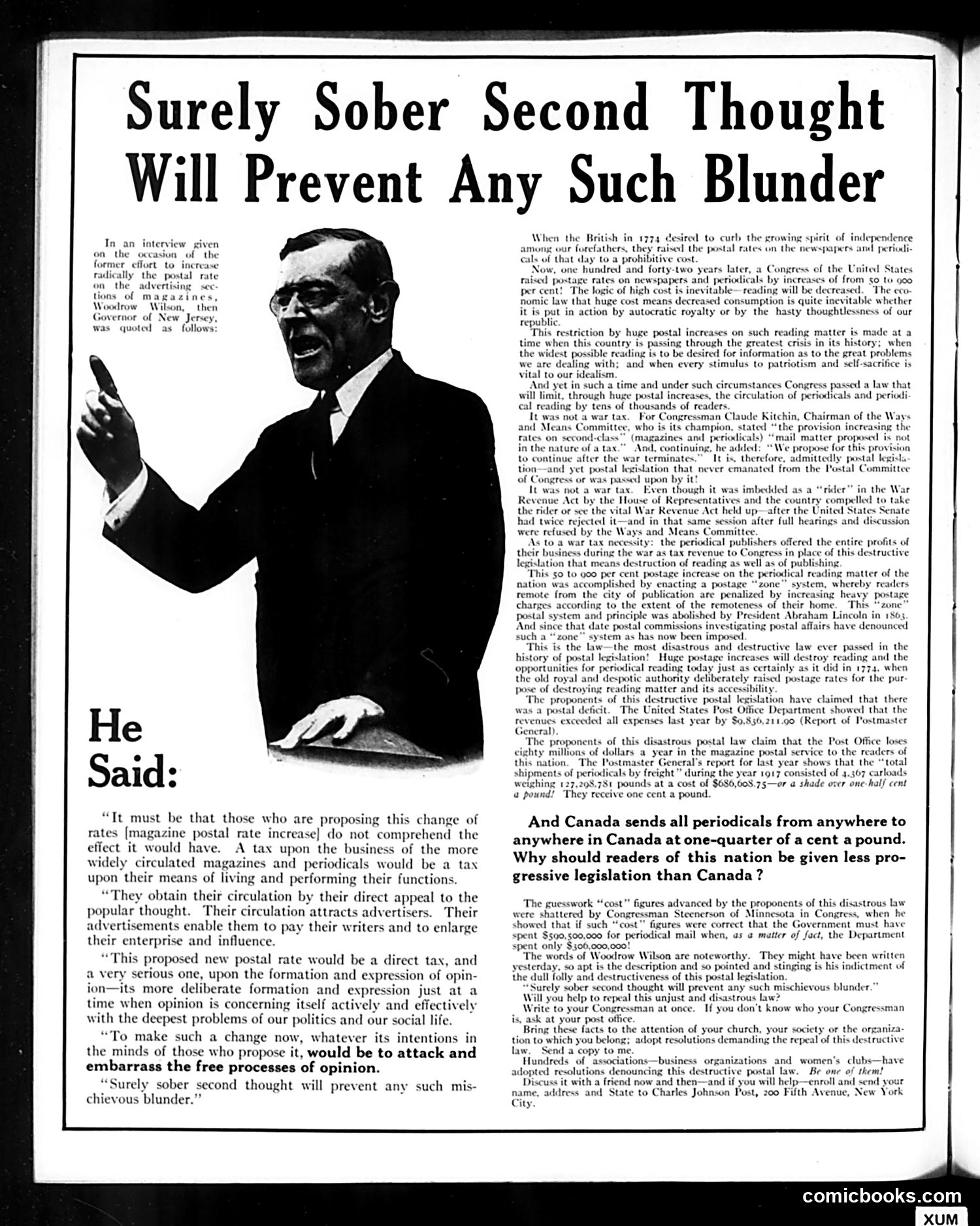
This Judge magazine page attacks a proposal to increase magazine postage rates. The caricatured figure (identified in the text as Governor of New Jersey, likely Edward Stokes) argues for the rate hike using economic reasoning about reduced circulation costs. The satire's point: such "sober second thought" won't prevent this "blunder." The text sarcastically documents how the measure would devastate magazine publishers and readers, particularly those in remote areas who'd face prohibitive costs. The article compares it unfavorably to British policies and notes Canada's more reasonable rates. The cartoon's target is false rationalization—presenting a destructive policy as economically logical when it actually serves special interests while harming democratic access to information during wartime.
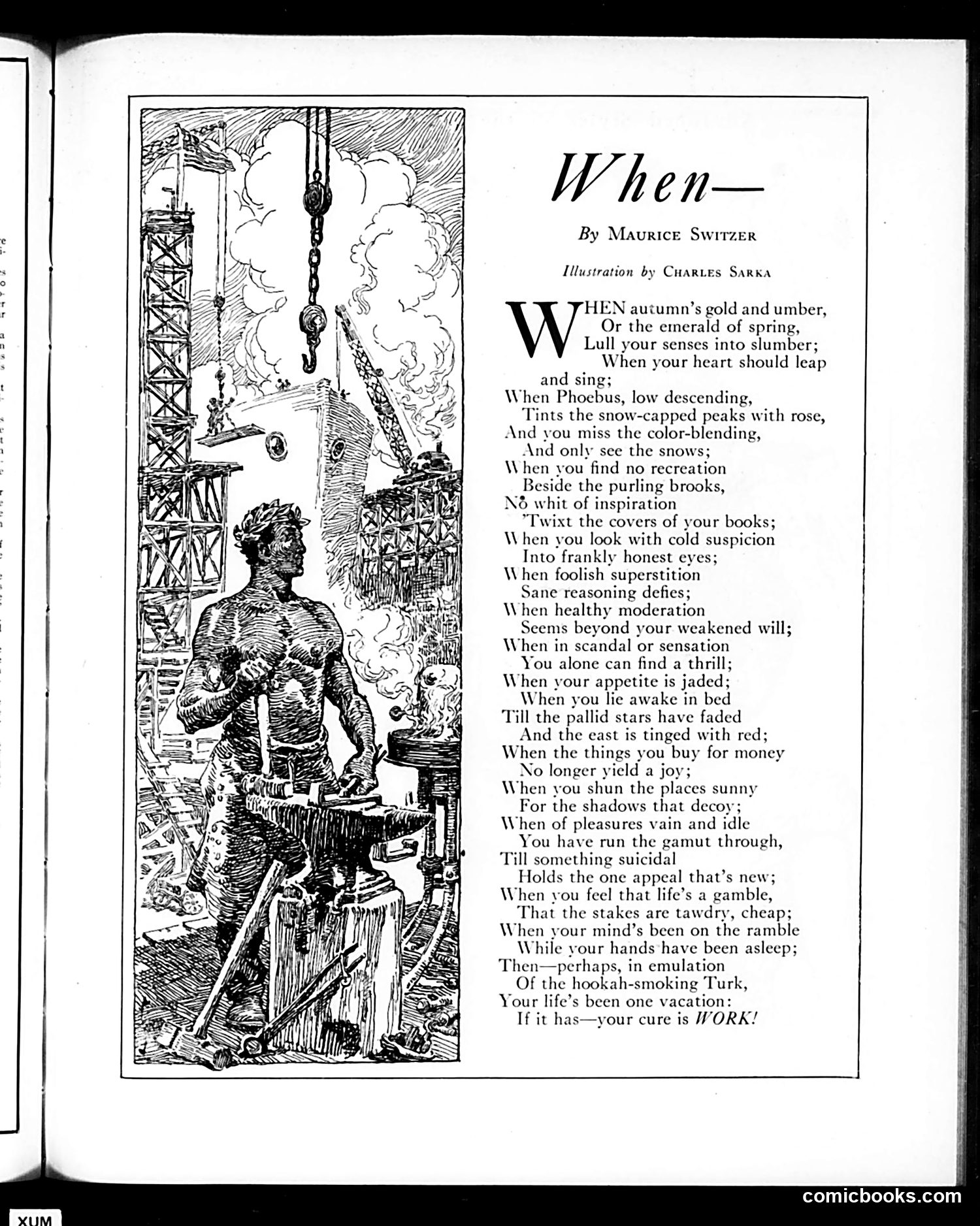
This is a poem by Maurice Switzer with illustration by Charles Sarka. The verse catalogs various modern anxieties and dissatisfactions—autumn melancholy, lost romance, spiritual emptiness, moral compromise, financial disappointment, scandal, and existential ennui. Each stanza begins with "When," describing scenarios of doubt, weakness, and disillusionment. The final lines pivot sharply: when life feels like a gamble and your mind wanders while hands idle, the cure is **work**—presented as salvation from modern malaise. The illustration shows a muscular, athletic man at an industrial site, embodying vigor and productive labor. This appears to be early 20th-century social commentary promoting work ethic and labor as antidote to the psychological and moral ailments of contemporary urban life.
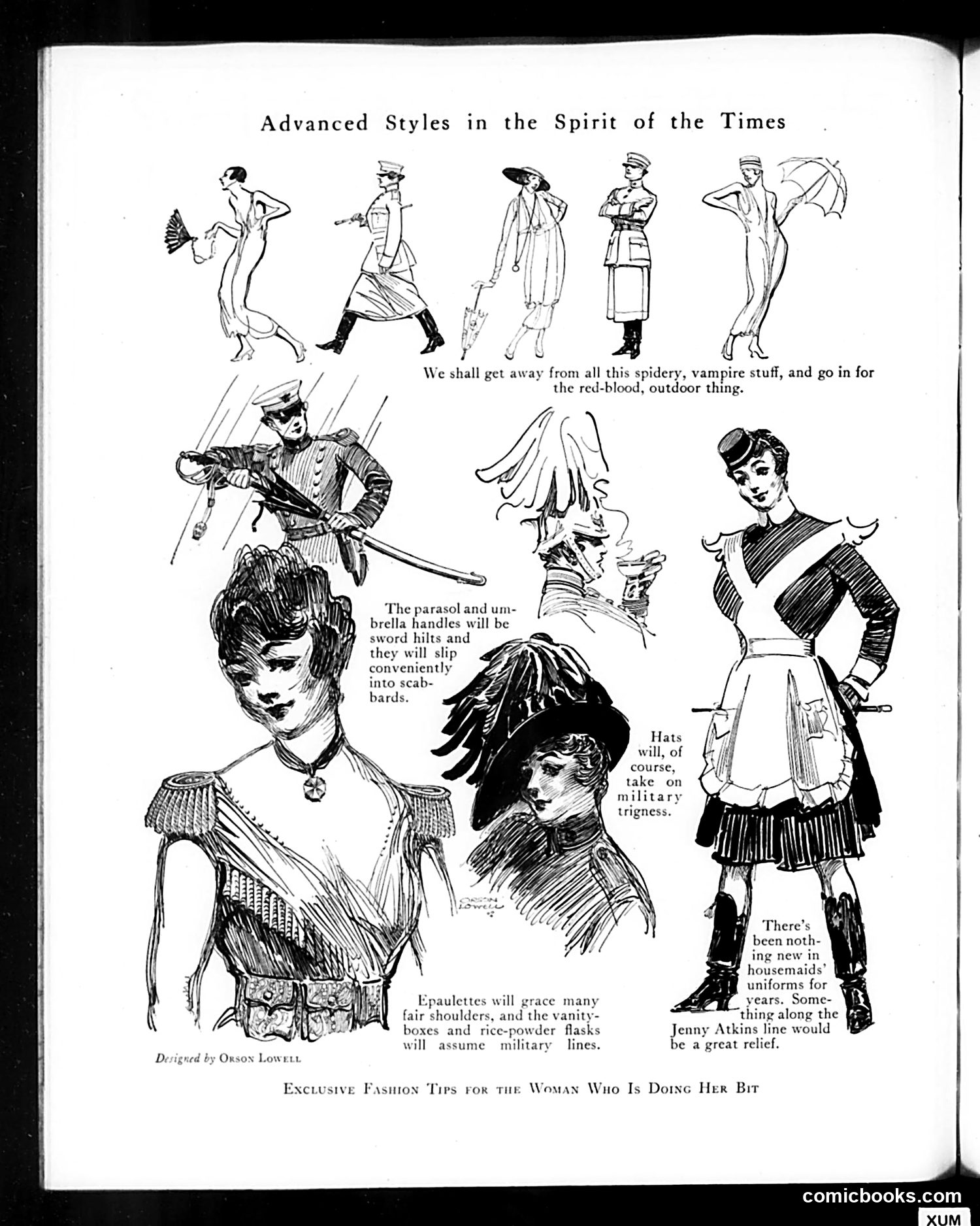
This page satirizes women's fashion during World War I, specifically the militarization of civilian women's clothing. The title "Advanced Styles in the Spirit of the Times" and subtitle "Exclusive Fashion Tips for the Woman Who Is Doing Her Bit" reference women's wartime contributions—factory work, nursing, and auxiliary service. The sketches show women adopting military-inspired elements: epaulettes, belts, boots, hats with military styling, and umbrella handles designed as swords. The joke targets how fashion responded to wartime mobilization by making ordinary women's clothing look militaristic. The text mocks this trend with phrases like "parasol and umbrella handles will be sword hilts" and references to "Jenny Atkins line" uniforms, suggesting women were adopting martial aesthetics for everyday wear—simultaneously poking fun at both fashion excess and women's wartime roles.
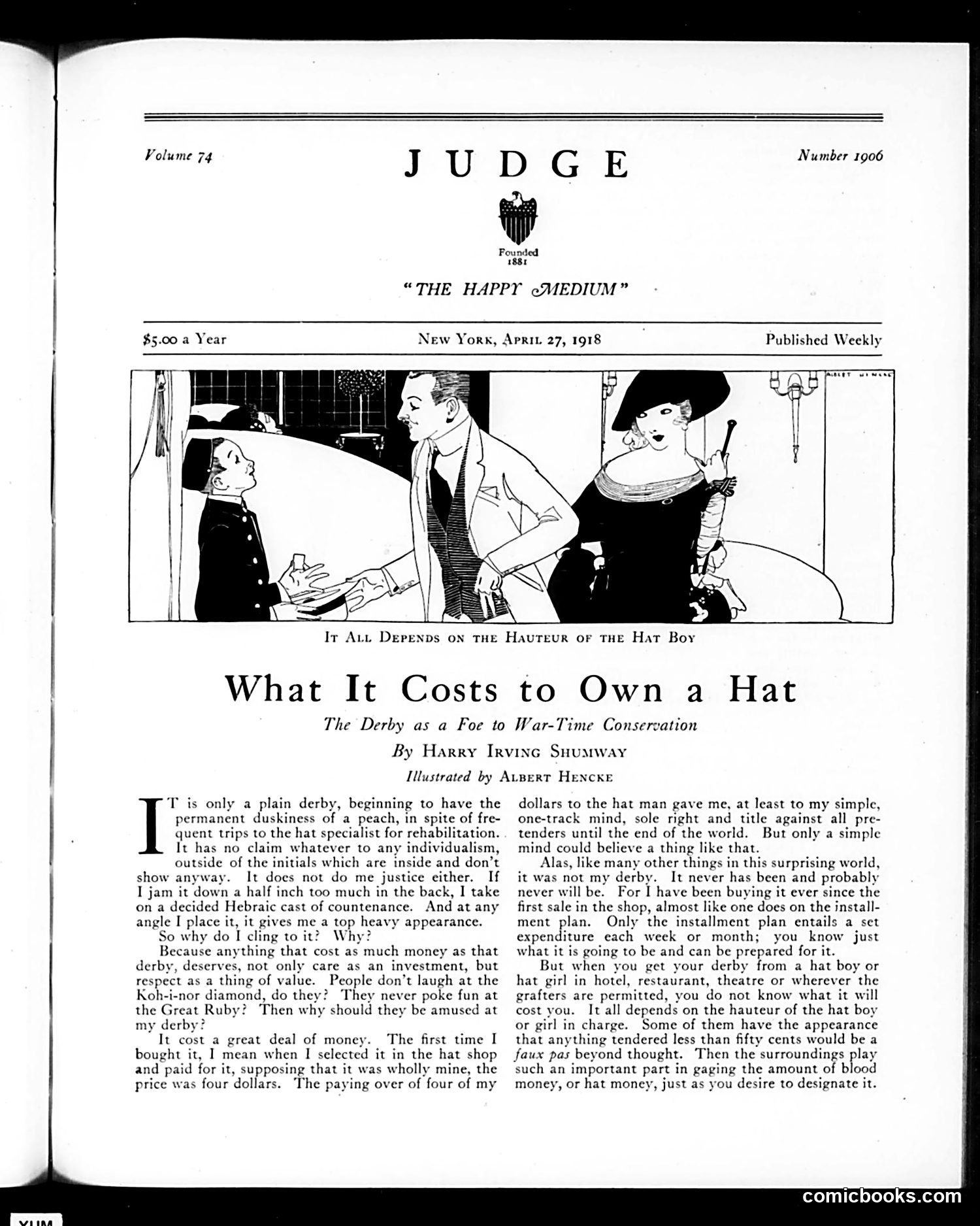
This is a satirical piece titled "What It Costs to Own a Hat: The Derby as a Foe to War-Time Conservation" by Harry Irving Shumway, illustrated by Albert Hencke. The cartoon depicts a well-dressed man presenting a bill to a woman wearing an elaborate, expensive hat adorned with feathers and ornaments. The satire targets wealthy women's extravagant millinery during World War I, when materials and resources were supposedly needed for the war effort. The author humorously argues that owning a fashionable derby hat—seemingly a simple item—actually becomes expensive through maintenance, cleaning, and styling costs. The broader point satirizes how the wealthy ignored conservation appeals during wartime by continuing frivolous spending on luxury goods, particularly expensive hats that required ongoing professional care and represented wasteful consumption when resources should support military needs.
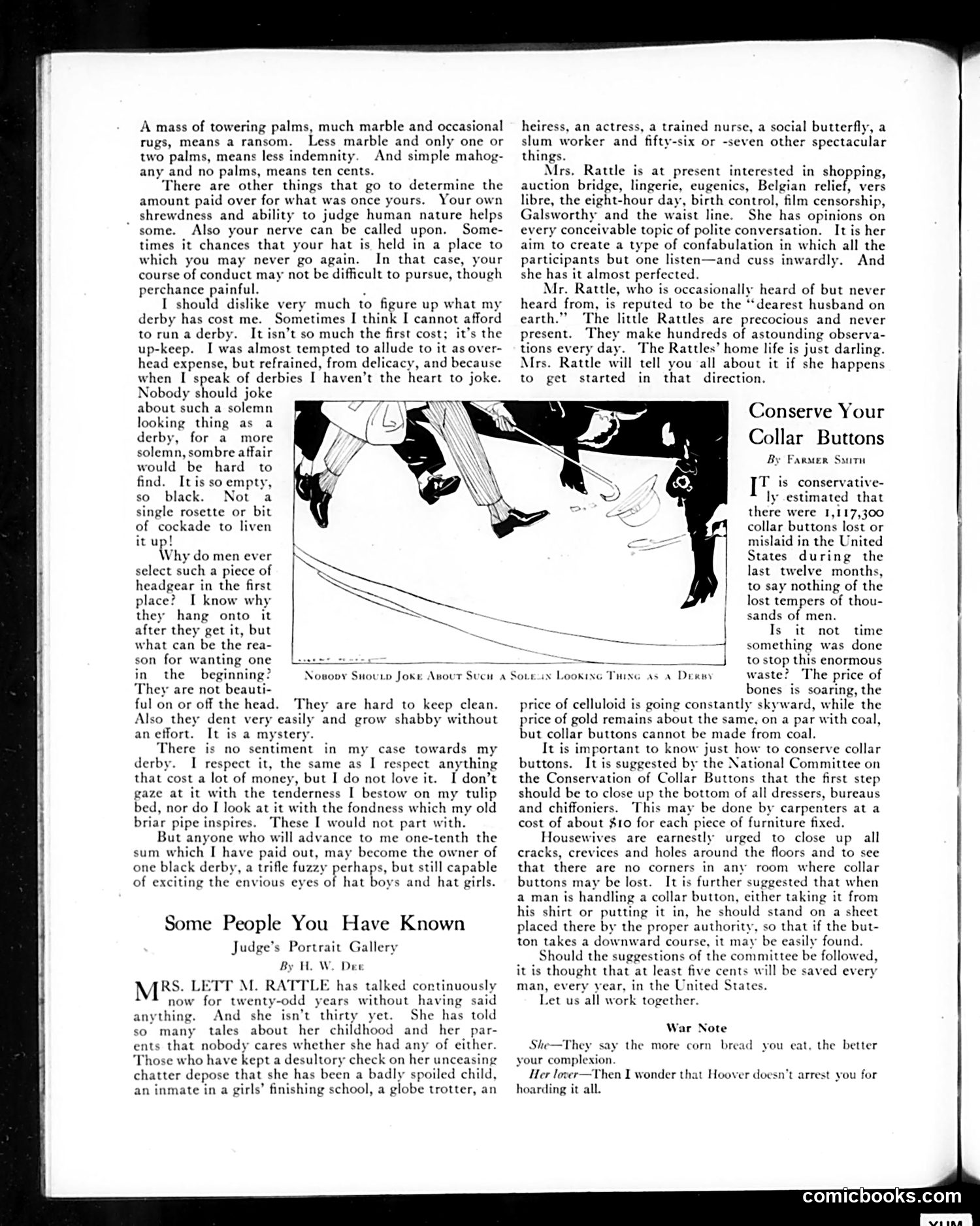
The cartoon titled "Nobody Should Joke About Such a Solemn-Looking Thing as a Derby" depicts well-dressed men and women's legs dangling from above, shown from a humorous low angle. The accompanying text discusses derby hats as serious fashion items—expensive, difficult to maintain, and not suitable subjects for ridicule. The writer expresses peculiar reverence for his own derby, comparing it favorably to other possessions like pipes and old briars. This appears to be satirizing early 20th-century male vanity and the rigid class consciousness around formal headwear. The derby hat was a status symbol requiring careful treatment, and the piece mocks both the hat's impracticality and men's overwrought attachment to it as a marker of respectability. The adjacent "War Note" section contains unrelated brief humor about corn bread and complexion.
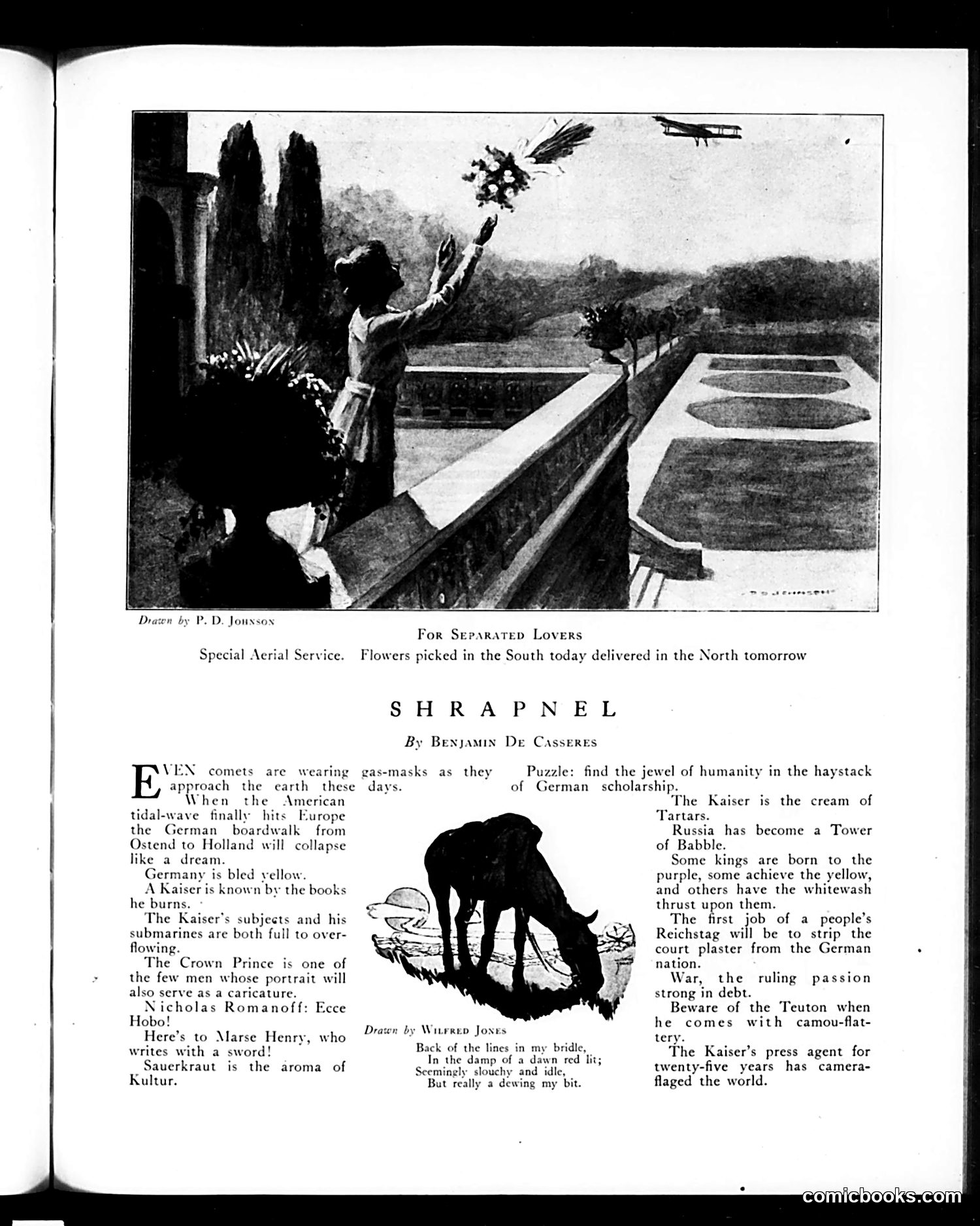
This page contains anti-German propaganda from America's involvement in World War I. The content mocks German leadership and culture through biting wordplay and caricature. **Key targets:** - **The Kaiser** (German Emperor Wilhelm II): Described as "cream of Tartars" and ridiculed for burning books, his subjects, and submarines being "full to overflowing" - **Crown Prince**: Dismissed as so naturally caricature-like his portrait needs no exaggeration - **Sauerkraut/German culture**: Sarcastically called "Kultur" - **Nicholas Romanoff** (Russian Tsar): Called "Hobo," reflecting his 1917 abdication **The satire's points:** Germany is financially exhausted ("bled yellow"), militarily unsustainable, and morally bankrupt. The top illustration of separated lovers receiving flowers via "aerial service" (bombing raids) darkly jokes about wartime destruction. This represents typical American wartime satirical journalism—crude, propagandistic, designed to boost morale and dehumanize the enemy through mockery and wordplay.
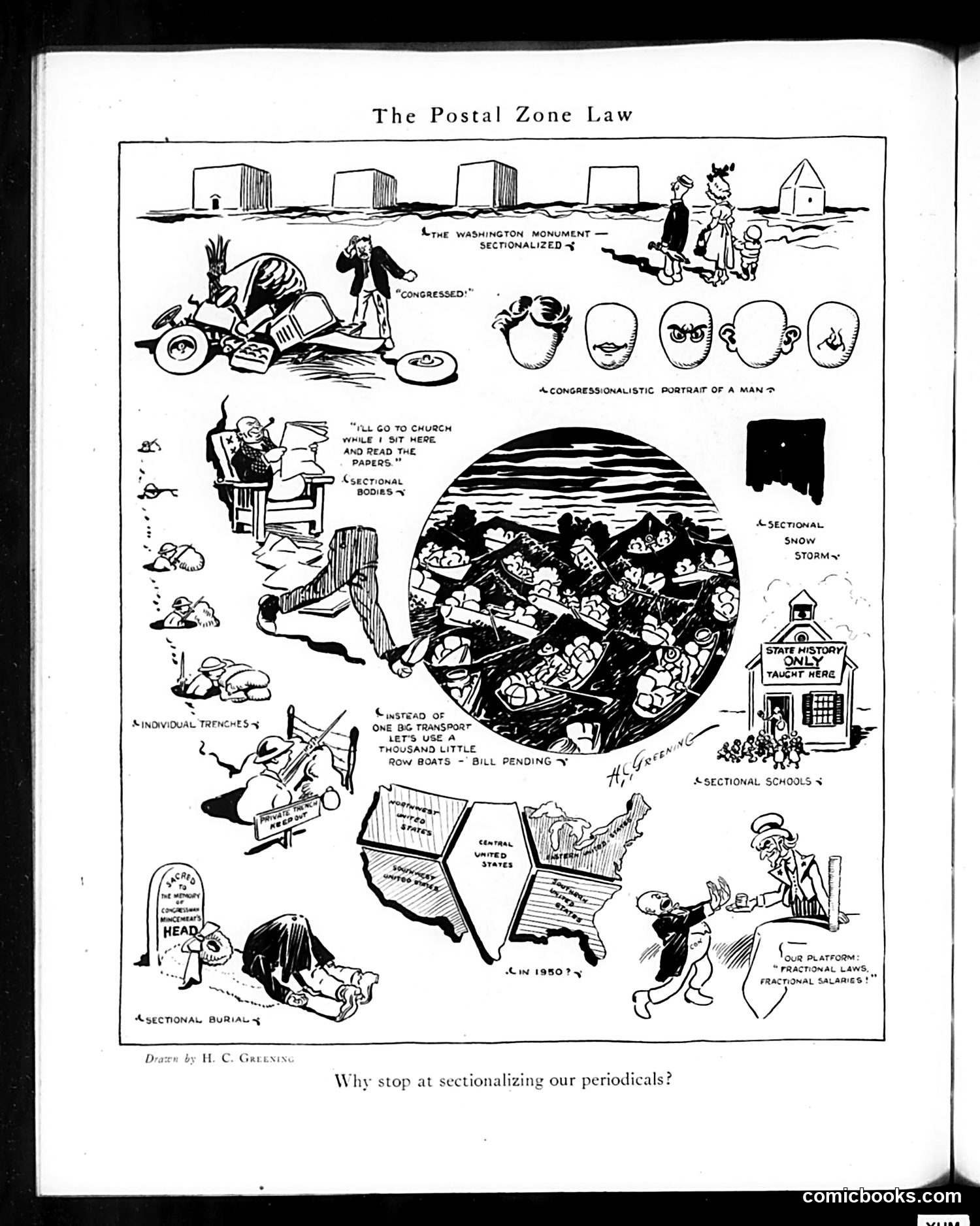
This political cartoon by H.C. Greening satirizes the U.S. Postal Zone Law, which divided the country into mail delivery zones. The satire extends this "sectionalization" concept absurdly across American life: **Key images show:** - The Washington Monument broken into sections - A man's face divided into compartmentalized parts - Churches, schools, and cemeteries each "sectioned" - Snow storms, transportation, and burials all fragmented by zones - A U.S. map divided into regions **The point:** The cartoon mocks the impracticality of dividing everything by postal zones, suggesting the law's logic taken to its extreme reduces national unity and creates bureaucratic chaos. The final caption—"Why stop at sectionalizing our periodicals?"—sarcastically questions whether limiting mail delivery to zones ultimately fragments the entire nation into disconnected pieces. The cartoon warns that postal zone regulations, while perhaps well-intentioned, represent excessive government compartmentalization threatening national cohesion.
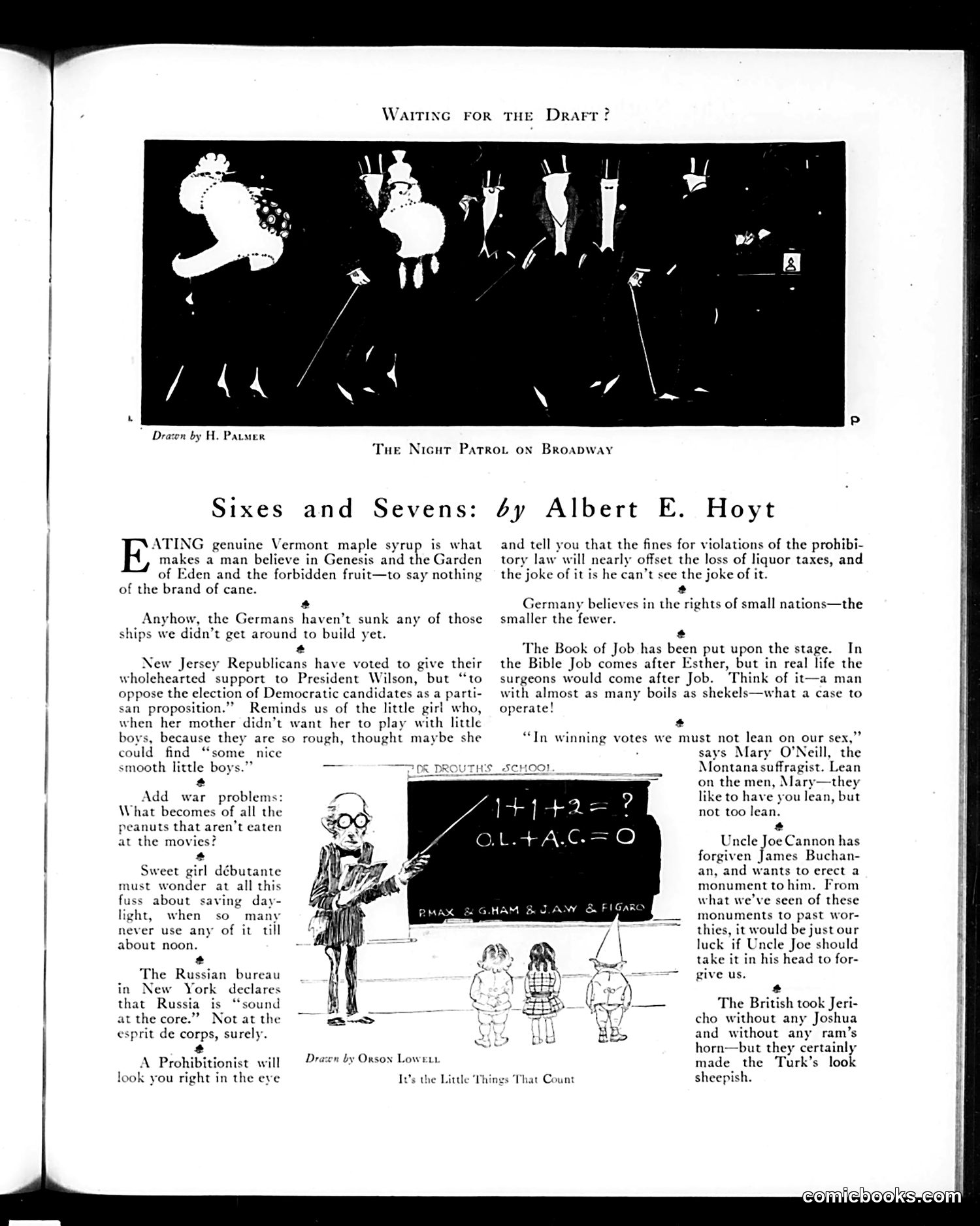
This 1917-1918 *Judge* page contains satirical commentary on WWI-era American politics and social issues. The top cartoon by H. Palmer depicts soldiers waiting for military conscription ("the Draft"). The column "Sixes and Sevens" by Albert E. Hoyt presents brief topical jokes: - **Vermont maple syrup/Genesis**: A dig at sentimentality about American traditions - **German ships**: Refers to WWI naval warfare - **New Jersey Republicans supporting Wilson "without partisan opposition"**: Satirizes transparent political hypocrisy - **Movie peanuts/daylight saving**: Trivial social observations - **Russian bureau "sound at the core"**: Questions Soviet stability - **Prohibitionist logic**: Mocks supporters of alcohol prohibition's flawed tax-revenue arguments - **Germany's "rights of small nations"**: Ironic—Germany was actually invading them - **Book of Job/surgeons**: Dark joke about suffering - **Montana suffragist quote**: Jokes about women's voting rights campaigns - **Uncle Joe Cannon/James Buchanan monument**: Political jabs at a former congressman - **British taking Jericho**: WWI reference; "made the Turk's look sheepish" plays on Joshua's biblical trumpet-collapse of Jericho's walls
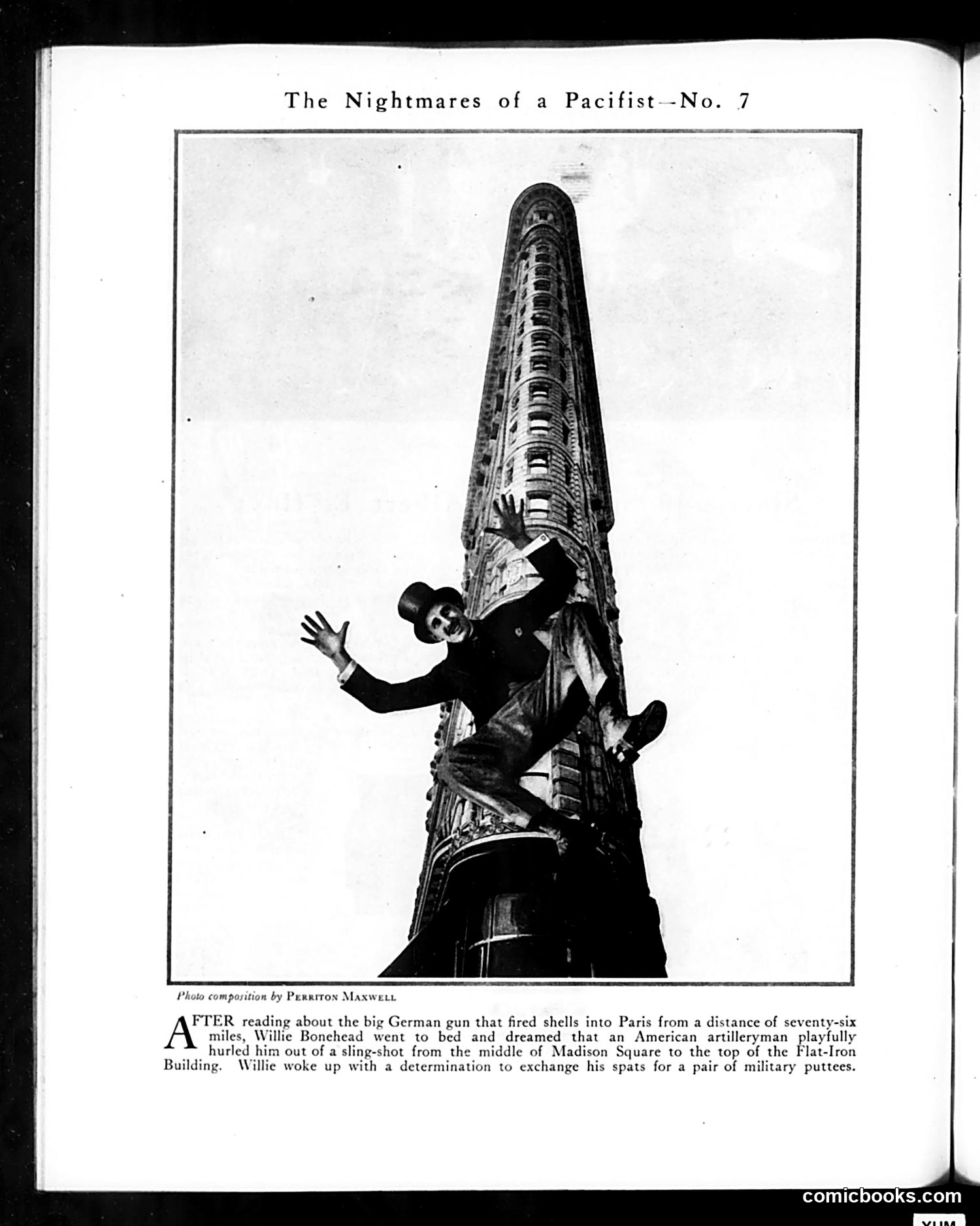
This is a satirical cartoon mocking American pacifists during World War I. The image shows a man being launched by sling-shot up a tall building (the Flatiron Building in New York). The joke targets "Willie Bonehead," a pacifist who reads about Germany's long-range artillery bombarding Paris. His nightmare—being violently launched skyward by an American soldier—is meant as dark comedy suggesting pacifists should abandon their opposition to military involvement. The satire's point: pacifism is naïve cowardice; even the threat of America entering the war should convince peaceniks to accept military service ("exchange his spats for a pair of military puttees"). This reflects Judge magazine's interventionist stance during the pre-1917 American debate over entering WWI, ridiculing those opposing U.S. military engagement.
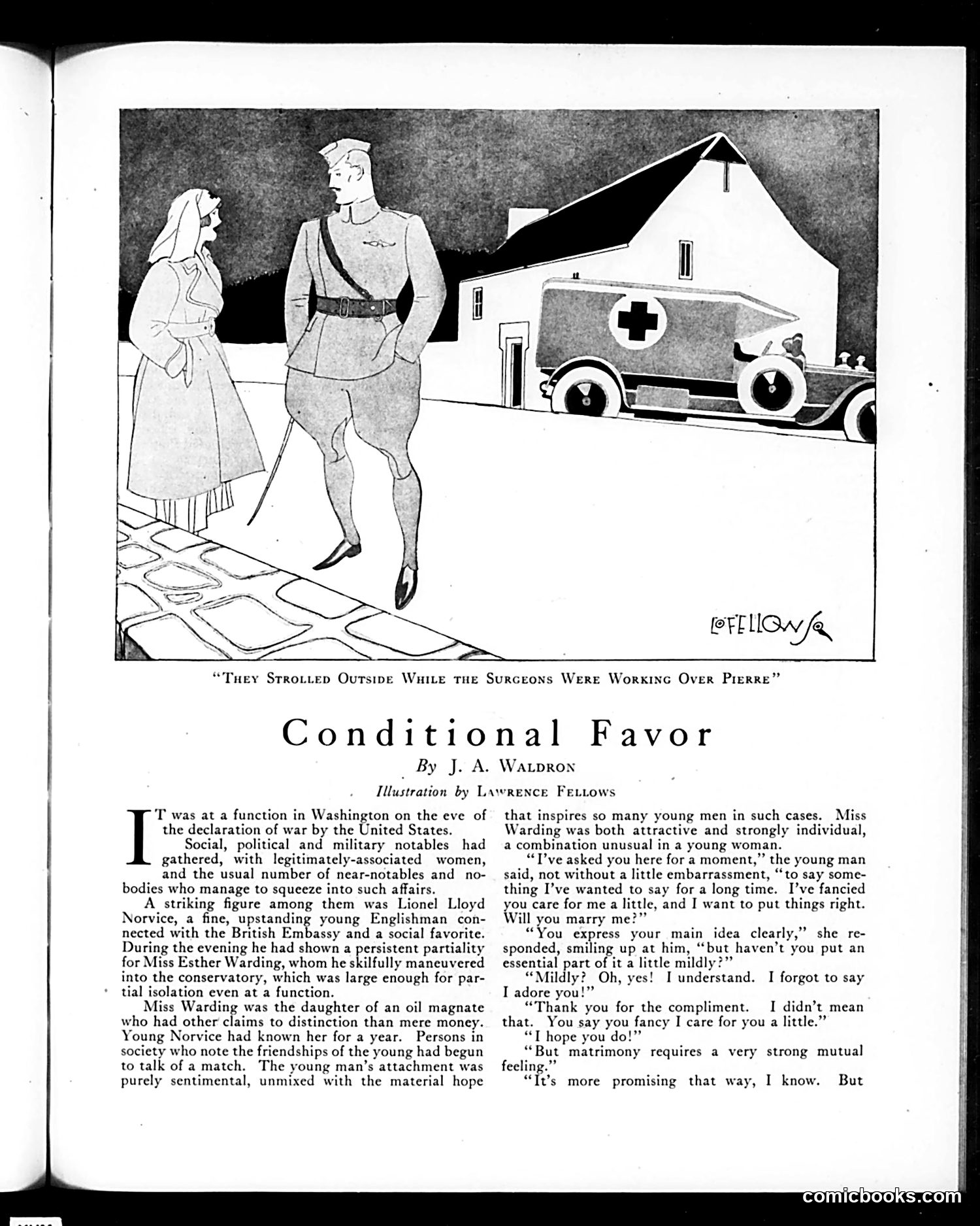
This is the opening of a short story illustrated with a cartoon showing a British military officer and a woman outside a hospital building with an ambulance—a reference to World War I medical care. The narrative involves Lionel Lloyd Norvice, a British Embassy official, proposing to Esther Warding, an American oil magnate's daughter, at a Washington function on the eve of America's entry into WWI. The cartoon's caption—"They Strolled Outside While the Surgeons Were Working Over Pierre"—suggests complications ahead involving someone named Pierre (likely French, given the name). The story satirizes the romantic entanglements and social maneuvering among the elite during wartime. Norvice's proposal, presented somewhat coldly as sentiment "unmixed with material hope," sets up tension: his attachment may be genuine, but the looming war context—and the reference to medical emergencies—suggests obstacles to their union. The "conditional favor" of the title hints that Warding's acceptance depends on something unresolved, likely Pierre's fate.
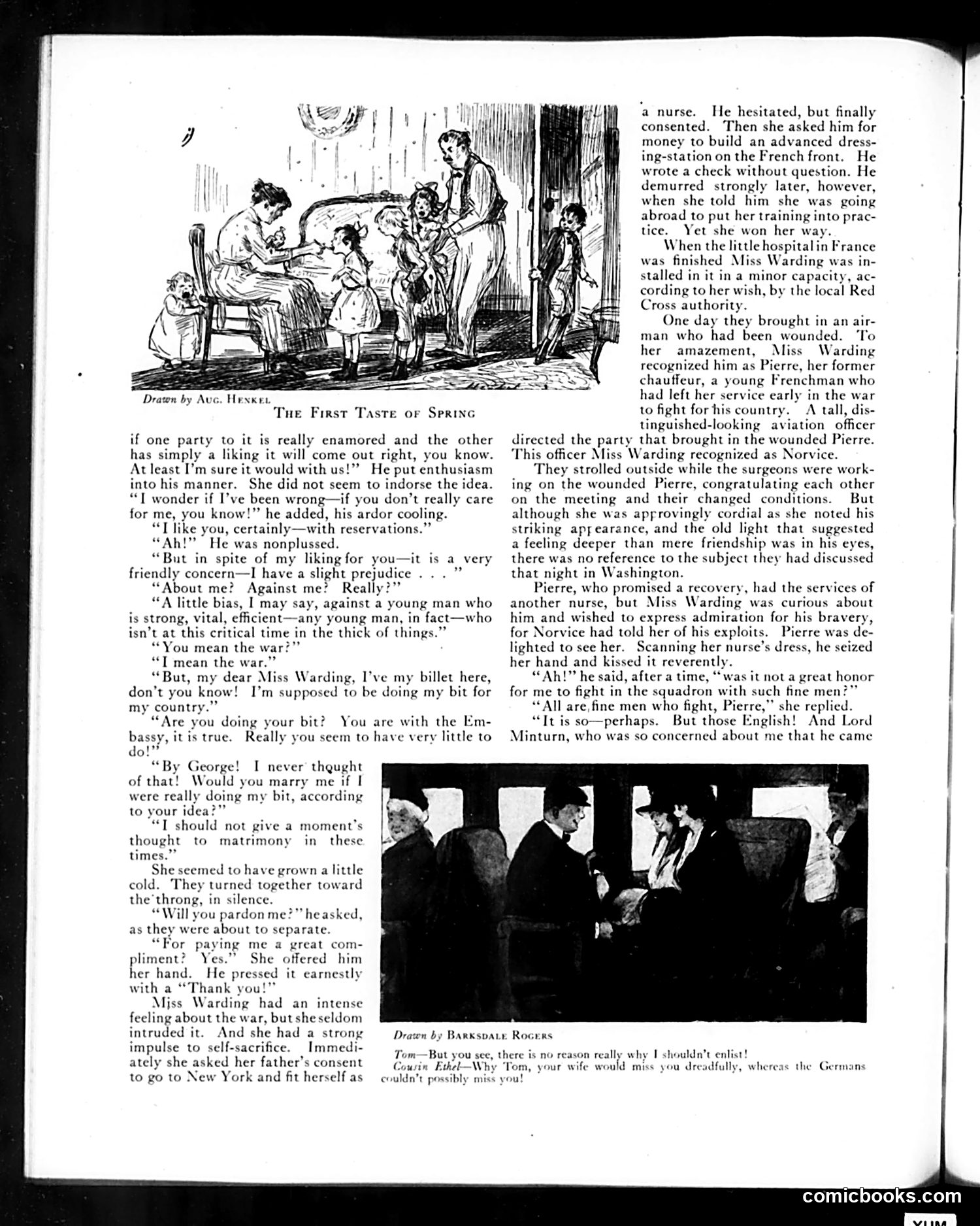
This page contains a serialized romance story illustrated by Avo Henkel, set during World War I. The narrative follows Miss Warding, a young American woman who rejects a suitor because he's not actively fighting in the war—he merely works at the Embassy. To prove his commitment, he enlists. The story shows Miss Warding's own patriotic fervor: she becomes a nurse and builds a field hospital in France. There she encounters two figures from her past: Pierre, her former French chauffeur now an aviator, and Norvice, another officer. **The satirical point** targets American attitudes toward WWI service and gender roles circa 1915-1917. Miss Warding's conditional affection—refusing romance with a man not "doing his bit"—reflects contemporary social pressure on men to enlist. Her own sacrifice (nursing abroad) portrays women's "appropriate" wartime contribution. The irony is gentle: her stringent demands on masculine duty drive his enlistment, suggesting women wielded significant moral pressure on men's military participation. The second photograph is unrelated promotional material.
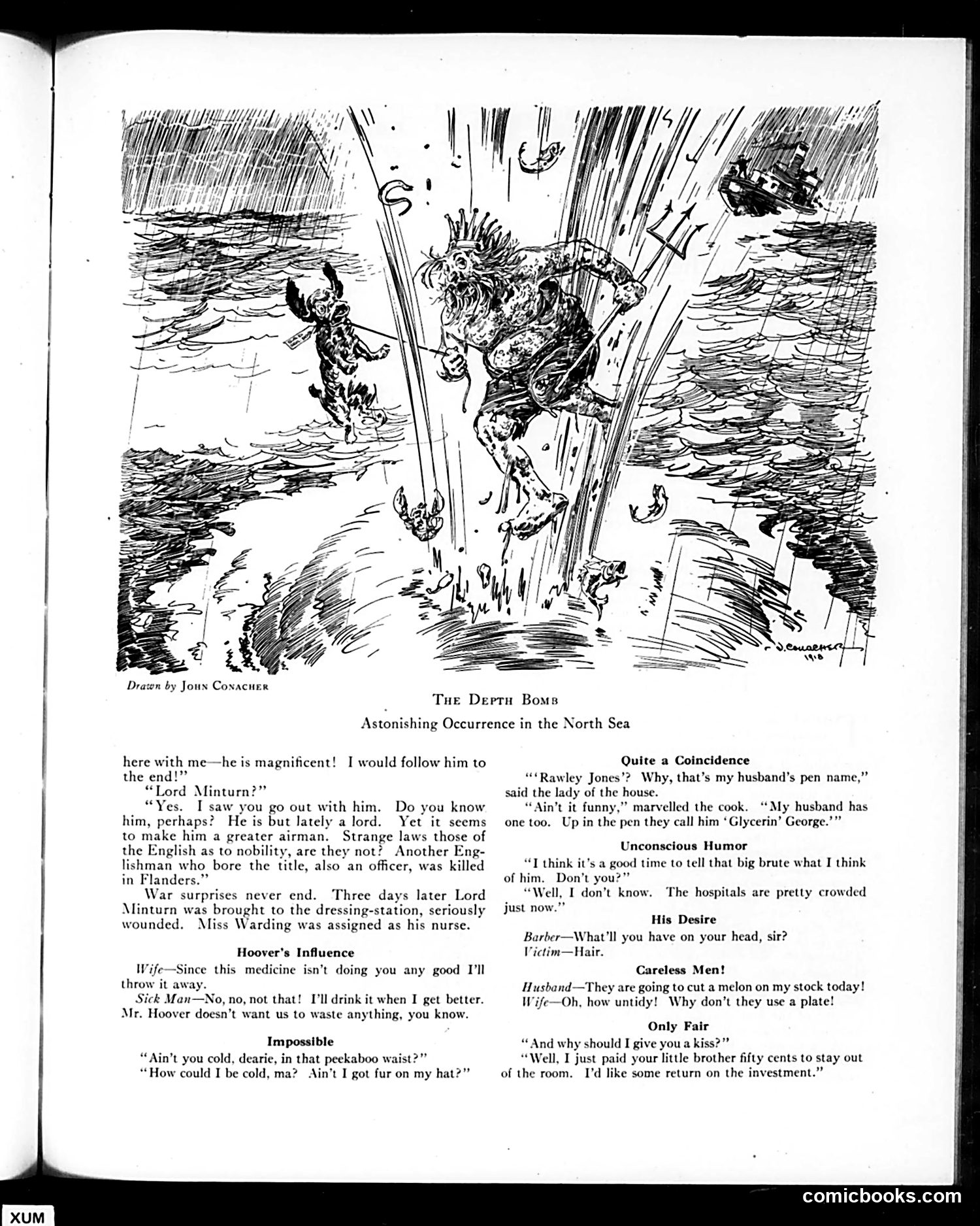
The main illustration depicts a dramatic WWI naval scene: a depth bomb explosion in the North Sea, with a grotesque creature (likely representing a German U-boat or submarine) caught in the blast. The accompanying narrative describes Lord Minturn, a newly-titled English airman, who is wounded and nursed by Miss Warding—a romantic wartime encounter. Below are brief humorous shorts reflecting 1910s-20s American domestic life: - **Hoover's Influence**: References Herbert Hoover's wartime food conservation campaign, mocking a sick man refusing to waste medicine - **Fashion/Class humor**: A woman in a revealing "peekaboo waist" claims her fur hat keeps her warm - **Domestic comedy**: Miscommunications about pen names, haircuts, melon-cutting etiquette, and relationship "investments" The page blends serious war content with lighthearted social satire typical of Judge's mixed editorial approach.
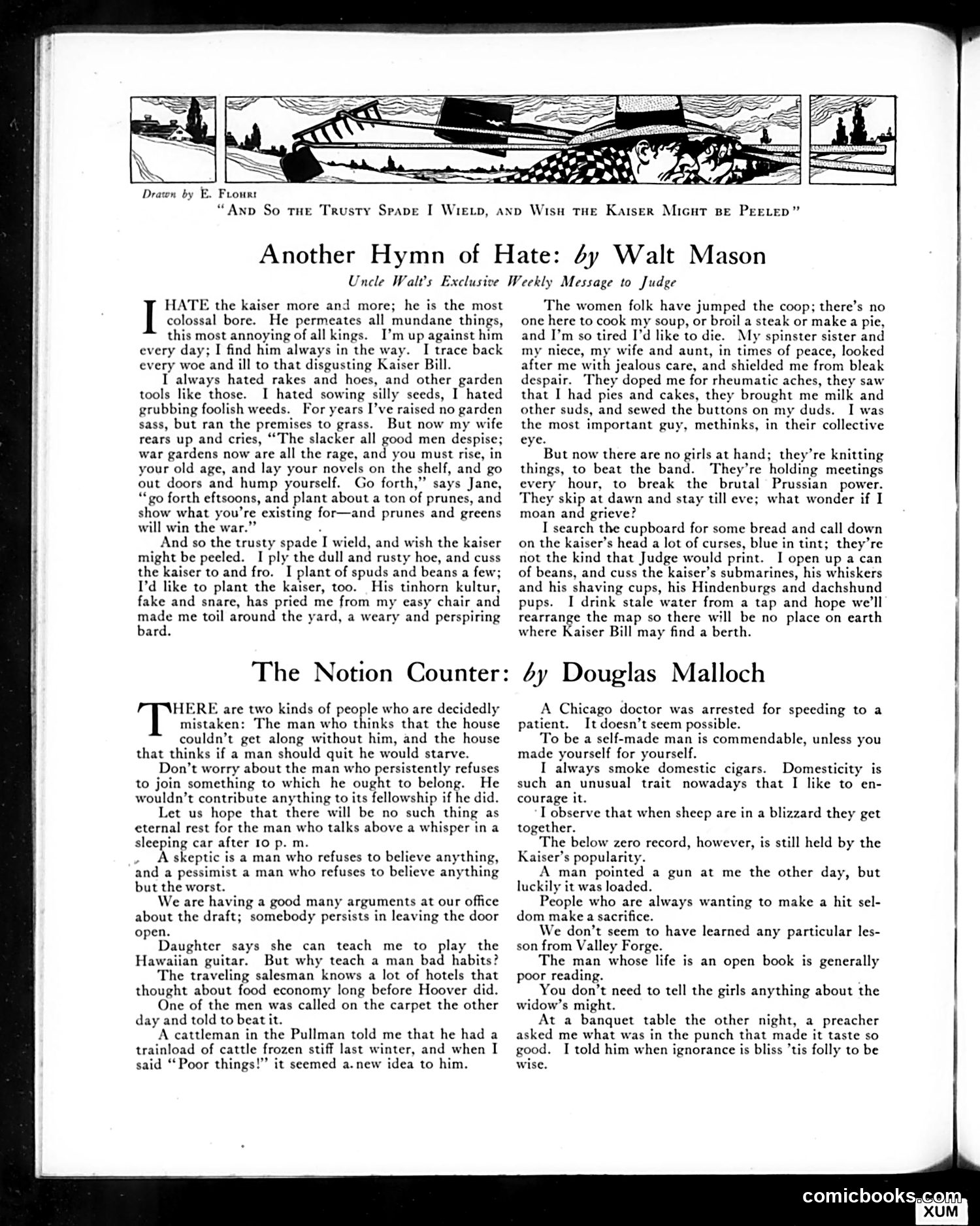
This page contains two satirical pieces from World War I-era America (likely 1917-1918): **"Another Hymn of Hate"** (by Walt Mason) depicts an aging man forced by his wife into wartime gardening and food production. The satire mocks domestic inconvenience during WWI mobilization—the narrator blames "Kaiser Bill" for everything from his lost leisure to his new yard labor. The cartoon's drawing shows him reluctantly wielding a spade. The humor targets both German resentment and American home-front grumbling about war sacrifices. **"The Notion Counter"** (by Douglas Malloch) collects brief observational humor—cynical quips about human nature unrelated to the war (skeptics, pessimists, traveling salesmen, etc.). Both pieces use Kaiser Wilhelm II as a villain/scapegoat. The satire assumes readers' anti-German sentiment while gently mocking American civilians complaining about minor wartime inconveniences like gardens and missing family members engaged in war work.
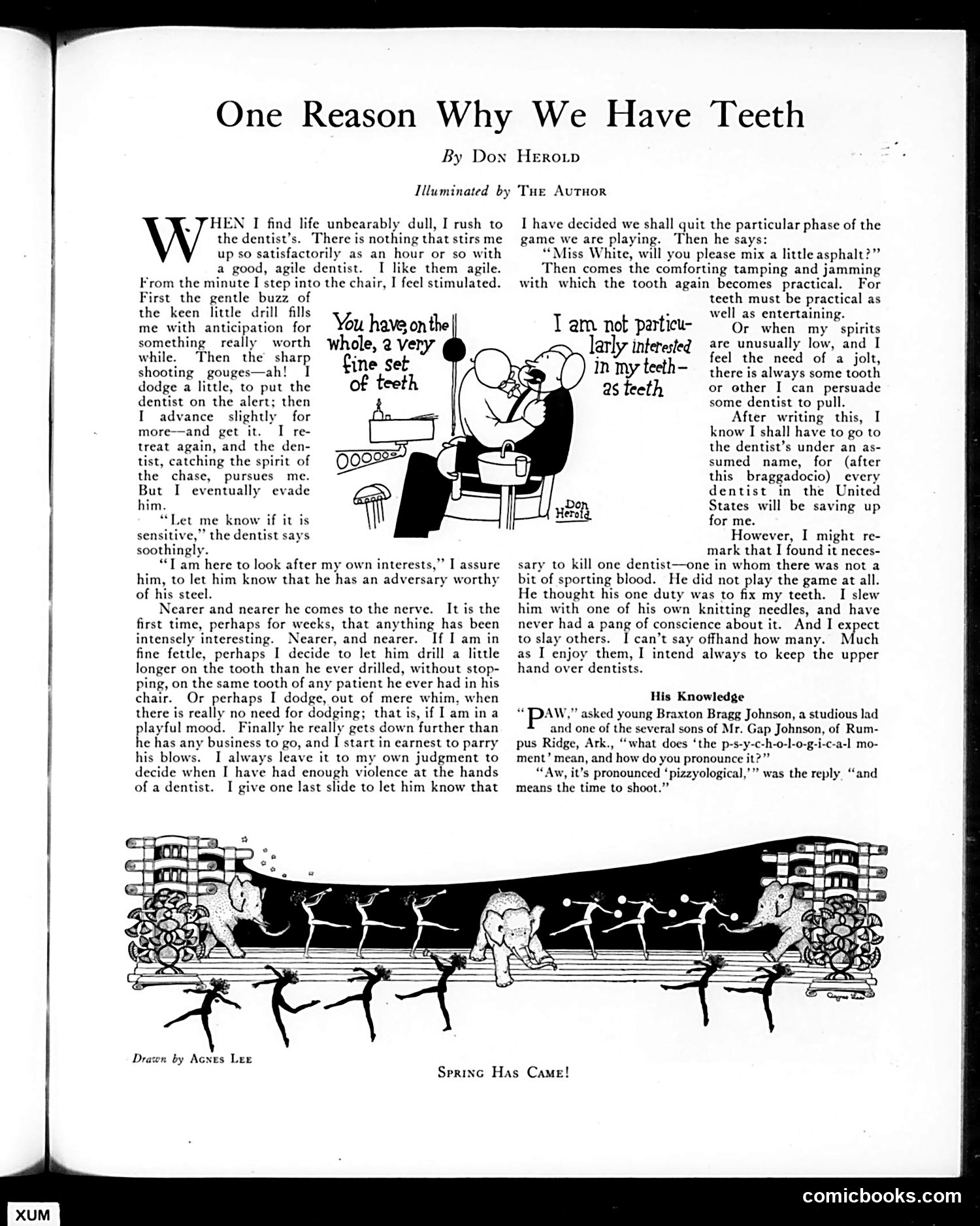
This 1920s *Judge* magazine page presents two satirical pieces: **Main Article: "One Reason Why We Have Teeth"** by Dox Herold uses exaggerated first-person humor. The author describes visiting a dentist as his primary entertainment—essentially playing a cat-and-mouse game where he deliberately dodges the drill, engages in playful combat, and admits to murdering a dentist who took the work seriously rather than treating it as sport. The satire mocks both the author's boredom-driven desperation for excitement and the adversarial dynamic some people have with dental care. The illustration shows a patient and dentist in animated conflict. **Sidebar: "His Knowledge"** is a brief joke about rural mispronunciation. A boy asks his father what "psychological moment" means; the father misunderstands it as "pizzyological" and defines it as "the time to shoot"—implying trigger-happy frontier mentality. The humor targets rural/uneducated speech patterns. The bottom illustration shows figures in motion, possibly related to spring activities. Both pieces trade in early 20th-century class-based humor targeting rural Americans and mock-heroic exaggeration.
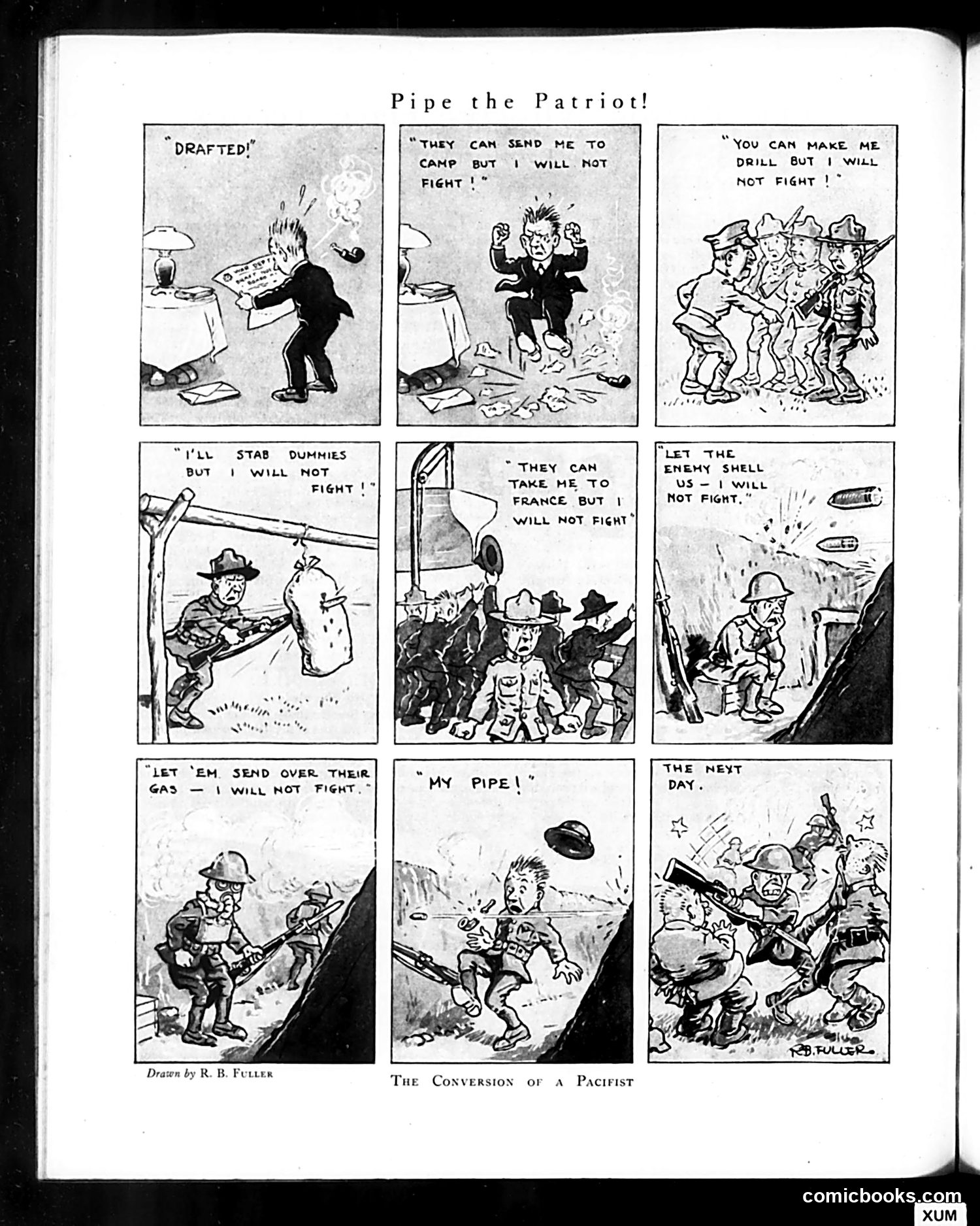
This comic satirizes American pacifists during World War I. A drafted man repeatedly declares he "will not fight" under various circumstances—when sent to camp, to France, when facing enemy shells, or gas attacks. Each refusal is presented as principled pacifism. The joke culminates in "The Conversion of a Pacifist": the final panel shows the same man actively fighting with enthusiasm "the next day," implying his pacifist convictions evaporated instantly when faced with actual combat. The satire mocks pacifists as hypocritical—willing to make grand moral declarations about refusing military service until genuine danger forces them to abandon their principles. The title "Pipe the Patriot" suggests mockery of someone claiming patriotic moral superiority while avoiding service. This reflects American WWI-era contempt for draft resisters and conscientious objectors.
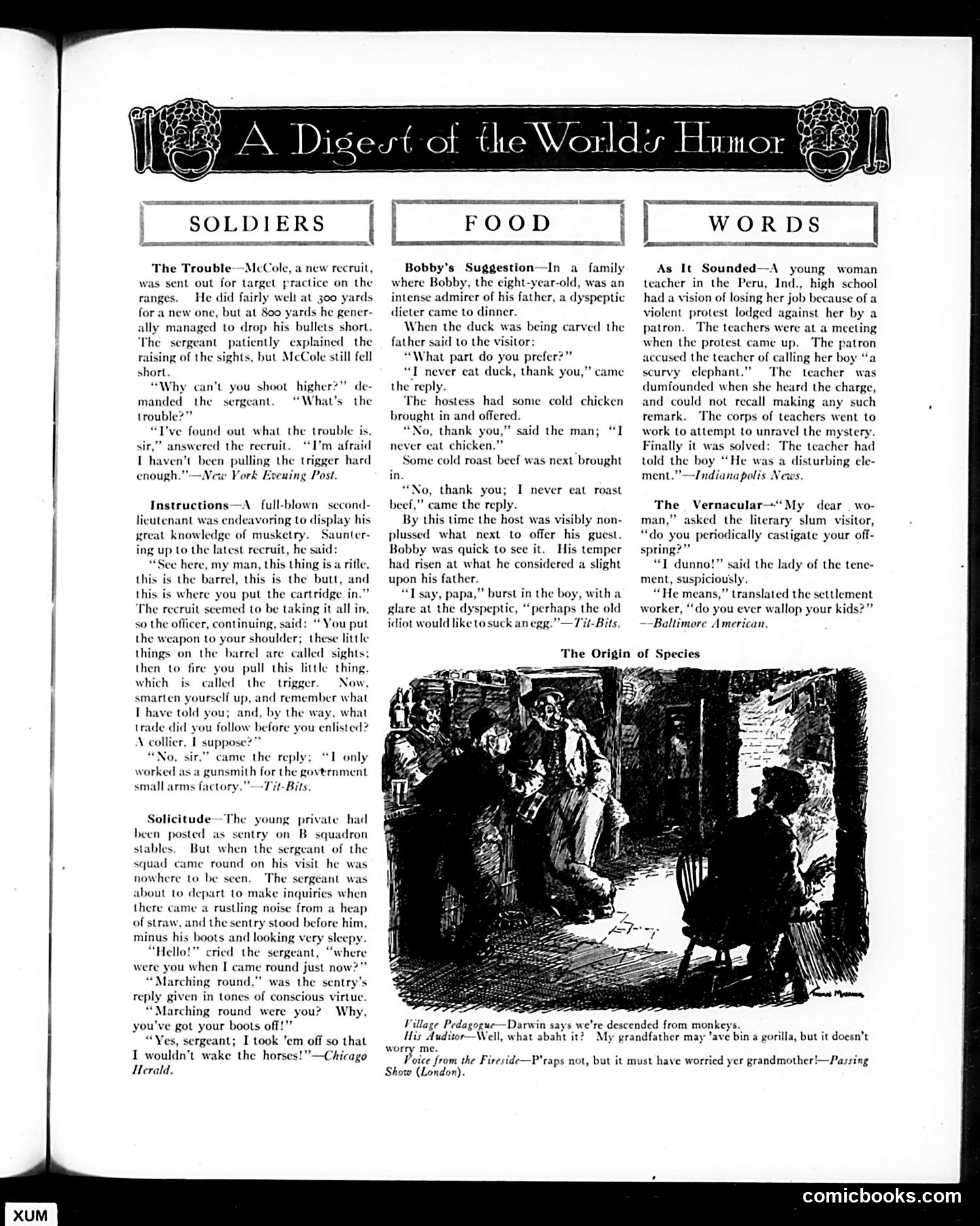
This page from *Judge* contains three soldier anecdotes and three miscellaneous jokes, typical of the magazine's format. The humor relies on wordplay and situational irony: **"The Trouble"** mocks a recruit's fundamental misunderstanding—he believes pulling the trigger harder affects bullet trajectory, not sight adjustment. **"Instructions"** satirizes military hierarchy: an officer patronizingly explains rifle basics to a recruit who turns out to be a former gunsmith, exposing the officer's pompous ignorance. **"Solicitude"** jokes about a sentry removing his boots while standing guard so as not to disturb horses—absurd logic presented deadpan. The non-soldier jokes include a child's crude solution to a picky guest ("perhaps the old idiot would like to suck an egg"), a mishearing of "disturbing element" as "scurvy elephant," and a social worker's pretentious vocabulary confusing a tenement resident. The humor targets military foolishness, class pretension, and miscommunication—standard *Judge* fare for this era.
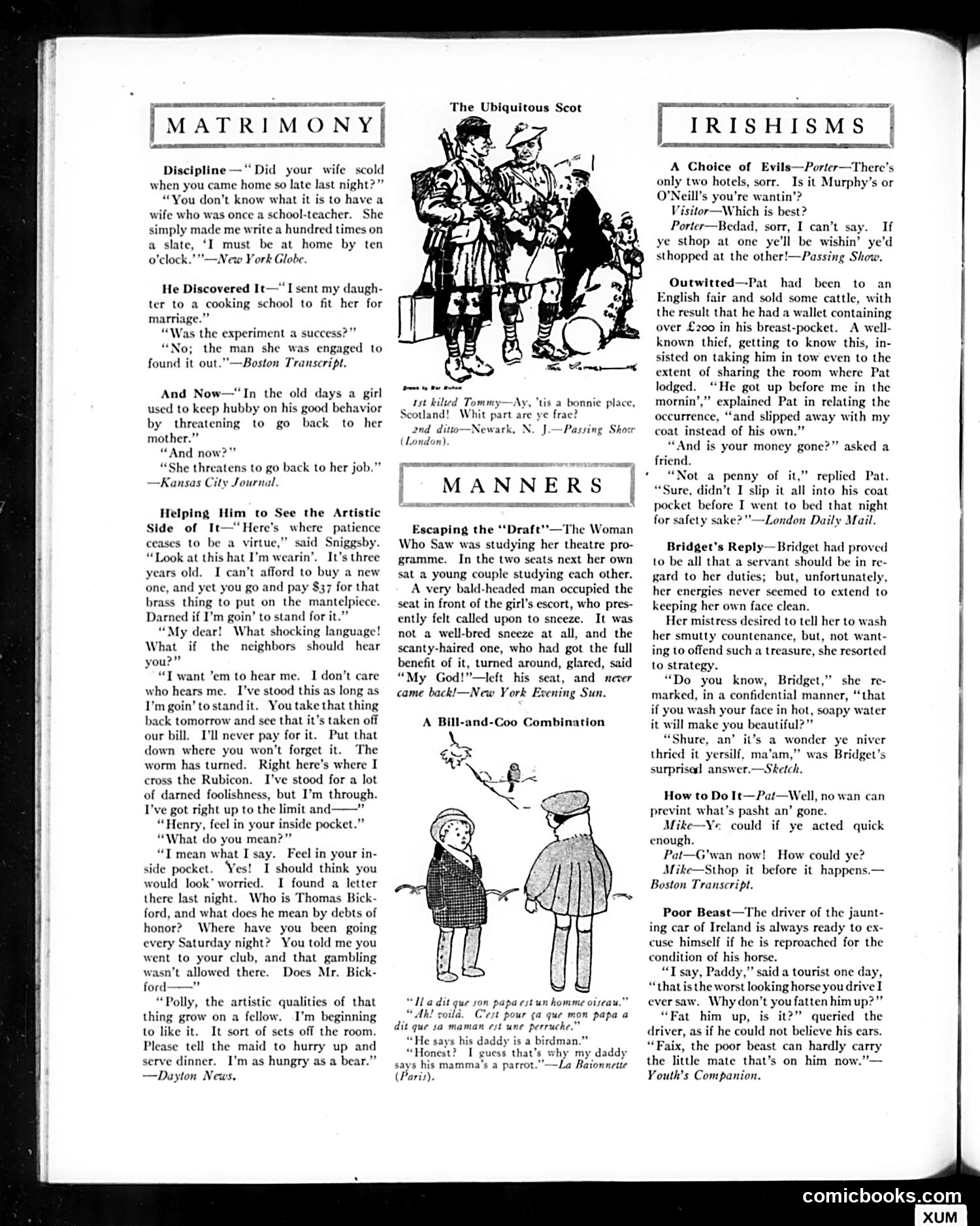
This page from Judge contains several short humorous anecdotes organized by topic, reflecting early 20th-century American domestic and social life. **MATRIMONY** section satirizes marriage dynamics: wives controlling husbands through nagging (echoing schoolteacher discipline), unexpected cooking skills deterring suitors, and wives now threatening to return to jobs rather than mothers' homes—reflecting women's increasing workforce participation. **MANNERS** and **IRISHISMS** sections present brief comedic vignettes about etiquette breaches and Irish stereotypes (including dialect humor and the traditional "cunning Irishman outwitting a thief" trope). **The Ubiquitous Scot** cartoon depicts Scottish immigrants—one from Scotland, one from Newark, New Jersey—meeting in kilts, joking about Scottish identity persisting regardless of location. The **Bill-and-Coo Combination** shows French dialogue between children making animal metaphors about parents. The overall tone reflects period humor about gender relations, immigration, and class dynamics, with heavy reliance on ethnic stereotypes and domestic conflict as entertainment for Judge's educated middle-class readership.
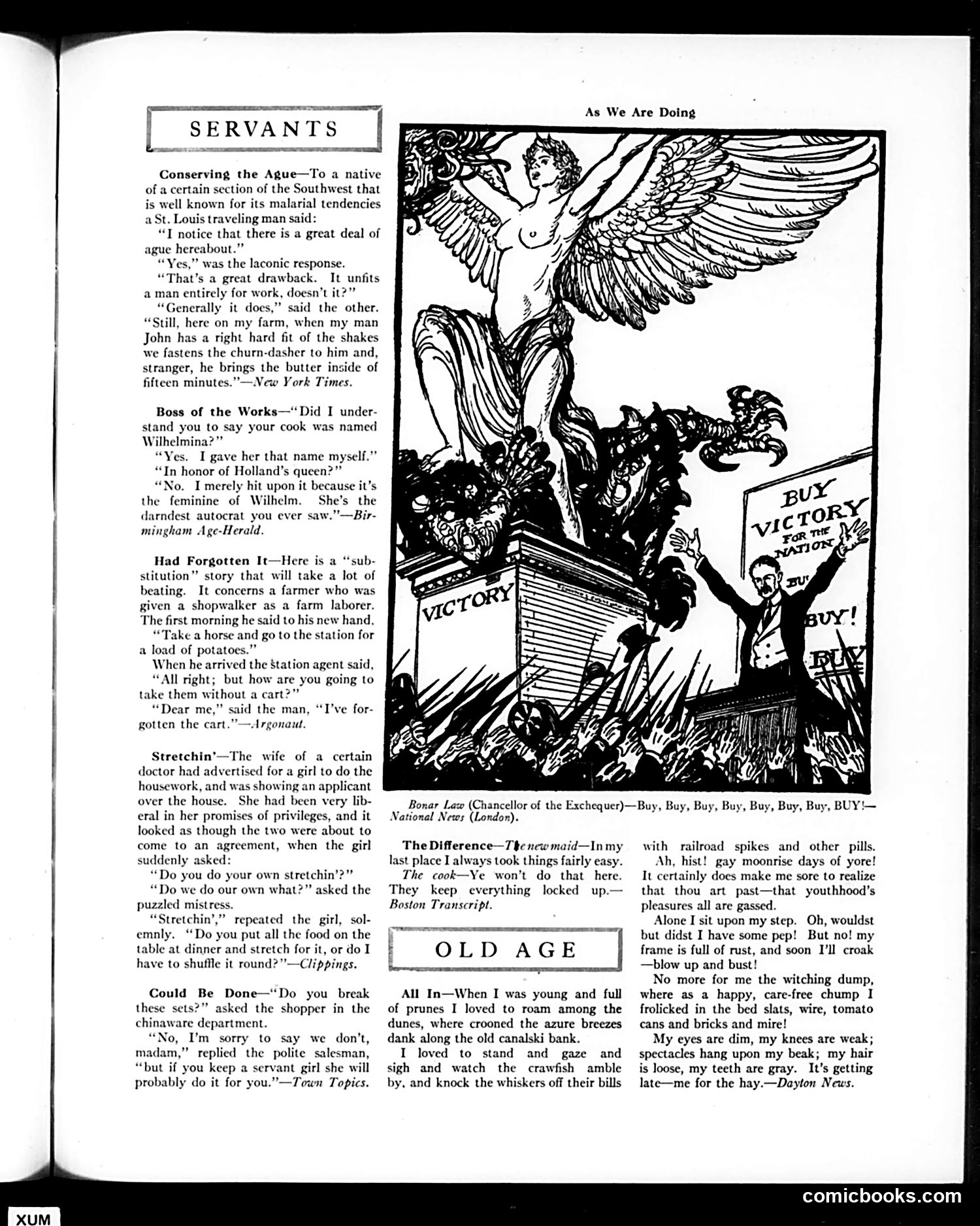
This page contains humorous anecdotes and a WWI-era political cartoon. The main cartoon depicts **Bonar Law** (British Chancellor of the Exchequer), shown as a winged figure driving people toward "Victory" signs while shouting "Buy! Buy! Buy!"—satirizing government demands for war bonds and financial contributions to fund the war effort. The surrounding text consists of brief jokes about servants, farm laborers, and domestic life. Most notably, "Had Forgotten It" mocks a shopwalker (department store clerk) reassigned as farm labor—suggesting he's incompetent at manual work. "Stretchin'" jokes about servant girls' misunderstandings of household duties, reflecting class divisions and servant-employer tensions of the era. The "Old Age" poem uses nostalgic, exaggerated language ("youthhood's pleasures all are gassed") to humorously lament aging and lost vitality—the WWI reference ("gassed") suggesting this appeared during or shortly after the war. The cartoon's core message: government financial pressure on citizens during wartime.
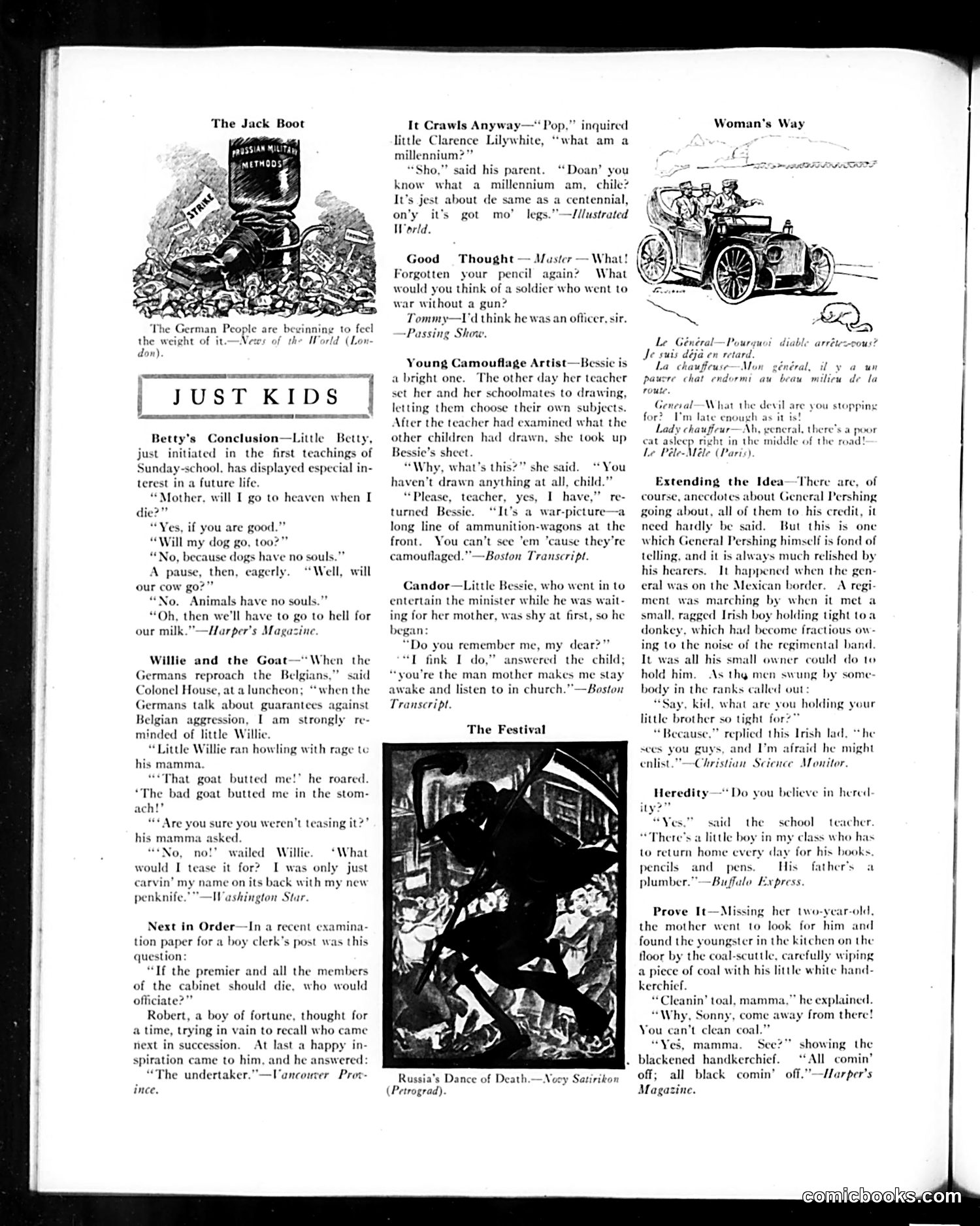
This page from *Judge* magazine contains WWI-era satirical content. The title piece, "The Jack Boot," references German military aggression—the "jack boot" was a symbol of Prussian militarism. The accompanying illustration depicts the burden of German militarism crushing civilians. The "Just Kids" section uses children's dialogue to mock current events: "Willie and the Goat" compares German complaints about Belgian aggression to a child falsely accusing a goat of attacking him while admitting he carved his name on its back—satirizing German hypocrisy about invading Belgium. "Young Camouflage Artist" jokes about wartime camouflage tactics. Other pieces reference General Pershing and the Mexican border, dating this to the WWI period. The page reflects American satirical commentary on the European war, using humor to criticize German militarism and celebrate Allied figures like Pershing.
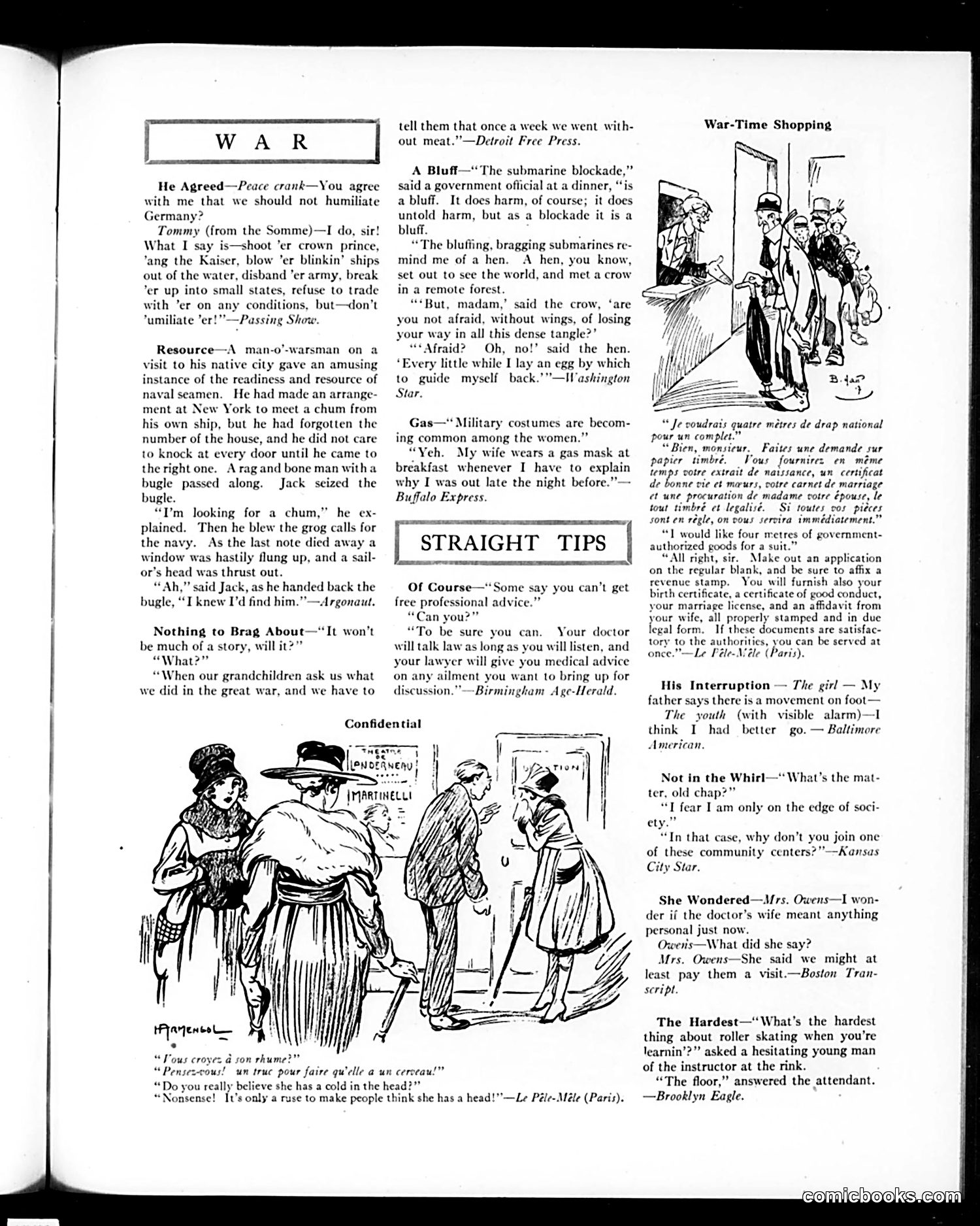
This Judge magazine page contains WWI-era satirical content. The main cartoon (top left) mocks "peace cranks"—pacifists opposing German punishment. A British soldier (Tommy) from the brutal Somme battlefield agrees they shouldn't "humiliate" Germany, then immediately contradicts himself by advocating harsh military destruction, revealing the hypocrisy of those claiming mercy while supporting devastating warfare. The "War-Time Shopping" cartoon (right) satirizes excessive wartime bureaucracy. A customer simply buying fabric must provide multiple official documents—birth certificates, marriage licenses, affidavits—a absurdist critique of government overreach during wartime rationing and control. Other brief anecdotes mock submarine warfare bluffing, gas mask fashion during chemical weapons threats, and conflicting professional advice. The page reflects 1917-1918 anxieties about military excess, government intrusion, and the war's absurdities.
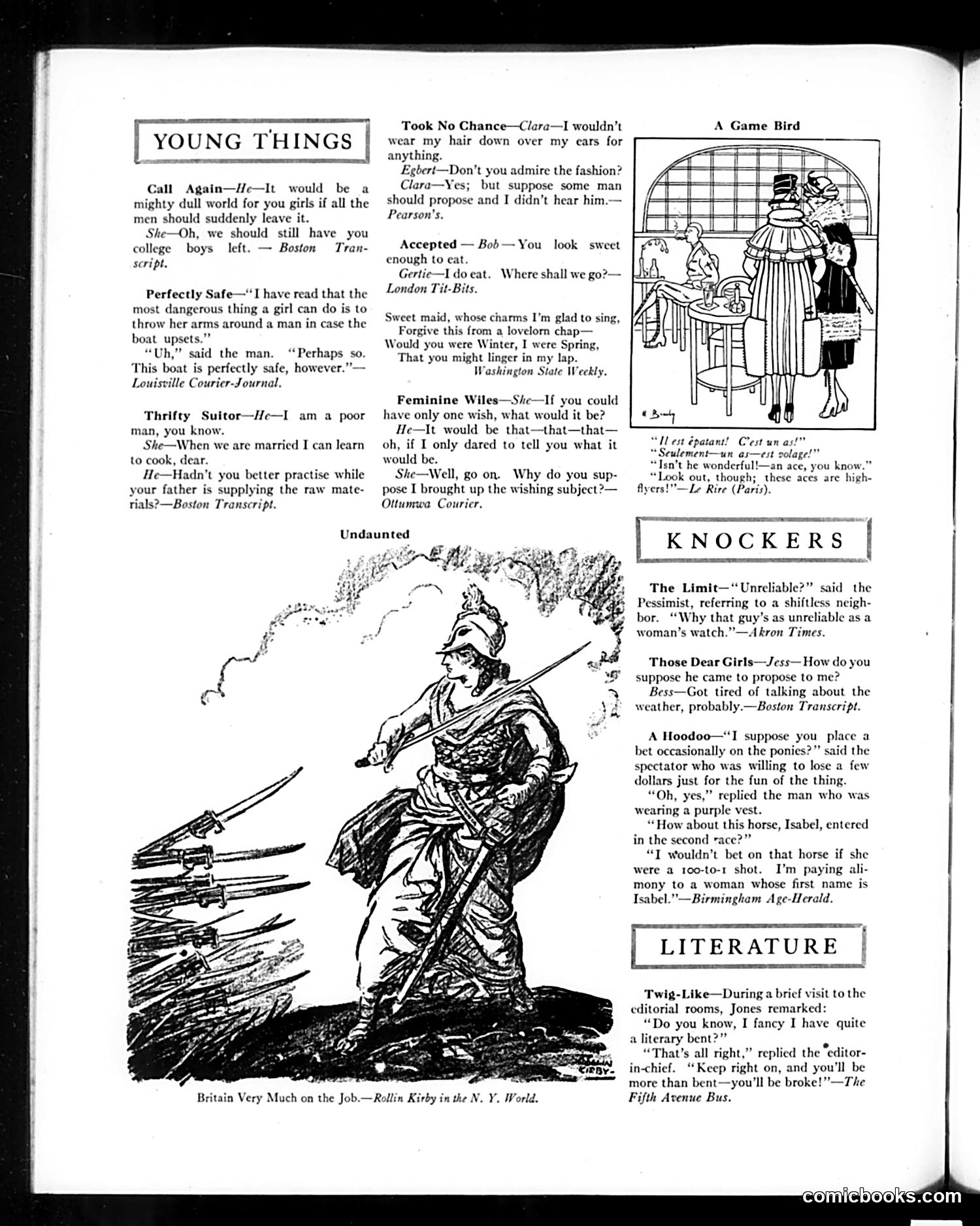
This page from *Judge* magazine contains brief humorous anecdotes (labeled "Young Things," "Knockers," and "Literature") plus one political cartoon. The **cartoon "Undaunted"** depicts a WWI soldier standing firm amid battlefield chaos—rifles stacked nearby, landscape scarred. The caption credits Rollin Kirby and references "Britain Very Much on the Job." This satirizes British resolve during World War I, likely from the American perspective during or shortly after the conflict, celebrating British military determination despite brutal conditions. The text sections are light domestic humor: men and women bantering about romance, dating, and marriage. These jokes—about proposals, eating, gambling, and unreliable behavior—reflect early 20th-century courtship anxieties and gender stereotypes common to *Judge's* satirical tone. The **"Game Bird"** section, credited to *Le Rire* (Paris), uses French dialogue about an "ace" who is "flighty"—a playful double meaning treating romantic success like gambling or aviation. Overall, the page mixes wartime patriotism with light social satire about courtship and character flaws.
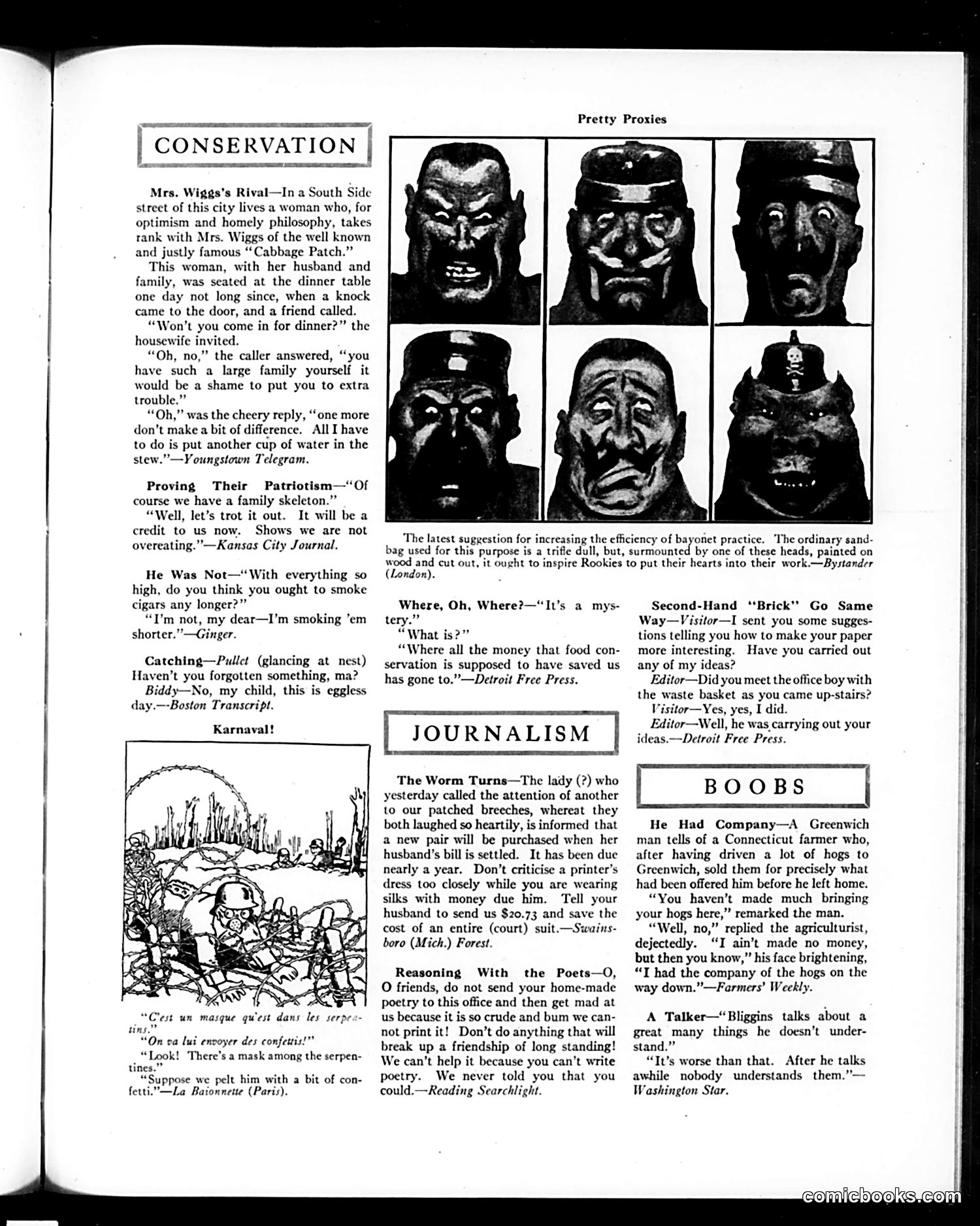
The cartoon section labeled "Pretty Proxies" shows six grotesque mask heads and references bayonet practice training. The caption explains these painted wooden heads are meant to replace sandbags used in bayonet drills, supposedly to motivate soldiers ("Rookies") by making the targets resemble enemy faces. This is **WWI-era satire** mocking military training methods. The horrific, dehumanized faces represent the enemy (likely German soldiers), and the joke is darkly cynical: the military believes making practice dummies look like actual people will inspire soldiers to thrust bayonets with more enthusiasm. The grotesque, caricatured nature of the masks—exaggerated features suggesting non-European faces—reflects period racial and ethnic stereotyping common in wartime propaganda. Modern readers should recognize this as both documenting wartime dehumanization tactics and expressing satirical criticism of such brutalization of combat training. The attribution to the *Bystander* (London) confirms this is British wartime commentary on military practices.
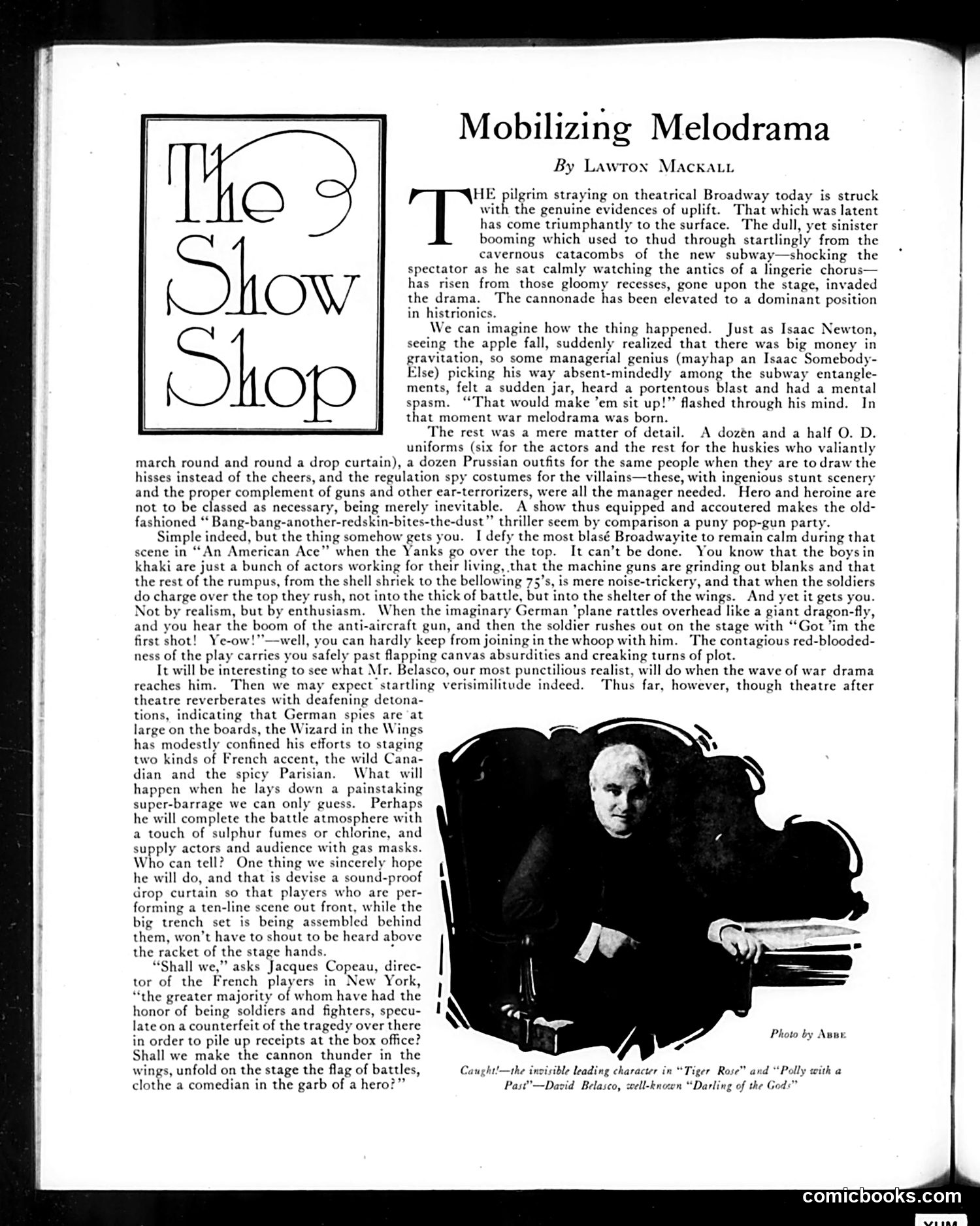
This article satirizes Broadway's opportunistic embrace of World War I themes in theatrical productions. Author Lawton Mackall mocks theater producers who cynically capitalized on wartime enthusiasm by retrofitting melodramas with military spectacle—uniforms, sound effects, stage battles, and explosions—to create "war dramas" that had little substance beyond sensationalism. The satire targets how these productions manipulate audiences emotionally through noise and patriotic fervor rather than genuine storytelling. Mackall notes the irony: audiences know actors are firing blanks and rushing into stage wings, yet remain swept up by the manufactured excitement. He specifically references producer David Belasco (the "Wizard in the Wings," visible in the accompanying photograph), wondering if even this famously meticulous realist will succumb to adding more theatrical "authenticity"—humorously suggesting Belasco might add actual poison gas effects. The piece represents wartime criticism of how commercial entertainment exploits patriotic sentiment for profit.
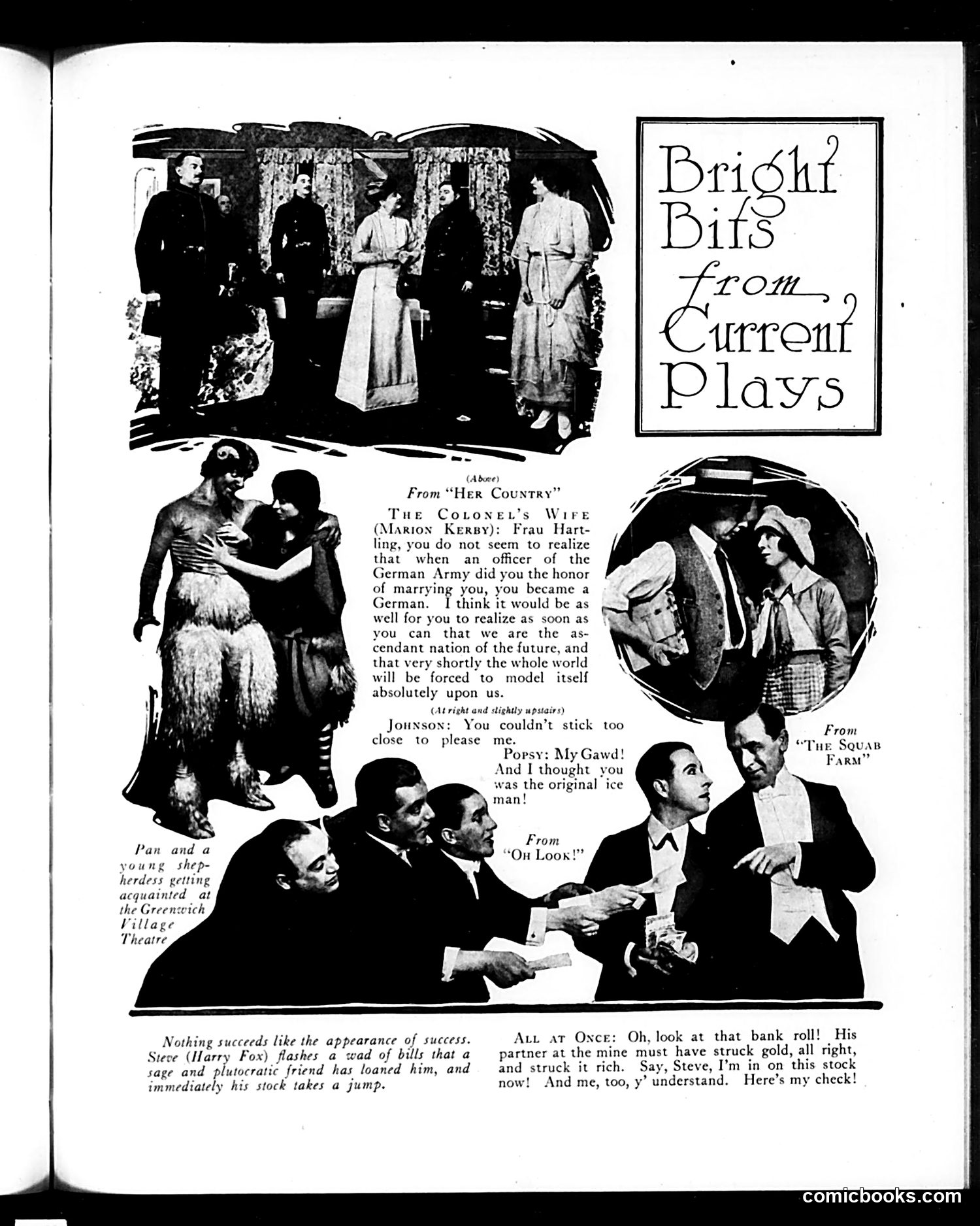
This page showcases theatrical excerpts from contemporary Broadway productions, mixing dramatic and comedic scenes. The content reflects early 20th-century stage humor and social attitudes. The "Her Country" scene depicts a German officer lecturing his American wife on German superiority—likely satirizing pre-WWI German militarism and xenophobia. The dialogue mocking Pan (a character type) and the "On Look!" bit with Johnson and Popsy appear to be comedic vaudeville-style exchanges about flirtation. The bottom caption about "Steve" illustrates a common theatrical trope: appearance of wealth (a borrowed "wad of bills") immediately attracts investors seeking quick riches. This satirizes human gullibility and get-rich-quick schemes—a recurring theme in early 20th-century social commentary. The page functions as entertainment promotion while subtly critiquing social pretense and wartime attitudes.
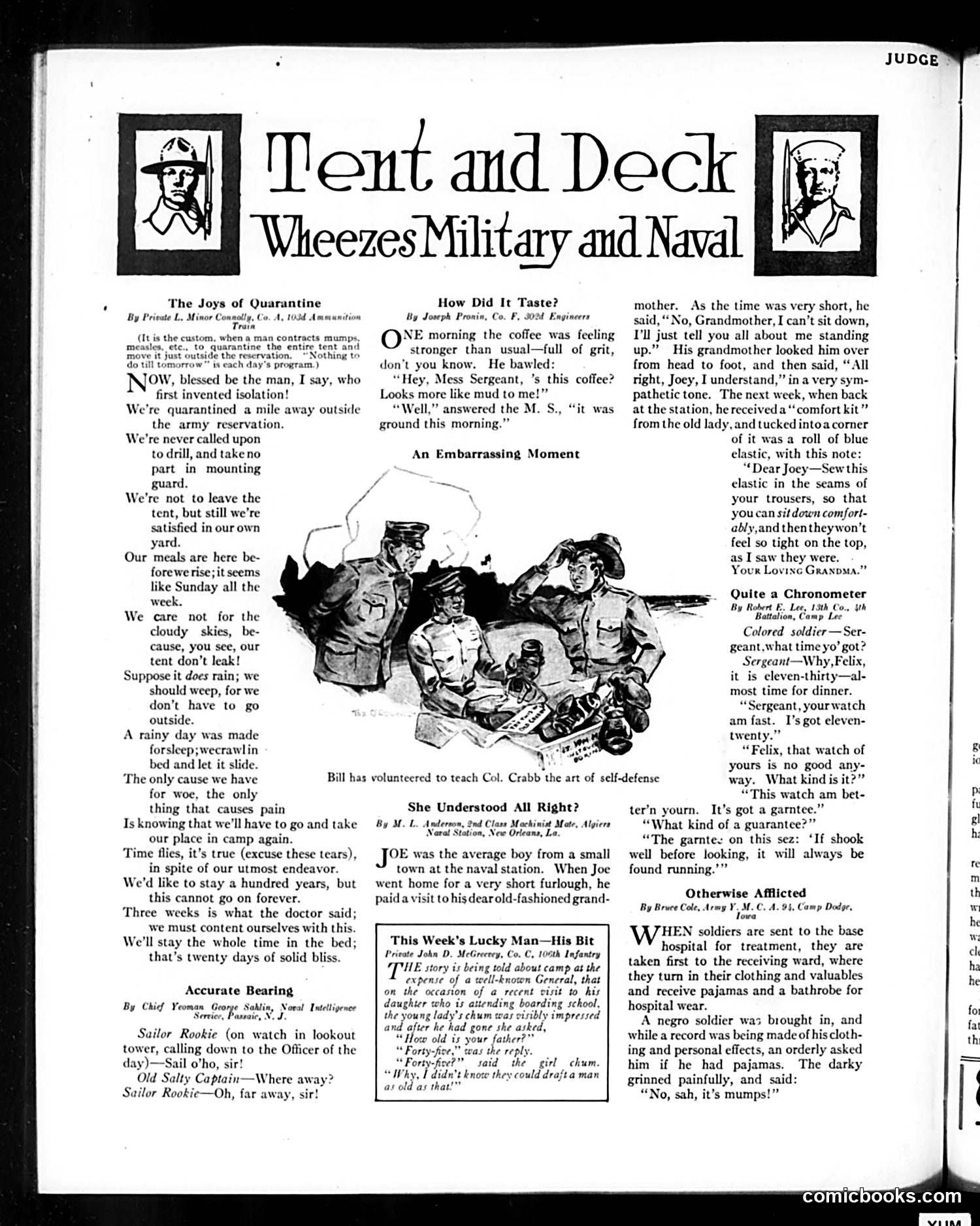
This page from *Judge* magazine collects humorous anecdotes and cartoons about soldiers' camp life, likely from World War I. The pieces satirize military routine through enlisted men's perspectives. "The Joys of Quarantine" mocks the tedium of isolation duty—soldiers celebrate avoiding drills and guard duty, sleeping late, and enjoying easy meals, though quarantine eventually ends. "How Did It Taste?" jokes about terrible camp coffee, comparing it to mud. "An Embarrassing Moment" references Colonel Crabb teaching self-defense, though the cartoon's full context is unclear. "She Understood All Right?" depicts a grandmother misinterpreting her grandson's standing posture, then helpfully sending elastic to tighten his loose uniform trousers. The racial humor in "Quite a Chronometer" reflects the period's casual stereotyping of Black soldiers, featuring dialect humor about a faulty watch with a humorous "guarantee." These pieces aimed at both soldiers and civilians, blending complaint with affection for military life's absurdities.
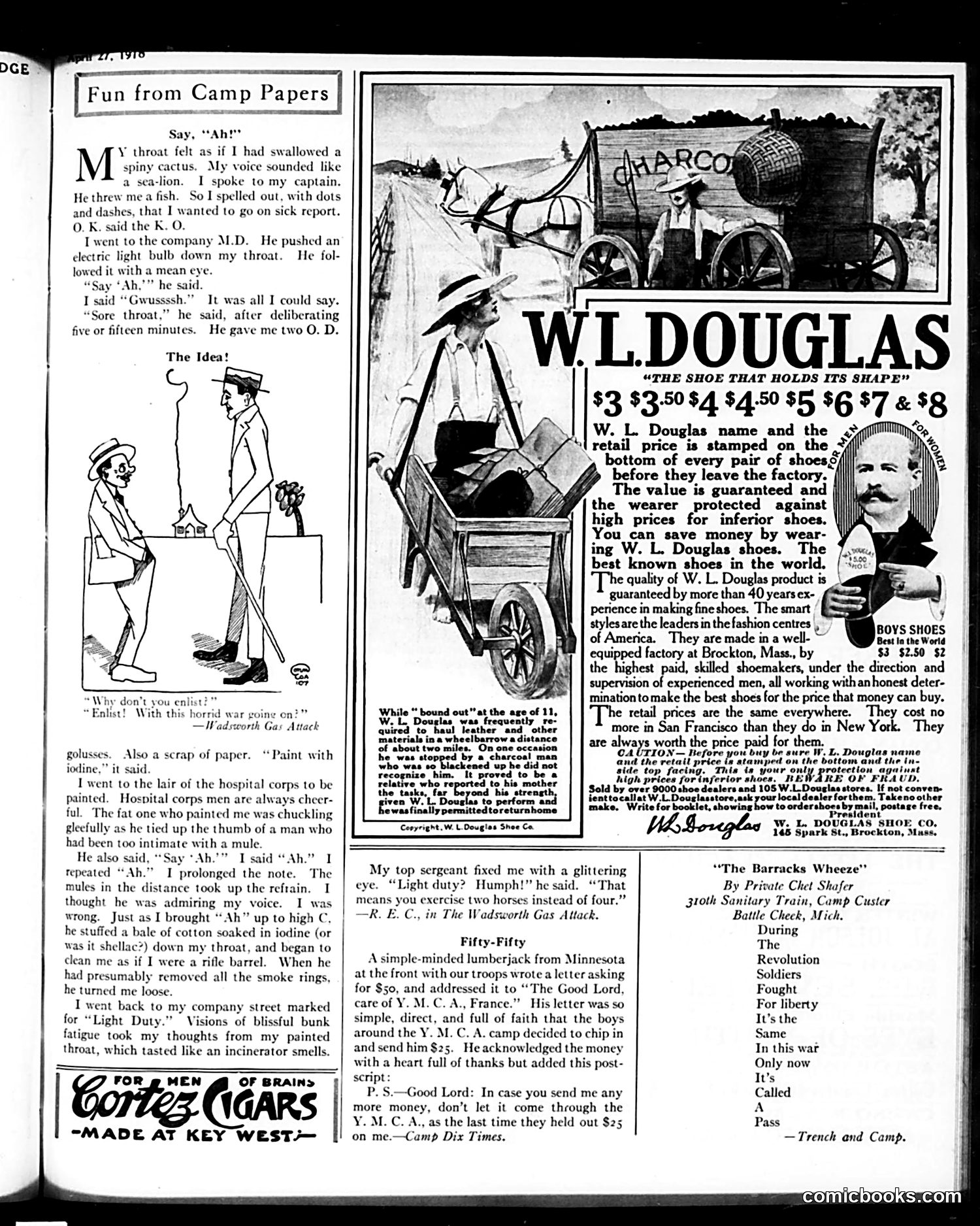
This page contains WWI military camp humor and period advertising. The main cartoon depicts a soldier with throat pain visiting a military doctor who prescribes "light duty." The humor relies on the soldier's voice sounding so terrible after treatment that mules in the distance mimic his cries—a slapstick joke about poor medical care in army camps. The surrounding anecdotes mock army bureaucracy and soldiers' creative schemes to avoid hard labor. One story describes a soldier painting his thumb to seem injured; another depicts a sergeant sarcastically reassigning "light duty" soldiers to exercise horses anyway. The page primarily features a large **W.L. Douglas shoe advertisement**, a major brand promising durability and fair pricing—a significant selling point during wartime inflation. The ad emphasizes quality control and protection against inflated prices. At bottom, "Fifty-Fifty" tells of a simple Minnesota soldier's letter to "The Good Lord, care of Y.M.C.A., France"—reflecting genuine soldiers' faith and the YMCA's role providing moral support to troops.
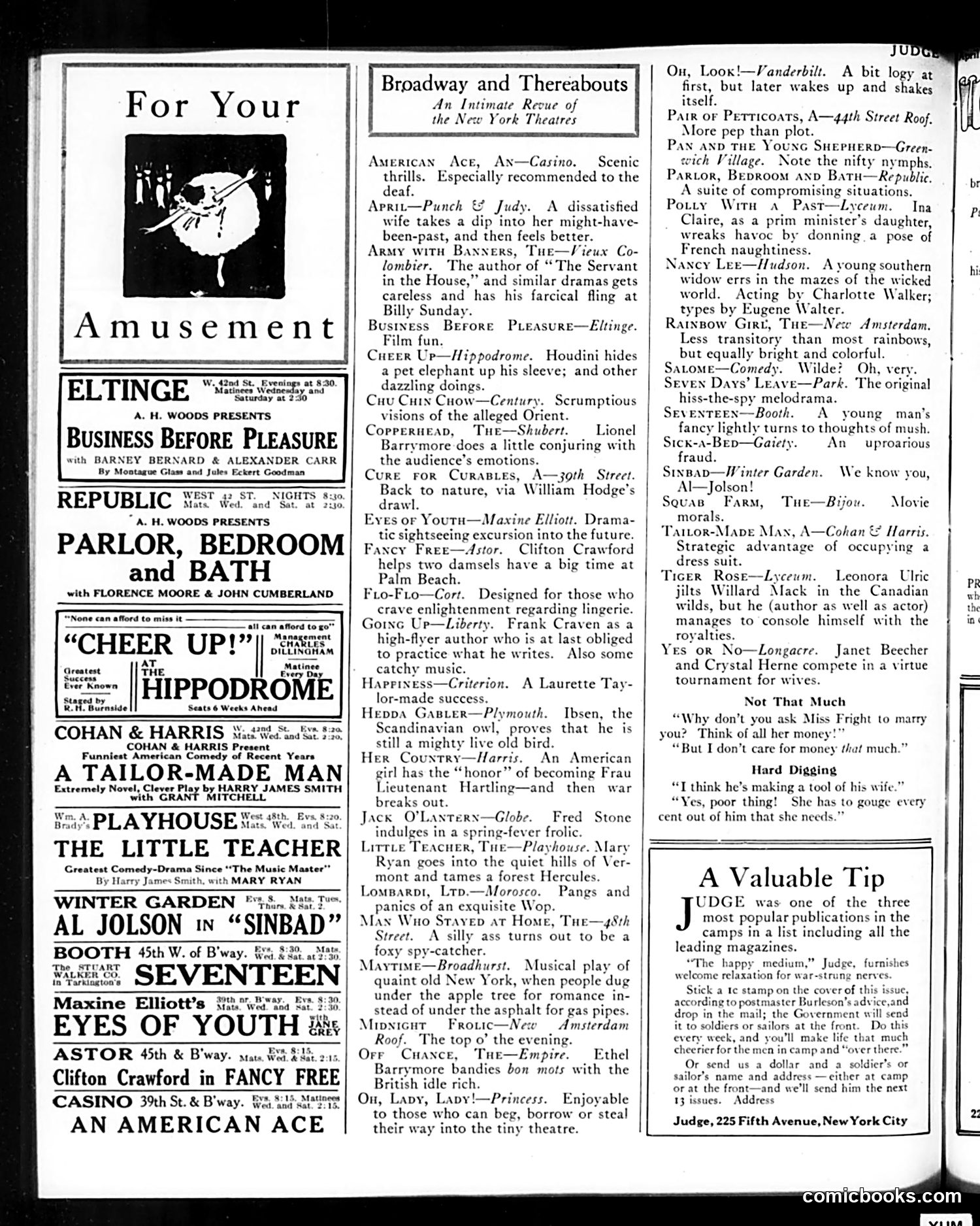
This page is primarily **theater advertising and reviews** for Broadway shows, typical of Judge magazine's entertainment coverage. The left column lists current productions with brief critical descriptions; the right column contains more detailed reviews. The content reflects **early 1920s theatrical tastes**: musical comedies, farces about romantic entanglements, and dramatic adaptations dominate. Notable is a review of "A Tailor-Made Man" and several shows featuring major stars like Al Jolson and Clifton Crawford. The reviews employ **period-specific humor and stereotypes**—one show is described as "Pangs and panics of an exquisite Wop" (referring to an Italian character), reflecting casual ethnic caricature common to the era. Another notes a character in "Her Country" becomes "Frau Lieutenant Hartling—and then war breaks out," playing on post-WWI anxieties. This page documents what New York theater-goers considered entertainment worth advertising to Judge's educated, affluent readership.
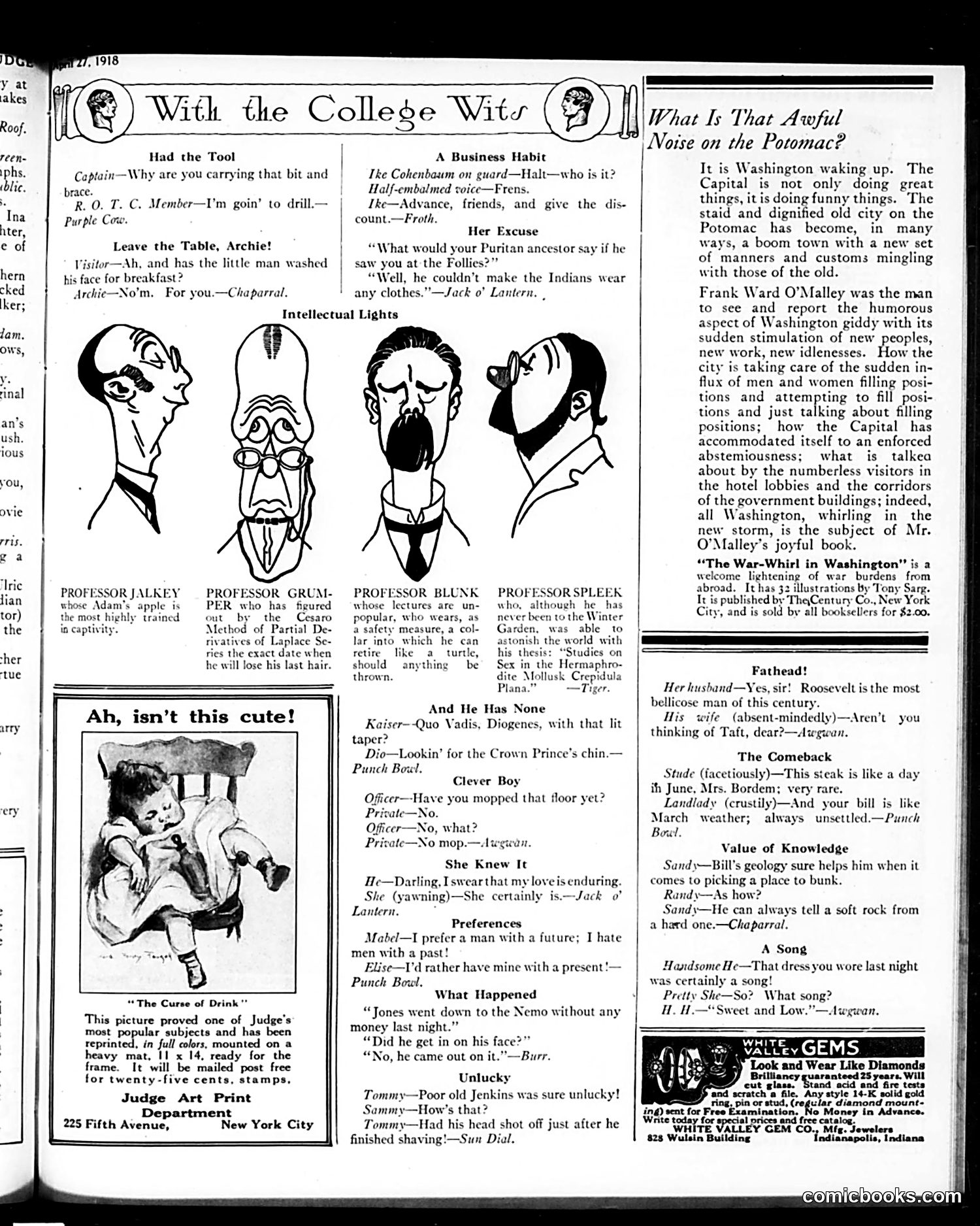
This is a **humor page from Judge magazine** (June 27, 1918) featuring short college jokes and satirical content typical of the era. **"Intellectual Lights"** presents four exaggerated academic stereotypes—pompous professors with absurd specialties (calculating hair loss via calculus; studying hermaphrodite mollusks). The satire mocks overwrought academic pretension. **Other jokes** reflect WWI-era humor: an R.O.T.C. member carrying drill equipment; a dark joke about a soldier shot after shaving (normalizing battlefield deaths); references to Washington D.C.'s wartime boom as a "boom town." **The advertisement section** promotes Frank Ward O'Malley's book *"The War-Whirl in Washington,"* depicting the capital's chaotic transformation during wartime mobilization. The final joke about Roosevelt versus Taft reflects ongoing political divisions between these former allies, still relevant in 1918. Overall, the page captures wartime American humor—crude, sometimes morbid, college-focused, and politically aware.
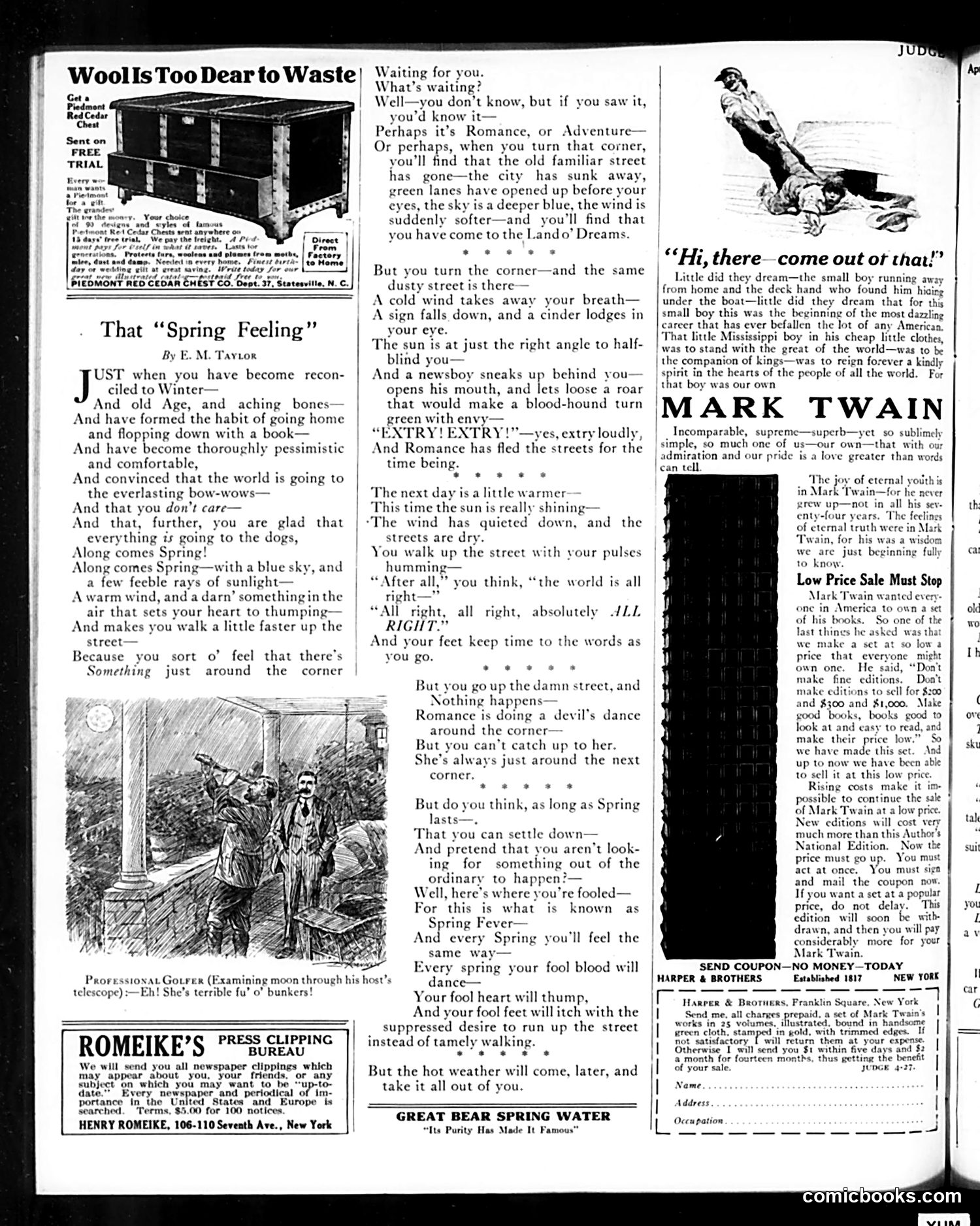
This page contains two main pieces of satirical content: **"That 'Spring Feeling'" (By E.M. Taylor):** A humorous essay-poem about the psychological cycle of spring fever. The satire targets the predictable human response to mild weather: winter brings resignation and pessimism, but spring's arrival—blue skies, warm breezes—rekindles irrational hope and restlessness. The joke is that despite romance and adventure seeming "just around the corner," reality delivers only dusty streets, newsboys yelling, and cinders in your eye. Yet people repeat this cycle annually, unable to resist spring's false promises. It's gentle satire of human nature's susceptibility to seasonal mood swings and unfounded optimism. **Supporting elements include period advertisements** (Red Cedar Chests, Mark Twain book sales, a press clipping bureau) that fill remaining space—typical for Judge's era. The cartoon illustration of a golfer examining the moon through binoculars is unrelated visual humor, likely a separate piece about sporting absurdity.
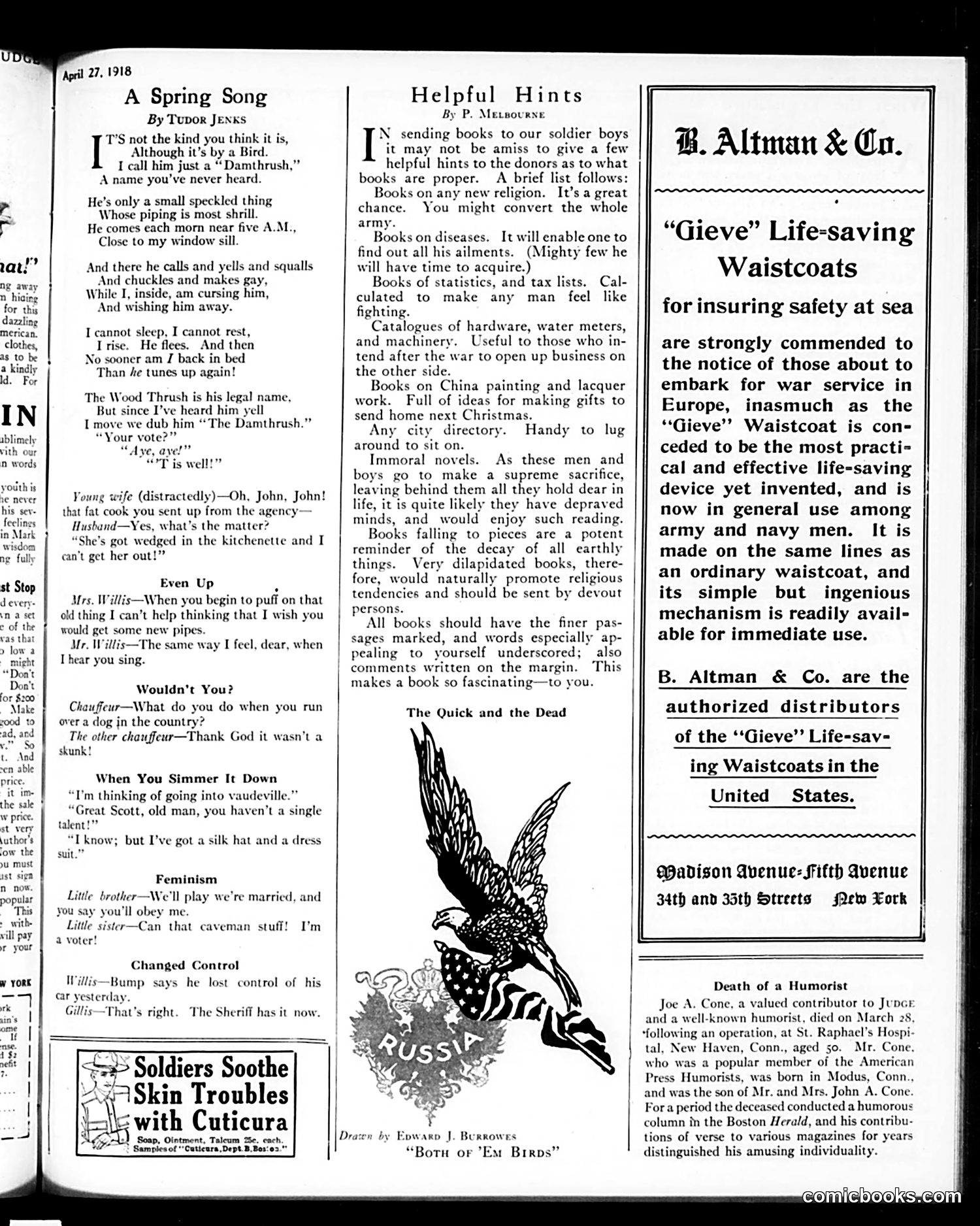
This page contains WWI-era humor and advertising reflecting wartime concerns. **"A Spring Song"** satirizes an early-morning bird (Wood Thrush) that disrupts sleep—a light domestic complaint contrasted with the serious wartime context outside. **"Helpful Hints"** offers tongue-in-cheek advice about sending books to soldiers. The satire mocks both sentimental donors and the absurdity of their selections—suggesting they send religious conversion materials, disease books, and "immoral novels" to demoralized troops. This ridicules well-meaning but tone-deaf home-front support efforts. **"The Quick and the Dead"** (cartoon by Edward J. Burrows) depicts an eagle grasping Russia, illustrated as a nest of chicks labeled "Both of 'Em Birds." This references Russia's chaotic exit from WWI (the 1917 revolution and subsequent civil conflict), portraying the nation as prey—a commentary on Russian instability during the war. The page otherwise contains domestic humor about marriage and gender (reflecting 1918 feminism debates) and a "Gieve" life-jacket advertisement targeting those enlisting for European service.
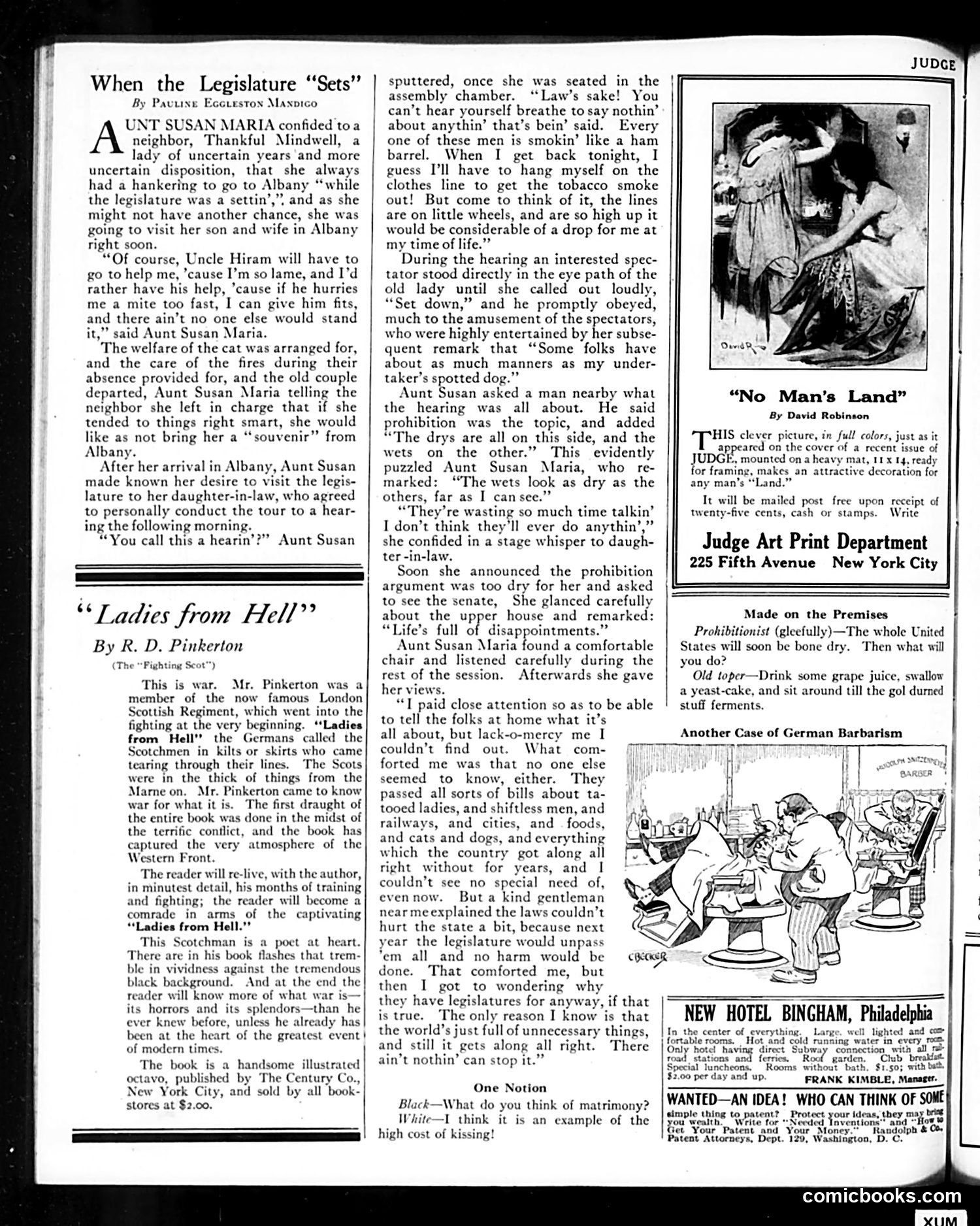
This page contains two distinct pieces of content: **"When the Legislature Sets"** (main story): A humorous narrative about Aunt Susan Maria, a rural elderly woman visiting the New York State Legislature in Albany. The satire mocks both the legislative process and rural ignorance: the legislature is portrayed as chaotic and ineffectual (endless talking about prohibition with no results), smoky, and disorderly. Aunt Susan's comments—about the noise, the smoking, calling out "Set down" to an obstructing spectator—satirize her blunt country manners while also suggesting the legislature itself is undignified and deserving of such treatment. **"Ladies from Hell"** (book advertisement): A sidebar promoting R.D. Pinkerton's WWI memoir about Scottish soldiers. The title references the German nickname for kilted Scottish troops. This advertises a serious war book, not satire. **The political reference**: The prohibition debate mentioned was a major legislative issue during the Prohibition era (1920s), making this story timely commentary on futile political grandstanding around alcohol regulation.
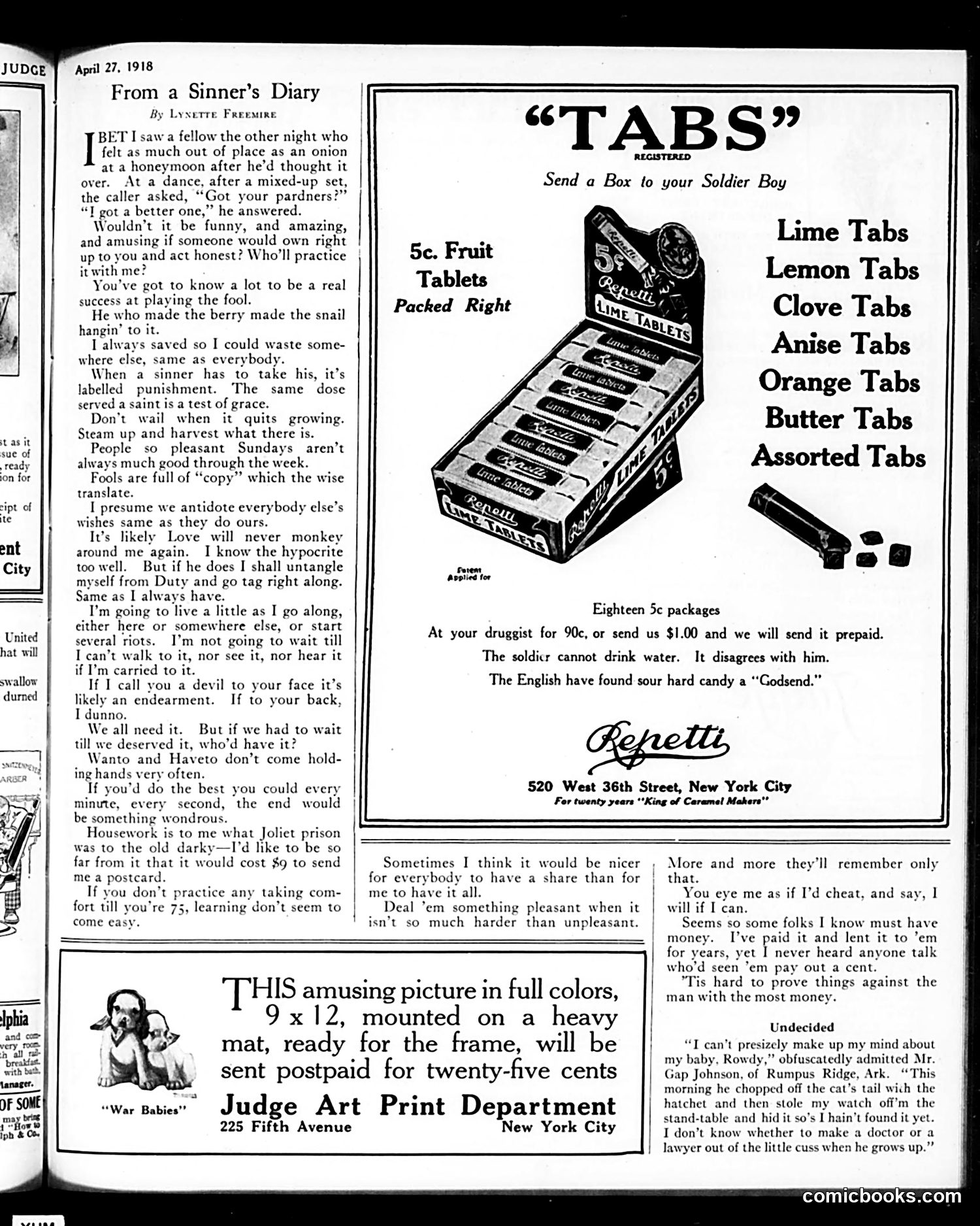
This page contains a cynical personal essay by Lysette Freemire alongside advertisements. The essay presents sardonic observations about human nature and morality: people are hypocritical (pleasant on Sundays, unreliable weekdays), dishonest, and reluctant to acknowledge their flaws. The author contemplates living for pleasure rather than duty, skepticism about love, and the futility of housework. The main advertisement promotes "Tabs" candy tablets for soldiers, marketed as a substitute for water (which "disagrees" with soldiers) and endorsed by the British as a "Godsend." A secondary ad offers a "War Babies" art print. The context is **World War I** (note the 1918 date and soldier references). The essay's cynicism about human nature and willingness to bend morality reflects wartime disillusionment. The candy's marketing to soldiers reflects home-front support efforts during the war.
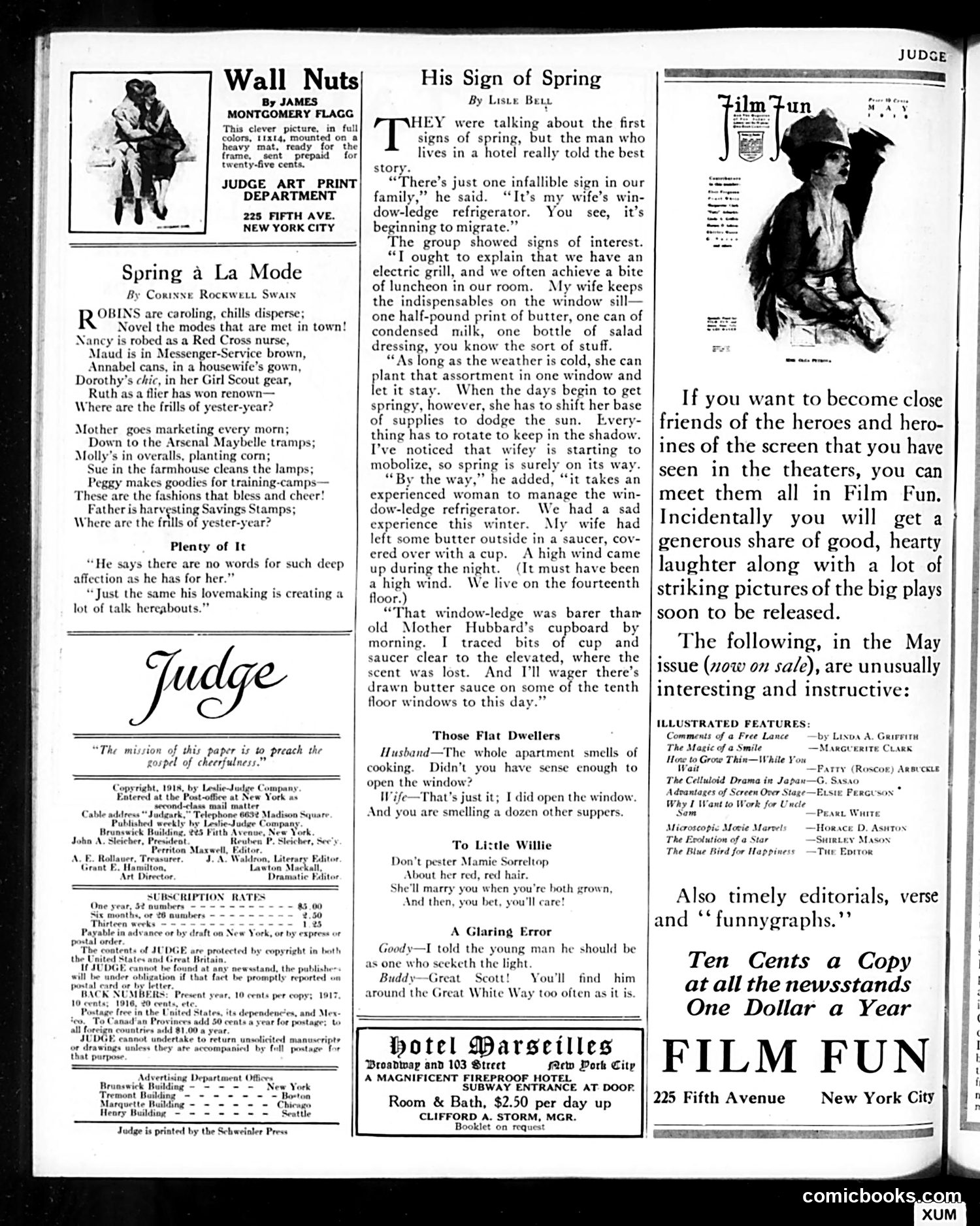
This page from Judge (circa 1918, based on copyright) contains several satirical pieces about wartime domestic life: **"Wall Nuts"** features a James Montgomery Flagg cartoon (available as a print) depicting a figure in heavy clothing—likely satirizing winter fashion or wartime rationing constraints. **"Spring à la Mode"** by Corinne Rockwell Swain mocks how women have adopted unconventional roles during WWI—working as nurses, farmers, Girl Scouts, and in other capacities traditionally held by men. The satire targets the novelty and disruption of these changes: "Where are the frills of yester-year?" **"His Sign of Spring"** humorously describes a hotel-dwelling couple's "window-ledge refrigerator"—using outdoor windowsills to keep food cool. The joke ridicules cramped urban apartment living and improvised solutions, with a running gag about wind carrying butter away. Other pieces include light domestic humor ("Those Flat Dwellers" about cooking smells in apartment buildings) and a mild joke about stage performers frequenting the Great White Way. The overall tone reflects Judge's satirical approach to wartime social upheaval and modern urban inconveniences.
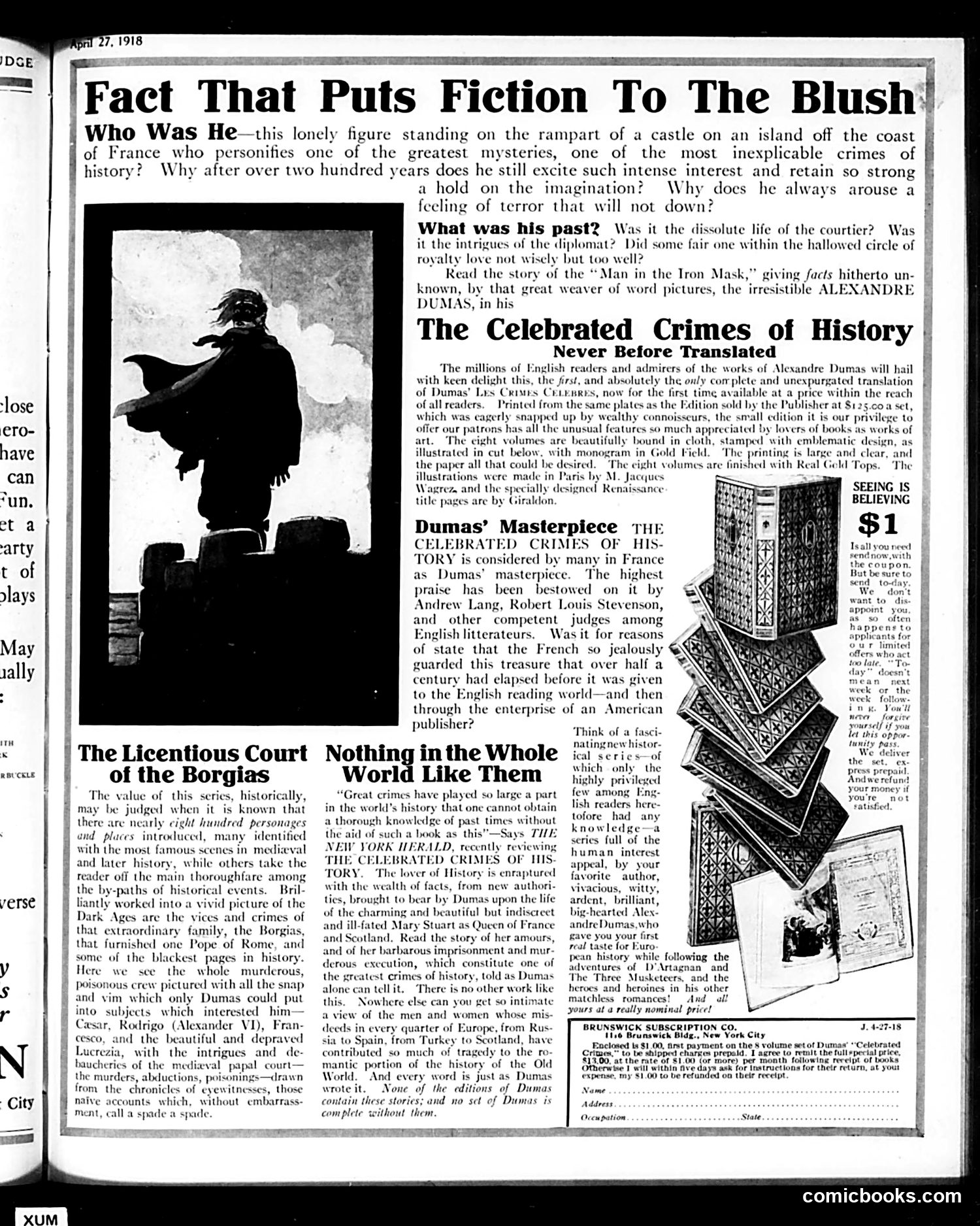
This page advertises Alexandre Dumas' *Les Crimes Célèbres* (The Celebrated Crimes of History), a historical work recently translated into English for the first time at an affordable price. The silhouetted figure on the castle rampart represents **the Man in the Iron Mask**—Dumas' famous historical mystery about a mysterious prisoner held in a French island fortress. The advertisement's title plays on the era's popular saying that "truth is stranger than fiction," arguing that Dumas' documented historical accounts of real crimes (the Borgias, papal court intrigues, etc.) are more sensational than invented stories. The satire targets **American publisher opportunism**: the French supposedly guarded this "treasure" for over 150 years before an American publisher finally made it available to English readers at reasonable cost. Judge celebrates this as bringing high European culture to ordinary American readers at last. The ornate book volumes pictured reinforce the product's prestige while appealing to middle-class aspirations for cultured home libraries.
This is a vintage cigarette advertisement, not political satire. It promotes Helmar Turkish Cigarettes at 13 cents per pack, emphasizing "Quality Superb." The image shows a woman in 1920s attire (cloche hat, rain gear) standing in the rain next to a Helmar advertisement poster featuring Egyptian imagery and a stylized face. The advertisement's tagline claims Helmar makes "the Highest Grade Turkish and Egyptian Cigars in the World." This represents early 20th-century marketing that leveraged "exotic" Middle Eastern imagery to appeal to American consumers. The woman's glamorous presentation alongside the product suggests cigarettes were marketed as sophisticated and aspirational to female consumers during this era—before widespread health warnings and advertising restrictions on tobacco products.