
Judge, 1918-04-27 · page 17 of 36
Judge — April 27, 1918 — page 17: what you’re looking at
What you’re looking at
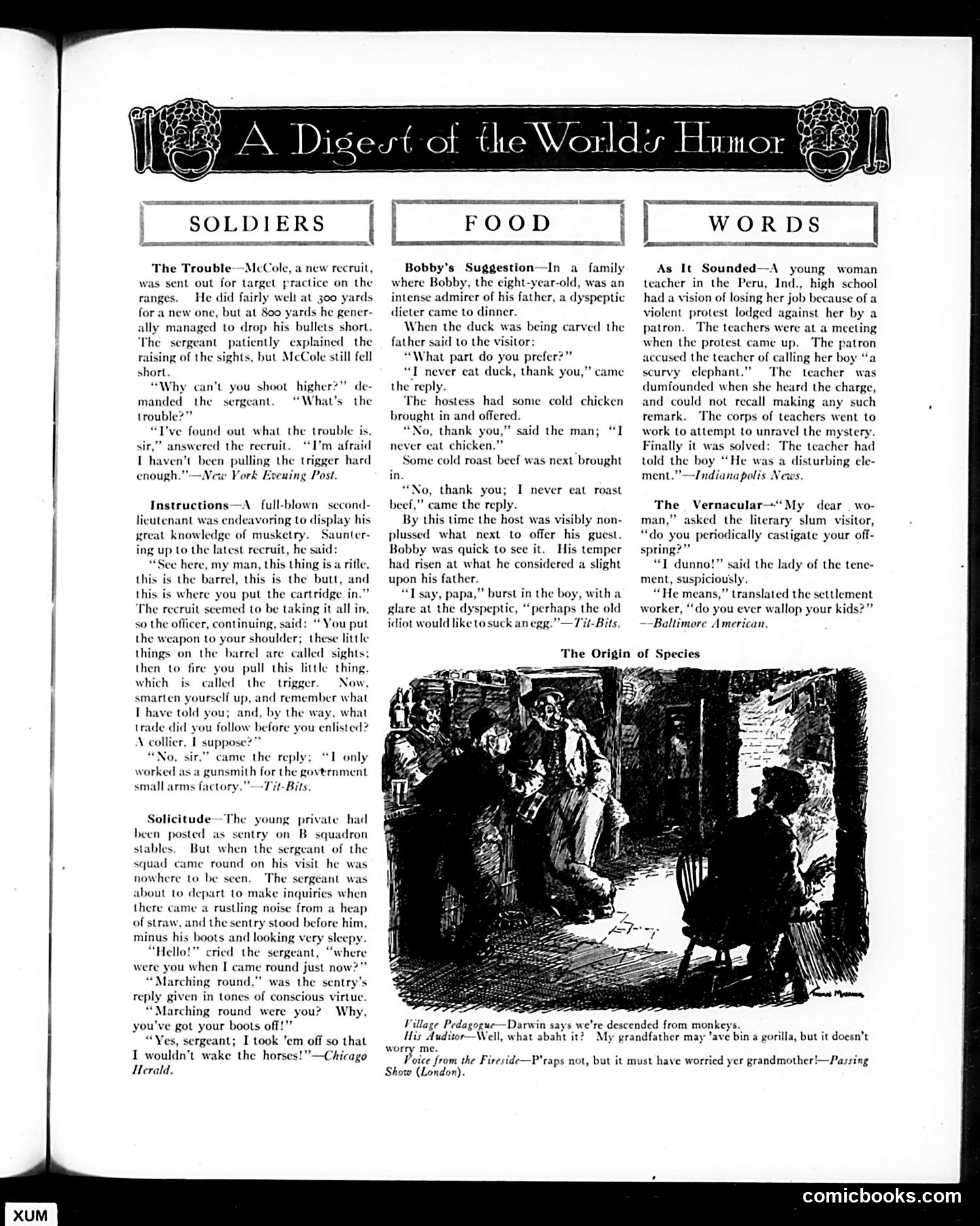
This page from *Judge* contains three soldier anecdotes and three miscellaneous jokes, typical of the magazine's format. The humor relies on wordplay and situational irony: **"The Trouble"** mocks a recruit's fundamental misunderstanding—he believes pulling the trigger harder affects bullet trajectory, not sight adjustment. **"Instructions"** satirizes military hierarchy: an officer patronizingly explains rifle basics to a recruit who turns out to be a former gunsmith, exposing the officer's pompous ignorance. **"Solicitude"** jokes about a sentry removing his boots while standing guard so as not to disturb horses—absurd logic presented deadpan. The non-soldier jokes include a child's crude solution to a picky guest ("perhaps the old idiot would like to suck an egg"), a mishearing of "disturbing element" as "scurvy elephant," and a social worker's pretentious vocabulary confusing a tenement resident. The humor targets military foolishness, class pretension, and miscommunication—standard *Judge* fare for this era.
📄 Transcribed text from this page (OCR, searchable)
Machine-transcribed from the original scan — historical spelling and the odd misread are preserved.
XUM / SOLDIERS The Trouble-—McCole, a new recruit, was sent out for target practice on the ranges. He did fairly well at 300 yards for a new one, but at 800 yards he gener- ally managed to drop his bullets short. © sergeant patiently explained the raising of the sights, but McCole still fell short. “Why can't manded the sergeant. “W trouble? “T've found out what the trouble is, sir,” answered the recruit. “I’m afraid I haven’t been pulling the trigger hard enough.” —New York Evening Post. you shoot higher?” de- ’s the Instructions—A full-blown second- licutenant was endeavoring to display his great knowledge of musketry. unter- ing up to the latest recruit, he said: “See here, my man, this thing is a rifle, this is the barrel, this is the butt, and this is where you put the cartridge in.” The recruit seemed to be taking it all in, so the officer, continuing, said: ‘* You put the weapon to your shoulder; these little things on the barrel are called sights: then to fire you pull this little thing. which is called the trigger. Now, smarten yourself up, and remember what I have told you; and, by the v trade did you follow before you enlisted? \ collier, 1 suppose “No, sir.” came the reply; “1 only worked as a gunsmith for the government small arms factory.”—Tit-Bits. Solicitude he young private had been posted as sentry on B squadron stables. But when the sergeant of the squad came round on his visit he was nowhere to be seen. The sergeant was about to depart to make inquiries when there came a rustling noise from a heap of straw, and the sentry stood before him, minus his boots and looking very sleepy. “Hello!” cried the sergeant, “where were you when I came round just now?” “Marching round,” was the sentry’s reply given in tones of conscious virtue. “Marching round were you? Why, you've got your boots off!” Yes, sergeant; I took ’em off so that I wouldn't wake the horses!"—Chicago Herald. f the Wo dis Ey; W ILO t ob Bobby's Suggestion—In a family where Bobby, the cight-year-old, was an inte dmirer of his father, a dyspeptic dieter came to dinner. When the duck was being carved the father said to the visitor: “What part do you prefer?” “T never eat duck, thank you,” came the reply. The hostess had some cold chicken brought in and offered. “No, thank you,” said the man; “I never eat chicken.” Some cold roast beef was next brought in. “No, thank you; I never cat roast ’ came the reply. By this time the host was visibly non- plussed what next to offer his guest. Bobby was quick to sce it. His temper had risen at what he considered a slight upon his father. “Tsay, papa,” burst in the boy, with a glare at the dyspeptic, “perhaps the old idiot would like to suck an egg.” —Tit-Bits. be The Origin WORDS See eee As It Sounded—A young woman teacher in the Peru, Ind., high school had a vision of losing her job because of a violent protest lodged against her by a patron. The teachers were meeting when the protest came up. The patron accused the teacher of calling her boy “a scurvy elephant.” The teacher was dumfounded when she heard the charge, and could not recall making any such remark. The corps of teachers went to work to attempt to unravel the mystery. Finally it was solved: The teacher had told the boy “He was a disturbing cle- ment.” —Indiana polis News. The Vernacular-“My dear, wo- man,” asked the literary slum visitor, “do you periodically castigate your off- spring?” “T dunno!” said the lady of the tene- ment, suspiciously. “He means,” translated the settlement worker, do you ever wallop your kids?” —-Baltimore American, of Speci: Village Pedagogue—Darwin says we're descended from monkeys. His Auditor—Well, what abaht it? worry me. My grandfather may ’ave bin a gorilla, but it doesn’t Voice from the Fireside—P'raps not, but it must have worried yer grandmother!—Passing Show (London). comicbooks.com