
Judge, 1918-04-27 · page 11 of 36
Judge — April 27, 1918 — page 11: what you’re looking at
What you’re looking at
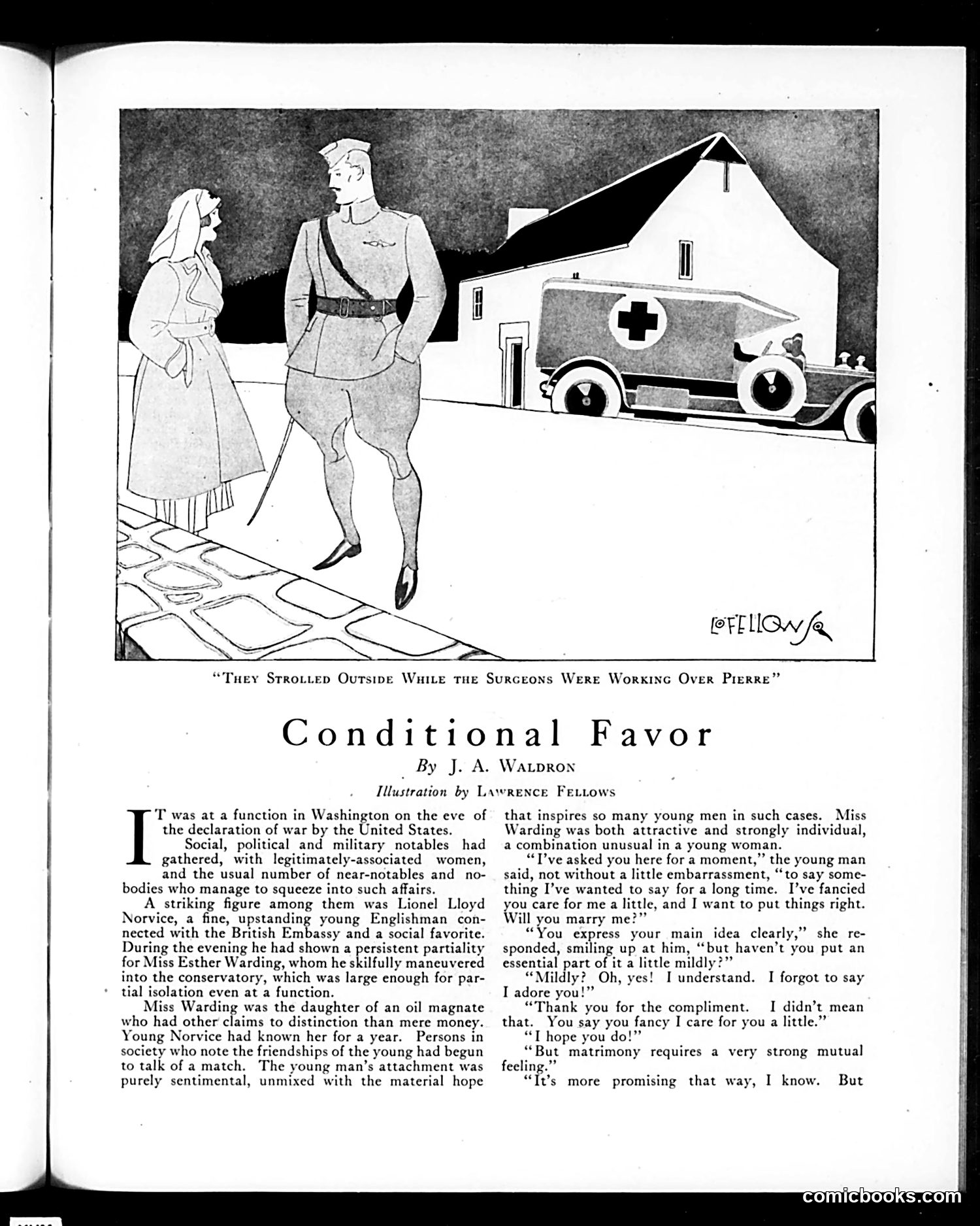
This is the opening of a short story illustrated with a cartoon showing a British military officer and a woman outside a hospital building with an ambulance—a reference to World War I medical care. The narrative involves Lionel Lloyd Norvice, a British Embassy official, proposing to Esther Warding, an American oil magnate's daughter, at a Washington function on the eve of America's entry into WWI. The cartoon's caption—"They Strolled Outside While the Surgeons Were Working Over Pierre"—suggests complications ahead involving someone named Pierre (likely French, given the name). The story satirizes the romantic entanglements and social maneuvering among the elite during wartime. Norvice's proposal, presented somewhat coldly as sentiment "unmixed with material hope," sets up tension: his attachment may be genuine, but the looming war context—and the reference to medical emergencies—suggests obstacles to their union. The "conditional favor" of the title hints that Warding's acceptance depends on something unresolved, likely Pierre's fate.
📄 Transcribed text from this page (OCR, searchable)
Machine-transcribed from the original scan — historical spelling and the odd misread are preserved.
“Trey Srrottep Outsipe WHILE THE SuRGeons Were Workinc Over Pierre” Conditional Favor _ By J. A. Watpron Illustration by Lawrence FELLows T was at a function in Washington on the eve of the declaration of war by the United States. Social, political and military notables had gathered, with legitimately-associated women, and the usual number of near-notables and_no- bodies who manage to squeeze into such affairs. A striking figure among them was Lionel Lloyd Norvice, a fine, upstanding young Englishman con- nected with the British Einbacey and a social favorite. During the evening he had shown a persistent partiality for Miss Esther Warding, whom he skilfully maneuvered into the conservatory, which was large enough for par- tial isolation even at a function. Miss Warding was the daughter of an oil magnate who had other claims to distinction than mere money. Young Norvice had known her for a year. Persons in society who note the friendships of the young had begun to talk of a match. The young man’s attachment was purely sentimental, unmixed with the material hope that inspires so many young men in such cases. Miss Warding was both attractive and strongly individual, a combination unusual in a young woman. “T’ve asked you here for a moment,” the young man said, not without a little embarrassment, “to say some- thing I’ve wanted to say for a long time. I’ve fancied you care for me a little, and I want to put things right. Will you marry me?” “You express your main idea clearly,” she re- sponded, smiling up at him, “but haven’t you put an essential part of it a little mildly?” “Mildly? Oh, yes! I understand. I adore you!” “Thank you for the compliment. I didn’t mean that. You say you fancy I care for you a little.” “T hope you do!” “But matrimony requires a very strong mutual feeling.” “Tt’s more promising that way, I know. But I forgot to say