
Judge, 1918-04-27 · page 24 of 36
Judge — April 27, 1918 — page 24: what you’re looking at
What you’re looking at
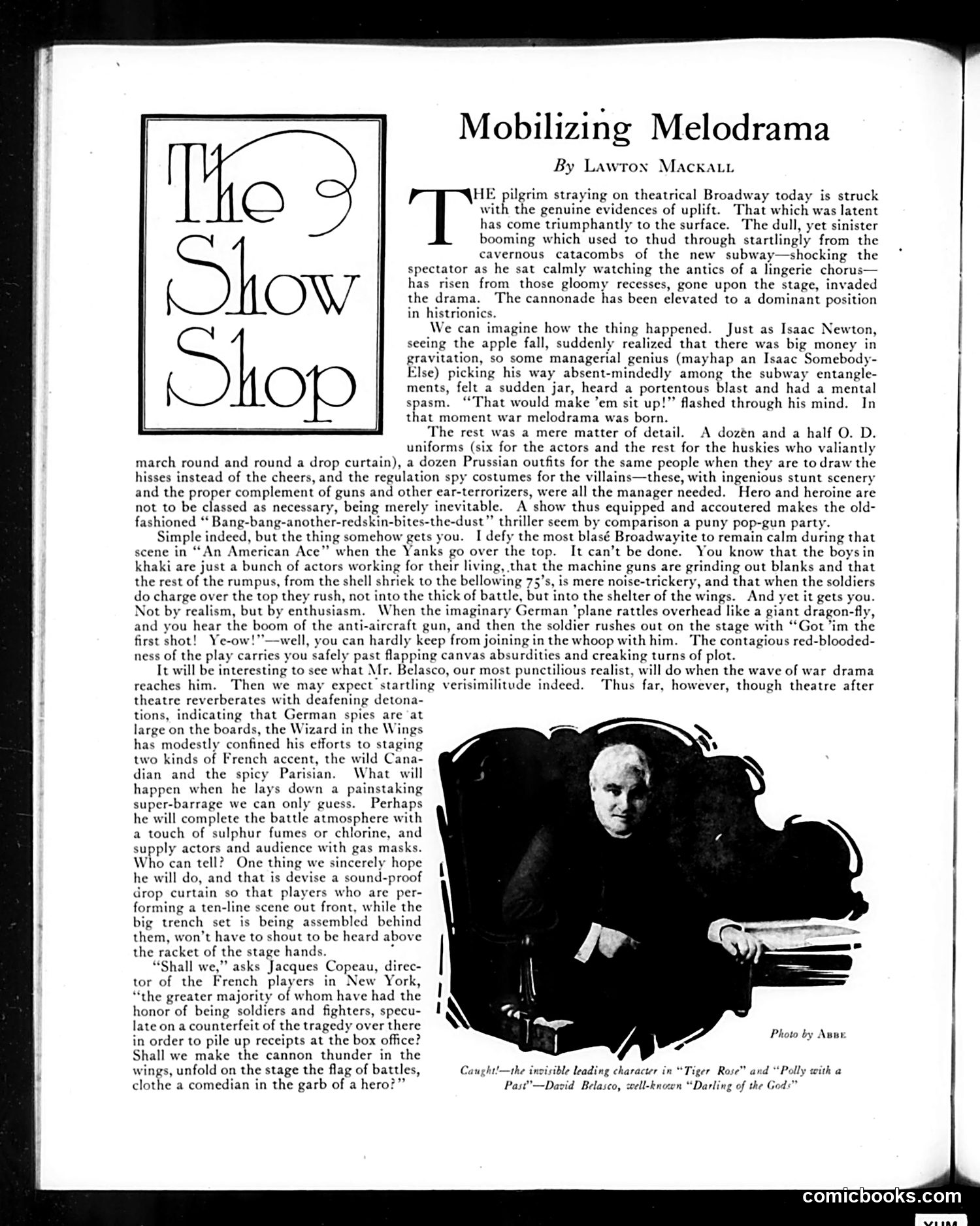
This article satirizes Broadway's opportunistic embrace of World War I themes in theatrical productions. Author Lawton Mackall mocks theater producers who cynically capitalized on wartime enthusiasm by retrofitting melodramas with military spectacle—uniforms, sound effects, stage battles, and explosions—to create "war dramas" that had little substance beyond sensationalism. The satire targets how these productions manipulate audiences emotionally through noise and patriotic fervor rather than genuine storytelling. Mackall notes the irony: audiences know actors are firing blanks and rushing into stage wings, yet remain swept up by the manufactured excitement. He specifically references producer David Belasco (the "Wizard in the Wings," visible in the accompanying photograph), wondering if even this famously meticulous realist will succumb to adding more theatrical "authenticity"—humorously suggesting Belasco might add actual poison gas effects. The piece represents wartime criticism of how commercial entertainment exploits patriotic sentiment for profit.
📄 Transcribed text from this page (OCR, searchable)
Machine-transcribed from the original scan — historical spelling and the odd misread are preserved.
Mobilizing Melodrama By Lawrox Mackauu HE pilgrim straying on theatrical Broadway today is struck with the genuine evidences of uplift. That which was latent has come triumphantly to the surface. The dull, yet sinister booming which used to thud through startlingly from the cavernous catacombs of the new subway—shocking the spectator as he sat calmly watching the antics of a lingerie chorus— has risen from those gloomy recesses, gone upon the stage, invaded the drama. The cannonade has been elevated to a dominant position in histrionics. We can imagine how the thing happened. Just as Isaac Newton, seeing the apple fall, suddenly realized that there was big money in gravitation, so some managerial genius (mayhap an Isaac Somebody- Else) picking his way absent-mindedly among the subway entangle- ments, felt a sudden jar, heard a portentous blast and had a mental spasm. ‘‘That would make ’em sit up!” flashed through his mind. In that moment war melodrama was born. The rest was a mere matter of detail. A dozen and a half O. D. uniforms (six for the actors and the rest for the huskies who valiantly march round and round a drop curtain), a dozen Prussian outfits for the same people when they are to draw the hisses instead of the cheers, and the regulation spy costumes for the villains—these, with ingenious stunt scenery and the proper complement of guns and other ear-terrorizers, were all the manager needed. Hero and heroine are not to be classed as necessary, being merely inevitable. show thus equipped and accoutered makes the old- fashioned “ Bang-bang-another-redskin-bites-the-dust” thriller seem by comparison a puny pop-gun party. Simple indeed, but the thing somehow gets you. I defy the most blasé Broadwayite to remain calm during that scene in “An American Ace” when the Yanks go over the top. It can’t be done. You know that the boys in khaki are just a bunch of actors working for their living, that the machine guns are grinding out blanks and that the rest of the rumpus, from the shell shriek to the bellowing 75’s, is mere noise-trickery, and that when the soldiers do charge over the top they rush, not into the thick of battle, but into the shelter of the wings. And yet it gets you. Not by realism, but by enthusiasm. When the imaginary German ‘plane rattles overhead like a giant dragon-fly, and you hear the boom of the anti-aircraft gun, and then the soldier rushes out on the stage with “Got ’im the first shot! Ye-ow!”’—well, you can hardly keep from joining in the whoop with him. The contagious red-blooded- ness of the play carries you safely past flapping canvas absurdities and creaking turns of plot. It will be interesting to see what Mr. Belasco, our most punctilious realist, will do when the wave of war drama reaches him. Then we may expect startling verisimilitude indeed. Thus far, however, though theatre after theatre reverberates with deafening detona- tions, indicating that German spies are at large on the boards, the Wizard in the Wings has modestly confined his efforts to staging two kinds of French accent, the wild Cana- dian and the spicy Parisian. What will happen when he lays down a painstaking super-barrage we can only guess. Perhaps he will complete the battle atmosphere with a touch of sulphur fumes or chlorine, and supply actors and audience with gas masks. Who can tell? One thing we sincerely hope he will do, and that is devise a sound-proof drop curtain so that players who are per- forming a ten-line scene out front, while the big trench set is being assembled behind them, won't have to shout to be heard above the racket of the stage hands “Shall we,” asks Jacques Copeau, direc- tor of the French players in New York, “the greater majority of whom have had the honor of being soldiers and fighters, specu- late on a counterfeit of the tragedy over there in order to pile up receipts at the box office? Shall we make the cannon thunder in the wings, unfold on the stage the flag of bat les, Caught!—the i clothe a comedian in the garb of a hero? Past’ Photo by Aspe sible leading character in “Tiger Rose” and “Polly with a David Belasco, well-knowon “Darling of the G comicbooks.com