
Judge, 1918-04-27 · page 20 of 36
Judge — April 27, 1918 — page 20: what you’re looking at
What you’re looking at
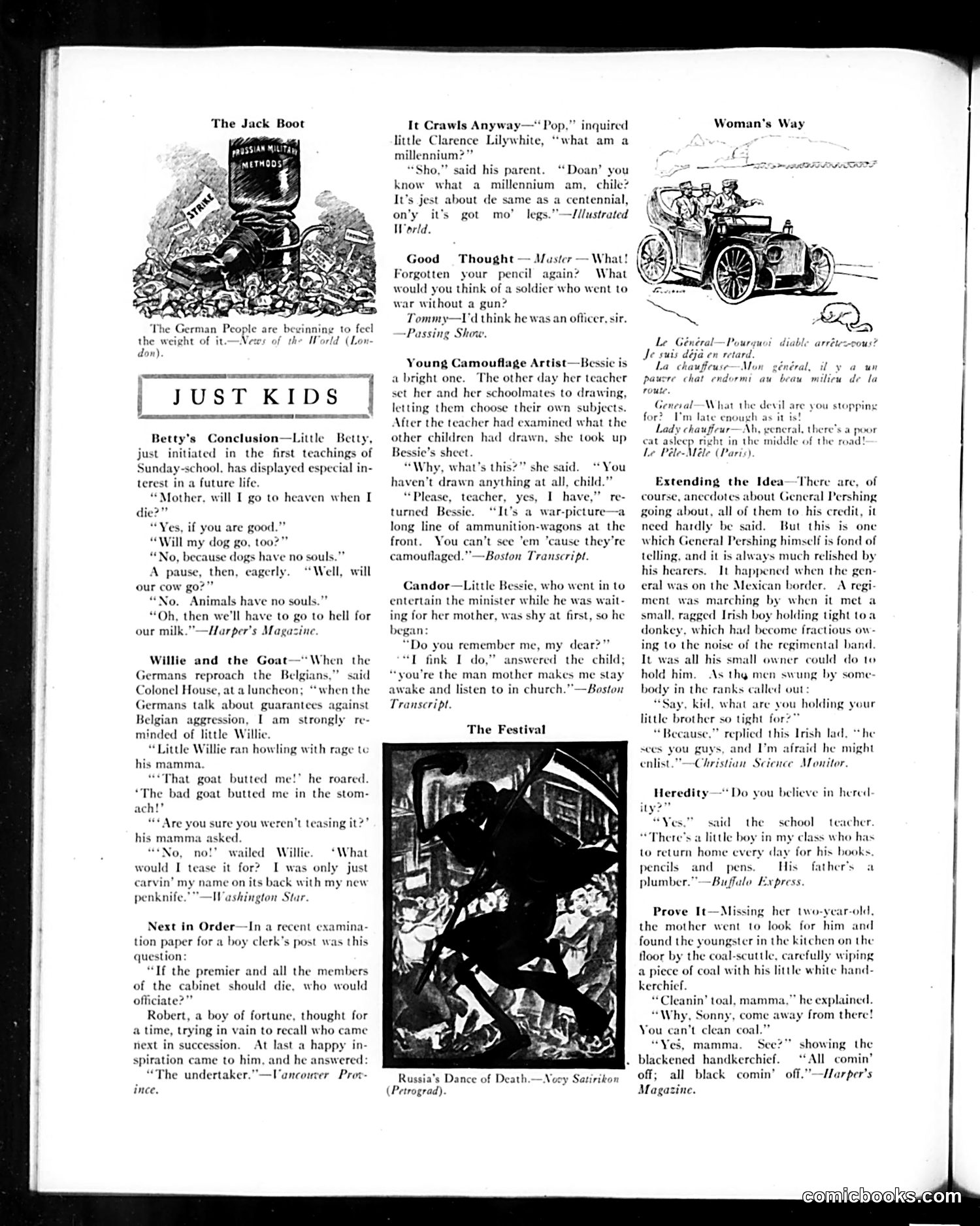
This page from *Judge* magazine contains WWI-era satirical content. The title piece, "The Jack Boot," references German military aggression—the "jack boot" was a symbol of Prussian militarism. The accompanying illustration depicts the burden of German militarism crushing civilians. The "Just Kids" section uses children's dialogue to mock current events: "Willie and the Goat" compares German complaints about Belgian aggression to a child falsely accusing a goat of attacking him while admitting he carved his name on its back—satirizing German hypocrisy about invading Belgium. "Young Camouflage Artist" jokes about wartime camouflage tactics. Other pieces reference General Pershing and the Mexican border, dating this to the WWI period. The page reflects American satirical commentary on the European war, using humor to criticize German militarism and celebrate Allied figures like Pershing.
📄 Transcribed text from this page (OCR, searchable)
Machine-transcribed from the original scan — historical spelling and the odd misread are preserved.
The Jack Boot erman People are bevini the weight of it.—N of the Wor earn — | JUST KIDS |} Betty's Conclusion—Little Betty, just initiated in the first teachings of Sunday-school. has displayed especial in- terest in a future life. fother, will I go to heaven when I if you are good “Will my dog go, too? “No, because dogs have no souls.” A pause, then, eagerly. “Well, will our cow go?” ‘o. Animals have no souls.”” Oh, then we'll have to go to hell for our milk.” —Harper’s Magazine. Willie and the Goat—*When the Germans reproach the Belgians,” said Colonel House, at a luncheon; “when the Germans talk about guarantees against Belgian aggression, [ am strongly re- minded of little Willie. “Little Willie ran howling with rage t his mamma. “*That goat butted me!” he roared. ‘The bad goat butted me in the stom- ach ‘Are you sure you weren't teasing it?” his mamma asked. ‘No, no!’ wailed Willie. ‘What would I tease it for? [ was only just carvin’ my name on its back with my new penknife. Washington Star. Next in Order—In a recent examina- tion paper for a boy clerk’s post was this question: “If the premier and all the members of the cabinet should die, who would officiate? Robert, a boy of fortune, thought for a time, trying in vain to recall who came next in succession. At last a happy in- spiration came to him, and he answered: he undertaker.”"—Vancouver Prov- It Crawls Anywa little Clarence Li millennium? “Sho,”” said his parent. ‘Doan’ you know what a millennium am, chile: It’s jest about de same as a centennial, on'y it’s got mo’ legs.” —//lustrated World. y—* Pop,” inquired white, “what am a Good Thought — Muster — What! Forgotten your pencil again? What would you think of a soldier who went to war without a gun? Tommy—I'd think he w -Passing Show. an officer, sir. Young Camouflage Artist—Bessic is a bright one. The other day her teacher set her and her schoolmates to drawing, letting them choose their own subjects. After the teacher had examined what the other children had drawn, she took up Bessie’s sheet “Why, what's this?” she said. ‘You haven't drawn anything at all, child.” “Please, teacher, yes, I hav turned Bessie. “It’s a war-picture long line of ammunition-wagons at the front. You can’t see ’em ‘cause they're camouflaged.” —Boston Transcript. a Candor—Little Bessie, who went in to entertain the minister while he was wait- ing for her mother, was shy at first, so he began: Do you remember me, my dear? “LT fink I do,” answered the child; “you're the man mother makes me stay awake and listen to in church.” —Bos Transcript. The Festival Russia’s Dance of Death (Petrograd) off; all black comin’ off.” Woman's Way Le Général—Pourgquoi dia Je suis déja en retard. La chauffeuse—Mon paucre chat endormi au rou beau Geneval—W hat the devil are you stopping for? I'm late enou Lady chauffeur—Nh, vene' cat asleep right in the middle of the Le Péle-Méle (Paris). as it is! Extending the Idea—There are, of cour, necdotes about General Pershing going about, all of them to his credit, it need hardly be said. But this is one which General Pershing himself is fond of telling, and it is always much relished by his hearers. It happened when the gen- eral was on the Mexican border. A regi ment was marching by when it met a small, ragged Irish boy holding tight toa donkey, which had become fractious ow- ing to the noise of the regimental band. It was all his small owner could do to hold him. As thy men swung by some- body in the ranks called out “Say, kid, what are you holding your little brother so tight for?” “Because.” replied this Irish lad, “he sees you guys, and I’m afraid he might enli Christian Science Monitor. Heredity—* Do you believe in hered ity?” “Yes.” said the school teacher. “There's a little boy in my class who has to return home every day for his books. pencils and pens. His father’s plumber.”—Buffalo Express. Prove It—Missing her two-year-old, the mother went to look for him and found the youngster in the kitchen on the floor by the coal-scuttle, carefully wiping piece of coal with his little white hand- kerchief. Cleanin’ toal, mamma,” he explained. “Why, Sonny, come away from there! You can’t clean co: “Yes, mamma. See?” showing the blackened handkerchief. “AIL comin’ Harper's Magazine.