
Judge, 1918-04-27 · page 5 of 36
Judge — April 27, 1918 — page 5: what you’re looking at
What you’re looking at
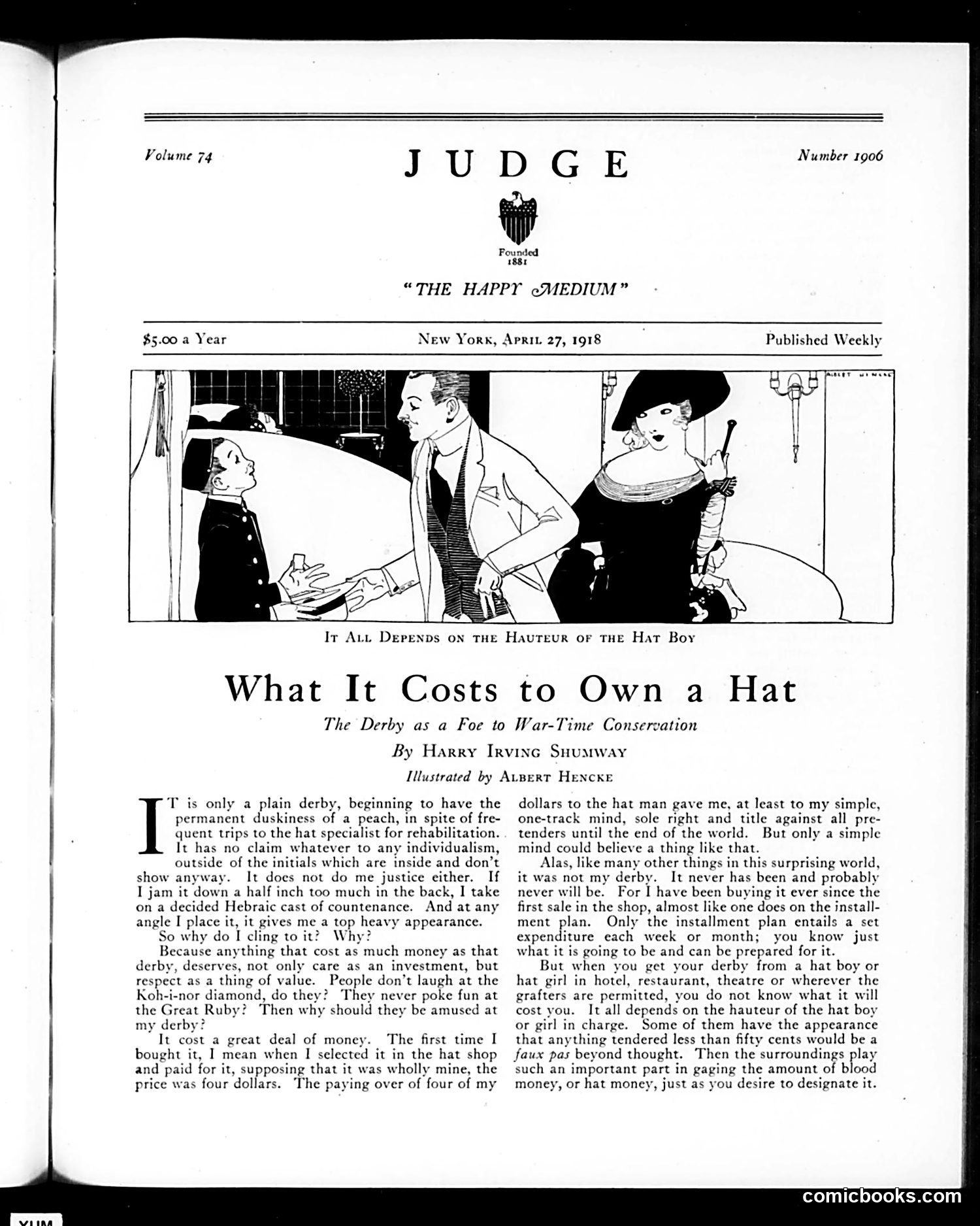
This is a satirical piece titled "What It Costs to Own a Hat: The Derby as a Foe to War-Time Conservation" by Harry Irving Shumway, illustrated by Albert Hencke. The cartoon depicts a well-dressed man presenting a bill to a woman wearing an elaborate, expensive hat adorned with feathers and ornaments. The satire targets wealthy women's extravagant millinery during World War I, when materials and resources were supposedly needed for the war effort. The author humorously argues that owning a fashionable derby hat—seemingly a simple item—actually becomes expensive through maintenance, cleaning, and styling costs. The broader point satirizes how the wealthy ignored conservation appeals during wartime by continuing frivolous spending on luxury goods, particularly expensive hats that required ongoing professional care and represented wasteful consumption when resources should support military needs.
📄 Transcribed text from this page (OCR, searchable)
Machine-transcribed from the original scan — historical spelling and the odd misread are preserved.
Volume 74 $5.00 a Year JUDGE Founded 1881 “THE HAPPY eMEDIUM” New York, Apri 27, 1918 Number 1906 Published Weekly Ir Aut Deper What It Costs ps on THE Hauteur oF tHE Hat Boy to Own a Hat The Derby as a Foe to War-Time Conservation By Harry Irving Suumway Illustrated by Aubert HENCKE is only a plain derby, beginning to have the permanent duskiness of a peach, in spite of fre- quent trips to the hat specialist for rehabilitation. It has no claim whatever to any individualism, outside of the initials which are inside and don’t show anywa It does not do me justice either. If I jam it down a half inch too much in the back, I take on a decided Hebraic cast of countenance. And at any angle I place it, it gives me a top heavy appearance. So why do I cling to it?) Why? Because anything that cost as much money as that derby, de not only care as an investment, but respect as a thing of value. People don’t laugh at the Koh-i-nor diamond, do they? They never poke fun at the Great Ruby? Then why should they be amused at my derby? It cost a great deal of money. The first time I bought it, I mean when I selected it in the hat shop and paid for it, supposing that it was wholly mine, the price was four dollars. The paying over of four of my dollars to the hat man gave me, at least to my simple, one-track mind, sole right and title against all pre- tenders until the end of the world. But only a simple mind could believe a thing like that. Alas, like many other things in this surprising world, it was not my derby. It never has been and probably never will be. For I have been buying it ever since the first sale in the shop, almost like one does on the install- ment plan. Only the installment plan entails a set expenditure each week or month; you know just what it is going to be and can be prepared for it. But when you get your derby from a hat boy or hat girl in hotel, restaurant, theatre or wherever the grafters are permitted, you do not know what it will cost you. It all depends on the hauteur of the hat boy or girl in charge. Some of them have the appearance that anything tendered less than fifty cents would be a faux pas beyond thought. Then the surroundings play such an important part in gaging the amount of blood money, or hat money, just as you desire to designate it. comicbooks.com