
Judge, 1918-04-27 · page 12 of 36
Judge — April 27, 1918 — page 12: what you’re looking at
What you’re looking at
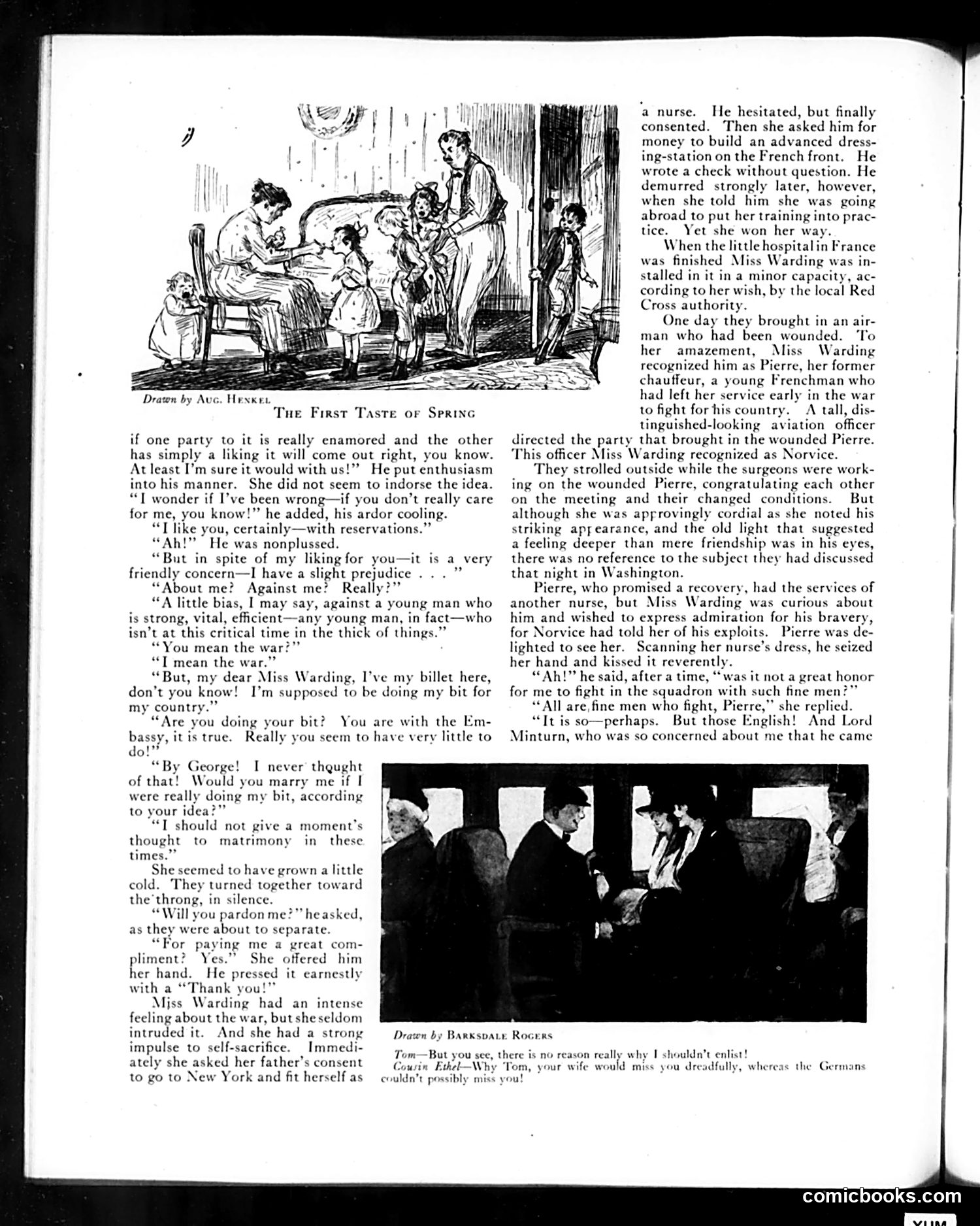
This page contains a serialized romance story illustrated by Avo Henkel, set during World War I. The narrative follows Miss Warding, a young American woman who rejects a suitor because he's not actively fighting in the war—he merely works at the Embassy. To prove his commitment, he enlists. The story shows Miss Warding's own patriotic fervor: she becomes a nurse and builds a field hospital in France. There she encounters two figures from her past: Pierre, her former French chauffeur now an aviator, and Norvice, another officer. **The satirical point** targets American attitudes toward WWI service and gender roles circa 1915-1917. Miss Warding's conditional affection—refusing romance with a man not "doing his bit"—reflects contemporary social pressure on men to enlist. Her own sacrifice (nursing abroad) portrays women's "appropriate" wartime contribution. The irony is gentle: her stringent demands on masculine duty drive his enlistment, suggesting women wielded significant moral pressure on men's military participation. The second photograph is unrelated promotional material.
📄 Transcribed text from this page (OCR, searchable)
Machine-transcribed from the original scan — historical spelling and the odd misread are preserved.
Drawn by Avo. Hexen Tue First Taste or Sprinc if one party to it is really enamored and the other has simply a liking it will come out right, you know. At least I’m sure it would with us!” He put enthusiasm into his manner. She did not seem to indorse the idea. “T wonder if I’ve been wrong—if you don’t really care for me, you know!” he added, his ardor cooling. “T like you, certainly—with reservations.” “Ah!” He was nonplussed. “But in spite of my liking for you—it is a very friendly concern—I have a slight prejudice . . . ” “About me? Against me? Really? “SA little bias, I may say, against a young man who is strong, vital, efficient—any young man, in fact—who isn’t at this critical time in the thick of things.” “You mean the war?” “T mean the war.” “But, my dear Miss Warding, I’ve my billet here, don’t you know! I’m supposed to be doing my bit for my country.” “Are you doing your bit? You are with the Em- , itis true. Really you seem to have very little to corge! I never thgught of that! Would you marry me if I were really doing my bit, according to your idea?” “T should not give a moment's thought to matrimony in these time: he seemed to have grown a little cold. They turned together toward the'throng, in silence. “Will you pardon me?” heasked, as they were about to separate. “For paying me a great com- pliment? Yes.” She offered him her hand. He pressed it earnestly with a “Thank you! Miss Warding had an intense feeling about the war, but she seldom intruded it. And she had a strong impulse to self-sacrifice. _Immedi- ately she asked her father’s consent to go to New York and fit herself as -But you see, there —Why wsibly miss you! ‘Tom, your wif a nurse. He hesitated, but finally consented. Then she asked him for money to build an advanced dress- ing-station on the French front. He wrote a check without question. He demurred strongly later, however, when she told him she was going abroad to put her training into prac- tice. Yet she won her way. When the little hospitalin France was finished Miss Warding was in- stalled in it in a minor capacity, ac- cording to her wish, by the local Red Cross authority. One day they brought in an air- man who had been wounded. ‘To her amazement, Miss Warding recognized him as Pierre, her former chauffeur, a young Frenchman who had left her service early in the war to fight for his country. A tall, dis- tinguished-looking aviation officer directed the party that brought in the wounded Pierre. This officer Miss Warding recognized as Norvice. They strolled outside while the surgeons were work- ing on the wounded Pierre, congratulating each other on the meeting and their changed conditions. But although she was approvingly cordial as she noted his striking appearance, and the old light that suggested a feeling deeper than mere friendship was in his there was no reference to the subject they had discussed that night in Washington. Pierre, who promised a recovery, had the services of another nurse, but Miss Warding was curious about him and wished to express admiration for his bravery, for Norvice had told her of his exploits. Pierre was de- lighted to see her. Scanning her nurse’s dress, he seized her hand and kissed it reverently. “Ah!” he said, after a time, “was it nota great h for me to fight in the squadron with such fine men “All are, fine men who fight, Pierre,” she replied. “It is so—perhaps. But those English! And Lord Minturn, who was so concerned about me that he came Drawn by Barkspare Rocrrs no reason really why [ shouldn't enlist! would miss you dreadfully, whereas the Germans comicbooks.com