
Judge, 1918-04-27 · page 18 of 36
Judge — April 27, 1918 — page 18: what you’re looking at
What you’re looking at
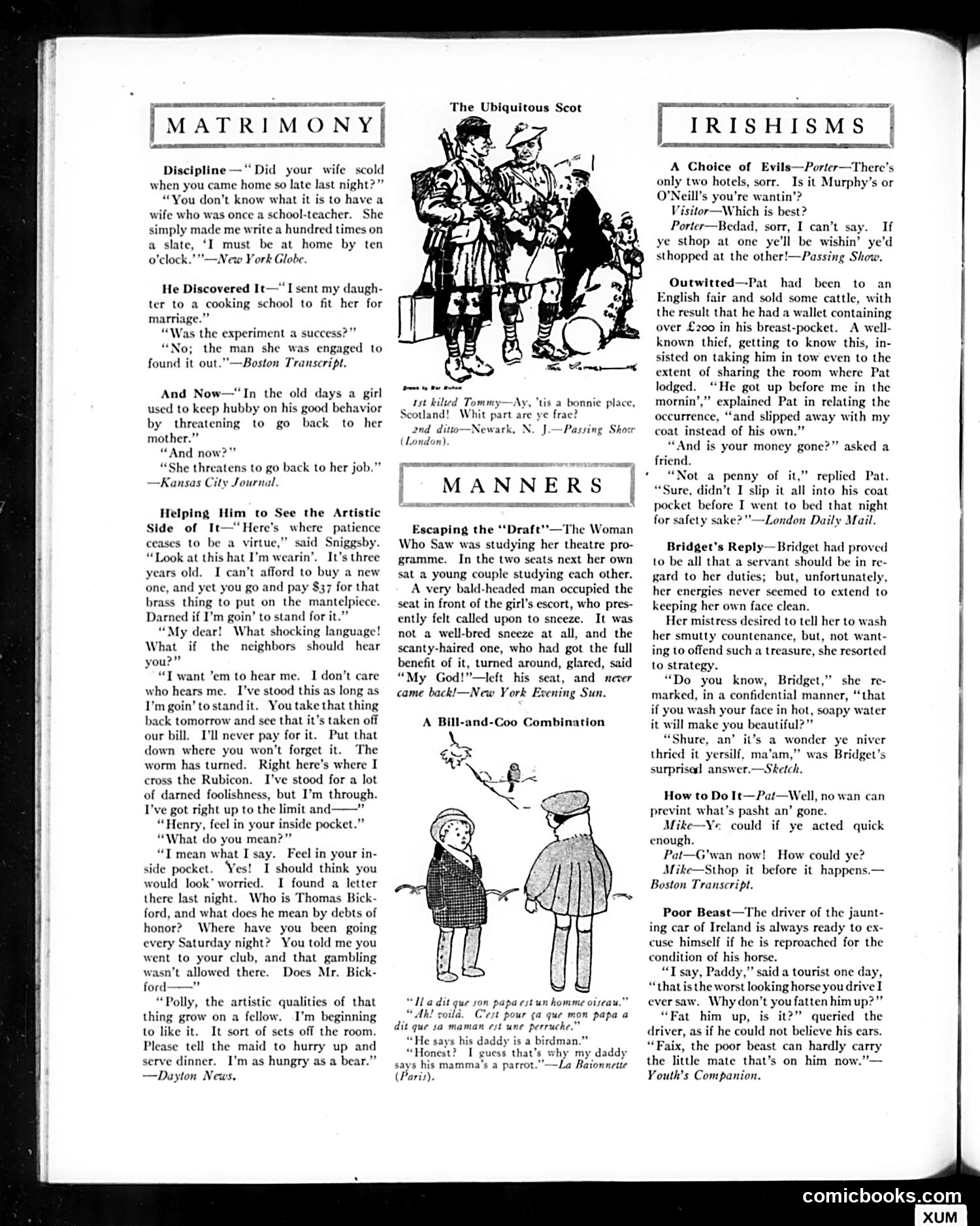
This page from Judge contains several short humorous anecdotes organized by topic, reflecting early 20th-century American domestic and social life. **MATRIMONY** section satirizes marriage dynamics: wives controlling husbands through nagging (echoing schoolteacher discipline), unexpected cooking skills deterring suitors, and wives now threatening to return to jobs rather than mothers' homes—reflecting women's increasing workforce participation. **MANNERS** and **IRISHISMS** sections present brief comedic vignettes about etiquette breaches and Irish stereotypes (including dialect humor and the traditional "cunning Irishman outwitting a thief" trope). **The Ubiquitous Scot** cartoon depicts Scottish immigrants—one from Scotland, one from Newark, New Jersey—meeting in kilts, joking about Scottish identity persisting regardless of location. The **Bill-and-Coo Combination** shows French dialogue between children making animal metaphors about parents. The overall tone reflects period humor about gender relations, immigration, and class dynamics, with heavy reliance on ethnic stereotypes and domestic conflict as entertainment for Judge's educated middle-class readership.
📄 Transcribed text from this page (OCR, searchable)
Machine-transcribed from the original scan — historical spelling and the odd misread are preserved.
PMATRIMONY Discipline —“ Did your wife scold when you came home so late last night?” “You don’t know what it is to have a wife who was once a school-teacher. She simply made me write a hundred times on a slate, ‘I must be home by ten o'clock.’ —New York Globe. He Discovered It—“I sent my daugh- ter to a cooking school to fit her for marriage.” “Was the experiment a success?” “No; the man she was engaged to found it out.”—Boston Transcript. And Now—“In the old day used to keep hubby on his good bel by threatening to go back to her mother.” “And now?” “She threatens to go back to her job.” —Kansas City Journal. Helping Him to See the Artistic Side of It—‘Here’s where patience ceases to be a virtue,” said Sniggsby. “Look at this hat I’m wearin’. It’s three years old. I can’t afford to buy a new one, and yet you go and pay $37 for that brass thing to put on the mantelpiece. Darned if I’m goin’ to stand for it.”” “My dear! What shocking language! What if the neighbors should hear you?” “T want ’em to hear me. I don’t care who hears me. I’ve stood this as long as I'mgoin’ tostandit. You take that thing back tomorrow and see that it’s taken off our bill. I'll never pay for it. Put that down where you won't forget it. The worm has turned. Right here’s where I cross the Rubicon. I've stood for a lot of darned foolishness, but I’m through. I’ve got right up to the limit and——” “Henry, feel in your inside pocket.” “What do you mean?” “T mean what I say. Feel in your in- side pocket. I should think you would look’ worried. I found a letter there last night. Who is Thomas Bick- ford, and what does he mean by debts of honor? Where have you been going every Saturday night? You told me you went to your club, and that gambling wasn’t allowed there. Does Mr. Bick- “Polly, the artistic qualities of that thing grow on a fellow. I'm beginning to like it. It sort of sets off the room. Please tell the maid to hurry up and serve dinner. I’m as hungry as a bear.” —Dayton News. The Ubiquitous Scot weet 1st kilted Tommy—Ay, ‘tis a bonnie place, Scotland! Whit part are ye frac? and ditto—Newark, N. J.—Passing Shore (London) “MANNERS Escaping the **Draft’’. he Woman Who Saw was studying her theatre pro- gramme. In the two seats next her own sat a young couple studying cach other. A very bald-headed man occupied the seat in front of the girl's escort, who pres- ently felt called upon to sneeze. It was not a well-bred sneeze at all, and the scanty-haired one, who had got the full benefit of it, turned around, glared, said “My God!"—left his seat, and never came backI—New York Evening Sun. A Bill-and-Coo Combination “Ila dit que son papa est un homme oiseau.” “Ah! coild. C'est pour ¢a que mon papa a dit que sa maman est une perrucke.” “He says his daddy is a birdman.” “Honest? I guess that’s why my daddy says his mamma's a parrot.” —La Baionnette (Paris). IRISHISMS | A Choice of _Evile—Porter—There's 's Is it Murphy's or you're wantin’? 2: Visitor—Which is best? Porter—Bedad, sorr, I can’t say. If ye sthop at one ye'll be wishin’ ye’d sthopped at the other!—Passing Show. Outwitted—Pat had been to an English fair and sold some cattle, with the result that he had a wallet containing over £200 in his breast-pocket. A v known thief, getting to know thi sisted on taking him in tow even to the extent of sharing the room where Pat lodged. ‘He got up before me in the mornin’,” explained Pat in relating the occurrence, “and slipped away with my 1 of his own.” And is your money gone?” friend. “Not a penny of it,” replied Pat. “Sure, didn’t I slip it all into his coat pocket before I went to bed that night for safety sake?” —London Daily Mail. asked a Bridget's Reply—Bridget had proved to be all that a servant should be in re- gard to her duties; but, unfortunately, her energies never seemed to extend to keeping her own face clean. Her mistress desired to tell her to wash her smutty countenance, but, not want- ing to offend such a treasure, she resorted to strategy. “Do you know, Bridget,” she re- marked, in a confidential manner, “that if you wash your face in hot, soapy water it will make you beautiful?” “Shure, an’ it’s a wonder ye niver thried it yersilf, ma ” was Bridget’s surprisasl answer.— How to Do It—Pat—Well, no wan can prevint what’s pasht an’ gone. Mike—Ye could if ye acted quick enough. Pat—G'wan now! How could ye? Mike—Sthop it before it happens.— Boston Transcript. Poor Beast—The driver of the jaunt- ing car of Ireland is always ready to ex- cuse himself if he is reproached for the condition of his horse. “Tsay, Paddy,” said a tourist one day, “that is the worst looking horse you drive I ever saw. Why don’t you fatten him up?” “Fat him up, is it?” queried the driver, as if he could not believe his ears. “Faix, the poor beast can hardly carry the little mate that’s on him now.”— Youth's Companion, comicbooks.com