
Judge, 1918-04-27 · page 2 of 36
Judge — April 27, 1918 — page 2: what you’re looking at
What you’re looking at
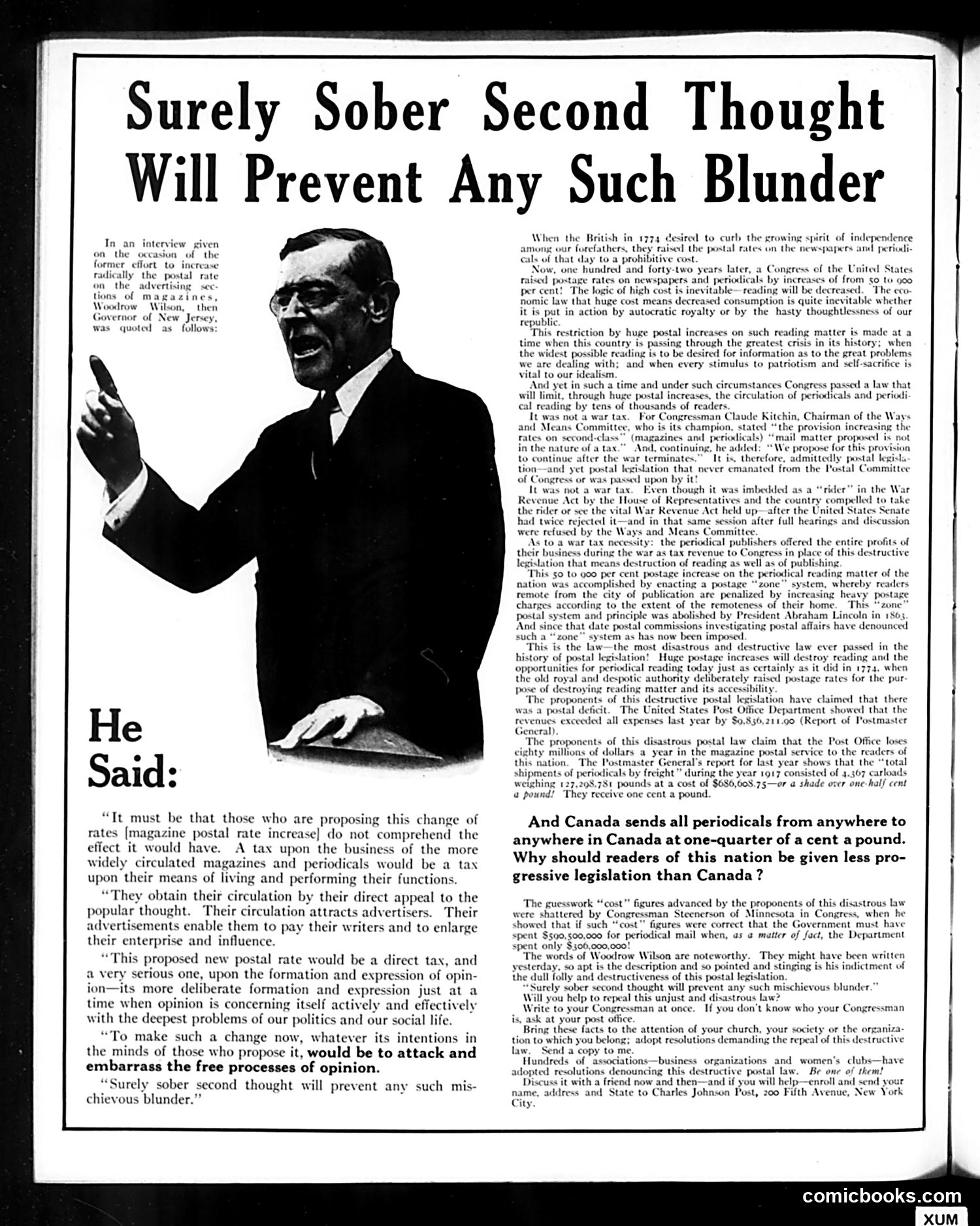
This Judge magazine page attacks a proposal to increase magazine postage rates. The caricatured figure (identified in the text as Governor of New Jersey, likely Edward Stokes) argues for the rate hike using economic reasoning about reduced circulation costs. The satire's point: such "sober second thought" won't prevent this "blunder." The text sarcastically documents how the measure would devastate magazine publishers and readers, particularly those in remote areas who'd face prohibitive costs. The article compares it unfavorably to British policies and notes Canada's more reasonable rates. The cartoon's target is false rationalization—presenting a destructive policy as economically logical when it actually serves special interests while harming democratic access to information during wartime.
📄 Transcribed text from this page (OCR, searchable)
Machine-transcribed from the original scan — historical spelling and the odd misread are preserved.
Surely Sober Second Thought Will Prevent Tn an interview given on the occasion of the former effort to increa ally the postal rate n the advertising sec tions of magazines, Woodrow Wilson, then Governor of New Jersey, was quoted as follows He Said: “Tt must be that those who are proposing this change of rates [magazine postal rate increase] do not comprehend the effect it would have. A tax upon the business of the more widely circulated magazines and periodicals would be a tax upon their means of living and performing their functions. “They obtain their circulation by their direct appeal to the popular thought. Their circulation attracts advertisers. Their advertisements enable them to pay their writers and to enlarge their enterprise and influence. “This proposed new postal rate would be a direct tax, and a very serious one, upon the formation and expression of opin- ion—its more deliberate formation and expression just at time when opinion is concerning itself actively and effectively with the deepest problems of our politics and our social life.” “To make such a change now, whatever its intentions in the minds of those who propose it, would be to attack and embarrass the free processes of opinion. Surely sober second thought will prevent any such mis- chievous blunder.” Any Such Blunder spirit of independence When the British in 1774 desired to curb the gro the newspapers and periodi- among our forefathers, they false the postal rates cals of that day to a prohibitive cost Now, one hundred and forty-two years later, a Congress of the United States raised postage rates on newspapers and periodicals by increases of from 50 to goo per cent! The logic of high cost is inevitable— reading will be decreased.“ The eco- nomic law that huge cost means decreased consumption is quite inevitable whether it is put in action by autocratic royalty or by the hasty thoughtlessness of our republic ‘This restriction by huge postal increases on such reading matter is made at a time when this country is passing through the greatest crisis in its history; when the widest possible reading is to be desired for information as to the great problems we are dealing with; and when every stimulus to patriotism and self-sacrifice is vital to our idealism: And yet in such a time and under such circumstances Congres will limit, through huge postal increases, the circulation of per cal reading by tens of thousands of readers It was not a war tax gressman Claude Kitchin, Chairman of the Ways and Means Committee, s champion, stated “the provision increasing t rates on second-class nd periodicals) “mail matter proposed is. 1 in the nature of a tax.” And, continuing, he added: “We propose for this p to continue after the war terminates.” It is, therefore, admittedly post tion—and yet postal legislation that never emanated from the P. of Congress or was passed upon by it! It was not a war tax. Even though it was imbedded as a “rider” in the War Revenue Act by the House of Representatives and the country compelled to take the rider or sce the vital War Revenue Act held up—after the United States Senate had twice rejected it—and in that same session after full hearings and discussion were refused by the Ways and Means Committee. As to a war tax necessity: the periodical publishers offered the entire profits their business during the war as tax revenue to Congress in place of this destructive legislation that means destruction of reading as well as of publishing This 50 to 900 per cent postage increase on the periodical reading matter of th nation was accomplished by enacting a postage “zone” system, whereby readers remote from the city of publication are penalized by increasing heavy posta charges according to. the extent of the remoteness of their home. This “zone postal system and principle was abolished by President Abraham Lincoln in 1863 And since that date postal commissions investigating postal affairs have denounced such a “zone” system as has now been imposed. This is the the most disastrous and destructive law ever passed in the history of postal legislation! Huge postage increases will destroy’ re: opportunities for periodical reading today just as certainly as it did in 1774, when the old royal and despotic authority deliberately raised postage rates for the pur pose of destroying reading matter and its accessibility The proponents of this destructive postal legislation have claimed that there was a postal deficit. The United States Post Office Department showed that the revenues exceeded all expenses last year by $0,836,211.90 (Report of Postmaster General) The proponents of this disast tal law claim that the Post Office loses cighty millions of dollars a year in the magazine postal service to the readers of this nation. The Postmaster ( 's report for last year shows that the “total shipments of periodicals by freight” during the year 1917 consisted of 4.367 carloads weighing 98,781 pounds at a cost of $686,608.75—or a shade over one-half cen @ pou receive one cent a pound. ssed a law that cals and period And Canada sends all periodicals from anywhere to anywhere in Canada at one-quarter of a cent a pound. Why should readers of this nation be given less pro- gressive legislation than Canada? The guesswork “cost” figures advanced by the proponents of this disastrous law were shattered by Congressman Steenerson of Minnesota in Congress, when he showed that if such “cost” figures were correct that the Government must have spent $590,500,000 for periodical mail when, as @ mutter of fact, the Department spent only $306,000,000! The words of Woodrow Wilson are noteworthy. They might have been written yesterday, so apt is the description and so pointed and stinging is his indictment of the dull folly and destructiveness of this postal legislation “Surely sober second thought will prevent any such mischievous blunder.” Will you help to repeal this unjust and disastrous law? Write to your Congressman at once. If you don’t know who your Congressman is, ask at your post office Bring these facts to the attention of your church, your society or the org tion to which you belong; adopt resolutions demanding the repeal of this destructive law. Send a copy to me. Hundreds of associations—business organizations and women’s clubs—have adopted resolutions denouncing this destructive postal law. Be one of them! Discuss it with a friend now and then—and if you will help—enroll and send your name, address and State to Charles Johnson Post, 200 Fifth Avenue, New York City comicbooks.com