
A complete issue · 36 pages · 1918
Judge — March 2, 1918
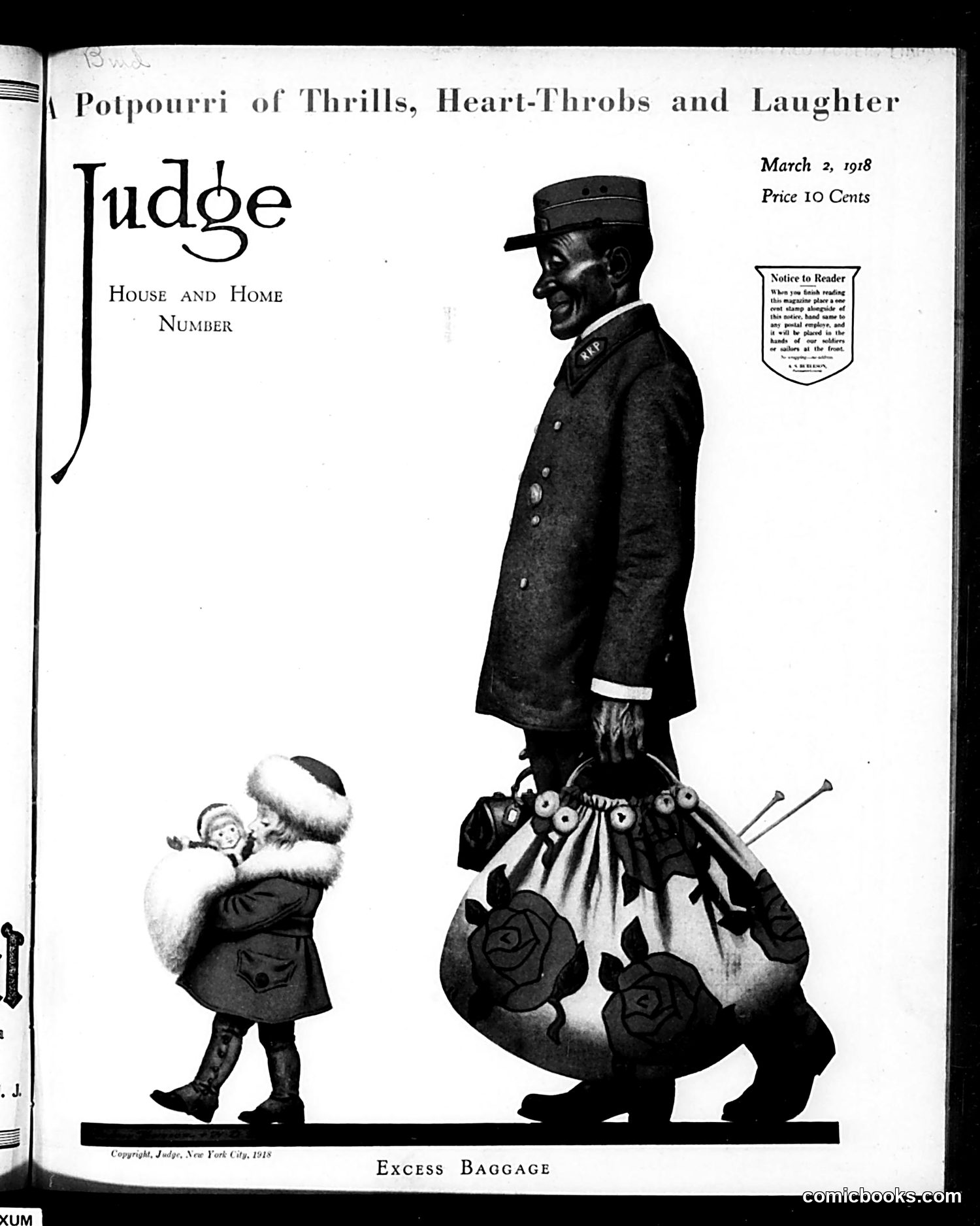
This cartoon satirizes military burdens during World War I. The large caricatured figure in a military uniform carries an enormous bag stuffed with supplies and equipment, while a small child (representing either a dependent or civilian) tugs at his leg. The title "Excess Baggage" suggests the cartoon critiques either: - Military overburden with unnecessary supplies or bureaucratic weight - The financial/logistical strain of supporting dependents during wartime - Possibly soldiers weighted down by unnecessary military apparatus The exaggerated caricature and grotesque features were common Judge magazine satirical style. The "Notice to Readers" box indicates wartime sensitivity about content, suggesting this may address a controversial aspect of the war effort or military organization.
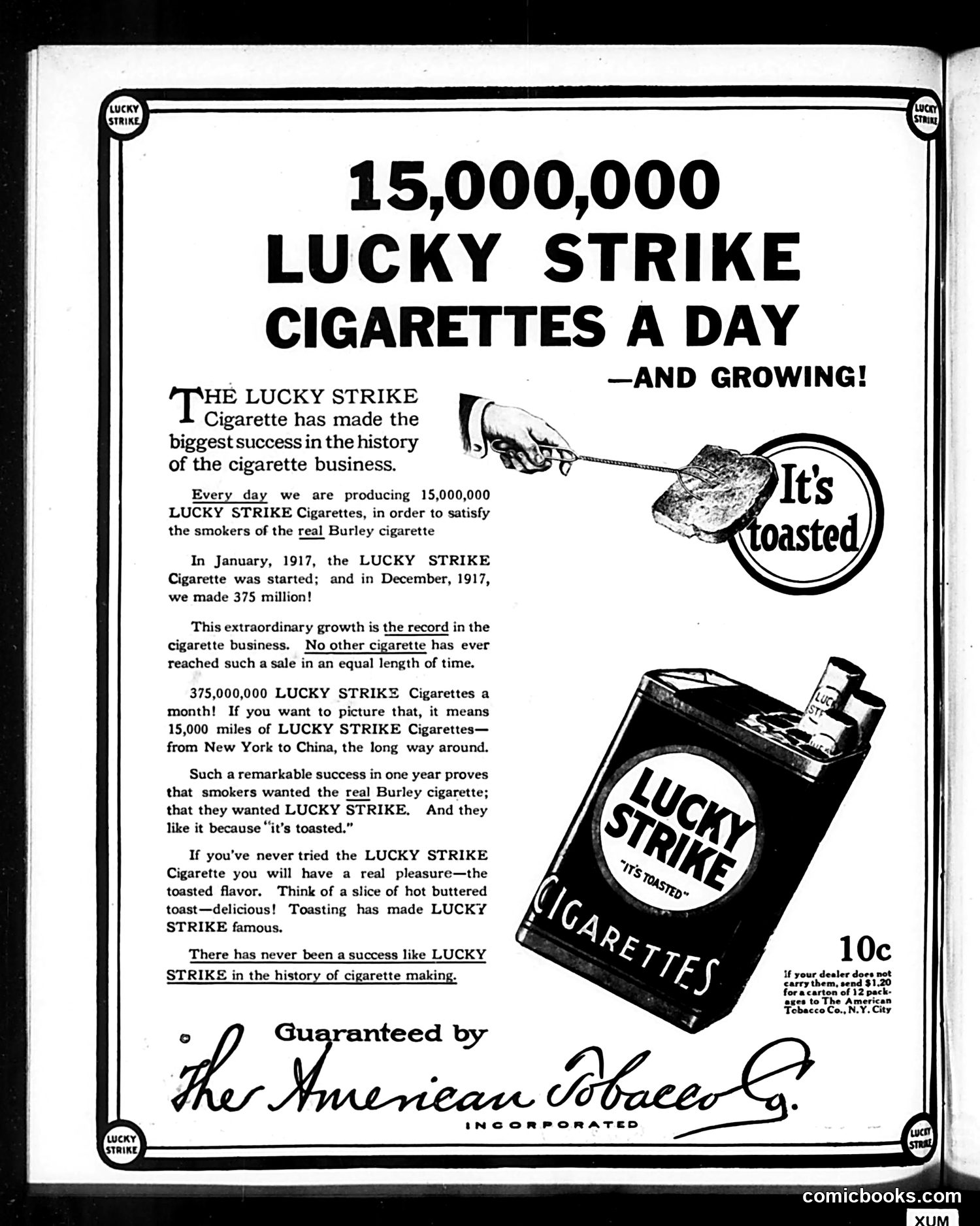
This is **not a satirical cartoon** but rather a **straightforward cigarette advertisement** for Lucky Strike brand cigarettes, published in *Judge* magazine (likely 1917-1918, based on internal dating). The ad celebrates Lucky Strike's massive sales success—15 million cigarettes daily by late 1917, just months after launch in January 1917. The key marketing claim is that cigarettes are "toasted," differentiating them from competitors. The imagery shows the product and includes a hand offering a toasted element, reinforcing the "It's toasted" slogan. The American Tobacco Company guarantees the product. By modern standards, this represents pre-regulation tobacco advertising that made health/quality claims without scientific basis. The rapid growth cited reflects early 20th-century cigarette marketing's effectiveness before health warnings existed.
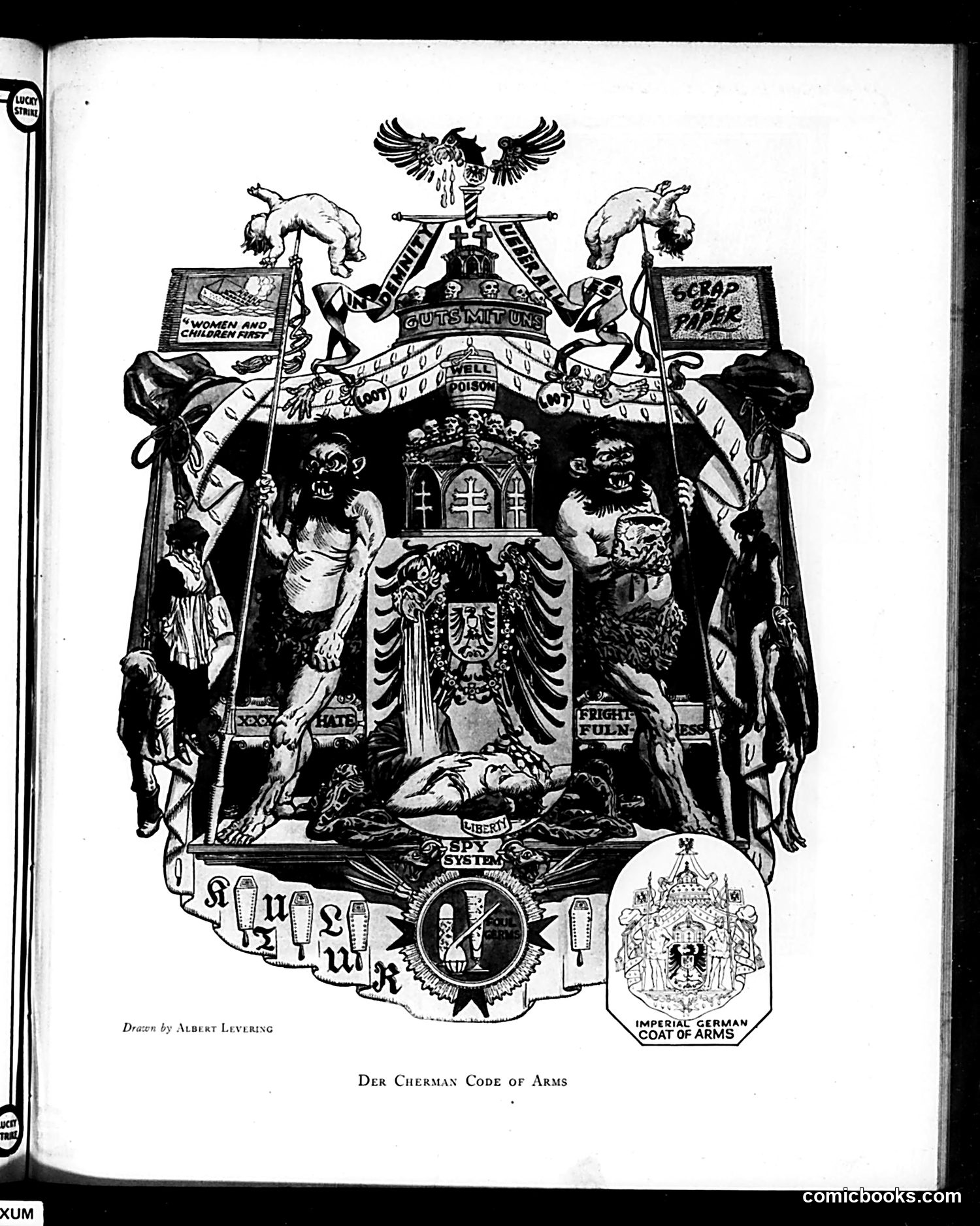
This satirical coat of arms, drawn by Albert Levering, appears to mock Imperial Germany through a heraldic parody. The design incorporates German imperial symbols (the double-headed eagle, coat of arms shown in the corner) but subverts them with darker imagery. The central tower contains crosses and religious iconography, while surrounding figures hold flags reading "Women and Children First" and "Scrap of Paper"—likely referencing Germany's violation of Belgian neutrality during WWI, which German officials dismissed as a mere "scrap of paper." Text labels include "Poison," "Liberty," "Spy System," and "Might Prevails"—portraying German militarism as relying on chemical weapons, espionage, and brutal force rather than legitimate authority. This is anti-German propaganda from the WWI era.
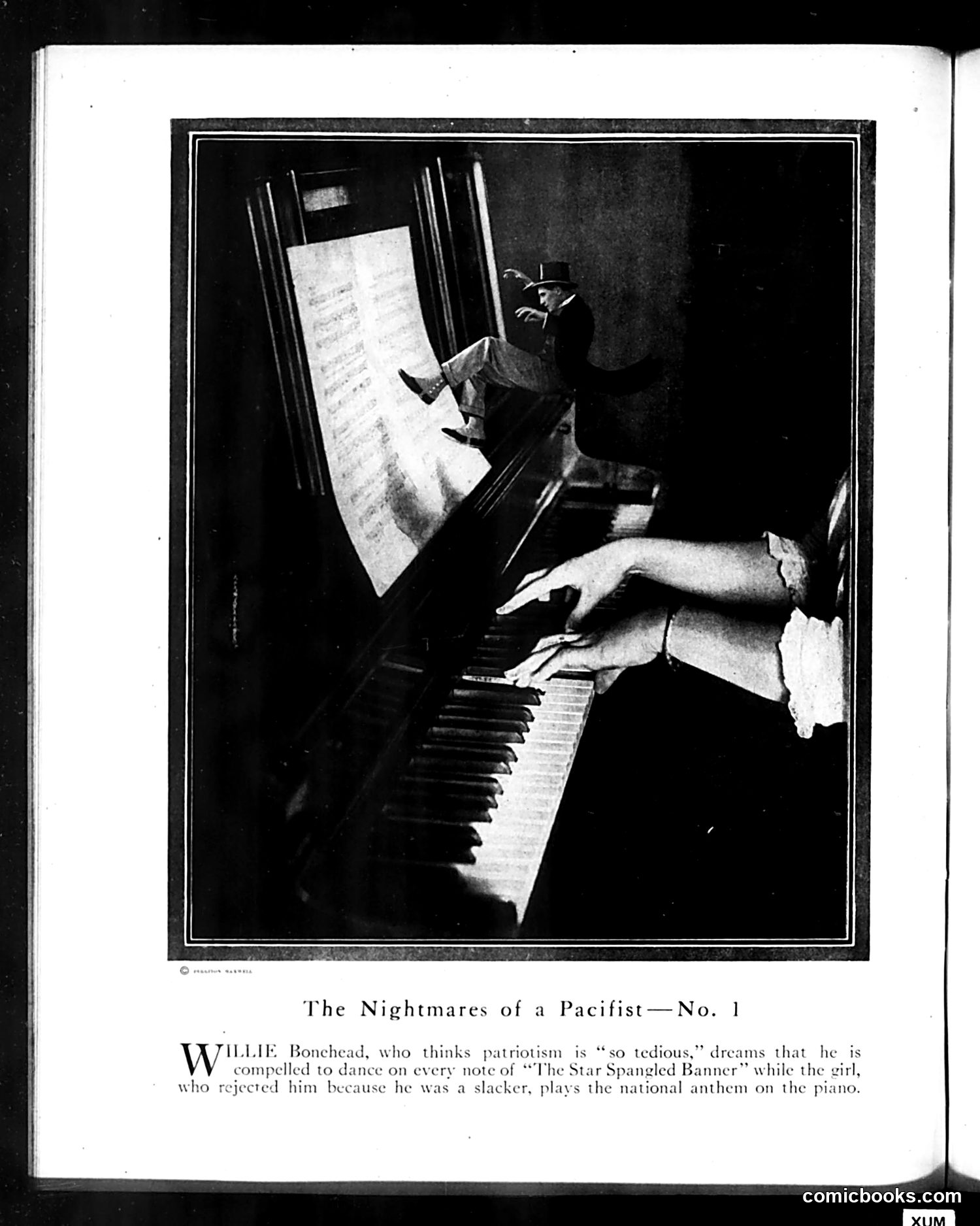
This Judge magazine cartoon satirizes anti-war sentiment during World War I. The caption introduces "Willie Bonehead," a pacifist who considers patriotism "tedious." The nightmare depicts his punishment: he's forced to dance uncontrollably to every note of "The Star-Spangled Banner" while a woman—who rejected him for being a "slacker" (draft-dodger)—plays the national anthem on piano. The satire mocks pacifists as cowardly and unmanliness, contrasting their opposition to the war with patriotic duty and romantic desirability. The dancing compulsion represents his inability to escape patriotic obligations. This reflects early-WWI American attitudes viewing draft resistance as dishonorable and unpatriotic, worthy of public ridicule.
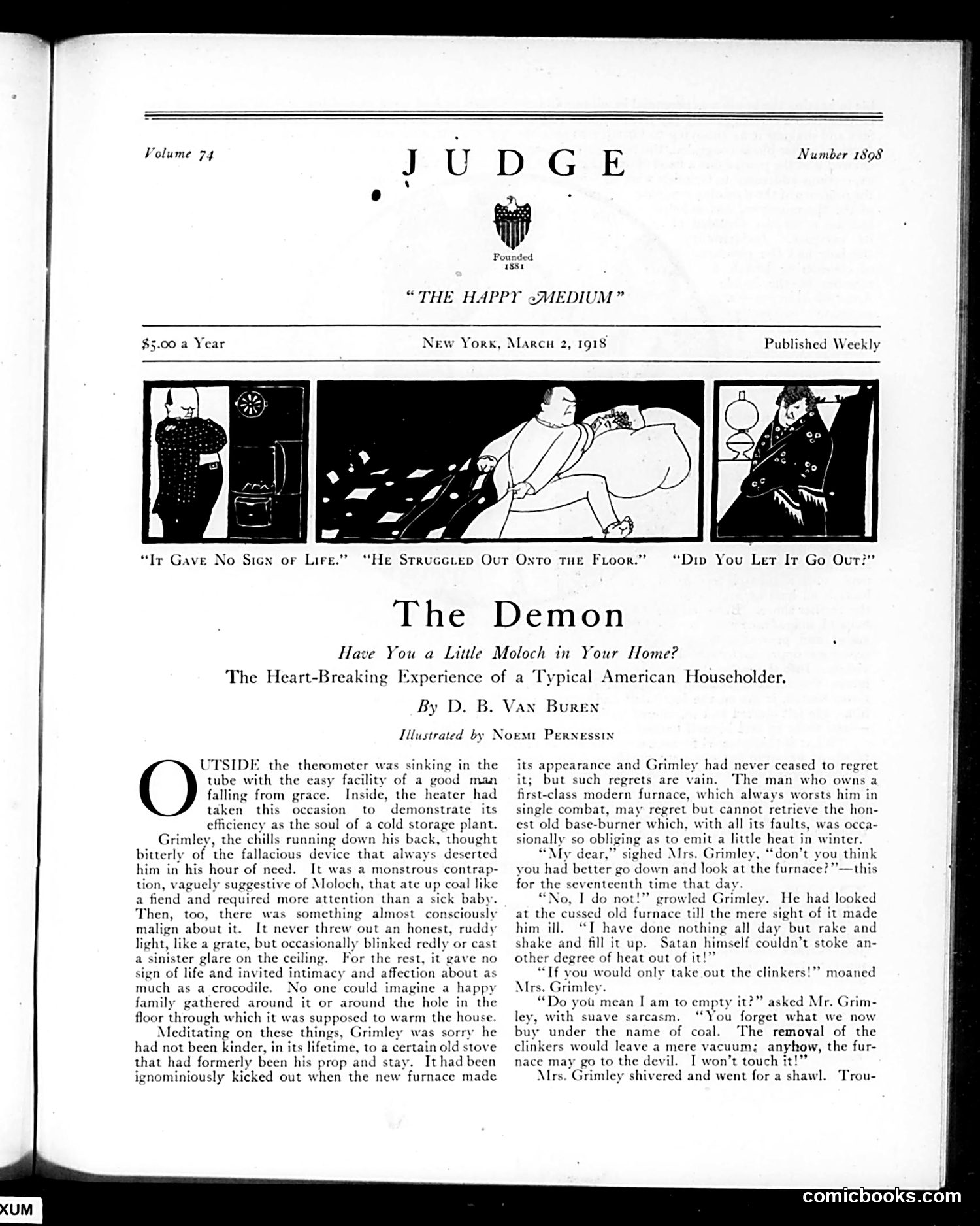
This satirical article by D.B. Van Buren, illustrated by Noemi Pernessin, mocks the frustrations of home heating during winter. The three cartoon panels at top show a malfunctioning furnace causing domestic chaos: a woman bundled in heavy clothing, a man struggling on the floor, and presumably an angry confrontation about the broken heating system. The story follows Mr. and Mrs. Grimley's battle with their new furnace, which has replaced their old coal stove. The "demon" is the temperamental modern heating system that refuses to function properly—a common complaint during this era's transition from traditional stoves to mechanical furnaces. The satire targets the false promise of modern convenience: the new technology is less reliable and more frustrating than what preceded it.
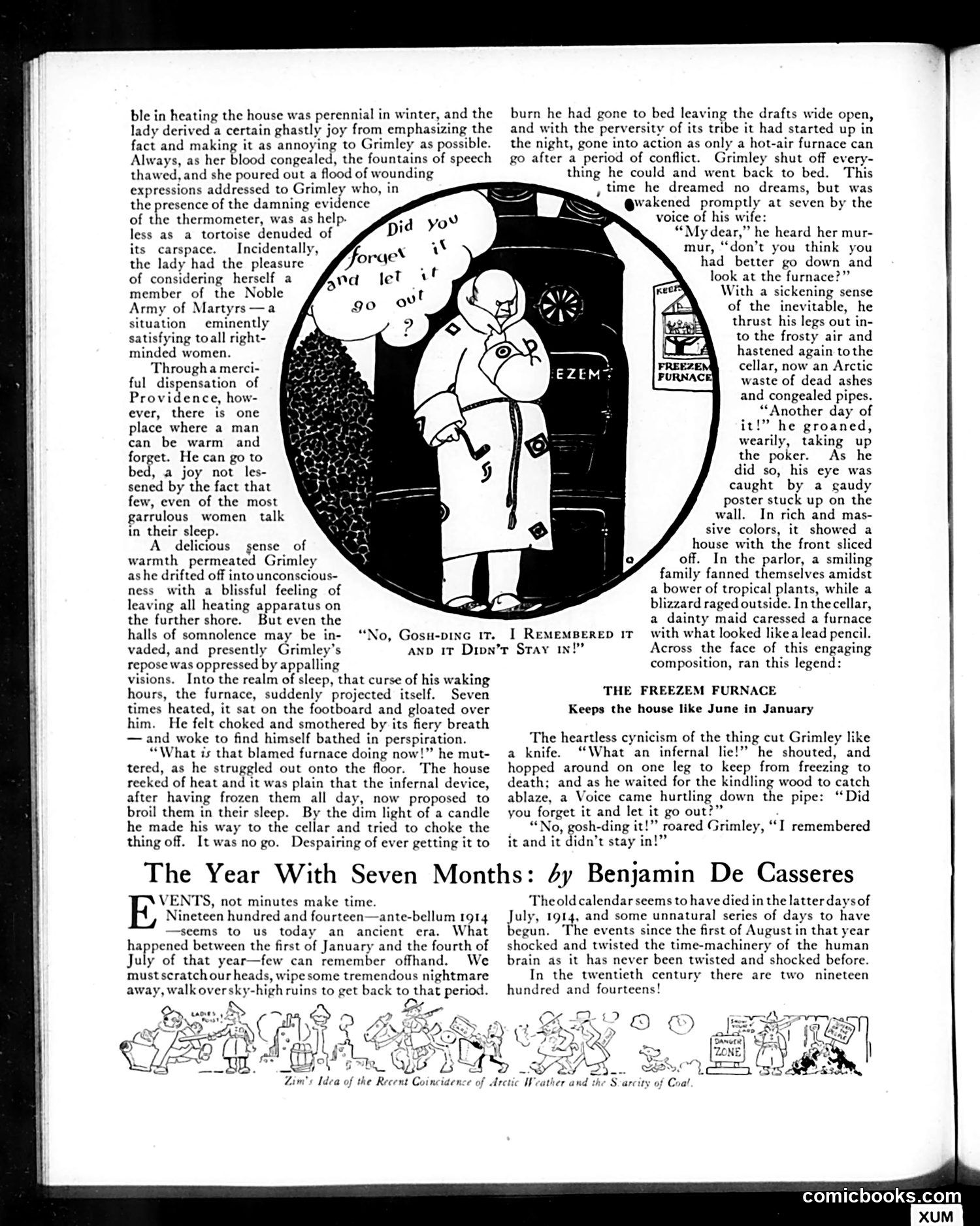
This page contains two main elements: 1. **"The Freezem Furnace" Advertisement**: A circular illustration showing a woman and child near a furnace, with the tagline "Keeps the house like June in January." This is a straightforward product advertisement for a home heating system, not political satire. 2. **"The Year With Seven Months" by Benjamin De Casseres**: The article's opening discusses how events between July 1st and July 4th, 1914 seemed to compress time unnaturally. This references the outbreak of World War I in early August 1914—the text notes the "shock and twist" to "time-machinery of the human brain" caused by rapid, catastrophic events leading up to the war. The piece appears to be reflective commentary on how major historical disruptions distort our perception of time.
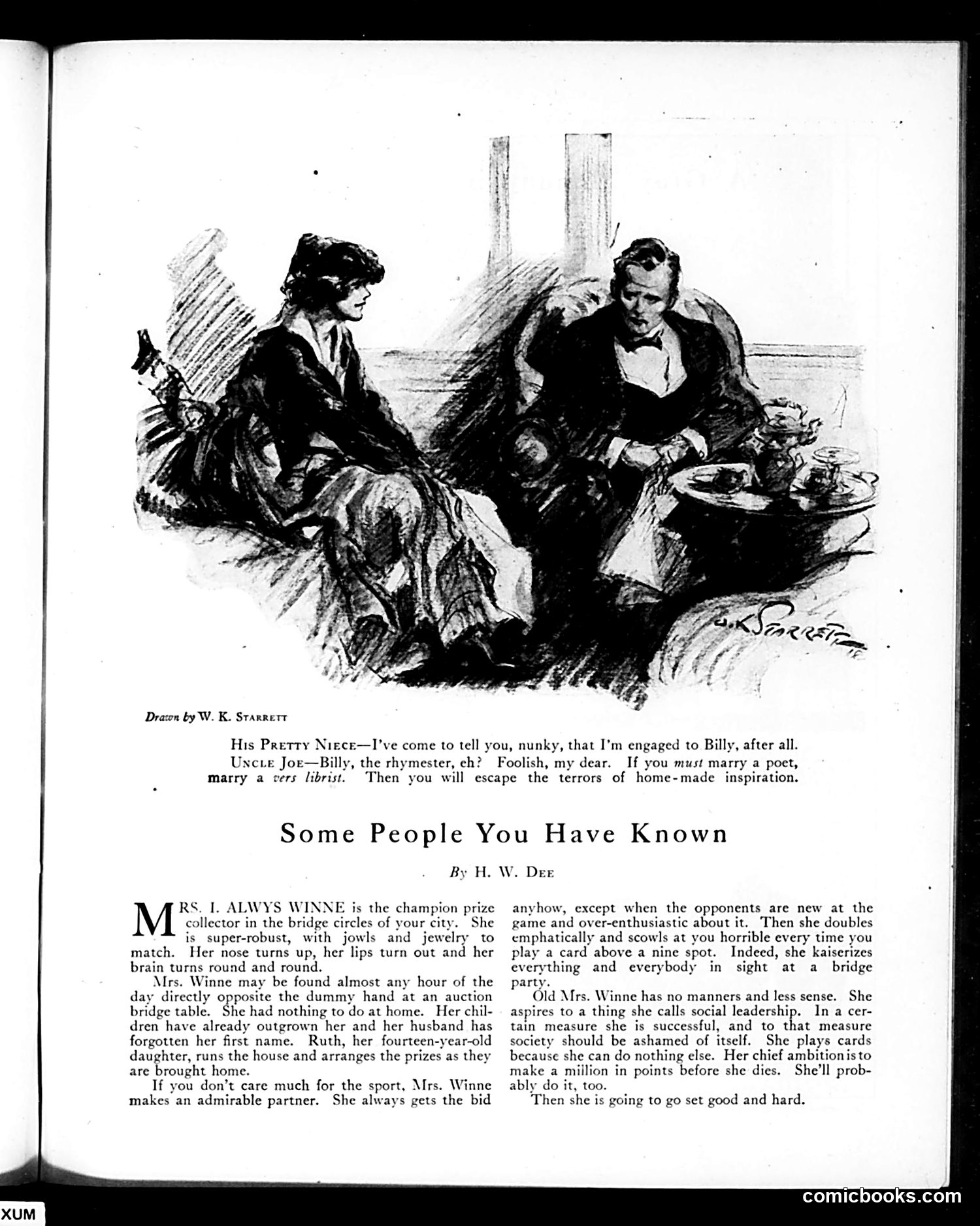
The page contains two distinct pieces: **The Cartoon** (top): A uncle-niece dialogue about marriage. The niece announces her engagement to "Billy, the rhymester" (a poet). Uncle Joe advises against marrying a poet who writes "vers librist" (free verse), warning she'll suffer "home-made inspiration"—likely meaning tedious, self-indulgent poetry recitations at home. The joke satirizes both the pretentiousness of early 20th-century poets and the practical concerns about marrying an artistic type. **The Character Sketch** (bottom): "Some People You Have Known" profiles Mrs. I. Alwys Winne, a bridge-playing society woman. The satire is brutal: she's intellectually empty ("brain turns round and round"), neglectful of family, and obsessed with competitive card-playing for prestige and points. The piece mocks social climbers who mistake card-game dominance for actual "social leadership," and suggests her only life goal is accumulating bridge points before death—then she'll "go set good and hard" (relax, having accomplished nothing meaningful).
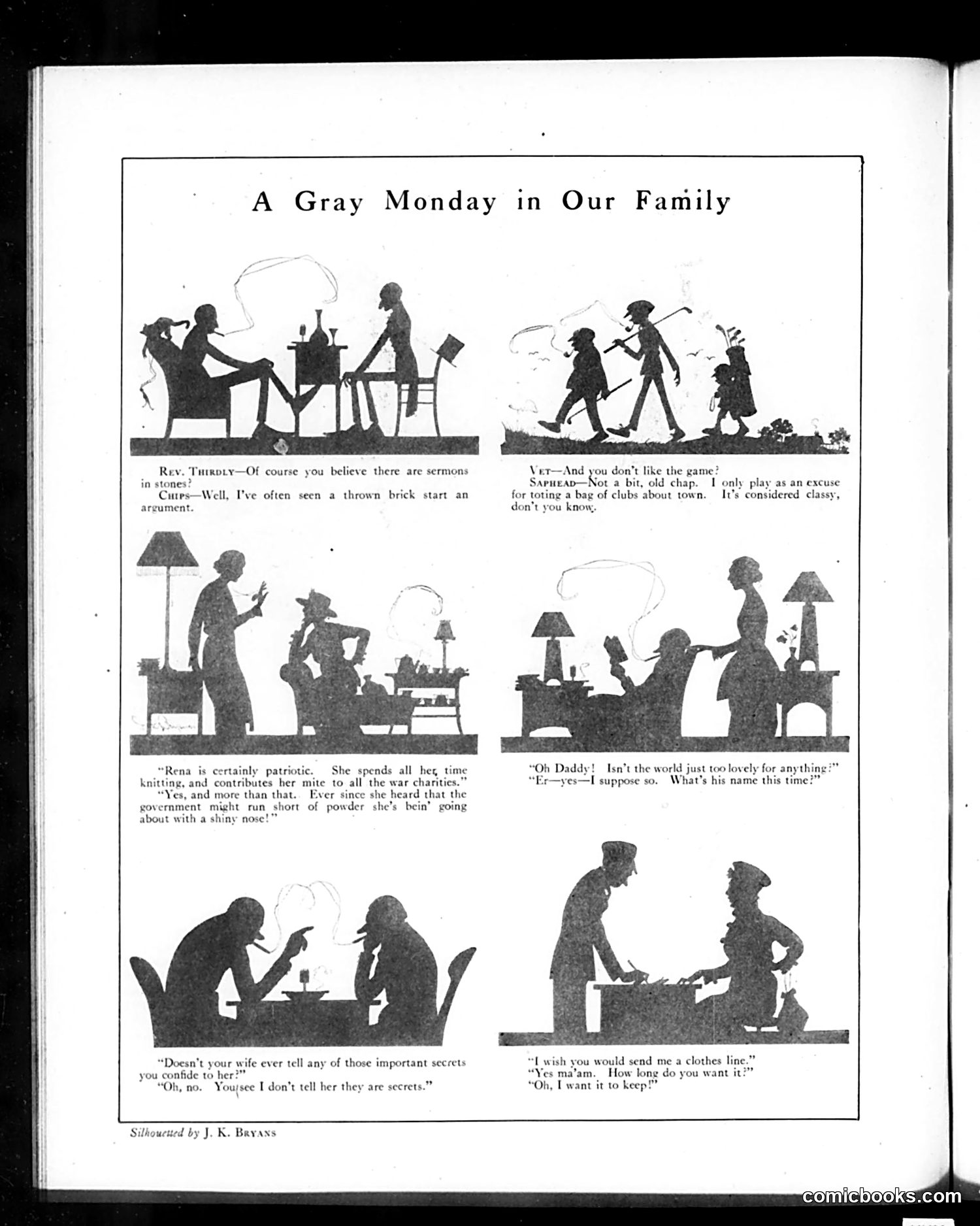
This page of silhouetted comic vignettes satirizes upper-class family life and social pretensions during World War I (suggested by references to "war charities" and government powder shortages). The jokes mock: - **Clerical hypocrisy**: A reverend's abstract sermon contrasted with practical arguments started by thrown bricks - **Social climbing through golf**: Playing golf framed as a fashionable status symbol rather than genuine sport - **Performative patriotism**: A woman "Rena" who knits for war charities while maintaining an artificially shiny nose (suggesting vanity over genuine sacrifice) - **Marital dynamics**: A husband's indifference to his daughter's enthusiasm, and a wife who reveals her husband's confidences despite claiming not to - **Materialism**: A woman demanding a permanent clothes line, emphasizing possession over utility The satire targets the gap between professed values (patriotism, marriage fidelity, religious devotion) and actual behavior driven by vanity, class anxiety, and self-interest. The silhouette format emphasizes the shadowy, insubstantial nature of these pretenses.
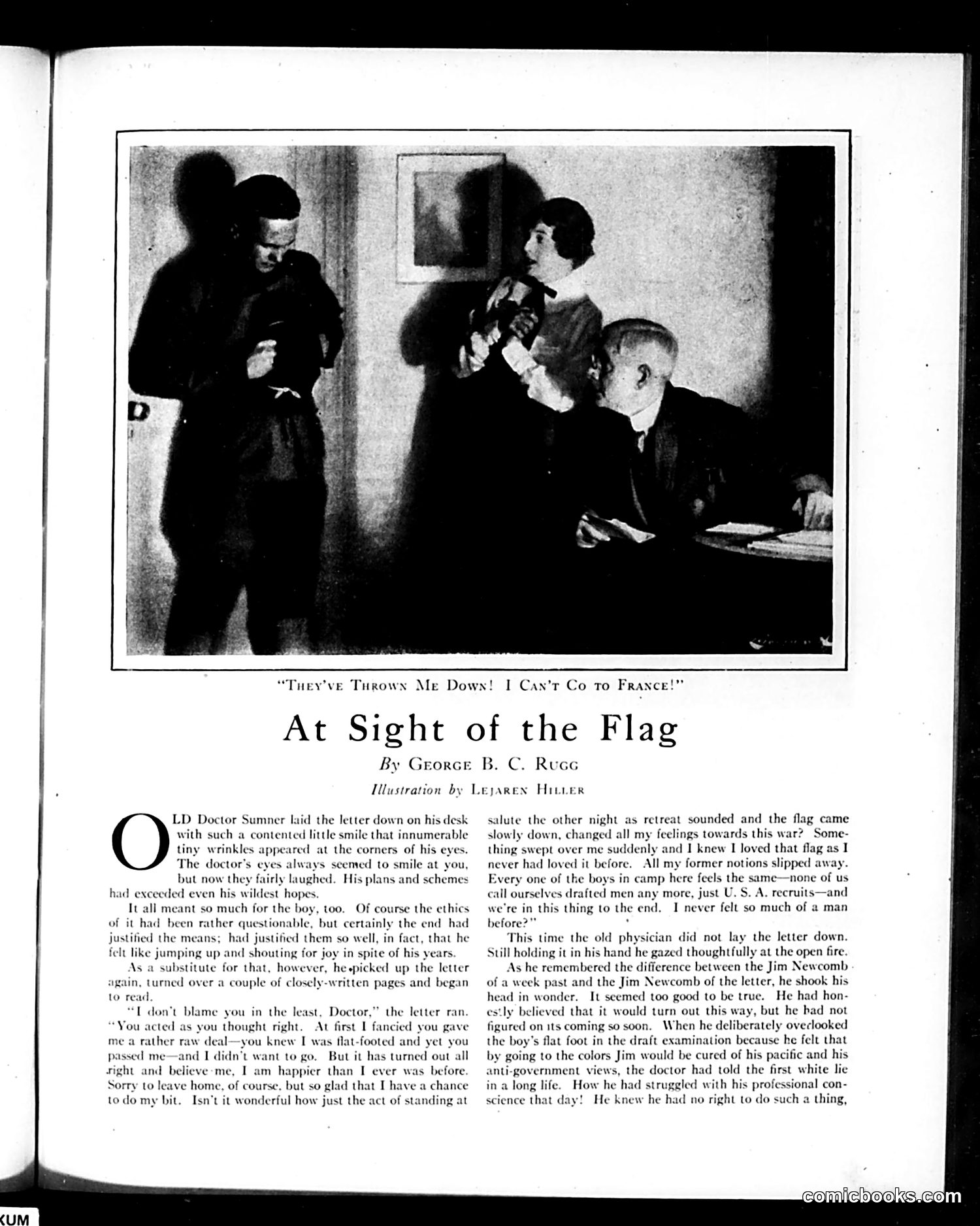
This story depicts a doctor who manipulates a military draft examination, deliberately overlooking a young man's (Jim Newcomb's) flat feet to enlist him. The doctor believes military service will cure Jim's pacifist and anti-government views. The narrative celebrates the outcome: Jim's patriotic transformation upon witnessing the flag at retreat. His letter expresses newfound love for his country and commitment to war service, crediting the emotional experience of the flag ceremony. **The satire's point**: This appears to be propaganda endorsing American entry into World War I (likely 1917-1918). It frames military service as morally redemptive—transforming a reluctant, ideologically opposed youth into an enthusiastic soldier through patriotic emotion. The doctor's ethical compromise is ultimately justified by the "good" result. The cartoon illustrates how flag symbolism and military ritual could overcome civilian resistance to war.
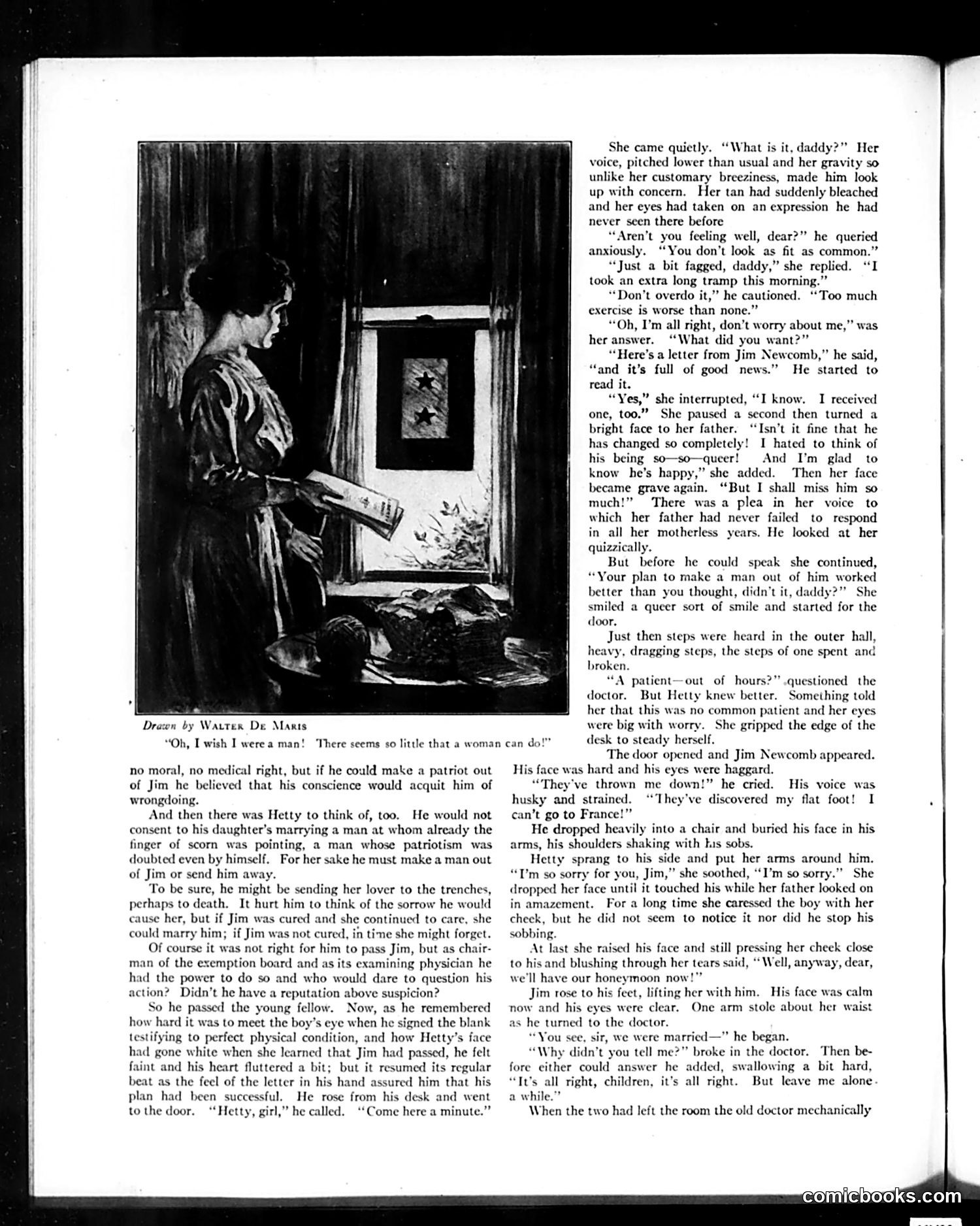
This page presents a serialized story with moral irony, illustrated by Walter De Maris. The narrative concerns a doctor and father who manipulates his daughter Hetty's suitor, Jim Newcomb, during World War I. The central conflict: The doctor, concerned Jim is "queer" (socially unfit), uses his position on a military exemption board to pass Jim as physically fit for combat, hoping military service will "make a man" of him. The doctor's plan is to either reform Jim through war or remove him from his daughter's life. The ironic twist: Jim returns rejected from the draft due to flat feet—a disqualifying condition the doctor examining physician should have caught. The daughter's cryptic comment ("Your plan worked better than you thought, didn't it, daddy?") suggests she knew her father's deception and is commenting sardonically on his failure. The satire critiques patriarchal authority and the callous use of military service as social "correction," exposing the moral hypocrisy of wartime decision-makers.
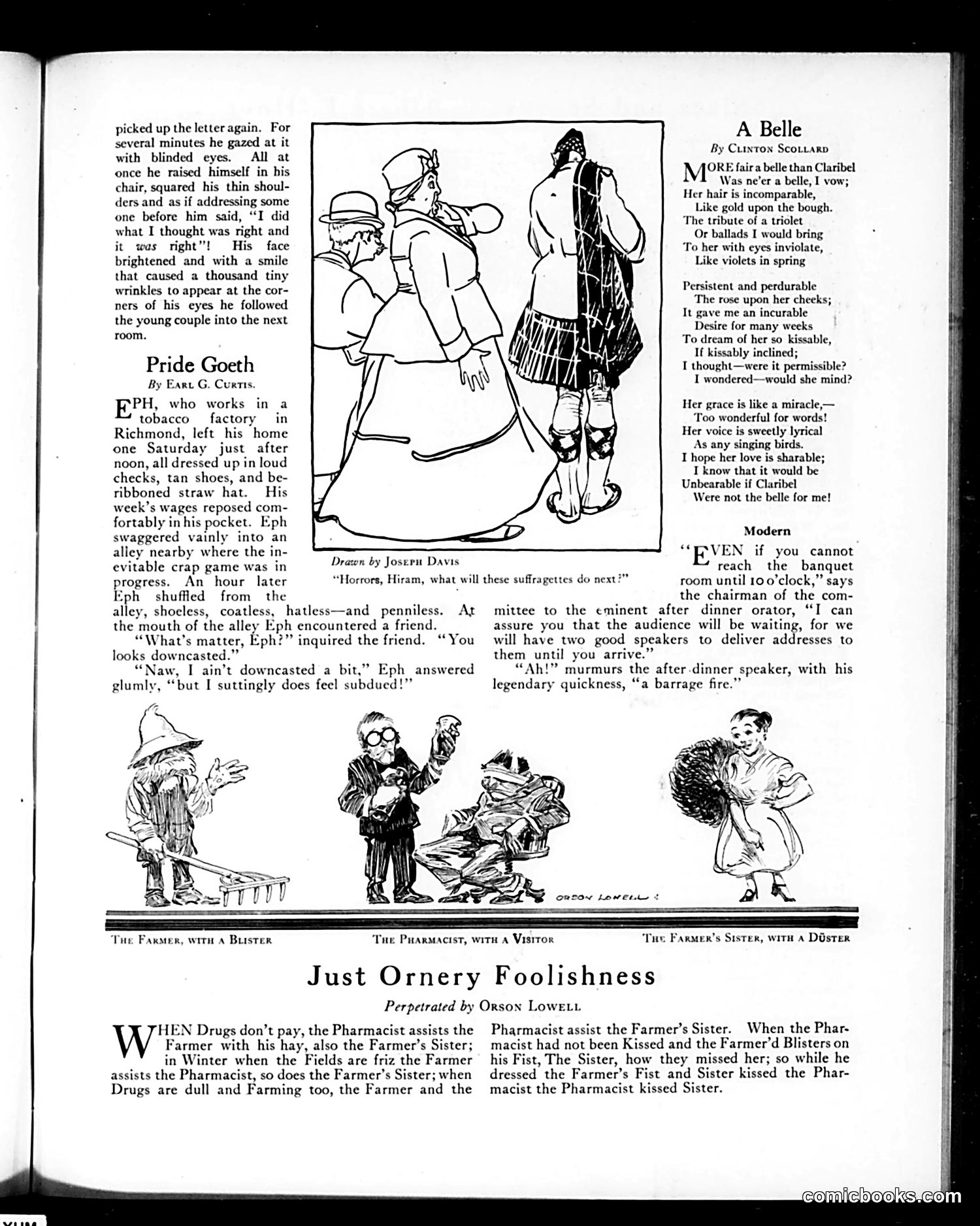
This page contains multiple satirical pieces typical of early 20th-century humor: **"Pride Goeth"** mocks a working-class African American man ("Eph") who loses his wages in a crap game, then claims he's not "downcasted" but merely "subdued"—humor derived from his self-deception and malapropism. **"A Belle"** is a romantic poem with no satirical content—simply sentimental verse about an idealized woman. **"Modern"** jokes about a speaker arriving late to a dinner, with the chairman quipping that two preliminary speakers will provide "barrage fire" (rapid-fire entertainment)—a mild observation about after-dinner speech conventions. **"Just Ornery Foolishness"** presents absurdist wordplay about how a pharmacist, farmer, and farmer's sister help each other depending on seasons, culminating in confused kissing arrangements—nonsensical humor. The cartoons at top and bottom appear unrelated to the text stories. Overall, the page reflects period humor conventions: racial caricature, sentimental romance, mild professional satire, and verbal silliness.
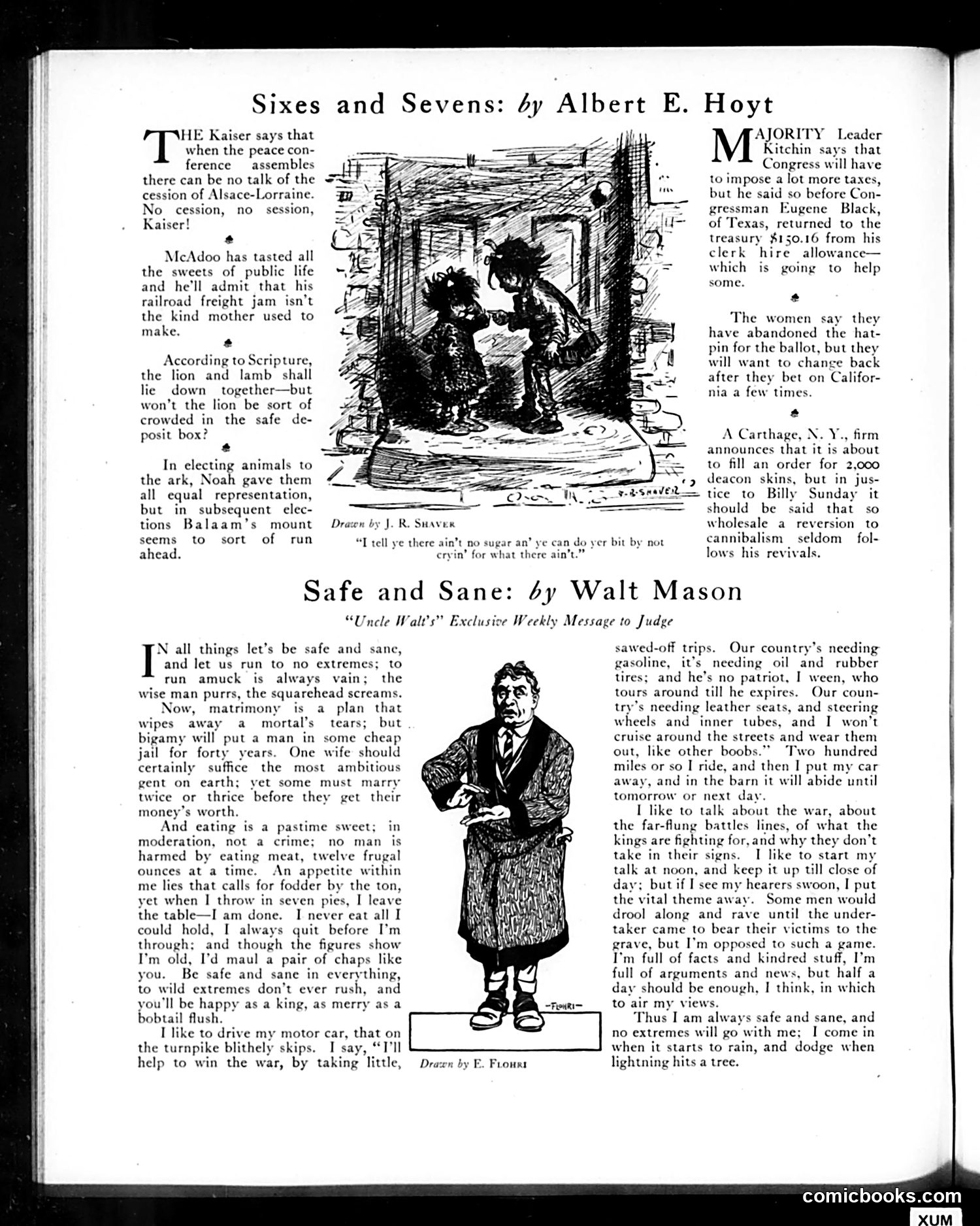
**Top section (Hoyt):** Political commentary on WWI-era issues. References to Kaiser Wilhelm (no peace without concessions), Treasury Secretary McAdoo's railroad problems, and domestic politics. A joke about women voting in California suggests recent female suffrage. The Billy Sunday reference mocks the evangelist's revival meetings. **Bottom section (Mason):** "Uncle Walt" advocates wartime patriotism and moderation. Citizens should conserve resources (gasoline, rubber tires, leather) for the war effort rather than wasteful driving or prolonged socializing. The repeated message: be "safe and sane"—practice restraint to support America's military needs during what appears to be WWI. Mason's folksy verse promotes rationing and self-discipline as patriotic duty. Both columns address American home-front sacrifice and proper civic behavior during wartime.
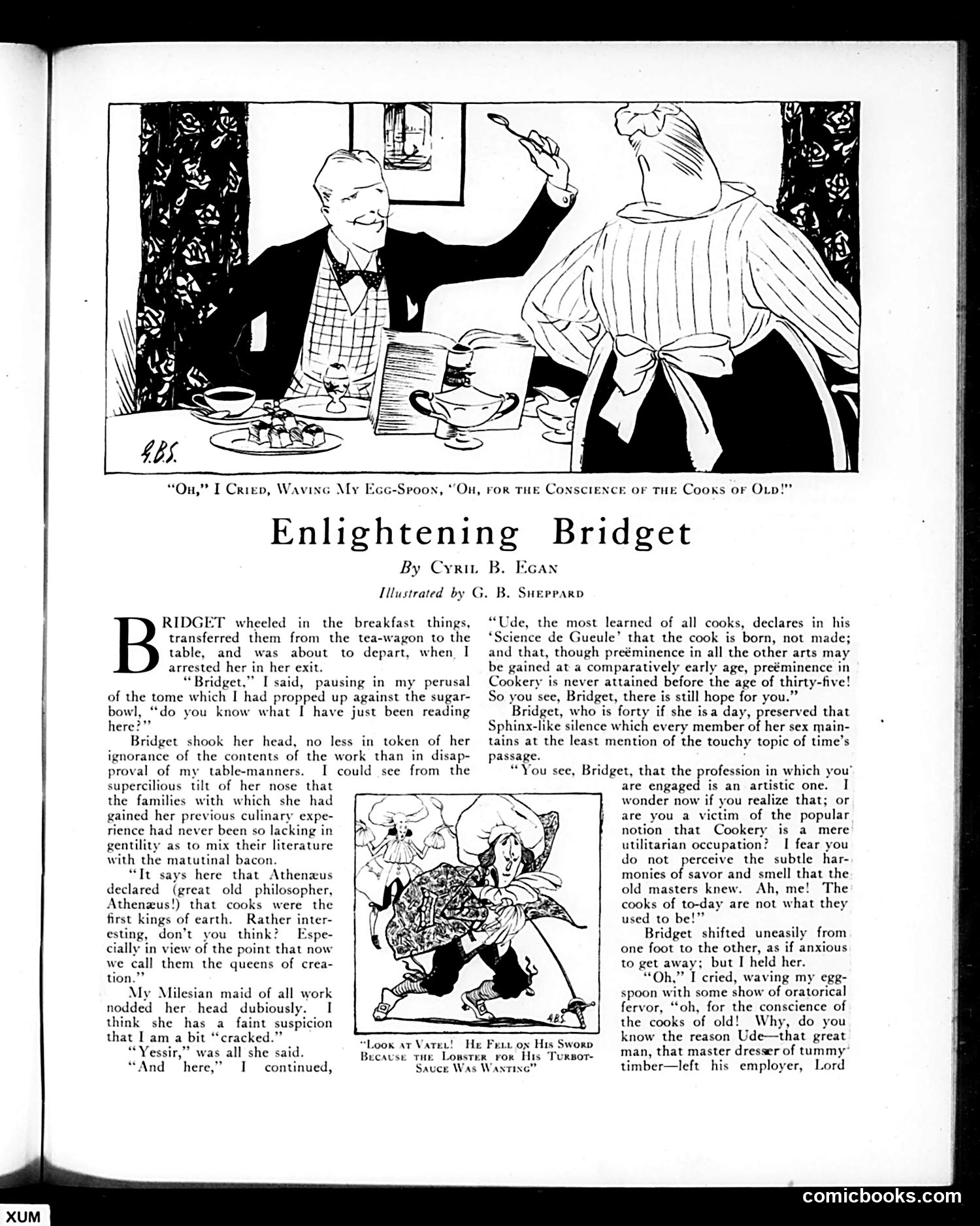
This is a humorous domestic sketch satirizing pretentious intellectualism. A pompous employer interrupts his Irish servant Bridget's work to lecture her from a book about cooking's historical importance—citing the ancient philosopher Athenaeus and a famous chef named Ude to argue that cooking is an "artistic" profession, not mere utilitarian work. The satire targets the employer's pedantic self-importance: he's waving an egg-spoon dramatically while reading obscure classical references to his clearly unimpressed servant, who only wants to finish her chores. The joke is his condescending assumption that Bridget needs enlightenment about her own profession, and his obliviousness to her discomfort. The illustration shows Ude (a real historical figure, likely Marie-Antoine Carême's predecessor) absurdly falling on his sword over inadequate sauce—visual comedy emphasizing how the employer's "proof" of cooking's dignity is ridiculous. The piece gently mocks both employer vanity and the era's class assumptions about domestic workers.
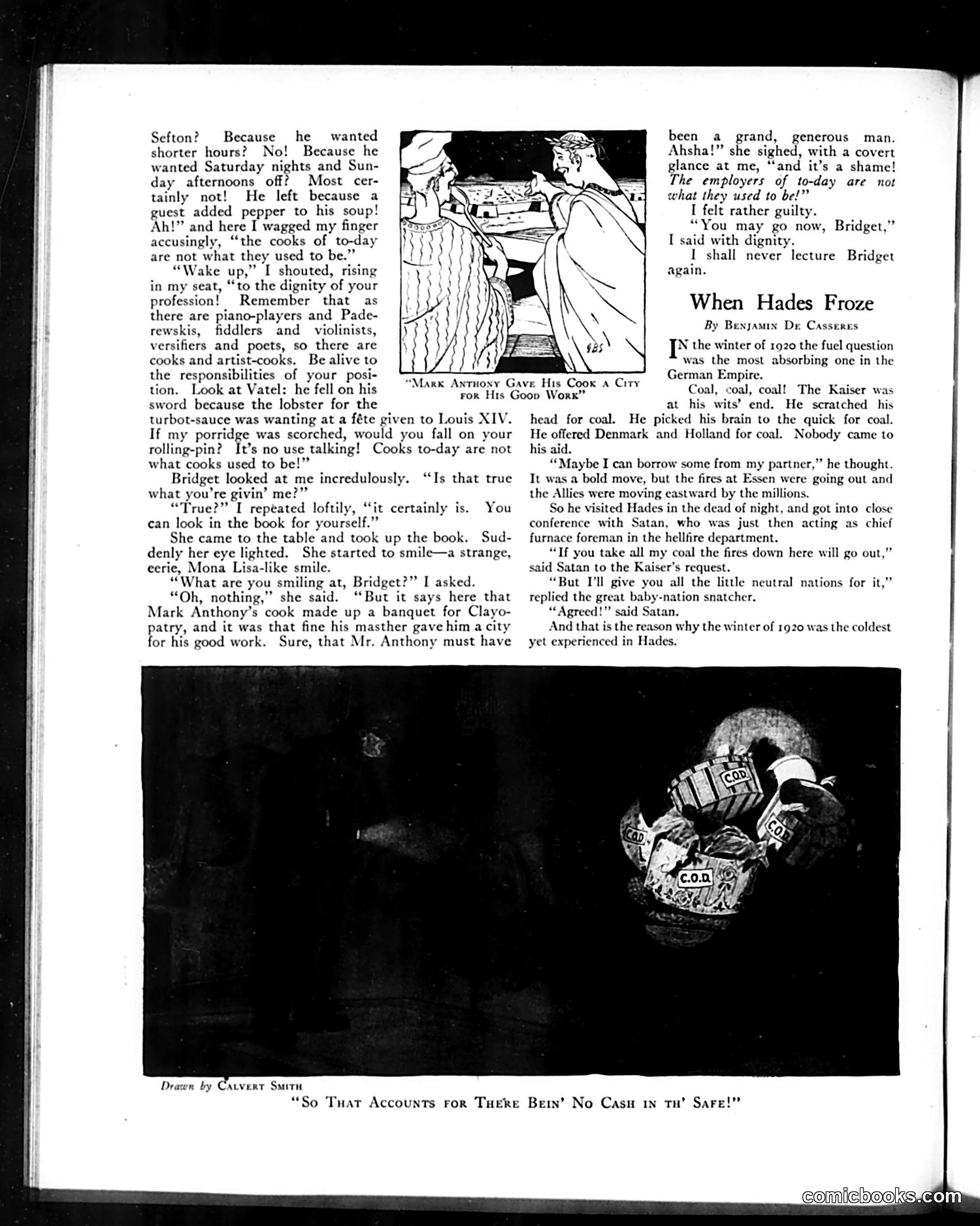
This page contains two satirical pieces from Judge magazine (likely early 1920s based on the "1920" reference in the second story). **Top Section:** A humorous domestic sketch where a homeowner lectures his Irish maid Bridget about professional dignity, citing the historical example of Vatel (a famous 17th-century chef who reportedly killed himself over a fish course failure for Louis XIV). The joke's reversal: Bridget counters by noting Mark Antony gave his cook an entire city as reward, making the employer look stingy by comparison. **"When Hades Froze" (Bottom):** A political allegory about post-WWI Germany's coal crisis. The Kaiser, desperate for fuel as the Allies advance eastward, visits Satan to negotiate. The satire mocks both Germany's desperation and the era's geopolitical chaos—the punchline being that Hell itself froze over because the Kaiser traded all "little neutral nations" for coal, leaving even the underworld depleted. The cartoon (drawn by Calvert Smith) visually represents this hellish fuel shortage with an ironic caption.
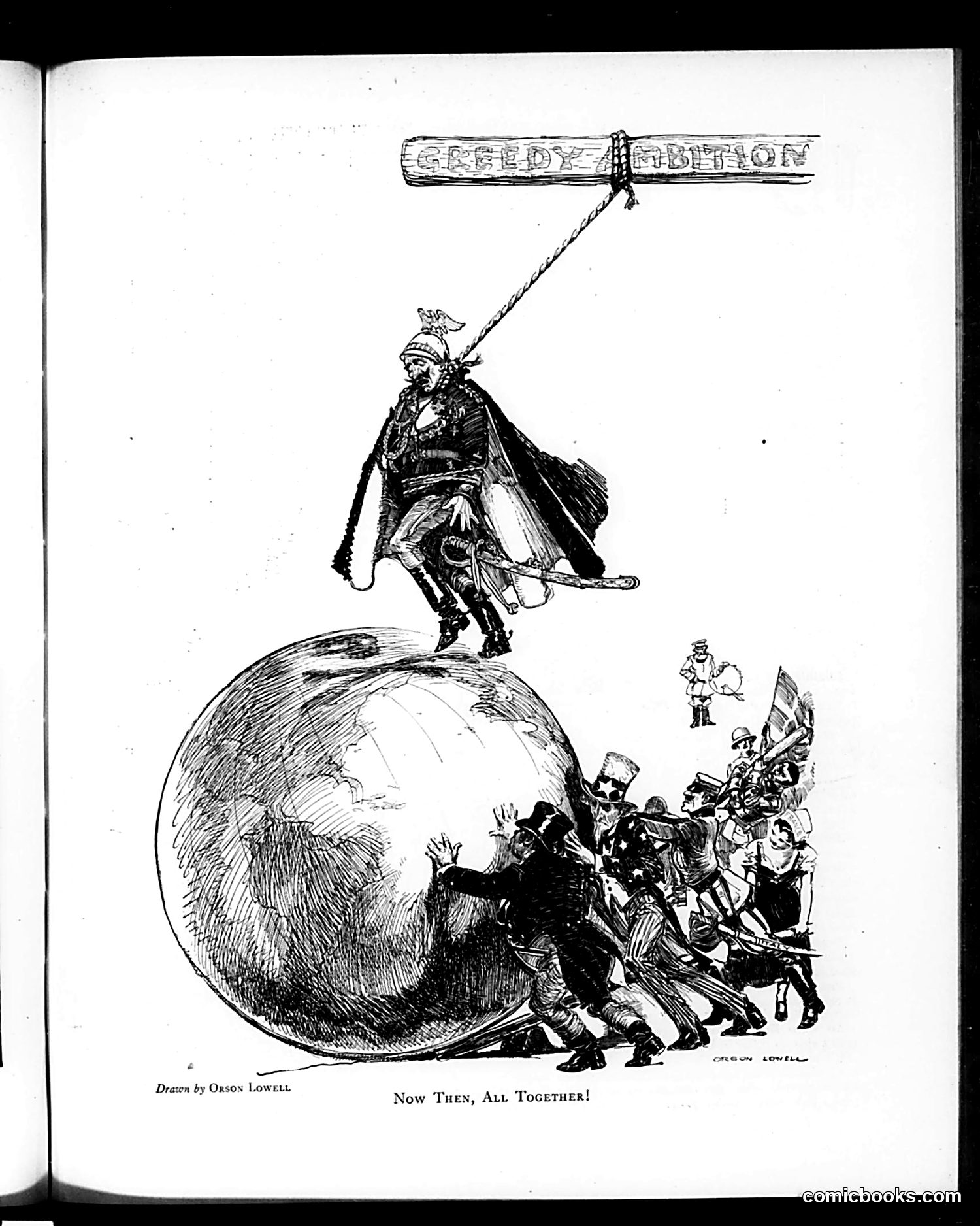
This Orson Lowell cartoon from *Judge* depicts a figure standing atop a large globe, holding a rope attached to a wooden sign reading "CREDIBILITY" (partially legible). Below, a group of military and political figures strain together, apparently trying to push or move the globe. The title "Now Then, All Together!" suggests coordinated effort. The satire appears to critique leadership's difficulty maintaining credibility or public trust—despite unified effort from various institutions (military, government), the task remains monumental. The protagonist's precarious position atop the globe suggests instability or the fragility of authority. Without identifying the specific figure at the top, the cartoon likely comments on early 20th-century political or wartime challenges to governmental credibility and institutional legitimacy.
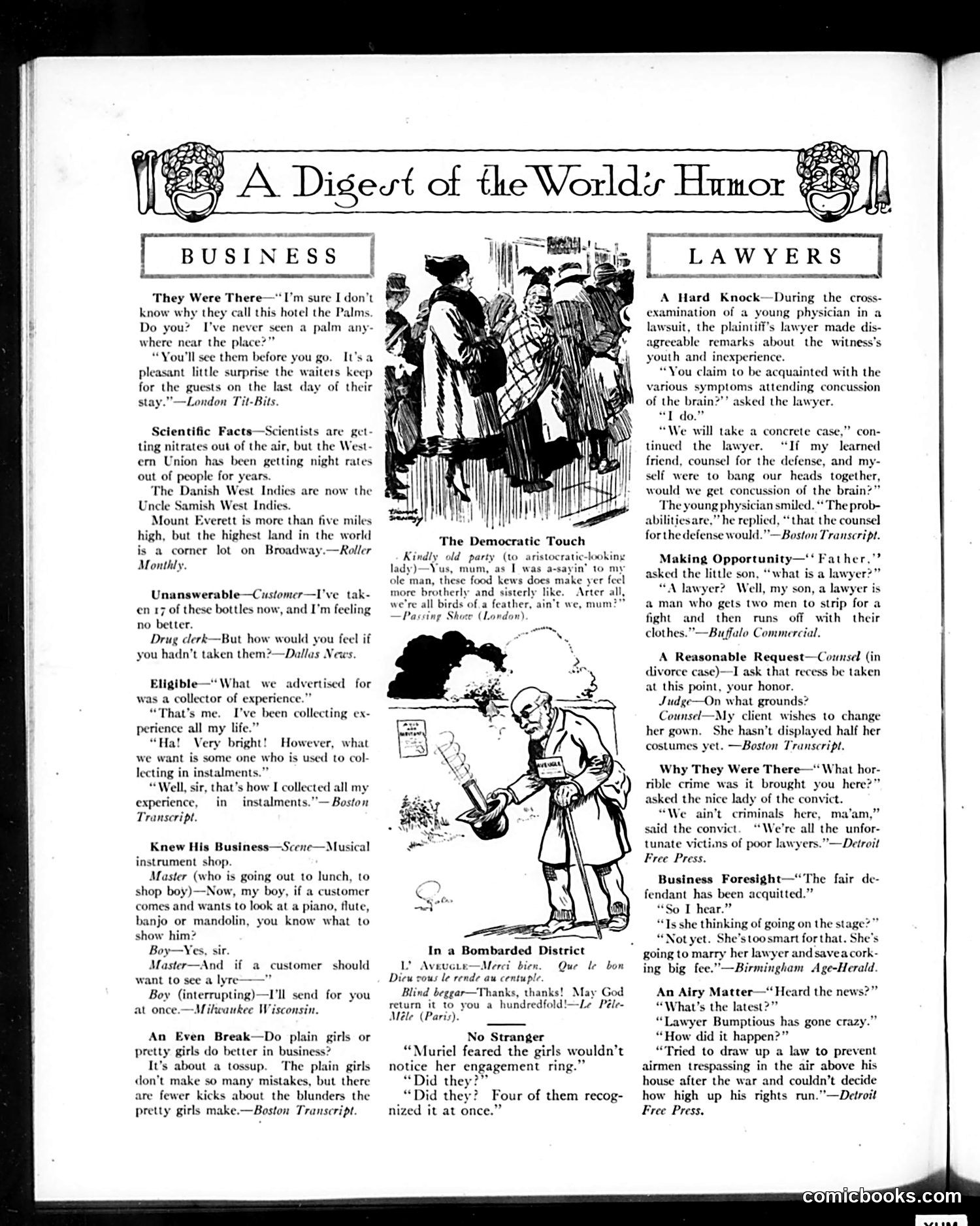
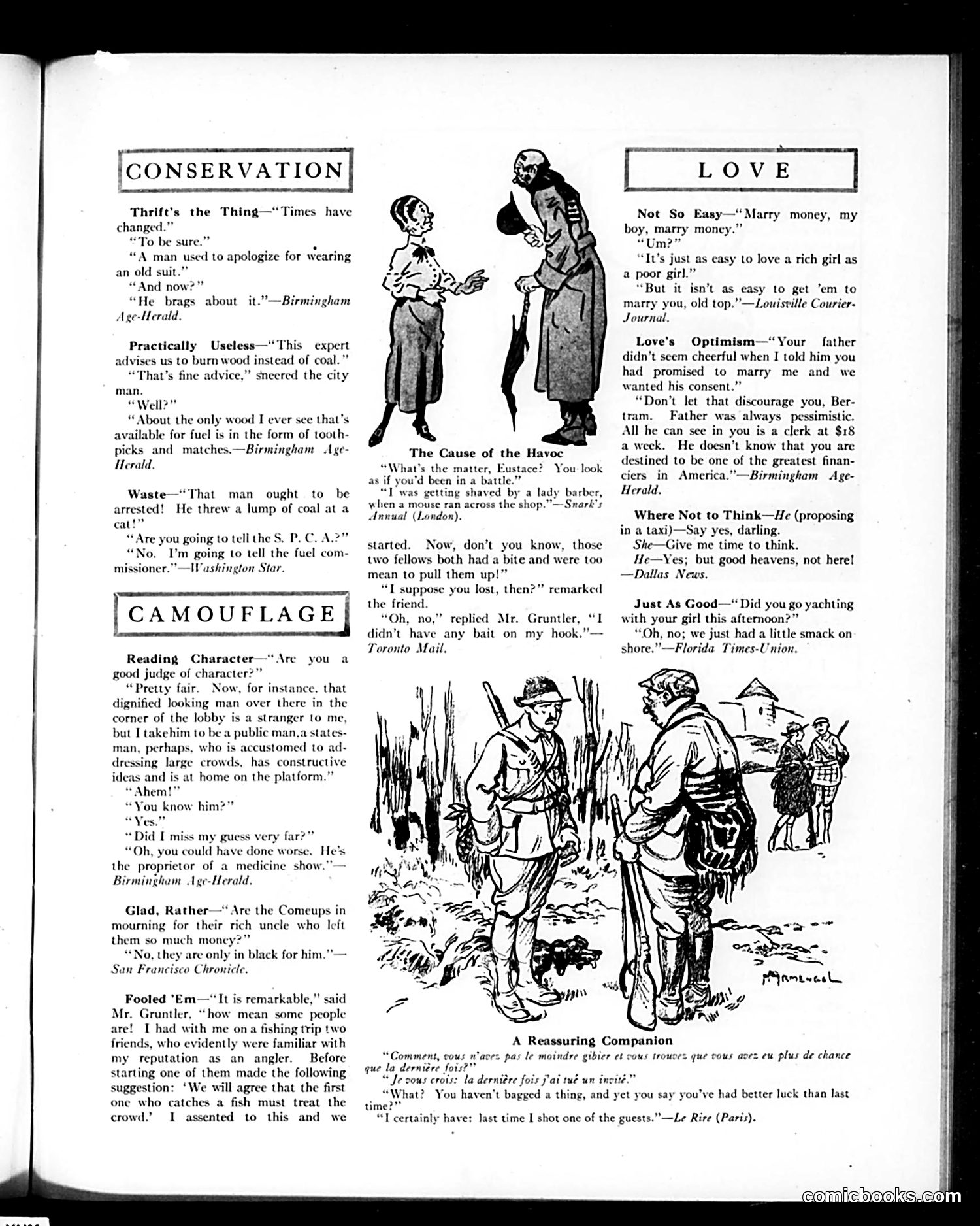
This page contains satirical humor pieces typical of early 20th-century American magazines, organized into three sections: **Conservation & Camouflage**: These mock wartime thrift efforts and social pretension. "Thrift's the Thing" jokes that men now *brag* about wearing old suits (reversing pre-war shame). "Practically Useless" ridicules experts advising wood fuel when city dwellers only see toothpicks. "Reading Character" features a man fooled by someone's dignified appearance—the stranger turns out to be a medicine-show charlatan, not a statesman. **Love**: Humorous takes on courtship and marriage. The jokes play on class anxiety (marrying rich girls requires wealth the suitor lacks) and male pessimism about women's earning potential. **Cartoons**: The illustration shows hunters or soldiers in a rural setting. The bottom caption (translated from French) darkly jokes that a hunting companion had "better luck" this season because last time he "shot one of the guests"—dark humor about accidental hunting deaths. The overall tone reflects early 1900s American attitudes toward thrift, social climbing, courtship, and class.
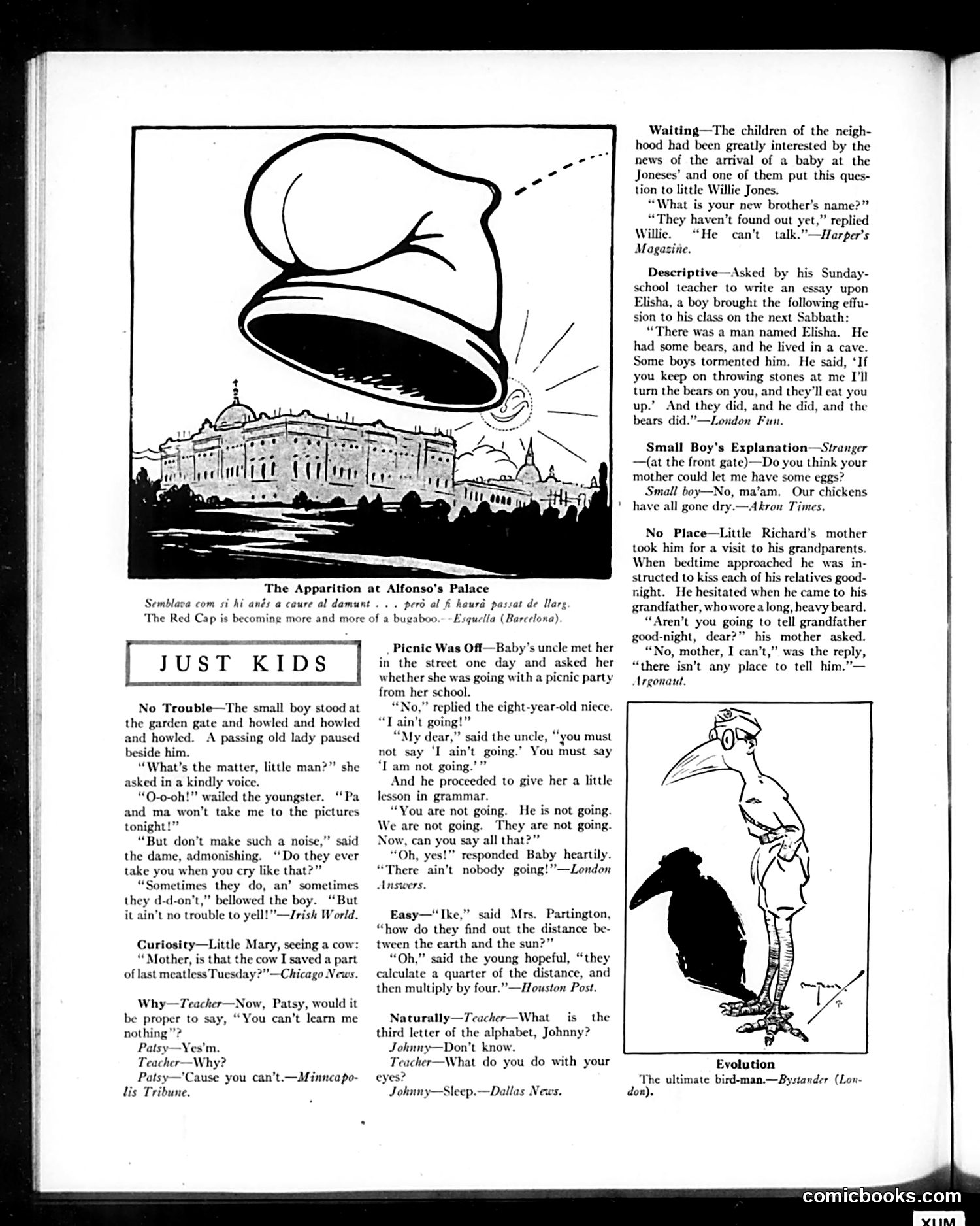
This page from Judge magazine contains two distinct elements: **Top cartoon**: "The Apparition at Alfonso's Palace" depicts a giant Red Cap (Phrygian cap, symbol of revolution/socialism) looming over a palace, referencing political unrest in Spain. The caption notes "The Red Cap is becoming more and more of a bugaboo"—expressing alarm about radical revolutionary movements threatening established institutions. **"Just Kids" section**: A humor column featuring brief jokes about children's logic and speech. The jokes mock childish malapropisms (like "ain't"), innocent misunderstandings, and the gap between adult instruction and children's literal interpretations. These were typical filler content in early 20th-century magazines. **"Evolution" cartoon**: A grotesque bird-man sketch, likely satirizing Darwinian evolution theory—a common target of early 1900s satirists who treated evolutionary ideas as ridiculous. The page reflects Judge's dual nature: serious political satire paired with light domestic humor for broad appeal.
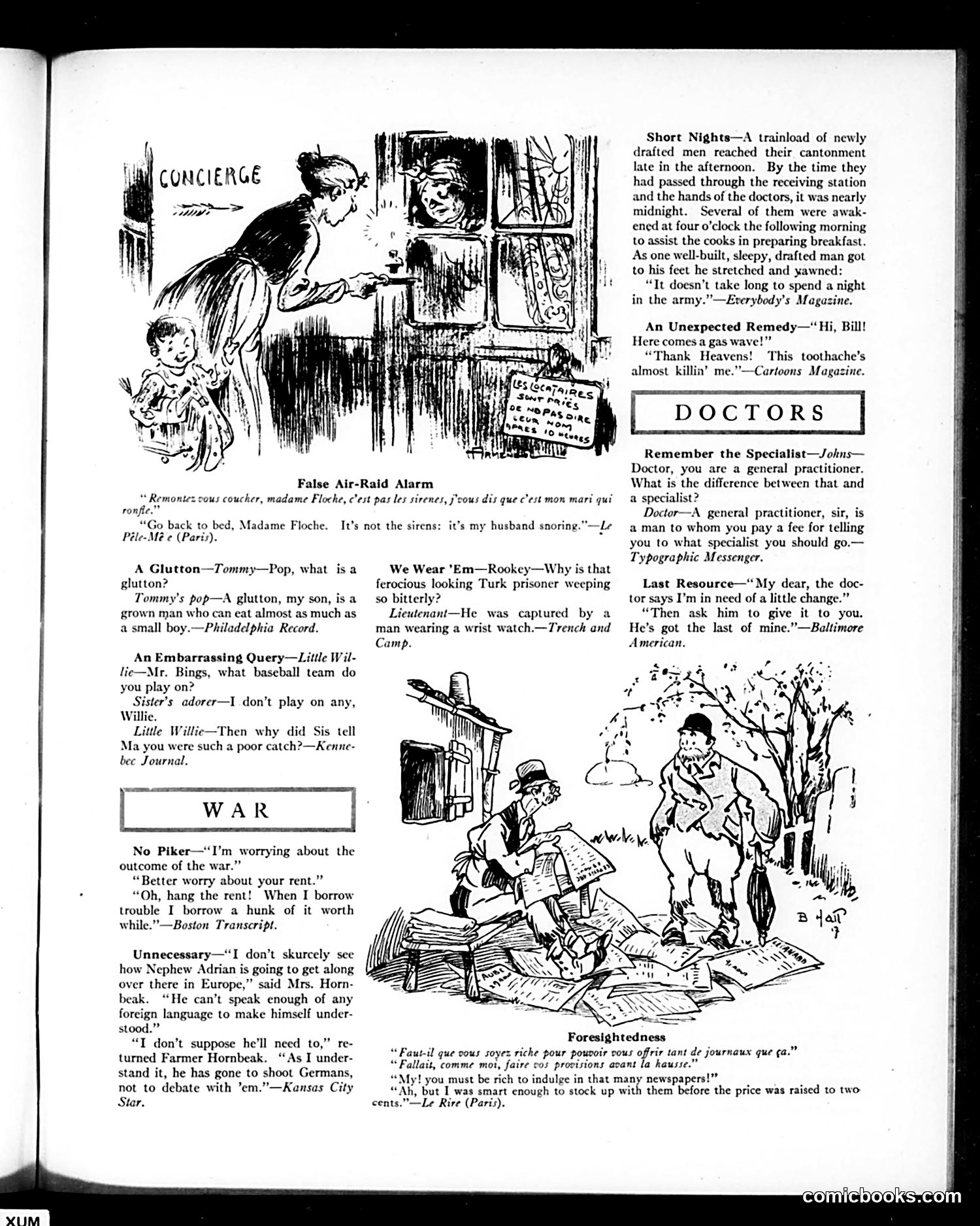
This Judge magazine page collects brief satirical quips organized under section headings. The content reflects WWI-era American concerns: **"War" section**: Dark humor about wartime anxieties—a man jokes he worries more about rent than the war's outcome; another quip dismisses the need for language skills when soldiers are sent to "shoot Germans, not debate." **"Doctors" section**: Medical satire, including a joke that general practitioners simply refer patients to specialists while charging fees—a timeless complaint about healthcare. **Other humor**: A French joke about a wife mistaking her husband's snoring for air-raid sirens reflects European combat fears. A "gas wave" toothache joke references poison gas warfare. A Turkish prisoner's distress over a wristwatch suggests German military superiority. The overall tone is cynical, treating wartime hardship, military life, and professional exploitation as fodder for dark comedy—typical of Judge's satirical approach during this period.
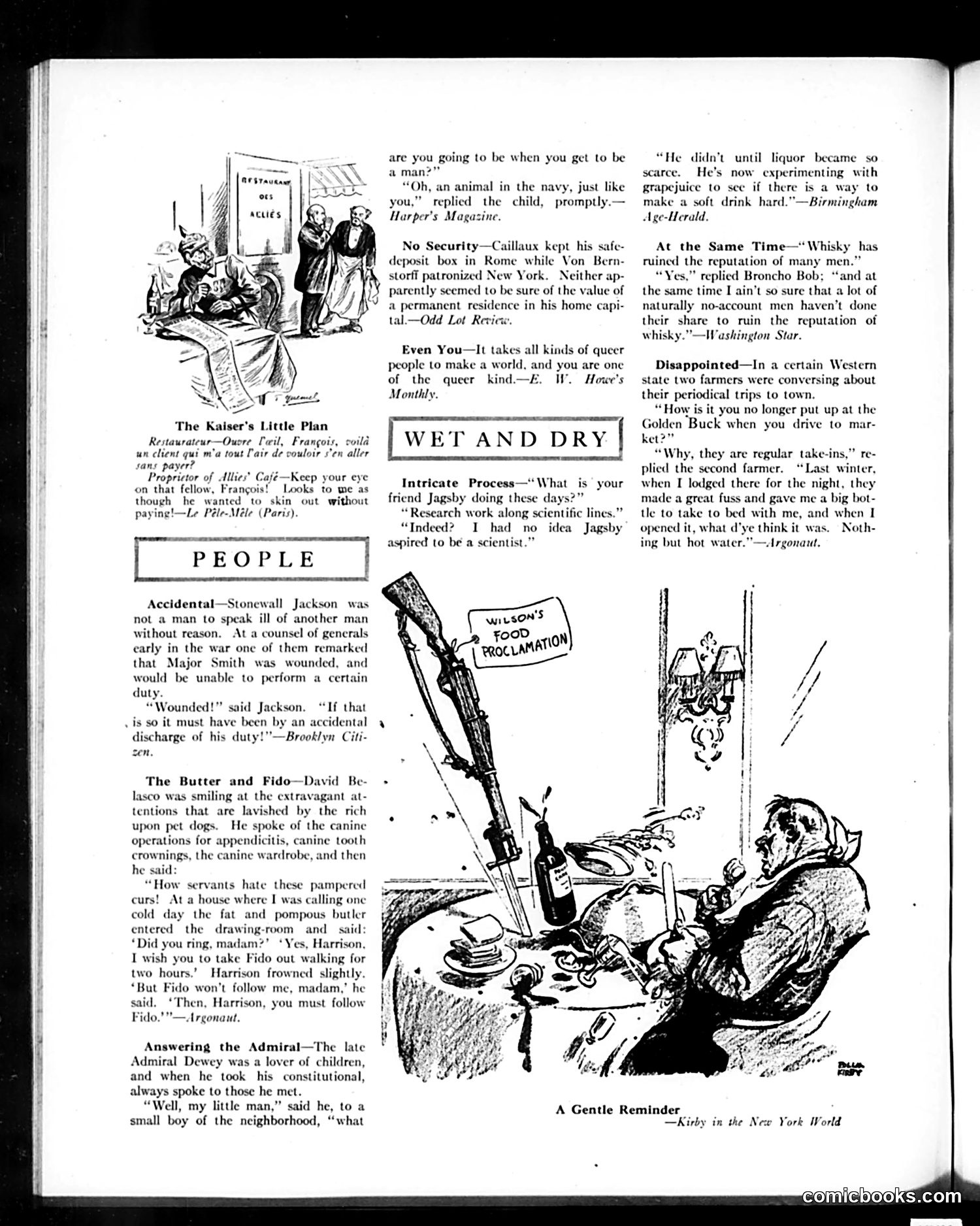
This page from Judge contains humorous anecdotes and a political cartoon rather than advocacy journalism. **"The Kaiser's Little Plan"** (top left): A cartoon mocking German leadership during WWI. A French restaurant owner warns his staff to watch a suspicious diner who looks like he'll leave without paying—a metaphor for Germany's anticipated default on war debts or reparations. The joke equates German war strategy with financial dishonesty. **"Wet and Dry" section**: These are Prohibition-era jokes. During Prohibition (1920-1933), alcohol was illegal. The humor mocks both prohibition enforcement and failed attempts to create alcohol substitutes. One joke suggests someone is "experimenting" with grapejuice to make it intoxicating; another presents whisky as both socially destructive and scapegoated for men's pre-existing character flaws. **"A Gentle Reminder"** (bottom right): A cartoon showing someone reading "Wilson's Food Proclamation"—likely referencing wartime food rationing under President Wilson during WWI. The page reflects American concerns: wartime debt, Prohibition, and government control during the Wilson administration.
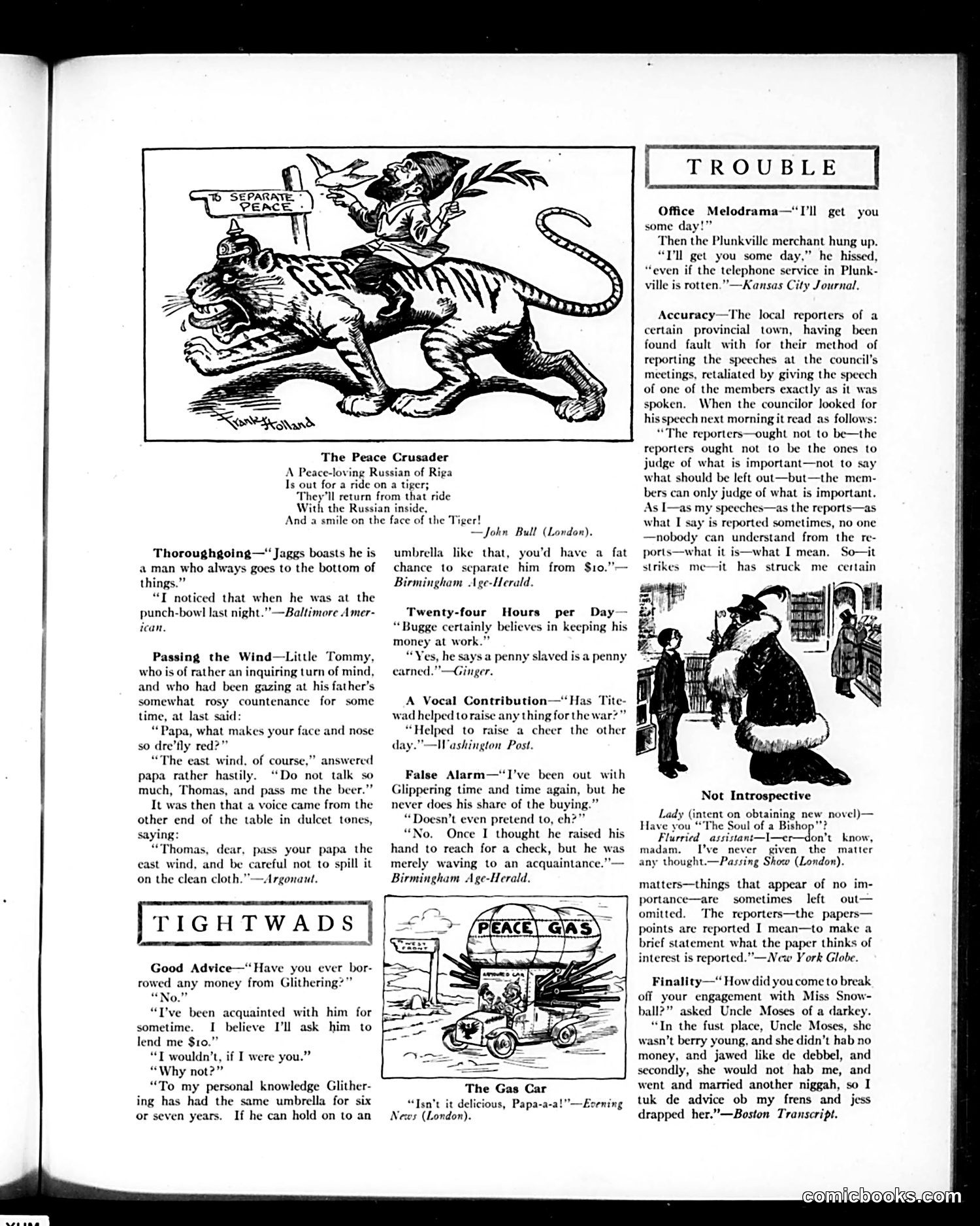
This page contains several brief satirical jokes and one political cartoon. "The Peace Crusader" depicts a Russian riding a tiger labeled "to separate," with the dark implication that Russia's peace efforts will end badly—the tiger will consume the peacemaker. This likely references Russian diplomatic initiatives during a period of international conflict, suggesting such efforts are naive and dangerous. The remaining items are domestic humor: jokes about stingy borrowers, marital dynamics, awkward fathers, and workplace incompetence. The "Accuracy" piece satirizes local reporters who transcribed a councilman's rambling speech verbatim, exposing his incoherence. These represent typical early-20th-century satirical commentary on everyday social absurdities rather than partisan politics.
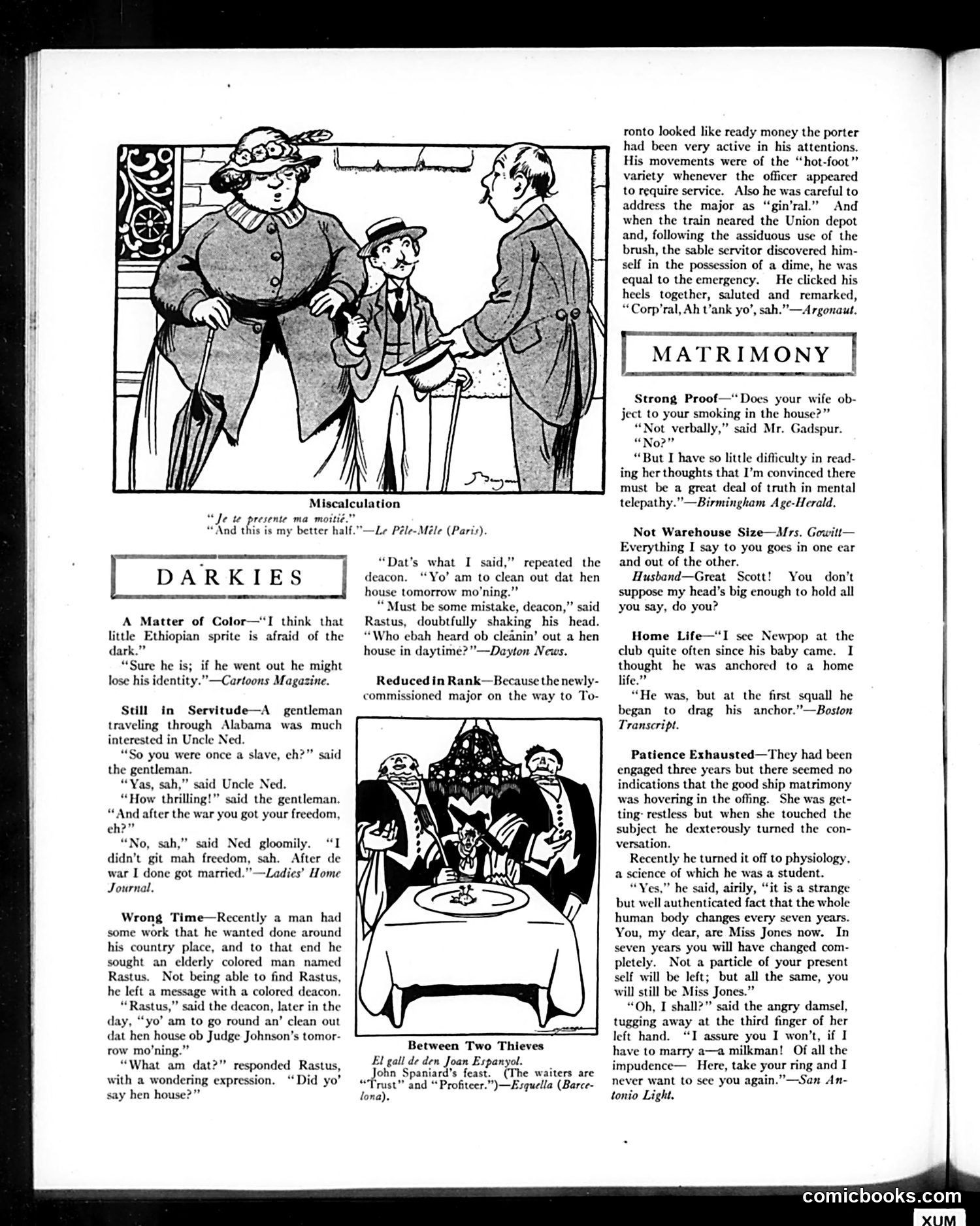
This page contains **four separate humor sections** mocking different groups: **"Darkies"** section: Four dialect jokes stereotyping Black Americans, presenting them as childlike or dim-witted. The "Still in Servitude" joke suggests marriage is worse than slavery—a common era trope trivializing actual bondage. **"Matrimony"** section: Middle-class domestic humor about marriage, where wives are portrayed as telepathic nags and husbands as bumbling avoiders. The final joke shows a woman breaking an engagement over a man's poor reasoning about body regeneration. **Two cartoons** (untranslated French/Spanish sources): The top shows what appears to be a domestic scene; the bottom depicts two figures flanking a central seated figure labeled "Between Two Thieves"—likely political commentary on corruption or wartime profiteering. **Context**: Judge (a satirical weekly) frequently punched down at marginalized groups while presenting bourgeois marriage anxieties as relatable comedy. The racist content reflects early 20th-century American publishing norms that modern readers would find offensive.
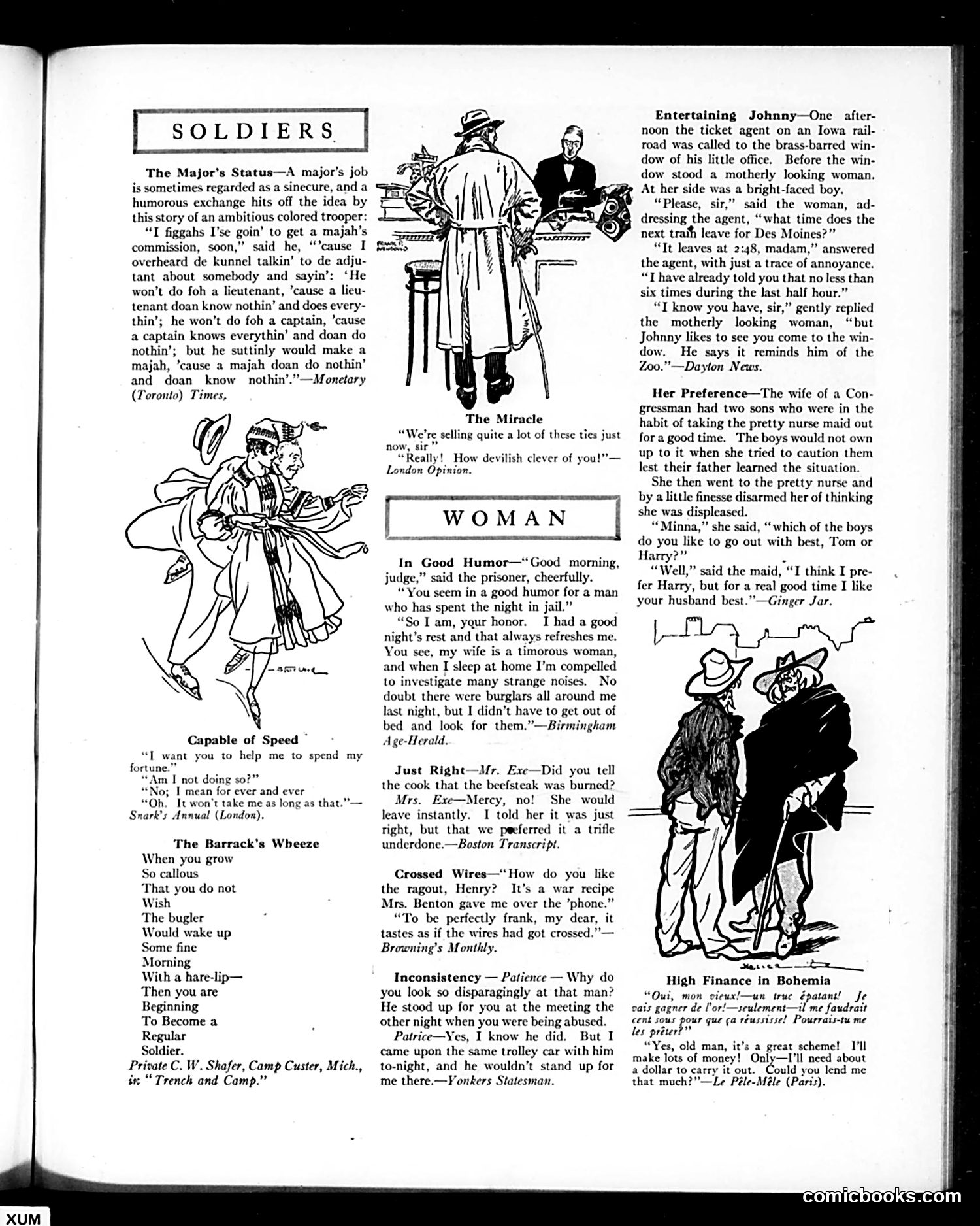
This page collects brief humorous anecdotes targeting early 20th-century social hierarchies and domestic life. The "Soldiers" section mocks military rank through dialect humor: a Black soldier observes that majors "doan do nothin' and doan know nothin'"—satirizing how promotions reward incompetence. The "Woman" section contains domestic comedy: a wife lies to her cook about burned steak to prevent her leaving; a husband's complaint about ragout mysteriously arriving via telephone wire gets blamed on "crossed wires" (a pun); and a congressman's wife diplomatically questions her sons' nursemaid about which boy she prefers dating. The final anecdote presents a mother repeatedly sending her son to ask a railroad agent for train times solely for entertainment—the agent's irritation is the joke's punchline. The humor relies on class consciousness, marital discord stereotypes, and casual sexism typical of the era.
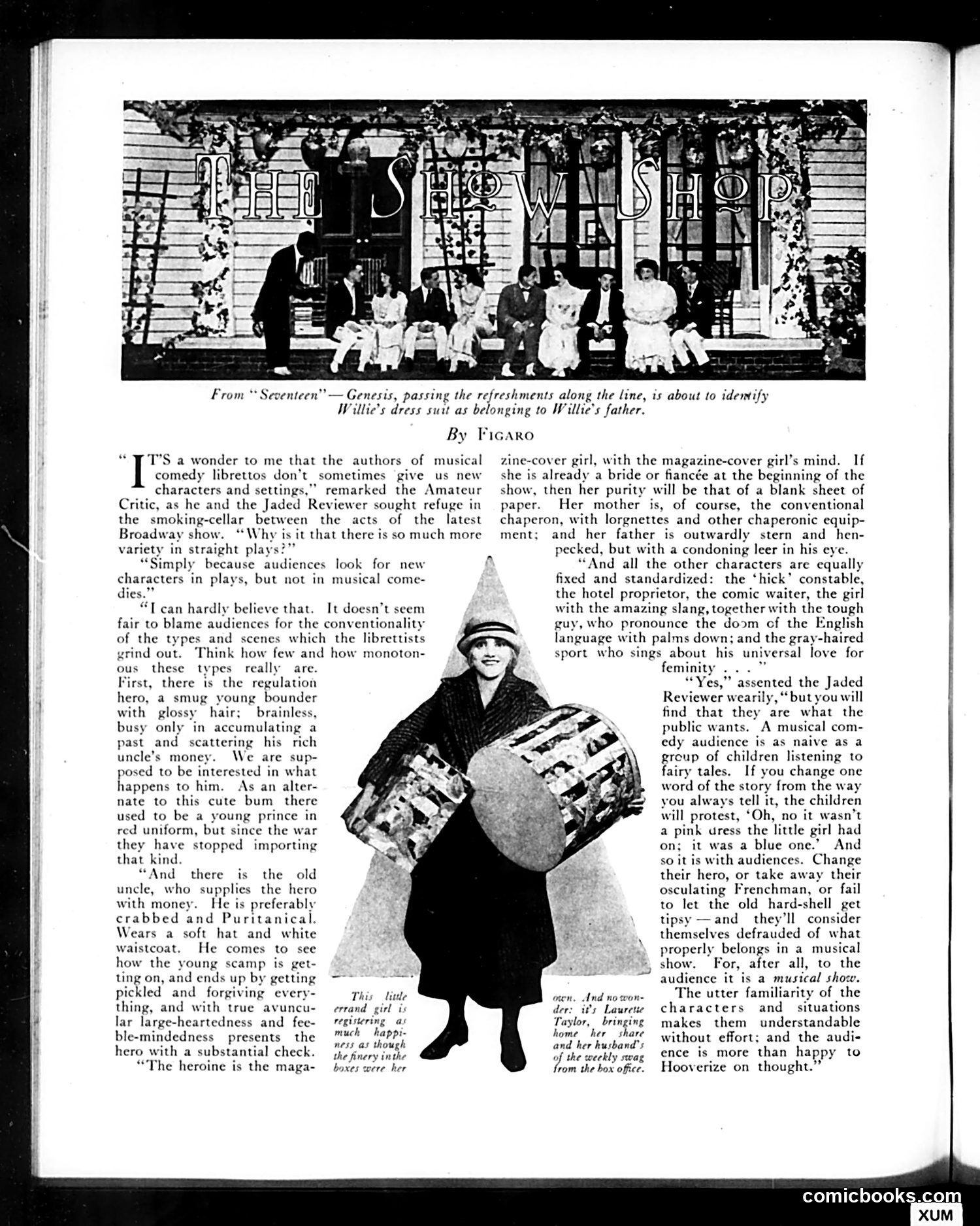
This page satirizes the formulaic nature of Broadway musical comedies of the 1910s-1920s. Two theater critics—an "Amateur Critic" and a "Jaded Reviewer"—discuss why musicals rely on tired, recycled character types while plays offer novelty. The satire catalogs these stock characters: the smug, brainless young hero; the wealthy, Puritanical uncle who funds him; the naive magazine-cover-girl heroine; the stern-but-lenient father; the comic waiter; the tough guy with poor English; and the gray-haired sentimental character. The photograph shows a scene from "Seventeen" with actors seated in a shop window. The caption indicates Willie is about to be identified by his dress suit. The critics conclude audiences *prefer* this predictability—they're likened to children who protest if fairy tales deviate even slightly from the familiar version. The jaded reviewer notes audiences find comfort in these standardized elements and feel "defrauded" without them. The satire mocks both theatrical conventions and audience complacency.
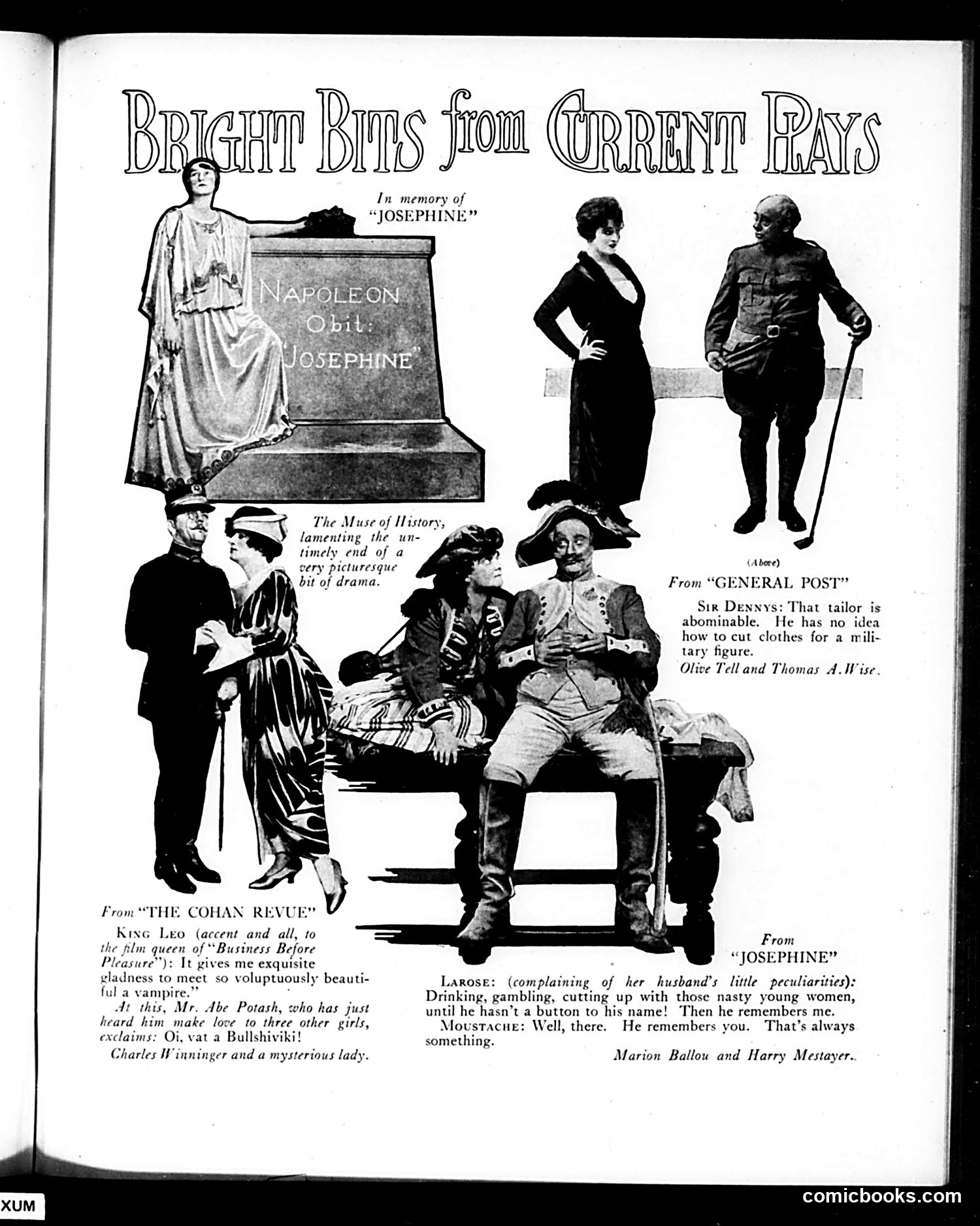
This page collects humorous excerpts from contemporary Broadway productions, presented as theatrical satire. The top section memorializes "Josephine," likely referencing a play or production that recently closed. The excerpts mock character types and situations: - **"General Post"**: A tailor's incompetence at fitting military uniforms - **"The Cohan Revue"**: A comedic scene where a character flatters a woman by calling her a "vampire" (a femme fatale type popular in early 20th-century theater), prompting an observer to exclaim "Oi, vat a Bullshiviki!"—using Yiddish to express shock, playing on contemporary anti-Bolshevik sentiment - **"Josephine"**: A domestic comedy where a husband's infidelity and drinking are forgiven because "he remembers" his wife The satire targets both theatrical conventions and social attitudes—particularly marital dynamics and ethnic stereotypes typical of the era's entertainment.
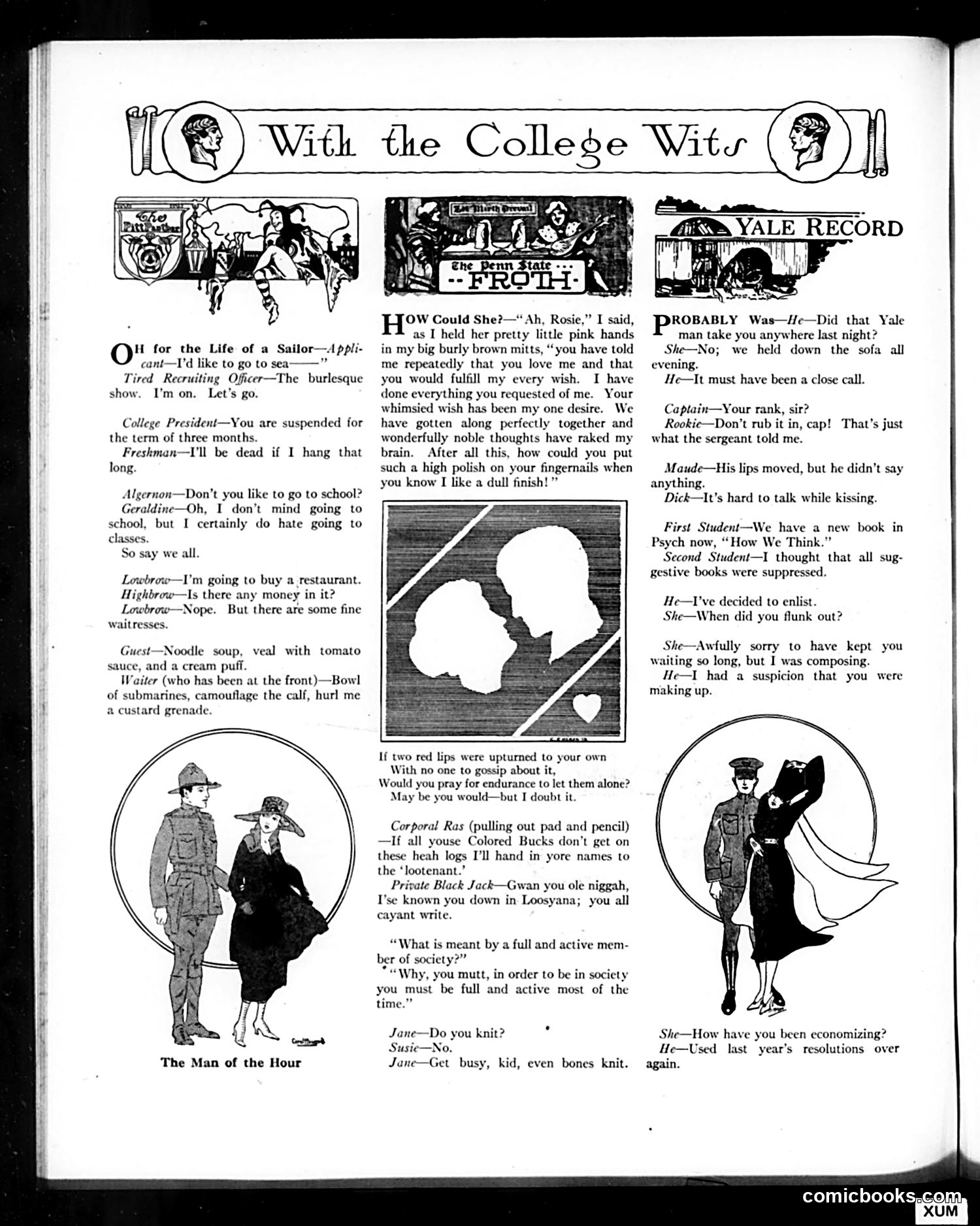
This page collects short satirical jokes targeting early 20th-century college life and social conventions. Key targets include: **College Culture**: A freshman threatens suicide over suspension; students hate attending classes despite liking school—mocking academic apathy. **War References**: A waiter uses military slang ("submarines," "camouflage," "custard grenade"), and "Corporal Ras" supervises Black laborers using racial slurs and threatening authority—reflecting WWI-era military humor and deeply racist attitudes of the period. **Gender/Romance**: Multiple jokes mock courtship rituals (the woman with nail polish, kissing difficulties, a woman "composing" excuses). "The Man of the Hour" illustration shows a soldier with a woman, likely celebrating wartime romance. **Class Humor**: A "Highbrow" wants a restaurant for the waitresses, not profit—stereotyping working-class motives. The page's satire assumes educated, white, male college readers would find crude mockery of service workers, soldiers, and women amusing. The racial content is particularly jarring to modern readers.
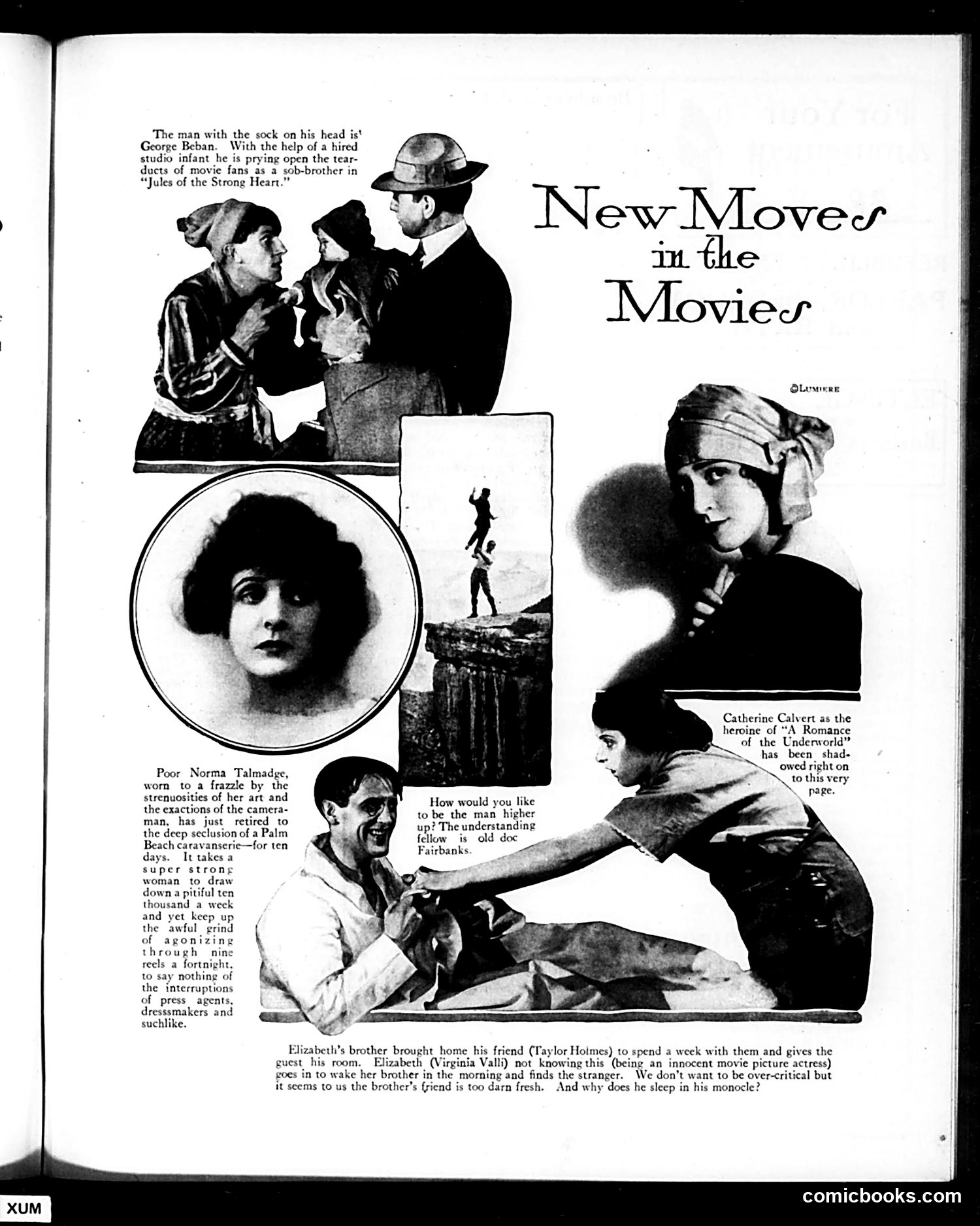
This page satirizes silent film stars and the movie industry's demands on performers. The text mocks: **Norma Talmadge**: Criticized for earning $10,000 weekly while exhausted from shooting nine reels per fortnight, managing press agents and dressmakers—implying stars are overpaid yet perpetually frazzled. **George Beban**: Shown manipulating a baby to extract tears from audiences in an emotional melodrama, satirizing the artificial sentimentality of silent films. **Catherine Calvert** and other unnamed actresses appear in promotional photos for their films. The bottom item ridicules a scenario involving "Taylor Holmes" (likely actor Taylor Holmes) sleeping in another man's room while wearing a monocle—sarcastically questioning both the plot's contrivance and the character's pretentiousness. The satire targets Hollywood's manufactured emotions, absurd plotting, and the physical/financial toll on performers, suggesting the industry prioritizes spectacle over sense.
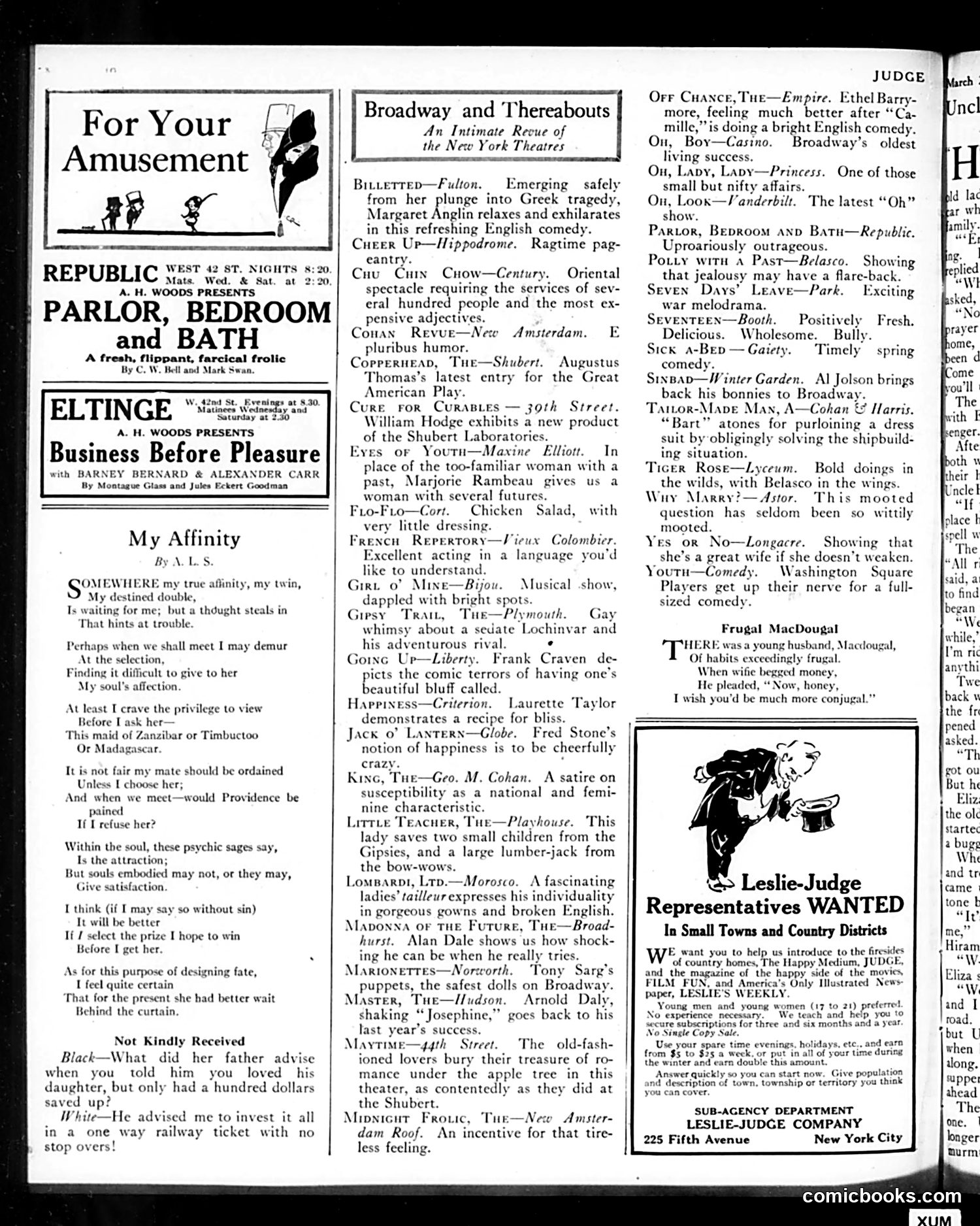
This page is primarily **theatrical advertising and reviews** rather than political satire. The main content consists of: **Theater Section ("Broadway and Thereabouts"):** Brief, witty capsule reviews of New York plays—employing puns and irreverent commentary. For example, "Flo-Flo" is described as "Chicken Salad, with very little dressing," mocking the play's substance. **"My Affinity" Poem:** A humorous philosophical piece about soulmates, expressing anxiety about meeting one's predestined romantic match—using early 20th-century pseudo-mystical language about "psychic sages" and "designed fate" to explore the absurdity of arranged or fated romance. **"Not Kindly Received" Joke:** A brief dialogue mocking a poor suitor advised to invest his hundred dollars in a one-way train ticket—satirizing economic disparity and dismissive attitudes toward the working poor. **Leslie-Judge Recruitment Ad:** Seeks theatrical representatives for small towns. The page reflects early 1900s Broadway culture and satirizes both theater and social pretension through humor rather than explicit political commentary.
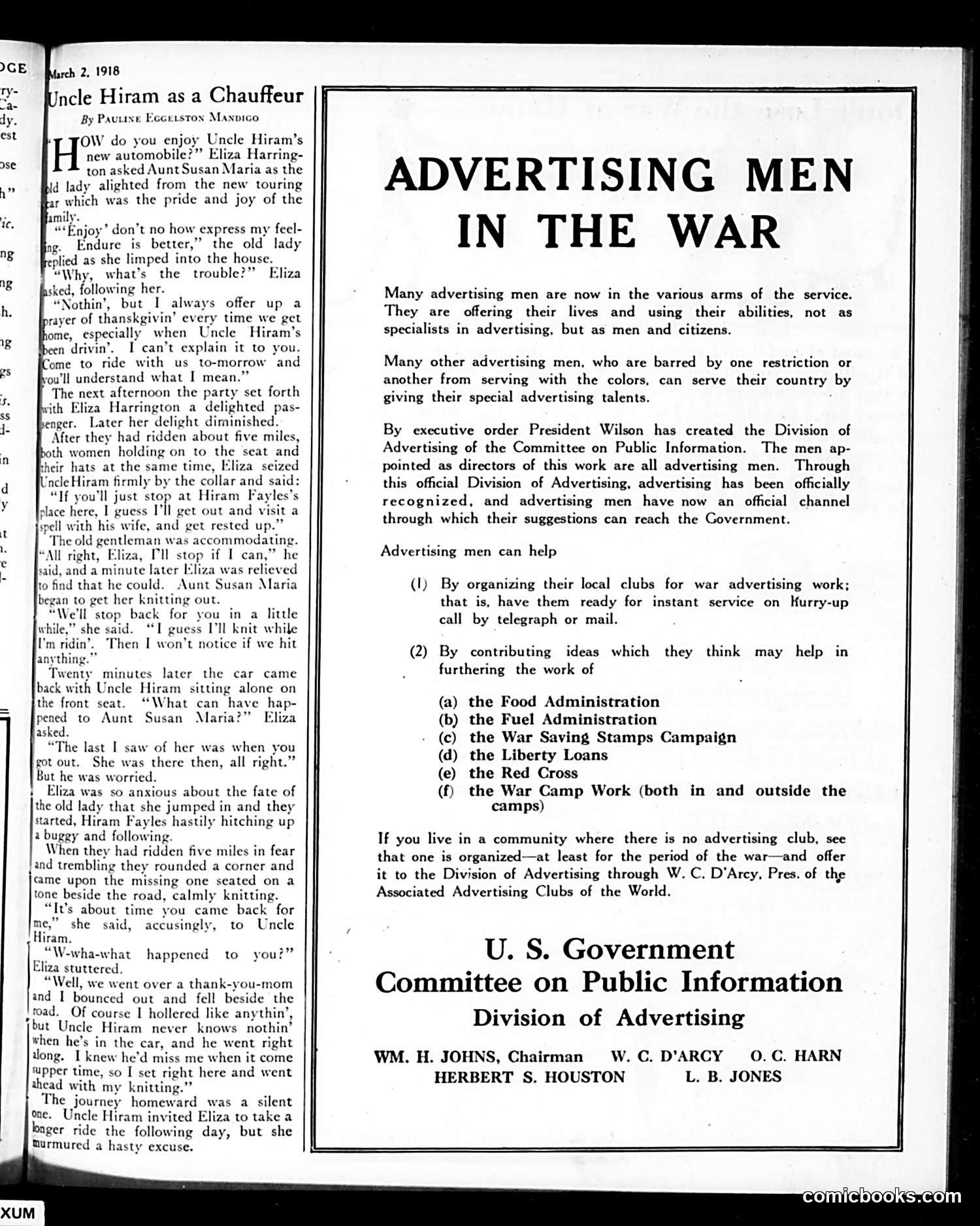
This page contains two distinct elements: **Left side:** A humorous short story titled "Uncle Hiram as a Chauffeur" by Pauline Eggeston Mandigo. The joke concerns an elderly man's reckless automobile driving. When Aunt Susan Maria falls out of the car during a rough bump (a "thank-you-mom"—slang for a road obstacle), Uncle Hiram doesn't notice and drives on. She calmly sits by the roadside knitting until they realize she's missing and retrieve her. The humor derives from her stoicism and his obliviousness as a driver—a satire on early 1900s motorists. **Right side:** A government advertisement recruiting advertising professionals to contribute their expertise to World War I efforts (the U.S. entered in 1917). President Wilson's administration has created an official Division of Advertising to channel their talents toward the Food Administration, Fuel Administration, War Savings Stamps, Liberty Loans, and Red Cross work. The page shows Judge magazine's mix of entertainment and patriotic messaging during wartime.
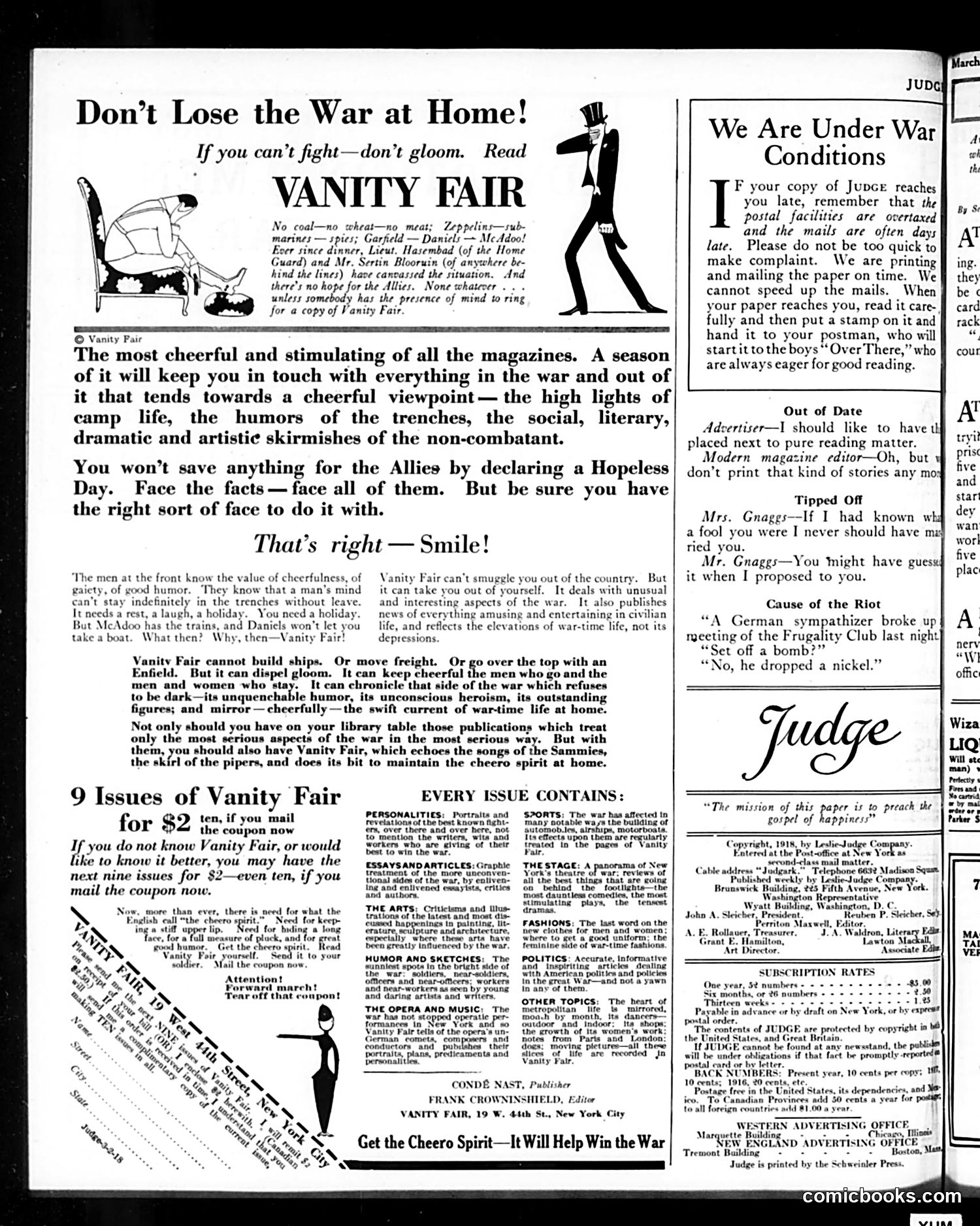
This is a **full-page advertisement for Vanity Fair magazine**, positioned as morale-building propaganda during World War I. The top cartoon depicts a gloomy man in an armchair surrounded by war worries (coal shortages, Zeppelins, submarines, spies), with Uncle Sam figure appearing to offer salvation through Vanity Fair. **The pitch**: Americans unable to fight shouldn't despair—read Vanity Fair instead. The magazine claims to maintain "the cheero spirit" by reporting on entertaining aspects of war (camp humor, trenches' lighter moments, home-front social life) rather than only grim news. **Key references**: McAdoo (Treasury Secretary controlling trains) and Daniels (Navy Secretary) are jokingly blamed for preventing civilian escape—only magazines offer mental relief. **The satire's logic**: Vanity Fair cynically argues that civilian morale matters militarily. It can't build ships or fight, but it can keep spirits up—positioning entertainment as patriotic duty during wartime rationing and anxiety. The subscription offer ($2 for nine issues) appears below the argument.
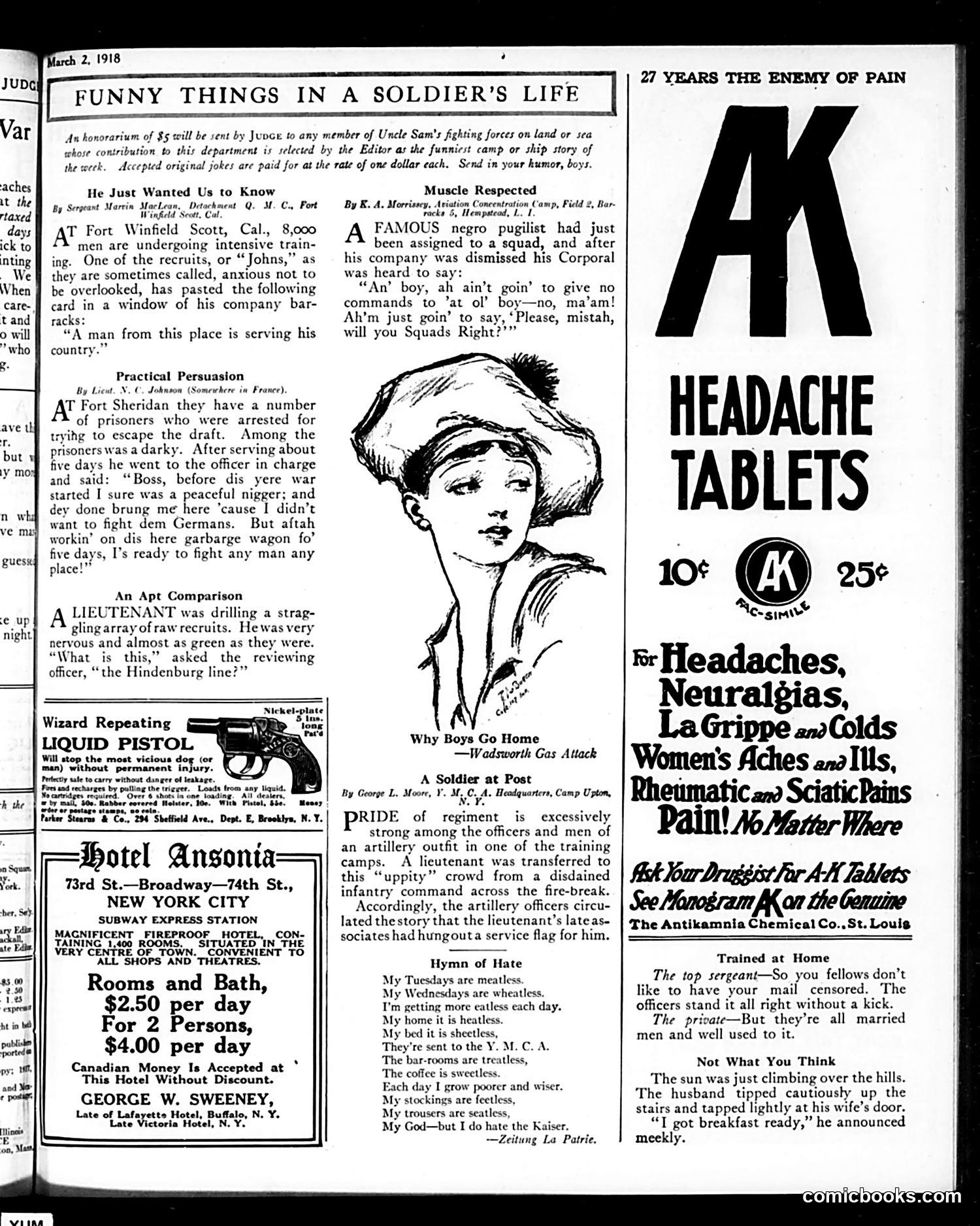
This page contains **humorous anecdotes about soldiers' lives** rather than political cartoons. The pieces satirize military training and camp experiences: - "He Just Taught Us to Know" mocks an anxious recruit who's failed to grasp basics - "Practical Persuasion" features a prisoner using dialect humor to convince an officer he's reformed - "An Apt Comparison" jokes about nervous raw recruits compared to the Hindenburg (the German airship, a contemporary enemy reference) The humor relies on **soldier slang, racial stereotypes typical of 1918**, and gentle mockery of military incompetence. The page also contains period advertisements, including an AK Headache Tablets ad. The content reflects American military culture during **World War I**, when such magazines entertained the public with lighthearted takes on the soldier experience.
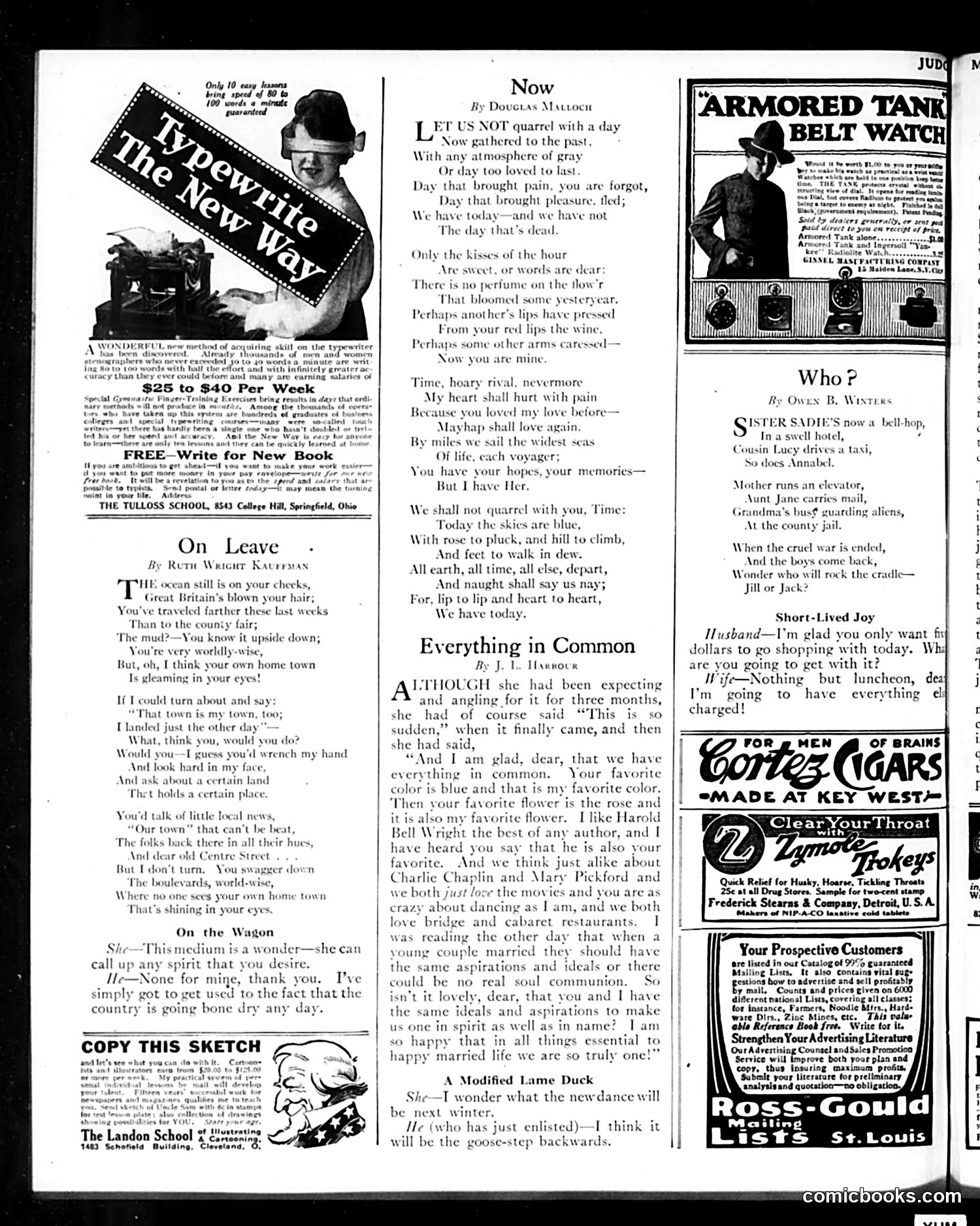
This page contains primarily **poetry and short prose pieces** rather than political cartoons. The content reflects **World War I-era concerns**: **"Now"** (by Douglas Malloch) is a romantic poem about seizing the present moment with a beloved, likely resonating with wartime separation anxieties. **"On Leave"** (by Ruth Wright Kauffman) depicts a soldier home on leave, homesick despite being home—capturing the psychological displacement of wartime. **"Everything in Common"** satirizes modern courtship by showing an engaged couple discovering they share trivial preferences (favorite colors, authors, dances), suggesting shallow compatibility based on surface agreement rather than genuine soul connection—a social commentary on contemporary marriage expectations. **"A Modified Lame Duck"** makes a dark joke: a newly enlisted soldier, asked about next winter's dance trends, quips it will be the "goose-step backwards"—a grim reference to either military marching or potential defeat/retreat. The advertisements (typing schools, mailing services) are period-typical. The overall tone reflects **wartime anxieties** mixed with gentle social satire about romance and modern life.
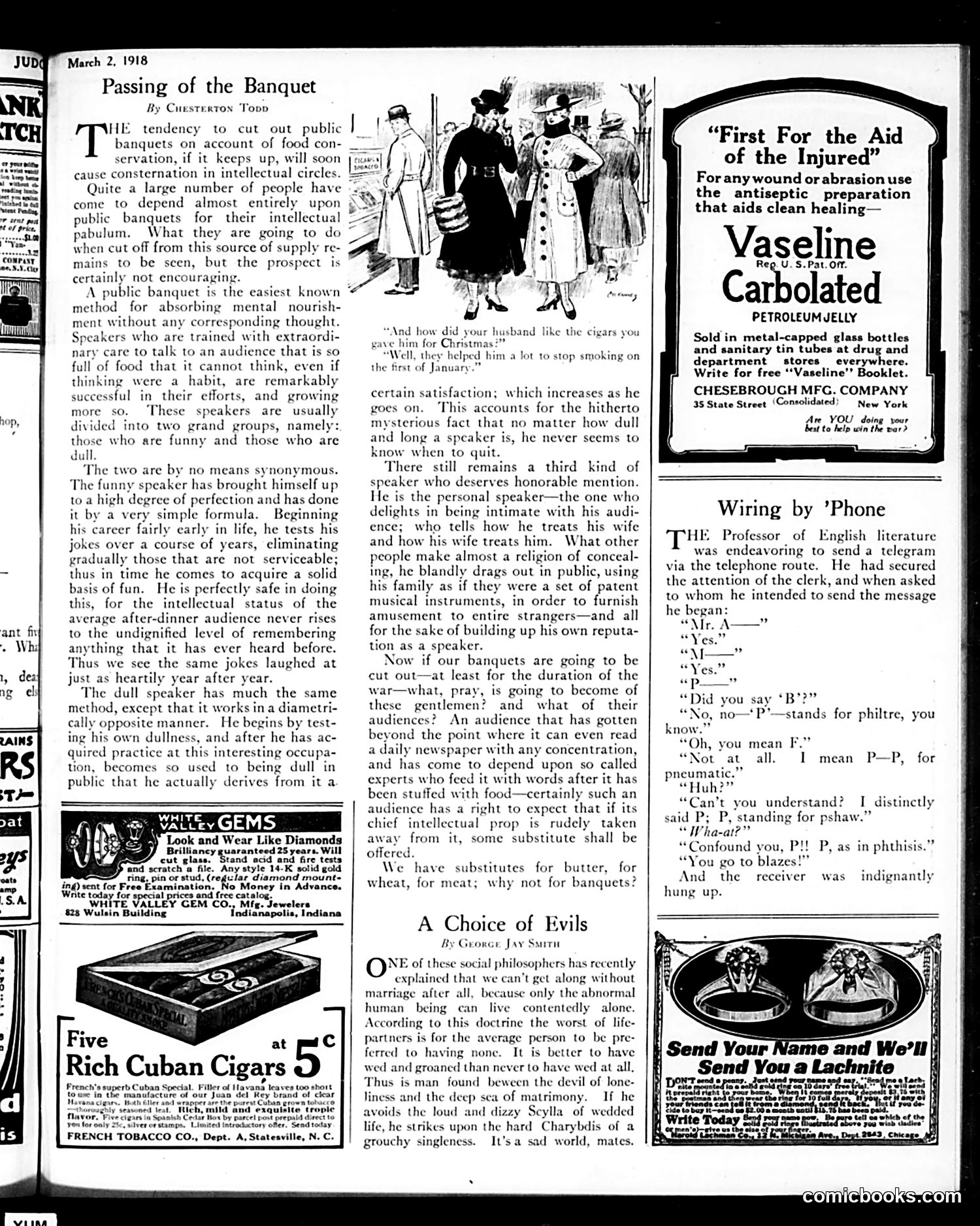
This article satirizes America's wartime food-conservation policy by mocking the intellectual classes' dependence on public banquets. During World War I, the government discouraged large public meals to preserve food supplies. The author argues that many intellectuals rely entirely on after-dinner speeches for mental stimulation, absorbing ideas passively while eating. He categorizes speakers into three types: the "funny" speaker who recycles tested jokes year after year; the "dull" speaker who oddly takes pride in his tedious performances; and the "personal" speaker who exploits his family for entertainment value. The satire's bite is that eliminating banquets poses no real intellectual loss—the audiences are too full to think anyway, and the speakers offer nothing original. The piece mocks both the speakers' shallow techniques and the audiences' passive consumption of rhetoric, suggesting wartime sacrifice may inadvertently improve intellectual discourse.
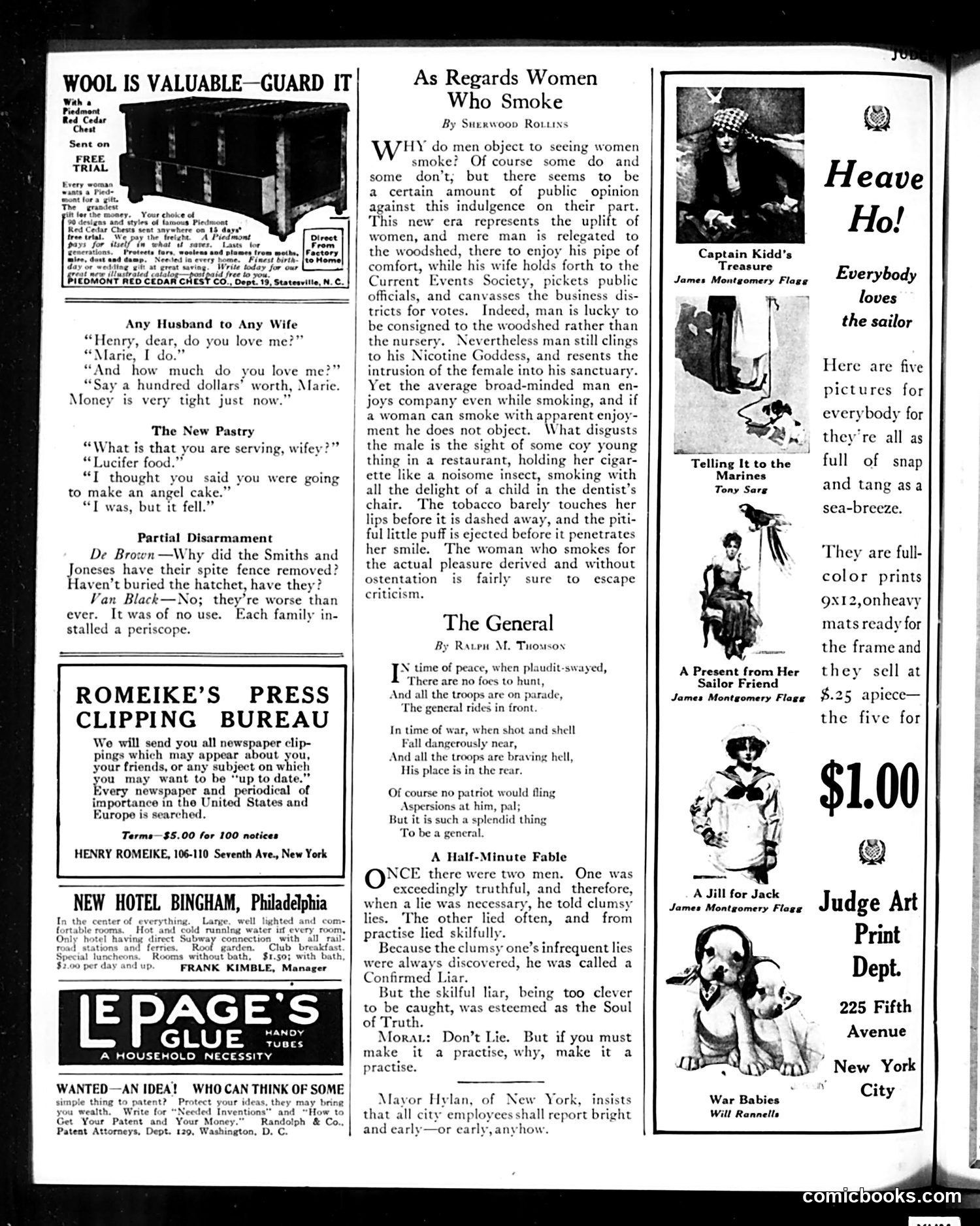
This page contains satirical commentary on contemporary social issues, primarily focused on **women's smoking** and gender relations. The main article "As Regards Women Who Smoke" by Sherwood Rollins discusses the growing controversy over female smoking during the women's liberation era. The piece mocks both sexes: men resenting women's intrusion into "his sanctuary" while being relegated to the woodshed, and women who affectedly smoke without genuine enjoyment, holding cigarettes "like a noisome insect." The satire suggests that actual women smokers who enjoy tobacco without pretense escape male criticism. Supporting humor includes domestic jokes about marriage ("Money is very tight just now") and jokes about modernization (spouses installing periscopes instead of removing spite fences during their conflict). Poems mock military hierarchy ("The General") and expose hypocrisy through fable—a skillful liar escapes detection while a clumsy truthful man gets branded "Confirmed Liar." The page reflects 1910s-1920s anxieties about rapidly changing gender roles and women's increasing social independence.
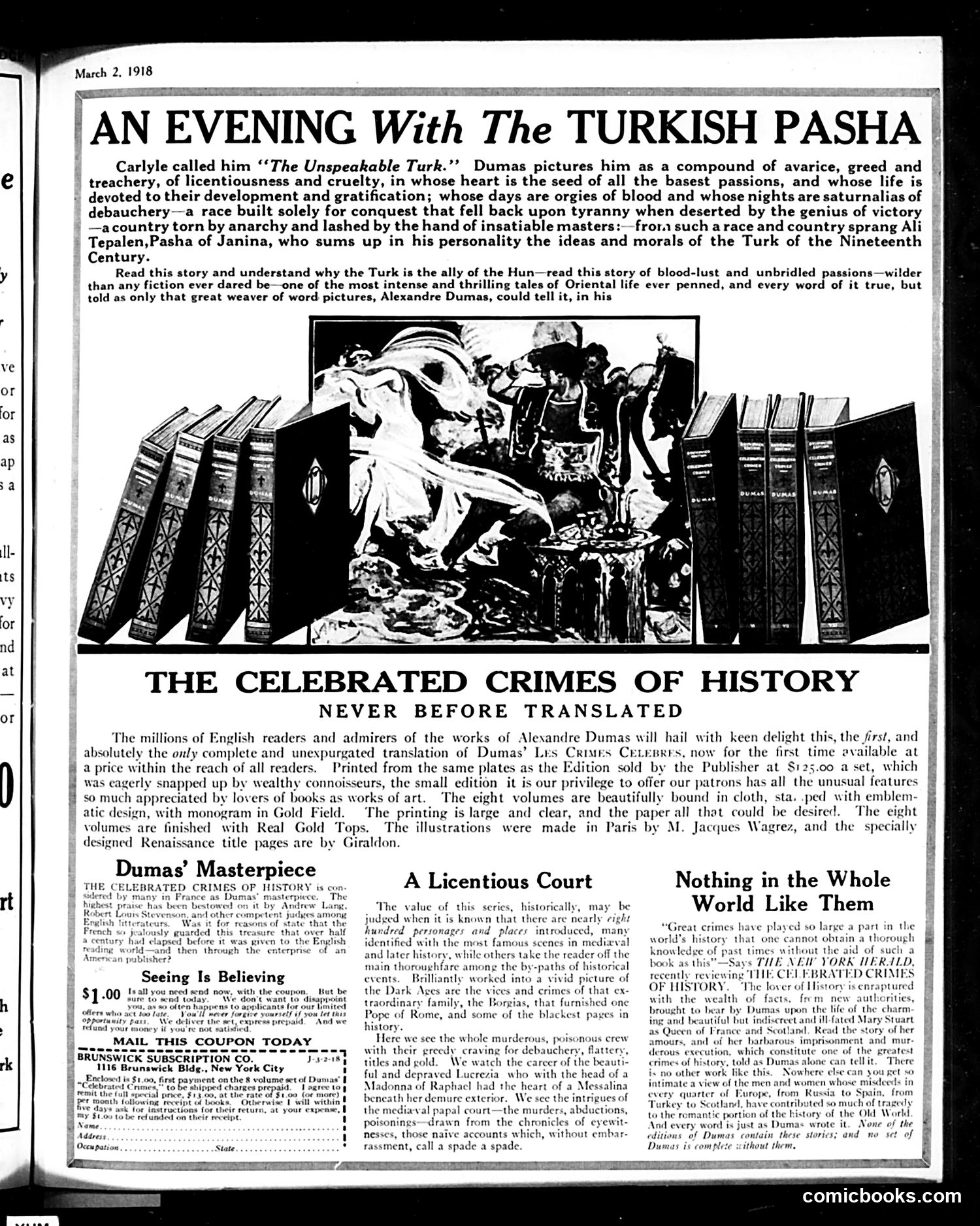
This is primarily an **advertisement for Alexandre Dumas's *Celebrated Crimes of History***, not a political cartoon. The page promotes a newly available English translation of Dumas's historical crime narratives. The introductory text frames the Turkish Pasha (Ali Tepelen of Janina) as exemplifying Oriental despotism and cruelty. Notably, the advertisement **explicitly compares the Turk to "the Hun"**—a contemporary slur for Germans during World War I. This 1918 date matters: the U.S. was actively fighting Germany. By equating Turkish Ottoman governance with German militarism, the ad leverages wartime anti-German sentiment to market Dumas's sensational tales as exposés of tyranny and vice. The rhetoric emphasizes blood-lust, debauchery, and "unbridled passions" to sell the books as thrilling, scandalous reading. The ornamental book spines in the illustration reinforce luxury and collectibility.
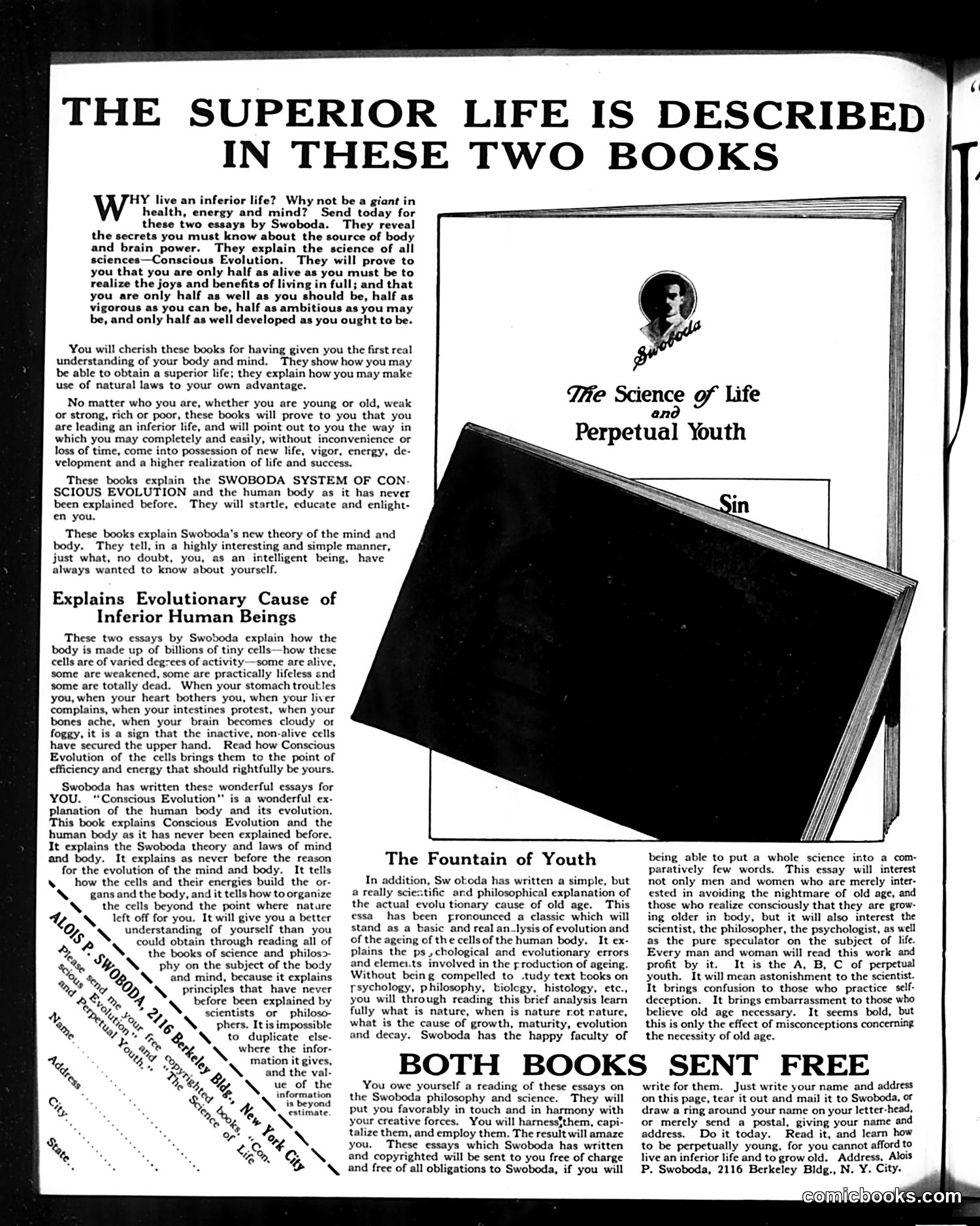
This is not a political cartoon but rather a **full-page advertisement** for mail-order books by someone named Swoboda (appears to be early 20th century). The ad promotes two books—*The Science of Life and Perpetual Youth* and *The Fountain of Youth*—claiming to reveal secrets of "Conscious Evolution" and superior health. Swoboda promises readers they are "only half alive" and can achieve vigor, energy, and longevity by understanding his theories about body cells and mind-body connection. The pitch targets insecurity: listing ailments (stomach troubles, heart problems, cloudy thinking) as signs of "inactive, non-alive cells" that his system can activate. The books are offered "free" (though readers must write in, likely incurring costs). This exemplifies early 20th-century pseudoscientific self-help marketing—exploiting anxiety about health and aging with vague evolutionary language to sell dubious remedies. The appearance in *Judge* magazine suggests this was a paid advertisement, not editorial satire.