
Judge, 1918-03-02 · page 9 of 36
Judge — March 2, 1918 — page 9: what you’re looking at
What you’re looking at
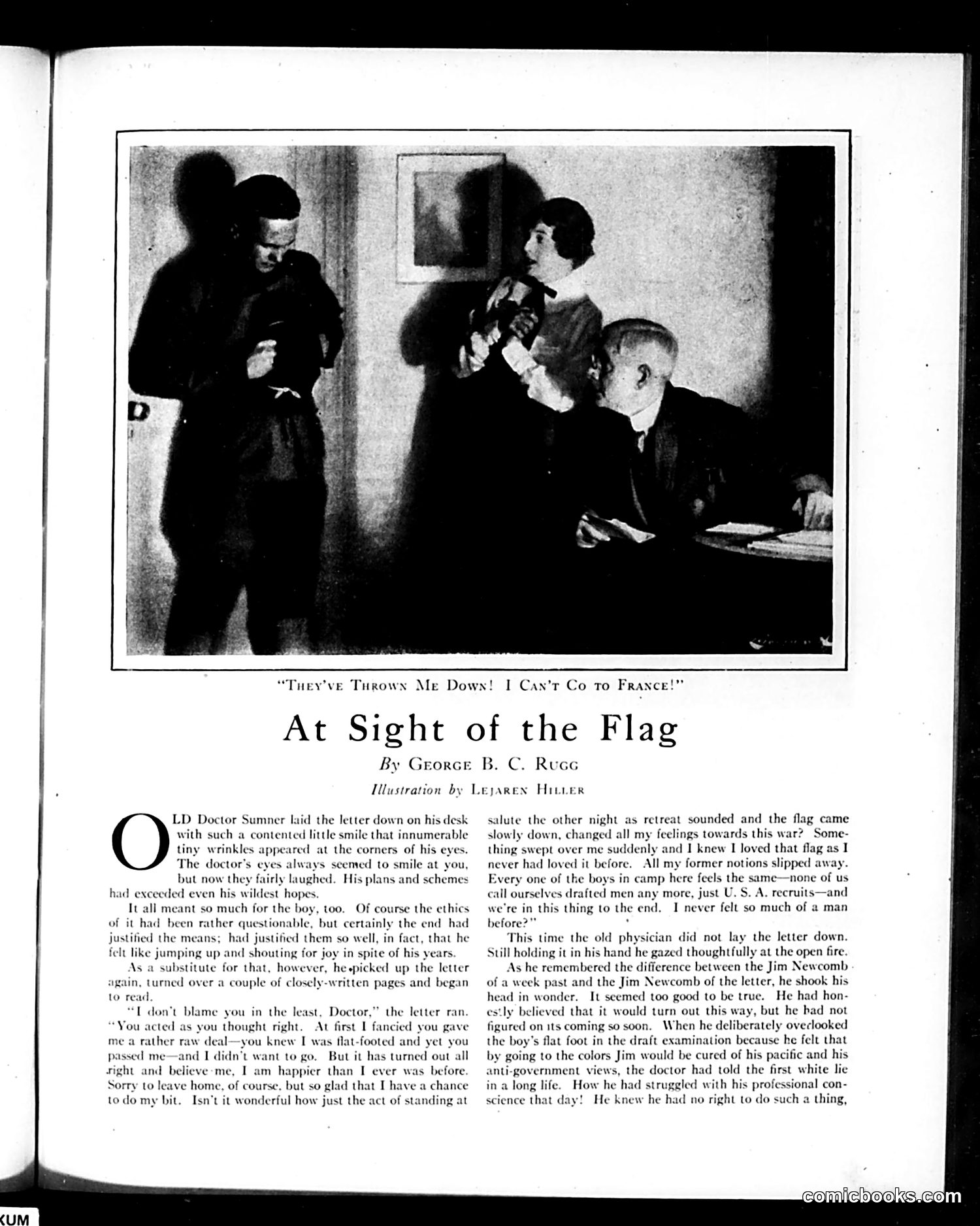
This story depicts a doctor who manipulates a military draft examination, deliberately overlooking a young man's (Jim Newcomb's) flat feet to enlist him. The doctor believes military service will cure Jim's pacifist and anti-government views. The narrative celebrates the outcome: Jim's patriotic transformation upon witnessing the flag at retreat. His letter expresses newfound love for his country and commitment to war service, crediting the emotional experience of the flag ceremony. **The satire's point**: This appears to be propaganda endorsing American entry into World War I (likely 1917-1918). It frames military service as morally redemptive—transforming a reluctant, ideologically opposed youth into an enthusiastic soldier through patriotic emotion. The doctor's ethical compromise is ultimately justified by the "good" result. The cartoon illustrates how flag symbolism and military ritual could overcome civilian resistance to war.
📄 Transcribed text from this page (OCR, searchable)
Machine-transcribed from the original scan — historical spelling and the odd misread are preserved.
“They've Turown Me Down! I Can’t Co to France At Sight of the Flag By Grorce B. C. Ruce Illustration by Leyarex Hitter LD Doctor Sumner laid the letter down on his desk with such a contented little smile that innumerable tiny wrinkles appeared at the corners of his eyes. The doctor's eyes always seemed to smile at you, but now they fairly laughed. His plans and schemes had exceeded even his wildest hopes. It all meant so much for the boy, too. Of course the ethics of it had been rather questionable, but certainly the end had justified the means; had justified them so well, in fact, that he felt like jumping up and shouting for joy in spite of his years As a substitute for that, however, hespicked up the letter again, turned over a couple of closely-written pages and began 10 read “LT don't blame you in the least, Doctor,” the letter ran At first I fancied you gave “You acted as you thought right you knew I was flat-footed and yet you But it has turned out all sight and believe-me, I am happier than I ever was before Sorry to leave home, of course, but so glad that I have a chance Isn’t it wonderful how just the act of standing at me a rather raw deal passed me—and I didn’t want to go. to do my bit. salute the other night as retreat sounded and the flag came slowly down, changed all my feelings towards this war? Some- thing swept over me suddenly and I knew I loved that flag as I never had loved it before. All my former notions slipped awa Every one of the boys in camp here feels the same—none of us call ourselves drafted men any more, just U. S. A. recruits—and we're in this thing to the end. I never felt so much of a man before?” * This time the old physician did not lay the letter down. Still holding it in his hand he gazed thoughtfully at the open fire. As he remembered the difference between the Jim Newcomb of a week past and the Jim Newcomb of the letter, he shook his head in wonder. It seemed too good to be true. He had hon- estly believed that it would turn out this way, but he bad not figured on its coming so soon. When he deliberately oveclooked the boy’s flat foot in the draft examination because he felt that by going to the colors Jim would be cured of his pacific and his anti-government views, the doctor had told the first white lie How he had struggled with his professional con- in a long life He knew he had no right to do such a thing, science