
Judge, 1918-03-02 · page 24 of 36
Judge — March 2, 1918 — page 24: what you’re looking at
What you’re looking at
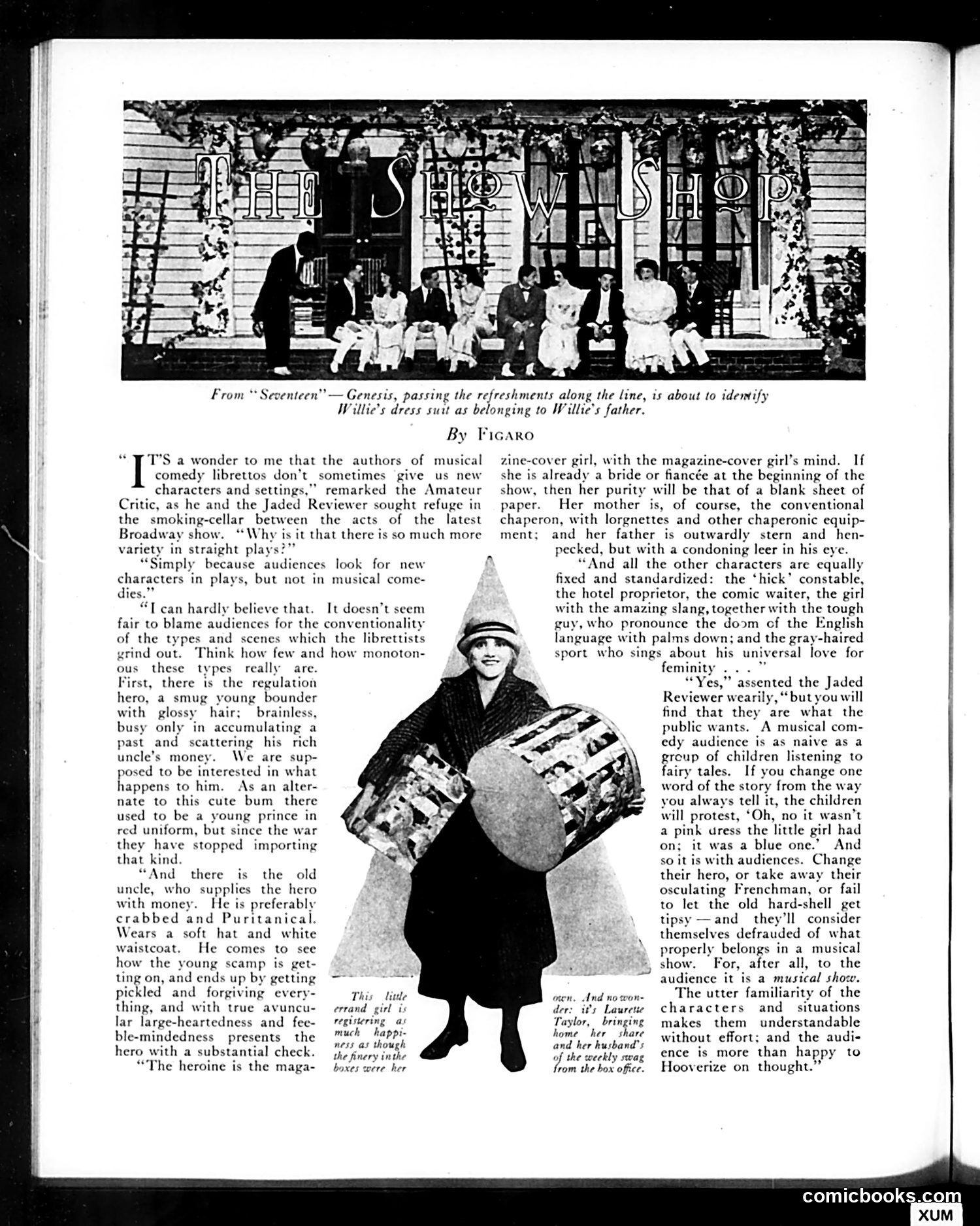
This page satirizes the formulaic nature of Broadway musical comedies of the 1910s-1920s. Two theater critics—an "Amateur Critic" and a "Jaded Reviewer"—discuss why musicals rely on tired, recycled character types while plays offer novelty. The satire catalogs these stock characters: the smug, brainless young hero; the wealthy, Puritanical uncle who funds him; the naive magazine-cover-girl heroine; the stern-but-lenient father; the comic waiter; the tough guy with poor English; and the gray-haired sentimental character. The photograph shows a scene from "Seventeen" with actors seated in a shop window. The caption indicates Willie is about to be identified by his dress suit. The critics conclude audiences *prefer* this predictability—they're likened to children who protest if fairy tales deviate even slightly from the familiar version. The jaded reviewer notes audiences find comfort in these standardized elements and feel "defrauded" without them. The satire mocks both theatrical conventions and audience complacency.
📄 Transcribed text from this page (OCR, searchable)
Machine-transcribed from the original scan — historical spelling and the odd misread are preserved.
From * Seventeen" — Genesis, passing the refreshments along the line, is about to idemi) Willie's dress suit as belonging to Willie's father. By Ficaro T’S a wonder to me that the authors of musical comedy librettos don’t sometimes give us new characters and settings,” remarked the Amateur Critic, as he and the Jaded Reviewer sought refuge in the smoking-cellar between the acts of the latest Broadway show. ‘Why is it that there is so much more y in straight plays? nply because audiences look for new characters in plays, but not in musical come- can hardly believe that. It doesn’t se fair to blame audiences for the conventionality of the types and scenes which the librettists grind out. ink how few and how monoton- ous these types really are. First, there is the regulation hero, a smug young bounder with glossy hair; brainless, busy only in accumulating a past and scattering his rich uncle’s money. We are sup- posed to be interested in what happens to him. As an alter- nate to this cute bum there used to be a young prince in red uniform, but since the war they have stopped importing that kind “And there is the old uncle, who supplies the hero with money. He is preferably crabbed and Puritanical. Wears a soft hat and white waiste He comes to see how the young scamp is ge! ting on, and ends up by getting pickled and forgiving every Thi thing, and with true avuncu- lar large-heartedness and fee- ble-mindedness presents the hero with a substantial chec “The heroine is the maga little errand girl i registering as much happi- ness as though the finery inthe boxes were her zine-cover girl, with the magazine-cover girl’s mind. If she is already a bride or fiancée at the beginning of the show, then her purity will be that of a blank sheet of paper. Her mother is, of course, the conventional chaperon, with lorgnettes and other chaperonic equip- ment; and her father is outwardly stern and hen- pecked, but with a condoning leer in his eye. “And all the other characters are equally fixed and standardized: the ‘hick’ constable, the hotel proprietor, the comic waiter, the girl with the amazing slang, together with the tough guy, who pronounce the doom cf the English language with palms down; and the gray-haired sport who sings about his universal love for feminity ...” “Yes,” assented the Jaded Reviewer wearily, “but you will find that they are what the public wants. A musical com- edy audience is as naive as a group of children listening to fairy tales. If you change one word of the story from the way you always tell it, the children will protest, ‘Oh, no it wasn’t a pink uress the little girl had on; it was a blue one.’ And so it is with audiences. Change their hero, or take away their osculating Frenchman, or fail to let the old hard-shell get tipsy —and_ they’ll_ consider themselves defrauded of what properly belongs in a musical show. For, after all, to the audience it is a musical show. The utter familiarity of the characters and_ situations makes them understandable without effort; and the audi- ence is more than happy to Hooverize on thought.” der: it's Laurette Taylor, bringing home her share and her husband's of the weekly swag from the box office. comicbooks.com