
Judge, 1918-03-02 · page 23 of 36
Judge — March 2, 1918 — page 23: what you’re looking at
What you’re looking at
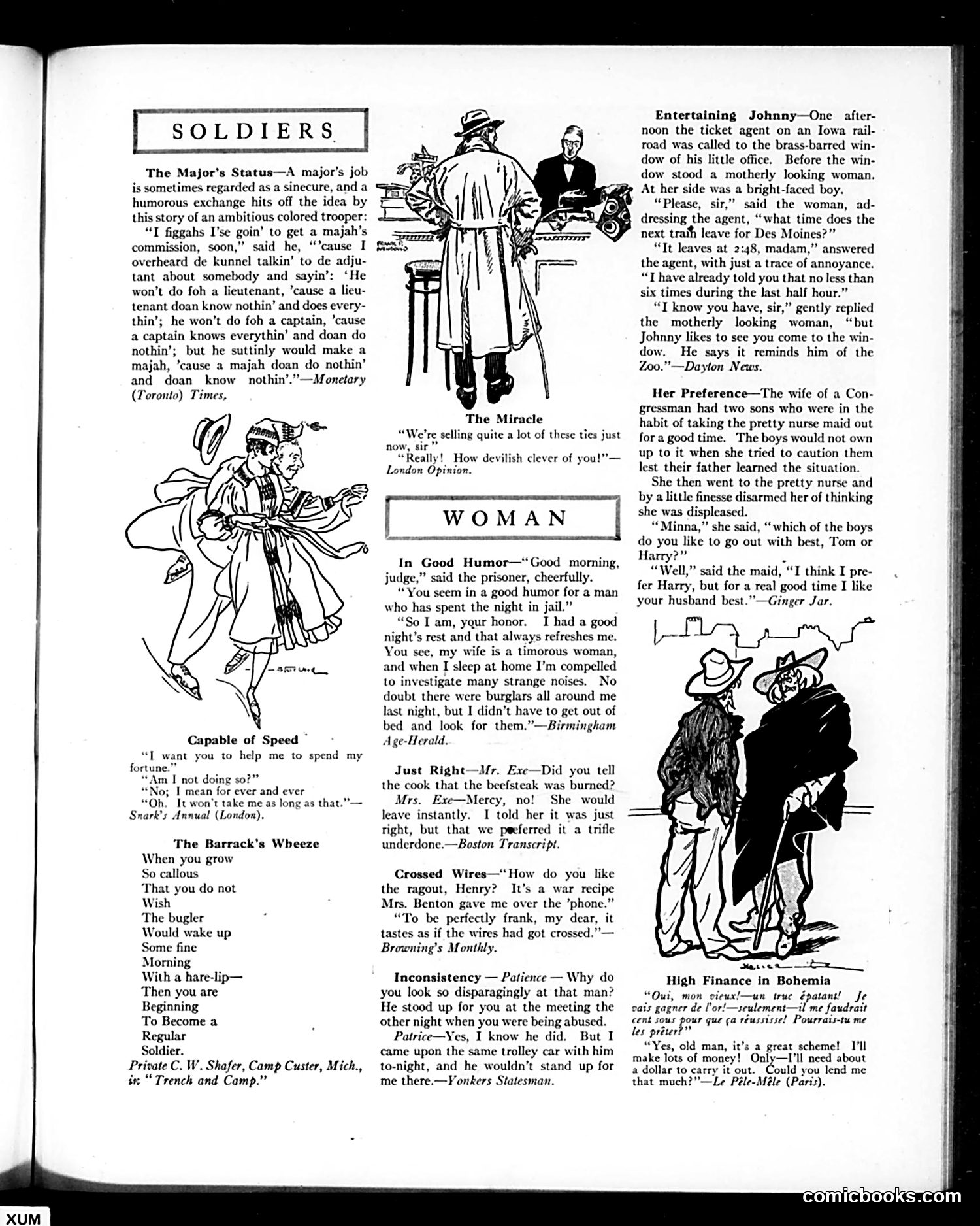
This page collects brief humorous anecdotes targeting early 20th-century social hierarchies and domestic life. The "Soldiers" section mocks military rank through dialect humor: a Black soldier observes that majors "doan do nothin' and doan know nothin'"—satirizing how promotions reward incompetence. The "Woman" section contains domestic comedy: a wife lies to her cook about burned steak to prevent her leaving; a husband's complaint about ragout mysteriously arriving via telephone wire gets blamed on "crossed wires" (a pun); and a congressman's wife diplomatically questions her sons' nursemaid about which boy she prefers dating. The final anecdote presents a mother repeatedly sending her son to ask a railroad agent for train times solely for entertainment—the agent's irritation is the joke's punchline. The humor relies on class consciousness, marital discord stereotypes, and casual sexism typical of the era.
📄 Transcribed text from this page (OCR, searchable)
Machine-transcribed from the original scan — historical spelling and the odd misread are preserved.
| SOLDIERS The Major's Status—A major’s job is sometimes regarded as a sinecure, and a humorous exchange hits off the idea by this story of an ambitious colored trooper: “T figgahs I’se goin’ to get a majah’s commission, soon,” said he, overheard de kunnel talkin’ to de adju- tant about somebody and sayin’: ‘He won’t do foh a lieutenant, ‘cause a lieu- tenant doan know nothin’ and does every- thin’; he won't do foh a captain, ’cause a captain knows everythin’ and doan do nothin’; but he suttinly would make a majah, ’cause a majah doan do nothin’ and doan know nothin’.”—Monetary (Toronto) Times, Capable of Speed © “IT want you to help me to spend my fortune.” “Am I not doing so?” “No; I mean for ever and ever “Oh. It won't take me as long as that.”— Snark’s Annual (London). The Barrack’s Wheeze When you grow So callous That you do not Wish The bugler Would wake up Some fine Morning With a hare-lip— Then you are Beginning To Become a Regular Soldier. Private C. W. Shafer, Camp Custer, Mich., ix: “‘ Trench and Camp.” pam “cause I fits The Miracle “We're selling quite a lot of these ties just now, sir” “Really! How devilish clever of you!"— London Opinion. In Good Humor—*Good morning, judge,” said the prisoner, cheerfully. “You seem in a good humor for a man who has spent the night in jail.” “So Iam, your honor. I had a good night’s rest and that always refreshes me. You see, my wife is a timorous woman, and when I sleep at home I’m compelled to investigate many strange noises. No doubt there were burglars all around me last night, but I didn’t have to get out of bed and look for them.”—Birmingham Age-Herald. Just Right—Mr. Exe—Did you tell the cook that the beefsteak was burned? Mrs. Exe—Mercy, no! She would leave instantly. I told her it was just right, but that we peeferred it a trifle underdone.—Boston Transcript. Crossed Wires—“How do you like the ragout, Henry? It’s a war recipe Mrs. Benton gave me over the ’phone.” “To be perfectly frank, my dear, it tastes as if the wires had got crossed.” — Browning's Monthly. Inconsistency — Patience — Why do you look so disparagingly at that man? He stood up for you at the meeting the other night when you were being abused. Patrice—Yes, I know he did. But I came upon the same trolley car with him to-night, and he wouldn’t stand up for me there.—Yonkers Statesman. Entertaining Johnny—One after- noon the ticket agent on an Iowa rail- road was called to the brass-barred win- dow of his little office. Before the win- dow stood a motherly looking woman. At her side was a bright-faced boy. “Please, sir,” said the woman, ad- dressing the agent, ‘what time does the next traih leave for Des Moines?” “Tt leaves at 2:48, madam,” answered the agent, with just a trace of annoyance. “T have already told you that no less than six times during the last half hour.” “T know you have, sir,” gently replied the motherly looking woman, “but Johnny likes to see you come to the win- dow. He says it reminds him of the Zoo.”—Dayton News. Her Preference—The wife of a Con- gressman had two sons who were in the habit of taking the pretty nurse maid out fora good time. The boys would not own up to it when she tried to caution them lest their father learned the situation. She then went to the pretty nurse and by a little finesse disarmed her of thinking she was displeased. “Minna,” she said, “which of the boys do you like to go out with best, Tom or Harry?” ‘. “Well,” said the maid, “I think I pre- fer Harry, but for a real good time I like your husband best."—Ginger Jar. High Finance in Bohemia “Oui, mon viewx!—un truc épatant! Je vais gagner de l'or!—seulement—il me faudrait cent sous pour que ca réussisse! Pourrats-tu me les préter?”” “Yes, old man, it’s a great scheme! I'll make lots of money! Cott need about a dollar to carry it out. Could you lend me that much?"—Le Péle-Méle (Paris).