
Judge, 1918-03-02 · page 29 of 36
Judge — March 2, 1918 — page 29: what you’re looking at
What you’re looking at
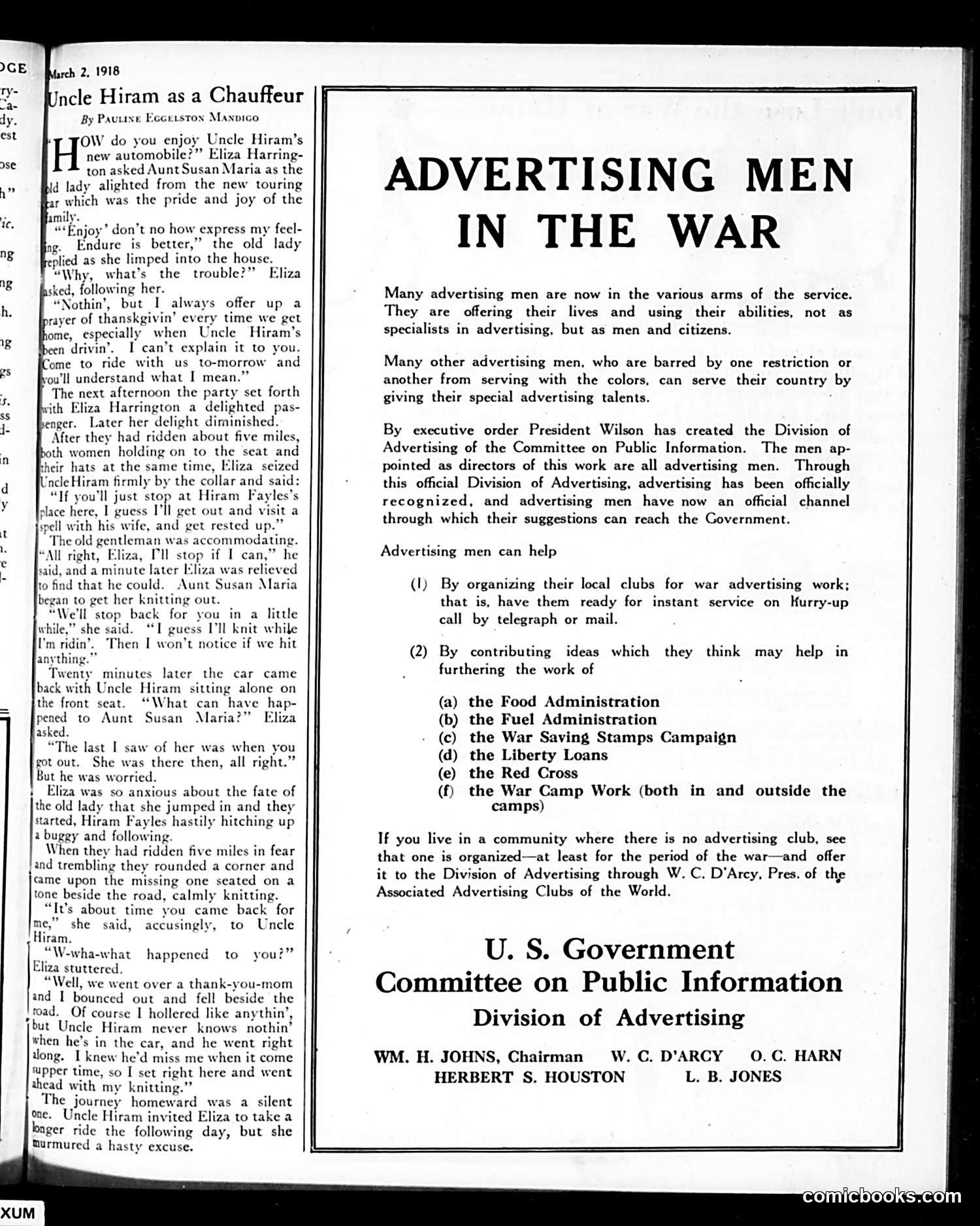
This page contains two distinct elements: **Left side:** A humorous short story titled "Uncle Hiram as a Chauffeur" by Pauline Eggeston Mandigo. The joke concerns an elderly man's reckless automobile driving. When Aunt Susan Maria falls out of the car during a rough bump (a "thank-you-mom"—slang for a road obstacle), Uncle Hiram doesn't notice and drives on. She calmly sits by the roadside knitting until they realize she's missing and retrieve her. The humor derives from her stoicism and his obliviousness as a driver—a satire on early 1900s motorists. **Right side:** A government advertisement recruiting advertising professionals to contribute their expertise to World War I efforts (the U.S. entered in 1917). President Wilson's administration has created an official Division of Advertising to channel their talents toward the Food Administration, Fuel Administration, War Savings Stamps, Liberty Loans, and Red Cross work. The page shows Judge magazine's mix of entertainment and patriotic messaging during wartime.
📄 Transcribed text from this page (OCR, searchable)
Machine-transcribed from the original scan — historical spelling and the odd misread are preserved.
NST LLL |! 2, 1918 ncle Hiram as a Chauffeur By Pavutse Eccrtstox Maxpico ‘OW do you enjoy Uncle Hiram’s H new automobile?” Eliza Harring- ton asked Aunt Susan Maria as the id lady alighted from the new touring ar which was the pride and joy of the il ain joy’ don’t no how express my feel- ing. Endure is better,” the old lady eplied as she limped into the house. “Why, what’s the trouble?” Eliza ed, following her. Nothin’, but 1 always offer up a rayer of thanskg y time we get ome, especially when Uncle Hiram’s een drivin’. I can’t explain it to you. Come to ride with us to-morrow and you'll understand what I mean.” The next afternoon the party set forth with a Harrington a delighted pas- wenger. Later her delight diminished. After they had ridden about five miles, th women holding on to the seat their hats at the same time, Eliza se ‘ncle Hiram firmly by the collar and said: “If you'll just stop at Hiram Fayles’s place here, I guess I'll get out and vi e, and get rested up. e old gentleman was accommodating. All right, Eliza, Pll stop if I can,” he said, and a minute later Eliza was relieve to find that he could. Aunt Susan Maria began to get her knitting out. “We'll stop back for you in a little while,” she said. ‘I guess I'll knit while I'm ridin’. Then I won’t notice if we hit Twenty minutes later the car came back with Uncle Hiram sitting alone on the front seat. “What can have hap- pened to Aunt Susan Maria?” Eliza asked. } “The last I saw of her was when you got out. She was there then, all right.” But he was worried. + Eliza was so anxious about the fate of the old lady that she jumped in and they started, Hiram Fayles hastily hitching up a buggy and following. When they had ridden five miles in fear and trembling they rounded a corner and came upon the missing one seated on a tone beside the road, calmly knitting. “It’s about time you came back for me,” she said, accusingly, to Uncle Hiram. _“Wewha-what happened to you?” Eliza stuttered. “Well, we went over a thank-you-mom and I bounced out and fell beside the ,foad. Of course I hollered like anythin’, but Uncle Hiram never knows nothin’ when he’s in the car, and he went right dong. I knew he'd miss me when it come ‘upper time, so I set right here and went thead with my knitting.” The journey homeward was a silent one. Uncle Hiram invited Eliza to take a lager ride the following day, but she turmured a hasty excuse. ADVERTISING MEN IN THE WAR Many advertising men are now in the various arms of the service. They are offering their lives and using their abilities, not as specialists in advertising, but as men and citizens. Many other advertising men, who are barred by one restriction or another from serving with the colors, can serve their country by giving their special advertising talents. By executive order President Wilson has created the Division of Advertising of the Committee on Public Information. The men ap- pointed as directors of this work are all advertising men. Through this official Division of Advertising, advertising has been officially recognized, and advertising men have now an official channel through which their suggestions can reach the Government. Advertising men can help (1) By organizing their local clubs for war advertising work; that is, have them ready for instant service on Hurry-up call by telegraph or mail. By contributing ideas which they think may help in furthering the work of (a) the Food Administration (b) the Fuel Administration (c) the War Saving Stamps Campaign (d) the Liberty Loans (e) the Red Cross (f) the War Camp Work (both in and outside the camps) If you live in a community where there is no advertising club, see that one is organized—at least for the period of the war—and offer it to the Division of Advertising through W. C. D'Arcy, Pres. of the Associated Advertising Clubs of the World. U. S. Government Committee on Public Information Division of Advertising WM. H. JOHNS, Chairman W.C. D’ARCY 0O.C. HARN HERBERT S. HOUSTON L. B. JONES