
Judge, 1918-03-02 · page 13 of 36
Judge — March 2, 1918 — page 13: what you’re looking at
What you’re looking at
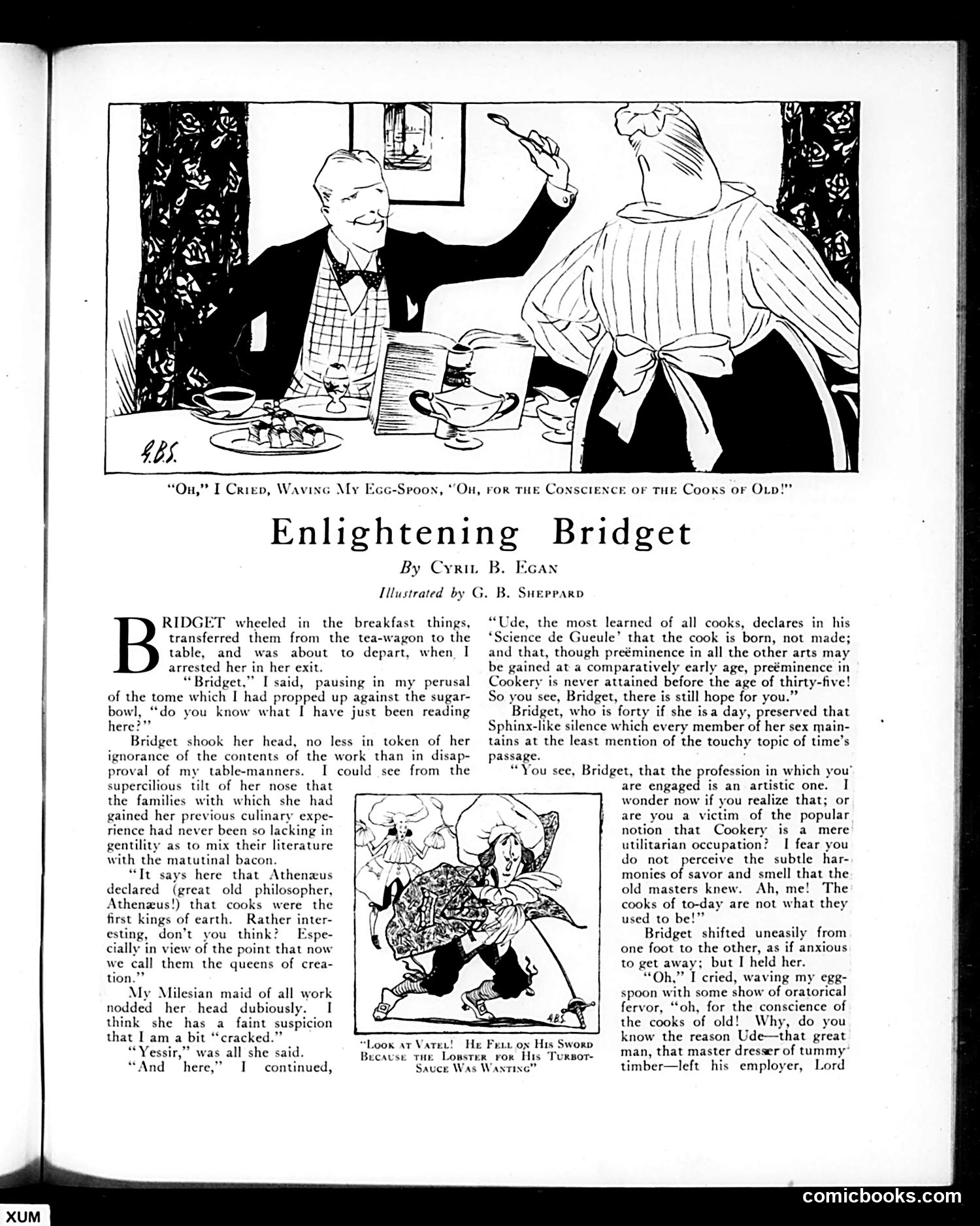
This is a humorous domestic sketch satirizing pretentious intellectualism. A pompous employer interrupts his Irish servant Bridget's work to lecture her from a book about cooking's historical importance—citing the ancient philosopher Athenaeus and a famous chef named Ude to argue that cooking is an "artistic" profession, not mere utilitarian work. The satire targets the employer's pedantic self-importance: he's waving an egg-spoon dramatically while reading obscure classical references to his clearly unimpressed servant, who only wants to finish her chores. The joke is his condescending assumption that Bridget needs enlightenment about her own profession, and his obliviousness to her discomfort. The illustration shows Ude (a real historical figure, likely Marie-Antoine Carême's predecessor) absurdly falling on his sword over inadequate sauce—visual comedy emphasizing how the employer's "proof" of cooking's dignity is ridiculous. The piece gently mocks both employer vanity and the era's class assumptions about domestic workers.
📄 Transcribed text from this page (OCR, searchable)
Machine-transcribed from the original scan — historical spelling and the odd misread are preserved.
“Ou,” I Criep, Wavinc My Ecc-Spoon, “Ou, ror THe Conscience or THE Cooks oF Oxp!” Enlightening Bridget By Cyr B. Gan Illustrated by G. B. Suepparpd RIDGET wheeled in the breakfast things, transferred them from the tea-wagon to the table, and was about to depart, when | arrested her in her exit. “Bridget,” [ said, pausing in my perusal ¢ tome which I had propped up against the sugar- ‘do you know what [ have just been reading Bridget shook her head, no less in token of her ignorance of the contents of the work than in disap- proval of my table-manners. I could see from the supercilious tilt of her nose that the families with which she had gained her previous culinary rience had never been so lacking in gentility as to mix their literature with the matutinal bacon. “Tt says here that Athenxus declared (great old philosopher, Athenzus!) that cooks were the first kings of earth. Rather inter- esting, don’t you think? Espe- cially in view of the point that now we call them the queens of crea- tion.”” My Milesian maid of all work nodded her head dubiously. I think she has a faint suspicion that I am a bit “cracked.” “Yessir,” was all she said. “And here,” I continued, “Loox ar Vaten! Because THe He Feit ox His Sworp Losster ror His Tursor- Sauce Was Waytixc” “Ude, the most learned of all cooks, declares in his ‘Science de Gueule’ that the cook is born, not made; and that, though preéminence in all the other arts may be gained at a comparatively early age, preéminence in Cookery is never attained before the age of thirty-five! So you see, Bridget, there is still hope for you.” Bridget, who is forty if she isa day, preserved that Sphinx-like silence which every member of her sex main- tains at the least mention of the touchy topic of time’s passage. “You see, Bridget, that the profession in which you" are engaged is an artistic one. I wonder now if you realize that; or are you a victim of the popular notion that Cookery is a mere utilitarian occupation? I fear you do not perceive the subtle har- monies of savor and smell that the old masters knew. Ah, me! The cooks of to-day are not what they used to be!” Bridget shifted uneasily from one foot to the other, as if anxious to get away; but I held her. “Oh,” I cried, waving my egg- spoon with some show of oratorical fervor, “oh, for the conscience of the cooks of old! Why, do you know the reason Ude—that great man, that master dresser of tummy timber—left his employer, Lord comicbooks.com