
Judge, 1918-03-02 · page 10 of 36
Judge — March 2, 1918 — page 10: what you’re looking at
What you’re looking at
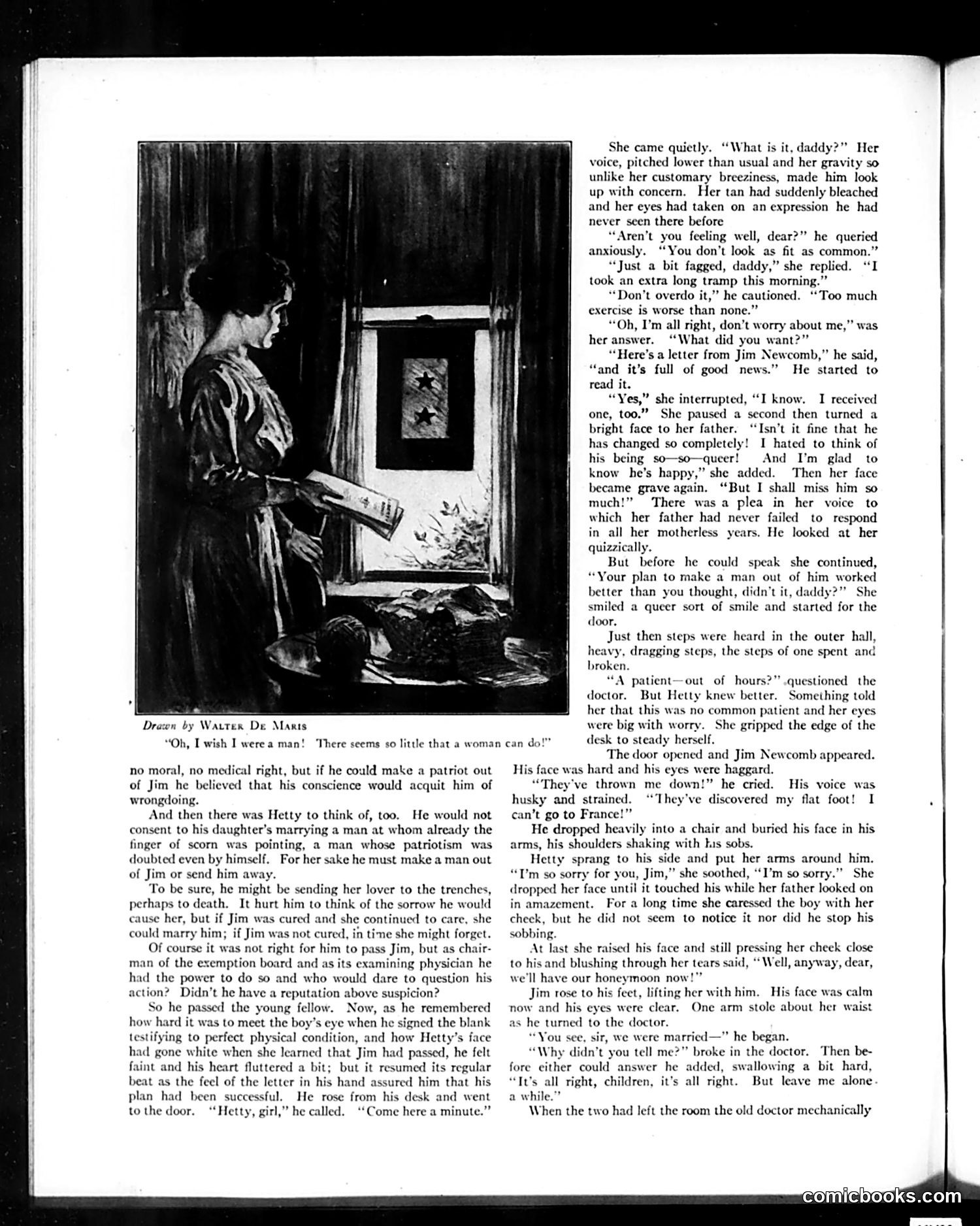
This page presents a serialized story with moral irony, illustrated by Walter De Maris. The narrative concerns a doctor and father who manipulates his daughter Hetty's suitor, Jim Newcomb, during World War I. The central conflict: The doctor, concerned Jim is "queer" (socially unfit), uses his position on a military exemption board to pass Jim as physically fit for combat, hoping military service will "make a man" of him. The doctor's plan is to either reform Jim through war or remove him from his daughter's life. The ironic twist: Jim returns rejected from the draft due to flat feet—a disqualifying condition the doctor examining physician should have caught. The daughter's cryptic comment ("Your plan worked better than you thought, didn't it, daddy?") suggests she knew her father's deception and is commenting sardonically on his failure. The satire critiques patriarchal authority and the callous use of military service as social "correction," exposing the moral hypocrisy of wartime decision-makers.
📄 Transcribed text from this page (OCR, searchable)
Machine-transcribed from the original scan — historical spelling and the odd misread are preserved.
by Watter De Manis “Oh, I wish I were a man! no moral, no medical right, but if he could make a patriot out of Jim he believed that his conscience would acquit him of wrongdoing. And then there was Hetty to think of, too. He would not consent to his daughter’s marrying a man at whom already the finger of scorn w pointing, a man whose patriotism was doubted even by himself. For her sake he must make a man out of Jim or send him away. To be sure, he might be sending her lover to the trenches, perhaps to death. It hurt him to think of the sorrow he would cause her, but if Jim was cured and she continued to care, she could marry him; if Jim was not cured, in tine she might forget. Of course it was not right for him to pass Jim, but as chair- man of the exemption board and as its examining physician he had the power to do so and who would dare to question his action? Didn’t he have a reputation above suspicion? So he passed the young fellow. Now, as he remembered how hard it was to meet the boy’ e when he signed the blank testifying to perfect physical condition, and how Hetty’s face had gone white when she learned that Jim had passed, he felt faint and his heart fluttered a bit; but it resumed its regular beat as the feel of the letter in his hand assured him that his plan had been successful. He rose from his desk and went tothe door. “Hetty, girl,” he called. ‘‘Come here a minute.” ‘There seems so little that a woman can do!” She came quietly. “What is it, daddy?” Her , pitched lower than usual and her gravity so unlike her customary breeziness, made him look up with concern. Her tan had suddenly bleached and her eyes had taken on an expression he had never seen there before “Aren't you feeling well, dear?” he queried anxiously. ‘‘You don’t look as fit as common.” “Just a bit fagged, daddy,” she replied. “I took an extra long tramp this morning.” “Don't overdo it,” he cautioned. “Too much exercise is worse than none.” “Oh, I’m all right, don’t worry about me,” was her answer. “What did you want?” “Here's a letter from Jim Newcomb,” he said, “and it’s full of good news.” He started to read it. “Yes,” she interrupted, “I know. I received one, too.” She paused a second then turned a bright face to her father. “‘Isn’t it fine that he has changed so completely! I hated to think of his being so—so—queer! And I'm glad to know he’s happy,” she added. Then her face became grave again. “But I shall miss him so much!” There was a plea in her voice to which her father had never failed to respond in all her motherless years. He looked at her quizzically. But before he could speak she continued, “Your plan to make a man out of him worked better than you thought, didn’t it, daddy?” She smiled a queer sort of smile and started for the door, Just then steps were heard in the outer hall, vy, dragging steps, the steps of one spent and broken. A patient—out of hour: doctor. But Hetty knew better. Something told her that this was no common patient and her eyes were big with worry. She gripped the edge of the desk to steady herself. The door opened and Jim Newcomb appeared. His face was hard and his eyes were haggard. “They've thrown me down!” he cried. His voice was husky and strained. “They've discovered my flat foot! I can’t go to France! He dropped heavily into a chair and buried his face in his arms, his shoulders shaking with kis sobs. Hetty sprang to his side and put her arms around him. “T’m so sorry for you, Jim,” she soothed, ‘‘I’m so sorry.” She dropped her face until it touched his while her father looked on in amazement. For a long time she caressed the boy with her cheek, but he did not seem to notice it nor did he stop his sobbing. At last she raised his face and s\ to his and blushing through her tears we'll have our honeymoon now!” m rose to his feet, lifting her with him. His face was calm were clear. One arm stole about her waist questioned the pressing her cheek close aid, “Well, anyway, dear, now and his ey as he turned to the doctor. “You see, sir, we were married—” he began. “Why didn’t you tell me?” broke in the doctor. Then be- fore either could answer he added, swallowing a bit hard, “It’s all right, children, it’s all right. But leave me alone a while.” When the two had left the room the old doctor mechanically