
Judge, 1918-03-02 · page 21 of 36
Judge — March 2, 1918 — page 21: what you’re looking at
What you’re looking at
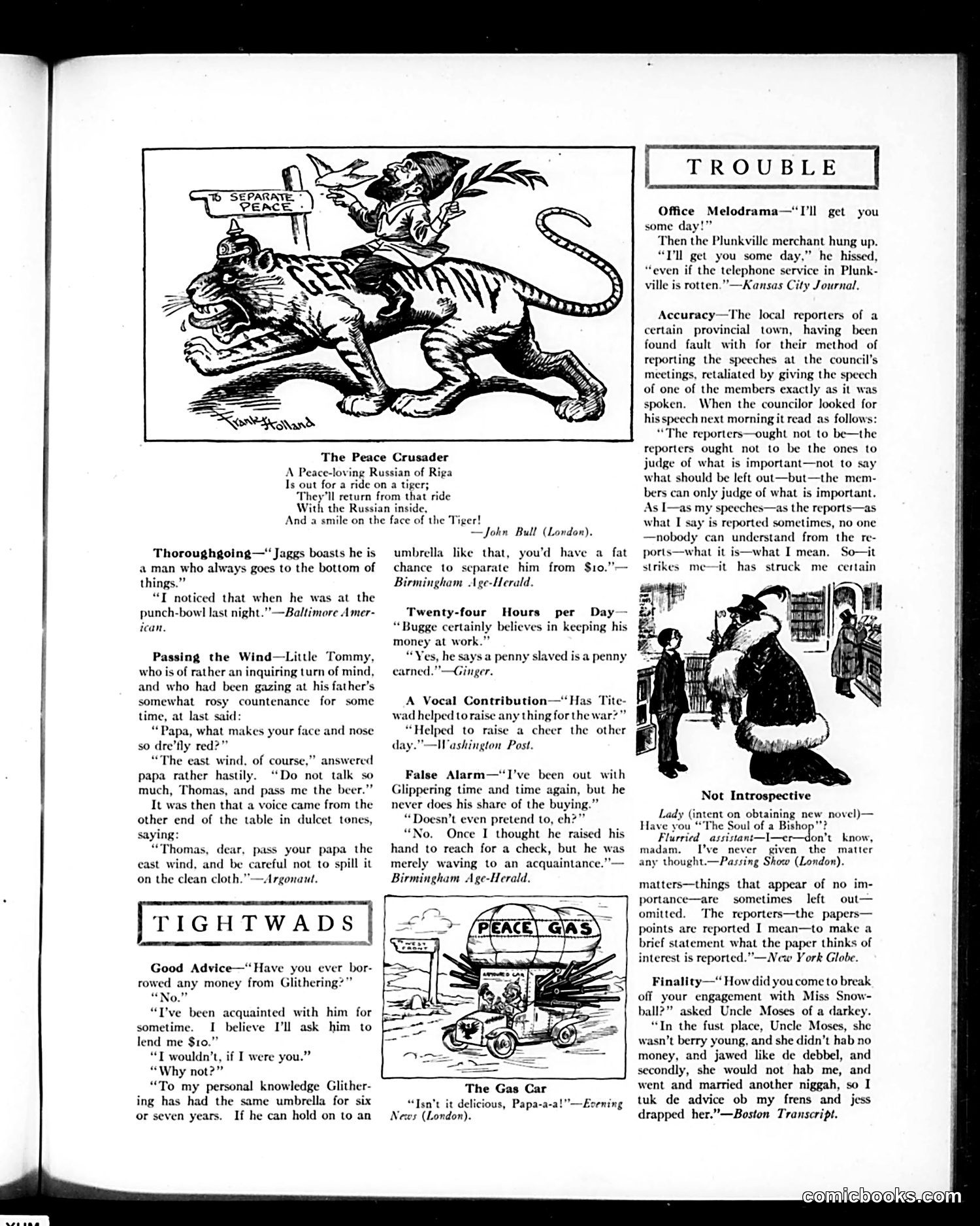
This page contains several brief satirical jokes and one political cartoon. "The Peace Crusader" depicts a Russian riding a tiger labeled "to separate," with the dark implication that Russia's peace efforts will end badly—the tiger will consume the peacemaker. This likely references Russian diplomatic initiatives during a period of international conflict, suggesting such efforts are naive and dangerous. The remaining items are domestic humor: jokes about stingy borrowers, marital dynamics, awkward fathers, and workplace incompetence. The "Accuracy" piece satirizes local reporters who transcribed a councilman's rambling speech verbatim, exposing his incoherence. These represent typical early-20th-century satirical commentary on everyday social absurdities rather than partisan politics.
📄 Transcribed text from this page (OCR, searchable)
Machine-transcribed from the original scan — historical spelling and the odd misread are preserved.
——— - Fos ahand The Peace Crusader A Peace-loving Russian of Riga Is out for a ride on a tige ‘They'll return from that ride With the Russian inside, And a smile on the face of the Tij Thoroughgoing—“ Jaggs boasts he is a man who always goes to the bottom of things.” “I noticed that when he was at the punch-bowl last night.""—Baltimore A mer- ican. Passing the Wind—Little Tommy, who is of rather an inquiring turn of mind, and who had been gazing at his father’s somewhat rosy countenance for some time, at last sai “Papa, what so dre’fly red?” “The east wind, of course,” answered papa rather hastily. “Do not talk so much, Thomas, and pass me the beer.”” It was then that a voice came from the other end of the table in dulcet tones, saying: “Thomas, dear, pass your papa the cast wind, and be careful not to spill it on the clean cloth.” Argonaut. [riGHTwaps | Good Advice—“ Have you ever bor- rowed any money from Glithering?” “No.” “T’ve been acquainted with him for sometime. I believe I'll ask him to lend me $10.” “T wouldn’t, if I were you.” “Why not?” “To my personal knowledge Glither- ing has had the same umbrella for six or seven years. If he can hold on to an es your face and nose Jokn Bull (London). umbrella like that, you'd have a fat chance to separate him from $10."— Birmingham Age-Herald. Hours Twenty-four per A Vocal Contribution—‘ Has © wad helped to raise any thing for the war? “Helped to raise a cheer the other day.” —IWashington Post. False Alarm—‘I've been out with Glippering time and time again, but he never does h are of the bu ag “Doesn’t even pretend to, eh? “No. Once I thought he raised his hand to reach for a check, but he was merely waving to an acquaintance.”— Birmingham Age-Herald. “Isn't it delicious, Papa-a-a!”. News (London). TROUBLE Office Melodrama—‘I’ll get you some da: Then the Plunkville merchant hung up. “T'll get you some day,” he hissed, en if the telephone service in Plunk- ville is rotten.” —Kansas City Journal, Accuracy—The local reporters of a certain provincial town, having been found fault with for their method of reporting the speeches the council’s meetings, retaliated by giving the speech of one of the members exactly as it was spoken. When the councilor looked for his speech next morning it read as follows: The reporters—ought not to be—the reporters ought not to be the ones to judge of what is important—not to say what should be left out—but—the mem- bers can only judge of what is important. As I—as my speeches—as the reports—as what I s is reported sometimes, no one —nobody can understand from the re- ports—what it is—what I mean, So—it strikes me—it has struck me certain Not Introspective Lady Have you “ tent on obtaining new novel)— he Soul of a Bishop”? Flurried _assistani—l—er—don't madam. I’ve never given the matter any thought.—Passing Show (London). things that appear of no im- portance—are sometimes left out— omitted. The reporters—the pape points are reported I mean—to make a brief statement what the paper thinks of interest is reported.” —New York Globe. matters: Finality—‘“ How did you come to break off your engagement with Miss Snow- ball?” asked Uncle Moses of a darkey. “In the fust place, Uncle Moses, she wasn’t berry young, and she didn’t hab no money, and jawed like de debbel, and secondly, she would not hab me, and went and married another niggah, so I tuk de advice ob my frens and jess drapped her.”—Boston Transcript.