
A complete issue · 36 pages · 1918
Judge — February 2, 1918
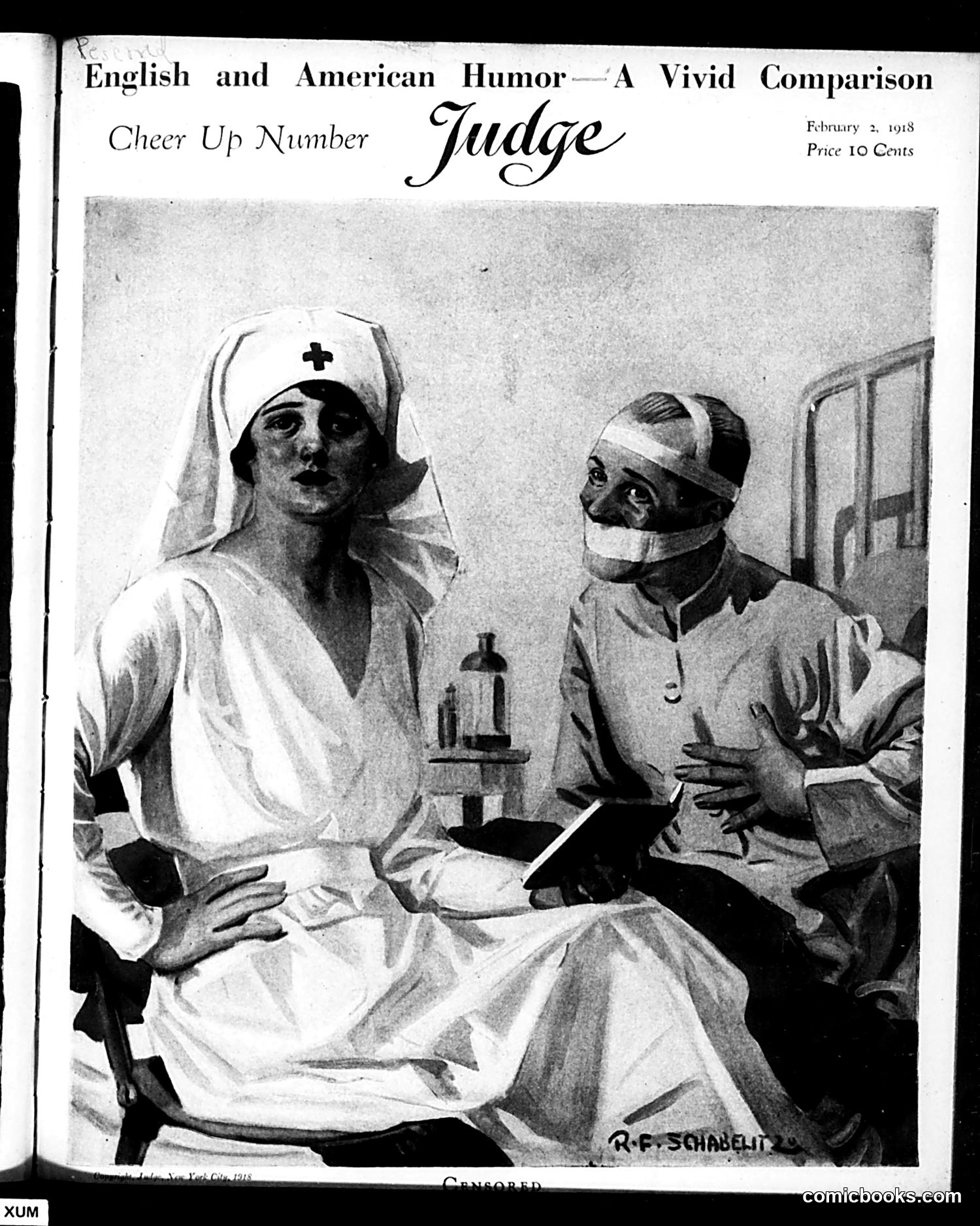
This is a "Cheer Up Number" from Judge magazine (February 2, 1918), during World War I. The cartoon depicts two medical professionals—a nurse and what appears to be a doctor or surgeon with bandaged head and eyes—in a hospital setting. The humor appears to satirize the irony of medical care during wartime: the caregiver (nurse) looks concerned while the medical professional himself is heavily bandaged, suggesting either incompetence, the dangers medical staff faced, or the absurdity of the medical situation during the war. The "censored" marking at the bottom indicates wartime publication restrictions. The satire likely mocks either medical mishaps or the general chaos of wartime healthcare administration.

This page is **not satire or political cartoon** — it's a straightforward advertisement for Nujol, a laxative product made by Standard Oil Company (New Jersey). The ad uses health messaging typical of early 20th-century patent medicine marketing. It warns that winter causes lowered vitality through constipation, claiming this makes people susceptible to illness. The solution: Nujol provides "clockwork bowel regularity" to maintain health. The phrase "Regular as Clockwork" references the mechanical precision desired from bowel function. The visual of bottles arranged like a timeline emphasizes consistency. This reflects a historical period when constipation remedies were heavily marketed as general health tonics, often without medical basis. The ad notably targets soldiers and sailors, suggesting wartime distribution.
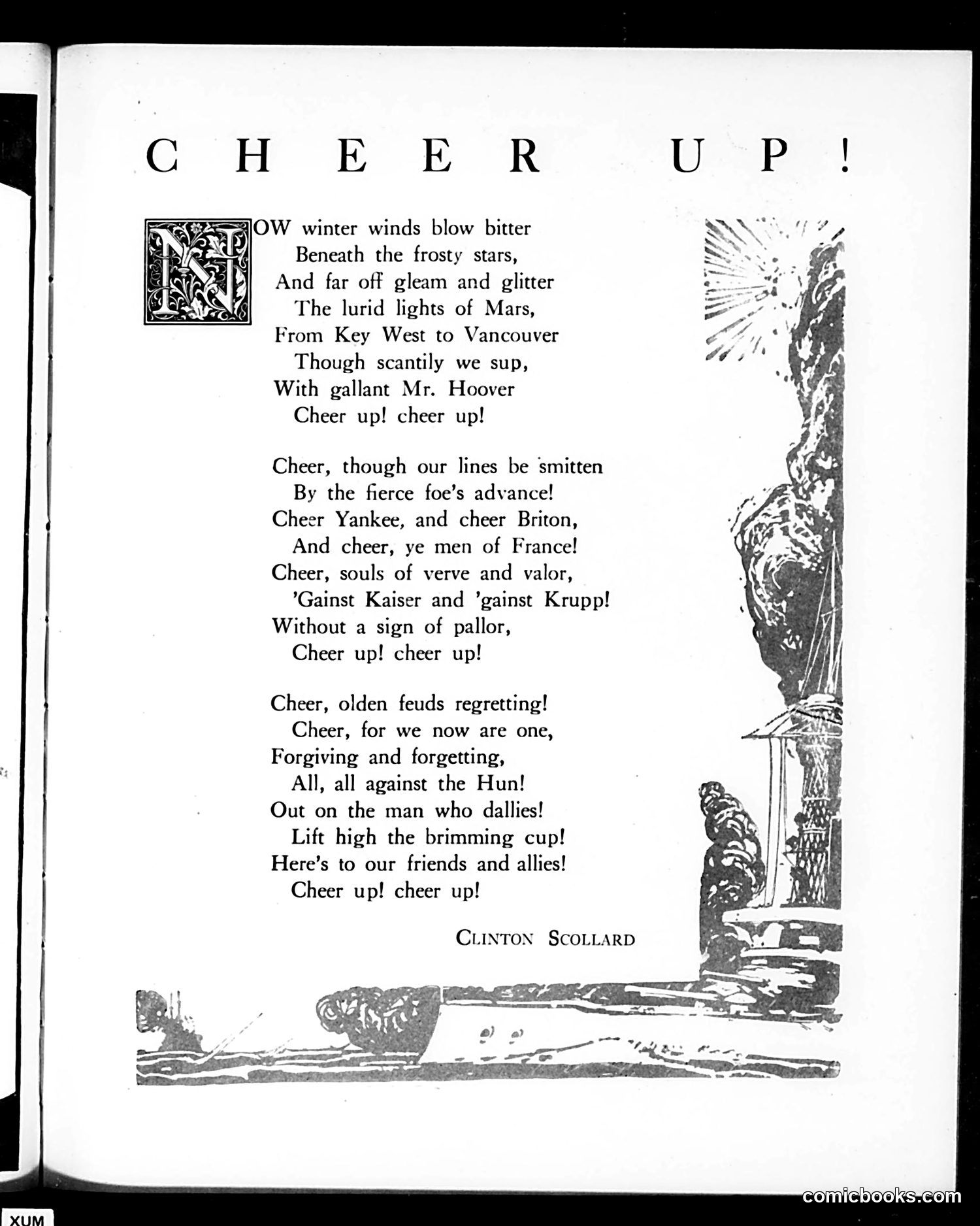
This patriotic poem, published in *Judge* magazine during World War I, uses military imagery to rally American morale. The text references "Mr. Hoover" (likely Herbert Hoover, who directed U.S. food administration during the war) and calls for unified support against Germany ("Kaiser," "Krupp"—a major German weapons manufacturer). The poem addresses multiple Allied nations—"Yankee," "Briton," "France"—emphasizing Allied solidarity against "the Hun" (derogatory term for Germans). Phrases like "our lines be smitten / By the fierce foe's advance" acknowledge military hardship while urging emotional resilience without "pallor" (fear). The decorative wartime illustration on the right suggests patriotic themes. This is straightforward war propaganda designed to boost American confidence during the conflict.
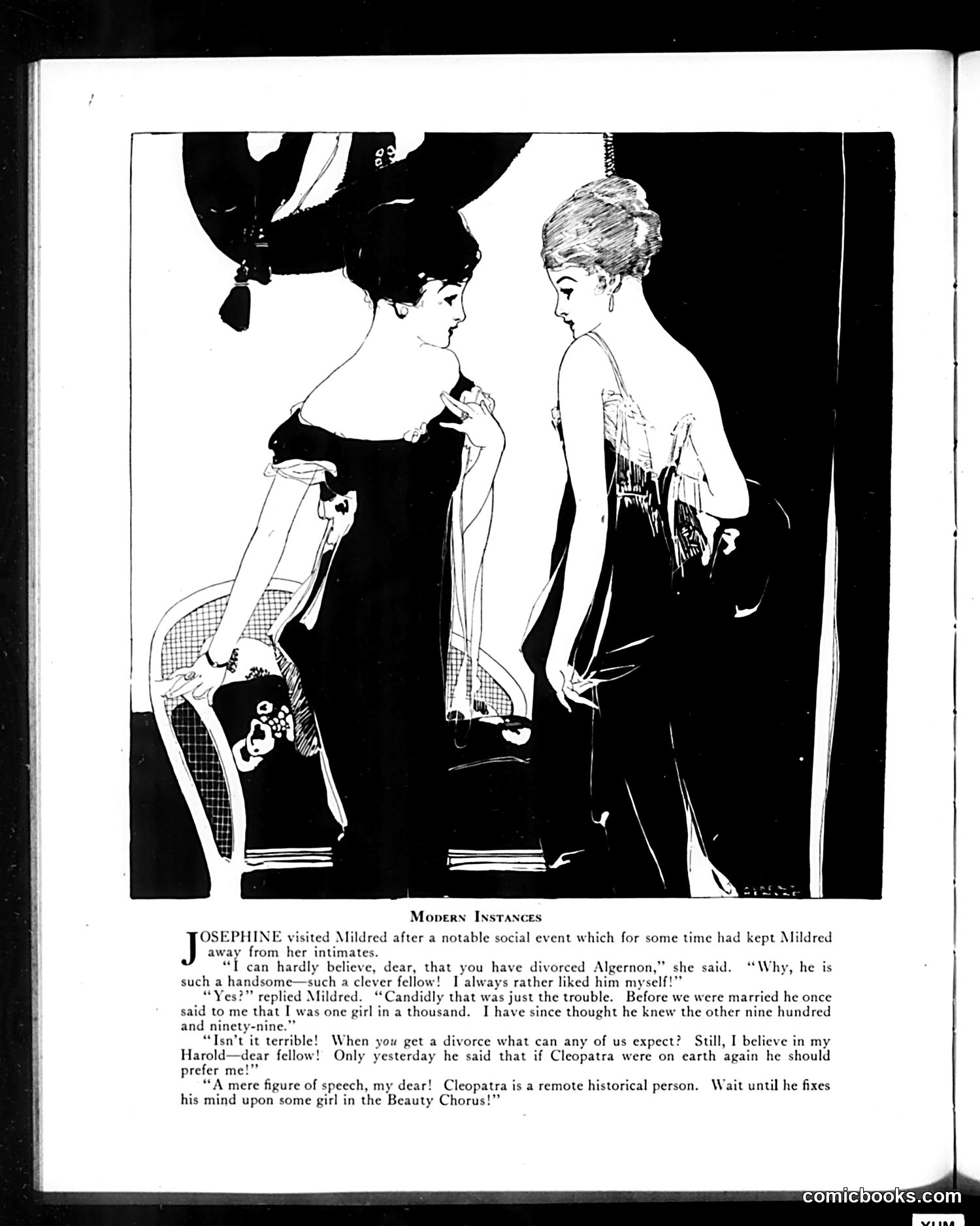
This page from *Judge* magazine presents a satirical dialogue titled "Modern Instances" between two women, Josephine and Mildred, discussing Mildred's recent divorce from a man named Algernon. The satire mocks contemporary attitudes toward divorce and infidelity. Mildred defends her ex-husband as "handsome" and "clever," while Josephine responds with sarcasm about divorce's social consequences and makes a cutting reference to Algernon's wandering eye, joking that if Cleopatra returned to earth, he'd prefer her over Mildred—before inevitably chasing someone from the "Beauty Chorus." The cartoon targets both the casualness with which wealthy men pursue multiple women and the social awkwardness divorce creates among the upper classes. The stylized Art Nouveau illustration and sophisticated dialogue suggest this ridicules high-society hypocrisy regarding marriage and fidelity.
This page contains an article by Campbell MacCulloch titled "A Solitary Shriek; A Bubbling Cry," comparing English and American humor. **The Cartoon:** A small black illustration shows a bird (appears to be a crow or raven) standing on what looks like a platform or pedestal, depicted in a minimalist style typical of early 20th-century satirical art. **The Content's Point:** MacCulloch argues Americans favor exaggerated, explicit humor ("overstatement"), while English humor relies on understatement and subtlety. He illustrates this with an anecdote from an Ohio hotel trial where a witness's dramatic hand-clapping demonstration contrasts with English restraint. **Historical Context:** Published during World War I (1918), this reflects Anglo-American cultural differences and the transatlantic relationship of the era, using humor analysis to explore national character differences.
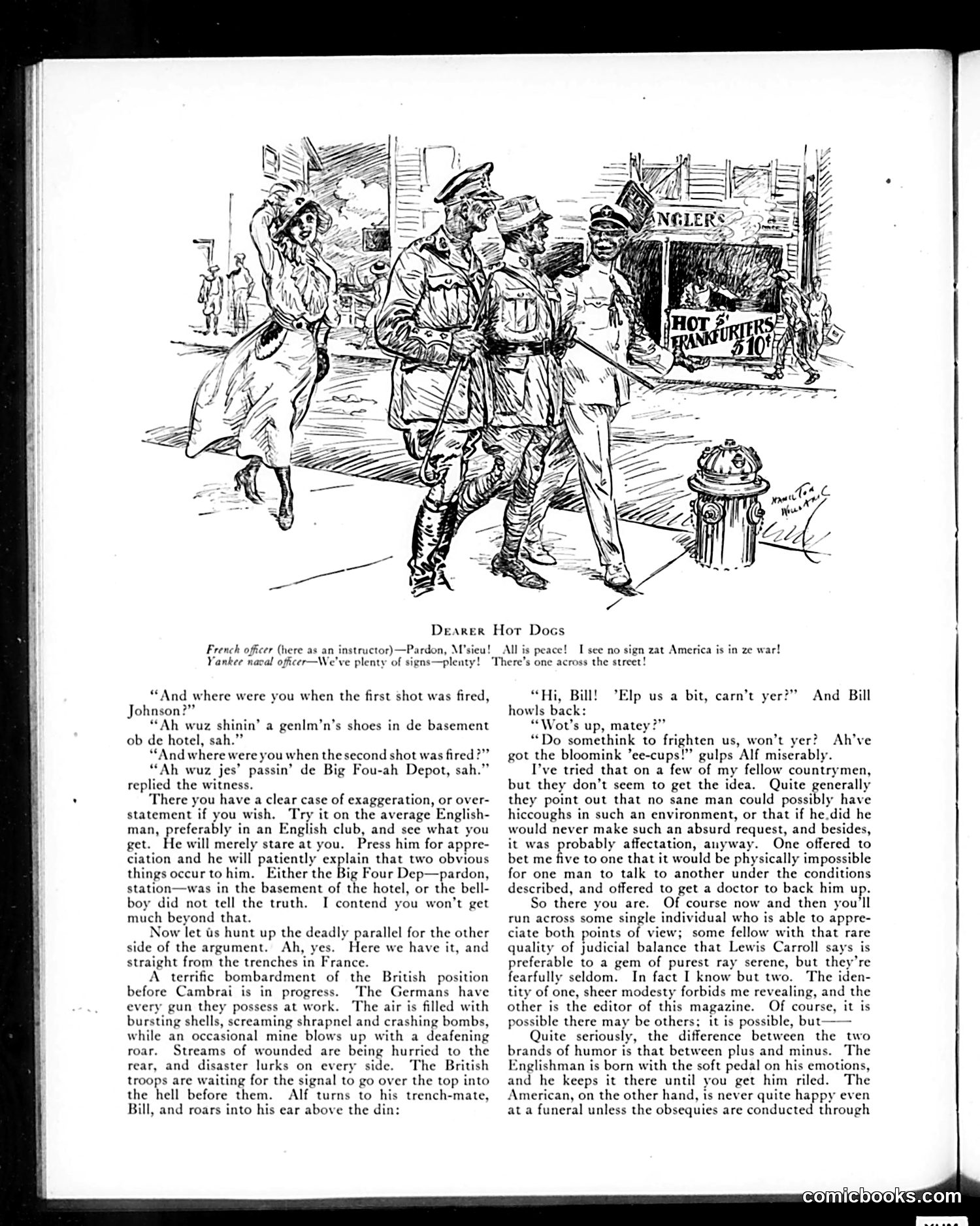
This cartoon satirizes American soldiers' complaints during World War I. The illustration shows a French officer instructing soldiers, with a hot dog vendor visible—the setup for the joke's title. The accompanying text records soldiers discussing where they were when shots were fired, with their responses focusing on mundane details (shining shoes, eating) rather than heroic war stories. The humor derives from soldiers deflating expectations of combat narratives with petty, domestic concerns. The broader satire critiques the difference between British and American humor: the text notes that English soldiers suppress emotions stoically, while Americans "never quite happy even at a funeral" unless things are done their way—suggesting American soldiers' persistent complaining about conditions, including food, even during wartime.
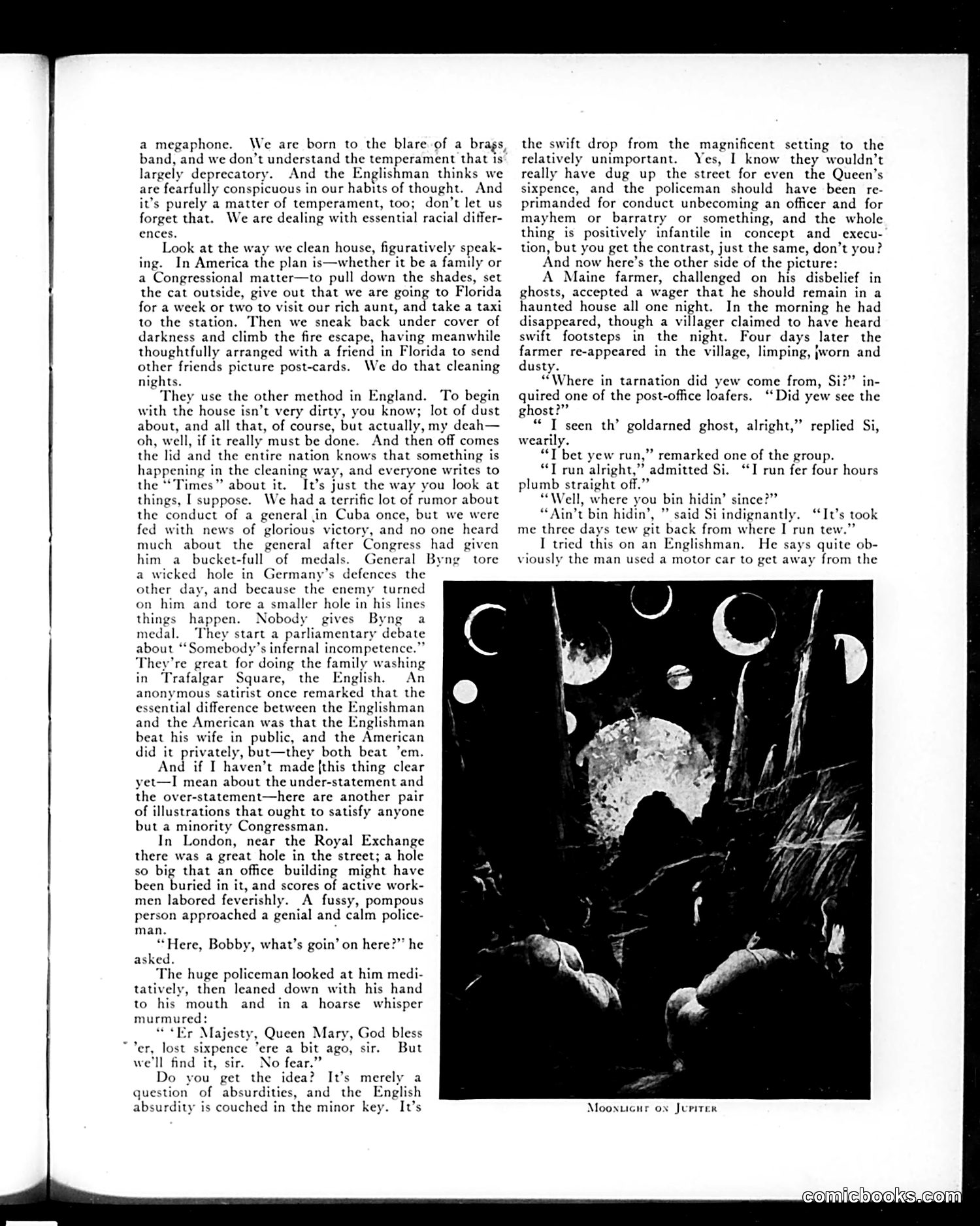
This illustration accompanies a satirical essay contrasting English and American temperaments. The cartoon depicts a Maine farmer's supernatural encounter—part of the author's argument about national character differences. The text describes the farmer accepting a wager to spend a night in a haunted house. By morning, he's vanished, though villagers report hearing swift footsteps. Post-office loafers debate whether he saw a ghost; one claims the farmer ran for four hours straight without stopping. The joke satirizes American *exaggeration*: Americans dramatize events with grand, obvious reactions, while English people understate everything. The farmer's extreme response (possibly fleeing in terror) exemplifies American excess. The celestial imagery ("Moonlight on Jupiter") emphasizes the fantastical, larger-than-life nature of the American tall tale—contrasting with the English policeman's deadpan understatement in the accompanying text about a lost sixpence.
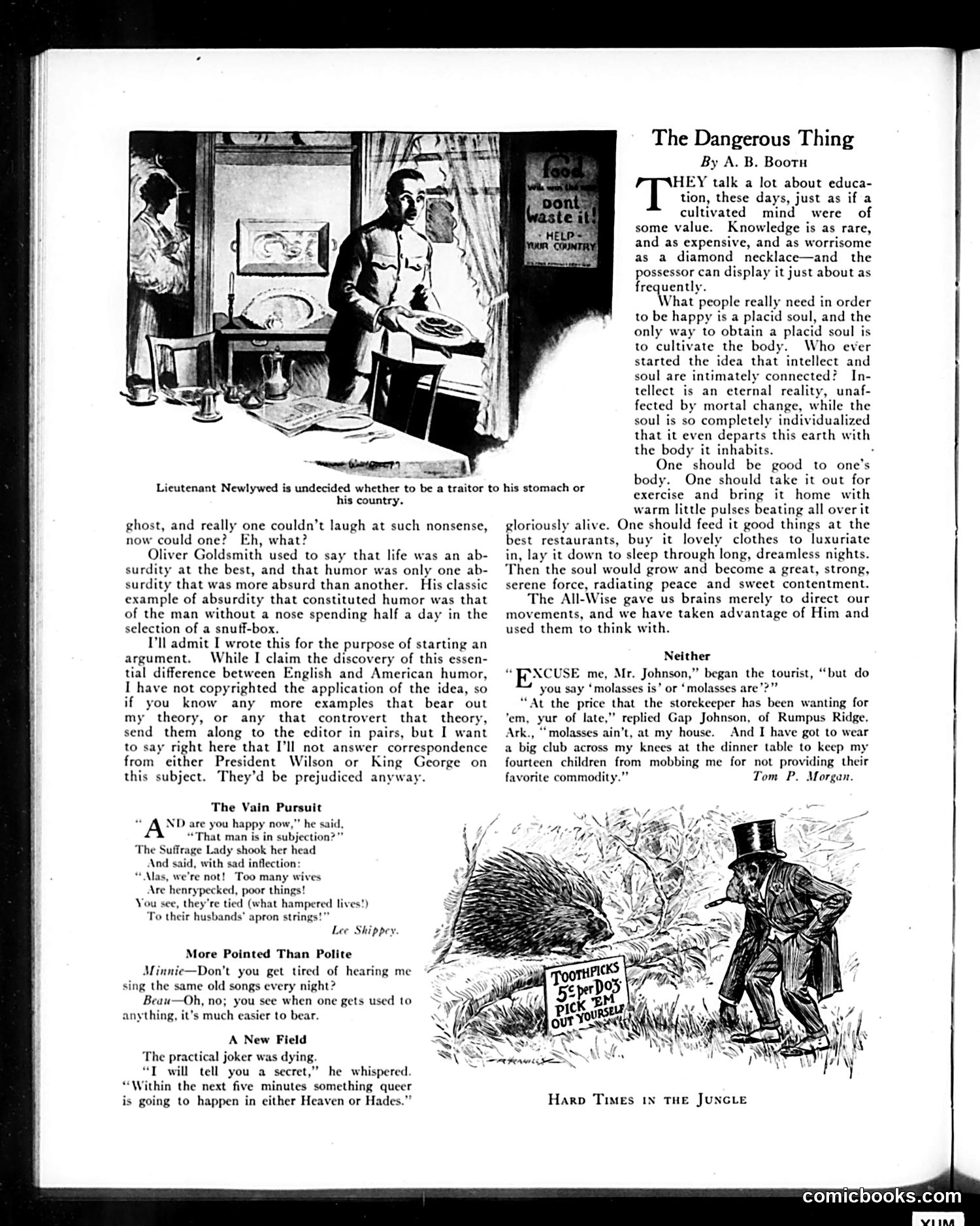
This page from **Judge** (an American satirical magazine) contains multiple short humor pieces typical of early 20th-century periodicals. The main article, "The Dangerous Thing" by A.B. Booth, satirizes contemporary obsession with education and intellect. Booth argues ironically that cultivating the *body* through good food, fine clothes, and exercise—rather than developing the mind—produces happiness and contentment. He dismisses intellect as merely a tool for directing physical movements, inverting the era's progressive emphasis on education as society's solution. The accompanying cartoon depicts **Lieutenant Newlywed** torn between military duty and hunger, humorously illustrating the conflict between patriotic obligation and bodily appetite—reinforcing Booth's theme. Other pieces mock women's suffrage ("The Vain Pursuit"), romantic boredom, and rural dialect humor. The page reflects Judge's satirical stance: mocking both intellectual pretension and social reform movements popular with progressive readers.
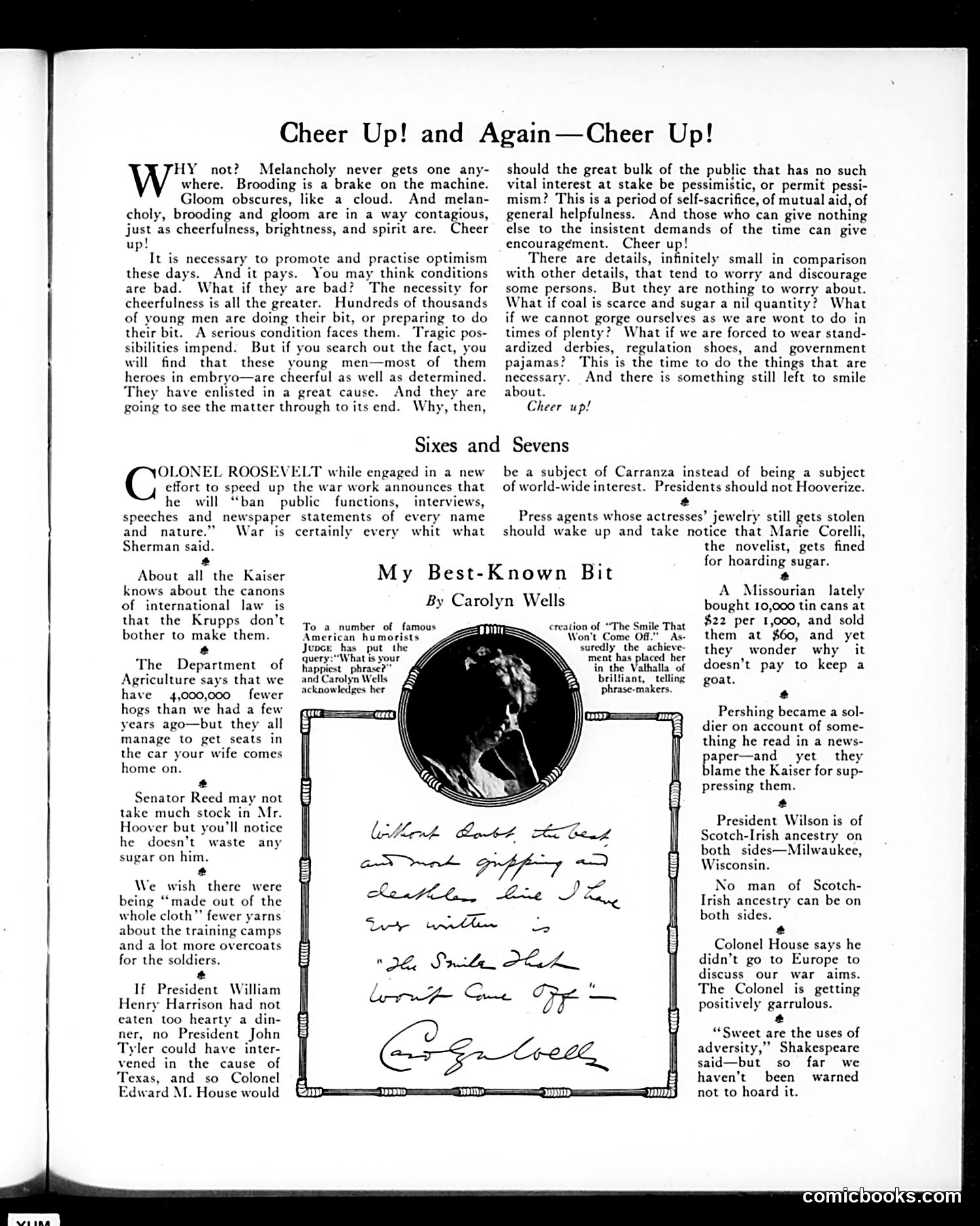
This is a WWI-era editorial page promoting wartime morale. The main article "Cheer Up! and Again—Cheer Up!" urges Americans to maintain optimism despite rationing (coal, sugar shortages) and mandatory standardization (government-issue shoes, pajamas, "Hooverizing"). It appeals to patriotism by contrasting soldiers' courage with civilians' minor hardships. The "Sixes and Sevens" section contains satirical jabs: Colonel Roosevelt's ban on public statements is mocked as typical Rooseveltian excess; the Kaiser's ignorance of international law is ridiculed; agricultural data about hog shortages is twisted into a joke about crowded cars. The center feature showcases Carolyn Wells' "The Smile That Won't Come Off"—apparently her well-known witty phrase. Sidebar jokes mock wartime profiteering (tin cans), press agent corruption, and hypocrisy (Marie Corelli fined for hoarding despite being famous for clever phrases). The overall message: sacrifice cheerfully; don't complain about minor deprivations when soldiers face danger.
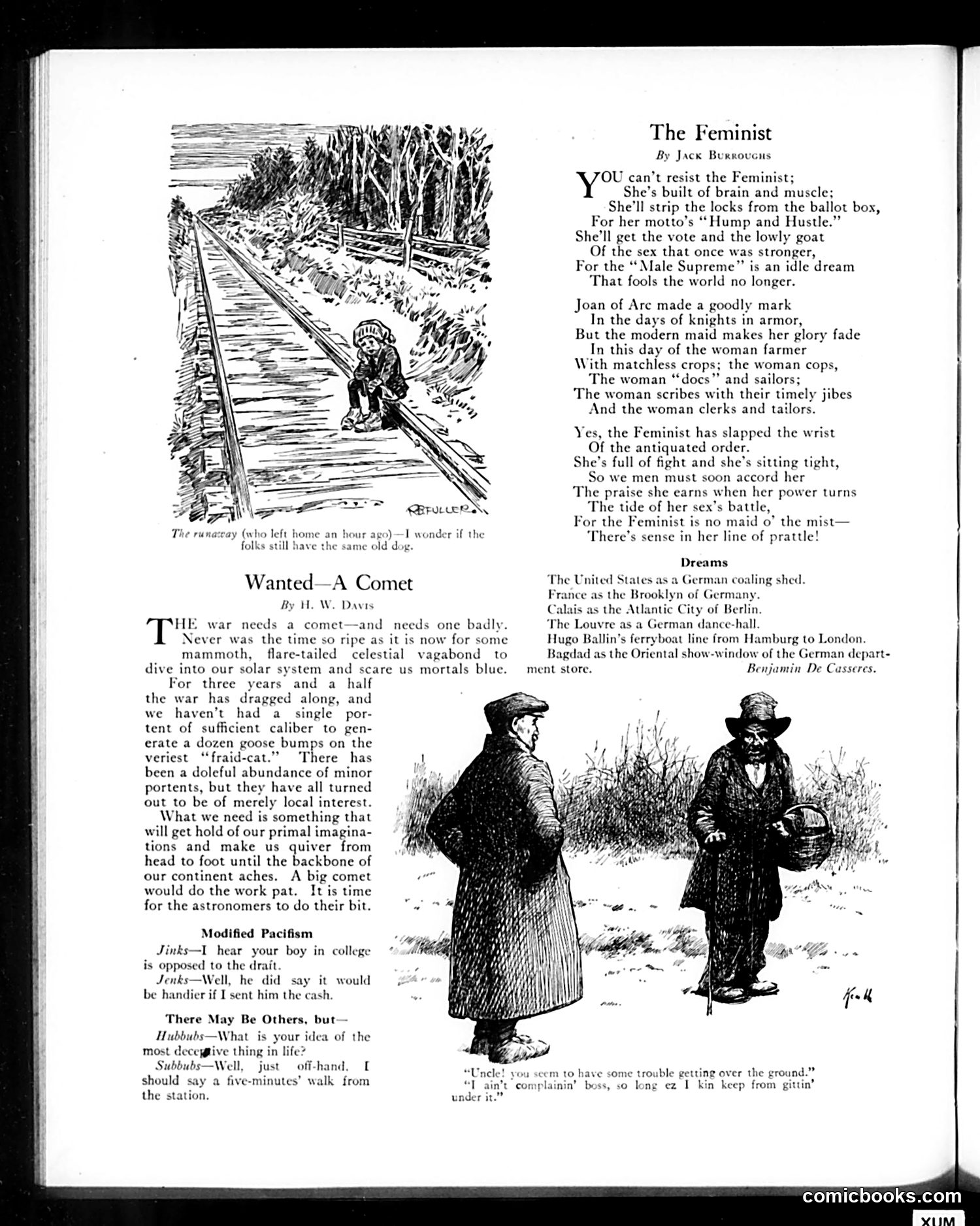
**"The Feminist"** is a satirical poem attacking women's suffrage and expanding female roles. The author presents feminism as an aggressive force—women gaining voting rights ("strip the locks from the ballot box"), entering traditionally male professions (farmers, police, doctors, sailors, clerks), and challenging male dominance. The poem's tone is mocking, portraying feminists as disruptive rather than liberatory. This reflects early 20th-century anti-suffrage sentiment. **"Wanted—A Comet"** is wartime satire wishing for a spectacular celestial event to inspire Americans during WWI (ongoing since 1914). The author argues three years of war has failed to galvanize public imagination; a dramatic comet would provide the emotional jolt needed to energize the nation's war effort. **"Dreams"** presents cynical post-war fantasies of German conquest—imagining European landmarks repurposed as German colonial infrastructure (the Louvre as a dance hall, Bagdad as a "show-window"). The page's humor relies on period anxieties: female empowerment as threatening, wartime pessimism, and imperial ambitions.
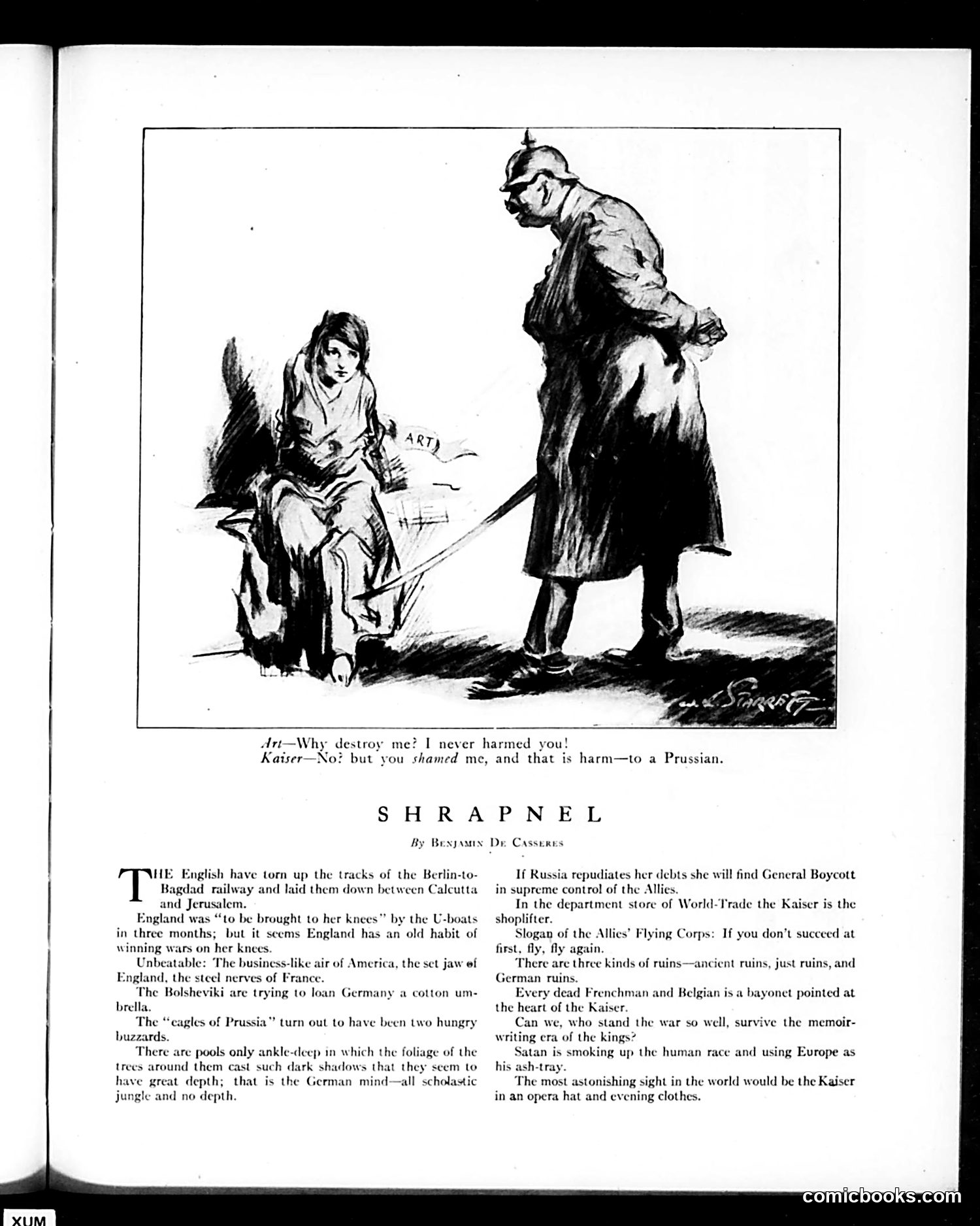
This cartoon, by Benjamin De Casseres, depicts a confrontation between a young woman (labeled "Art") and a Prussian military officer (the Kaiser). The woman pleads she never harmed him; he responds that merely "shaming" him constitutes harm "to a Prussian"—a satirical jab at Prussian honor and militarism. The accompanying essay collection titled "Shrapnel" uses sharp aphorisms to mock Germany and Kaiser Wilhelm II during World War I. It attacks German military arrogance, U-boat warfare, and the Kaiser's vanity. References to "three kinds of ruins—ancient ruins, just ruins, and German ruins" and characterizations of Germany as intellectually shallow ("scholastic jungle and no depth") reflect wartime Allied propaganda. The piece equates German conduct with theft and destruction, positioning the Kaiser as a predatory "shoplifter" in world trade.
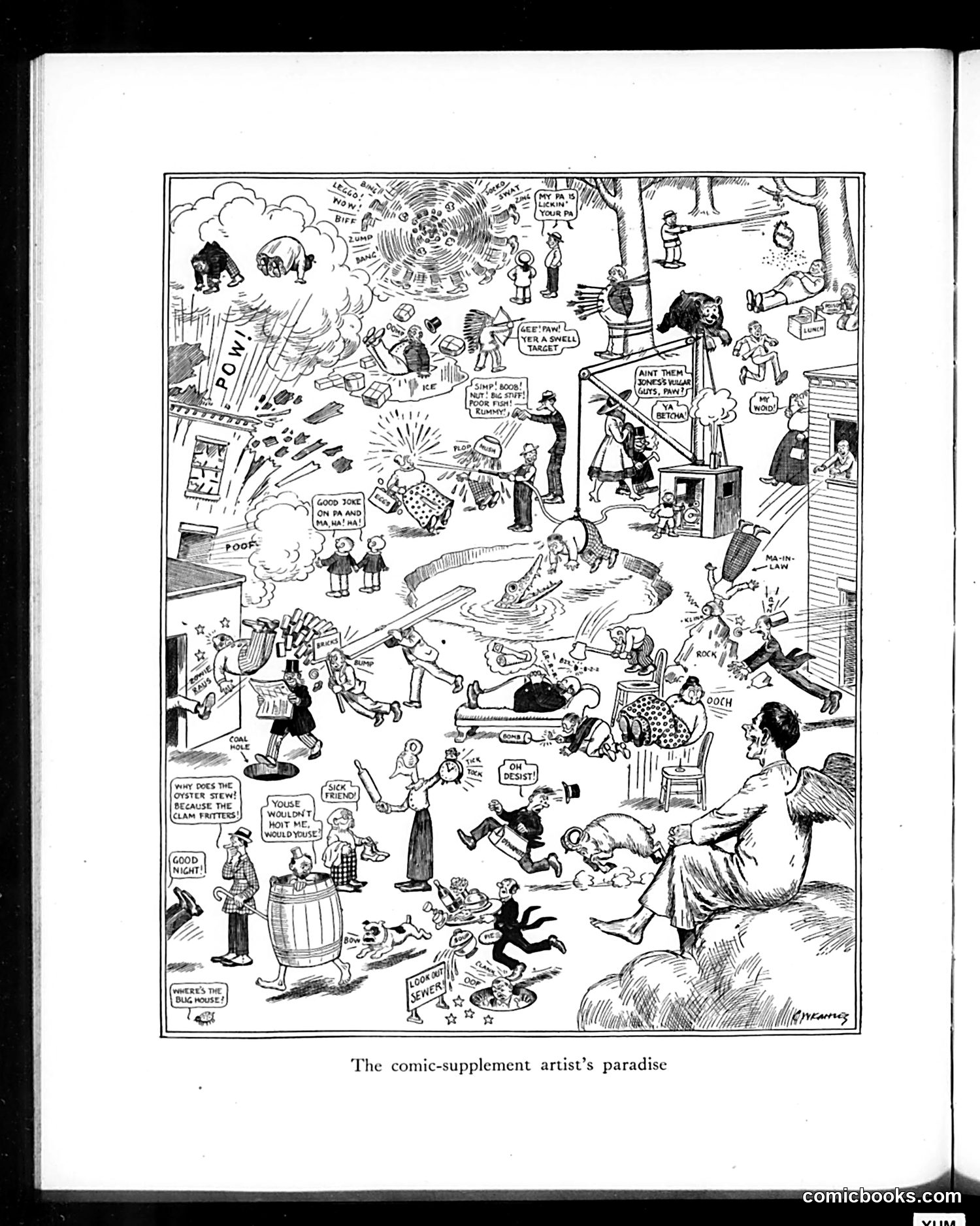
This is a satirical illustration about the working conditions and creative freedoms of comic-strip artists. The chaotic scene depicts an idealized fantasy world where an artist can depict anything without editorial constraints or real-world consequences. The cartoon shows various impossible, violent, and absurd scenarios simultaneously: explosions, people falling, animals running wild, characters in ridiculous situations, and general mayhem. Speech bubbles contain nonsensical dialogue. The satire suggests that comic-supplement artists felt constrained by editorial oversight and audience expectations in actual publication. This "paradise" represents their desire for complete creative freedom—to draw whatever they imagined without concerns about appropriateness, logic, or propriety. It's a metacommentary on the tensions between artistic expression and commercial publishing standards in early 20th-century American journalism.
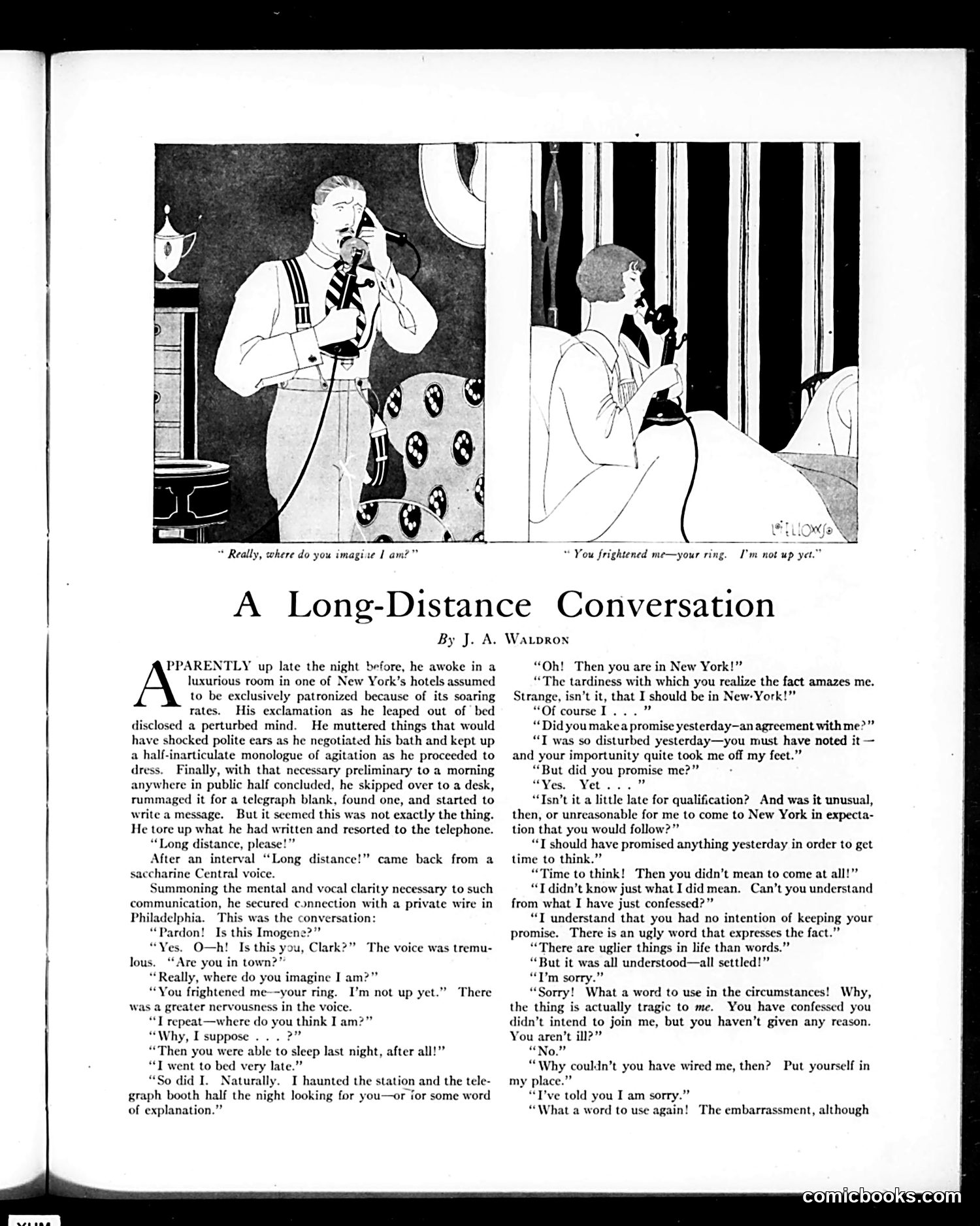
This satirical story depicts a romantic misunderstanding via early 20th-century telephone technology. A man ("Clark") has traveled from Philadelphia to New York, apparently after a woman ("Imogene") promised to meet him. She failed to appear and didn't explain why. The satire targets the emotional chaos enabled by long-distance communication: the woman made a careless promise, hoped he wouldn't follow through, and is now caught in her lie. Her excuses—being "disturbed," needing "time to think"—ring hollow against his clear sacrifice (haunting the station all night). The joke critiques both parties: his melodramatic pursuit and her casual commitment, but especially the modern awkwardness of technological intimacy. A phone conversation forces immediate confrontation that letters might have delayed. The title itself is ironic—this "conversation" only deepens the conflict rather than resolving it.
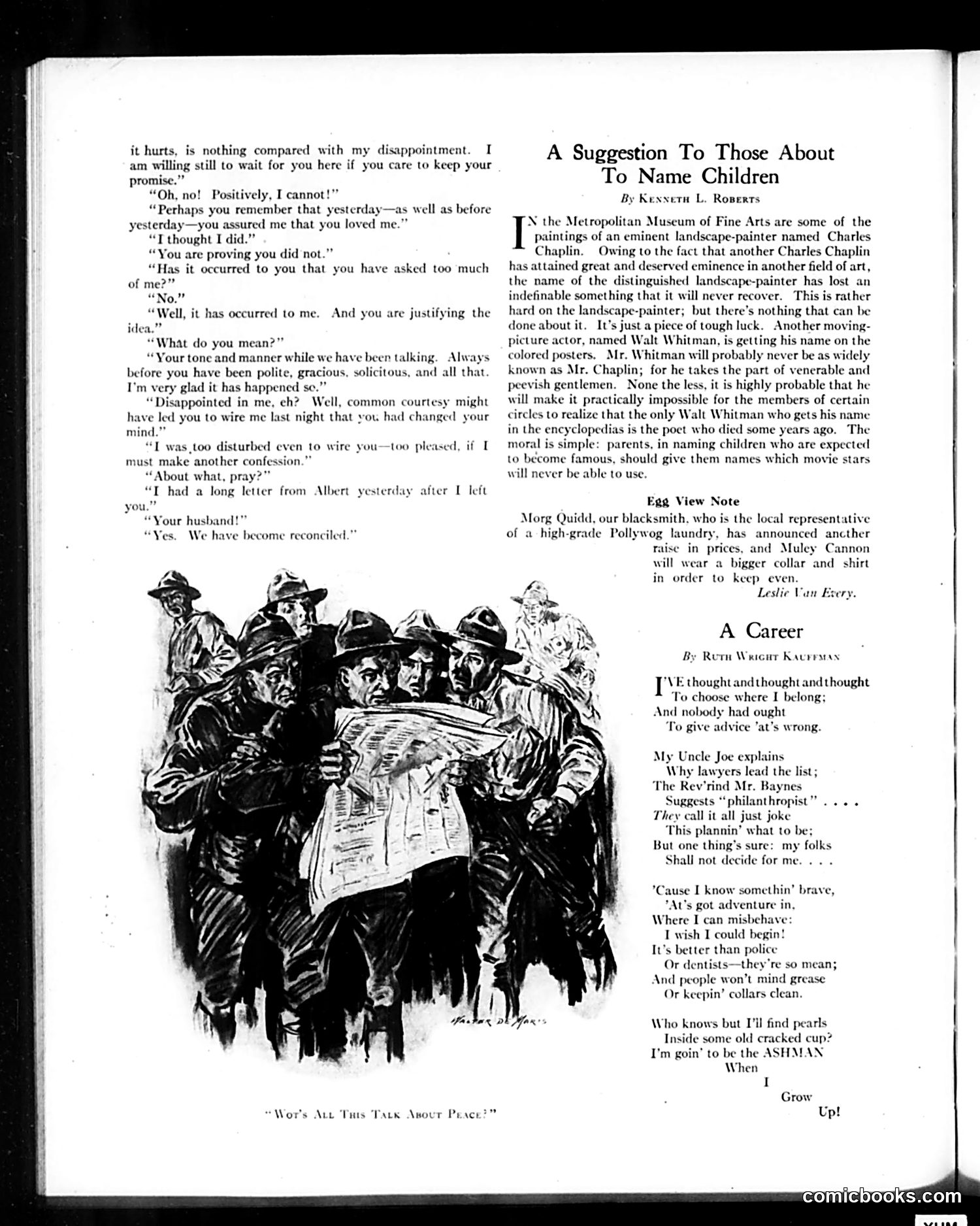
This page contains two distinct pieces: **Left Side - Dialogue & Cartoon:** A domestic dispute scene captioned "Wor's All This Talk About Peace?" Two figures reconcile after a separation, with the husband confessing he received a letter from "Albert" (likely another man) and they've "become reconciled." The satirical point appears to target post-WWI peace negotiations through marital metaphor—suggesting that even personal reconciliations involve complex jealousies and compromises, mirroring international peace-making's difficulties. **Right Side - Two Articles:** 1. **"A Suggestion to Those About Naming Children"** by Kenneth L. Roberts critiques naming children after famous people. Examples: a landscape painter named Charles Chaplin lost prominence after the film star Chaplin became famous; a movie actor named Walt Whitman will overshadow the historical poet. The satire warns against unintentionally sabotaging children's identities through shared names with future celebrities. 2. **"A Career"** by Ruth Wright Kauffman is a poem about a child resisting parental career guidance, dreaming instead of becoming an ashman (garbage collector) with adventure and freedom.
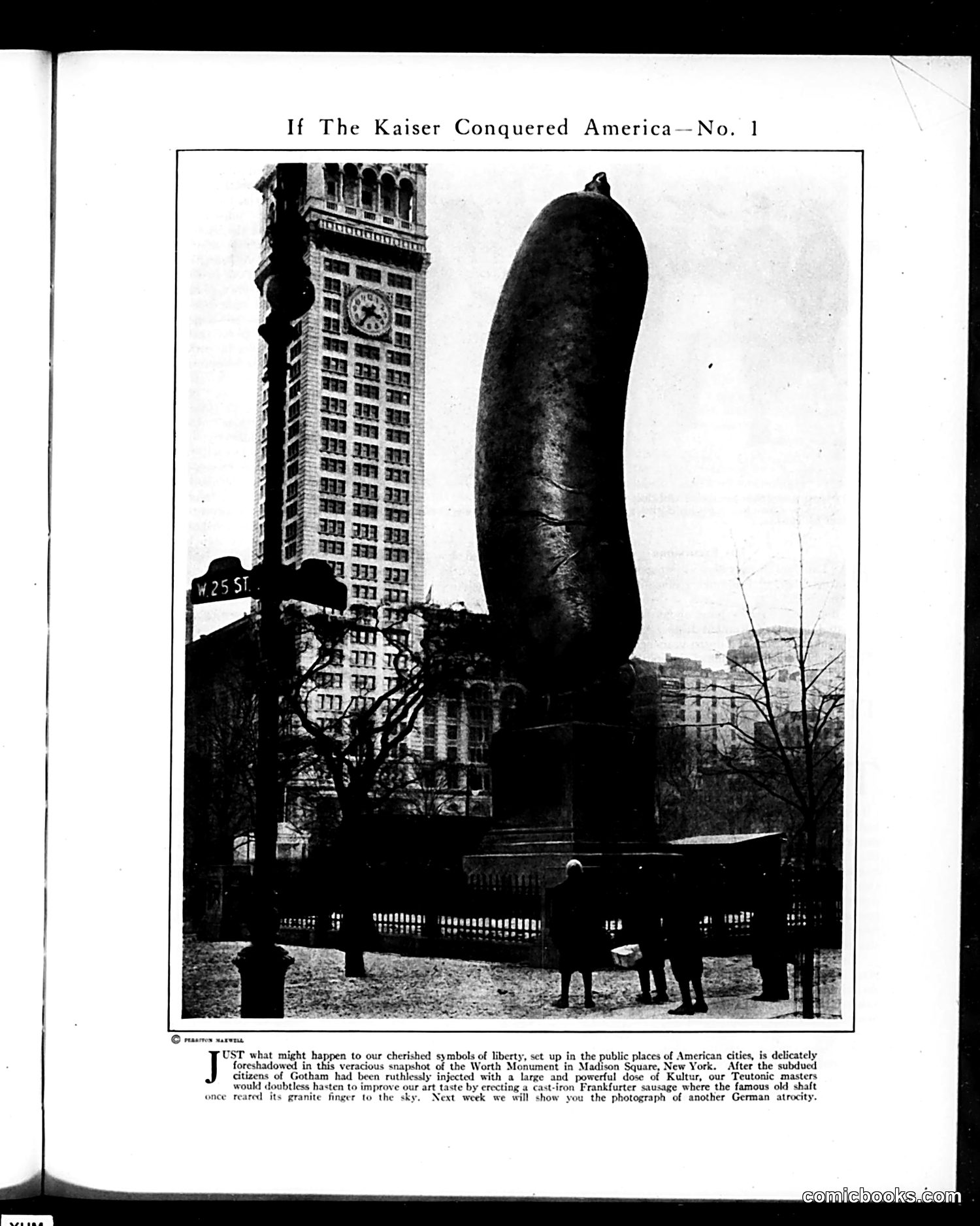
This is wartime propaganda satire from Judge magazine, likely from WWI era. The cartoon depicts a grotesque, oversized **sausage monument** replacing the Worth Monument in Madison Square Park, New York City—a real civic landmark. The satire warns American readers what would happen if Germany's Kaiser conquered America: German occupiers would destroy American symbols of liberty and replace them with crude representations of German culture. The term **"Kultur"** (deliberately spelled German-style) was used mockingly to mock German claims of cultural superiority. The sausage—a stereotypical German food—represents the authors' contempt for German aesthetic taste and serves as deliberate ridicule. The text calls this an "atrocity," inverting the language Germans used for their own grievances. The series format ("No. 1") suggests multiple predictions of post-conquest humiliations, designed to rally American patriotic sentiment against German victory.
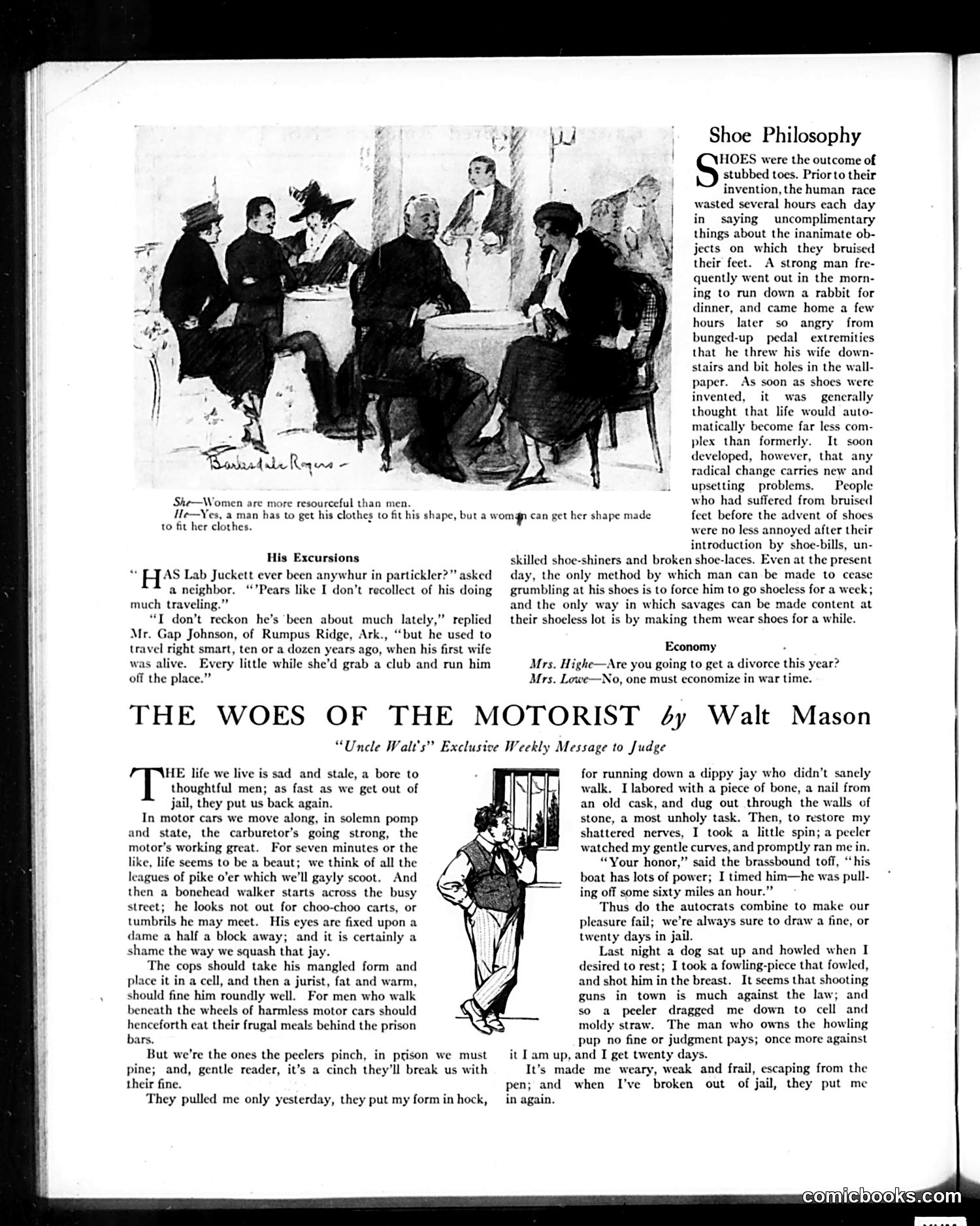
This page contains three satirical pieces mocking early 20th-century social attitudes: **"Shoe Philosophy"** presents a tongue-in-cheek history claiming shoes were invented to prevent domestic violence caused by men's foot pain. The joke subverts earnest progress narratives by suggesting civilization's improvements merely replace old problems with new ones (shoe bills, broken laces). **"His Excursions"** is a brief anecdote joke: a man's wife was so violent she'd chase him off with a club, so he "traveled" frequently. It's dark humor about domestic abuse played for laughs. **"The Woes of the Motorist"** by Walt Mason satirizes automobile culture and judicial bias. A motorist who hits a pedestrian faces jail time, yet the narrative suggests the pedestrian was careless. The piece critiques both reckless drivers and a legal system that seems to punish motorists harshly while ignoring pedestrian negligence—reflecting 1910s-20s anxieties about cars, class, and justice. All three pieces use humor to critique social contradictions and hypocrisy.
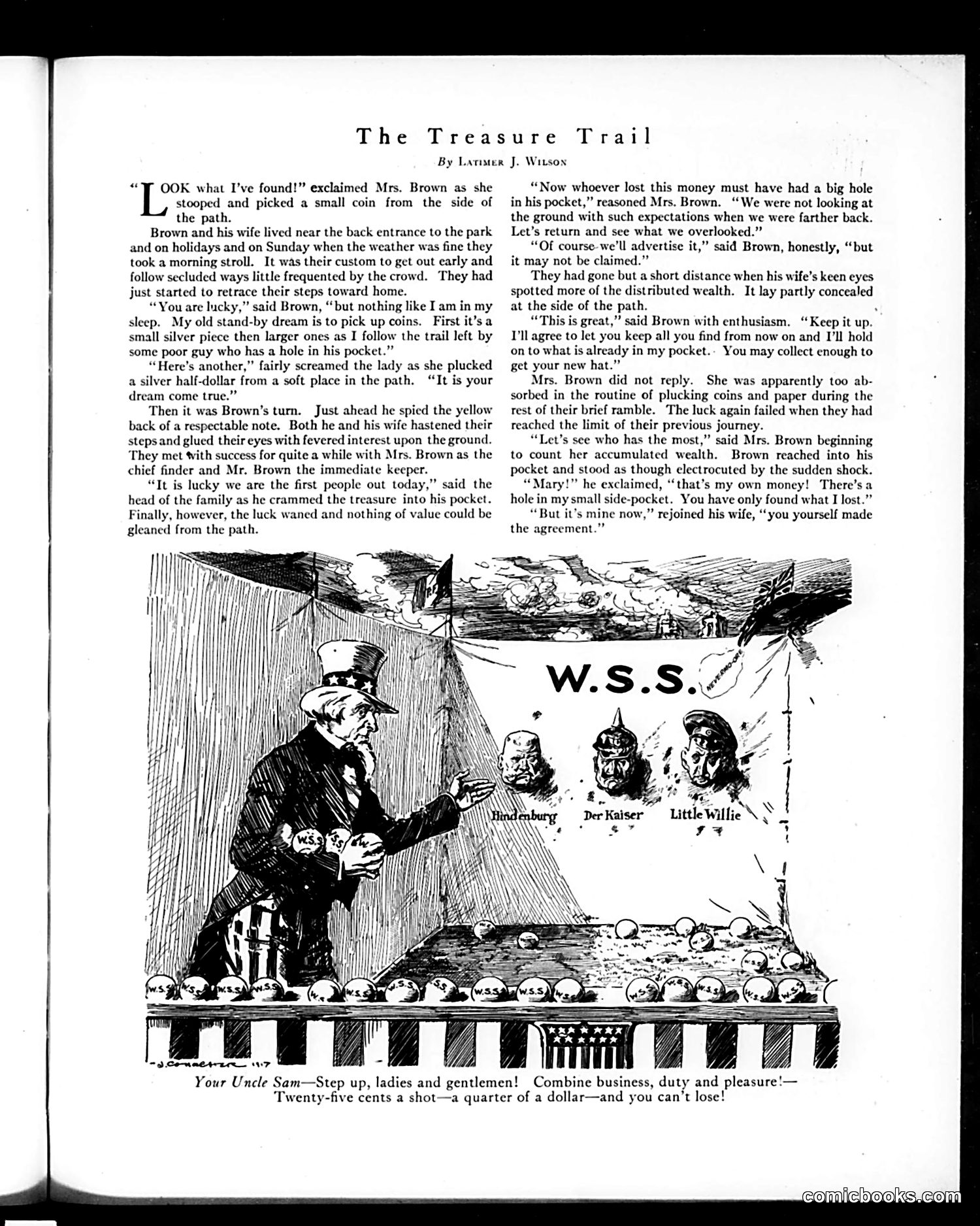
"The Treasure Trail" is a two-part page: a short story about a couple finding coins on a park path, and a political cartoon below. The **story** is a domestic comedy about Mr. and Mrs. Brown discovering money during their walk. The joke's twist: the "treasure" comes from a hole in Brown's own pocket. When he agrees to let his wife keep all future finds, she wins the bet—the money was always his. The **cartoon below** is sharper satire. It depicts "Uncle Sam" operating a carnival game labeled "W.S.S." (likely "War Savings Stamps"), with three caricatured heads visible—appearing to reference political figures like Hindenburg, the Kaiser, and "Little Willie" (the German Crown Prince). The pitch promises: "Combine business, duty and pleasure!—Twenty-five cents a shot...and you can't lose!" This mocks American WWI-era bond/savings drives as a rigged game where citizens are persuaded to "invest" in war efforts under the guise of patriotic duty and guaranteed returns—echoing the domestic story's bait-and-switch above it.
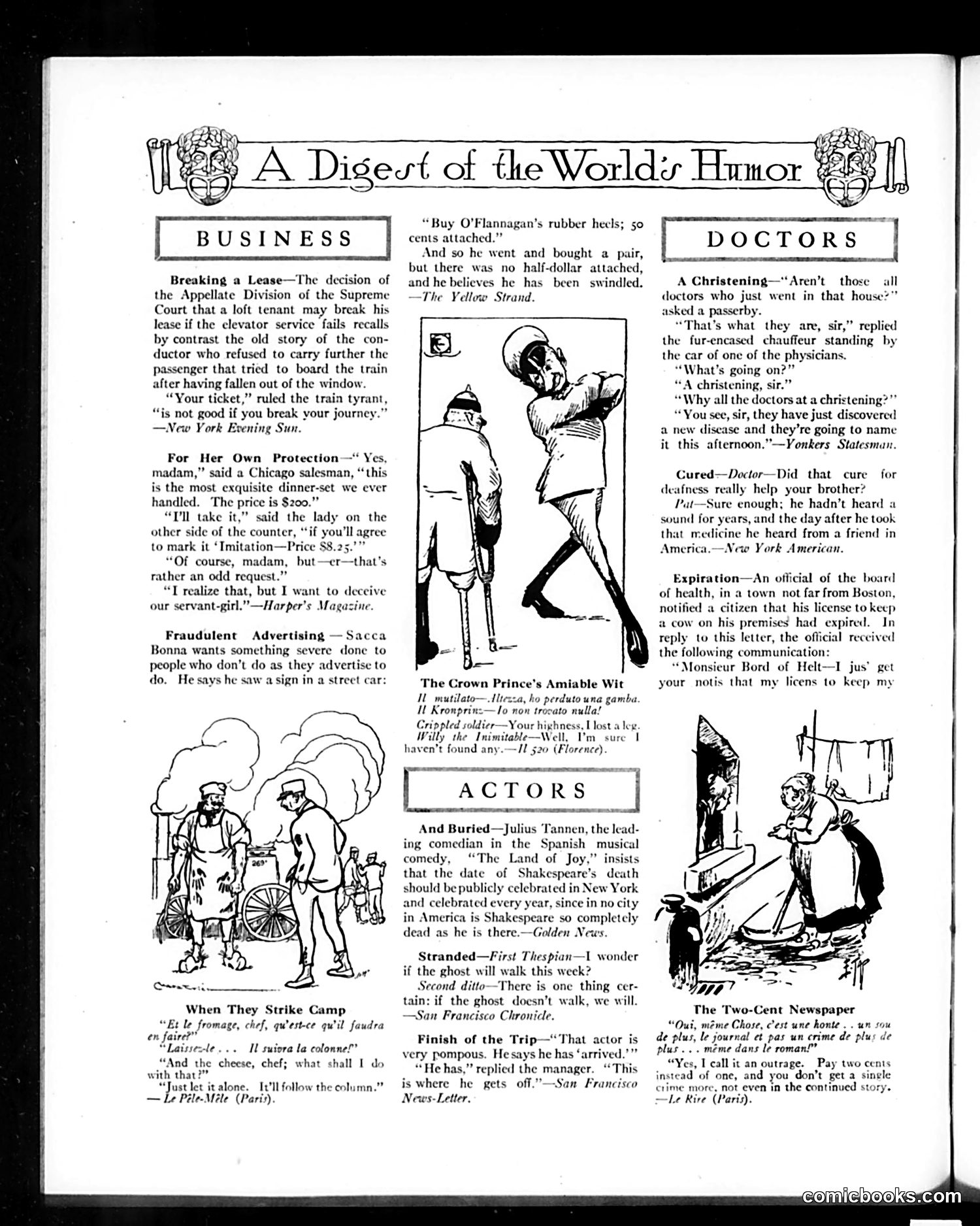
This page from Judge presents short satirical anecdotes organized by profession—Business, Doctors, and Actors—typical of early 20th-century American humor magazines. **Key jokes** include: a Chicago woman requesting a dinner set be marked "Imitation" to deceive her servant girl (mocking class pretension); a fraudulent rubber heel advertisement promising an attached fifty-cent coin that never arrives; and a Crown Prince's quip about a crippled soldier—cruel humor relying on disability as comedy. The **Doctors section** satirizes physicians attending a christening to name a newly "discovered" disease, mocking medical profession's tendency toward inventing ailments. The **Actors section** uses theatrical slang ("the ghost will walk" = payment) and jokes about unemployed performers. **One section** appears to reference Shakespeare's relative obscurity in New York theater. The cartoons show working-class figures and physical comedy typical of the era. This reflects Judge's audience: educated middle-class readers enjoying gentle social satire about commerce, medicine, and entertainment.
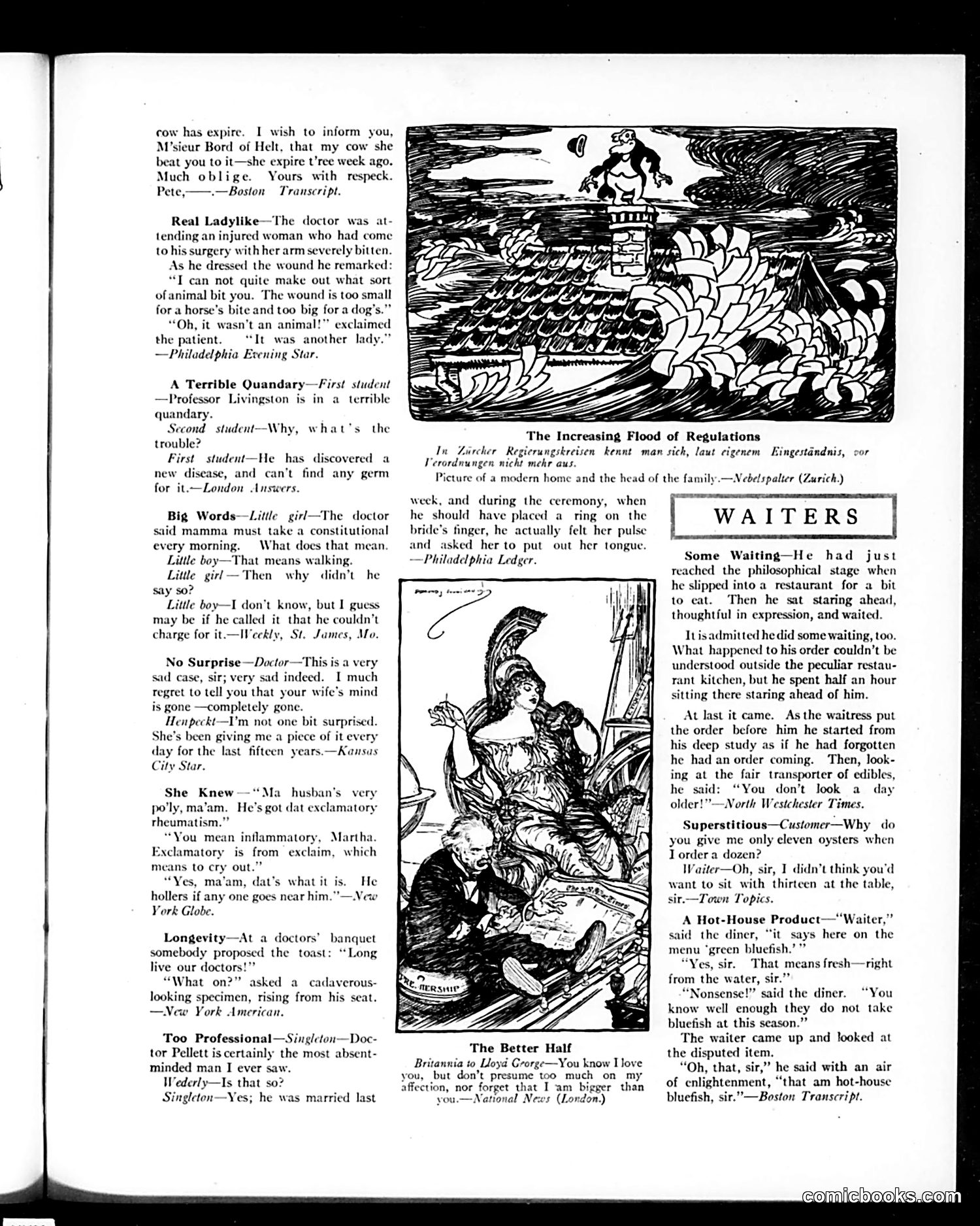
This page from *Judge* (a satirical American magazine) contains several short humorous anecdotes and two cartoons mocking bureaucratic excess and professional absurdity. **Top cartoon**: "The Increasing Flood of Regulations" depicts a Swiss home drowning in paperwork—literally submerged by regulatory documents. This satirizes European (specifically Swiss) government overregulation, with the caption noting officials themselves admit they can no longer understand the rules. **Bottom cartoon**: "The Better Half" shows Britannia (Britain personified as a woman) warning Prime Minister Lloyd George not to presume too much on her affection, reminding him she's "bigger." This likely references post-WWI British imperial power dynamics or tensions within the British government. **Text anecdotes** mock doctors' absent-mindedness (a doctor performs medical exams during his own wedding ceremony) and restaurant service inefficiency—common satirical targets across eras. The overall theme: institutional incompetence and regulatory absurdity.
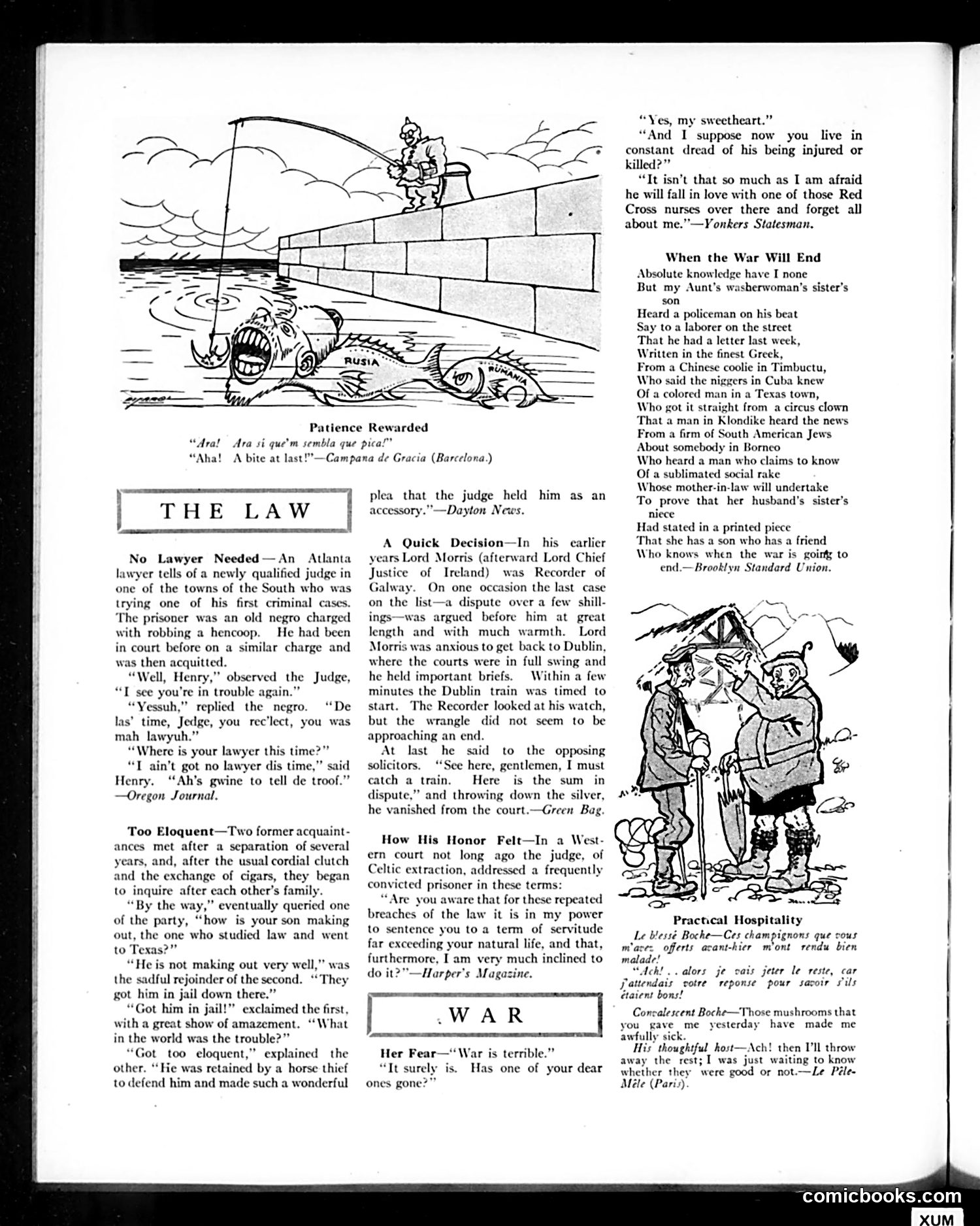
This page contains several legal anecdotes and war-related humor typical of early 20th-century American satire. **"Patience Rewarded"** cartoon depicts a fisherman catching what appears to be a large creature or person, illustrating the caption about finally getting "a bite." **The Law section** includes three jokes mocking the legal system: - A newly appointed Southern judge accepts a defendant's claim he'll "tell de troof" instead of hiring a lawyer—satirizing both judicial inexperience and racial stereotypes - A lawyer's eloquence backfires when he defends a horse thief so persuasively the judge holds *him* as an accessory - A harried Irish judge (Lord Morris) simply throws money at litigants to settle a dispute quickly so he can catch his train **The War section** satirizes anxieties about World War I. One joke mocks a woman's real concern: not that her sweetheart might be injured, but that he'll fall in love with Red Cross nurses. Another poem parodies rumor-mongering by depicting an absurdly long chain of secondhand gossip about when the war will end. The humor relies on assumptions about class, race, and Irish stereotypes common to the era.
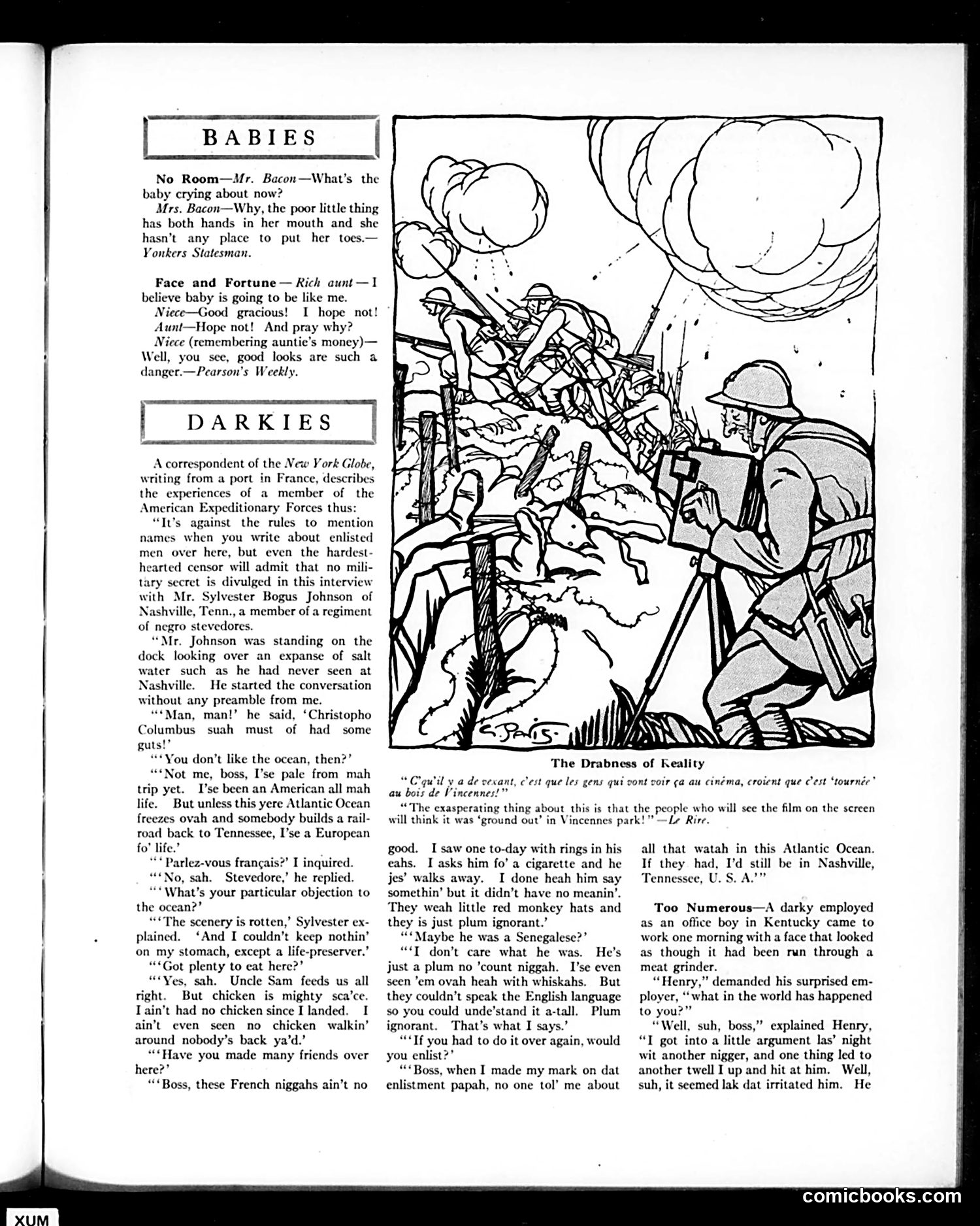
This page contains two satirical sections using deeply racist stereotypes typical of early-20th-century American humor magazines. **"Babies"** presents brief domestic jokes about infant behavior and inheritance—standard non-political humor. **"Darkies"** is a longer piece mocking African American soldiers serving in World War I. The satire presents a fictional interview with "Sylvester Bogus Johnson," a Black stevedore from Nashville, using exaggerated dialect and portraying him as ignorant, cowardly about ocean travel, and unable to communicate. The piece ridicules Black soldiers' experiences abroad while reinforcing stereotypes about their intelligence and capability. The accompanying illustration depicts WWI trench warfare—relevant to the soldier interview. **Important context**: This represents the racist attitudes endemic to American mainstream media of that era. Judge magazine routinely featured such content, reflecting (and reinforcing) the prejudices of its white readership, particularly regarding Black military service and capability.
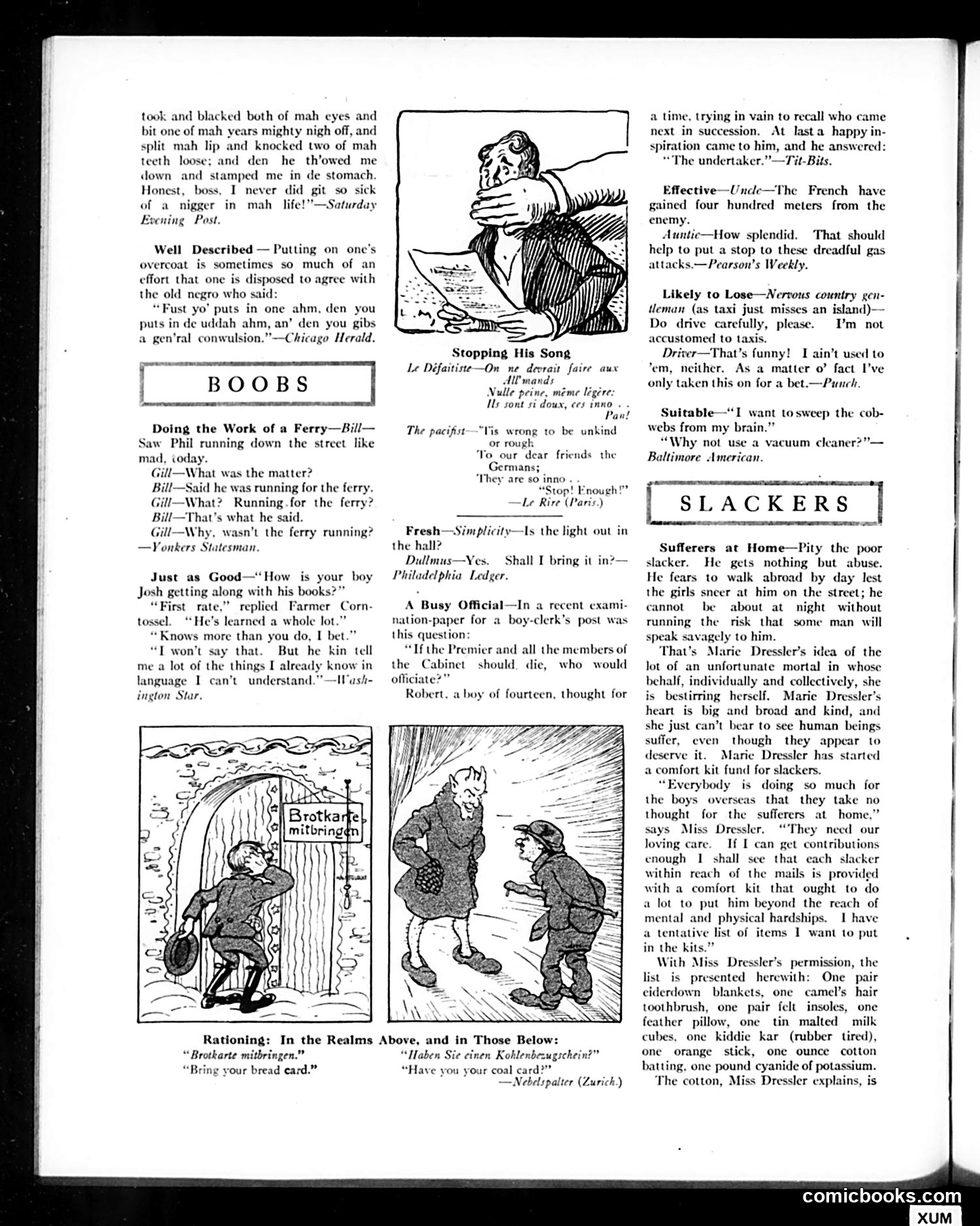
This page contains WWI-era humor and satire (likely 1914-1918). Key content: **"Boobs" section**: Light jokes about working-class speech and stupidity—a mainstay of the era's humor mocking rural/uneducated dialects. **"Stopping His Song"**: A French pacifist cartoon mocking Germans as "innocent" and kind. The punchline cuts him off—satire of German apologists who downplayed German aggression during WWI. **"Slackers" section**: Commentary on men avoiding military service. Actress Marie Dressler (named) advocates comfort kits for "slackers"—those not enlisting—who faced public shaming. The tone is sympathetic to slackers' plight despite societal condemnation. **"Rationing" cartoons**: German ration cards (bread, coal), depicting civilian wartime hardship in enemy territory. The page reflects American WWI sentiment: skepticism toward German pacifism, shame culture around non-enlistment, and awareness of enemy civilian suffering.
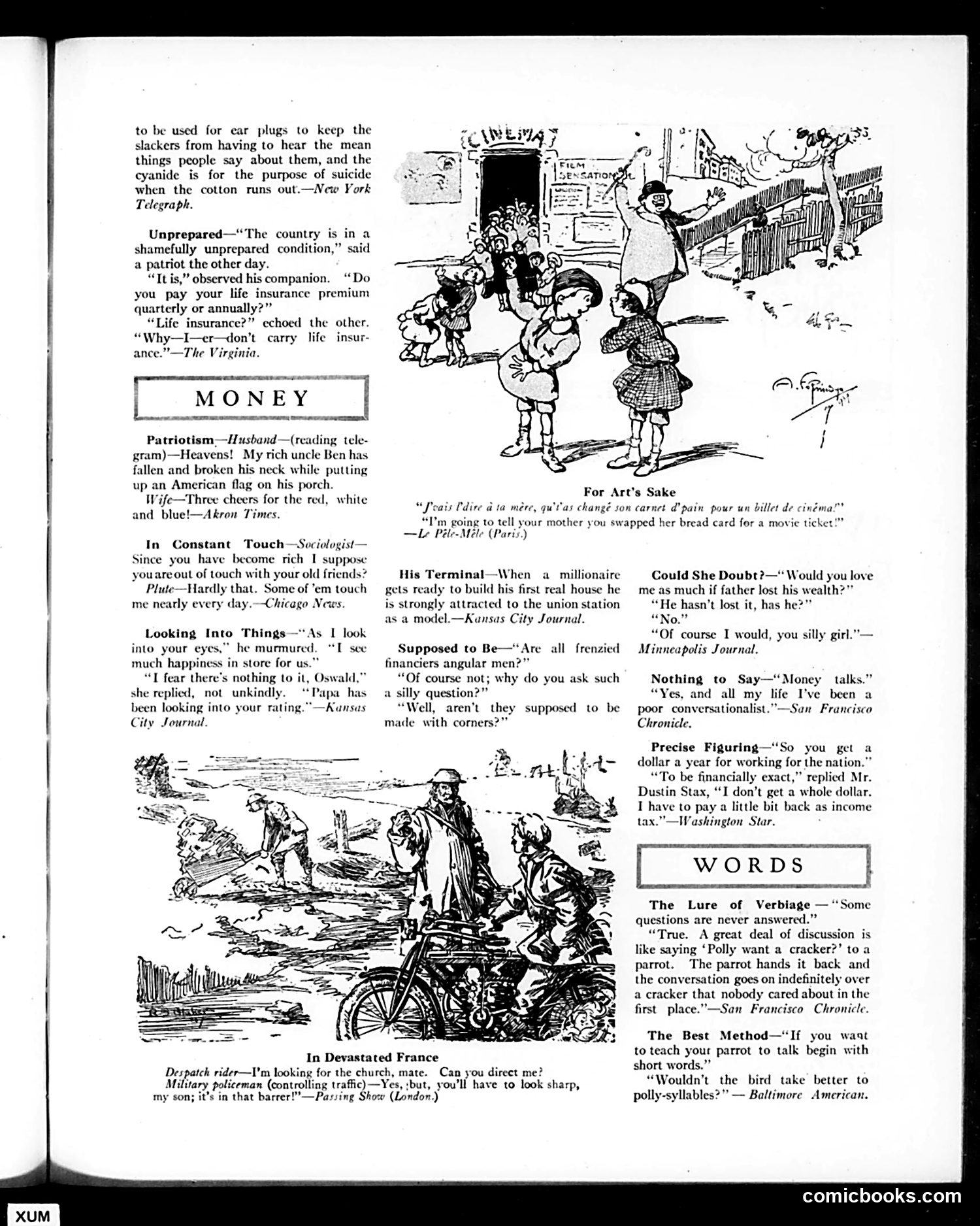
This page contains satirical humor pieces and cartoons typical of early 20th-century American satirical journalism. Key items: **"Unprepared" and "Patriotism"** joke about hollow patriotism—a man claims the country is unprepared for war, yet doesn't even carry life insurance. Another celebrates his uncle's death while raising an American flag, treating patriotic gestures as more important than actual welfare. **Money section** satirizes wealth and hypocrisy among the rich: a newly rich man still maintains contact with old friends (because they ask for money); financiers are mocked as angular and artificial; precise figuring mocks a laborer earning nominally a dollar annually but losing it to taxes. **"In Devastated France"** cartoon references post-WWI destruction—a soldier seeks a church in the rubble and is told to "look sharp" because it's now in a barrel, suggesting complete obliteration of landmarks. The **Words section** offers general humor about verbose, pointless conversation and teaching parrots to talk—social satire unrelated to specific events.
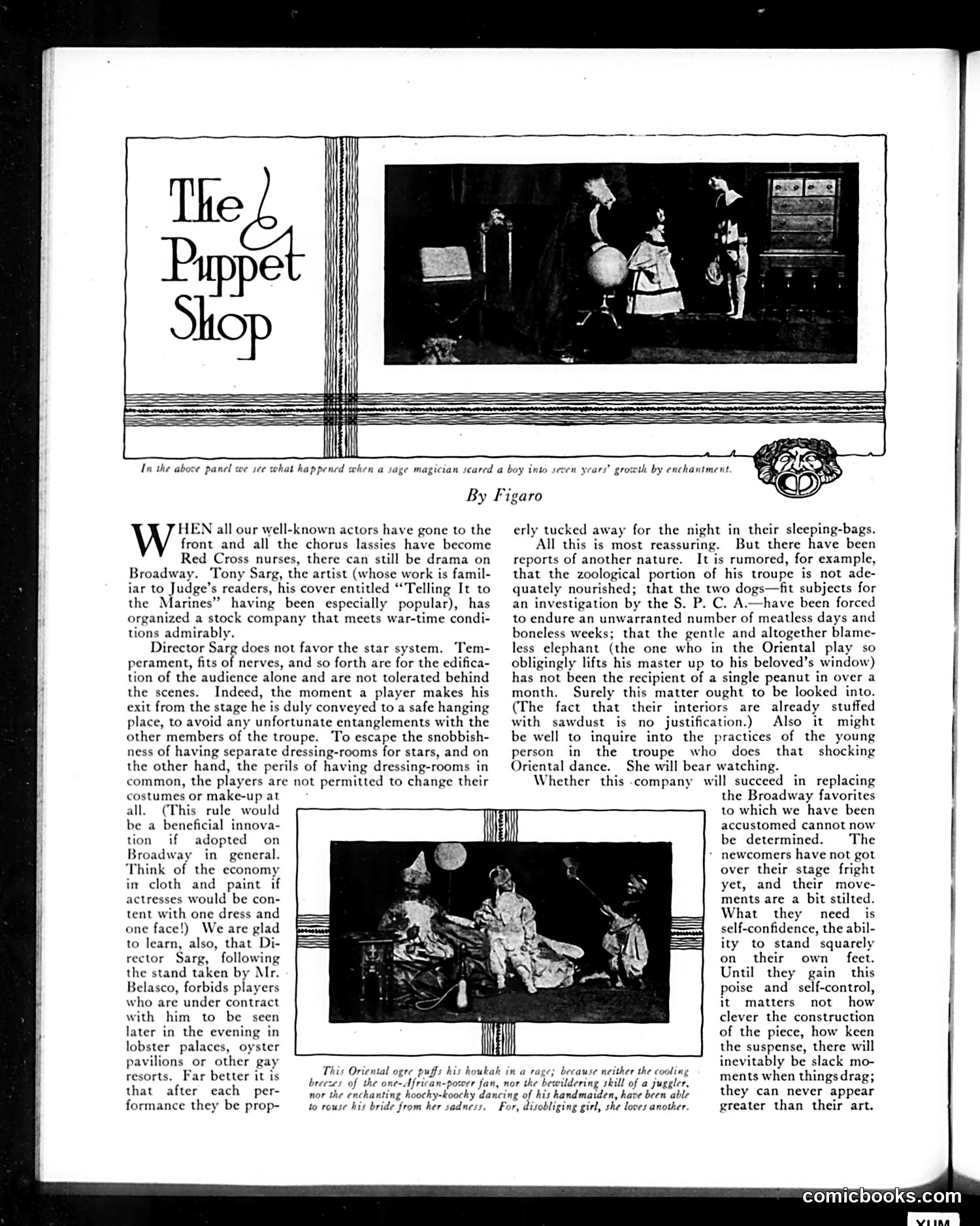
This is a satirical piece by Figaro about director Tony Sarg's experimental theater company during wartime (likely WWI, when actors enlisted and women became nurses). The joke: Sarg has replaced human actors with **puppets and trained animals**—the images show an elephant, dogs, and what appear to be marionettes performing. The satire mocks this as a cost-cutting measure while pretending it solves theatrical problems like temperament and dressing-room drama. The article humorously critiques both the concept and rumors about it: the animals are supposedly underfed (meatless days for dogs, no peanuts for the elephant), and there's concern about a young female dancer's "shocking Oriental dance" and whether she can be trusted. The underlying social commentary targets wartime sacrifices and the absurdity of theatrical conventions—suggesting that even puppet shows would be better managed than real actors, while poking fun at actual Broadway's pretensions and waste.
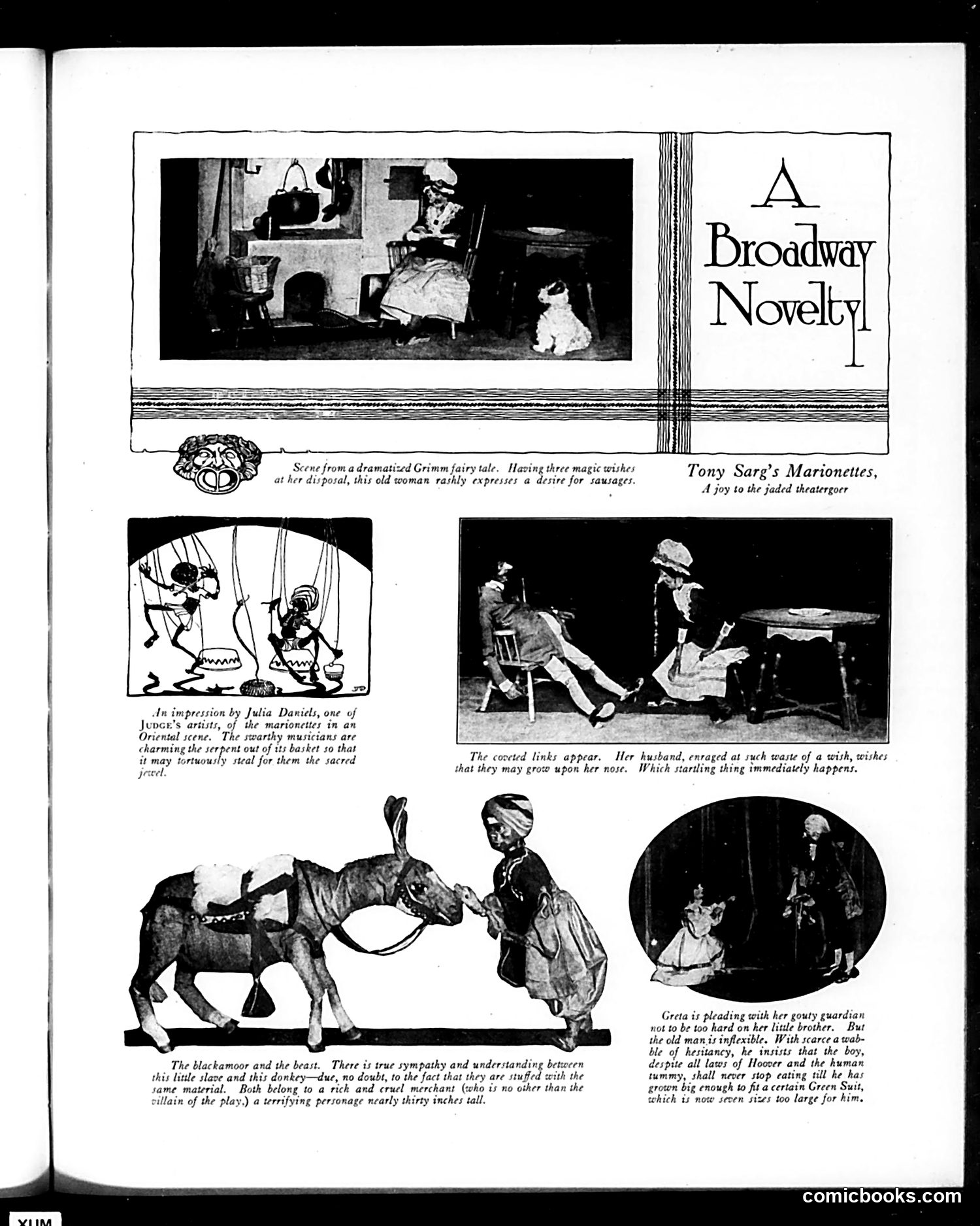
This page celebrates Tony Sarg's marionette theater productions, a popular Broadway attraction of the early 20th century. The images showcase scenes from his puppet shows, including: 1. **A Grimm fairy tale adaptation** where a woman wastes a magical wish on sausages; her angry husband then wishes them onto her nose—a physical comedy gag. 2. **Oriental-themed scene** with musicians charming a snake, demonstrating the detailed artistry of the marionettes. 3. **Character sketches** including a slave child and donkey showing sympathy, and a "goaty guardian" refusing mercy to a boy, with a joke about Hoover-era food scarcity. The satire is gentle: Judge celebrates Sarg's technical skill and imaginative productions as a refreshing theatrical novelty for sophisticated New York audiences tired of conventional entertainment. The humor derives from the marionettes' expressive performances and absurdist scenarios rather than sharp social critique.
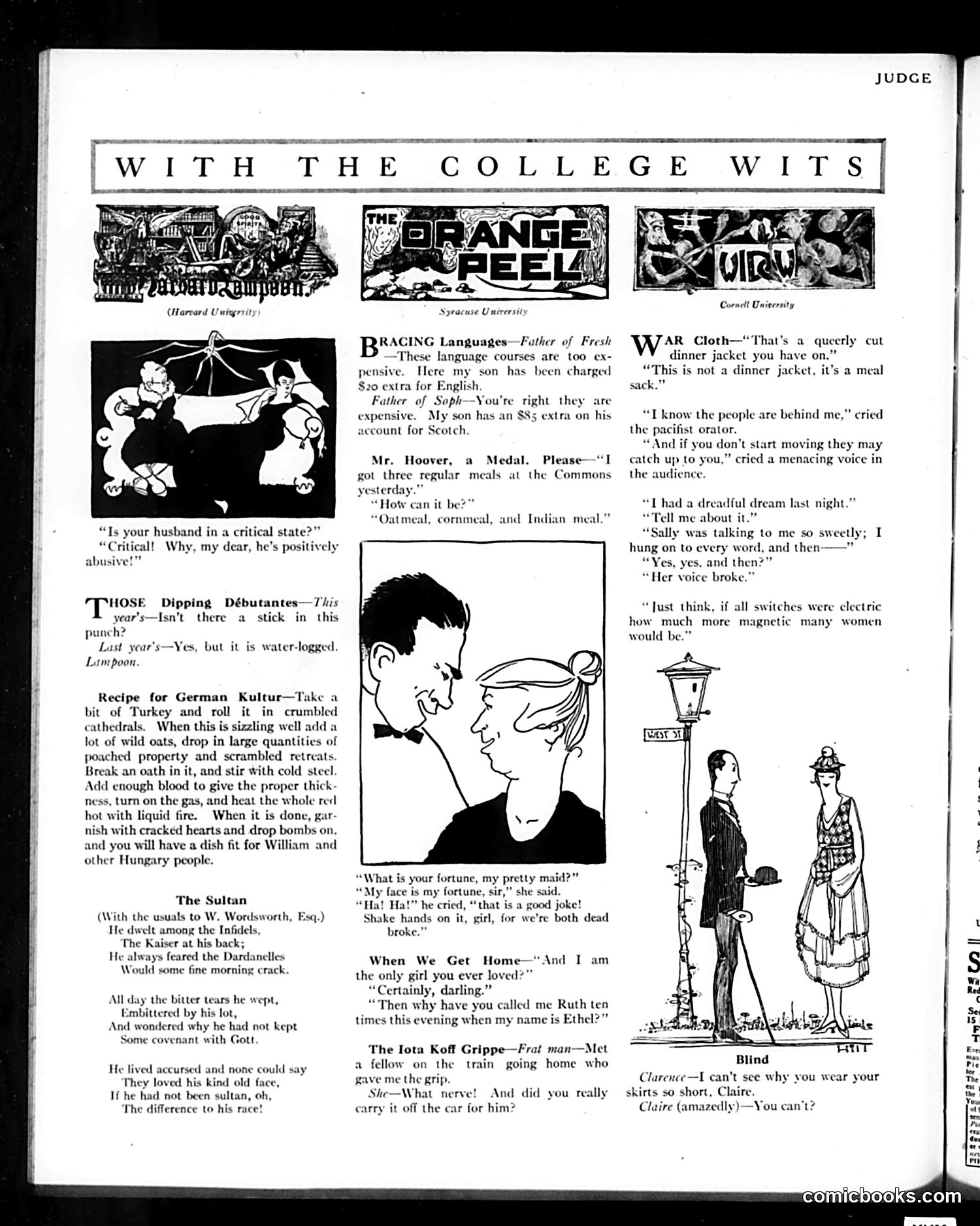
This is a humor page from Judge featuring collegiate jokes and satirical verses. Key content: **"Recipe for German Kultur"** is wartime satire attacking Germany during World War I, listing grotesque ingredients (broken oaths, blood, bombs) as a recipe—mocking German militarism and imperialism as barbaric. **"The Sultan"** poem appears to reference the Ottoman Empire's precarious position during WWI, depicting the Sultan as fearful and morally compromised, caught between the Germans and the failing Dardanelles defense. **College humor pieces** mock student life: expensive language courses, poor dining hall food (repetitive grain-based meals), and romantic misadventures. **Gender jokes** are period-typical: women's appearance, voice changes when emotional, and the innuendo about "magnetic" women and short skirts. The overall tone is typical of 1910s Judge—patriotic wartime sentiment mixed with mildly risqué collegiate humor aimed at educated readers.
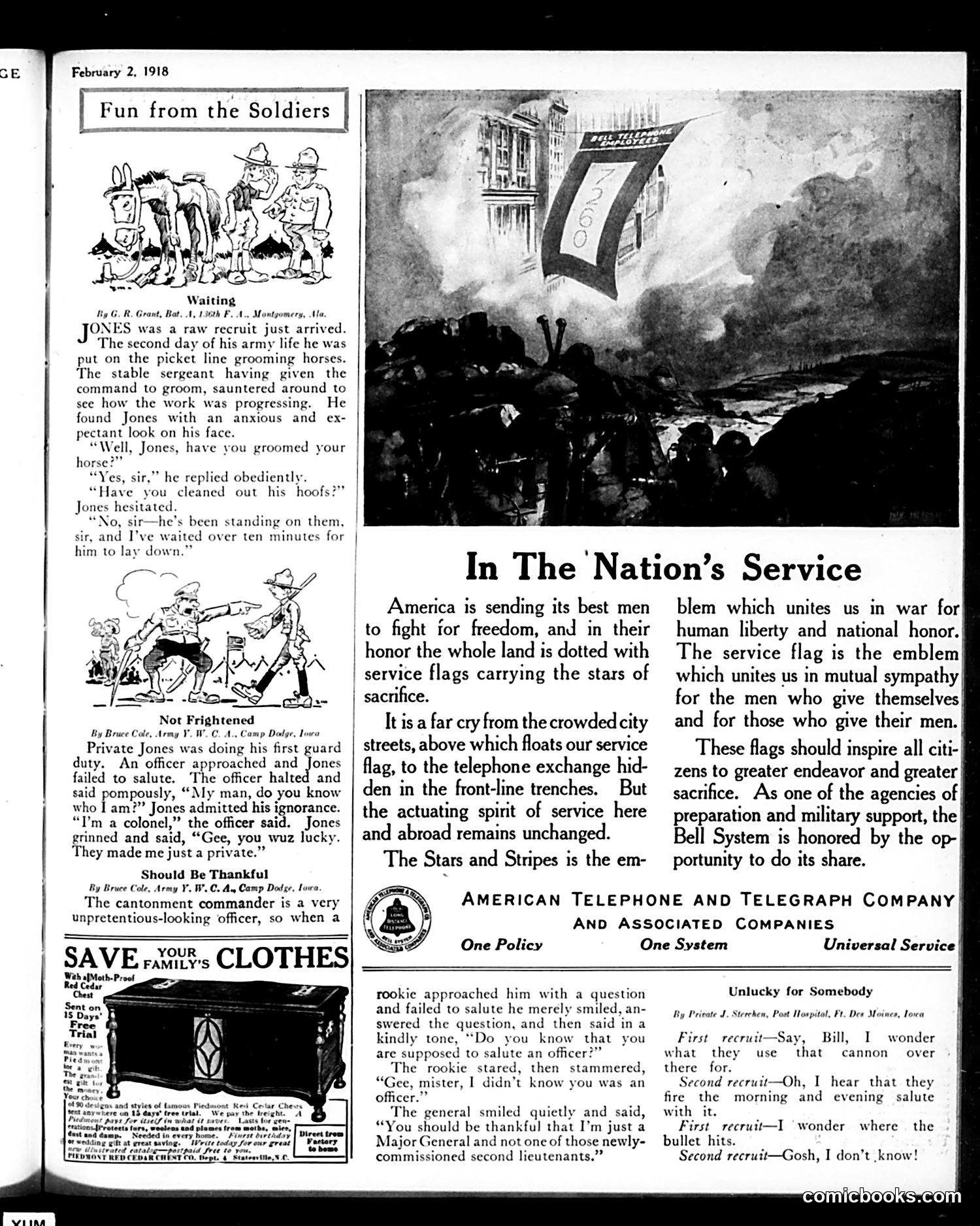
This February 1918 page from *Judge* contains three soldier humor comics meant to entertain the home front during World War I. **"Waiting"**: A raw recruit, ordered to groom a horse, hasn't cleaned its hooves because the horse won't lie down—he's been standing on them. The joke mocks the recruit's literal-minded incompetence. **"Not Frightened"**: A private fails to salute a colonel, then admits he didn't know who the officer was. The humor lies in the private's irreverent response: he's "lucky" the man is merely a colonel, not a higher-ranking officer. **"Should Be Thankful"**: A general, dressed unpretentiously, doesn't demand a salute from a rookie who didn't recognize him. The general jokes that the recruit should be grateful—newly-commissioned second lieutenants are far more rigid about protocol. These jokes depict soldiers as amusingly naive or disrespectful of rank, poking gentle fun at military hierarchy and recruit incompetence. The facing advertisement for Bell System telephone service presents the company as patriotically supporting the war effort through communication infrastructure.
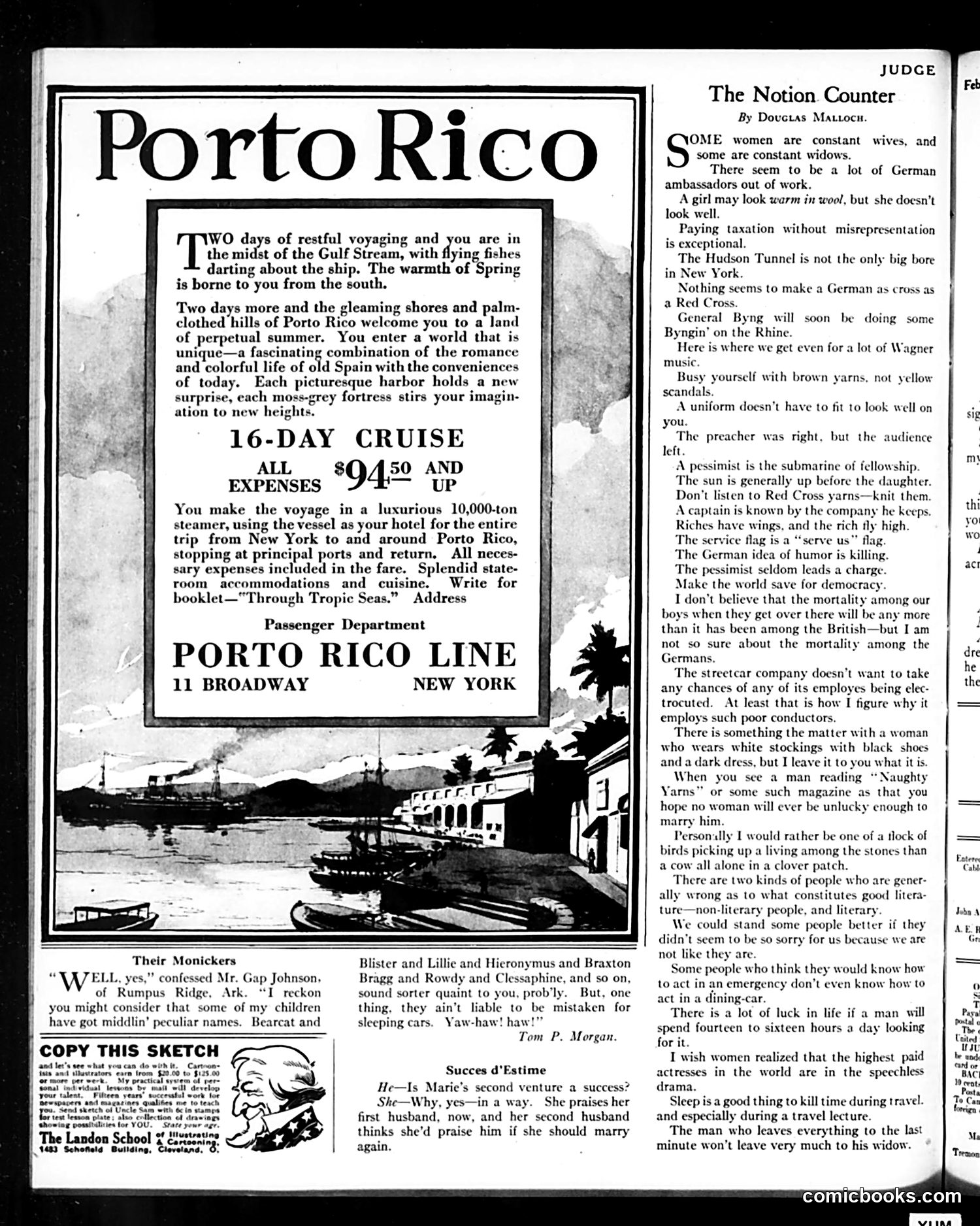
This page combines a **travel advertisement** with **satirical commentary**. **The Main Advertisement:** The Porto Rico Line cruise dominates the left side, promoting a luxurious 16-day Caribbean voyage for $94.50 and up—presented as an escape to romantic, colonial Spanish landscapes with modern conveniences. **The Cartoons/Satire (Right Side):** 1. **"Their Monikers"** by Tom P. Morgan: A rural character defends his children's unusual names (Bearcat, Blister, Hieronymus, Braxton, etc.), arguing they're distinctive and unlikely to be confused with others—gentle small-town humor. 2. **"Succes d'Estime"**: A joke about a woman named Marie whose first husband now praises her, and whose second husband would praise her too if she remarried—satirizing female remarriage and fickle relationships. 3. **"The Notion Counter"** by Douglas Malloch: A series of one-liner observations mixing social commentary with wartime references (Red Cross, General Byng, Germans, submarines). Likely written during or shortly after WWI, these quips critique German behavior, pessimism, social conventions, and human nature with dry wit.
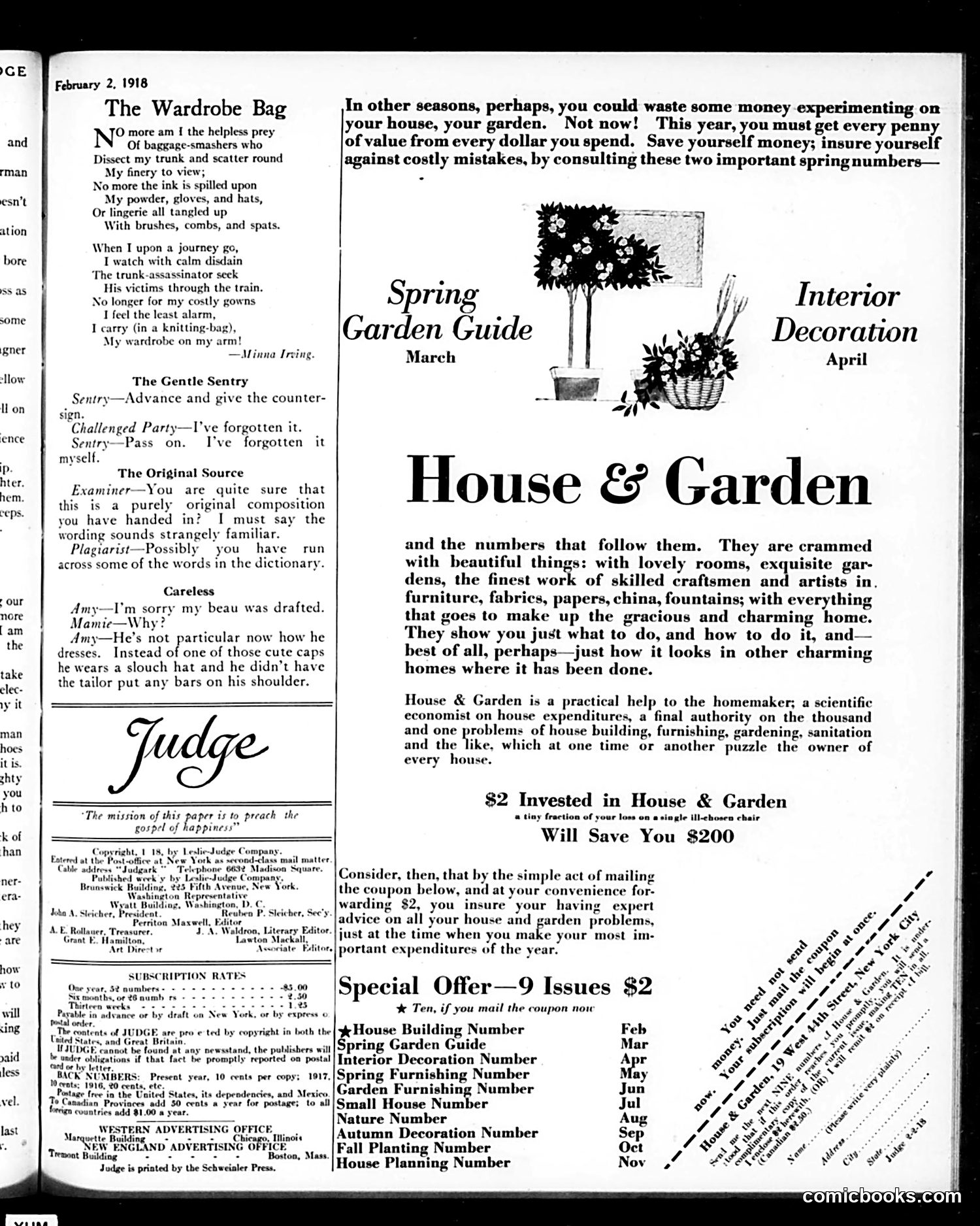
This page is primarily **advertising and editorial content** rather than political satire. The dominant feature is a subscription promotion for *House & Garden* magazine, capitalizing on wartime economic anxiety. The context: America had entered World War I in 1917. The advertisement explicitly invokes financial conservation: "This year, you must get every penny of value from every dollar you spend." This frames home improvement as patriotic thrift rather than luxury. The page includes minor humorous pieces: "The Wardrobe Bag" (a woman's poem celebrating a travel-friendly knitting bag), "The Gentle Sentry" (a joke about forgetful military guards), and "Careless" (about a drafted soldier). These appear designed to appeal to wartime audiences—the military reference and emphasis on practicality align with the publication's broader commercial message about responsible spending. The overall pitch: subscribe to *House & Garden* to make economical domestic decisions during wartime. It's **commercial messaging dressed in patriotic language**, not political commentary.
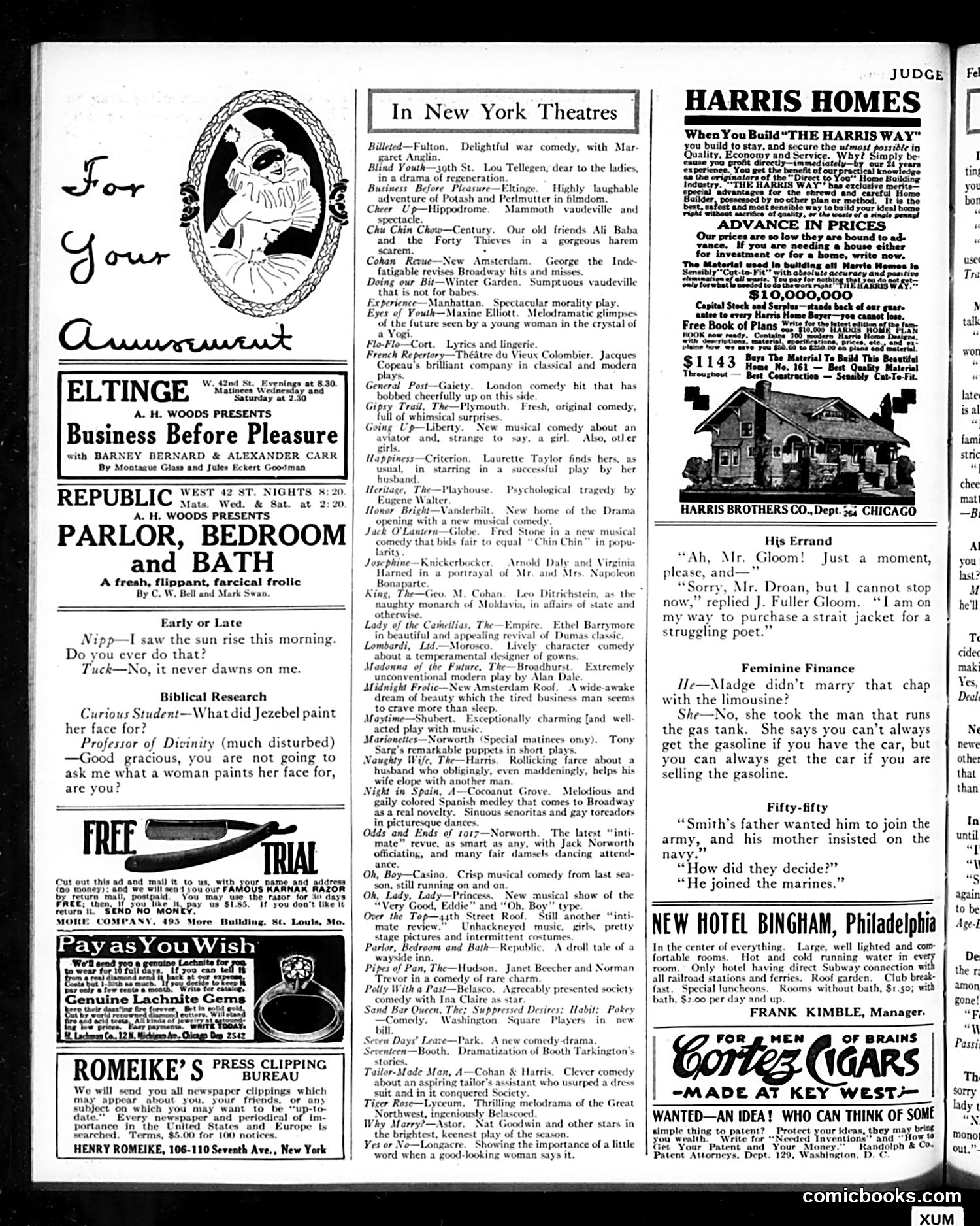
This page is primarily **advertising and theater listings**, not political satire. The main content includes: **Theater Reviews**: A column listing New York theatrical productions with brief descriptions—musicals, comedies, and plays currently running (titles like "Chu Chin Chow," "Going Up," "Jack O'Lantern"). **The Cartoon**: The oval illustration at top-left appears to be a **generic Santa Claus or festive character** labeled "For Your Amusement"—decorative rather than satirical. **Humor Snippets**: Two brief joke exchanges ("Early or Late" and "Biblical Research") featuring mild, era-typical humor about sunrise and women painting faces—inoffensive comedic filler. **Advertisements**: Harris Homes real estate, Cortez Cigars, Hotel Bingham, Romeike's Press Clipping Bureau, and razor/razor blade promotions dominate the page. The page lacks sharp political commentary or identifiable caricatures of public figures. It's a typical Judge issue page mixing light entertainment, local theater promotion, and commercial advertising.
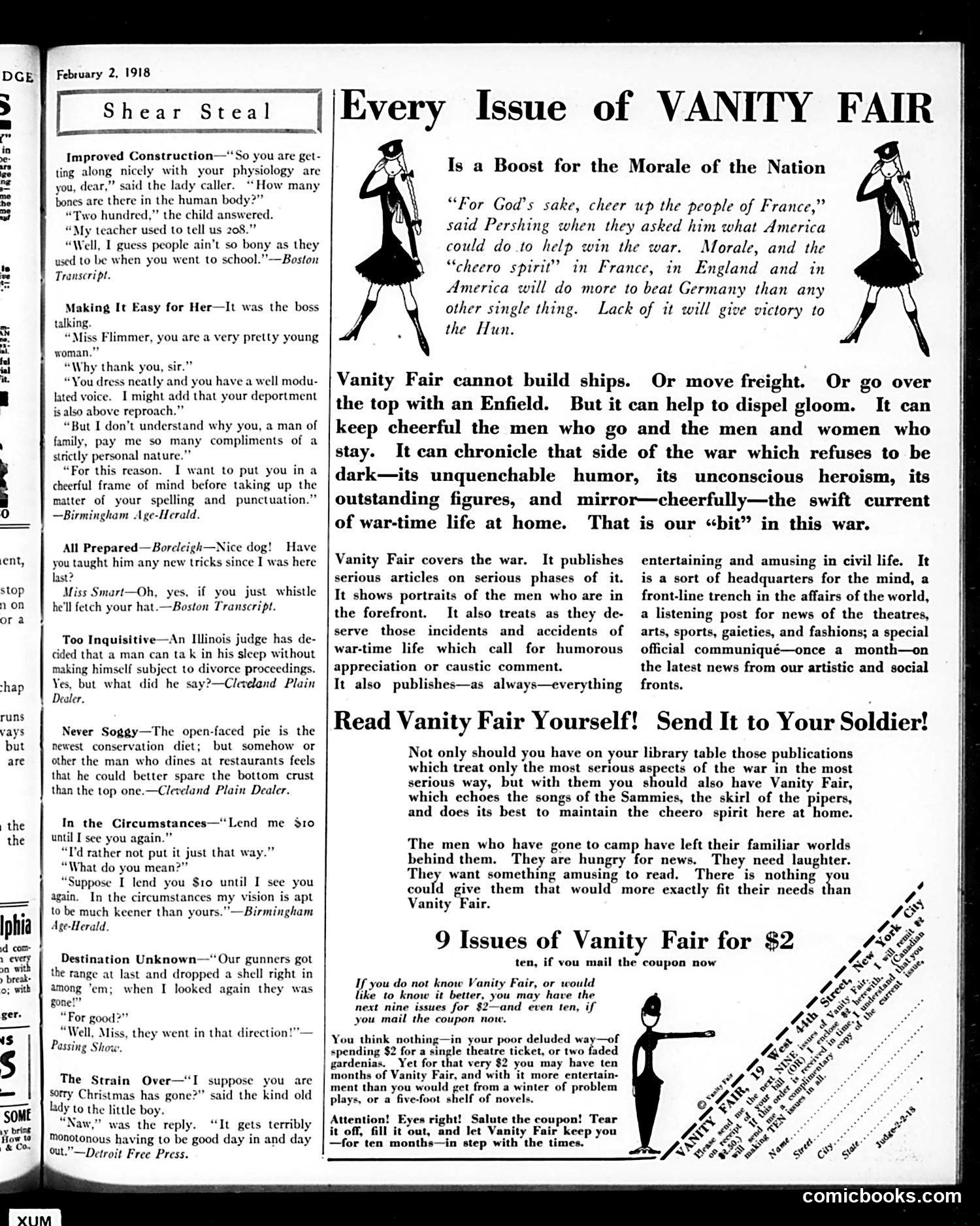
This page contains **advertising and humor columns**, not political cartoons. The **main content** is a full-page advertisement for *Vanity Fair* magazine positioned as a **wartime morale booster**. It quotes General Pershing urging Americans to "cheer up the people of France," arguing that maintaining "cheero spirit" matters for winning WWI. The ad acknowledges Vanity Fair cannot build ships or move freight, but claims it sustains morale through entertainment and humor—positioning the magazine as a patriotic duty. The **left column** contains brief humor snippets ("Shear Steal") from various newspapers, typical of Judge's format: jokes about schoolchildren, office romance, and homefront observations—lighthearted domestic comedy meant for distraction during wartime. The **context**: Published February 1918 (months before war's end), this reflects American efforts to maintain civilian morale through entertainment and humor magazines, framed explicitly as contribution to the war effort.
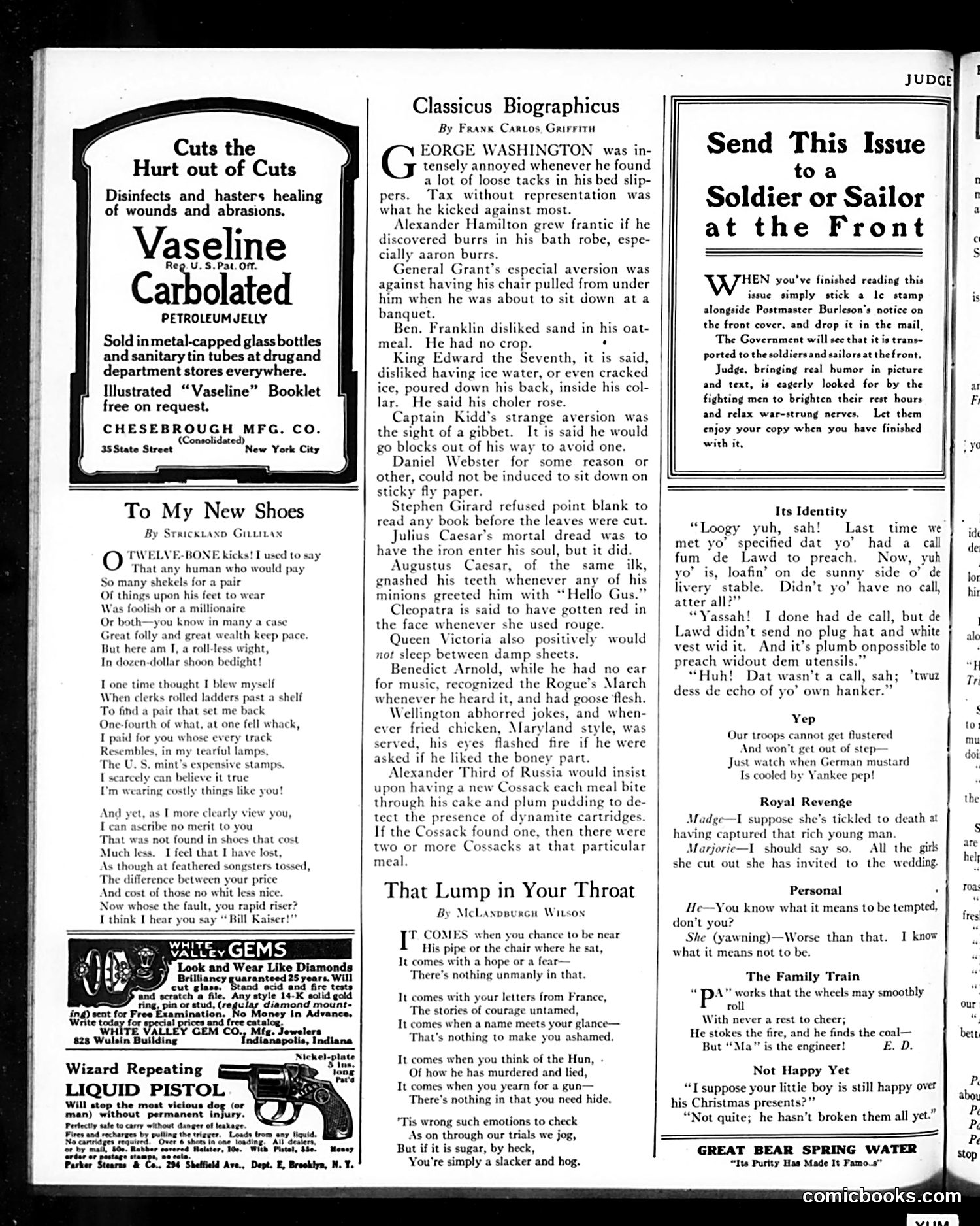
This page is primarily **advertisements and light humor pieces** rather than political satire. The main content includes: **"Classicus Biographicus"** is a humorous column making puns about famous historical figures and their alleged personal quirks. The jokes rely on wordplay—for instance, George Washington's annoyance with "tacks" in his slippers punning on "tax," and Alexander Hamilton's dislike of "aaron burrs" in his bathwater. These are gentle, absurdist jokes about historical figures rather than political commentary. **"To My New Shoes"** is a poem lamenting the purchase of expensive footwear, questioning whether the high price was justified—a relatable consumer complaint about class and value. The remainder consists of period advertisements for Vaseline, gem simulants, and "liquid pistol" (likely tear gas or self-defense spray). The page contains **no apparent political cartoons or serious satire**—it's recreational humor and advertising typical of Judge magazine's lighter content.
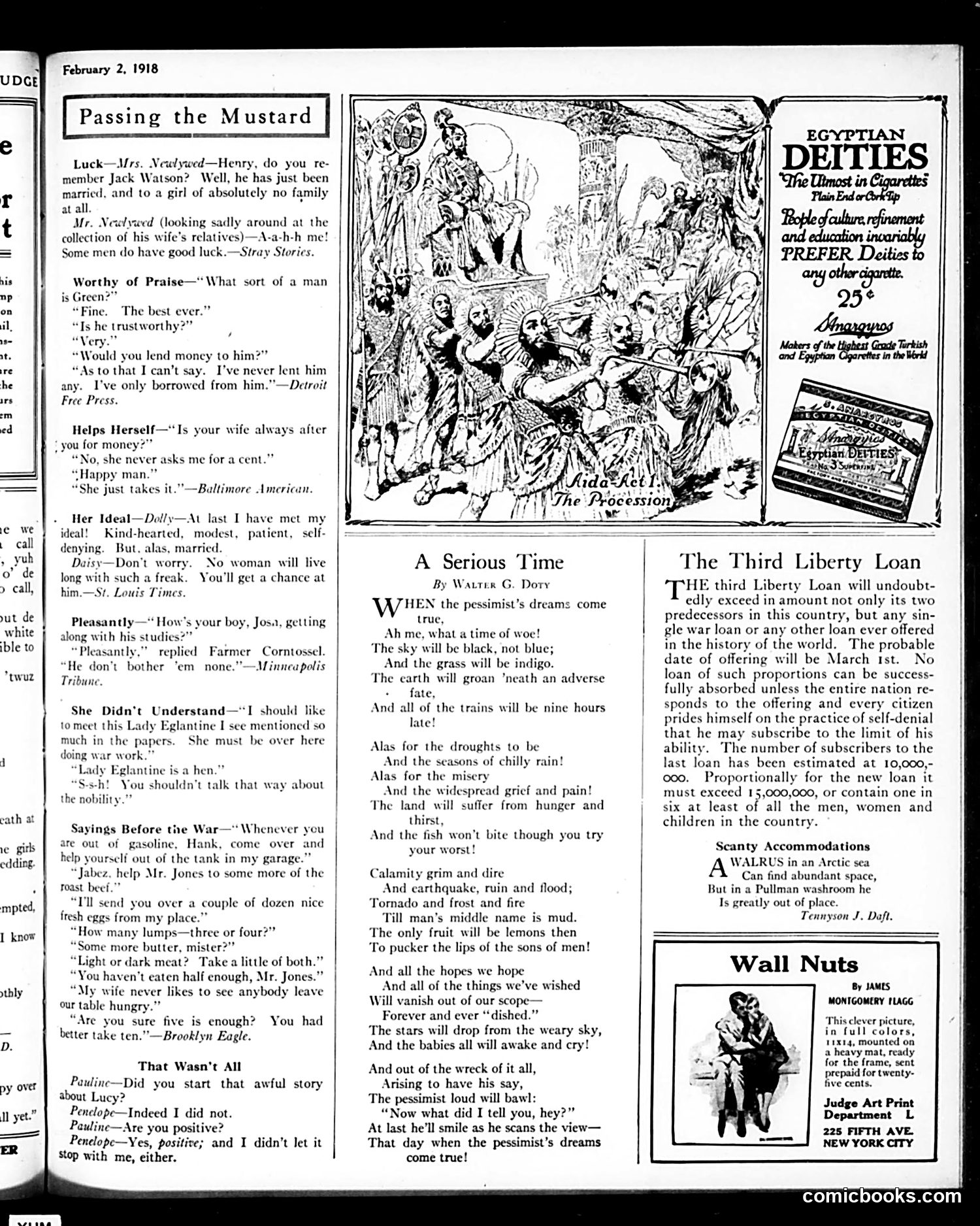
This February 2, 1918 page from *Judge* magazine contains mostly humorous domestic anecdotes ("Passing the Mustard") typical of the era—jokes about newlyweds, stingy wives, and generous hosts. The central cartoon, labeled "Ride a Rail / The Procession," depicts Egyptian deities in a parade or procession, likely satirizing contemporary events through classical/mythological reference, though the specific target is unclear from the image alone. The page's most substantive content is a serious poem, "A Serious Time," mocking pessimists through exaggerated catastrophe—late trains, droughts, earthquakes, lemons as the only fruit. This reflects wartime anxiety (WWI was ongoing). Adjacent text promotes the Third Liberty Loan, a government bond drive to finance the war effort, appealing to citizens' patriotic self-denial. The Egyptian Deities cigarette advertisement occupies the right margin, unrelated to editorial content.
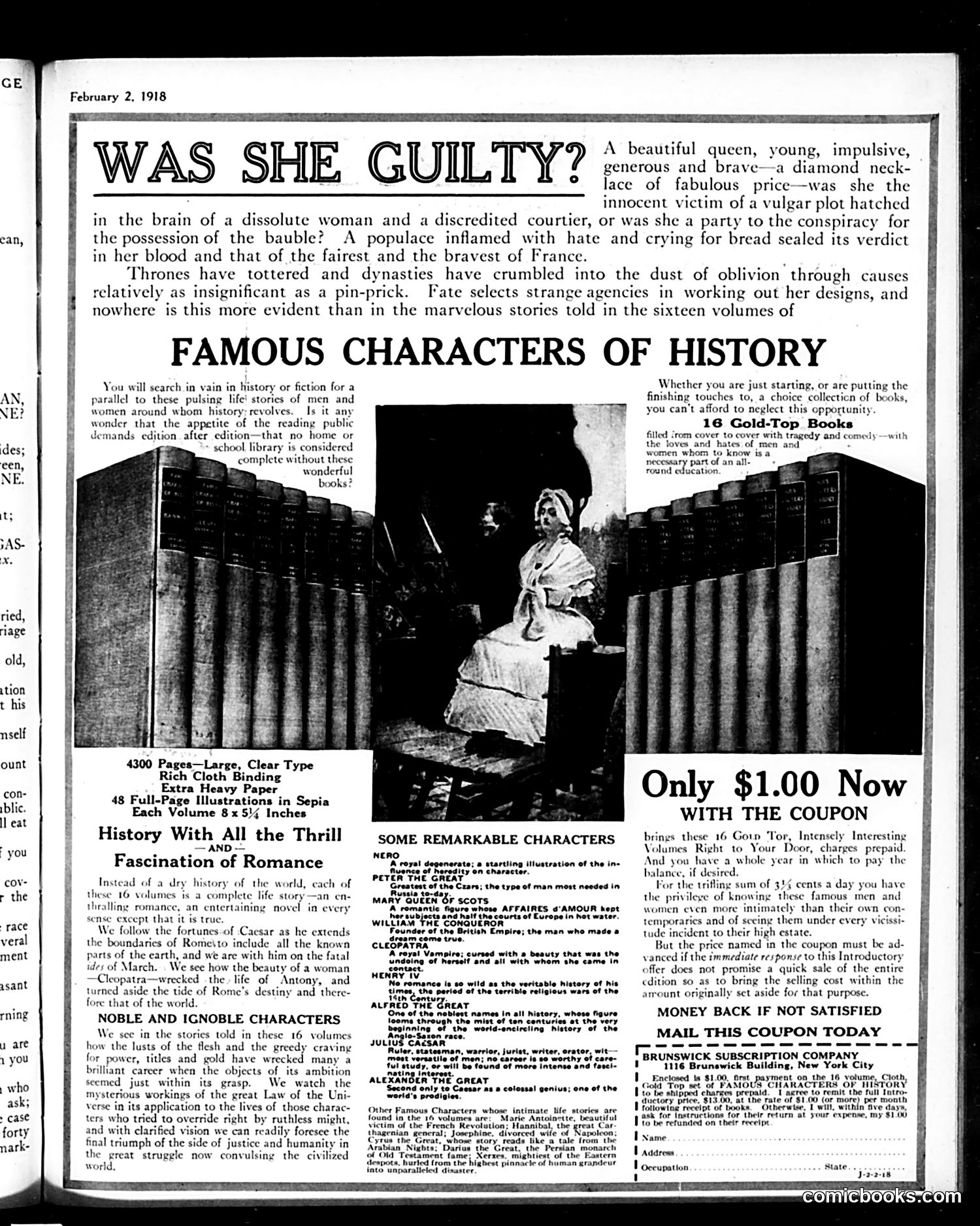
This is primarily **advertising**, not political satire. The page promotes a 16-volume book series called "Famous Characters of History" by the Brunswick Subscription Company. The header "WAS SHE GUILTY?" refers to **Marie Antoinette**, the French queen executed during the Revolution. The ad uses her infamous story—a "beautiful queen" destroyed by scandal and popular hatred—as a hook to sell historical biography. The text emphasizes how "thrones have tottered" through "strange agencies," positioning the books as thrilling narratives of powerful historical figures. The central image shows a woman surrounded by book spines, suggesting comprehensive historical knowledge. The ad targets middle-class readers seeking "complete life stories" rather than "dry history," promising entertainment alongside education. The list of characters (Peter the Great, Mary Queen of Scots, Julius Caesar, Napoleon) aims to demonstrate the series' breadth and appeal. The $1.00 price ("WITH THE COUPON") was designed as an accessible impulse purchase for 1918 readers. This reflects early 20th-century popular history publishing—packaging biography as dramatic narrative.
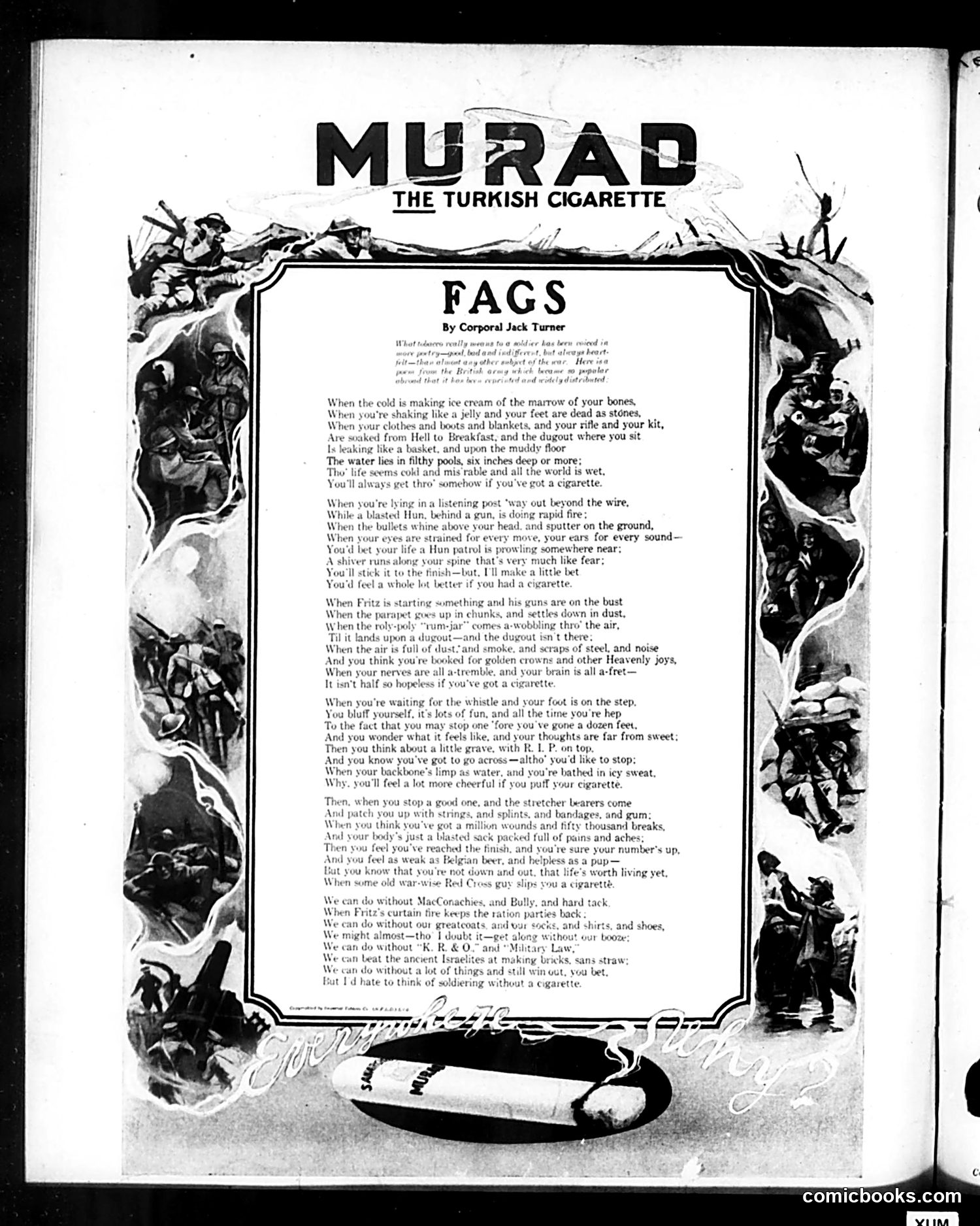
This is a WWI soldier's poem celebrating cigarettes as essential morale-boosters during combat. Written by "Corporal Jack Turner," "Fags" (British slang for cigarettes) describes the brutal conditions of trench warfare—cold, mud, shelling, fear, and exhaustion—and argues that cigarettes provide crucial psychological relief. The text emphasizes that soldiers can endure deprivation (no food, supplies, or comfort) if they have cigarettes. Lines like "it isn't half so hopeless if you've got a cigarette" and "I'd hate to think of soldiering without a cigarette" frame smoking as essential to survival. The ornate border illustrations depict chaotic battle scenes—explosions, soldiers in combat, casualties. Together, image and text constitute **cigarette advertising disguised as patriotic poetry**—a common WWI marketing tactic that associated the product with military service, masculinity, and national sacrifice. The "Murad" brand name anchors this as a commercial promotion for Turkish cigarettes.