
Judge, 1918-02-02 · page 20 of 36
Judge — February 2, 1918 — page 20: what you’re looking at
What you’re looking at
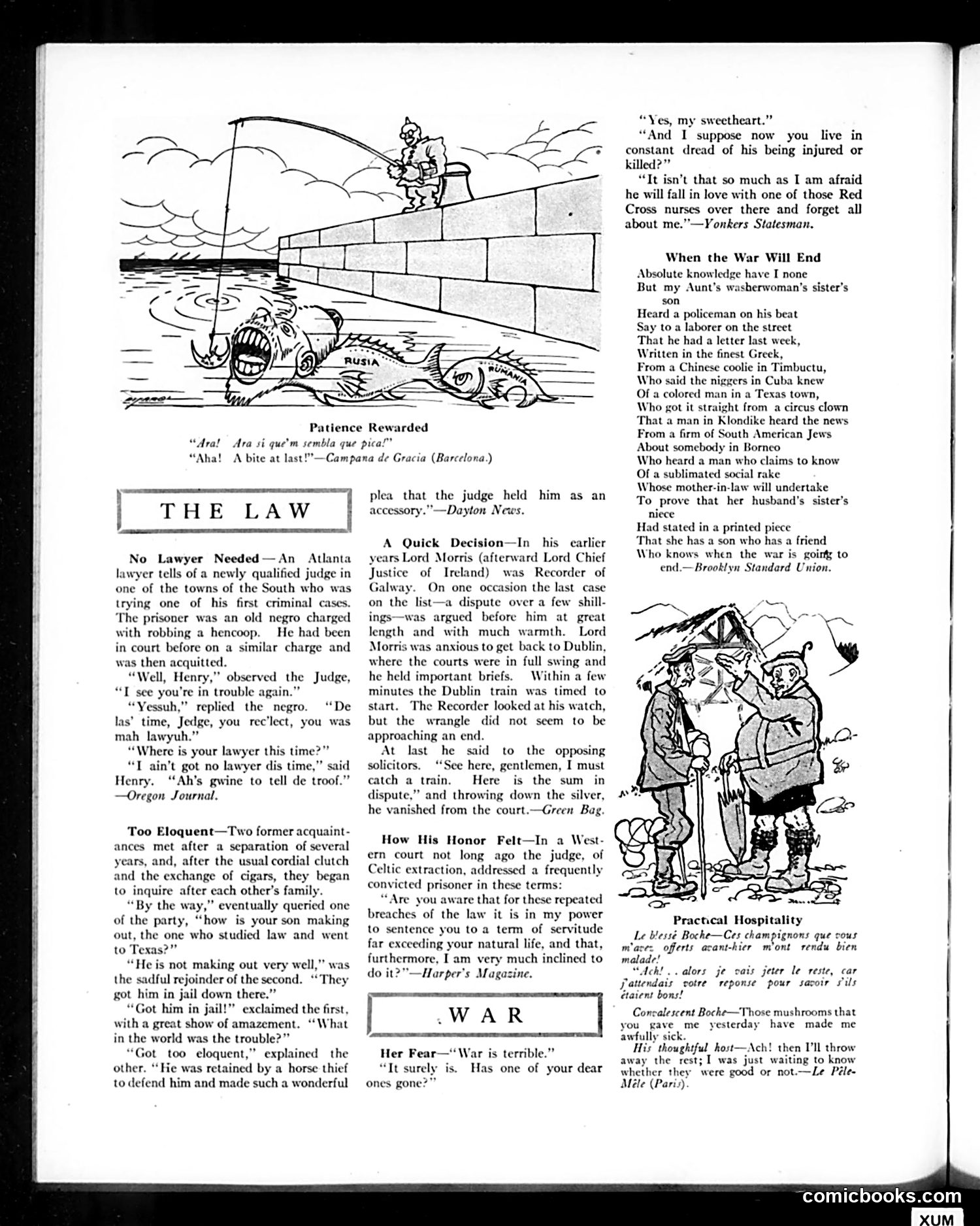
This page contains several legal anecdotes and war-related humor typical of early 20th-century American satire. **"Patience Rewarded"** cartoon depicts a fisherman catching what appears to be a large creature or person, illustrating the caption about finally getting "a bite." **The Law section** includes three jokes mocking the legal system: - A newly appointed Southern judge accepts a defendant's claim he'll "tell de troof" instead of hiring a lawyer—satirizing both judicial inexperience and racial stereotypes - A lawyer's eloquence backfires when he defends a horse thief so persuasively the judge holds *him* as an accessory - A harried Irish judge (Lord Morris) simply throws money at litigants to settle a dispute quickly so he can catch his train **The War section** satirizes anxieties about World War I. One joke mocks a woman's real concern: not that her sweetheart might be injured, but that he'll fall in love with Red Cross nurses. Another poem parodies rumor-mongering by depicting an absurdly long chain of secondhand gossip about when the war will end. The humor relies on assumptions about class, race, and Irish stereotypes common to the era.
📄 Transcribed text from this page (OCR, searchable)
Machine-transcribed from the original scan — historical spelling and the odd misread are preserved.
Patience Rewarded “Aral “Aha! yo | THE LAW No Lawyer Needed—An Atlanta lawyer tells of a newly qualified judge in one of the towns of the South who was ying one of his first criminal cases. The prisoner was an old negro charged with robbing a hencoop. He had been in court before on a similar charge and was then acquitt “Well, Henry,” observed the Judge, “I see you're in trouble again.” “Yessuh,” replied the negro. “De las’ time, Jedge, you rec’lect, you was mah lawyuh.” “Where is your lawyer this time?” “T ain't got no lawyer dis time,” said Henry. ‘‘Ah’'s gwine to tell de troof.” —Oregon Journal. Too Eloquent—Two former acquaint- ances met after a separation of several and, after the usual cordial clutch d the exchange of cigars, they began to inquire after cach other’s family. “By the way,” eventually queried one of the party, “how is your son making out, the one who studied law and went to Texas?” “He is not making out very well,” was the sadful rejoinder of the second. “They got him in jail down there.” “Got him in jail!” exclaimed the first, with a great show of amazement. “What in the world was the trouble?” “Got too eloquent,” explained the other. ‘‘ He was retained by a horse thief to defend him and made such a wonderful Ara si que'm sembla que pica!” A bite at last!”"—Campana de Gracia (Barcelona.) plea that the judge held him as an accessory.” —Dayton News. A Quick Decision—In his earlier y Lord Morris (afterward Lord Chief Justice of Ireland) was Recorder of Galway. On one occasion the last case on the list—a dispute over a few shill- ings—was argued before him at great length and with much warmth. Lord Morris was anxious to get back to Dublin, where the courts were in full swing and he held important bri Within a few minutes the Dublin train was timed to start. The Recorder looked at his watch, but the wrangle did not seem to be approaching an end. At last he said to the opposing solicitors. ‘See here, gentlemen, I must catch a train. Here is the sum in dispute,” and throwing down the silver, he vanished from the court.—Green Bag. How His Honor Felt—In a West- ern court not long ago the judge, of Celtic extraction, addressed a frequently convicted prisoner in these terms: “Are you aware that for these repeated breaches of the law it is in my power to sentence you to a term of servitude far exceeding your natural life, and that, furthermore, Iam very much inclined to do it?” —Harper’s Magazine. .WAR Her Fear—‘ War is terrible. “Tt surely is. Has one of your dear ones gone? “Yes, my sweetheart.” “And I suppose now you live in constant dread of his being injured or killed?” “Tt isn’t that so much as I am afraid he will fall in love with one of those Red Cross nurses over there and forget all about me.""—Yonkers Statesman. When the War Will End Absolute knowledge have I none But my Aunt’s washerwoman’s sister’s son Heard a policeman on his beat Say to a laborer on the street That he had a letter last week, Written in the finest Greek, From a Chinese coolie in Timbuctu, Who said the niggers in Cuba knew Of a colored man in a Texas town, Who got it straight from a circus clown That a man in Klondike heard the news From a firm of South American Jews. About somebody in Borneo Who heard a man who claims to know Of a sublimated social rake Whose mother-in-law will undertake To prove that her husband's sister’s niece ad stated in a printed piece That she has a son who has a friend Who knows when the war is going to end.—Brooklyn Standard Union, Practical Hospitality Le blessé Boche—Ces champignons que cous mace: offerts acant-hier m’ont rendu bien ..alors je vais jeter le reste, car frattendais votre reponse pour savoir sils étaient bons! Concalescent Bocke—Those mushrooms that you gave me yesterday have made me awfully sick. His thoughtful host—Ach! then V'll throw away the rest; I was just waiting to know whether they were good or not—Le Péle- Méle (Paris) “‘comicbooks.com