
Judge, 1918-02-02 · page 13 of 36
Judge — February 2, 1918 — page 13: what you’re looking at
What you’re looking at
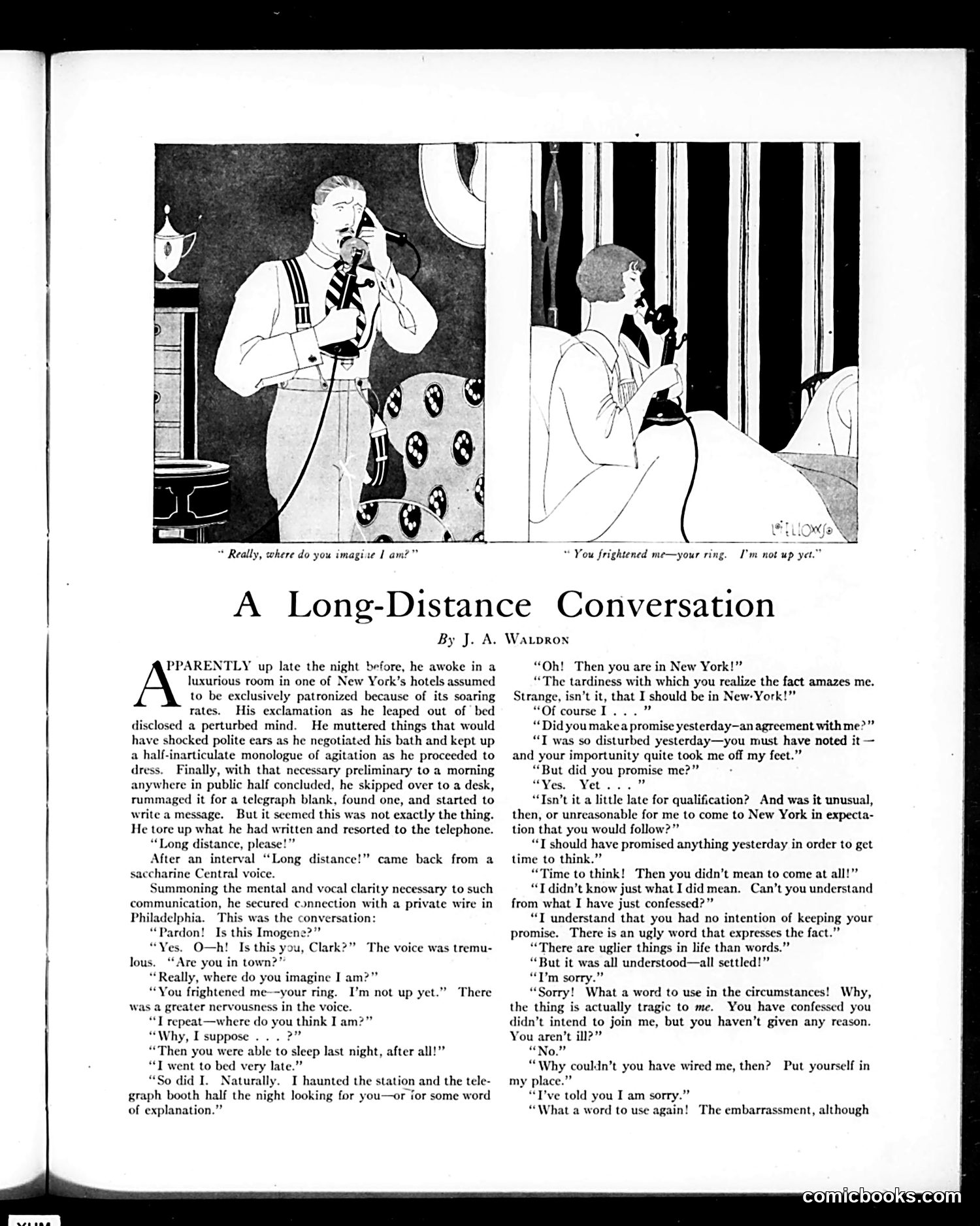
This satirical story depicts a romantic misunderstanding via early 20th-century telephone technology. A man ("Clark") has traveled from Philadelphia to New York, apparently after a woman ("Imogene") promised to meet him. She failed to appear and didn't explain why. The satire targets the emotional chaos enabled by long-distance communication: the woman made a careless promise, hoped he wouldn't follow through, and is now caught in her lie. Her excuses—being "disturbed," needing "time to think"—ring hollow against his clear sacrifice (haunting the station all night). The joke critiques both parties: his melodramatic pursuit and her casual commitment, but especially the modern awkwardness of technological intimacy. A phone conversation forces immediate confrontation that letters might have delayed. The title itself is ironic—this "conversation" only deepens the conflict rather than resolving it.
📄 Transcribed text from this page (OCR, searchable)
Machine-transcribed from the original scan — historical spelling and the odd misread are preserved.
~ Really, where do you imagire 1 am?” “You frightened me—your ring. I’m not up yet.” A Long-Distance Conversation By J. A. Watpron PPARENTLY up late the night before, he awoke in a luxurious room in one of New York’s hotels assumed to be exclusively patronized because of its soaring rates. His exclamation as he leaped out of bed disclosed a perturbed mind. He muttered things that would have shocked polite ears as he negotiated his bath and kept up a half-inarticulate monologue of agitation as he proceeded to dress. Finally, with that necessary preliminary to a morning anywhere in public half concluded, he skipped over to a desk, rummaged it for a telegraph blank, found one, and started to write a message. But it seemed this was not exactly the thing. He tore up what he had written and resorted to the telephone. “Long distance, please!” After an interval “Long distance!” saccharine Central voice. Summoning the mental and vocal clarity necessary to such communication, he secured connection with a private wire in Philadelphia. This was the conversation: “Pardon! Is this Imogene?” “Yes. O—h! Is this you, Clark?” The voice was tremu- lous. “Are you in town?” “Really, where do you imagine I am?” “You frightened me—your ring. I’m not up yet.” There was a greater nervousness in the voice. “T repeat—where do you think I am?” “Why, I suppose... ?” “Then you were able to sleep last night, after all!” “T went to bed very late.” “So did I. Naturally. I haunted the station and the tele- graph booth half the night looking for you—or ior some word of explanation.” came back from a “Oh! Then you are in New York!” “The tardiness with which you realize the fact amazes me. Strange, isn’t it, that I should be in New-York!” “Of courseI...” “Did you makea promise yesterday—an agreement with me “T was so disturbed yesterday—you must have noted it — and your importunity quite took me off my feet.” “But did you promise me?” “Yes. Yet...” “Tsn’t it a little late for qualification? And was it unusual, then, or unreasonable for me to come to New York in expecta- tion that you would follow: “T should have promised anything yesterday in order to get time to think.” “Time to think! Then you didn’t mean to come at all!” “T didn’t know just what I did mean. Can’t you understand from what I have just confessed?” “TI understand that you had no intention of keeping your promise. There is an ugly word that expresses the fact.” “There are uglier things in life than words.” “But it was all understood—all settled!” “T’m sorry.” “Sorry! What a word to use in the circumstances! Why, the thing is actually tragic to me. You have confessed you didn’t intend to join me, but you haven’t given any reason. You aren’t ill?” “No.” “Why couldn’t you have wired me, then? my place.” “T’ve told you I am sorry.” “What a word to use again! The embarrassment, although >” Put yourself in